Working with Children with Special Needs: Inclusion and Universal Design for Learning Adapted from  Who Am I in the Lives of Children Feeney, Christensen, Moravcik CAST and NAEYC Prepared by Dr. Carla Piper
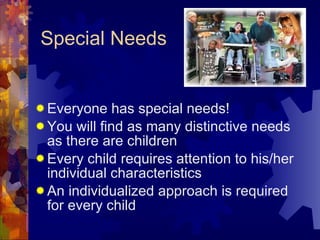
Special Needs Everyone has special needs! You will find as many distinctive needs as there are children  Every child requires attention to his/her individual characteristics An individualized approach is required for every child
The Exceptional Child A child with special needs A child who is different enough from the “standard” or “average” child to require special methods, services, and possibly equipment in order to attain desired learning objectives. May differ at rate at which they learn May learn in different ways McCormick 1994
Guidelines for Reference to Disabilities Speak of the child first and the disability second Do not demean or stereotype Emphasize child’s abilities, not disabilities Refer to disability only when that information is relevant in a situation Use “people first” language Refer to child by name Don’t label child by disability
Identifying a Child with Special Needs Use your knowledge of child development and your observation skills Early identification and appropriate intervention can avoid developmental problems that become more difficult to remedy as child gets older. Not your role to diagnose a disability Begin with observation
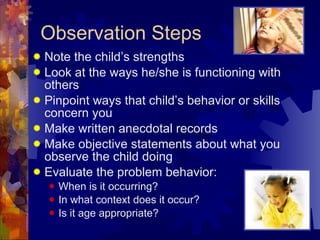
Observation Steps Note the child’s strengths Look at the ways he/she is functioning with others Pinpoint ways that child’s behavior or skills concern you Make written anecdotal records Make objective statements about what you observe the child doing Evaluate the problem behavior: When is it occurring? In what context does it occur? Is it age appropriate?
Getting Help Share concerns and observation notes with a co-worker or supervisor Have your colleagues conduct independent observations Be careful not to come to conclusions too quickly Enlist the support of program administrators Ask for ideas on community resources
Individuals with Disabilities Education Act (IDEA) Mandates a free and appropriate education for all children ages 3-21 Educational services are to be provided in the “least restrictive environment” Educate each child in the same school he/she would attend if no disability existed Children with disabilities to be included with typically developing peers Educated in regular school programs
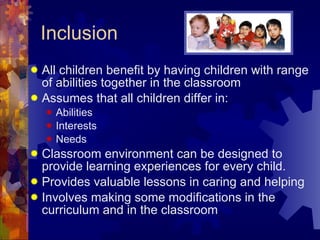
Inclusion All children benefit by having children with range of abilities together in the classroom Assumes that all children differ in: Abilities Interests Needs Classroom environment can be designed to provide learning experiences for every child. Provides valuable lessons in caring and helping Involves making some modifications in the curriculum and in the classroom
Preparing for Inclusion Best source of information to help you learn about the child – family members Consult with child’s doctor, therapist, and former teachers to find out What types of therapy child is taking part in Precautions you must take Limitations or requirements you need to know Maintain regular communication with family and other specialists
Suggestions for Inclusion Find out what services are available to support your work with the child Brainstorm with experts and consultants on how you can best support the development of the child Ask yourself: “How can I make group time relevant to this child and also   meet needs of the other children?” Be patient – the child may have to be told or shown many times Be flexible and open to learning new things
Preparing Your Students Use simple explanations of the disability Answer other children’s questions honestly and directly Help them understand any differences they observe Assure them that a disability isn’t “catching”  Treat the special needs child as much like any other child Help children understand that no one can do everything and each of us has strengths and weaknesses
Suggested Teaching Strategies With ALL Students: Respond to their interests Focus on what they are intending to communicate rather than their actual work Arrange the learning environment to promote engagement and interactions with peers Use open-ended and thought-provoking questions to assist them in interacting successfully with people and materials. Use modeling and assist them to learn through observation and interaction with their peers
Developmentally Appropriate Practice: Inclusion NAEYC’s Position Statement on Inclusion   Inclusion, as a value, supports the right of all children, regardless of their diverse abilities, to participate actively in natural settings within their communities. A natural setting is one in which the child would spend time had he or she not had a disability. Such settings include, but are not limited to, home and family, play groups, child care, nursery schools, Head Start programs, kindergartens, and neighborhood school classrooms.
Developmentally Appropriate Practice: Inclusion Desired Results Access – State of California Program Standards for Child Development Division -  http://www.draccess.org/   The program is inclusive of children with exceptional needs and consistent with their Individualized Family Service Plan or Individual Education Plan and provides an environment of acceptance.
Circle of Inclusion http://www.circleofinclusion.org/   Guidelines http://www.circleofinclusion.org/english/guidelines/index.html   Reproducible Forms Index   http://www.circleofinclusion.org/english/formsarticles/forms/formsindex.html
Universal Design for Learning UDL for Inclusion Multiple means of representation   to give learners various ways of acquiring information and knowledge  Multiple means of action and expression   to provide learners alternatives for demonstrating what they know  Multiple means of engagement   to tap into learners' interests offer appropriate challenges  increase motivation CAST
UDL – Teaching Diverse Learners Learning disabilities such as dyslexia  English language barriers  Emotional or behavioral problems  Lack of interest or engagement  Sensory and physical disabilities  One-size-fits-all approach to education  simply does not work!  How can teachers respond to individual differences?   CAST
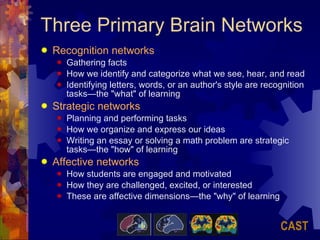
Three Primary Brain Networks Recognition networks Gathering facts How we identify and categorize what we see, hear, and read  Identifying letters, words, or an author's style are recognition tasks—the "what" of learning Strategic networks Planning and performing tasks  How we organize and express our ideas  Writing an essay or solving a math problem are strategic tasks—the "how" of learning Affective networks How students are engaged and motivated  How they are challenged, excited, or interested These are affective dimensions—the "why" of learning CAST
UDL Changes Teaching Children with disabilities fall along a continuum of learner differences rather than constituting a separate category. Teachers adjust for learner differences  for ALL children , not just those with disabilities Curriculum materials should be varied and diverse including digital and online resources not merely a single resource Teachers allow for flexibility to accommodate learner differences rather than set curriculum The Universal Design of Early Education: Moving Forward for All Children
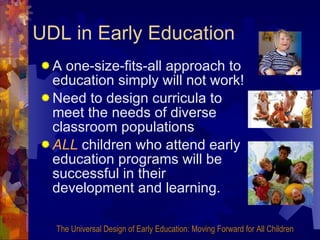
UDL in Early Education A one-size-fits-all approach to education simply will not work! Need to design curricula to meet the needs of diverse classroom populations ALL  children who attend early education programs will be successful in their development and learning. The Universal Design of Early Education: Moving Forward for All Children
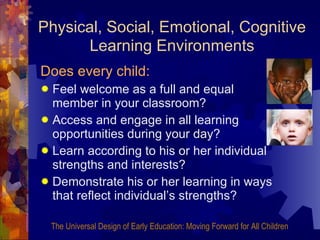
Physical, Social, Emotional, Cognitive   Learning Environments Does every child: Feel welcome as a full and equal member in your classroom? Access and engage in all learning opportunities during your day? Learn according to his or her individual strengths and interests? Demonstrate his or her learning in ways that reflect individual’s strengths? The Universal Design of Early Education: Moving Forward for All Children
UDL in Preschool Environments The physical environment   Enables all children to have access and equitable opportunities for full participation in all program activities.  Includes structures, permanent and movable equipment and furnishings, storage, and materials. Health and safety components   Promote wellness and minimize risks and hazards for all children.  All children, regardless of health status or conditions, have ongoing access to learning without interruptions due to illness and injury The social-emotional environment  Offers all children equitable access to and full membership in the social-emotional life of the group Supports their social-emotional development The Universal Design of Early Education: Moving Forward for All Children
UDL in Preschool Settings The teaching environment   Gives all children equitable access to learning opportunities information and activities in multiple formats multiple means for engagement, expression, and learning. Includes the curriculum, teaching practices, materials, and activities Individual assessment and program evaluation practices Provide multiple approaches to finding out what children know and can do Equitably assess individual learning, development, and educational progress Family involvement practices  Support the equitable access and engagement of all families in the full range of experiences  Includes ongoing communication, learning opportunities, and program involvement activities The Universal Design of Early Education: Moving Forward for All Children
Physical Environment How can the space be arranged to accommodate everyone? How will children be seated to accommodate different motor abilities and activity levels so that everyone can move about or attend as needed? What materials are needed to allow for the range of motor abilities? The Universal Design of Early Education: Moving Forward for All Children
Physical Environment Expand the group meeting area so that all children can be present and focus their attention on the activities. Provide varied seating options so each child may lie on the floor, sit on a mat or chair, or use specialized seating. Use other materials of different sizes, textures, and shapes to help each child actively manipulate the objects for learning. The Universal Design of Early Education: Moving Forward for All Children
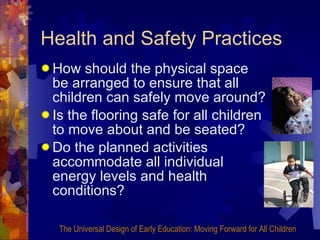
Health and Safety Practices How should the physical space be arranged to ensure that all children can safely move around? Is the flooring safe for all children to move about and be seated? Do the planned activities accommodate all individual energy levels and health conditions? The Universal Design of Early Education: Moving Forward for All Children
Health and Safety Practices Provide clear, wide paths throughout the classroom so each child may safely and easily reach the meeting area. Ensure safe floor covering for safe passage for any child, including for example a child who is in a hurry, has visual impairments, or uses a wheeled stander. Consider each child’s energy level and health conditions in planning activities. The Universal Design of Early Education: Moving Forward for All Children
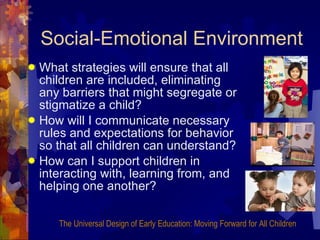
Social-Emotional Environment What strategies will ensure that all children are included, eliminating any barriers that might segregate or stigmatize a child? How will I communicate necessary rules and expectations for behavior so that all children can understand? How can I support children in interacting with, learning from, and helping one another? The Universal Design of Early Education: Moving Forward for All Children
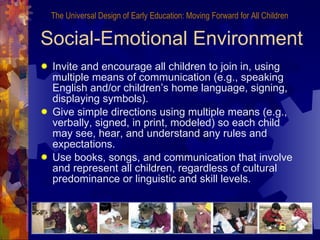
Social-Emotional Environment Invite and encourage all children to join in, using multiple means of communication (e.g., speaking English and/or children’s home language, signing, displaying symbols). Give simple directions using multiple means (e.g., verbally, signed, in print, modeled) so each child may see, hear, and understand any rules and expectations. Use books, songs, and communication that involve and represent all children, regardless of cultural predominance or linguistic and skill levels. The Universal Design of Early Education: Moving Forward for All Children
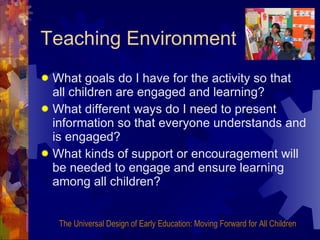
Teaching Environment What goals do I have for the activity so that all children are engaged and learning? What different ways do I need to present information so that everyone understands and is engaged? What kinds of support or encouragement will be needed to engage and ensure learning among all children? The Universal Design of Early Education: Moving Forward for All Children
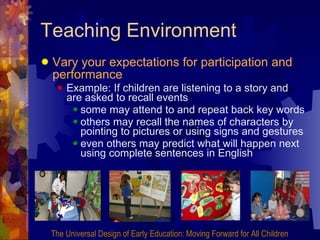
Teaching Environment Vary your expectations for participation and performance   Example: If children are listening to a story and are asked to recall events some may attend to and repeat back key words  others may recall the names of characters by pointing to pictures or using signs and gestures even others may predict what will happen next using complete sentences in English The Universal Design of Early Education: Moving Forward for All Children
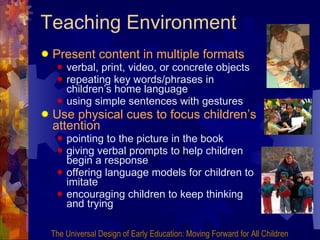
Teaching Environment Present content in multiple formats verbal, print, video, or concrete objects repeating key words/phrases in children’s home language using simple sentences with gestures Use physical cues to focus children’s attention pointing to the picture in the book giving verbal prompts to help children begin a response  offering language models for children to imitate encouraging children to keep thinking and trying The Universal Design of Early Education: Moving Forward for All Children
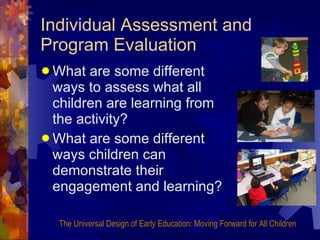
Individual Assessment and Program Evaluation What are some different ways to assess what all children are learning from the activity?  What are some different ways children can demonstrate their engagement and learning? The Universal Design of Early Education: Moving Forward for All Children
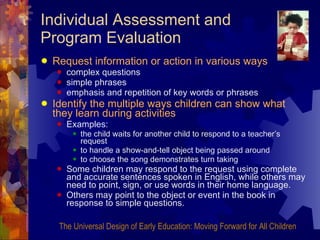
Individual Assessment and Program Evaluation Request information or action in various ways complex questions simple phrases emphasis and repetition of key words or phrases Identify the multiple ways children can show what they learn during activities   Examples:  the child waits for another child to respond to a teacher’s request to handle a show-and-tell object being passed around to choose the song demonstrates turn taking Some children may respond to the request using complete and accurate sentences spoken in English, while others may need to point, sign, or use words in their home language. Others may point to the object or event in the book in response to simple questions. The Universal Design of Early Education: Moving Forward for All Children
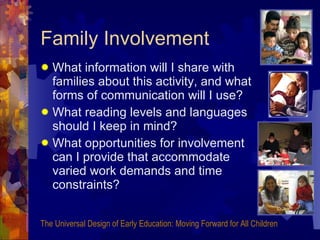
Family Involvement What information will I share with families about this activity, and what forms of communication will I use? What reading levels and languages should I keep in mind? What opportunities for involvement can I provide that accommodate varied work demands and time constraints? The Universal Design of Early Education: Moving Forward for All Children
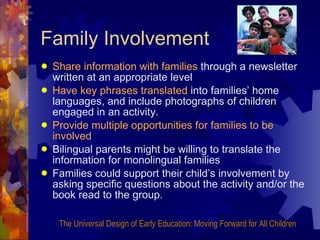
Family Involvement Share information with families  through a newsletter written at an appropriate level Have key phrases translated  into families’ home languages, and include photographs of children engaged in an activity. Provide multiple opportunities for families to be involved Bilingual parents might be willing to translate the information for monolingual families Families could support their child’s involvement by asking specific questions about the activity and/or the book read to the group. The Universal Design of Early Education: Moving Forward for All Children