1
Ensuring a World Class Curriculum
S Keeble
January 2009
2
Objective
To explore ways to develop a modern, world-class curriculum
that will inspire and challenge all our learners and prepare
them for the future using;
a) A Competency Curriculum in KS3
b) An Academic/Applied Curriculum at KS4
c) Extended Learning Sessions 11-16
d) Innovative Curriculum Enhancement Opportunities
Using the schools specialism to drive the change
3
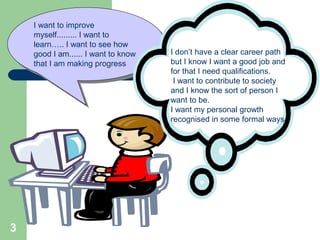
I want to improve
myself......... I want to
learn….. I want to see how
good I am...... I want to know
that I am making progress
I want to improve
myself......... I want to
learn….. I want to see how
good I am...... I want to know
that I am making progress
I don’t have a clear career path
but I know I want a good job and
for that I need qualifications.
I want to contribute to society
and I know the sort of person I
want to be.
I want my personal growth
recognised in some formal ways
4
Five questions
driving curriculum development
 What is it that we do well?
 What are we trying to achieve?
 How do we organise learning?
 How well are we achieving our aims?
 What do we want to develop?
5
Problem solving, reasoning
and numeracy
Physical
development
Personal, social and
emotional development
Knowledge and
understanding of the world
Communication,
language and literacy
Creative
development
PSHE
PW EW+FC
PEMuMFL RE SCMaICTHiGeEnD & TCiA & D
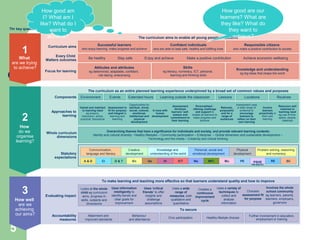
The curriculum as an entire planned learning experience underpinned by a broad set of common values and purposes
Whole curriculum
dimensions
Approaches to
learning
Components
Every Child
Matters outcomes
Focus for learning
Curriculum aims
Be healthy Stay safe Enjoy and achieve Make a positive contribution Achieve economic wellbeing
Attitudes and attributes
eg determined, adaptable, confident,
risk-taking, enterprising
Knowledge and understanding
eg big ideas that shape the world
Skills
eg literacy, numeracy, ICT, personal,
learning and thinking skills
Successful learners
who enjoy learning, make progress and achieve
Responsible citizens
who make a positive contribution to society
Confident individuals
who are able to lead safe, healthy and fulfilling lives
The curriculum aims to enable all young people to become
Statutory
expectations
Overarching themes that have a significance for individuals and society, and provide relevant learning contexts:
Identity and cultural diversity - Healthy lifestyles – Community participation – Enterprise – Global dimension and sustainable development –
Technology and the media – Creativity and critical thinking.
Varied and matched
to learning need
e.g. enquiry,
instruction, active,
practical, theoretical
Assessment is
fit for purpose
and integral to
learning and
teaching
Opportunities for
spiritual, moral,
social, cultural,
emotional,
intellectual and
physical
development
In tune with
human
development
Assessment
develops
learners’ self-
esteem and
commitment to
their learning
Personalised -
offering challenge
and support to
enable all learners
make progress and
achieve
Assessment uses
a wide range of
evidence to
encourage
learners to
reflect on their
own learning
Involve
learners
proactively in
their own
learning
Resource well-
matched to
learning need
eg. use of time,
space, people,
materials
Relevant,
purposeful
and for a
range of
audiences
Environment RoutinesLocationsLessonsLearning outside the classroomEvents Extended hours
Evaluating impact
Accountability
measures
To secure
The curriculum as an entire planned learning experience underpinned by a broad set of common values and purposes
Whole curriculum
dimensions
Approaches to
learning
Components
Every Child
Matters outcomes
Focus for learning
Curriculum aims
Be healthy Stay safe Enjoy and achieve Make a positive contribution Achieve economic wellbeing
Attitudes and attributes
eg determined, adaptable, confident,
risk-taking, enterprising
Knowledge and understanding
eg big ideas that shape the world
Skills
eg literacy, numeracy, ICT, personal,
learning and thinking skills
Successful learners
who enjoy learning, make progress and achieve
Responsible citizens
who make a positive contribution to society
Confident individuals
who are able to lead safe, healthy and fulfilling lives
The curriculum aims to enable all young people to become
Statutory
expectations
Overarching themes that have a significance for individuals and society, and provide relevant learning contexts:
Identity and cultural diversity - Healthy lifestyles – Community participation – Enterprise – Global dimension and sustainable development –
Technology and the media – Creativity and critical thinking.
Varied and matched
to learning need
eg enquiry,
instruction, active,
practical, theoretical
Assessment is
fit for purpose
and integral to
learning and
teaching
Opportunities for
spiritual, moral,
social, cultural,
emotional,
intellectual and
physical
development
In tune with
human
development
Assessment
develops
learners’ self-
esteem and
commitment to
their learning
Personalised -
offering challenge
and support to
enable all learners to
make progress and
achieve
Assessment uses
a wide range of
evidence to
encourage
learners to
reflect on their
own learning
Involve
learners
proactively in
their own
learning
Resource well
matched to
learning need
eg use of time,
space, people,
materials
Relevant,
purposeful
and for a
range of
audiences
PSHE
PW EW+FC
PEMuMFL RE SCMaICTHiGeEnD & TCiA & D
Problem solving, reasoning
and numeracy
Physical
development
Personal, social and
emotional development
Knowledge and
understanding of the world
Communication,
language and literacy
Creative
development
Environment RoutinesLocationsLessonsLearning outside the classroomEvents Extended hours
Attainment and
improved standards
Behaviour
and attendance
Further involvement in education,
employment or trainingCivic participation Healthy lifestyle choices
Thr key questions
3
How well
are we
achieving
our aims?
1
What
are we trying
to achieve?
2
How
do we
organise
learning?
To make learning and teaching more effective so that learners understand quality and how to improve
Involves the whole
school community
eg learners, parents,
teachers, employers,
governors
Chooses
assessment fit
for purpose
Creates a
continuous
improvement
cycle
Uses a wide
range of
measures, both
qualitative and
quantitative
Uses ‘critical
friends’ to offer
insights and
challenge
assumptions
Uses information
intelligently to
identify trends and
clear goals for
improvement
Looks at the whole
child eg curriculum
aims, progress in
skills, subjects and
dimensions
Uses a variety of
techniques to
collect and
analyse
information
How good are our
learners? What are
they like? What do
they want to
achieve?
How good am
I? What am I
like? What do I
want to
achieve?
6
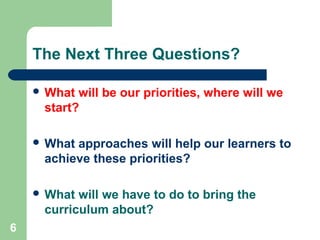
The Next Three Questions?
 What will be our priorities, where will we
start?
 What approaches will help our learners to
achieve these priorities?
 What will we have to do to bring the
curriculum about?
7
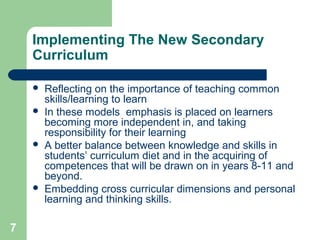
Implementing The New Secondary
Curriculum
 Reflecting on the importance of teaching common
skills/learning to learn
 In these models emphasis is placed on learners
becoming more independent in, and taking
responsibility for their learning
 A better balance between knowledge and skills in
students’ curriculum diet and in the acquiring of
competences that will be drawn on in years 8-11 and
beyond.
 Embedding cross curricular dimensions and personal
learning and thinking skills.
8
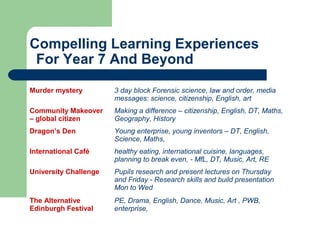
Compelling Learning Experiences
For Year 7 And Beyond
Murder mystery 3 day block Forensic science, law and order, media
messages: science, citizenship, English, art
Community Makeover
– global citizen
Making a difference – citizenship, English, DT, Maths,
Geography, History
Dragon’s Den Young enterprise, young inventors – DT, English,
Science, Maths,
International Café healthy eating, international cuisine, languages,
planning to break even, - MfL, DT, Music, Art, RE
University Challenge Pupils research and present lectures on Thursday
and Friday - Research skills and build presentation
Mon to Wed
The Alternative
Edinburgh Festival
PE, Drama, English, Dance, Music, Art , PWB,
enterprise,
9
The 14-19 Curriculum
 What principles should underpin different learning
pathways and accreditation routes at our school?
 Regardless of learning pathway (academic,
vocational, mixed), what experiences is it essential
for all students to participate in?
 What pathways do we need 14-16 and 14-19 and
how do we want to ensure that no doors are closed
to students as they develop and that move towards
parity of esteem in academic and vocational
learning?
10
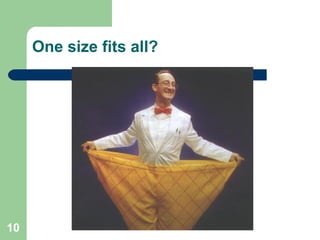
One size fits all?
11
Diploma v Traditional
 Vocational/Applied?
 Yes, but it is more than that.
 Work and life skills
 Confidence
 Problem solving
 Valuable employees and clearly link to local
need.
12
Creating the conditions for
Vocational/Applied Learning
 Successful vocational learning challenges
conventional teaching approaches
 It is necessary to change the CULTURE of learning
in the school
 Change needs capacity – building the capacity of
staff is one the most important aspects of developing
vocational course provision
 Investing in CPD is essential
 Working in teams is essential
 Middle Leadership support is vital
13
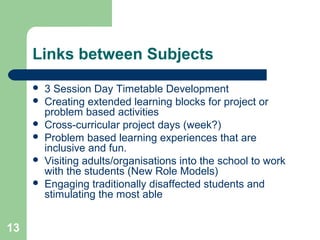
Links between Subjects
 3 Session Day Timetable Development
 Creating extended learning blocks for project or
problem based activities
 Cross-curricular project days (week?)
 Problem based learning experiences that are
inclusive and fun.
 Visiting adults/organisations into the school to work
with the students (New Role Models)
 Engaging traditionally disaffected students and
stimulating the most able
14
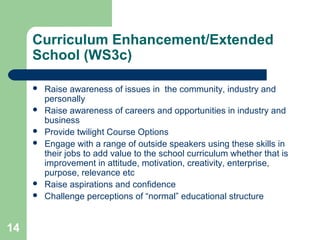
Curriculum Enhancement/Extended
School (WS3c)
 Raise awareness of issues in the community, industry and
personally
 Raise awareness of careers and opportunities in industry and
business
 Provide twilight Course Options
 Engage with a range of outside speakers using these skills in
their jobs to add value to the school curriculum whether that is
improvement in attitude, motivation, creativity, enterprise,
purpose, relevance etc
 Raise aspirations and confidence
 Challenge perceptions of “normal” educational structure
15
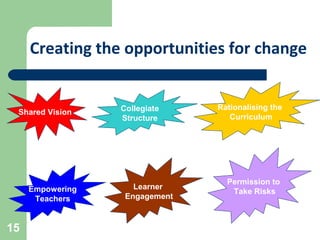
Creating the opportunities for change
Shared Vision Collegiate
Structure
Rationalising the
Curriculum
Empowering
Teachers
Learner
Engagement
Permission to
Take Risks
16
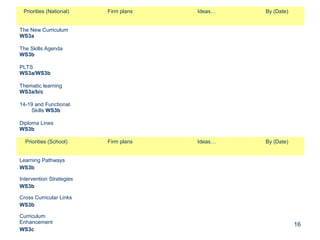
Priorities (National) Firm plans Ideas… By (Date)
The New Curriculum
WS3a
The Skills Agenda
WS3b
PLTS
WS3a/WS3b
Thematic learning
WS3a/b/c
14-19 and Functional.
Skills WS3b
Diploma Lines
WS3b
Priorities (School) Firm plans Ideas… By (Date)
Learning Pathways
WS3b
Intervention Strategies
WS3b
Cross Curricular Links
WS3b
Curriculum
Enhancement
WS3c
17
So what has changed?
 An increased focus on whole curriculum design underpinned by
Aims
 Increased flexibility – less prescription but focus on key concepts
and processes in subjects.
 More room for personalisation and locally determined curriculum
 More emphasis on skills – functional and wider skills for learning and
life
 More emphasis on personal development and ECM
 More opportunities for coherence and relevance - linking learning to
life outside school, making connections between subjects, cross-
curricular themes and dimensions
 A real opportunity for renewal and re-invigoration (Diplomas)
18
EDUCATIONAL CHANGE ?
“The pace of change is accelerating… there will be far greater
transformations in the first two decades of the twenty-first century
than we saw in the entire twentieth century.”
Ray Kurzwell – “The Age of Spiritual Machines”
“We are preparing students for a world we don’t understand, to do
jobs which don’t exist yet, using technologies which haven’t been
invented”
Shift Happens

Ensuring A World Class Curriculum

  • 1.
    1 Ensuring a WorldClass Curriculum S Keeble January 2009
  • 2.
    2 Objective To explore waysto develop a modern, world-class curriculum that will inspire and challenge all our learners and prepare them for the future using; a) A Competency Curriculum in KS3 b) An Academic/Applied Curriculum at KS4 c) Extended Learning Sessions 11-16 d) Innovative Curriculum Enhancement Opportunities Using the schools specialism to drive the change
  • 3.
    3 I want toimprove myself......... I want to learn….. I want to see how good I am...... I want to know that I am making progress I want to improve myself......... I want to learn….. I want to see how good I am...... I want to know that I am making progress I don’t have a clear career path but I know I want a good job and for that I need qualifications. I want to contribute to society and I know the sort of person I want to be. I want my personal growth recognised in some formal ways
  • 4.
    4 Five questions driving curriculumdevelopment  What is it that we do well?  What are we trying to achieve?  How do we organise learning?  How well are we achieving our aims?  What do we want to develop?
  • 5.
    5 Problem solving, reasoning andnumeracy Physical development Personal, social and emotional development Knowledge and understanding of the world Communication, language and literacy Creative development PSHE PW EW+FC PEMuMFL RE SCMaICTHiGeEnD & TCiA & D The curriculum as an entire planned learning experience underpinned by a broad set of common values and purposes Whole curriculum dimensions Approaches to learning Components Every Child Matters outcomes Focus for learning Curriculum aims Be healthy Stay safe Enjoy and achieve Make a positive contribution Achieve economic wellbeing Attitudes and attributes eg determined, adaptable, confident, risk-taking, enterprising Knowledge and understanding eg big ideas that shape the world Skills eg literacy, numeracy, ICT, personal, learning and thinking skills Successful learners who enjoy learning, make progress and achieve Responsible citizens who make a positive contribution to society Confident individuals who are able to lead safe, healthy and fulfilling lives The curriculum aims to enable all young people to become Statutory expectations Overarching themes that have a significance for individuals and society, and provide relevant learning contexts: Identity and cultural diversity - Healthy lifestyles – Community participation – Enterprise – Global dimension and sustainable development – Technology and the media – Creativity and critical thinking. Varied and matched to learning need e.g. enquiry, instruction, active, practical, theoretical Assessment is fit for purpose and integral to learning and teaching Opportunities for spiritual, moral, social, cultural, emotional, intellectual and physical development In tune with human development Assessment develops learners’ self- esteem and commitment to their learning Personalised - offering challenge and support to enable all learners make progress and achieve Assessment uses a wide range of evidence to encourage learners to reflect on their own learning Involve learners proactively in their own learning Resource well- matched to learning need eg. use of time, space, people, materials Relevant, purposeful and for a range of audiences Environment RoutinesLocationsLessonsLearning outside the classroomEvents Extended hours Evaluating impact Accountability measures To secure The curriculum as an entire planned learning experience underpinned by a broad set of common values and purposes Whole curriculum dimensions Approaches to learning Components Every Child Matters outcomes Focus for learning Curriculum aims Be healthy Stay safe Enjoy and achieve Make a positive contribution Achieve economic wellbeing Attitudes and attributes eg determined, adaptable, confident, risk-taking, enterprising Knowledge and understanding eg big ideas that shape the world Skills eg literacy, numeracy, ICT, personal, learning and thinking skills Successful learners who enjoy learning, make progress and achieve Responsible citizens who make a positive contribution to society Confident individuals who are able to lead safe, healthy and fulfilling lives The curriculum aims to enable all young people to become Statutory expectations Overarching themes that have a significance for individuals and society, and provide relevant learning contexts: Identity and cultural diversity - Healthy lifestyles – Community participation – Enterprise – Global dimension and sustainable development – Technology and the media – Creativity and critical thinking. Varied and matched to learning need eg enquiry, instruction, active, practical, theoretical Assessment is fit for purpose and integral to learning and teaching Opportunities for spiritual, moral, social, cultural, emotional, intellectual and physical development In tune with human development Assessment develops learners’ self- esteem and commitment to their learning Personalised - offering challenge and support to enable all learners to make progress and achieve Assessment uses a wide range of evidence to encourage learners to reflect on their own learning Involve learners proactively in their own learning Resource well matched to learning need eg use of time, space, people, materials Relevant, purposeful and for a range of audiences PSHE PW EW+FC PEMuMFL RE SCMaICTHiGeEnD & TCiA & D Problem solving, reasoning and numeracy Physical development Personal, social and emotional development Knowledge and understanding of the world Communication, language and literacy Creative development Environment RoutinesLocationsLessonsLearning outside the classroomEvents Extended hours Attainment and improved standards Behaviour and attendance Further involvement in education, employment or trainingCivic participation Healthy lifestyle choices Thr key questions 3 How well are we achieving our aims? 1 What are we trying to achieve? 2 How do we organise learning? To make learning and teaching more effective so that learners understand quality and how to improve Involves the whole school community eg learners, parents, teachers, employers, governors Chooses assessment fit for purpose Creates a continuous improvement cycle Uses a wide range of measures, both qualitative and quantitative Uses ‘critical friends’ to offer insights and challenge assumptions Uses information intelligently to identify trends and clear goals for improvement Looks at the whole child eg curriculum aims, progress in skills, subjects and dimensions Uses a variety of techniques to collect and analyse information How good are our learners? What are they like? What do they want to achieve? How good am I? What am I like? What do I want to achieve?
  • 6.
    6 The Next ThreeQuestions?  What will be our priorities, where will we start?  What approaches will help our learners to achieve these priorities?  What will we have to do to bring the curriculum about?
  • 7.
    7 Implementing The NewSecondary Curriculum  Reflecting on the importance of teaching common skills/learning to learn  In these models emphasis is placed on learners becoming more independent in, and taking responsibility for their learning  A better balance between knowledge and skills in students’ curriculum diet and in the acquiring of competences that will be drawn on in years 8-11 and beyond.  Embedding cross curricular dimensions and personal learning and thinking skills.
  • 8.
    8 Compelling Learning Experiences ForYear 7 And Beyond Murder mystery 3 day block Forensic science, law and order, media messages: science, citizenship, English, art Community Makeover – global citizen Making a difference – citizenship, English, DT, Maths, Geography, History Dragon’s Den Young enterprise, young inventors – DT, English, Science, Maths, International Café healthy eating, international cuisine, languages, planning to break even, - MfL, DT, Music, Art, RE University Challenge Pupils research and present lectures on Thursday and Friday - Research skills and build presentation Mon to Wed The Alternative Edinburgh Festival PE, Drama, English, Dance, Music, Art , PWB, enterprise,
  • 9.
    9 The 14-19 Curriculum What principles should underpin different learning pathways and accreditation routes at our school?  Regardless of learning pathway (academic, vocational, mixed), what experiences is it essential for all students to participate in?  What pathways do we need 14-16 and 14-19 and how do we want to ensure that no doors are closed to students as they develop and that move towards parity of esteem in academic and vocational learning?
  • 10.
  • 11.
    11 Diploma v Traditional Vocational/Applied?  Yes, but it is more than that.  Work and life skills  Confidence  Problem solving  Valuable employees and clearly link to local need.
  • 12.
    12 Creating the conditionsfor Vocational/Applied Learning  Successful vocational learning challenges conventional teaching approaches  It is necessary to change the CULTURE of learning in the school  Change needs capacity – building the capacity of staff is one the most important aspects of developing vocational course provision  Investing in CPD is essential  Working in teams is essential  Middle Leadership support is vital
  • 13.
    13 Links between Subjects 3 Session Day Timetable Development  Creating extended learning blocks for project or problem based activities  Cross-curricular project days (week?)  Problem based learning experiences that are inclusive and fun.  Visiting adults/organisations into the school to work with the students (New Role Models)  Engaging traditionally disaffected students and stimulating the most able
  • 14.
    14 Curriculum Enhancement/Extended School (WS3c) Raise awareness of issues in the community, industry and personally  Raise awareness of careers and opportunities in industry and business  Provide twilight Course Options  Engage with a range of outside speakers using these skills in their jobs to add value to the school curriculum whether that is improvement in attitude, motivation, creativity, enterprise, purpose, relevance etc  Raise aspirations and confidence  Challenge perceptions of “normal” educational structure
  • 15.
    15 Creating the opportunitiesfor change Shared Vision Collegiate Structure Rationalising the Curriculum Empowering Teachers Learner Engagement Permission to Take Risks
  • 16.
    16 Priorities (National) Firmplans Ideas… By (Date) The New Curriculum WS3a The Skills Agenda WS3b PLTS WS3a/WS3b Thematic learning WS3a/b/c 14-19 and Functional. Skills WS3b Diploma Lines WS3b Priorities (School) Firm plans Ideas… By (Date) Learning Pathways WS3b Intervention Strategies WS3b Cross Curricular Links WS3b Curriculum Enhancement WS3c
  • 17.
    17 So what haschanged?  An increased focus on whole curriculum design underpinned by Aims  Increased flexibility – less prescription but focus on key concepts and processes in subjects.  More room for personalisation and locally determined curriculum  More emphasis on skills – functional and wider skills for learning and life  More emphasis on personal development and ECM  More opportunities for coherence and relevance - linking learning to life outside school, making connections between subjects, cross- curricular themes and dimensions  A real opportunity for renewal and re-invigoration (Diplomas)
  • 18.
    18 EDUCATIONAL CHANGE ? “Thepace of change is accelerating… there will be far greater transformations in the first two decades of the twenty-first century than we saw in the entire twentieth century.” Ray Kurzwell – “The Age of Spiritual Machines” “We are preparing students for a world we don’t understand, to do jobs which don’t exist yet, using technologies which haven’t been invented” Shift Happens

Editor's Notes

  • #4 Research has shown that the majority of learners want to learn but…… 20% of time in school = no planned learning Blackpool example, the majority of students questioned said they only learn in school, not anywhere else. Research has shown that the majority of learners want to learn but…… 20% of time in school = no planned learning Blackpool example, the majority of students questioned said they only learn in school, not anywhere else.
  • #5 10 Minute Discussion What will success look like? In your groups describe the characteristics of a Successful learner Confident individual Responsible citizen