CURRICULUM FOUNDATIONS
• Curriculumfoundations are generally referred to as the
basic force or ideas which influence and shape the
curriculum. (The forces that influence the minds of
curriculum developers. In this way these effect the
content and structure of the curriculum.)
• It is usually considered that these includes
philosophical ideas about the nature of education and
knowledge, the influence of society and culture, and
view about the person (child) and how he or she learns.
• The foundations of curriculum are sometimes called
the ‘source’ of the curriculum.
3.
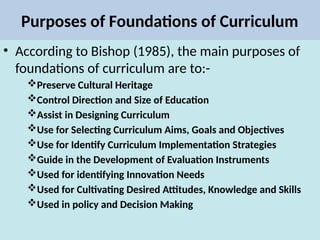
Purposes of Foundationsof Curriculum
• According to Bishop (1985), the main purposes of
foundations of curriculum are to:-
Preserve Cultural Heritage
Control Direction and Size of Education
Assist in Designing Curriculum
Use for Selecting Curriculum Aims, Goals and Objectives
Use for Identify Curriculum Implementation Strategies
Guide in the Development of Evaluation Instruments
Used for identifying Innovation Needs
Used for Cultivating Desired Attitudes, Knowledge and Skills
Used in policy and Decision Making
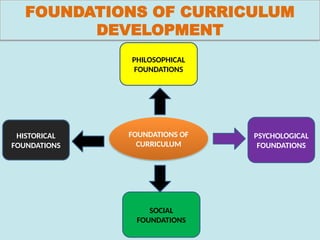
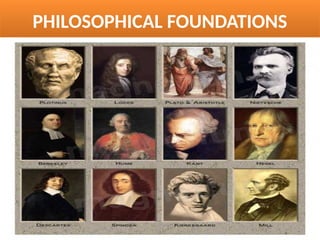
PHILOSOPHICAL FOUNDATIONS
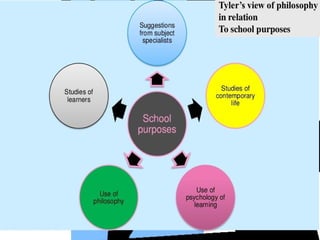
• Philosophyprovides educators, especially
curriculum workers, with a framework or
frameworks for organizing schools and classrooms.
It helps them determine
what schools are for,
what subjects have value,
how students learn, and
what methods and materials to use.
7.
PHILOSOPHICAL FOUNDATIONS
• Itclarifies education’s goals, suitable content,
teaching and learning processes, and the
experiences and activities that schools should
emphasize.
• Philosophy also provides a basis for deciding
which textbooks to use, how to use them, and
how much homework to assign, how to test
students and use the test results, and what
courses or subject matter to emphasize.
8.
PHILOSOPHICAL FOUNDATIONS
• Indecision making: Philosophy provides the
starting point and will be used for the
succeeding decision making.
• The philosophy of a curriculum planner,
implementer or evaluator reflects his or her
life experiences, common beliefs, social and
economic background and education
10.
The Four EducationalPhilosophies
• Perennialism
• Essentialism
• Progressivism
• Reconstructionism
11.
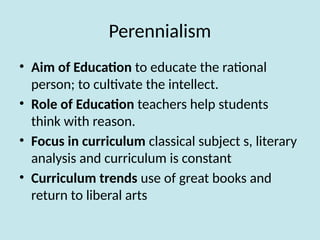
Perennialism
• Aim ofEducation to educate the rational
person; to cultivate the intellect.
• Role of Education teachers help students
think with reason.
• Focus in curriculum classical subject s, literary
analysis and curriculum is constant
• Curriculum trends use of great books and
return to liberal arts
12.
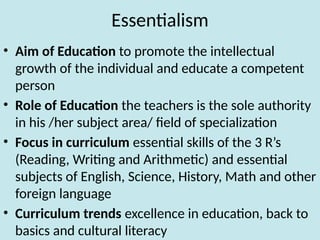
Essentialism
• Aim ofEducation to promote the intellectual
growth of the individual and educate a competent
person
• Role of Education the teachers is the sole authority
in his /her subject area/ field of specialization
• Focus in curriculum essential skills of the 3 R’s
(Reading, Writing and Arithmetic) and essential
subjects of English, Science, History, Math and other
foreign language
• Curriculum trends excellence in education, back to
basics and cultural literacy
13.
Progressivism
• Aim ofEducation to promote democratic and social
living
• Role of Education knowledge lead s to growth and
development of life long learners who actively learn by
doing.
• Focus in curriculum subjects are interdisciplinary,
integrative and interactive. Curriculum is focused on
students’ interest, human problems and affairs
• Curriculum trends school reforms, relevant and
contextualized curriculum, humanistic education
14.
Reconstructivism
• Aim ofEducation to improve and reconstruct society
Education for change
• Role of Education teachers act as agents of change and
reform in various educational projects including
research
• Focus in curriculum focus on present and future trends
and issues of national and international interests
• Curriculum trends equality of educational opportunities
in education, access to global education
15.
The Psychological Foundations
•Psychology is the scientific study of human behavior. It
deals with how human learn and behave. It gives insight
into:
Child development
Learning
Inquiry techniques
Educational objectives
Student characteristics
Learning process
Teaching method
Evaluation procedures
16.
Major Theories ofLearning
• Behaviorism – stimulus and reinforces
• Cognitivism – mental operation
• Phenomenology/Humanistic psychology –
whole child (social, psychology, and cognitive
development)
17.
Behaviorist Psychology
• BehavioristPsychology is a theory of learning based upon the
idea that all behavior are required through conditioning
(conditioning occurs through interaction with the
environment)
• There are positive and negative reinforcement:
• Positive reinforcement - "keep up the good work" A
student receives positive reinforcement when a test paper
is returned with a grade of A and noted with the message.
• Negative reinforcement - "Keep quiet!" A teacher shouts
to the class, and the student quiet down, the students'
silence reinforces the teachers' shouting.
• P/s - sometimes punishment can inhibits learning
18.
Behaviorism and Curriculum
•Curriculum should be organized so students
experience success in master the subject
matter. Behaviorist are very prescriptive and
diagnostic in their approach. Rely on step-by-
step structured methods for learning.
• Behaviorism in curriculum includes careful
analyzing and sequencing of the learners’
needs and behaviors.
19.
Cognitivism Theory ofJean Piaget
• Cognitive Psychology is scientific study of mind and
mental function, including learning, memory,
attention, perception, reasoning, decision making
• Describes cognitive development in terms of stages
from birth to maturity
• Sensorimotor stage (0-2),
• preoperational stage (2-7),
• concrete operations stage (7-11) and
• formal operations (11 – onwards)
20.
Key to learning
•Assimilation (incorporation of new
experience),
• Accommodation (learning modification and
adaptation) and
• Equilibration (balance between previous and
later learning)
21.
Cognitivism and Curriculum
Whyuse cognitivism in curriculum making?
• Cognitive approach constitutes a logical method for
organizing and interpreting learning
• Rooted in the tradition of subject matter
• Educators been trained in cognitive approaches
• Schools are the place for cognitive learning.
Students should not afraid to ask, not afraid of
being wrong, not afraid of not please teacher, and
not afraid of taking risk and playing with ideas.
Gestalt Theory (Gestalt)
•Learning is explained in terms of “wholeness”
of the problem
• Human beings do not respond to isolated
stimuli but to an organization or patter of
stimuli.
24.
Key to learning
•Learning is complex and abstract
• Learner analyzes the problem, discriminates
between essential and nonessential data, and
perceive relationships.
• Learners will perceive something in relation to
the whole. What/how they perceive it’s
related to their previous experiences.
25.
Phenomenology/Humanistic Psychology and
Curriculum
•Motivation and Achievement
• Self esteem and self concept must be recognized as essential factors
• Affective needs are more important than cognitive needs
• Support and nurture
• The Concept of Freedom
• Freedom permits the learners to probe, explore and deepen
understanding
• Enhance learning opportunities and alternatives
• In search of Curriculum
• Leaners draw on experiences, subject matter, and intellectual skills to
attain full potential
• Affection is measured through testimonials
• Curriculum that enhance the self-actualizing and self-determining
learning process
The Sociological Foundations
•Latin “Socius” - “social or being with
others” - and the Greek “logos” - “study”
• Therefore, the term “Sociology” basically
means the “study of social beings”. It
includes
Human behavior in groups
social structure and social phenomena
different forms of human interrelations
28.
The Sociological Foundations
•Issues from society including groups and institutions in
the culture and their contribution to education
- refers to issues from society that have an influence on
curriculum.
There are many aspects of the society that need
consideration in curriculum making. These include:
• Changes occurring in societal structures;
• Transmission of culture;
• social problems as issues for Curriculum and
• Economics issues.
29.
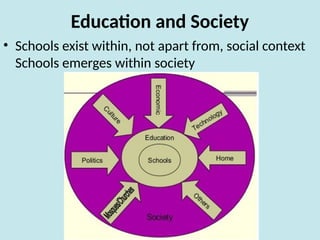
Education and Society
•Schools exist within, not apart from, social context
Schools emerges within society
30.
AIMS OF EDUCATION
•Development of social feelings and qualities
• Development of a socially efficient individual
• Improvement of vocational efficiency
• Use of leisure time and development of healthy
recreational pursuits
• Transmission of social heritage
• Diffusion of more and more knowledge
• Development of constructive and creative outlook of the
individual
• Education for social service, social efficiency, emotional
integration, national unity and patriotism
31.
CURRICULUM
• Based onconditions, problems and needs of society
• An agent for transmission of basic values of culture
• Prepare the child for global/world society
• Flexible and changeable for the effective realization
of socially determined objectives
• Lead to the development of genuine ‘we feeling’ i.e.
of a group having a spirit of social interaction
32.
METHODS OF TEACHING
•Enable child to acquire skills and knowledge
needed
• Develop a capacity for social adjustment
• Develop problem solving and constructive
thinking
• Socialized techniques; project and group
methods
33.
ROLE OF THETEACHER
• Destiny of the nation is shaped in classrooms
by the teachers
• Be exposed to the concept of freedom, dignity
of the individual, rights and duties so as to
transmit the same to the younger generation
• Expected to possess right attitude of social
behavior
• Remain above casteism, regionalism
34.
The School andDiscipline
• The School
• Reflect and epitomize the larger society
outside its walls
• Balance, purify and simplify the activities of
the society in its environment
• The Discipline
• Should come through participation in group
activities and social service activities
35.
Curriculum and Society
•Education takes place in society
• Education is essentially a social process
• Social environment educates the child education
has a social role to play
• Education is a lifelong process
• Education is not only schooling
• Education is formal, non-formal and informal
• Education must be social in nature and develop
democratic skills and values in students