OPINION
AND COMMON FALLACIES
Prepared by:
MR. ANTONIO T. DELGADO
Faculty, General De Jesus College
FOCUS QUESTIONS
1. What is opinion?
2. What is argument? What are its parts?
3. What are fallacies?
4. Why is it important to avoid fallacies in forming
opinion?
2
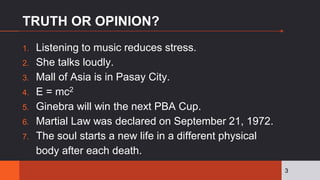
TRUTH OR OPINION?
1. Listening to music reduces stress.
2. She talks loudly.
3. Mall of Asia is in Pasay City.
4. E = mc2
5. Ginebra will win the next PBA Cup.
6. Martial Law was declared on September 21, 1972.
7. The soul starts a new life in a different physical
body after each death.
3
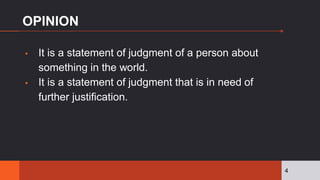
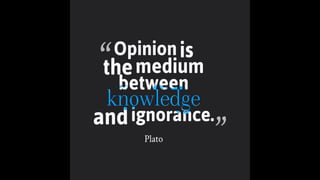
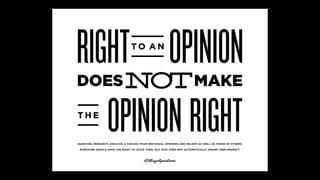
OPINION
▪ It is a statement of judgment of a person about
something in the world.
▪ It is a statement of judgment that is in need of
further justification.
4
5
“
Walang maling opinyon.
6
“
Akala mo lang wala…
7
“
…pero meron!
8
“
“Opinyon ko na
dapat mamatay
na tayong lahat.”
“
10
ARGUMENT
▪ It is a group of statements that serve to support a
conclusion.
▪ It is made up of a claim (the conclusion of an
argument) and premises (the reasons used to
support the conclusion).
11
ARGUMENT
▪ Not all arguments are good arguments.
12
13
14
17
“
“Everyone is entitled
to his own opinion...”
19
20
FALLACIES
▪ We call fake arguments “fallacies”.
▪ Fallacies are groups of statements that appear to
be arguments, but fail to support the conclusion.
21
COMMON
FALLACIES
22
1.
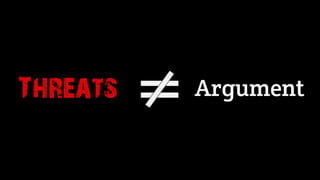
AD BACULUM
This occurs when one appeals
to force or the threat of force to bring about
the acceptance of a conclusion.
24
25
2.
COMPOSITION
This arises when one infers that something is true of the
whole from the fact that it is true of some part of the whole.
Composition
▪ This tire is made of rubber, therefore the vehicle to
which it is a part is also made of rubber.
27
3.
DIVISION
This is an error in logic that occurs when one reasons that
something that is true for a whole or a class must also be
true of all or some of its parts.
Division
▪ The Twelfth Grade in in General De Jesus College
eats a lot of ice cream. Carlos is a 12th grader in
General De Jesus College. Therefore, Carlos eats
a lot of ice cream.
29
4.
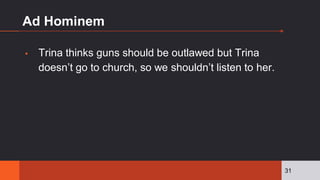
AD HOMINEM
This occurs when an author attacks his
opponent instead of his opponent’s argument.
Ad Hominem
▪ Trina thinks guns should be outlawed but Trina
doesn’t go to church, so we shouldn’t listen to her.
31
5.
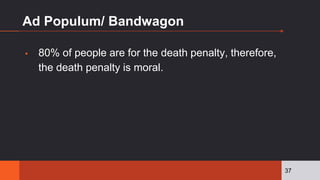
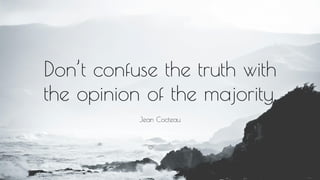
AD POPULUM
It attempts to prove an argument as correct
simply because many people believe it to be so.
Ad Populum/ Bandwagon
▪ 80% of people are for the death penalty, therefore,
the death penalty is moral.
37
38
6.
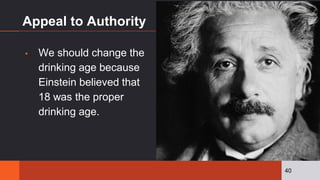
APPEAL TO AUTHORITY
The author claims his argument is right because
someone famous or powerful supports it.
Appeal to Authority
▪ We should change the
drinking age because
Einstein believed that
18 was the proper
drinking age.
40
7.
BEGGING THE QUESTION
This happens when the author’s premise and
conclusion say the same thing.
Begging the Question
▪ Fashion magazines don’t
hurt women’s self-esteem
because women’s
confidence is intact after
reading the magazine.
42
8.
FALSE DICHOTOMY
This fallacy rests on the assumption that there
are only two possible solutions.
False Dichotomy
▪ The teacher gives too many 90’s and therefore
must be fired because grade inflation is unfair to
other students.
44
9.
HASTY GENERALIZATION
It occurs when the proponent uses too small of a
sample size to support a sweeping generalization.
Hasty Generalization
▪ Sally couldn’t find any cute clothes at the boutique
and neither could Maura, so the boutique doesn’t
have any cute clothes.
46
47
48
10.
POST HOC
This fallacy assumes that correlation
equals causation.
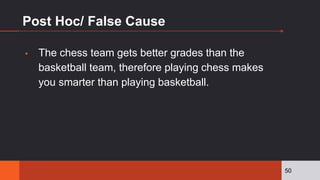
Post Hoc/ False Cause
▪ The chess team gets better grades than the
basketball team, therefore playing chess makes
you smarter than playing basketball.
50
11.
MISSING THE POINT
It occurs when the premise of the argument supports a
specific conclusion but not the one the author draws.
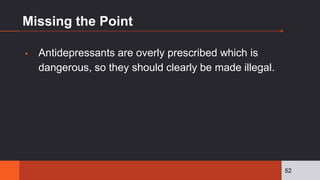
Missing the Point
▪ Antidepressants are overly prescribed which is
dangerous, so they should clearly be made illegal.
52
12.
SPOTLIGHT FALLACY
It occurs when the author assumes that the cases that
receive the most publicity are the most common cases.
Spotlight Fallacy
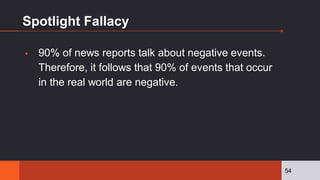
▪ 90% of news reports talk about negative events.
Therefore, it follows that 90% of events that occur
in the real world are negative.
54
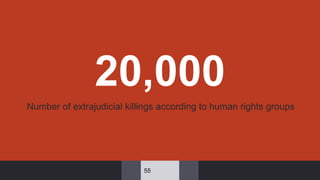
20,000
Number of extrajudicial killings according to human rights groups
55
56
“This is the front-page photo in the Philippine Daily
Inquirer’s July 24, 2016 issue showing pedicab
driver Michael Siaron’s lifeless body being cradled
in a Pieta-like pose by his partner. Siaron, the
newspaper claimed,* was executed by the police in
the course of President Duterte’s war against illegal
drugs. The photo went viral on the internet, with
Western newspapers publishing it on their own front
pages.
57
“
It turns out now, after more than a year of police
investigation, that the pedicab driver was killed by a
drug syndicate’s assassin, one Nesty Santiago,
who was also responsible for five other killings. The
unique scratches – like fingerprints – on the bullets
that murdered Siaron matched with the gun used by
the killer, recovered when he was killed in
December.
58
13.
STRAW MAN
The author puts forth one of his opponent’s weaker,
less central arguments forward and destroys it, while
acting like this argument is the crux of the issue.
Straw Man
▪ My opponent wants to increase teachers’ pay but
studies have shown that professors with tenure
don’t work as hard at their job to improve
themselves.
60
14.
APPEAL TO EMOTION
This is characterized by the manipulation of the
recipient's emotions in order to win an argument,
especially in the absence of factual evidence.
Appeal to Emotion
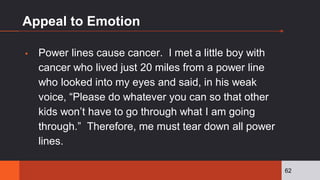
▪ Power lines cause cancer. I met a little boy with
cancer who lived just 20 miles from a power line
who looked into my eyes and said, in his weak
voice, “Please do whatever you can so that other
kids won’t have to go through what I am going
through.” Therefore, me must tear down all power
lines.
62
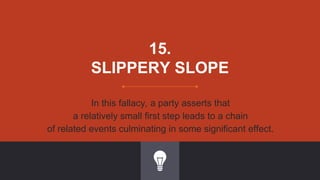
15.
SLIPPERY SLOPE
In this fallacy, a party asserts that
a relatively small first step leads to a chain
of related events culminating in some significant effect.
Slippery Slope
▪ Example: If I loan you a peso today then you will
eventually ask me for one hundred pesos and then
one million pesos. I do not want that to happen, so
I cannot give you the one peso loan.
64
EVALUATION
1. What is opinion?
2. What is argument? What are its parts?
3. What are fallacies?
4. Why is it important to avoid fallacies in forming
opinion?
65
THANKS!
ANY QUESTIONS?
PowerPoint presentations are available at:
▪ www.facebook.com/GJCphilo
REFERENCES
1. Skoskiewicz, M. (May 22, 2011). 10 Common
Logical Fallacies. Retrieved May 17, 2018, from
https://www.myguruedge.com/our-
thinking/myguru-blog/bid/214477/10-common-
logical-fallacies
2. Richardson, J., et al. Thou Shalt Not Commit
Logical Fallacies. Retrieved July 9, 2019, from
https://yourlogicalfallacyis.com
67

OPINION AND COMMON FALLACIES v2.0

  • 1.
    OPINION AND COMMON FALLACIES Preparedby: MR. ANTONIO T. DELGADO Faculty, General De Jesus College
  • 2.
    FOCUS QUESTIONS 1. Whatis opinion? 2. What is argument? What are its parts? 3. What are fallacies? 4. Why is it important to avoid fallacies in forming opinion? 2
  • 3.
    TRUTH OR OPINION? 1.Listening to music reduces stress. 2. She talks loudly. 3. Mall of Asia is in Pasay City. 4. E = mc2 5. Ginebra will win the next PBA Cup. 6. Martial Law was declared on September 21, 1972. 7. The soul starts a new life in a different physical body after each death. 3
  • 4.
    OPINION ▪ It isa statement of judgment of a person about something in the world. ▪ It is a statement of judgment that is in need of further justification. 4
  • 5.
  • 6.
  • 7.
  • 8.
  • 9.
    “ “Opinyon ko na dapatmamatay na tayong lahat.”
  • 10.
  • 11.
    ARGUMENT ▪ It isa group of statements that serve to support a conclusion. ▪ It is made up of a claim (the conclusion of an argument) and premises (the reasons used to support the conclusion). 11
  • 12.
    ARGUMENT ▪ Not allarguments are good arguments. 12
  • 13.
  • 14.
  • 17.
  • 18.
    “ “Everyone is entitled tohis own opinion...”
  • 19.
  • 20.
  • 21.
    FALLACIES ▪ We callfake arguments “fallacies”. ▪ Fallacies are groups of statements that appear to be arguments, but fail to support the conclusion. 21
  • 22.
  • 23.
    1. AD BACULUM This occurswhen one appeals to force or the threat of force to bring about the acceptance of a conclusion.
  • 24.
  • 25.
  • 26.
    2. COMPOSITION This arises whenone infers that something is true of the whole from the fact that it is true of some part of the whole.
  • 27.
    Composition ▪ This tireis made of rubber, therefore the vehicle to which it is a part is also made of rubber. 27
  • 28.
    3. DIVISION This is anerror in logic that occurs when one reasons that something that is true for a whole or a class must also be true of all or some of its parts.
  • 29.
    Division ▪ The TwelfthGrade in in General De Jesus College eats a lot of ice cream. Carlos is a 12th grader in General De Jesus College. Therefore, Carlos eats a lot of ice cream. 29
  • 30.
    4. AD HOMINEM This occurswhen an author attacks his opponent instead of his opponent’s argument.
  • 31.
    Ad Hominem ▪ Trinathinks guns should be outlawed but Trina doesn’t go to church, so we shouldn’t listen to her. 31
  • 36.
    5. AD POPULUM It attemptsto prove an argument as correct simply because many people believe it to be so.
  • 37.
    Ad Populum/ Bandwagon ▪80% of people are for the death penalty, therefore, the death penalty is moral. 37
  • 38.
  • 39.
    6. APPEAL TO AUTHORITY Theauthor claims his argument is right because someone famous or powerful supports it.
  • 40.
    Appeal to Authority ▪We should change the drinking age because Einstein believed that 18 was the proper drinking age. 40
  • 41.
    7. BEGGING THE QUESTION Thishappens when the author’s premise and conclusion say the same thing.
  • 42.
    Begging the Question ▪Fashion magazines don’t hurt women’s self-esteem because women’s confidence is intact after reading the magazine. 42
  • 43.
    8. FALSE DICHOTOMY This fallacyrests on the assumption that there are only two possible solutions.
  • 44.
    False Dichotomy ▪ Theteacher gives too many 90’s and therefore must be fired because grade inflation is unfair to other students. 44
  • 45.
    9. HASTY GENERALIZATION It occurswhen the proponent uses too small of a sample size to support a sweeping generalization.
  • 46.
    Hasty Generalization ▪ Sallycouldn’t find any cute clothes at the boutique and neither could Maura, so the boutique doesn’t have any cute clothes. 46
  • 47.
  • 48.
  • 49.
    10. POST HOC This fallacyassumes that correlation equals causation.
  • 50.
    Post Hoc/ FalseCause ▪ The chess team gets better grades than the basketball team, therefore playing chess makes you smarter than playing basketball. 50
  • 51.
    11. MISSING THE POINT Itoccurs when the premise of the argument supports a specific conclusion but not the one the author draws.
  • 52.
    Missing the Point ▪Antidepressants are overly prescribed which is dangerous, so they should clearly be made illegal. 52
  • 53.
    12. SPOTLIGHT FALLACY It occurswhen the author assumes that the cases that receive the most publicity are the most common cases.
  • 54.
    Spotlight Fallacy ▪ 90%of news reports talk about negative events. Therefore, it follows that 90% of events that occur in the real world are negative. 54
  • 55.
    20,000 Number of extrajudicialkillings according to human rights groups 55
  • 56.
  • 57.
    “This is thefront-page photo in the Philippine Daily Inquirer’s July 24, 2016 issue showing pedicab driver Michael Siaron’s lifeless body being cradled in a Pieta-like pose by his partner. Siaron, the newspaper claimed,* was executed by the police in the course of President Duterte’s war against illegal drugs. The photo went viral on the internet, with Western newspapers publishing it on their own front pages. 57
  • 58.
    “ It turns outnow, after more than a year of police investigation, that the pedicab driver was killed by a drug syndicate’s assassin, one Nesty Santiago, who was also responsible for five other killings. The unique scratches – like fingerprints – on the bullets that murdered Siaron matched with the gun used by the killer, recovered when he was killed in December. 58
  • 59.
    13. STRAW MAN The authorputs forth one of his opponent’s weaker, less central arguments forward and destroys it, while acting like this argument is the crux of the issue.
  • 60.
    Straw Man ▪ Myopponent wants to increase teachers’ pay but studies have shown that professors with tenure don’t work as hard at their job to improve themselves. 60
  • 61.
    14. APPEAL TO EMOTION Thisis characterized by the manipulation of the recipient's emotions in order to win an argument, especially in the absence of factual evidence.
  • 62.
    Appeal to Emotion ▪Power lines cause cancer. I met a little boy with cancer who lived just 20 miles from a power line who looked into my eyes and said, in his weak voice, “Please do whatever you can so that other kids won’t have to go through what I am going through.” Therefore, me must tear down all power lines. 62
  • 63.
    15. SLIPPERY SLOPE In thisfallacy, a party asserts that a relatively small first step leads to a chain of related events culminating in some significant effect.
  • 64.
    Slippery Slope ▪ Example:If I loan you a peso today then you will eventually ask me for one hundred pesos and then one million pesos. I do not want that to happen, so I cannot give you the one peso loan. 64
  • 65.
    EVALUATION 1. What isopinion? 2. What is argument? What are its parts? 3. What are fallacies? 4. Why is it important to avoid fallacies in forming opinion? 65
  • 66.
    THANKS! ANY QUESTIONS? PowerPoint presentationsare available at: ▪ www.facebook.com/GJCphilo
  • 67.
    REFERENCES 1. Skoskiewicz, M.(May 22, 2011). 10 Common Logical Fallacies. Retrieved May 17, 2018, from https://www.myguruedge.com/our- thinking/myguru-blog/bid/214477/10-common- logical-fallacies 2. Richardson, J., et al. Thou Shalt Not Commit Logical Fallacies. Retrieved July 9, 2019, from https://yourlogicalfallacyis.com 67