Basics of Electricity
PRESENTED BY
GOBINATH K
ASSISTANT PROFESSOR
DEPARTMENT OF BIOMEDICAL ENGINEERING
HINDUSTHAN COLLEGE OF ENGINEERING AND
TECHNOLOGY
COIMBATORE
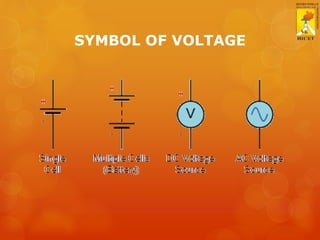
SYMBOL OF VOLTAGE
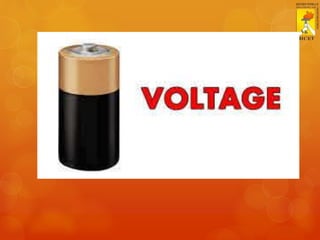
VOLTAGE
 Voltage, also called electromotive force, is a quantitative expression
of the potential difference in charge between two points in an
electrical field.
 The greater the voltage, the greater the flow of electrical current (that
is, the quantity of charge carriers that pass a fixed point per unit of
time) through a conducting or semiconducting medium for a given
resistance to the flow.
 Voltage is symbolized by an uppercase italic letter V or E. The
standard unit is the volt, symbolized by a non-italic uppercase letter
V.
 One volt will drive one coulomb (6.24 x 10¹⁸) charge carriers, such
as electrons, through a resistance of one ohm in one second.
TYPE THE STANDARD VALUE OF
VOLTAGE FOR SINGLE PHASE AC
SUPPLY WE ARE GETTING FOR OUR
HOME FROM ELECTRICITY BOARD IN
COMMENT BOX NOW
?????
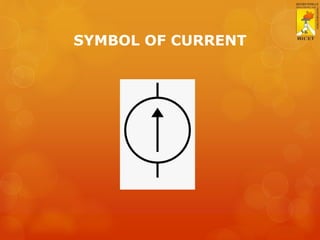
SYMBOL OF CURRENT
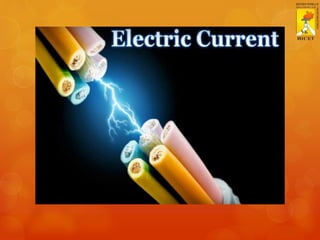
CURRENT
 The electric current is the rate of flow of electric charge through a
conducting medium with respect to time.
 When there is a potential difference between two points in a conductive
medium, electric charge starts flowing from the higher potential point to
the lower potential point to balance the charge distribution between the
points.
 The rate of flow of charge in respect of time is known as electric
current.
 If q Coulomb electric charge gets transferred between these two points in
time t sec, then the current can be calculated as
q/t
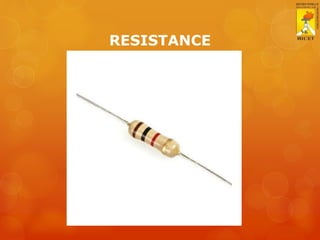
RESISTANCE
RESISTANCE
 Resistance (also known as ohmic resistance or electrical
resistance) is a measure of the opposition to current flow in an
electrical circuit. Resistance is measured in ohms, symbolized
by the Greek letter omega (Ω).
 When a voltage is applied across a substance there will be
an electric current through it.
 The applied voltage across the substance is directly
proportional to the current through it.
 The constant of proportionality is resistance. Hence resistance
is defined as the ratio of the applied voltage to the current
through the substance.Where V is voltage, I is current and R is
resistance.
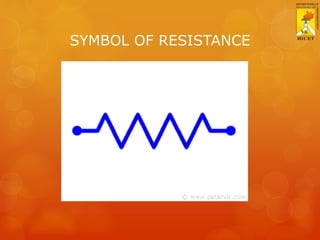
SYMBOL OF RESISTANCE
RELATIONSHIP BETWEEN
VOLTAGE, CURRENT AND
RESISTANCE
FOR BETTER UNDERSTANDING…
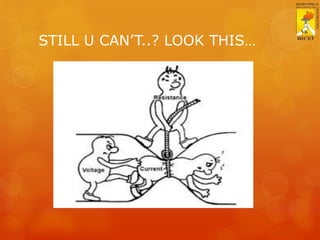
STILL U CAN’T..? LOOK THIS…
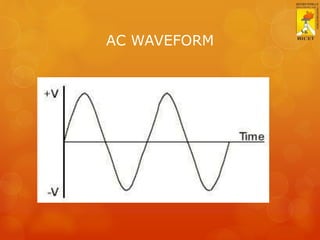
AC WAVEFORM
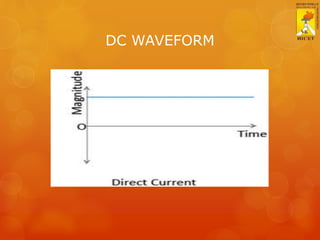
DC WAVEFORM
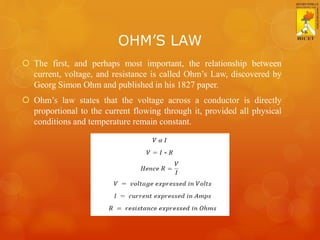
OHM’S LAW
 The first, and perhaps most important, the relationship between
current, voltage, and resistance is called Ohm’s Law, discovered by
Georg Simon Ohm and published in his 1827 paper.
 Ohm’s law states that the voltage across a conductor is directly
proportional to the current flowing through it, provided all physical
conditions and temperature remain constant.
THANK YOU

econtent1.pptx

  • 2.
    Basics of Electricity PRESENTEDBY GOBINATH K ASSISTANT PROFESSOR DEPARTMENT OF BIOMEDICAL ENGINEERING HINDUSTHAN COLLEGE OF ENGINEERING AND TECHNOLOGY COIMBATORE
  • 5.
  • 6.
    VOLTAGE  Voltage, alsocalled electromotive force, is a quantitative expression of the potential difference in charge between two points in an electrical field.  The greater the voltage, the greater the flow of electrical current (that is, the quantity of charge carriers that pass a fixed point per unit of time) through a conducting or semiconducting medium for a given resistance to the flow.  Voltage is symbolized by an uppercase italic letter V or E. The standard unit is the volt, symbolized by a non-italic uppercase letter V.  One volt will drive one coulomb (6.24 x 10¹⁸) charge carriers, such as electrons, through a resistance of one ohm in one second.
  • 7.
    TYPE THE STANDARDVALUE OF VOLTAGE FOR SINGLE PHASE AC SUPPLY WE ARE GETTING FOR OUR HOME FROM ELECTRICITY BOARD IN COMMENT BOX NOW ?????
  • 9.
  • 10.
    CURRENT  The electriccurrent is the rate of flow of electric charge through a conducting medium with respect to time.  When there is a potential difference between two points in a conductive medium, electric charge starts flowing from the higher potential point to the lower potential point to balance the charge distribution between the points.  The rate of flow of charge in respect of time is known as electric current.  If q Coulomb electric charge gets transferred between these two points in time t sec, then the current can be calculated as q/t
  • 11.
  • 12.
    RESISTANCE  Resistance (alsoknown as ohmic resistance or electrical resistance) is a measure of the opposition to current flow in an electrical circuit. Resistance is measured in ohms, symbolized by the Greek letter omega (Ω).  When a voltage is applied across a substance there will be an electric current through it.  The applied voltage across the substance is directly proportional to the current through it.  The constant of proportionality is resistance. Hence resistance is defined as the ratio of the applied voltage to the current through the substance.Where V is voltage, I is current and R is resistance.
  • 13.
  • 14.
  • 15.
  • 16.
    STILL U CAN’T..?LOOK THIS…
  • 17.
  • 18.
  • 19.
    OHM’S LAW  Thefirst, and perhaps most important, the relationship between current, voltage, and resistance is called Ohm’s Law, discovered by Georg Simon Ohm and published in his 1827 paper.  Ohm’s law states that the voltage across a conductor is directly proportional to the current flowing through it, provided all physical conditions and temperature remain constant.
  • 20.