Motion
Motion
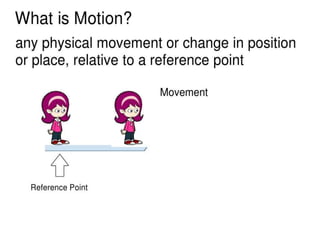
The change of position of
an object with respect to
time.
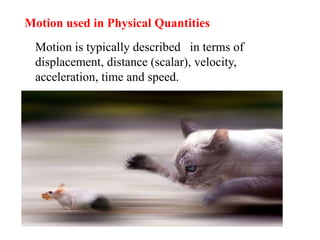
Motion used in Physical Quantities
Motion is typically described in terms of
displacement, distance (scalar), velocity,
acceleration, time and speed.
Motion in One Dimension
When a body moves along a straight line
path
It is also called as Rectilinear Motion
Ex: An ant moving in straight line, running
athlete
Motion In Two Dimensional
If a body moves along a Curved Path.
It is also called as Curvilinear Motion
Ex: throwing paper airplanes, a body
moving in a plane
Motion In Three Dimensional
The position of body change => If a body moves
in space;
It is also called as Random Motion
Ex: motion of a flying bird, kite in the sky,
molecule, etc…,
Motion in one Dimension
The important parameters required to study
the motion along a straight line are position,
displacement, velocity, acceleration.
The motion of a particle can be described
if its position is known continuously with
respect to time.
Distance
The Length of the path traversed
by a body is called travelled by it.
The path may not be straight.
Displacement
The Shortest distance from
the initial to the final position of
the body is called the magnitude
of displacement.
Distance Displacement
1.”How much ground an object has
covered” during its motion
1.”Howfar out of place an object is”;
It is the objects overall change in
position.
2.It is Scalar Quantity i.e it only has the
magnitude.
2. 2.It is Vector Quantity i.e it has both
the magnitude and direction.
3.It depends on path 3. It does not depend on the path
4.It is always positive 4. It can be Positive or Negative
depending on direction.
5. The length of the path between two
objects.
5. The total length of the path is the
distance travelled by the particle and the
Shortest distance between the initial and
final position of the particle.
Vector
The Vector quantities have both
magnitude and direction.
Ex: acceleration , force , displacement ,
velocity, weight, momentum, etc…
Scalar
The Scalar quantities have magnitude
only
It is denoted by a number and unit.
Ex: pressure, length, mass, time, speed,
work, energy, temperature, etc…
Speed
The Speed Of a body is the rate of change
of distance with time.
It is scalar quantity. It is represented by the
letter u & v.
Speed = Distance / Time
The S.I unit of Speed is m/s
Velocity
The Velocity of a body is the distance travelled per
second by the body in a specific direction.
It is a vector quantity.
Velocity = displacement / time
The S.I unit of Velocity is m / s
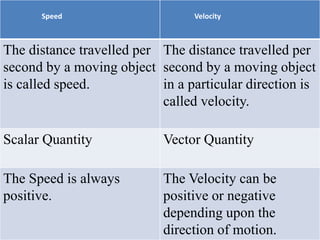
Speed Velocity
The distance travelled per
second by a moving object
is called speed.
The distance travelled per
second by a moving object
in a particular direction is
called velocity.
Scalar Quantity Vector Quantity
The Speed is always
positive.
The Velocity can be
positive or negative
depending upon the
direction of motion.
Acceleration
The rate of change of change of velocity
with time.
Acceleration = Velocity / Time
It is Vector quantity; Represented by the
symbol a
Retardation
If the velocity decreases with time,
the acceleration is negative . The negative
acceleration is called retardation or deceleration.
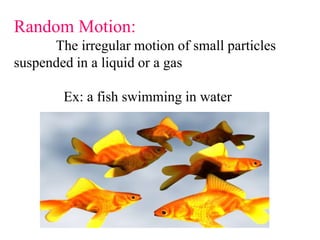
Random Motion:
The irregular motion of small particles
suspended in a liquid or a gas
Ex: a fish swimming in water
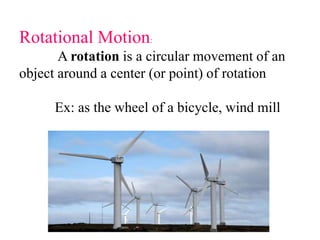
Rotational Motion:
A rotation is a circular movement of an
object around a center (or point) of rotation
Ex: as the wheel of a bicycle, wind mill
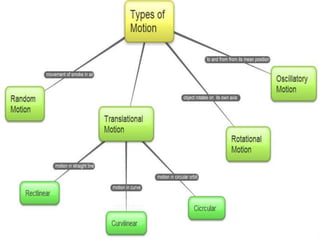
Rectilinear Motion:
Ex: when a body moves in a straight
line path
Curvilinear Motion:
Ex: throwing paper airplanes
Circular Motion:
Ex: the orbits of planets
Uniform Motion
The object covers equal distances in equal intervals of
time is called uniform motion.
Non - Uniform Motion
The object covers unequal distances in equal
intervals of time is called uniform motion.
Ex: when a car is moving in a traffic
Equation of Motion
When an object moves along a straight line
with uniform acceleration, it is possible to relate its
velocity, acceleration during motion and the
distance covered by it in a certain time interval by a
set of equations known as the Equations of motion.
Equation for Velocity – Time Relation
Acceleration = change in velocity / time
a= v-u / t
at= v-u
v= u + at
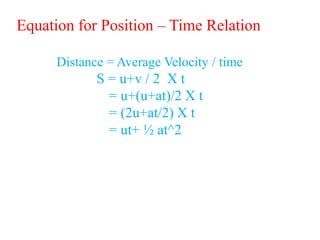
Equation for Position – Time Relation
Distance = Average Velocity / time
S = u+v / 2 X t
= u+(u+at)/2 X t
= (2u+at/2) X t
= ut+ ½ at^2
Equation for Position - Velocity Relation
Distance = Average Velocity X time
s = u+v / 2 X t
s = u+v / 2 X v-u / a
= v^2 –u^2 / 2a
2as = v^2 – u^2
v^2 = u^2 + 2as
PROBLEMS
1.A train moving with uniform speed covers a distance of 120m
in 2 s. Calculate i) the speed of the train ii) the time it will take
to cover 240 m.
2. Find the distance travelled by a body in 5 mins if it travels
with a uniform speed of 20 m/s.
3. Express the speed 36 km / h in m / s
4. The velocity of an object increases at a constant rate from 20
m/s to 50 m/s in 10 s. Find the acceleration.
5. A pebble thrown vertically upwards with an initial velocity
50 m/s comes to a stop in 5s. Find the retardation.
Uniform Circular Motion :
When an object moves in a circular path with
uniform speed, its motion is called Uniform
Circular Motion.
Thank You

Motion

  • 1.
  • 3.
    Motion The change ofposition of an object with respect to time.
  • 4.
    Motion used inPhysical Quantities Motion is typically described in terms of displacement, distance (scalar), velocity, acceleration, time and speed.
  • 6.
    Motion in OneDimension When a body moves along a straight line path It is also called as Rectilinear Motion Ex: An ant moving in straight line, running athlete
  • 7.
    Motion In TwoDimensional If a body moves along a Curved Path. It is also called as Curvilinear Motion Ex: throwing paper airplanes, a body moving in a plane
  • 8.
    Motion In ThreeDimensional The position of body change => If a body moves in space; It is also called as Random Motion Ex: motion of a flying bird, kite in the sky, molecule, etc…,
  • 9.
    Motion in oneDimension The important parameters required to study the motion along a straight line are position, displacement, velocity, acceleration. The motion of a particle can be described if its position is known continuously with respect to time.
  • 10.
    Distance The Length ofthe path traversed by a body is called travelled by it. The path may not be straight.
  • 11.
    Displacement The Shortest distancefrom the initial to the final position of the body is called the magnitude of displacement.
  • 12.
    Distance Displacement 1.”How muchground an object has covered” during its motion 1.”Howfar out of place an object is”; It is the objects overall change in position. 2.It is Scalar Quantity i.e it only has the magnitude. 2. 2.It is Vector Quantity i.e it has both the magnitude and direction. 3.It depends on path 3. It does not depend on the path 4.It is always positive 4. It can be Positive or Negative depending on direction. 5. The length of the path between two objects. 5. The total length of the path is the distance travelled by the particle and the Shortest distance between the initial and final position of the particle.
  • 13.
    Vector The Vector quantitieshave both magnitude and direction. Ex: acceleration , force , displacement , velocity, weight, momentum, etc…
  • 14.
    Scalar The Scalar quantitieshave magnitude only It is denoted by a number and unit. Ex: pressure, length, mass, time, speed, work, energy, temperature, etc…
  • 15.
    Speed The Speed Ofa body is the rate of change of distance with time. It is scalar quantity. It is represented by the letter u & v. Speed = Distance / Time The S.I unit of Speed is m/s
  • 16.
    Velocity The Velocity ofa body is the distance travelled per second by the body in a specific direction. It is a vector quantity. Velocity = displacement / time The S.I unit of Velocity is m / s
  • 17.
    Speed Velocity The distancetravelled per second by a moving object is called speed. The distance travelled per second by a moving object in a particular direction is called velocity. Scalar Quantity Vector Quantity The Speed is always positive. The Velocity can be positive or negative depending upon the direction of motion.
  • 18.
    Acceleration The rate ofchange of change of velocity with time. Acceleration = Velocity / Time It is Vector quantity; Represented by the symbol a
  • 19.
    Retardation If the velocitydecreases with time, the acceleration is negative . The negative acceleration is called retardation or deceleration.
  • 22.
    Random Motion: The irregularmotion of small particles suspended in a liquid or a gas Ex: a fish swimming in water
  • 23.
    Rotational Motion: A rotationis a circular movement of an object around a center (or point) of rotation Ex: as the wheel of a bicycle, wind mill
  • 25.
    Rectilinear Motion: Ex: whena body moves in a straight line path Curvilinear Motion: Ex: throwing paper airplanes Circular Motion: Ex: the orbits of planets
  • 27.
    Uniform Motion The objectcovers equal distances in equal intervals of time is called uniform motion.
  • 28.
    Non - UniformMotion The object covers unequal distances in equal intervals of time is called uniform motion. Ex: when a car is moving in a traffic
  • 29.
    Equation of Motion Whenan object moves along a straight line with uniform acceleration, it is possible to relate its velocity, acceleration during motion and the distance covered by it in a certain time interval by a set of equations known as the Equations of motion.
  • 30.
    Equation for Velocity– Time Relation Acceleration = change in velocity / time a= v-u / t at= v-u v= u + at
  • 31.
    Equation for Position– Time Relation Distance = Average Velocity / time S = u+v / 2 X t = u+(u+at)/2 X t = (2u+at/2) X t = ut+ ½ at^2
  • 32.
    Equation for Position- Velocity Relation Distance = Average Velocity X time s = u+v / 2 X t s = u+v / 2 X v-u / a = v^2 –u^2 / 2a 2as = v^2 – u^2 v^2 = u^2 + 2as
  • 33.
    PROBLEMS 1.A train movingwith uniform speed covers a distance of 120m in 2 s. Calculate i) the speed of the train ii) the time it will take to cover 240 m. 2. Find the distance travelled by a body in 5 mins if it travels with a uniform speed of 20 m/s. 3. Express the speed 36 km / h in m / s 4. The velocity of an object increases at a constant rate from 20 m/s to 50 m/s in 10 s. Find the acceleration. 5. A pebble thrown vertically upwards with an initial velocity 50 m/s comes to a stop in 5s. Find the retardation.
  • 34.
    Uniform Circular Motion: When an object moves in a circular path with uniform speed, its motion is called Uniform Circular Motion.
  • 35.