VOLTAGE
WHAT IS VOLTAGE?
• Voltage is the pressure from an electrical circuit's power source that
pushes charged electrons (current) through a conducting loop, enabling them
to do work such as illuminating a light.
• It provided by an energy source such as a battery, is what causes current to
flow.
• In brief, voltage = pressure, and it is measured in volts (V).
• The term recognizes Italian physicist Alessandro Volta (1745-1827), inventor
of the voltaic pile—the forerunner of today's household battery.
WHAT IS VOLTAGE?
• During early days of electricity, Voltage was known as Electromotive Force
(emf). This is why in early formulas as Ohm’s Law, voltage is represented by
the symbol E. In modern days, it is represented by the symbol “V” or “E“.
• The greater the amount of charge and the greater the physical separation, the
greater the voltage or stored energy. The greater the voltage, the greater the
force that is driving the charges together.
• We use voltmeter to measure the electric potential in volts.
ALESSANDRO VOLTA (1745 – 1827)
• Alessandro Volta was a physicist, chemist and a pioneer of electrical science.
He is most famous for his invention of the electric battery.
• • Discovered “contact electricity” resulting from contact between different
metals.
• Wrote the first electromotive series.
• In recognition of Alessandro Volta’s contributions to science, the unit of
electric potential is called the volt.
EXAMPLE OF
VOLTAGE
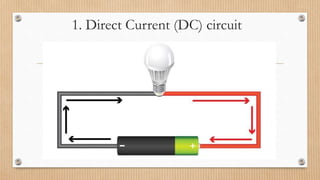
1. Direct Current (DC) circuit
DIRECT CURRENT CIRCUIT
• Travels in a straight line, and in one direction only.
• Commonly produced by sources of stored energy such as batteries.
• Sources of dc voltage have positive and negative terminals. Terminals
establish polarity in a circuit, and polarity can be used to determine if a
circuit is dc or ac.
• Commonly used in battery-powered portable equipment
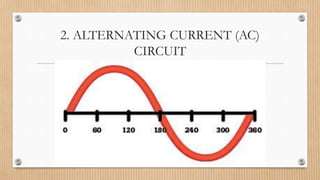
2. ALTERNATING CURRENT (AC)
CIRCUIT
ALTERNATING CURRENT (AC) CIRCUIT
• Reverses direction at regular intervals.
• Commonly produced by utilities via generators, where mechanical energy—
rotating motion powered by flowing water, steam, wind or heat—is
converted to electrical energy.
• More than dc voltage. Utilities deliver ac voltage to homes and businesses
where the majority of devices use ac voltage.
WHAT IS THE
DIFFERENCE
BETWEEN VOLTAGE
AND CURRENT?
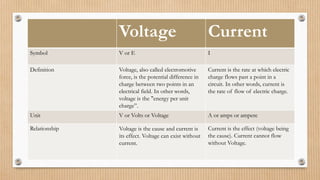
Voltage Current
Symbol V or E I
Definition Voltage, also called electromotive
force, is the potential difference in
charge between two points in an
electrical field. In other words,
voltage is the "energy per unit
charge”.
Current is the rate at which electric
charge flows past a point in a
circuit. In other words, current is
the rate of flow of electric charge.
Unit V or Volts or Voltage A or amps or ampere
Relationship Voltage is the cause and current is
its effect. Voltage can exist without
current.
Current is the effect (voltage being
the cause). Current cannot flow
without Voltage.
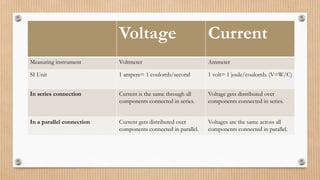
Voltage Current
Measuring instrument Voltmeter Ammeter
SI Unit 1 ampere= 1 coulomb/second 1 volt= 1 joule/coulomb. (V=W/C)
In series connection Current is the same through all
components connected in series.
Voltage gets distributed over
components connected in series.
In a parallel connection Current gets distributed over
components connected in parallel.
Voltages are the same across all
components connected in parallel.
SAMPLE PROBLEM
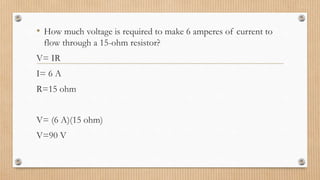
• How much voltage is required to make 6 amperes of current to
flow through a 15-ohm resistor?
V= IR
I= 6 A
R=15 ohm
V= (6 A)(15 ohm)
V=90 V
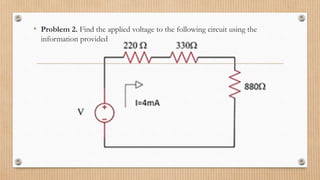
• Problem 2. Find the applied voltage to the following circuit using the
information provided
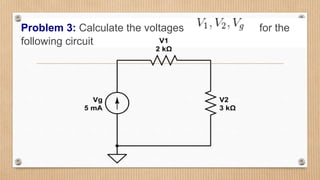
Problem 3: Calculate the voltages for the
following circuit.
CURRENT
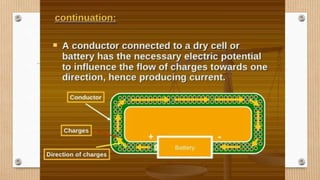
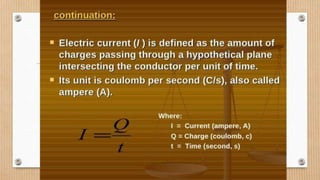
ELECTRIC CURRENT• Electric current is the continuous flow of
electric charge.
• Two types of current are alternating and
direct current.
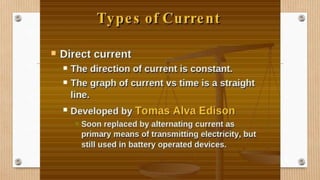
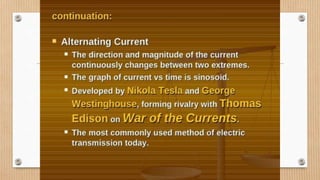
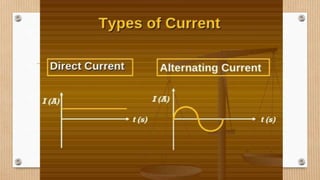
• Direct current is when a charge flows In one
direction
• Alternating current is when the flow of
electric charge regularly reverses direction
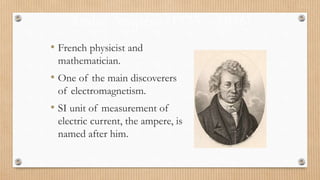
André Ampère (1775 – 1836)
• French physicist and
mathematician.
• One of the main discoverers
of electromagnetism.
• SI unit of measurement of
electric current, the ampere, is
named after him.
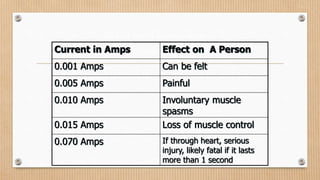
What level of current is
dangerous to people?Current in Amps Effect on A Person
0.001 Amps Can be felt
0.005 Amps Painful
0.010 Amps Involuntary muscle
spasms
0.015 Amps Loss of muscle control
0.070 Amps If through heart, serious
injury, likely fatal if it lasts
more than 1 second
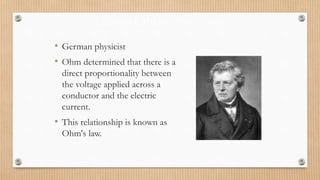
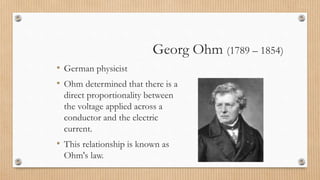
Georg Ohm (1789 – 1854)
• German physicist
• Ohm determined that there is a
direct proportionality between
the voltage applied across a
conductor and the electric
current.
• This relationship is known as
Ohm's law.
Voltage and Current• If the voltage in a circuit increases, the current
will increase.
• If the voltage in a circuit decreases, the current
will decrease.
• This is a direct/proportional relationship.
Resistance and Current• If the resistance in a circuit increases, the
current will decrease.
• If the resistance in a circuit decreases, the
current will increase.
• This is an inversely proportional
relationship.
Ohm’s Law• State the relationship between current, voltage,
and resistance.
• German physicist George Ohm had the law
named after him, because of his extensive
research.
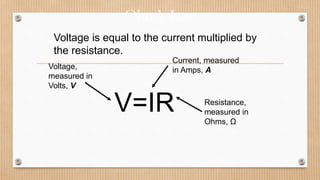
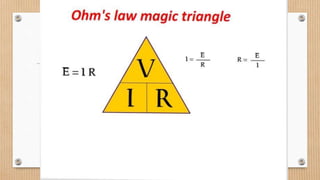
V=IR
Ohm’s Law
Voltage is equal to the current multiplied by
the resistance.
Voltage,
measured in
Volts, V
Current, measured
in Amps, A
Resistance,
measured in
Ohms, Ω
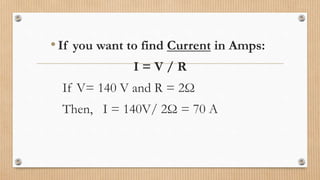
Examples…•If you want to find Current in Amps:
I = V / R
If V= 140 V and R = 2Ω
Then, I = 140V/ 2Ω = 70 A
Resistance
By Jillian Guadana
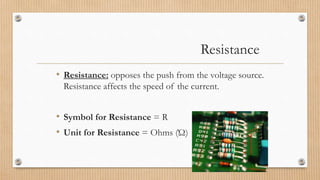
Resistance
• Resistance: opposes the push from the voltage source.
Resistance affects the speed of the current.
• Symbol for Resistance = R
• Unit for Resistance = Ohms (Ώ)
Georg Ohm (1789 – 1854)
• German physicist
• Ohm determined that there is a
direct proportionality between
the voltage applied across a
conductor and the electric
current.
• This relationship is known as
Ohm's law.
All materials resist current flow to some degree.
They fall into one of two broad categories:
• Conductors: Materials that offer very little resistance where
electrons can move easily. Examples: silver, copper, gold and
aluminum.
• Insulators: Materials that present high resistance and restrict the
flow of electrons. Examples: Rubber, paper, glass, wood and
plastic.
"Resistance" may sound negative, but in
electricity it can be used beneficially.
Examples: Current must struggle to flow
through the small coils of a toaster, enough to
generate heat that browns bread. Old-style
incandescent light bulbs force current to flow
through filaments so thin that light is
generated.
Ohm’s Law
• State the relationship between current, voltage,
and resistance.
• German physicist George Ohm had the law
named after him, because of his extensive
research.
Resistance and Current
• If the resistance in a circuit increases, the
current will decrease.
• If the resistance in a circuit decreases, the
current will increase.
• This is an inversely proportional
relationship.
• The lower the resistance, the higher the current
flow. Possible causes: insulators damaged by
moisture or overheating.
• The higher the resistance, the lower the current
flow. If abnormally high, one possible cause
(among many) could be damaged conductors due
to burning or corrosion. All conductors give off
some degree of heat, so overheating is an issue
often associated with resistance.
Examples…
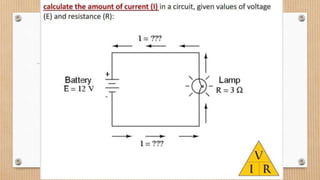
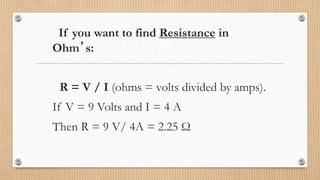
If you want to find Resistance in
Ohm’s:
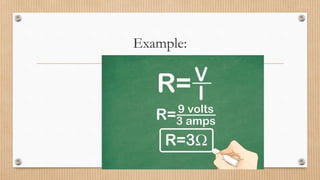
R = V / I (ohms = volts divided by amps).
If V = 9 Volts and I = 4 A
Then R = 9 V/ 4A = 2.25 Ω
Example:

ELECTRONICS 10: VOLTAGE

  • 1.
  • 2.
    WHAT IS VOLTAGE? •Voltage is the pressure from an electrical circuit's power source that pushes charged electrons (current) through a conducting loop, enabling them to do work such as illuminating a light. • It provided by an energy source such as a battery, is what causes current to flow. • In brief, voltage = pressure, and it is measured in volts (V). • The term recognizes Italian physicist Alessandro Volta (1745-1827), inventor of the voltaic pile—the forerunner of today's household battery.
  • 3.
    WHAT IS VOLTAGE? •During early days of electricity, Voltage was known as Electromotive Force (emf). This is why in early formulas as Ohm’s Law, voltage is represented by the symbol E. In modern days, it is represented by the symbol “V” or “E“. • The greater the amount of charge and the greater the physical separation, the greater the voltage or stored energy. The greater the voltage, the greater the force that is driving the charges together. • We use voltmeter to measure the electric potential in volts.
  • 4.
    ALESSANDRO VOLTA (1745– 1827) • Alessandro Volta was a physicist, chemist and a pioneer of electrical science. He is most famous for his invention of the electric battery. • • Discovered “contact electricity” resulting from contact between different metals. • Wrote the first electromotive series. • In recognition of Alessandro Volta’s contributions to science, the unit of electric potential is called the volt.
  • 5.
  • 6.
    1. Direct Current(DC) circuit
  • 7.
    DIRECT CURRENT CIRCUIT •Travels in a straight line, and in one direction only. • Commonly produced by sources of stored energy such as batteries. • Sources of dc voltage have positive and negative terminals. Terminals establish polarity in a circuit, and polarity can be used to determine if a circuit is dc or ac. • Commonly used in battery-powered portable equipment
  • 8.
  • 9.
    ALTERNATING CURRENT (AC)CIRCUIT • Reverses direction at regular intervals. • Commonly produced by utilities via generators, where mechanical energy— rotating motion powered by flowing water, steam, wind or heat—is converted to electrical energy. • More than dc voltage. Utilities deliver ac voltage to homes and businesses where the majority of devices use ac voltage.
  • 10.
    WHAT IS THE DIFFERENCE BETWEENVOLTAGE AND CURRENT?
  • 11.
    Voltage Current Symbol Vor E I Definition Voltage, also called electromotive force, is the potential difference in charge between two points in an electrical field. In other words, voltage is the "energy per unit charge”. Current is the rate at which electric charge flows past a point in a circuit. In other words, current is the rate of flow of electric charge. Unit V or Volts or Voltage A or amps or ampere Relationship Voltage is the cause and current is its effect. Voltage can exist without current. Current is the effect (voltage being the cause). Current cannot flow without Voltage.
  • 12.
    Voltage Current Measuring instrumentVoltmeter Ammeter SI Unit 1 ampere= 1 coulomb/second 1 volt= 1 joule/coulomb. (V=W/C) In series connection Current is the same through all components connected in series. Voltage gets distributed over components connected in series. In a parallel connection Current gets distributed over components connected in parallel. Voltages are the same across all components connected in parallel.
  • 13.
  • 14.
    • How muchvoltage is required to make 6 amperes of current to flow through a 15-ohm resistor? V= IR I= 6 A R=15 ohm V= (6 A)(15 ohm) V=90 V
  • 15.
    • Problem 2.Find the applied voltage to the following circuit using the information provided
  • 16.
    Problem 3: Calculatethe voltages for the following circuit.
  • 17.
  • 19.
    ELECTRIC CURRENT• Electriccurrent is the continuous flow of electric charge. • Two types of current are alternating and direct current. • Direct current is when a charge flows In one direction • Alternating current is when the flow of electric charge regularly reverses direction
  • 28.
    André Ampère (1775– 1836) • French physicist and mathematician. • One of the main discoverers of electromagnetism. • SI unit of measurement of electric current, the ampere, is named after him.
  • 29.
    What level ofcurrent is dangerous to people?Current in Amps Effect on A Person 0.001 Amps Can be felt 0.005 Amps Painful 0.010 Amps Involuntary muscle spasms 0.015 Amps Loss of muscle control 0.070 Amps If through heart, serious injury, likely fatal if it lasts more than 1 second
  • 30.
    Georg Ohm (1789– 1854) • German physicist • Ohm determined that there is a direct proportionality between the voltage applied across a conductor and the electric current. • This relationship is known as Ohm's law.
  • 31.
    Voltage and Current•If the voltage in a circuit increases, the current will increase. • If the voltage in a circuit decreases, the current will decrease. • This is a direct/proportional relationship.
  • 32.
    Resistance and Current•If the resistance in a circuit increases, the current will decrease. • If the resistance in a circuit decreases, the current will increase. • This is an inversely proportional relationship.
  • 33.
    Ohm’s Law• Statethe relationship between current, voltage, and resistance. • German physicist George Ohm had the law named after him, because of his extensive research.
  • 34.
    V=IR Ohm’s Law Voltage isequal to the current multiplied by the resistance. Voltage, measured in Volts, V Current, measured in Amps, A Resistance, measured in Ohms, Ω
  • 35.
    Examples…•If you wantto find Current in Amps: I = V / R If V= 140 V and R = 2Ω Then, I = 140V/ 2Ω = 70 A
  • 41.
  • 42.
    Resistance • Resistance: opposesthe push from the voltage source. Resistance affects the speed of the current. • Symbol for Resistance = R • Unit for Resistance = Ohms (Ώ)
  • 43.
    Georg Ohm (1789– 1854) • German physicist • Ohm determined that there is a direct proportionality between the voltage applied across a conductor and the electric current. • This relationship is known as Ohm's law.
  • 44.
    All materials resistcurrent flow to some degree. They fall into one of two broad categories: • Conductors: Materials that offer very little resistance where electrons can move easily. Examples: silver, copper, gold and aluminum. • Insulators: Materials that present high resistance and restrict the flow of electrons. Examples: Rubber, paper, glass, wood and plastic.
  • 45.
    "Resistance" may soundnegative, but in electricity it can be used beneficially. Examples: Current must struggle to flow through the small coils of a toaster, enough to generate heat that browns bread. Old-style incandescent light bulbs force current to flow through filaments so thin that light is generated.
  • 46.
    Ohm’s Law • Statethe relationship between current, voltage, and resistance. • German physicist George Ohm had the law named after him, because of his extensive research.
  • 47.
    Resistance and Current •If the resistance in a circuit increases, the current will decrease. • If the resistance in a circuit decreases, the current will increase. • This is an inversely proportional relationship.
  • 48.
    • The lowerthe resistance, the higher the current flow. Possible causes: insulators damaged by moisture or overheating. • The higher the resistance, the lower the current flow. If abnormally high, one possible cause (among many) could be damaged conductors due to burning or corrosion. All conductors give off some degree of heat, so overheating is an issue often associated with resistance.
  • 49.
    Examples… If you wantto find Resistance in Ohm’s: R = V / I (ohms = volts divided by amps). If V = 9 Volts and I = 4 A Then R = 9 V/ 4A = 2.25 Ω
  • 50.

Editor's Notes

  • #5 Invented the first electric battery – which people then called the “voltaic pile” – in 1800. Using his invention, scientists were able to produce steady flows of electric current for the first time, unleashing a wave of new discoveries and technologies. This showed, from highest to lowest, the voltages that different metals can produce in a battery.
  • #7 In this dc circuit, the switch is closed (turned ON). Voltage in the power source—the "potential difference" between the battery's two poles—is activated, creating pressure that forces electrons to flow as current out the battery's negative terminal. Current reaches the light, causing it to glow. Current returns to the power source.