Guided By: Presented By:
Prof. Prashant G. Ahire Miss.Poonam Kshirsagar
Roll No. 204
A SURVEY OF CLUSTERING
TECHNIQUES
FOR BIG DATA ANALYSIS
Agenda
 Problem Definition
 Objective
Literature Survey
 Big Data and it’s Analytics Challenges
 Cluster
 Criterion To Benchmark Clustering Methods
 Proposed System
 ELM
 ELM Feature Mapping Process
 ELM K-mean Algorithm
 Advantages
 Disadvantages
 Conclusion
Problem Definition:
Among various challenges in analyzing big data the major issue
is to design and develop the new techniques for clustering.
Cloud computing can be used for big data analysis but there is
problem to analyze data on cloud environment as many traditional
algorithms cannot be applied directly on cloud environment and
also there is an issue of applying scalability on traditional
algorithms, delay in result produced and accuracy of result
produced.
 These issues can be addressed by clustering techniques.
Objectives:
The objectives of the thesis are as follows:
To study the existing clustering techniques for analyzing big data.
 To propose and design an efficient clustering technique for big
data analysis.
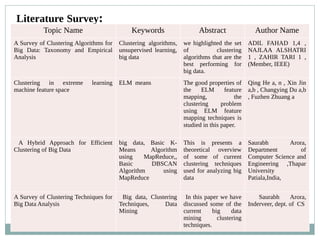
Literature Survey:
Topic Name Keywords Abstract Author Name
A Survey of Clustering Algorithms for
Big Data: Taxonomy and Empirical
Analysis
Clustering algorithms,
unsupervised learning,
big data
we highlighted the set
of clustering
algorithms that are the
best performing for
big data.
ADIL FAHAD 1,4 ,
NAJLAA ALSHATRI
1 , ZAHIR TARI 1 ,
(Member, IEEE)
Clustering in extreme learning
machine feature space
ELM means The good properties of
the ELM feature
mapping, the
clustering problem
using ELM feature
mapping techniques is
studied in this paper.
Qing He a, n , Xin Jin
a,b , Changying Du a,b
, Fuzhen Zhuang a
A Hybrid Approach for Efficient
Clustering of Big Data
big data, Basic K-
Means Algorithm
using MapReduce,,
Basic DBSCAN
Algorithm using
MapReduce
This is presents a
theoretical overview
of some of current
clustering techniques
used for analyzing big
data
Saurabh Arora,
Department of
Computer Science and
Engineering ,Thapar
University
Patiala,India,
A Survey of Clustering Techniques for
Big Data Analysis
Big data, Clustering
Techniques, Data
Mining
In this paper we have
discussed some of the
current big data
mining clustering
techniques.
Saurabh Arora,
Inderveer, dept. of CS
What is Big data ?
Big Data means data that’s too big, too fast , or too hard for
existing tools to process.
 Too big : Peta byte-scale collection of data.
 Too fast: Processed quickly.
 Too hard: It is a catch all for data that doesn’t fit neatly
into an existing processing tools.
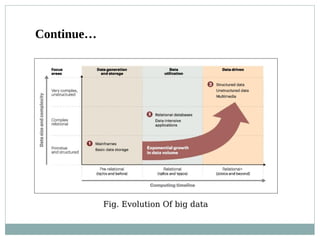
Fig. Evolution Of big data
Continue…
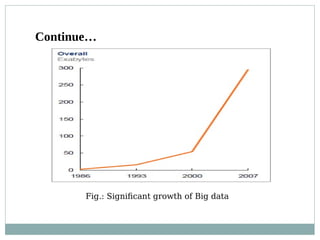
Fig.: Significant growth of Big data
Continue…
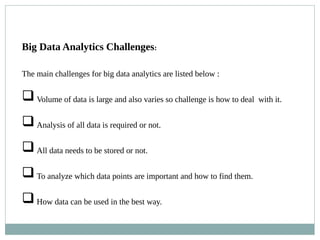
Big Data Analytics Challenges:
The main challenges for big data analytics are listed below :
Volume of data is large and also varies so challenge is how to deal with it.
Analysis of all data is required or not.
All data needs to be stored or not.
To analyze which data points are important and how to find them.
How data can be used in the best way.
What is Cluster ?
 Clustering is a division of data into groups of similar objects.
Each group, called cluster.
 Cluster consists of objects that are similar between themselves
and dissimilar to objects of other groups.
 It is one of the major techniques used for data mining.
Criterion To Benchmark Clustering Methods:
Volume : Refers large amount of data Criteria:
(i) Size of the dataset
(ii) Handling high dimensionality
(iii) Handling outliers/ noisy data
Velocity : Refers speed of processing data. Criteria :
(i) Complexity of algorithm
(ii) The run time performances
Variety: Refers to the ability to handle different types of data
(i) Type of dataset
(ii) Clusters shape.
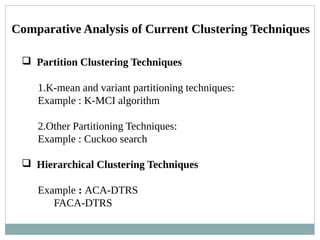
Comparative Analysis of Current Clustering Techniques
 Partition Clustering Techniques
1.K-mean and variant partitioning techniques:
Example : K-MCI algorithm
2.Other Partitioning Techniques:
Example : Cuckoo search
 Hierarchical Clustering Techniques
Example : ACA-DTRS
FACA-DTRS
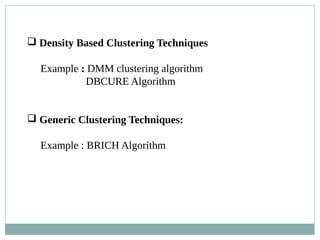
 Density Based Clustering Techniques
Example : DMM clustering algorithm
DBCURE Algorithm
 Generic Clustering Techniques:
Example : BRICH Algorithm
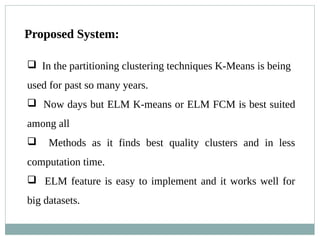
Proposed System:
 In the partitioning clustering techniques K-Means is being
used for past so many years.
 Now days but ELM K-means or ELM FCM is best suited
among all
 Methods as it finds best quality clusters and in less
computation time.
 ELM feature is easy to implement and it works well for
big datasets.
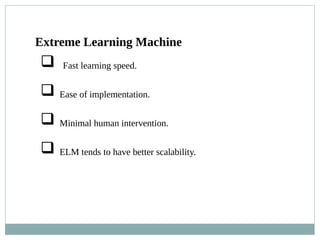
 Fast learning speed.
 Ease of implementation.
 Minimal human intervention.
 ELM tends to have better scalability.
Extreme Learning Machine
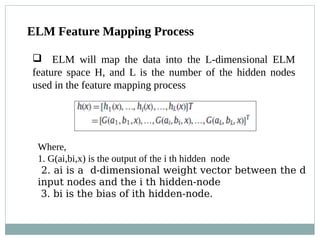
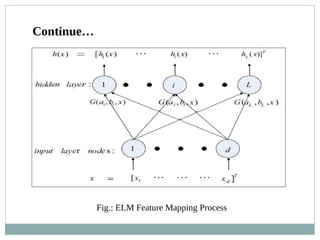
ELM Feature Mapping Process
Where,
1. G(ai,bi,x) is the output of the i th hidden node
2. ai is a d-dimensional weight vector between the d
input nodes and the i th hidden-node
3. bi is the bias of ith hidden-node.
 ELM will map the data into the L-dimensional ELM
feature space H, and L is the number of the hidden nodes
used in the feature mapping process
Fig.: ELM Feature Mapping Process
Continue…
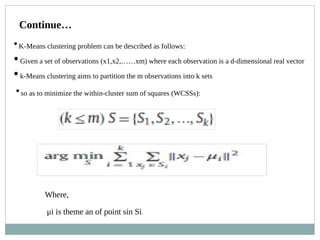
•K-Means clustering problem can be described as follows:
•Given a set of observations (x1,x2,……xm) where each observation is a d-dimensional real vector
•k-Means clustering aims to partition the m observations into k sets
•so as to minimize the within-cluster sum of squares (WCSSs):
Where,
μi is theme an of point sin Si.
Continue…
ELM k-Means algorithm
Input: k : the number of clusters,
L : the number of the hidden-layer nodes,
D : a data set containing m objects.
Output : A set of k clusters.
Method :
1: Mapping the original data object sin D into the ELM feature
space H using h(x)=[H1(x),….,hi(x),…hl(x)]T ;
2: Arbitrarily choose k objects from H as the initial cluster centres;
3: repeat
4: (Re) assign each object to the cluster to which the object is the most
similar , based on the mean value of the object sin the cluster;
5: Update the cluster means , i.e. , calculate the mean value of the
objects for each cluster;
6: until no change in the cluster centres or reached the maximal
iteration number limit.
7: return A set of k clusters.
Advantages:
 ELM features are easy to implement and ELM K-means
produce better results than Mercer kernel based methods.
 The mapping is very intuitive and straight
forward
Disadvantages
 Number of nodes should be greater than 300 else
performance is not optimal.
 After studying these techniques it is observed
that still new methodologies are required for
analyzing big data as these techniques could are
not so efficient for analyzing real time and online
streaming data
Conclusion:
we have studied various clustering techniques
which are currently used for analyzing big data. All
these recent techniques are compared on the basis of
execution time and cluster quality and their merits
and demerits are provided.
Current clustering techniques

Current clustering techniques

  • 1.
    Guided By: PresentedBy: Prof. Prashant G. Ahire Miss.Poonam Kshirsagar Roll No. 204 A SURVEY OF CLUSTERING TECHNIQUES FOR BIG DATA ANALYSIS
  • 2.
    Agenda  Problem Definition Objective Literature Survey  Big Data and it’s Analytics Challenges  Cluster  Criterion To Benchmark Clustering Methods  Proposed System  ELM  ELM Feature Mapping Process  ELM K-mean Algorithm  Advantages  Disadvantages  Conclusion
  • 3.
    Problem Definition: Among variouschallenges in analyzing big data the major issue is to design and develop the new techniques for clustering. Cloud computing can be used for big data analysis but there is problem to analyze data on cloud environment as many traditional algorithms cannot be applied directly on cloud environment and also there is an issue of applying scalability on traditional algorithms, delay in result produced and accuracy of result produced.  These issues can be addressed by clustering techniques.
  • 4.
    Objectives: The objectives ofthe thesis are as follows: To study the existing clustering techniques for analyzing big data.  To propose and design an efficient clustering technique for big data analysis.
  • 5.
    Literature Survey: Topic NameKeywords Abstract Author Name A Survey of Clustering Algorithms for Big Data: Taxonomy and Empirical Analysis Clustering algorithms, unsupervised learning, big data we highlighted the set of clustering algorithms that are the best performing for big data. ADIL FAHAD 1,4 , NAJLAA ALSHATRI 1 , ZAHIR TARI 1 , (Member, IEEE) Clustering in extreme learning machine feature space ELM means The good properties of the ELM feature mapping, the clustering problem using ELM feature mapping techniques is studied in this paper. Qing He a, n , Xin Jin a,b , Changying Du a,b , Fuzhen Zhuang a A Hybrid Approach for Efficient Clustering of Big Data big data, Basic K- Means Algorithm using MapReduce,, Basic DBSCAN Algorithm using MapReduce This is presents a theoretical overview of some of current clustering techniques used for analyzing big data Saurabh Arora, Department of Computer Science and Engineering ,Thapar University Patiala,India, A Survey of Clustering Techniques for Big Data Analysis Big data, Clustering Techniques, Data Mining In this paper we have discussed some of the current big data mining clustering techniques. Saurabh Arora, Inderveer, dept. of CS
  • 6.
    What is Bigdata ? Big Data means data that’s too big, too fast , or too hard for existing tools to process.  Too big : Peta byte-scale collection of data.  Too fast: Processed quickly.  Too hard: It is a catch all for data that doesn’t fit neatly into an existing processing tools.
  • 7.
    Fig. Evolution Ofbig data Continue…
  • 8.
    Fig.: Significant growthof Big data Continue…
  • 9.
    Big Data AnalyticsChallenges: The main challenges for big data analytics are listed below : Volume of data is large and also varies so challenge is how to deal with it. Analysis of all data is required or not. All data needs to be stored or not. To analyze which data points are important and how to find them. How data can be used in the best way.
  • 10.
    What is Cluster?  Clustering is a division of data into groups of similar objects. Each group, called cluster.  Cluster consists of objects that are similar between themselves and dissimilar to objects of other groups.  It is one of the major techniques used for data mining.
  • 11.
    Criterion To BenchmarkClustering Methods: Volume : Refers large amount of data Criteria: (i) Size of the dataset (ii) Handling high dimensionality (iii) Handling outliers/ noisy data Velocity : Refers speed of processing data. Criteria : (i) Complexity of algorithm (ii) The run time performances Variety: Refers to the ability to handle different types of data (i) Type of dataset (ii) Clusters shape.
  • 12.
    Comparative Analysis ofCurrent Clustering Techniques  Partition Clustering Techniques 1.K-mean and variant partitioning techniques: Example : K-MCI algorithm 2.Other Partitioning Techniques: Example : Cuckoo search  Hierarchical Clustering Techniques Example : ACA-DTRS FACA-DTRS
  • 13.
     Density BasedClustering Techniques Example : DMM clustering algorithm DBCURE Algorithm  Generic Clustering Techniques: Example : BRICH Algorithm
  • 14.
    Proposed System:  Inthe partitioning clustering techniques K-Means is being used for past so many years.  Now days but ELM K-means or ELM FCM is best suited among all  Methods as it finds best quality clusters and in less computation time.  ELM feature is easy to implement and it works well for big datasets.
  • 15.
     Fast learningspeed.  Ease of implementation.  Minimal human intervention.  ELM tends to have better scalability. Extreme Learning Machine
  • 16.
    ELM Feature MappingProcess Where, 1. G(ai,bi,x) is the output of the i th hidden node 2. ai is a d-dimensional weight vector between the d input nodes and the i th hidden-node 3. bi is the bias of ith hidden-node.  ELM will map the data into the L-dimensional ELM feature space H, and L is the number of the hidden nodes used in the feature mapping process
  • 17.
    Fig.: ELM FeatureMapping Process Continue…
  • 18.
    •K-Means clustering problemcan be described as follows: •Given a set of observations (x1,x2,……xm) where each observation is a d-dimensional real vector •k-Means clustering aims to partition the m observations into k sets •so as to minimize the within-cluster sum of squares (WCSSs): Where, μi is theme an of point sin Si. Continue…
  • 19.
    ELM k-Means algorithm Input:k : the number of clusters, L : the number of the hidden-layer nodes, D : a data set containing m objects. Output : A set of k clusters. Method : 1: Mapping the original data object sin D into the ELM feature space H using h(x)=[H1(x),….,hi(x),…hl(x)]T ; 2: Arbitrarily choose k objects from H as the initial cluster centres; 3: repeat 4: (Re) assign each object to the cluster to which the object is the most similar , based on the mean value of the object sin the cluster; 5: Update the cluster means , i.e. , calculate the mean value of the objects for each cluster; 6: until no change in the cluster centres or reached the maximal iteration number limit. 7: return A set of k clusters.
  • 20.
    Advantages:  ELM featuresare easy to implement and ELM K-means produce better results than Mercer kernel based methods.  The mapping is very intuitive and straight forward
  • 21.
    Disadvantages  Number ofnodes should be greater than 300 else performance is not optimal.  After studying these techniques it is observed that still new methodologies are required for analyzing big data as these techniques could are not so efficient for analyzing real time and online streaming data
  • 22.
    Conclusion: we have studiedvarious clustering techniques which are currently used for analyzing big data. All these recent techniques are compared on the basis of execution time and cluster quality and their merits and demerits are provided.