Assigned by Sir Inam
Prepared by Shahid
What is Culture??
 Definition:
The ideas, customs, and social
behavior of a particular people or society.
OR
Culture is the characteristics and
knowledge of a particular group of people,
having same language, religion, food,
social habits, music and arts.
What is communication
Definition:
The process through which people share
their message, information and idea’s.
 Message:
Information and meaning exchanged
during communication
 Encoding:
Process by which people select, imbed
messages in signals, and send signals to others
Communication
Signals:
Specific verbal language and nonverbal
behaviors that are encoded when message sent
Channels:
Sensory modalities by which signals sent and
messages retrieved
Decoding:
Process by which people receives signal from
encoder and translates those signals to meaningful
messages
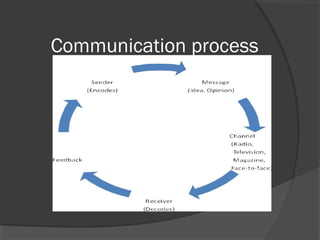
Communication process
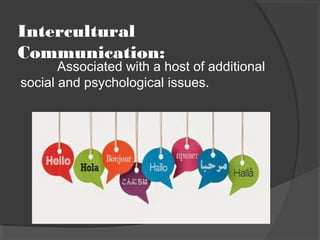
Intercultural
Communication:
Associated with a host of additional
social and psychological issues.
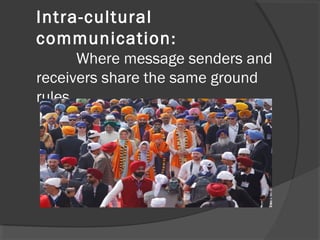
Intra-cultural
communication:
Where message senders and
receivers share the same ground
rules
Conflict
 Once we engage in intercultural
communication, some conflict and
misunderstanding is inevitable.
 Conflict arises when people’s behavior does
not confirm to our expectations.
 We tend to interpret such behaviors as
transgressions against our values.
CULTURAL INFLUENCES ONCULTURAL INFLUENCES ON
NONVERBALNONVERBAL
COMMUNICATIONCOMMUNICATION
 Nonverbal behaviors: all behaviors that occur
during communication that do not include
verbal language
 Nonverbal channels are more important in
understanding meaning and emotional states
of speakers than verbal language
 It is imperative to be most attentive to
nonverbal cues that occur in communication
The Functions of
Nonverbal Behaviors
 Nonverbal behaviors serve as symbol,
speech illustrators, conversation
regulators, and convey emotions.
INTRACULTURAL ANDINTRACULTURAL AND
INTERCULTURALINTERCULTURAL
COMMUNICATIONCOMMUNICATION
Intracultural
communication Communication between people of the
same cultural background
Interactants share same ground rules; they
encode and decode using the same cultural
codes
Can be negative because of expectations created
by cultural filters and ethnocentrism
We tend to read more than is intended
Intracultural
communication Communication between people of the
cross cultural background
Interactants do not share same ground rules;
they encode and decode using different cultural
codes
Can lead to
○ Uncertainty and ambiguity
○ Conflict
Barriers to Effective
Intercultural communication
1. Assumptions of similarities
2. Language differences
3. Nonverbal misinterpretations
4. Preconceptions and stereotypes
5. Tendency to evaluate
6. High anxiety or tension
Barriers
1. Assumptions of similarities
 communication is a uniquely human
trait shaped by culture.
 In fact, communication itself is a
product of culture, and cultures vary in
their assumptions of similarities.
Barriers
2. Language differences
 The use of words which may be highly
effective at conveying meaning within a
particular culture often communicate
unintended meanings across cultures.
Barriers
3. Nonverbal misinterpretations
 This is the single most frequent cause of
breakdowns in the communication
process across cultures.
4. Preconceptions and stereotypes
 These are natural and inevitable
psychological processes that have a
strong influence on our perceptions and
communications.
Barriers
5. Tendency to evaluate
 We make attributions about the behavior
of others based on our own cultural
values.
6. High anxiety or tension
 While some degree of anxiety may be
conducive to optimal performance, too
much anxiety or stress can lead to
dysfunctional thought processes and
behaviors.
Any Question
??
The End

Culture & Communication

  • 1.
    Assigned by SirInam Prepared by Shahid
  • 2.
    What is Culture?? Definition: The ideas, customs, and social behavior of a particular people or society. OR Culture is the characteristics and knowledge of a particular group of people, having same language, religion, food, social habits, music and arts.
  • 3.
    What is communication Definition: Theprocess through which people share their message, information and idea’s.  Message: Information and meaning exchanged during communication  Encoding: Process by which people select, imbed messages in signals, and send signals to others
  • 4.
    Communication Signals: Specific verbal languageand nonverbal behaviors that are encoded when message sent Channels: Sensory modalities by which signals sent and messages retrieved Decoding: Process by which people receives signal from encoder and translates those signals to meaningful messages
  • 5.
  • 6.
    Intercultural Communication: Associated with ahost of additional social and psychological issues.
  • 7.
    Intra-cultural communication: Where message sendersand receivers share the same ground rules
  • 8.
    Conflict  Once weengage in intercultural communication, some conflict and misunderstanding is inevitable.  Conflict arises when people’s behavior does not confirm to our expectations.  We tend to interpret such behaviors as transgressions against our values.
  • 9.
    CULTURAL INFLUENCES ONCULTURALINFLUENCES ON NONVERBALNONVERBAL COMMUNICATIONCOMMUNICATION
  • 10.
     Nonverbal behaviors:all behaviors that occur during communication that do not include verbal language  Nonverbal channels are more important in understanding meaning and emotional states of speakers than verbal language  It is imperative to be most attentive to nonverbal cues that occur in communication
  • 11.
    The Functions of NonverbalBehaviors  Nonverbal behaviors serve as symbol, speech illustrators, conversation regulators, and convey emotions.
  • 12.
  • 13.
    Intracultural communication Communication betweenpeople of the same cultural background Interactants share same ground rules; they encode and decode using the same cultural codes Can be negative because of expectations created by cultural filters and ethnocentrism We tend to read more than is intended
  • 14.
    Intracultural communication Communication betweenpeople of the cross cultural background Interactants do not share same ground rules; they encode and decode using different cultural codes Can lead to ○ Uncertainty and ambiguity ○ Conflict
  • 15.
    Barriers to Effective Interculturalcommunication 1. Assumptions of similarities 2. Language differences 3. Nonverbal misinterpretations 4. Preconceptions and stereotypes 5. Tendency to evaluate 6. High anxiety or tension
  • 16.
    Barriers 1. Assumptions ofsimilarities  communication is a uniquely human trait shaped by culture.  In fact, communication itself is a product of culture, and cultures vary in their assumptions of similarities.
  • 17.
    Barriers 2. Language differences The use of words which may be highly effective at conveying meaning within a particular culture often communicate unintended meanings across cultures.
  • 18.
    Barriers 3. Nonverbal misinterpretations This is the single most frequent cause of breakdowns in the communication process across cultures. 4. Preconceptions and stereotypes  These are natural and inevitable psychological processes that have a strong influence on our perceptions and communications.
  • 19.
    Barriers 5. Tendency toevaluate  We make attributions about the behavior of others based on our own cultural values. 6. High anxiety or tension  While some degree of anxiety may be conducive to optimal performance, too much anxiety or stress can lead to dysfunctional thought processes and behaviors.
  • 20.