Screenplay Format
Lecture #1
Tutor: Muhammad Rawaha Saleem
Company: ecHaaR Studio
Screenplay Format
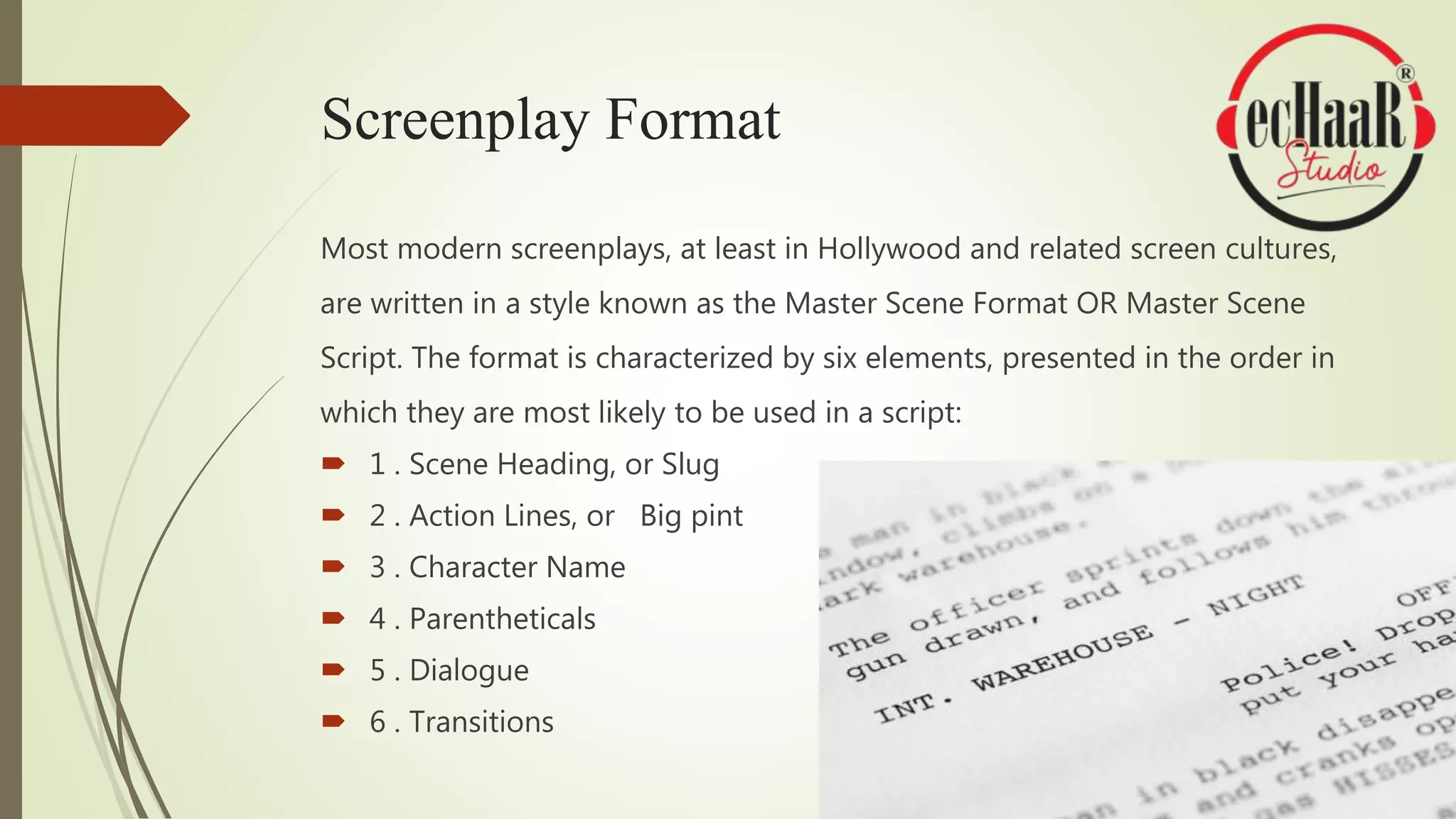
Most modern screenplays, at least in Hollywood and related screen cultures,
are written in a style known as the Master Scene Format OR Master Scene
Script. The format is characterized by six elements, presented in the order in
which they are most likely to be used in a script:
 1 . Scene Heading, or Slug
 2 . Action Lines, or Big pint
 3 . Character Name
 4 . Parentheticals
 5 . Dialogue
 6 . Transitions
Screenplay Format – Scene Headings
Scripts written in Master Scene Format are divided into scenes: "a unit of
story that takes place at a specific location and time". Scene headings (or
slugs) indicate the location the following scene is to take place in, whether it
is interior or exterior, and the time-of-day it appears to be.
Conventionally, they are capitalized, and may be underlined and/or bolded.
In production drafts, scene headings are numbered.
Screenplay Format – Action Lines
Next are action lines, which describe stage direction and are generally written
in the present tense with a focus only on what can be seen and/or heard by
the audience.
Screenplay Format – Character Names
Character names are in all caps, centered in the middle of the page, and
indicate that a character is speaking the following dialogue. Characters who
are speaking off-screen or in voice-over are indicated by the suffix (O.S.) and
(V.O) respectively.
Screenplay Format – Parentheticals
Parentheticals provide stage direction for the dialogue that follows. Most
often this is to indicate how dialogue should be performed (for example,
angry) but can also include small stage directions (for example, picking up
vase). Overuse of parentheticals is discouraged.
Screenplay Format – Dialogue
Dialogue blocks are offset from the page's margin by 3.7" and are left-
justified. Dialogue spoken by two characters at the same time is written side-
by-side and is conventionally known as dual-dialogue.
Screenplay Format – Transitions
The final element is the scene transition and is used to indicate how the
current scene should transition into the next. It is generally assumed that the
transition will be a cut, and using "CUT TO:" will be redundant. Thus the
element should be used sparingly to indicate a different kind of transition
such as "DISSOLVE TO:".
Screenplay Sample
Screenplay Sample
Screenplay Format – (Keywords)
Imagery
Dialogue
Plot
Five Basic Steps in writing a
Screenplay
To be Continued…..

Screenplay Format | Film Production

  • 1.
    Screenplay Format Lecture #1 Tutor:Muhammad Rawaha Saleem Company: ecHaaR Studio
  • 2.
    Screenplay Format Most modernscreenplays, at least in Hollywood and related screen cultures, are written in a style known as the Master Scene Format OR Master Scene Script. The format is characterized by six elements, presented in the order in which they are most likely to be used in a script:  1 . Scene Heading, or Slug  2 . Action Lines, or Big pint  3 . Character Name  4 . Parentheticals  5 . Dialogue  6 . Transitions
  • 3.
    Screenplay Format –Scene Headings Scripts written in Master Scene Format are divided into scenes: "a unit of story that takes place at a specific location and time". Scene headings (or slugs) indicate the location the following scene is to take place in, whether it is interior or exterior, and the time-of-day it appears to be. Conventionally, they are capitalized, and may be underlined and/or bolded. In production drafts, scene headings are numbered.
  • 4.
    Screenplay Format –Action Lines Next are action lines, which describe stage direction and are generally written in the present tense with a focus only on what can be seen and/or heard by the audience.
  • 5.
    Screenplay Format –Character Names Character names are in all caps, centered in the middle of the page, and indicate that a character is speaking the following dialogue. Characters who are speaking off-screen or in voice-over are indicated by the suffix (O.S.) and (V.O) respectively.
  • 6.
    Screenplay Format –Parentheticals Parentheticals provide stage direction for the dialogue that follows. Most often this is to indicate how dialogue should be performed (for example, angry) but can also include small stage directions (for example, picking up vase). Overuse of parentheticals is discouraged.
  • 7.
    Screenplay Format –Dialogue Dialogue blocks are offset from the page's margin by 3.7" and are left- justified. Dialogue spoken by two characters at the same time is written side- by-side and is conventionally known as dual-dialogue.
  • 8.
    Screenplay Format –Transitions The final element is the scene transition and is used to indicate how the current scene should transition into the next. It is generally assumed that the transition will be a cut, and using "CUT TO:" will be redundant. Thus the element should be used sparingly to indicate a different kind of transition such as "DISSOLVE TO:".
  • 9.
  • 10.
  • 11.
    Screenplay Format –(Keywords) Imagery Dialogue Plot
  • 12.
    Five Basic Stepsin writing a Screenplay To be Continued…..