Presented by: Bashar Ahmad
Self Regulations and Code of Conduct
Regulation
 Media regulation is the control or guidance of mass media by
governments and other bodies.
 The use of legal means to control media ownership and the content
of media communications.
 Regulation refers to the whole process of control or guidance, by
established rules and procedures, applied by governments and
other political and administrative authorities to all kinds of media
activities. Thus regulation is always a potential intervention in
ongoing activities, usually for some stated "public interest" goal, but
also to serve the needs of the market (for instance, by supporting
competition) or for reasons of technical efficiency (for instance,
setting technical standards).
Self regulation
 Self-regulation is a process whereby media organizations set up a
committee of their own members to oversee a code of practice. Those in
favour say it is less heavy handed. Those against say it is like putting
Dracula in charge of the blood bank. Self-regulation does not involve the
government, but is instead carried out by the industry or profession
itself.A code of practice is usually developed that defines the expected
behaviour.
 Media organizations prefer self-regulation because it frees them from
heavy handed government control or censorship. Self-regulation is also
seen as more flexible and more likely to be complied with. Self-regulated
media usually set up a panel of representatives of each of the major
companies involved, together with some representatives of the general
public. This panel then sits in judgement on particular cases or
complaints. It uses the code of practice to help it decide if there has been
 PERSONAL ETHICS
 • Ethics: rules of conduct or principles of morality guiding us to
proper behavior • Ethical principles do not provide magic answers
to all ethical dilemmas
 Ethical Principles
 • Principle of the Golden Mean • Categorical Imperative • Principle
of Utility • Veil of Ignorance • Principle of Self-Determination
 A Model for Individual Ethical Decisions
 • Potter’s Model: – Definitions Values Principles Loyalties
Action – Before taking action, consider the following: • Define the
situation • What values are involved? • What ethical principles
apply? • Where do our loyalties lie?
 Acculturation •
 Acculturation is accepting the ideas, attitudes, and options of the
people whose story you’re covering – Not necessarily bad, but can
affect journalistic judgment
 PERFORMANCE CODES • Many media have codes of conduct or
ethics. • Codes help professionals make ethical decisions more
quickly and with more uniformity. • Media systems have no review
boards, so few disciplinary sanctions result from poor performance
 The Print Media • American Society of Newspaper Editors (ASNE) –
Canons of Journalism • Responsibility, freedom of the press,
independence, accuracy, impartiality, fair play, decency • Society of
Professional Journalists (SPJ) – Codes of conduct • See the truth and
report it • Minimize harm • Act independently • Be accountable • Other
associations or organizations have adopted their own ethical codes
 Broadcasting
 • Several broadcast organizations have tried to codify ethical systems, but
none have survived with specificity or enforceability • V-Chip is
compromise between formal and informal controls
 Motion Pictures
 • Motion Picture Producers and Distributors of America (MPPDA) –
MPPDA had a highly specific code; films sought MPPDA seal of approval •
Motion Picture Association of America (MPAA) – Simple rating system • As
revised: G, PG, PG-13, R, NC-17
 The Advertising Industry
 • The advertising industry also has professional organizations with
professional codes of conduct – Membership in organizations is voluntary,
as is adherence to codes – Industry believes self-regulation is preferable
 INTERNAL CONTROLS
 • Most media organizations have their own internal self-regulatory
guidelines
 Organizational Policy:
 Television Networks’ Standards and Practices • Standards and
practices departments review content aired on the network •
Monitoring of content differs at different broadcast and cable
networks. – Some monitor everything, including ads. – Networks
are relying more on program producers to follow accepted
guidelines – Content not acceptable for broadcast may appear on
Internet • Individual stations self regulate (policy book); may air a
network program later, or not at all
 Organizational Policy:
 Newspapers and Magazines • Newspapers and magazines have
two forms of policy statements – Operating policies – Editorial
policies • Boosterism – Consumers should seek multiple media to
get more complete view
 Self-Criticism
 • Self-criticism in media industry is the exception, not the rule •
Internet opens new channel for media self- criticism •
Ombudsperson concept has been tried but has not caught on
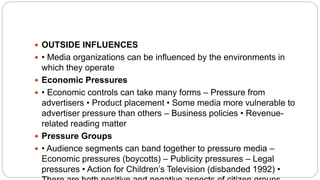
 OUTSIDE INFLUENCES
 • Media organizations can be influenced by the environments in
which they operate
 Economic Pressures
 • Economic controls can take many forms – Pressure from
advertisers • Product placement • Some media more vulnerable to
advertiser pressure than others – Business policies • Revenue-
related reading matter
 Pressure Groups
 • Audience segments can band together to pressure media –
Economic pressures (boycotts) – Publicity pressures – Legal
pressures • Action for Children’s Television (disbanded 1992) •
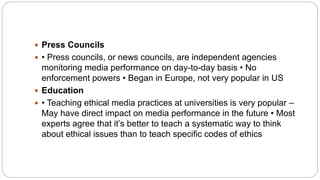
 Press Councils
 • Press councils, or news councils, are independent agencies
monitoring media performance on day-to-day basis • No
enforcement powers • Began in Europe, not very popular in US
 Education
 • Teaching ethical media practices at universities is very popular –
May have direct impact on media performance in the future • Most
experts agree that it’s better to teach a systematic way to think
about ethical issues than to teach specific codes of ethics
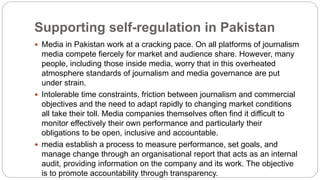
Supporting self-regulation in Pakistan
 Media in Pakistan work at a cracking pace. On all platforms of journalism
media compete fiercely for market and audience share. However, many
people, including those inside media, worry that in this overheated
atmosphere standards of journalism and media governance are put
under strain.
 Intolerable time constraints, friction between journalism and commercial
objectives and the need to adapt rapidly to changing market conditions
all take their toll. Media companies themselves often find it difficult to
monitor effectively their own performance and particularly their
obligations to be open, inclusive and accountable.
 media establish a process to measure performance, set goals, and
manage change through an organisational report that acts as an internal
audit, providing information on the company and its work. The objective
is to promote accountability through transparency.
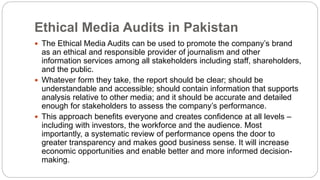
Ethical Media Audits in Pakistan
 The Ethical Media Audits can be used to promote the company’s brand
as an ethical and responsible provider of journalism and other
information services among all stakeholders including staff, shareholders,
and the public.
 Whatever form they take, the report should be clear; should be
understandable and accessible; should contain information that supports
analysis relative to other media; and it should be accurate and detailed
enough for stakeholders to assess the company’s performance.
 This approach benefits everyone and creates confidence at all levels –
including with investors, the workforce and the audience. Most
importantly, a systematic review of performance opens the door to
greater transparency and makes good business sense. It will increase
economic opportunities and enable better and more informed decision-
making.
Thank You

Self Regulation and Code of Conduct

  • 1.
    Presented by: BasharAhmad Self Regulations and Code of Conduct
  • 2.
    Regulation  Media regulationis the control or guidance of mass media by governments and other bodies.  The use of legal means to control media ownership and the content of media communications.  Regulation refers to the whole process of control or guidance, by established rules and procedures, applied by governments and other political and administrative authorities to all kinds of media activities. Thus regulation is always a potential intervention in ongoing activities, usually for some stated "public interest" goal, but also to serve the needs of the market (for instance, by supporting competition) or for reasons of technical efficiency (for instance, setting technical standards).
  • 3.
    Self regulation  Self-regulationis a process whereby media organizations set up a committee of their own members to oversee a code of practice. Those in favour say it is less heavy handed. Those against say it is like putting Dracula in charge of the blood bank. Self-regulation does not involve the government, but is instead carried out by the industry or profession itself.A code of practice is usually developed that defines the expected behaviour.  Media organizations prefer self-regulation because it frees them from heavy handed government control or censorship. Self-regulation is also seen as more flexible and more likely to be complied with. Self-regulated media usually set up a panel of representatives of each of the major companies involved, together with some representatives of the general public. This panel then sits in judgement on particular cases or complaints. It uses the code of practice to help it decide if there has been
  • 4.
     PERSONAL ETHICS • Ethics: rules of conduct or principles of morality guiding us to proper behavior • Ethical principles do not provide magic answers to all ethical dilemmas  Ethical Principles  • Principle of the Golden Mean • Categorical Imperative • Principle of Utility • Veil of Ignorance • Principle of Self-Determination  A Model for Individual Ethical Decisions  • Potter’s Model: – Definitions Values Principles Loyalties Action – Before taking action, consider the following: • Define the situation • What values are involved? • What ethical principles apply? • Where do our loyalties lie?
  • 5.
     Acculturation • Acculturation is accepting the ideas, attitudes, and options of the people whose story you’re covering – Not necessarily bad, but can affect journalistic judgment  PERFORMANCE CODES • Many media have codes of conduct or ethics. • Codes help professionals make ethical decisions more quickly and with more uniformity. • Media systems have no review boards, so few disciplinary sanctions result from poor performance  The Print Media • American Society of Newspaper Editors (ASNE) – Canons of Journalism • Responsibility, freedom of the press, independence, accuracy, impartiality, fair play, decency • Society of Professional Journalists (SPJ) – Codes of conduct • See the truth and report it • Minimize harm • Act independently • Be accountable • Other associations or organizations have adopted their own ethical codes
  • 6.
     Broadcasting  •Several broadcast organizations have tried to codify ethical systems, but none have survived with specificity or enforceability • V-Chip is compromise between formal and informal controls  Motion Pictures  • Motion Picture Producers and Distributors of America (MPPDA) – MPPDA had a highly specific code; films sought MPPDA seal of approval • Motion Picture Association of America (MPAA) – Simple rating system • As revised: G, PG, PG-13, R, NC-17  The Advertising Industry  • The advertising industry also has professional organizations with professional codes of conduct – Membership in organizations is voluntary, as is adherence to codes – Industry believes self-regulation is preferable
  • 7.
     INTERNAL CONTROLS • Most media organizations have their own internal self-regulatory guidelines  Organizational Policy:  Television Networks’ Standards and Practices • Standards and practices departments review content aired on the network • Monitoring of content differs at different broadcast and cable networks. – Some monitor everything, including ads. – Networks are relying more on program producers to follow accepted guidelines – Content not acceptable for broadcast may appear on Internet • Individual stations self regulate (policy book); may air a network program later, or not at all
  • 8.
     Organizational Policy: Newspapers and Magazines • Newspapers and magazines have two forms of policy statements – Operating policies – Editorial policies • Boosterism – Consumers should seek multiple media to get more complete view  Self-Criticism  • Self-criticism in media industry is the exception, not the rule • Internet opens new channel for media self- criticism • Ombudsperson concept has been tried but has not caught on
  • 9.
     OUTSIDE INFLUENCES • Media organizations can be influenced by the environments in which they operate  Economic Pressures  • Economic controls can take many forms – Pressure from advertisers • Product placement • Some media more vulnerable to advertiser pressure than others – Business policies • Revenue- related reading matter  Pressure Groups  • Audience segments can band together to pressure media – Economic pressures (boycotts) – Publicity pressures – Legal pressures • Action for Children’s Television (disbanded 1992) •
  • 10.
     Press Councils • Press councils, or news councils, are independent agencies monitoring media performance on day-to-day basis • No enforcement powers • Began in Europe, not very popular in US  Education  • Teaching ethical media practices at universities is very popular – May have direct impact on media performance in the future • Most experts agree that it’s better to teach a systematic way to think about ethical issues than to teach specific codes of ethics
  • 11.
    Supporting self-regulation inPakistan  Media in Pakistan work at a cracking pace. On all platforms of journalism media compete fiercely for market and audience share. However, many people, including those inside media, worry that in this overheated atmosphere standards of journalism and media governance are put under strain.  Intolerable time constraints, friction between journalism and commercial objectives and the need to adapt rapidly to changing market conditions all take their toll. Media companies themselves often find it difficult to monitor effectively their own performance and particularly their obligations to be open, inclusive and accountable.  media establish a process to measure performance, set goals, and manage change through an organisational report that acts as an internal audit, providing information on the company and its work. The objective is to promote accountability through transparency.
  • 12.
    Ethical Media Auditsin Pakistan  The Ethical Media Audits can be used to promote the company’s brand as an ethical and responsible provider of journalism and other information services among all stakeholders including staff, shareholders, and the public.  Whatever form they take, the report should be clear; should be understandable and accessible; should contain information that supports analysis relative to other media; and it should be accurate and detailed enough for stakeholders to assess the company’s performance.  This approach benefits everyone and creates confidence at all levels – including with investors, the workforce and the audience. Most importantly, a systematic review of performance opens the door to greater transparency and makes good business sense. It will increase economic opportunities and enable better and more informed decision- making.
  • 13.