Three Approaches to studying intercultural communicationS.M.Jamal                (smjamaal@gmail.com)
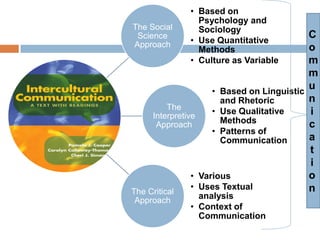
Commun i ca t   i o n
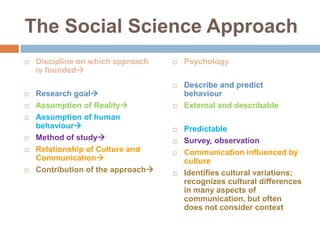
The Social Science ApproachDiscipline on which approach is foundedResearch goalAssumption of RealityAssumption of human behaviourMethod of studyRelationship of Culture and CommunicationContribution of the approachPsychologyDescribe and predict behaviourExternal and describablePredictableSurvey, observationCommunication influenced by cultureIdentifies cultural variations; recognizes cultural differences in many aspects of communication, but often does not consider context
The Social Science ApproachPsychologists help us understand notions of stereotyping and the ways in which prejudice functions in our lives and in intercultural interaction.Gordon Allport’s work ‘The Nature of Prejudice’(1979), describes how prejudice can develop from “normal” human cognitive activities such as categorization and generalization.Richard Brislin (1999) and Dan Landis, reveal how variables like nationality, ethnicity, personality, and gender influence our communication.
The Social Science Approach9/11 Attacks on USTo understand the aftermath of the 9/11 tragedy, social science researchers might try to measure attitudes towards Muslims and Middle Easterners by tracking the increasing rate of hate crimes against those perceived to be Middle Eastern.Based on these attitude changes, social scientists might then try to predict future hate crimes and ethnic conflicts, and suggest ways to work to avoid conflict based on these attitudes.
The Social Science Approach9/11 Attacks on USSocial Scientists might investigate perceived reasons for the terrorist attacks and then frame appropriate responses to them. i.e., they might measure differences in perception among various cultural groups to try to understand how different cultures perceive the reasons for the attacks and what they view as appropriate and inappropriate responses by the United States.In this type of study, social scientists would be using culture as a variable to measure these differences while focusing on the perceptions that are widely held in a particular culture.
The Social Science ApproachTrends in Communication Media Use and Primary Motives in Using CommunicationSocial scientists might study what kinds of communication media people used after the attacks and how they used them.This type of study attempts to quantify the trends in communication media use and the primary motives in using communication.
The Social Science ApproachIndividualist or Collectivist CultureSocial scientist like, William Gudykunst,  a leading communication researcher, was interested in whether people from different cultures varied in their strategies for reducing uncertainty on first encounter. He found that strategies varied depending on whether people were from individualistic or collectivistic cultures.Many people in United States, which has an individualistic orientation, ask direct questions when interacting with acquaintances.In cultures with a more collectivistic orientation, such as Japan or China, people are more likely to use an indirect approach.
The Social Science ApproachThe Communication Accommodation TheoryIt is the result of social science program in which researchers attempted to identify how and when individuals accommodate their speech and nonverbal behavior to others during an interaction.Researchers posited that in some situations individuals will change their communication patterns to accommodate others.(Gallois, Giles, Jones, Cargile, & Ota, 1995)It is so because we accommodate when we feel positive toward the other person.Similarly when talking to international students, we may speak more slowly, enunciate more clearly, use less jargon, and mirror their communication.
The Social Science ApproachCommunication StylesMany social Science studies explain how communication styles vary from culture to culture. Dean Barnlund (Barnulnd & Yoshioka, 1990), a well-known intercultural communication scholar, compared Japanese and U.S. communication styles.He identified many differences, including how members of the two groups give compliments and offer apologies. U.S. Americans tend to apologize (and compliment) more often; further; Japanese prefer to do something whereas Americans tend to explain as a way to apologize.Successful travelers factors predicted by social scientists include age, gender, language, preparation level, and personality characteristics—played a role. (Kim, 2001).
The Social Science ApproachStrengths and Limitations of Social Science ApproachThis approach is limited as many scholars now realize that human communication is often more creative than predictable and that reality is not just external but also internally constructed. We cannot identify all of the variables that affect our communication. Nor can we predict exactly why one intercultural interaction seems to succeed and another does not.Researchers may not really understand the cultural groups they are studying. For example, suppose we conducted a study that compared self-disclosure in the United States and Algeria using the social science perspective. We might distribute Jourard’s self-disclosure measure(a common instrument used in U.S. research) to students in both countries. However, we might not realize that the concept of
The Social Science ApproachStrengths and Limitations of Social Science Approach     self-disclosure does not translate exactly between the United States and Algeria, and that Algerians and U.S. Americans have different notion of this concept.To overcome these kinds of problems, social scientists have developed strategies for achieving equivalence of measures. These include translation equivalence and conceptual equivalence. To establish translation equivalence in cross-cultural studies, research materials should be translated several times, using different translators. Materials that proceed smoothly through these multiple steps are considered translation equivalent.
The Social Science ApproachStrengths and Limitations of Social Science ApproachResearchers can establish conceptual equivalence by ensuring that the notions they are investigating are similar at various levels. Problem solving is one aspect of intelligence that may be conceptually equivalent in many cultures. Once this equivalence is established, researchers can identify culture-specific ways in which problem solving is achieved.In the United States and western Europe, good problem solving might mean quick cognitive reasoning; in other cultures; it might involve slow and careful thought (Serpell, 1982).Establishing these equivalencies allows researchers to isolate and describe what distinguishes on culture from another.
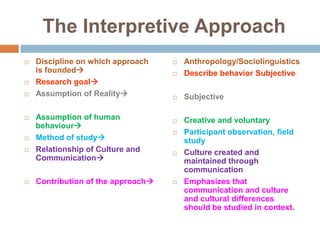
The Interpretive ApproachDiscipline on which approach is foundedResearch goalAssumption of RealityAssumption of human behaviourMethod of studyRelationship of Culture and CommunicationContribution of the approachAnthropology/SociolinguisticsDescribe behavior SubjectiveSubjectiveCreative and voluntaryParticipant observation, field studyCulture created and maintained through communicationEmphasizes that communication and culture and cultural differences should be studied in context.
The Interpretive ApproachRhetorical ApproachIt as an example of interpretive research. Rhetoricians typically examine and analyze texts or public speeches in the contexts in which they occur.
The Interpretive Approach9/11 attacks on U.S.One interpretive approach to study 9/11 attacks, possibly be to interview both U.S. Americans and Arabs, and perhaps other around the world. From these interviews, as well as conversations with others, the researcher might gain insight into a variety of potential responses.In the weeks after 9/11, communication scholar studied attacks from different perspectives.In order to know whether the attacks were an act of war or a crime, communication scholar Nola Heidlebaugh argues that this rhetorical approach to understanding attitudes is preferable to the social science survey/polling approach because it focuses on conversations of those who are engaged with the topic.
The Social Science Approach9/11 attacks on U.S.     Attitude polls survey anyone, even those who haven’t thought about the topic.“Military” versus a “crime” rhetorical response. Alan Dershowitz (2001), Law professor at Harvard University, expresses concern about the loss of civil liberties in the aftermath of 9/11.Interpretivists might also study the cultural and communication phenomena that occurred immediately after 9/11 when many U.S. Americans felt compelled to fly the American flag in their homes, cars, and businesses. By interviewing people who participated in this phenomenon, interpretivists might better understand what these people were trying to communicate and how displaying the flag funtioned to do that.
The Social Science ApproachFor example, why didn’t people fly the New York City flag instead? How would that have created a different meaning?
The Social Science Approach

Three approaches to studying intercultural communication

  • 1.
    Three Approaches tostudying intercultural communicationS.M.Jamal (smjamaal@gmail.com)
  • 2.
  • 3.
    The Social ScienceApproachDiscipline on which approach is foundedResearch goalAssumption of RealityAssumption of human behaviourMethod of studyRelationship of Culture and CommunicationContribution of the approachPsychologyDescribe and predict behaviourExternal and describablePredictableSurvey, observationCommunication influenced by cultureIdentifies cultural variations; recognizes cultural differences in many aspects of communication, but often does not consider context
  • 4.
    The Social ScienceApproachPsychologists help us understand notions of stereotyping and the ways in which prejudice functions in our lives and in intercultural interaction.Gordon Allport’s work ‘The Nature of Prejudice’(1979), describes how prejudice can develop from “normal” human cognitive activities such as categorization and generalization.Richard Brislin (1999) and Dan Landis, reveal how variables like nationality, ethnicity, personality, and gender influence our communication.
  • 5.
    The Social ScienceApproach9/11 Attacks on USTo understand the aftermath of the 9/11 tragedy, social science researchers might try to measure attitudes towards Muslims and Middle Easterners by tracking the increasing rate of hate crimes against those perceived to be Middle Eastern.Based on these attitude changes, social scientists might then try to predict future hate crimes and ethnic conflicts, and suggest ways to work to avoid conflict based on these attitudes.
  • 6.
    The Social ScienceApproach9/11 Attacks on USSocial Scientists might investigate perceived reasons for the terrorist attacks and then frame appropriate responses to them. i.e., they might measure differences in perception among various cultural groups to try to understand how different cultures perceive the reasons for the attacks and what they view as appropriate and inappropriate responses by the United States.In this type of study, social scientists would be using culture as a variable to measure these differences while focusing on the perceptions that are widely held in a particular culture.
  • 7.
    The Social ScienceApproachTrends in Communication Media Use and Primary Motives in Using CommunicationSocial scientists might study what kinds of communication media people used after the attacks and how they used them.This type of study attempts to quantify the trends in communication media use and the primary motives in using communication.
  • 8.
    The Social ScienceApproachIndividualist or Collectivist CultureSocial scientist like, William Gudykunst, a leading communication researcher, was interested in whether people from different cultures varied in their strategies for reducing uncertainty on first encounter. He found that strategies varied depending on whether people were from individualistic or collectivistic cultures.Many people in United States, which has an individualistic orientation, ask direct questions when interacting with acquaintances.In cultures with a more collectivistic orientation, such as Japan or China, people are more likely to use an indirect approach.
  • 9.
    The Social ScienceApproachThe Communication Accommodation TheoryIt is the result of social science program in which researchers attempted to identify how and when individuals accommodate their speech and nonverbal behavior to others during an interaction.Researchers posited that in some situations individuals will change their communication patterns to accommodate others.(Gallois, Giles, Jones, Cargile, & Ota, 1995)It is so because we accommodate when we feel positive toward the other person.Similarly when talking to international students, we may speak more slowly, enunciate more clearly, use less jargon, and mirror their communication.
  • 10.
    The Social ScienceApproachCommunication StylesMany social Science studies explain how communication styles vary from culture to culture. Dean Barnlund (Barnulnd & Yoshioka, 1990), a well-known intercultural communication scholar, compared Japanese and U.S. communication styles.He identified many differences, including how members of the two groups give compliments and offer apologies. U.S. Americans tend to apologize (and compliment) more often; further; Japanese prefer to do something whereas Americans tend to explain as a way to apologize.Successful travelers factors predicted by social scientists include age, gender, language, preparation level, and personality characteristics—played a role. (Kim, 2001).
  • 11.
    The Social ScienceApproachStrengths and Limitations of Social Science ApproachThis approach is limited as many scholars now realize that human communication is often more creative than predictable and that reality is not just external but also internally constructed. We cannot identify all of the variables that affect our communication. Nor can we predict exactly why one intercultural interaction seems to succeed and another does not.Researchers may not really understand the cultural groups they are studying. For example, suppose we conducted a study that compared self-disclosure in the United States and Algeria using the social science perspective. We might distribute Jourard’s self-disclosure measure(a common instrument used in U.S. research) to students in both countries. However, we might not realize that the concept of
  • 12.
    The Social ScienceApproachStrengths and Limitations of Social Science Approach self-disclosure does not translate exactly between the United States and Algeria, and that Algerians and U.S. Americans have different notion of this concept.To overcome these kinds of problems, social scientists have developed strategies for achieving equivalence of measures. These include translation equivalence and conceptual equivalence. To establish translation equivalence in cross-cultural studies, research materials should be translated several times, using different translators. Materials that proceed smoothly through these multiple steps are considered translation equivalent.
  • 13.
    The Social ScienceApproachStrengths and Limitations of Social Science ApproachResearchers can establish conceptual equivalence by ensuring that the notions they are investigating are similar at various levels. Problem solving is one aspect of intelligence that may be conceptually equivalent in many cultures. Once this equivalence is established, researchers can identify culture-specific ways in which problem solving is achieved.In the United States and western Europe, good problem solving might mean quick cognitive reasoning; in other cultures; it might involve slow and careful thought (Serpell, 1982).Establishing these equivalencies allows researchers to isolate and describe what distinguishes on culture from another.
  • 14.
    The Interpretive ApproachDisciplineon which approach is foundedResearch goalAssumption of RealityAssumption of human behaviourMethod of studyRelationship of Culture and CommunicationContribution of the approachAnthropology/SociolinguisticsDescribe behavior SubjectiveSubjectiveCreative and voluntaryParticipant observation, field studyCulture created and maintained through communicationEmphasizes that communication and culture and cultural differences should be studied in context.
  • 15.
    The Interpretive ApproachRhetoricalApproachIt as an example of interpretive research. Rhetoricians typically examine and analyze texts or public speeches in the contexts in which they occur.
  • 16.
    The Interpretive Approach9/11attacks on U.S.One interpretive approach to study 9/11 attacks, possibly be to interview both U.S. Americans and Arabs, and perhaps other around the world. From these interviews, as well as conversations with others, the researcher might gain insight into a variety of potential responses.In the weeks after 9/11, communication scholar studied attacks from different perspectives.In order to know whether the attacks were an act of war or a crime, communication scholar Nola Heidlebaugh argues that this rhetorical approach to understanding attitudes is preferable to the social science survey/polling approach because it focuses on conversations of those who are engaged with the topic.
  • 17.
    The Social ScienceApproach9/11 attacks on U.S. Attitude polls survey anyone, even those who haven’t thought about the topic.“Military” versus a “crime” rhetorical response. Alan Dershowitz (2001), Law professor at Harvard University, expresses concern about the loss of civil liberties in the aftermath of 9/11.Interpretivists might also study the cultural and communication phenomena that occurred immediately after 9/11 when many U.S. Americans felt compelled to fly the American flag in their homes, cars, and businesses. By interviewing people who participated in this phenomenon, interpretivists might better understand what these people were trying to communicate and how displaying the flag funtioned to do that.
  • 18.
    The Social ScienceApproachFor example, why didn’t people fly the New York City flag instead? How would that have created a different meaning?
  • 19.
  • 20.
  • 21.
  • 22.
  • 23.
  • 24.
  • 25.
  • 26.
  • 27.
  • 28.
  • 29.
  • 30.
  • 31.
  • 32.
  • 33.
  • 34.
  • 35.
  • 36.
  • 37.
  • 38.
  • 39.
  • 40.
  • 41.
  • 42.
  • 43.
  • 44.
  • 45.
  • 46.
  • 47.
  • 48.
  • 49.
  • 50.
  • 51.
  • 52.
  • 53.
  • 54.
  • 55.