(Managed By Shree Tapi Brahmcharyashram Sabha)
Shree Swami Atmanand Vidhya Sankul, Kapodra, Varachha Road, Surat, Gujarat, India. 395006
Phone: 0261-2573552 Fax No.: 0261-2573554 Email: ssasit@yahoo.in Web: www.ssasit.ac.in
Shree Swami atmanand SaraSwati
inStitute of technology, Surat
1
Communication
Skills
Presented by:
Patel Raj G.
Patel Hardik R.
Patel Greenik D.
2
NAME ENROLL. NUMBER
160760106082
160760106074
160760106073
Communication - Meaning
 Communication is a dynamic process…
 through this process we convey a thought or feeling to someone else.
 how it is received depends on a set of events, stimuli, that person is
exposed to.
 how you say what you say plays an important role in communication.
3
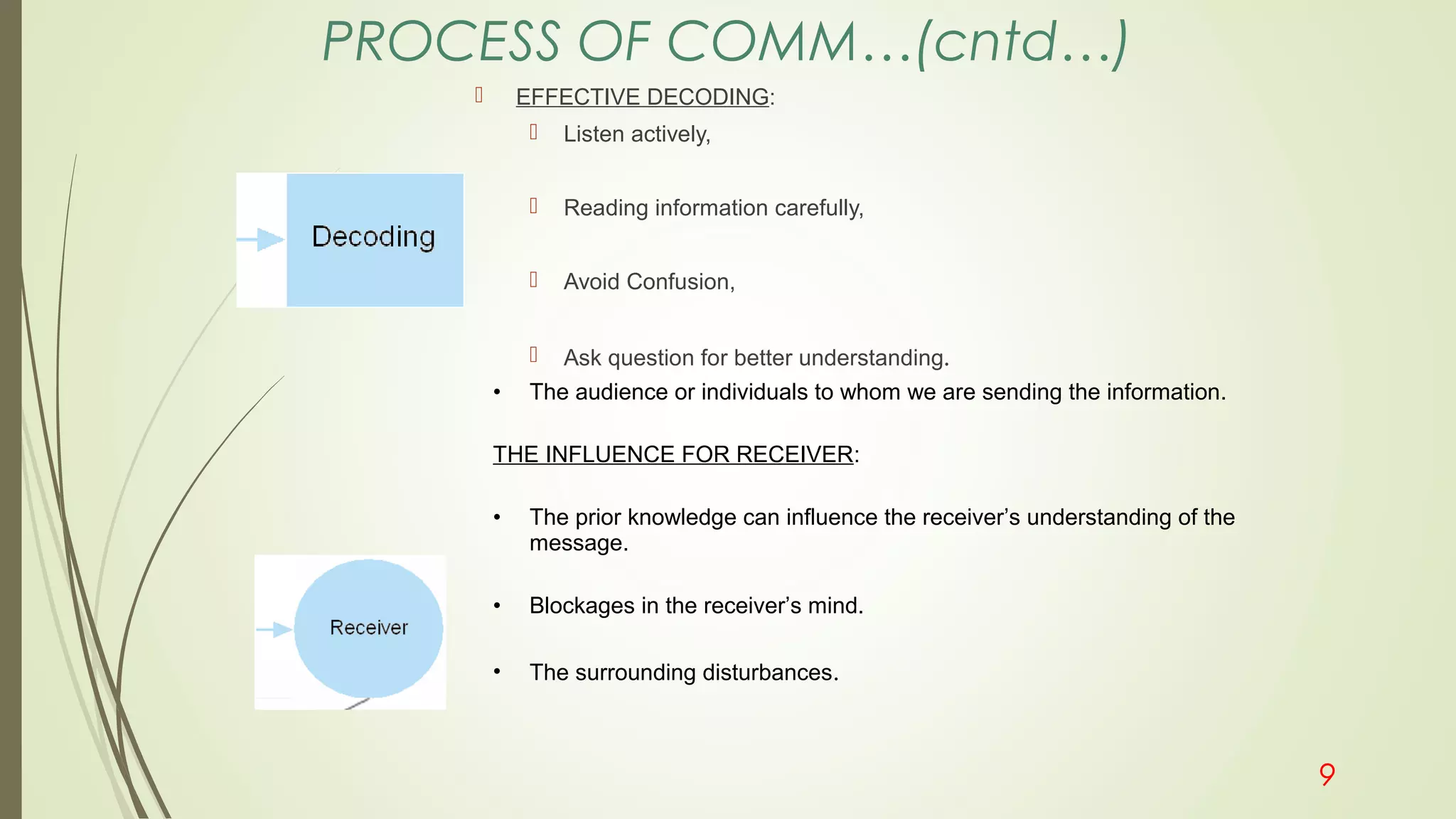
TOTAL COMMUNICATION PROCESS
Reading
16%
Writing
9% Speaking
30%
Listening
45%
4
PROCESS OF COMMUNICATION
5
PROCESS OF COMM…(cntd…)
Encoding:
• The process of transferring the information you want to communicate
into a form that can be sent and correctly decoded at the other end.
• Ability to convey the information.
• Eliminate sources of confusion. For e.g. cultural issues, mistaken
assumptions, and missing information.
• Knowing your audience.
6
Source:
 Why to communicate?
 What to communicate?
 Usefulness of the communication.
 Accuracy of the Information to be communicated.
 Written Communication Channels
 Letters,
 e-Mails,
 Memos,
 Reports.
 Verbal Communication Channels
 Face-To-Face meetings,
 Telephones,
 Video Conferencing.
PROCESS OF COMM…(cntd…)
7
Strengths and Weaknesses
 Verbal Communication:
Strength - Role of Body Language.
Weakness - Not possible to give long list of directions
 Written Communication:
Strength - A proof of a communication
Weakness - Written words does not show a person’s
actual feelings.
PROCESS OF COMM…(cntd…)
8
 EFFECTIVE DECODING:
 Listen actively,
 Reading information carefully,
 Avoid Confusion,
 Ask question for better understanding.
PROCESS OF COMM…(cntd…)
• The audience or individuals to whom we are sending the information.
THE INFLUENCE FOR RECEIVER:
• The prior knowledge can influence the receiver’s understanding of the
message.
• Blockages in the receiver’s mind.
• The surrounding disturbances.
9
FEEDBACK:
Feedback can be:
 Verbal Reactions and Non-Verbal Reactions.
 Positive feedback and Negative feedback.
PROCESS OF COMM…(cntd…)
10
Verbal communication
 Use of words, numbers and symbols.
 Tone, pitch, quality and rate of speech carries more weight than the words
 The latter convey the emotions and meaning, regardless of the content of
the message.
11
Non-verbal communication
 Facial expressions
 Eye contact, pupil dilation
 Gestures
 Body language and posture
 Proximity and touch
 Paralinguistic
Most of our communication is non-verbal
(which is missing in emails and tweets)
12
1 . Facial expressions :-
Your face can show many feelings
2 . Eye contact : -
 Maintaining appropriate eye contact when speaking with others helps communication
13
3 . Gestures :-
 Also convey meanings
 Be mindful of cultural
differences
Waving Making a fist Thumbs up
Pointing Nodding Yawning
4 . Body language (kinesics) :-
 A great deal of your (true) message can be
communicated by your body use and posture
 To work effectively with others
you need to read body
language and ensure you
are not conveying the
wrong signals
14
 Cultural norms dictate a comfortable distance for interaction with audience.
 You should look for signals of discomfort caused by invading young audience‘s
space.
 Some of these are:
 Rocking,
 Leg swinging,
 Tapping,
 Gaze aversion,
5 . PROXIMITY:
This facet of nonverbal communication includes such vocal elements as:
- Tone
- Pitch
- Rhythm
- Timbre
- Loudness
- Inflection
6 . Paralinguistic :
15
Barriers to Communication:
 Definition:-
“The factors which affect the free flow of communication process are called as
barriers to communication”
 Types of Barriers:
There are five types of barriers:
1. Physical barriers
2. Mechanical barriers
3. Socio-cultural barriers
4. Psychological barriers
5. Linguistics barriers
16
1. Physical Barriers:
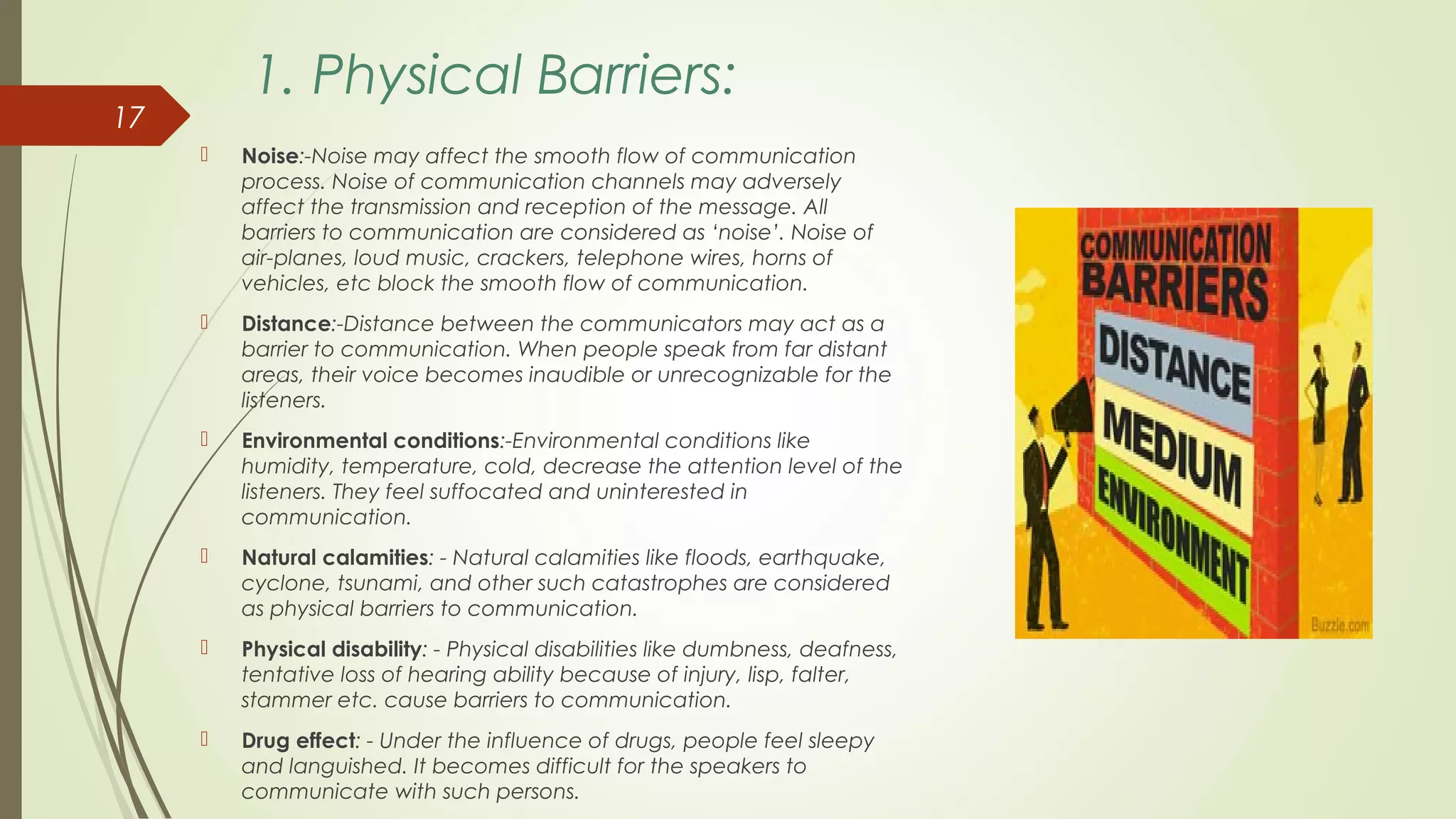
 Noise:-Noise may affect the smooth flow of communication
process. Noise of communication channels may adversely
affect the transmission and reception of the message. All
barriers to communication are considered as ‘noise’. Noise of
air-planes, loud music, crackers, telephone wires, horns of
vehicles, etc block the smooth flow of communication.
 Distance:-Distance between the communicators may act as a
barrier to communication. When people speak from far distant
areas, their voice becomes inaudible or unrecognizable for the
listeners.
 Environmental conditions:-Environmental conditions like
humidity, temperature, cold, decrease the attention level of the
listeners. They feel suffocated and uninterested in
communication.
 Natural calamities: - Natural calamities like floods, earthquake,
cyclone, tsunami, and other such catastrophes are considered
as physical barriers to communication.
 Physical disability: - Physical disabilities like dumbness, deafness,
tentative loss of hearing ability because of injury, lisp, falter,
stammer etc. cause barriers to communication.
 Drug effect: - Under the influence of drugs, people feel sleepy
and languished. It becomes difficult for the speakers to
communicate with such persons.
17
2. Mechanical Barriers:
 Many mechanical factors are
responsible for breakdown in
communication process.
 There two types of mechanical barriers,
1. Faulty instruments
2. Machine illiteracy
 Faulty instruments:-Use of defective
communication device affects the
transmission and reception of message.
Faulty instruments give rise to
mechanical barriers to communication.
 Machine illiteracy: - Many people lack
adequate knowledge and to use
modern communication technology like
computer, internet, video conferencing
etc. Lack of knowledge to handle the
instruments may create barriers to
communication.
18
3. Socio-cultural Barriers:
 Socio-cultural barriers influence the inter personal and cross
cultural relations of individuals class-conflict, caste-divide, cross
cultural differences, excommunicated groups of society, social
and cultural codes and conducts of communication may give
rise to conflict and barriers to communication.
 Inter cultural:
 Caste-divide: due to the upper and lower caste issues free or
frankly communication is not possible
 Class-divide: Economical differences also creates barriers
 Culture divide: country’s social and political imbalanced
harmony creates barriers. Because of these barriers many
communities feel marginalizes, subjugated, and victimized. This
creates communication gap between social groups
 Cross- cultural: Cross cultural communication is prone to raise
many legal and ethical issues which can create barriers to
effective communication. Modern workplace is full of diversity
and multiculturalism. Global organizations cannot afford to
recruit people of one cultural background or nationality.
When these culturally different people communicate with
each other, there is possibility of misunderstanding and
conflict.
19
3. Socio-cultural Barriers: (cntd..)
 Ethnocentrism: Ethnocentrism is judging another culture solely by the values and standards of one's own
culture. Ethnocentric individuals judge other groups relative to their own ethnic group or culture,
especially with concern for language, behavior, customs, and religion. It is the belief in the intrinsic
superiority of the nation, culture, or group to which one belongs, often accompanied by feelings of dislike
for other groups.
 One of the well known and the most horrible examples of ethnocentrism to ever occur was during Nazi
Germany. Adolf Hitler decided that he hated Jews, as well as some other groups of people, and had
many innocent people slaughtered in concentration camps. They did not deserve the torture that they
received, and this was clearly an extreme case of ethnocentrism. While prejudice certainly leads to
problems, very rarely in history has ethnocentrism led to the mass slaughter of millions of innocent people.
 Non- verbal clues: Different cultures have different codes for using non-verbal communication. Failing to
understand these non- verbal code or ethical standards can result into barriers to communication.
 Non verbal clues including eye-contact, Proxemics, sign, symbols, is used differently by different culture
20
4. Psychological Barriers:
Human psychology is a challenging task to study. Our
Psychological factors sometimes result into various types of
barriers to communication .Moreover; these barriers can be
overcome only by one’s own efforts. Let us understand some
of the major psychological barriers.
Fear/phobia: - People suffering from fear and phobia may
shun communication. People affected by agoraphobia avoid
meeting and communicating at public places.
Superiority complexes:-People suffering from superiority
complex, consider them as omnipotent people. They do not
listen to other’s suggestions and nullify others thoughts. This
discourages the speaker and blocks the flow of
communication.
Inferiority complex:-People suffering from inferiority complex
consider themselves as ‘nobody’. They feel subjugated and
defeated. They do not communicate frankly and freely.
Emotional Outburst: Sometime emotions for someone play a
role of barrier in communication. If you are too much attached
to someone emotionally at that time also you will not
communicate effectively or clearly with that person. A few of
the emotional interferences include hostility, anger,
resentfulness and fear.
21
5. Linguistics/Semantic barriers :
 Language can act as major barriers to
communication.
 Illiteracy: Illiterate people cannot read and write
the messages. This creates difficulty in
understanding the thoughts and emotions of the
speaker and writer.
 Jargon: Overuse of technical jargons and scientific
terms can make it difficult for the people to
understand the thoughts of the speaker. Difficult
terms and abstruse words can be responsible for
breakdown in communication.
 Errata: An erratum is error in printing and writing
Messages can be distorted or misunderstood by the
readers because of printing mistakes in the text.
 Slang: Use of slang or informal varieties of language
makes it difficult for the strangers to understand
what the speaker is speaking and what he is asking
for.
22
5. Linguistics/Semantic barriers : (cntd…)
 Spelling and grammar errors: Grammatical mistake in writing and structural errors while speaking
are major barrier to communication. Spelling mistakes can distort the message and may create
misunderstanding in the mind of the reader.
 Information Overload: one of the major problems is the availability of huge amounts of data which
the receiver is unable handle effectively. This is known as the information overloads. Very often the
relevant information gets mixed up with too much irrelevant information, and therefore goes
ignored by the receiver.
 Freudian slip: Many a times we say something accidently and which provokes anger of the
listener. The speaker actually has to say something else but unknowingly he says something
differently. This may affect the flow of communication and Interpersonal relationship of individuals.
23
Differentiate between Oral Communication
and Written Communication.
Oral Communication Written Communication
(1) Oral Communication happens when we
communicate with the help of spoken
words. In this way, we can say that the
conversations, meetings, conferences,
interviews, training sessions, speeches,
public announcements, radio speeches,
telephone talk, public speaking, are all
forms of oral communication. It can be
used effectively to inform, satisfy, praise,
criticize, please, inquire and for many
other purposes.
Advantages :
(2) Oral Communication saves time.
(3) There is immediate feedback.
(4) Oral communication saves money.
(5) In Oral communication, there is less
formality.
Disadvantages :
(6) Oral Communication can be
misunderstood more easily compared to
written communication.
(7) If we consider the legal point of view,
oral communication has little value as
there is no permanent record or proof of
what has been said.
(8) Oral Communication requires a good
speaker otherwise it will not be
meaningful.
(1) Written communication is also a type
of verbal communication. With the help
of writing, we express ourselves. The
human language is expressed by means of
visible signs. Since long, letter writing is
considered the only reliable means of
communication. Far a long time in the
business world, it was believed that
sending letters, memorandum and
notices was the only proper way for
businessmen to communicate.
Disadvantage :
(2) Written communication is slow and
time consuming
(3) There is no immediate feedback.
(4) Written communication needs
stationary and other equipments.
(5) Written communication is formal. It
is only for literate people.
Advantages :
(6) Written messages are less likely to be
misunderstood and the doubts can be
removed by reading it again.
(7) Written communication is best for
legal or financial matters. It acts as a
proof.
(8) Written communication has provided
a permanent record. It can be preserved
for years.
24
Thanks
25

Communication Skill

  • 1.
    (Managed By ShreeTapi Brahmcharyashram Sabha) Shree Swami Atmanand Vidhya Sankul, Kapodra, Varachha Road, Surat, Gujarat, India. 395006 Phone: 0261-2573552 Fax No.: 0261-2573554 Email: ssasit@yahoo.in Web: www.ssasit.ac.in Shree Swami atmanand SaraSwati inStitute of technology, Surat 1 Communication Skills
  • 2.
    Presented by: Patel RajG. Patel Hardik R. Patel Greenik D. 2 NAME ENROLL. NUMBER 160760106082 160760106074 160760106073
  • 3.
    Communication - Meaning Communication is a dynamic process…  through this process we convey a thought or feeling to someone else.  how it is received depends on a set of events, stimuli, that person is exposed to.  how you say what you say plays an important role in communication. 3
  • 4.
  • 5.
  • 6.
    PROCESS OF COMM…(cntd…) Encoding: •The process of transferring the information you want to communicate into a form that can be sent and correctly decoded at the other end. • Ability to convey the information. • Eliminate sources of confusion. For e.g. cultural issues, mistaken assumptions, and missing information. • Knowing your audience. 6 Source:  Why to communicate?  What to communicate?  Usefulness of the communication.  Accuracy of the Information to be communicated.
  • 7.
     Written CommunicationChannels  Letters,  e-Mails,  Memos,  Reports.  Verbal Communication Channels  Face-To-Face meetings,  Telephones,  Video Conferencing. PROCESS OF COMM…(cntd…) 7
  • 8.
    Strengths and Weaknesses Verbal Communication: Strength - Role of Body Language. Weakness - Not possible to give long list of directions  Written Communication: Strength - A proof of a communication Weakness - Written words does not show a person’s actual feelings. PROCESS OF COMM…(cntd…) 8
  • 9.
     EFFECTIVE DECODING: Listen actively,  Reading information carefully,  Avoid Confusion,  Ask question for better understanding. PROCESS OF COMM…(cntd…) • The audience or individuals to whom we are sending the information. THE INFLUENCE FOR RECEIVER: • The prior knowledge can influence the receiver’s understanding of the message. • Blockages in the receiver’s mind. • The surrounding disturbances. 9
  • 10.
    FEEDBACK: Feedback can be: Verbal Reactions and Non-Verbal Reactions.  Positive feedback and Negative feedback. PROCESS OF COMM…(cntd…) 10
  • 11.
    Verbal communication  Useof words, numbers and symbols.  Tone, pitch, quality and rate of speech carries more weight than the words  The latter convey the emotions and meaning, regardless of the content of the message. 11
  • 12.
    Non-verbal communication  Facialexpressions  Eye contact, pupil dilation  Gestures  Body language and posture  Proximity and touch  Paralinguistic Most of our communication is non-verbal (which is missing in emails and tweets) 12
  • 13.
    1 . Facialexpressions :- Your face can show many feelings 2 . Eye contact : -  Maintaining appropriate eye contact when speaking with others helps communication 13
  • 14.
    3 . Gestures:-  Also convey meanings  Be mindful of cultural differences Waving Making a fist Thumbs up Pointing Nodding Yawning 4 . Body language (kinesics) :-  A great deal of your (true) message can be communicated by your body use and posture  To work effectively with others you need to read body language and ensure you are not conveying the wrong signals 14
  • 15.
     Cultural normsdictate a comfortable distance for interaction with audience.  You should look for signals of discomfort caused by invading young audience‘s space.  Some of these are:  Rocking,  Leg swinging,  Tapping,  Gaze aversion, 5 . PROXIMITY: This facet of nonverbal communication includes such vocal elements as: - Tone - Pitch - Rhythm - Timbre - Loudness - Inflection 6 . Paralinguistic : 15
  • 16.
    Barriers to Communication: Definition:- “The factors which affect the free flow of communication process are called as barriers to communication”  Types of Barriers: There are five types of barriers: 1. Physical barriers 2. Mechanical barriers 3. Socio-cultural barriers 4. Psychological barriers 5. Linguistics barriers 16
  • 17.
    1. Physical Barriers: Noise:-Noise may affect the smooth flow of communication process. Noise of communication channels may adversely affect the transmission and reception of the message. All barriers to communication are considered as ‘noise’. Noise of air-planes, loud music, crackers, telephone wires, horns of vehicles, etc block the smooth flow of communication.  Distance:-Distance between the communicators may act as a barrier to communication. When people speak from far distant areas, their voice becomes inaudible or unrecognizable for the listeners.  Environmental conditions:-Environmental conditions like humidity, temperature, cold, decrease the attention level of the listeners. They feel suffocated and uninterested in communication.  Natural calamities: - Natural calamities like floods, earthquake, cyclone, tsunami, and other such catastrophes are considered as physical barriers to communication.  Physical disability: - Physical disabilities like dumbness, deafness, tentative loss of hearing ability because of injury, lisp, falter, stammer etc. cause barriers to communication.  Drug effect: - Under the influence of drugs, people feel sleepy and languished. It becomes difficult for the speakers to communicate with such persons. 17
  • 18.
    2. Mechanical Barriers: Many mechanical factors are responsible for breakdown in communication process.  There two types of mechanical barriers, 1. Faulty instruments 2. Machine illiteracy  Faulty instruments:-Use of defective communication device affects the transmission and reception of message. Faulty instruments give rise to mechanical barriers to communication.  Machine illiteracy: - Many people lack adequate knowledge and to use modern communication technology like computer, internet, video conferencing etc. Lack of knowledge to handle the instruments may create barriers to communication. 18
  • 19.
    3. Socio-cultural Barriers: Socio-cultural barriers influence the inter personal and cross cultural relations of individuals class-conflict, caste-divide, cross cultural differences, excommunicated groups of society, social and cultural codes and conducts of communication may give rise to conflict and barriers to communication.  Inter cultural:  Caste-divide: due to the upper and lower caste issues free or frankly communication is not possible  Class-divide: Economical differences also creates barriers  Culture divide: country’s social and political imbalanced harmony creates barriers. Because of these barriers many communities feel marginalizes, subjugated, and victimized. This creates communication gap between social groups  Cross- cultural: Cross cultural communication is prone to raise many legal and ethical issues which can create barriers to effective communication. Modern workplace is full of diversity and multiculturalism. Global organizations cannot afford to recruit people of one cultural background or nationality. When these culturally different people communicate with each other, there is possibility of misunderstanding and conflict. 19
  • 20.
    3. Socio-cultural Barriers:(cntd..)  Ethnocentrism: Ethnocentrism is judging another culture solely by the values and standards of one's own culture. Ethnocentric individuals judge other groups relative to their own ethnic group or culture, especially with concern for language, behavior, customs, and religion. It is the belief in the intrinsic superiority of the nation, culture, or group to which one belongs, often accompanied by feelings of dislike for other groups.  One of the well known and the most horrible examples of ethnocentrism to ever occur was during Nazi Germany. Adolf Hitler decided that he hated Jews, as well as some other groups of people, and had many innocent people slaughtered in concentration camps. They did not deserve the torture that they received, and this was clearly an extreme case of ethnocentrism. While prejudice certainly leads to problems, very rarely in history has ethnocentrism led to the mass slaughter of millions of innocent people.  Non- verbal clues: Different cultures have different codes for using non-verbal communication. Failing to understand these non- verbal code or ethical standards can result into barriers to communication.  Non verbal clues including eye-contact, Proxemics, sign, symbols, is used differently by different culture 20
  • 21.
    4. Psychological Barriers: Humanpsychology is a challenging task to study. Our Psychological factors sometimes result into various types of barriers to communication .Moreover; these barriers can be overcome only by one’s own efforts. Let us understand some of the major psychological barriers. Fear/phobia: - People suffering from fear and phobia may shun communication. People affected by agoraphobia avoid meeting and communicating at public places. Superiority complexes:-People suffering from superiority complex, consider them as omnipotent people. They do not listen to other’s suggestions and nullify others thoughts. This discourages the speaker and blocks the flow of communication. Inferiority complex:-People suffering from inferiority complex consider themselves as ‘nobody’. They feel subjugated and defeated. They do not communicate frankly and freely. Emotional Outburst: Sometime emotions for someone play a role of barrier in communication. If you are too much attached to someone emotionally at that time also you will not communicate effectively or clearly with that person. A few of the emotional interferences include hostility, anger, resentfulness and fear. 21
  • 22.
    5. Linguistics/Semantic barriers:  Language can act as major barriers to communication.  Illiteracy: Illiterate people cannot read and write the messages. This creates difficulty in understanding the thoughts and emotions of the speaker and writer.  Jargon: Overuse of technical jargons and scientific terms can make it difficult for the people to understand the thoughts of the speaker. Difficult terms and abstruse words can be responsible for breakdown in communication.  Errata: An erratum is error in printing and writing Messages can be distorted or misunderstood by the readers because of printing mistakes in the text.  Slang: Use of slang or informal varieties of language makes it difficult for the strangers to understand what the speaker is speaking and what he is asking for. 22
  • 23.
    5. Linguistics/Semantic barriers: (cntd…)  Spelling and grammar errors: Grammatical mistake in writing and structural errors while speaking are major barrier to communication. Spelling mistakes can distort the message and may create misunderstanding in the mind of the reader.  Information Overload: one of the major problems is the availability of huge amounts of data which the receiver is unable handle effectively. This is known as the information overloads. Very often the relevant information gets mixed up with too much irrelevant information, and therefore goes ignored by the receiver.  Freudian slip: Many a times we say something accidently and which provokes anger of the listener. The speaker actually has to say something else but unknowingly he says something differently. This may affect the flow of communication and Interpersonal relationship of individuals. 23
  • 24.
    Differentiate between OralCommunication and Written Communication. Oral Communication Written Communication (1) Oral Communication happens when we communicate with the help of spoken words. In this way, we can say that the conversations, meetings, conferences, interviews, training sessions, speeches, public announcements, radio speeches, telephone talk, public speaking, are all forms of oral communication. It can be used effectively to inform, satisfy, praise, criticize, please, inquire and for many other purposes. Advantages : (2) Oral Communication saves time. (3) There is immediate feedback. (4) Oral communication saves money. (5) In Oral communication, there is less formality. Disadvantages : (6) Oral Communication can be misunderstood more easily compared to written communication. (7) If we consider the legal point of view, oral communication has little value as there is no permanent record or proof of what has been said. (8) Oral Communication requires a good speaker otherwise it will not be meaningful. (1) Written communication is also a type of verbal communication. With the help of writing, we express ourselves. The human language is expressed by means of visible signs. Since long, letter writing is considered the only reliable means of communication. Far a long time in the business world, it was believed that sending letters, memorandum and notices was the only proper way for businessmen to communicate. Disadvantage : (2) Written communication is slow and time consuming (3) There is no immediate feedback. (4) Written communication needs stationary and other equipments. (5) Written communication is formal. It is only for literate people. Advantages : (6) Written messages are less likely to be misunderstood and the doubts can be removed by reading it again. (7) Written communication is best for legal or financial matters. It acts as a proof. (8) Written communication has provided a permanent record. It can be preserved for years. 24
  • 25.

Editor's Notes

  • #14 (Example of non-verbal communication) Facial expressions – Your face can show many of your feelings. For example, a frown or a smile shows a very clear message depending on how or when it is used. Question – What emotions are the images on this slide demonstrating? Ask group to write down for each-see if there are any differences. It is very hard to control facial expressions: not many good poker players!
  • #15 (Example of non-verbal communication) Gestures – the gestures you use also convey meanings. It is important to be mindful of cultural differences: different gestures might mean different things. ASK: What does the symbol in the picture mean? =OK. But in some parts of the Middle East or South America, it is an insulting gesture referring to the anus. It could even be telling someone about their sexual preference (not in a nice way!). Question – What do the gestures listed mean? (you might want to demonstrate gestures). Come up with (at least) 2 alternatives for each.