Chapter 1
Communication:
Essential Human
Behavior
Real Communication, Second Edition
by Dan O’Hair and Mary Wiemann
Why Study
Communication?
 Formal study can
− Improve our skills
− Help us make sense of what
happens in our lives
− Increase our personal impact
− Enhance our relationships
with others
Communication
Enables Us to…
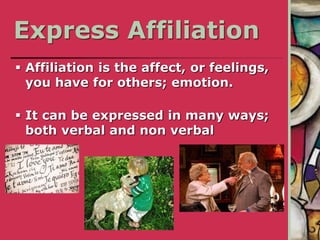
Express Affiliation
 Affiliation is the affect, or feelings,
you have for others; emotion.
 It can be expressed in many ways;
both verbal and non verbal
Achieve Goals
 We need communication to
accomplish particular objectives
 Goal or task oriented
communication can be both direct
and indirect
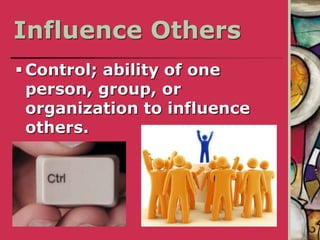
Influence Others
 Control; ability of one
person, group, or
organization to influence
others.
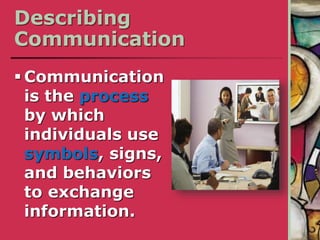
Describing
Communication
 Communication
is the process
by which
individuals use
symbols, signs,
and behaviors
to exchange
information.
Characteristics of
Communication
 Symbolic
−Symbols are arbitrary
constructions that refer to
people, things, and concepts
−Symbols stand for things,
but they are not the “thing.”
There is no relationship
between symbols and the
“thing” they stand for.
Symbols
Tree
Features (cont’d)
Meaning
−the significance we bestow
on phenomena—what they
signify to us
−We negotiate the meaning of
symbols with others through
communication
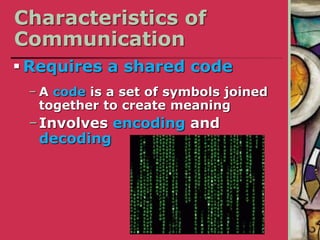
Characteristics of
Communication
 Requires a shared code
− A code is a set of symbols joined
together to create meaning
−Involves encoding and
decoding
Characteristics of
Communication
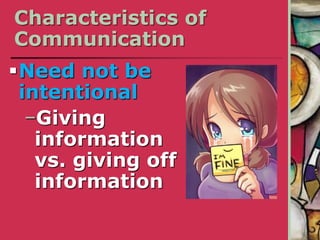
Need not be
intentional
−Giving
information
vs. giving off
information
Characteristics of
Communication
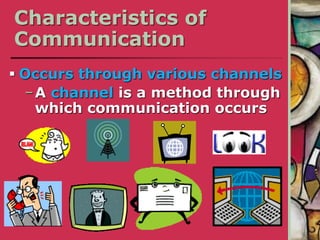
 Occurs through various channels
−A channel is a method through
which communication occurs
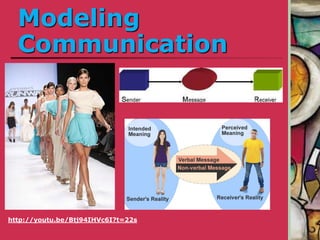
Modeling
Communication
http://youtu.be/Btj94IHVc6I?t=22s
Components of
Communication (cont’d)
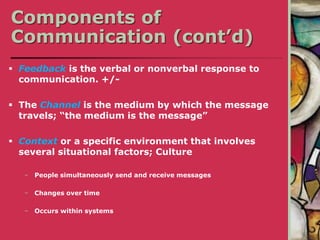
 Feedback is the verbal or nonverbal response to
communication. +/-
 The Channel is the medium by which the message
travels; “the medium is the message”
 Context or a specific environment that involves
several situational factors; Culture
− People simultaneously send and receive messages
− Changes over time
− Occurs within systems
Components of
Communication (cont’d)
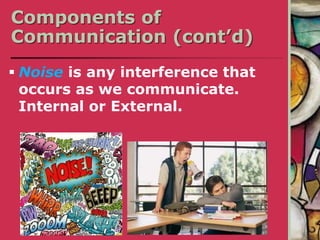
 Noise is any interference that
occurs as we communicate.
Internal or External.
Chapter 3
Communication and
Culture
Real Communication, Second Edition
by Dan O’Hair and Mary Wiemann
Copyright ©2012, 2009, 2006 Pearson Education, Inc. All rights reserved.
Culture Described
Culture is a…
learned system of thought and behavior
that belongs to and typifies a relatively
large group of people; it is the composite of
their shared beliefs, values, and practices.
How do we learn
culture?
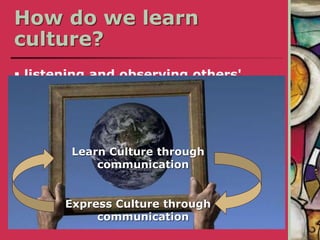
 listening and observing others'
communication
 worldview—the framework through
which we interpret the world
Learn Culture through
communication
Express Culture through
communication
Copyright ©2012, 2009, 2006 Pearson Education, Inc. All rights reserved.
Intercultural Communication
Communication between people from
different cultures who have different
worldviews.
Why does it matter?
Copyright ©2012, 2009, 2006 Pearson Education, Inc. All rights reserved.
Intercultural Communication
We live in a diverse society.
The world is mobile.
Computer mediated communication
Global market place
Copyright ©2012, 2009, 2006 Pearson Education, Inc. All rights reserved.
Cultural Variation
1. High Context vs. Low-Context
2. Collectivist vs. Individualist
3. Uncertainty Tolerance
4. Masculine vs. Feminine
5. Power Distance
6. Time Orientation
7. Emotional Expression
Copyright ©2012, 2009, 2006 Pearson Education, Inc. All rights reserved.
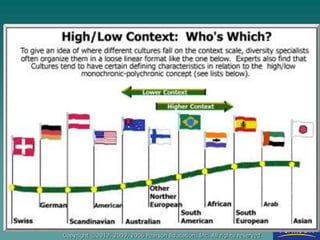
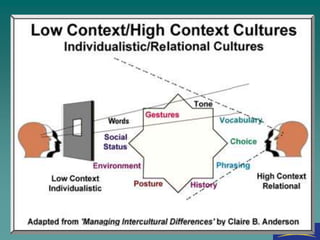
High-Context vs Low-Context
 High-context cultures use contextual
cues (such as time, place,
relationship, and situation) to
interpret meaning and send subtle
messages.
 Low-context cultures use very direct
language and rely less on situational
factors to communicate.
Copyright ©2012, 2009, 2006 Pearson Education, Inc. All rights reserved.
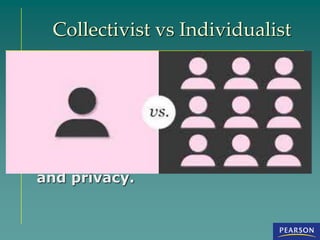
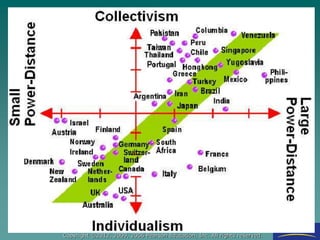
Collectivist vs Individualist
 Collectivists tend to perceive
themselves as members of larger
groups first and communicate
from that perspective.
 People from individualist cultures
value individuality, autonomy,
and privacy.
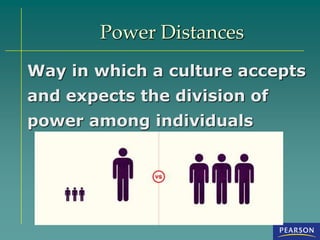
Power Distances
Way in which a culture accepts
and expects the division of
power among individuals
Copyright ©2012, 2009, 2006 Pearson Education, Inc. All rights reserved.
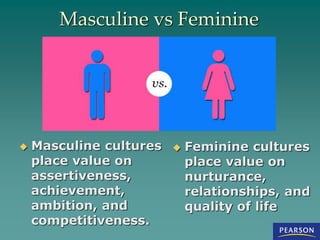
Masculine vs Feminine
 Masculine cultures
place value on
assertiveness,
achievement,
ambition, and
competitiveness.
 Feminine cultures
place value on
nurturance,
relationships, and
quality of life
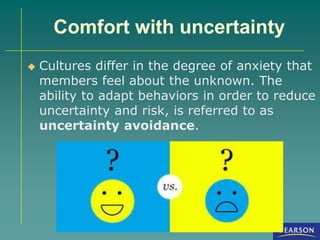
Comfort with uncertainty
 Cultures differ in the degree of anxiety that
members feel about the unknown. The
ability to adapt behaviors in order to reduce
uncertainty and risk, is referred to as
uncertainty avoidance.
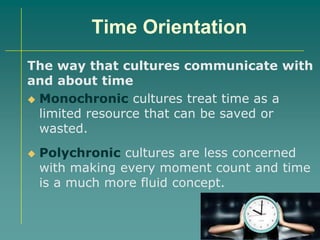
Time Orientation
The way that cultures communicate with
and about time
 Monochronic cultures treat time as a
limited resource that can be saved or
wasted.
 Polychronic cultures are less concerned
with making every moment count and time
is a much more fluid concept.
Value of Emotional Expression
Hyperbole, vivid language with great
emotional intensity, is often used by
collectivist cultures.
Individualist cultures tend to use more
understatement, language that
downplays the emotional intensity or
importance of events.
What Co-Cultures do you
belong to?
 Groupings with unique
characteristics; race, sex, gender
religion, common interests,
activities.
 Generational cultures
Barriers to Competent
Intercultural Communication
Anxiety
Ethnocentrism
Discrimination
Combat with…
Intercultural sensitivity
Intergroup contact
Accommodation

Powerpoint Lecture 1 - Communication and Culture

  • 1.
    Chapter 1 Communication: Essential Human Behavior RealCommunication, Second Edition by Dan O’Hair and Mary Wiemann
  • 2.
    Why Study Communication?  Formalstudy can − Improve our skills − Help us make sense of what happens in our lives − Increase our personal impact − Enhance our relationships with others
  • 3.
  • 4.
    Express Affiliation  Affiliationis the affect, or feelings, you have for others; emotion.  It can be expressed in many ways; both verbal and non verbal
  • 5.
    Achieve Goals  Weneed communication to accomplish particular objectives  Goal or task oriented communication can be both direct and indirect
  • 6.
    Influence Others  Control;ability of one person, group, or organization to influence others.
  • 7.
    Describing Communication  Communication is theprocess by which individuals use symbols, signs, and behaviors to exchange information.
  • 8.
    Characteristics of Communication  Symbolic −Symbolsare arbitrary constructions that refer to people, things, and concepts −Symbols stand for things, but they are not the “thing.” There is no relationship between symbols and the “thing” they stand for.
  • 9.
  • 10.
    Features (cont’d) Meaning −the significancewe bestow on phenomena—what they signify to us −We negotiate the meaning of symbols with others through communication
  • 11.
    Characteristics of Communication  Requiresa shared code − A code is a set of symbols joined together to create meaning −Involves encoding and decoding
  • 12.
    Characteristics of Communication Need notbe intentional −Giving information vs. giving off information
  • 13.
    Characteristics of Communication  Occursthrough various channels −A channel is a method through which communication occurs
  • 14.
  • 15.
    Components of Communication (cont’d) Feedback is the verbal or nonverbal response to communication. +/-  The Channel is the medium by which the message travels; “the medium is the message”  Context or a specific environment that involves several situational factors; Culture − People simultaneously send and receive messages − Changes over time − Occurs within systems
  • 16.
    Components of Communication (cont’d) Noise is any interference that occurs as we communicate. Internal or External.
  • 17.
    Chapter 3 Communication and Culture RealCommunication, Second Edition by Dan O’Hair and Mary Wiemann
  • 18.
    Copyright ©2012, 2009,2006 Pearson Education, Inc. All rights reserved.
  • 19.
    Copyright ©2012, 2009,2006 Pearson Education, Inc. All rights reserved.
  • 20.
    Copyright ©2012, 2009,2006 Pearson Education, Inc. All rights reserved.
  • 21.
    Culture Described Culture isa… learned system of thought and behavior that belongs to and typifies a relatively large group of people; it is the composite of their shared beliefs, values, and practices.
  • 22.
    How do welearn culture?  listening and observing others' communication  worldview—the framework through which we interpret the world Learn Culture through communication Express Culture through communication
  • 23.
    Copyright ©2012, 2009,2006 Pearson Education, Inc. All rights reserved. Intercultural Communication Communication between people from different cultures who have different worldviews. Why does it matter?
  • 24.
    Copyright ©2012, 2009,2006 Pearson Education, Inc. All rights reserved. Intercultural Communication We live in a diverse society. The world is mobile. Computer mediated communication Global market place
  • 25.
    Copyright ©2012, 2009,2006 Pearson Education, Inc. All rights reserved. Cultural Variation 1. High Context vs. Low-Context 2. Collectivist vs. Individualist 3. Uncertainty Tolerance 4. Masculine vs. Feminine 5. Power Distance 6. Time Orientation 7. Emotional Expression
  • 26.
    Copyright ©2012, 2009,2006 Pearson Education, Inc. All rights reserved. High-Context vs Low-Context  High-context cultures use contextual cues (such as time, place, relationship, and situation) to interpret meaning and send subtle messages.  Low-context cultures use very direct language and rely less on situational factors to communicate.
  • 27.
    Copyright ©2012, 2009,2006 Pearson Education, Inc. All rights reserved.
  • 28.
    Collectivist vs Individualist Collectivists tend to perceive themselves as members of larger groups first and communicate from that perspective.  People from individualist cultures value individuality, autonomy, and privacy.
  • 30.
    Power Distances Way inwhich a culture accepts and expects the division of power among individuals
  • 31.
    Copyright ©2012, 2009,2006 Pearson Education, Inc. All rights reserved.
  • 32.
    Copyright ©2012, 2009,2006 Pearson Education, Inc. All rights reserved.
  • 33.
    Masculine vs Feminine Masculine cultures place value on assertiveness, achievement, ambition, and competitiveness.  Feminine cultures place value on nurturance, relationships, and quality of life
  • 34.
    Comfort with uncertainty Cultures differ in the degree of anxiety that members feel about the unknown. The ability to adapt behaviors in order to reduce uncertainty and risk, is referred to as uncertainty avoidance.
  • 35.
    Time Orientation The waythat cultures communicate with and about time  Monochronic cultures treat time as a limited resource that can be saved or wasted.  Polychronic cultures are less concerned with making every moment count and time is a much more fluid concept.
  • 36.
    Value of EmotionalExpression Hyperbole, vivid language with great emotional intensity, is often used by collectivist cultures. Individualist cultures tend to use more understatement, language that downplays the emotional intensity or importance of events.
  • 37.
    What Co-Cultures doyou belong to?  Groupings with unique characteristics; race, sex, gender religion, common interests, activities.  Generational cultures
  • 38.
    Barriers to Competent InterculturalCommunication Anxiety Ethnocentrism Discrimination Combat with… Intercultural sensitivity Intergroup contact Accommodation