Principles of External Fixation
DR. D. P. SWAMI
DPS "ONLY FOR EDUCATIONAL
PURPOSES"
Overview
• Indications
• Advantages and disadvantages
• Mechanics
• Biology
• Complications
DPS "ONLY FOR EDUCATIONAL
PURPOSES"
Indications
• Definitive fx care:
• Open fractures
• Peri-articular fractures
• Pediatric fractures
• Temporary fx care
• “Damage control”
– Long bone fracture
temporization
• Pelvic ring injury
• Periarticular fractures
– Pilon fracture
• Malunion/nonunion
• Arthrodesis
• Osteomyelitis
• Limb deformity/length
inequality
• Congenital
• Acquired
DPS "ONLY FOR EDUCATIONAL
PURPOSES"
Advantages
• Minimally invasive
• Flexibility (build to fit)
• Quick application
• Useful both as a temporizing or definitive
stabilization device
• Reconstructive and salvage applications
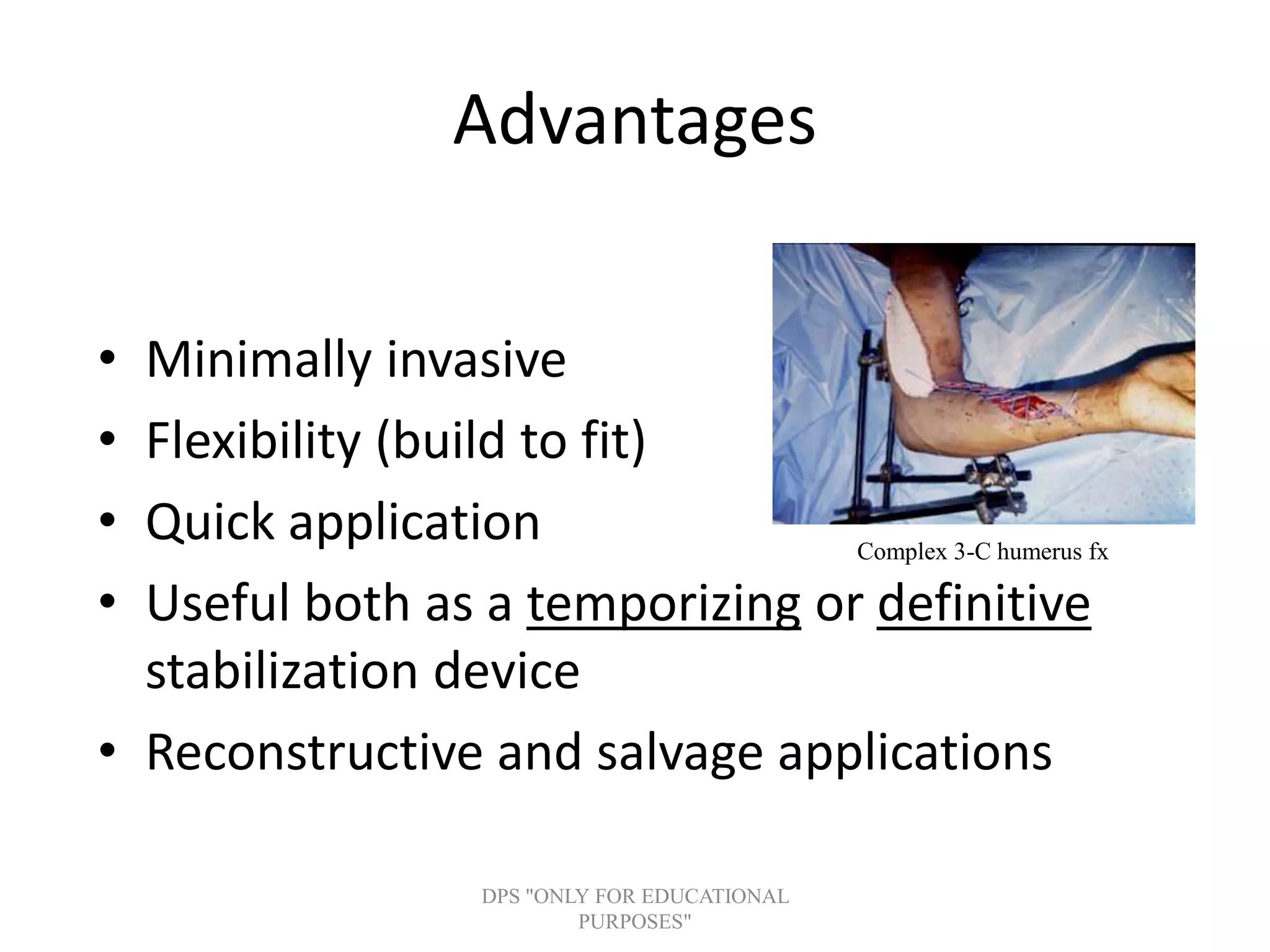
Complex 3-C humerus fx
DPS "ONLY FOR EDUCATIONAL
PURPOSES"
Disadvantages
• Mechanical
– Distraction of fracture site
– Inadequate immobilization
– Pin-bone interface failure
– Weight/bulk
– Refracture (pediatric femur)
• Biologic
– Infection (pin track)
• May preclude conversion to IM nailing or internal fixation
– Neurovascular injury
– Tethering of muscle
– Soft tissue contracture
May result in
malunion/nonunion,
loss of function
DPS "ONLY FOR EDUCATIONAL
PURPOSES"
Components of the Ex-fix
• Pins
• Clamps
• Connecting rods
DPS "ONLY FOR EDUCATIONAL
PURPOSES"
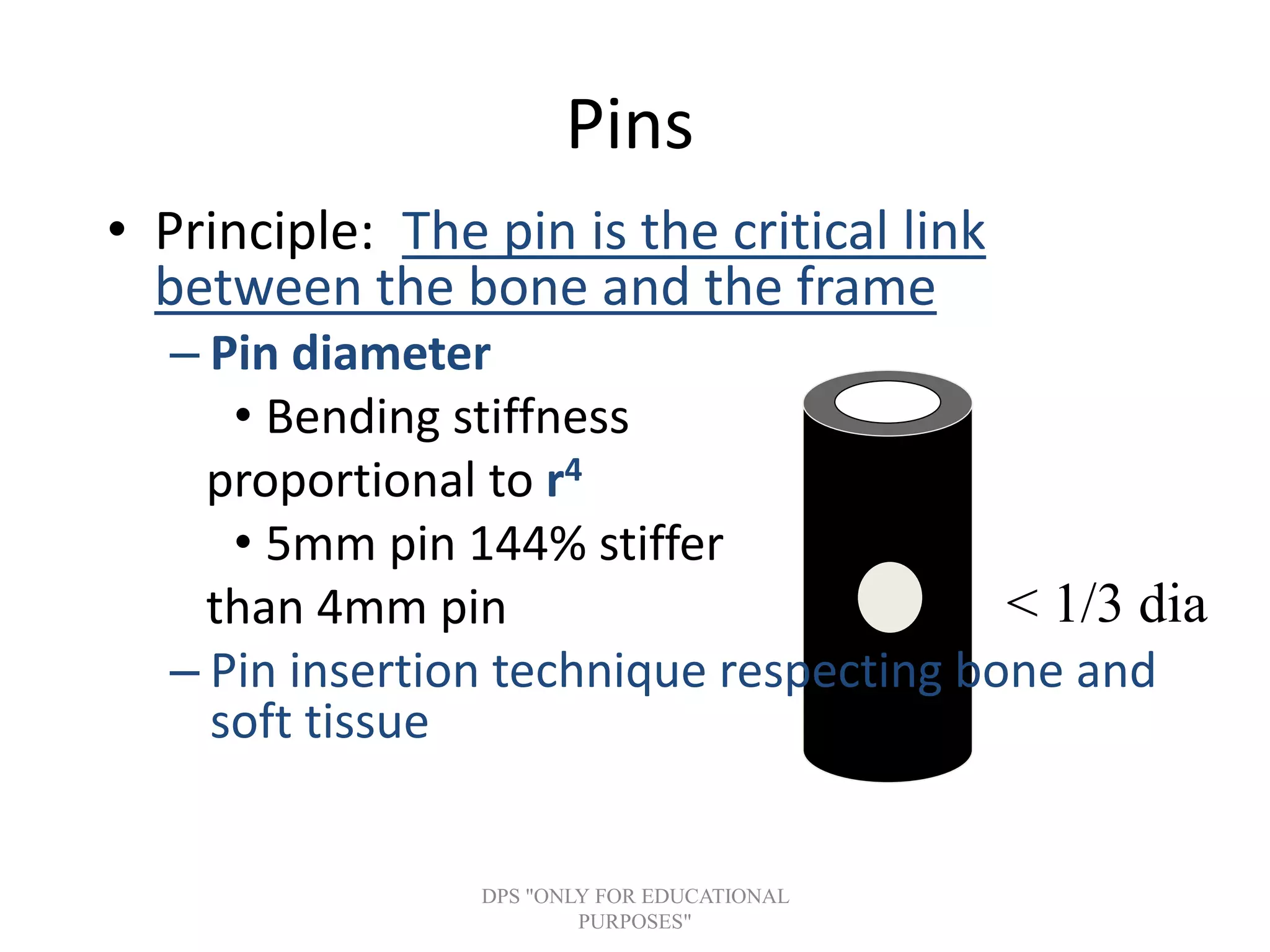
< 1/3 dia
Pins
• Principle: The pin is the critical link
between the bone and the frame
– Pin diameter
• Bending stiffness
proportional to r4
• 5mm pin 144% stiffer
than 4mm pin
– Pin insertion technique respecting bone and
soft tissue
DPS "ONLY FOR EDUCATIONAL
PURPOSES"
Pins
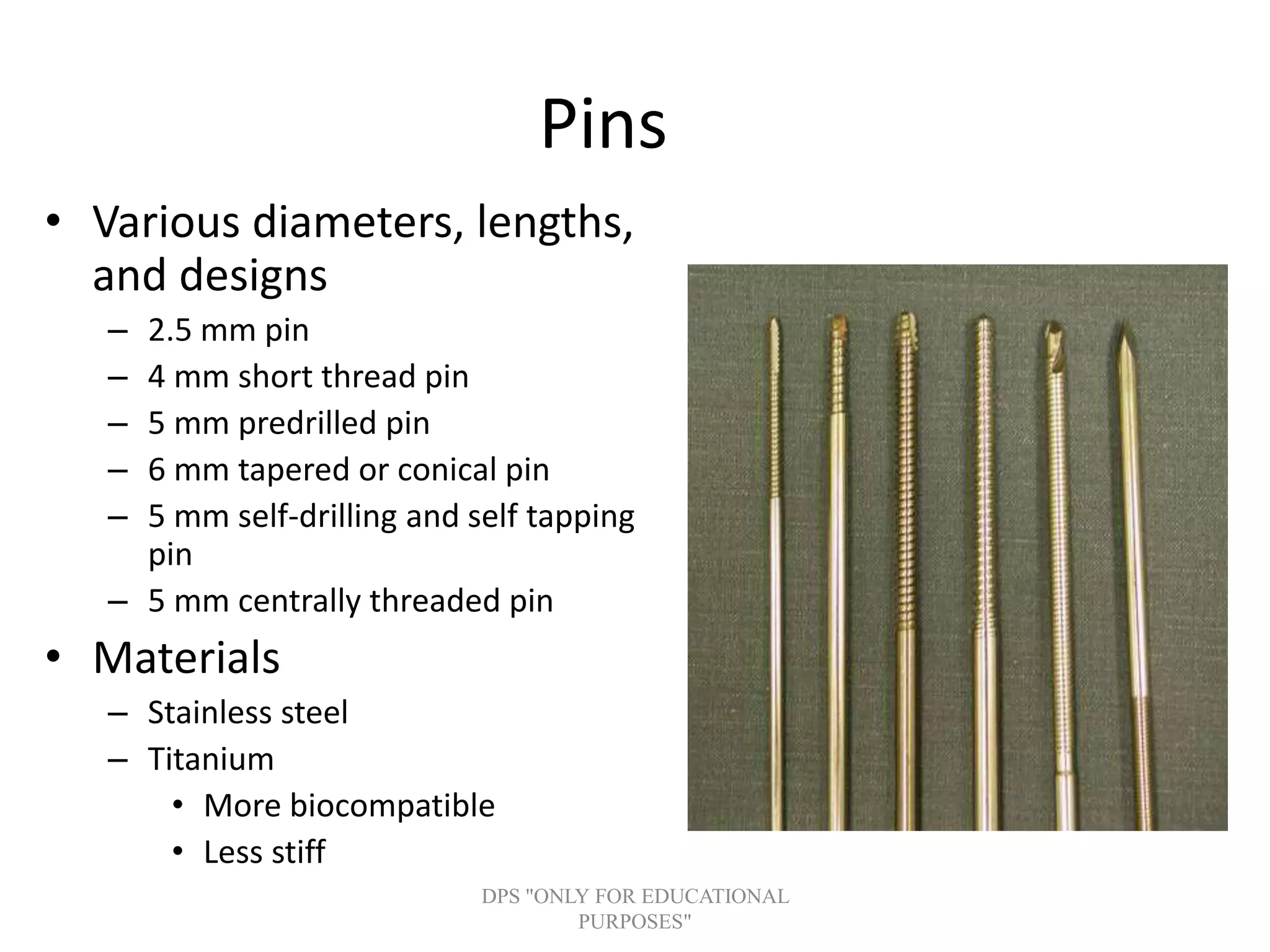
• Various diameters, lengths,
and designs
– 2.5 mm pin
– 4 mm short thread pin
– 5 mm predrilled pin
– 6 mm tapered or conical pin
– 5 mm self-drilling and self tapping
pin
– 5 mm centrally threaded pin
• Materials
– Stainless steel
– Titanium
• More biocompatible
• Less stiff
DPS "ONLY FOR EDUCATIONAL
PURPOSES"
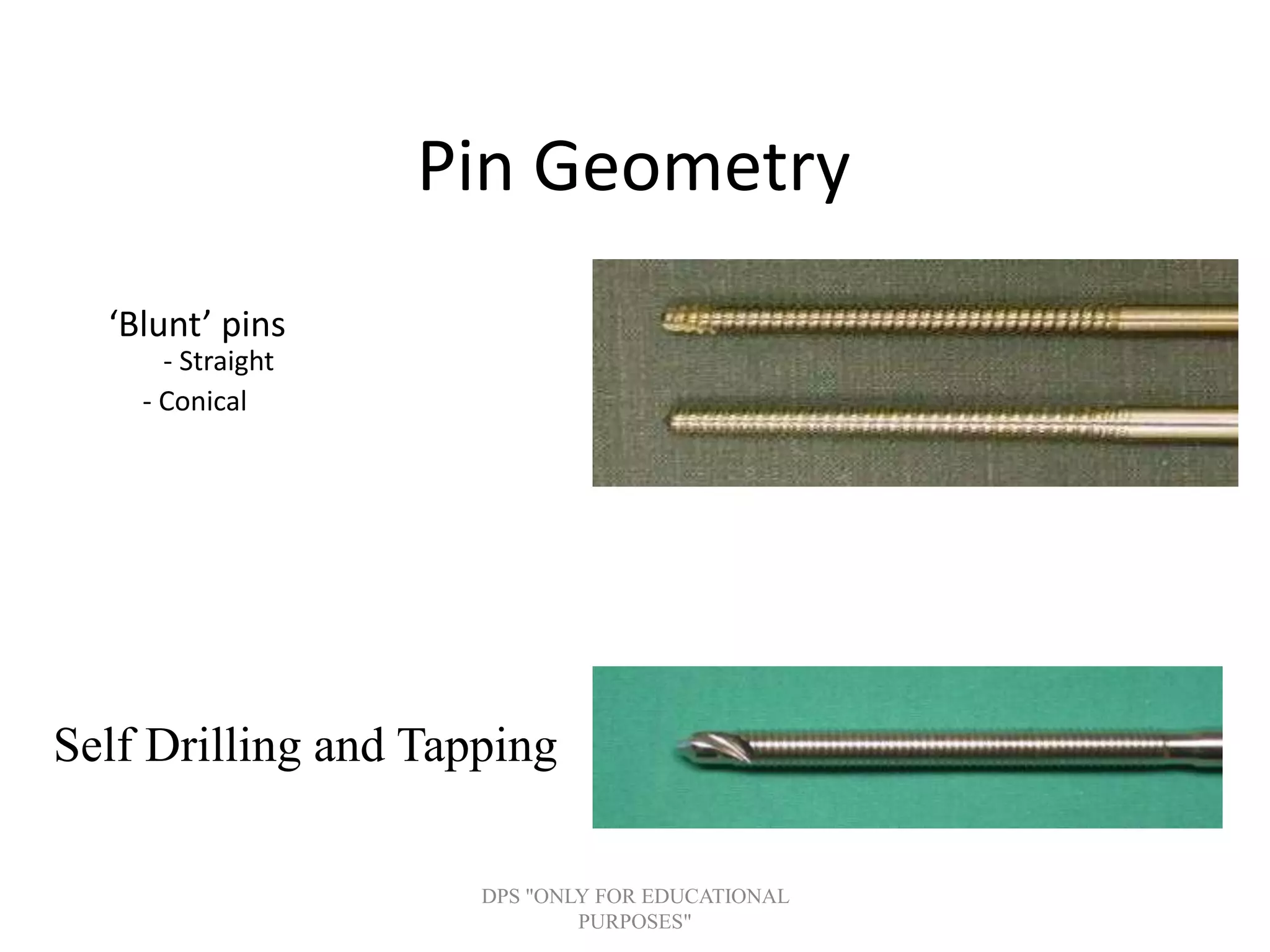
Pin Geometry
‘Blunt’ pins
- Straight
- Conical
Self Drilling and Tapping
DPS "ONLY FOR EDUCATIONAL
PURPOSES"
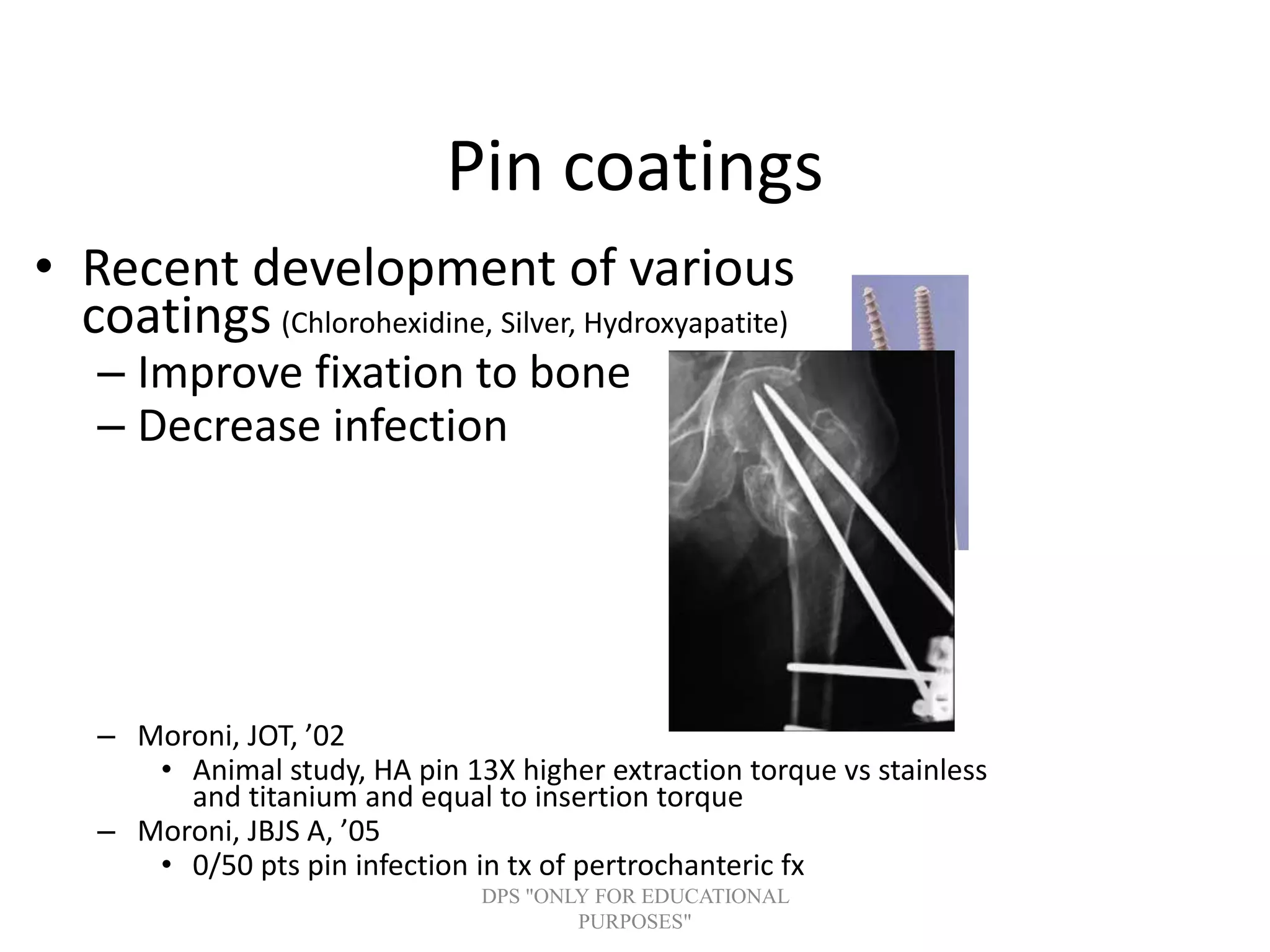
Pin coatings
• Recent development of various
coatings (Chlorohexidine, Silver, Hydroxyapatite)
– Improve fixation to bone
– Decrease infection
– Moroni, JOT, ’02
• Animal study, HA pin 13X higher extraction torque vs stainless
and titanium and equal to insertion torque
– Moroni, JBJS A, ’05
• 0/50 pts pin infection in tx of pertrochanteric fx
DPS "ONLY FOR EDUCATIONAL
PURPOSES"
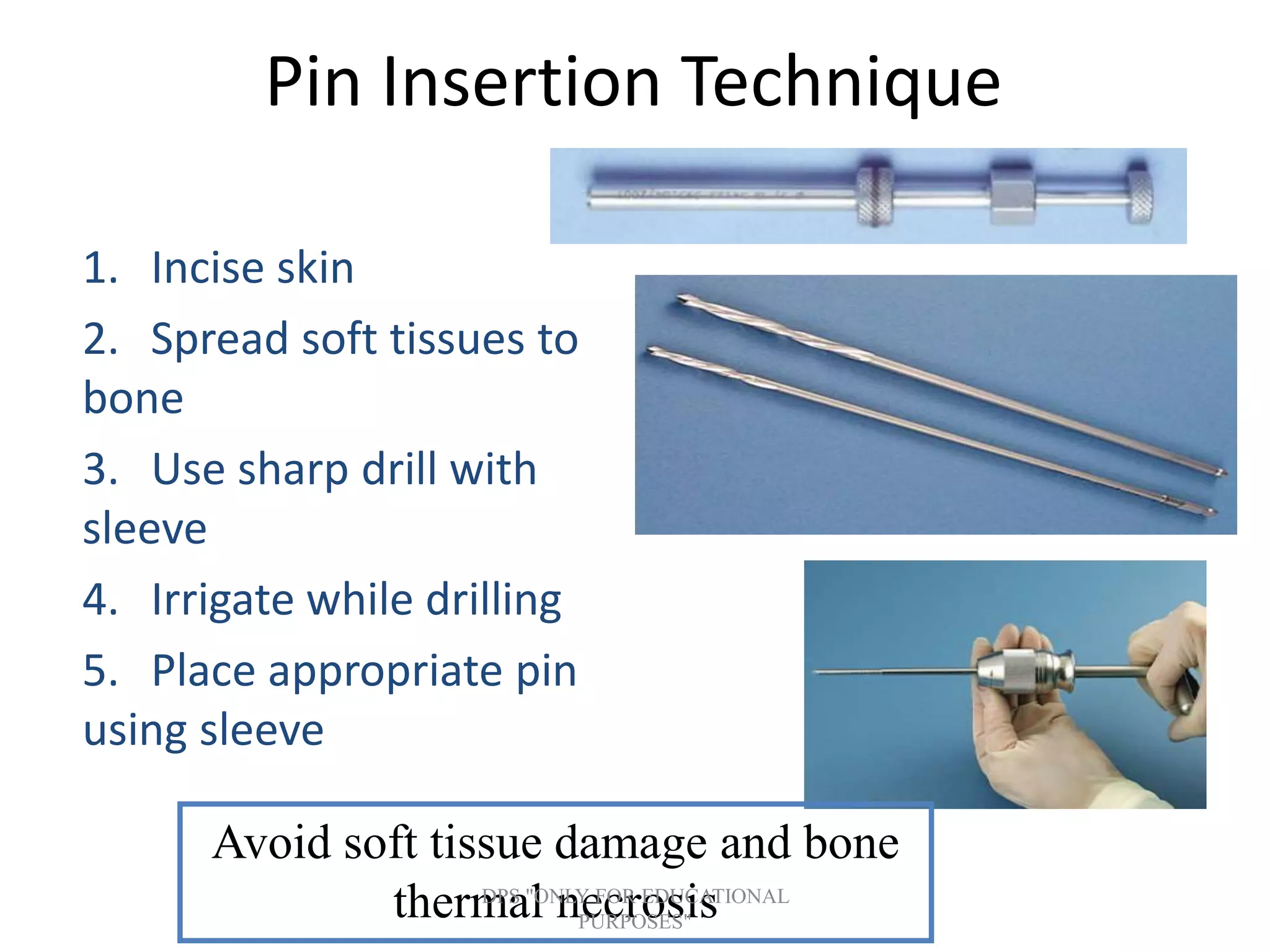
Pin Insertion Technique
1. Incise skin
2. Spread soft tissues to
bone
3. Use sharp drill with
sleeve
4. Irrigate while drilling
5. Place appropriate pin
using sleeve
Avoid soft tissue damage and bone
thermal necrosisDPS "ONLY FOR EDUCATIONAL
PURPOSES"
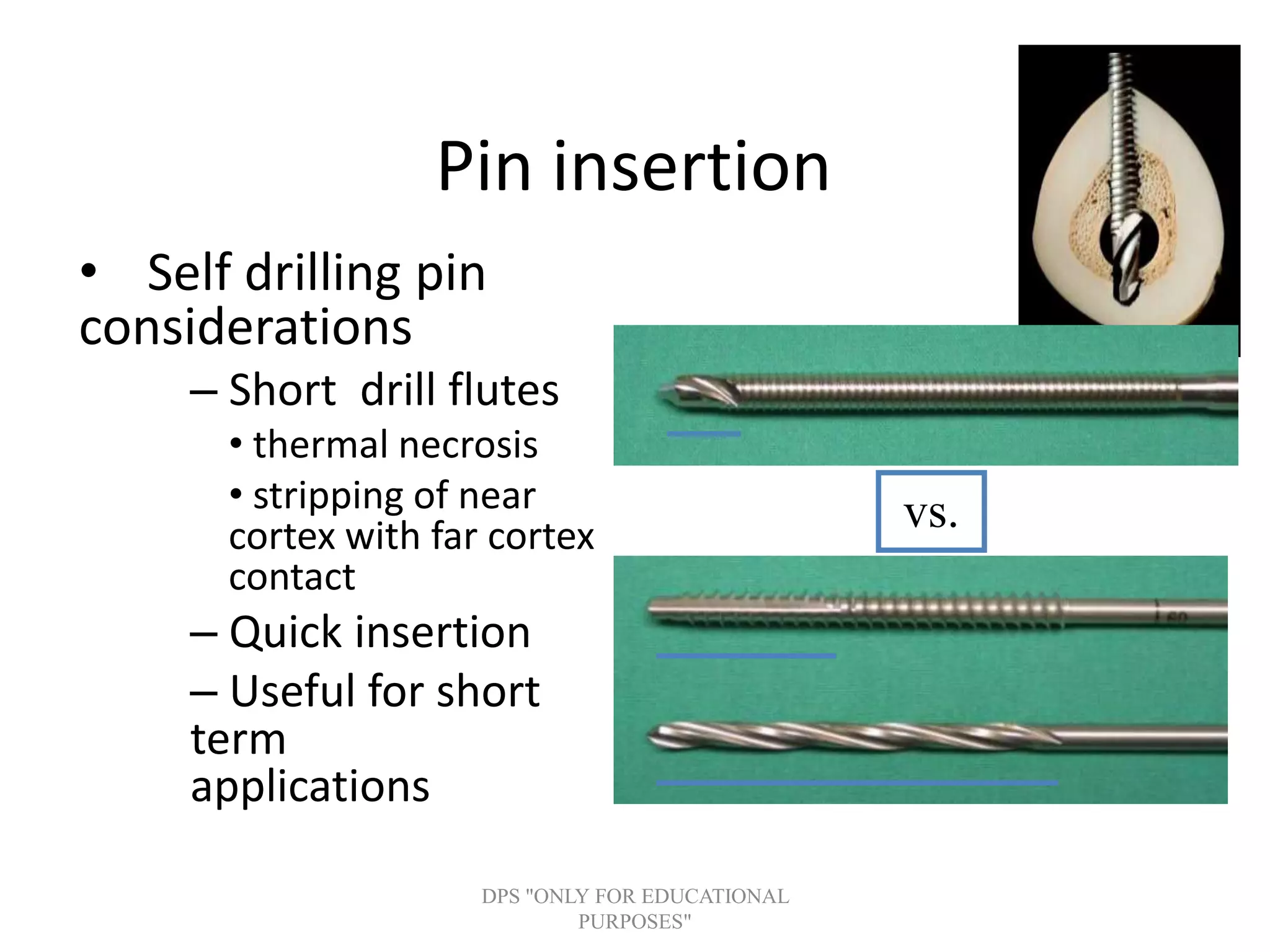
Pin insertion
• Self drilling pin
considerations
– Short drill flutes
• thermal necrosis
• stripping of near
cortex with far cortex
contact
– Quick insertion
– Useful for short
term
applications
vs.
DPS "ONLY FOR EDUCATIONAL
PURPOSES"
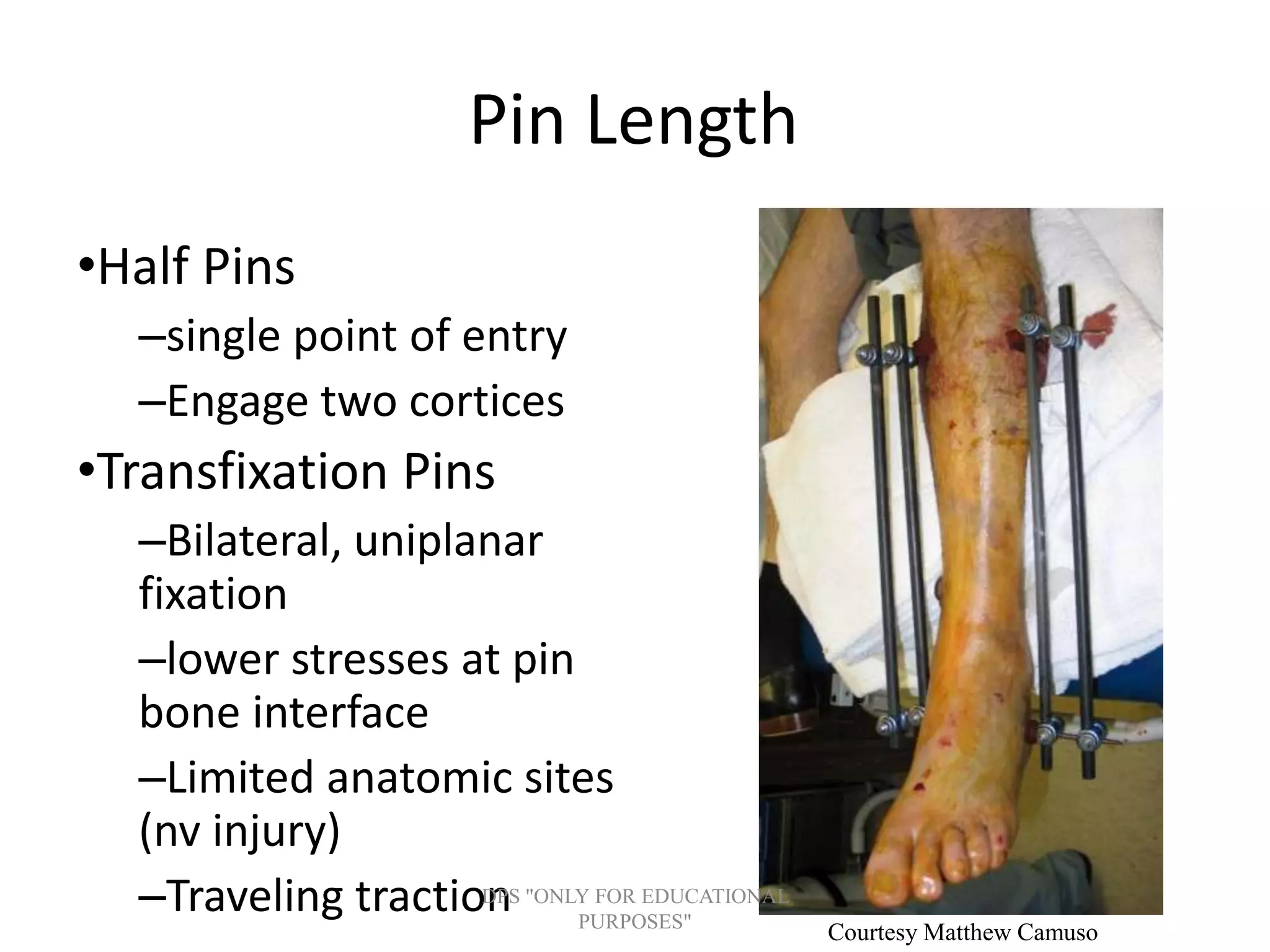
Pin Length
•Half Pins
–single point of entry
–Engage two cortices
•Transfixation Pins
–Bilateral, uniplanar
fixation
–lower stresses at pin
bone interface
–Limited anatomic sites
(nv injury)
–Traveling traction
Courtesy Matthew Camuso
DPS "ONLY FOR EDUCATIONAL
PURPOSES"
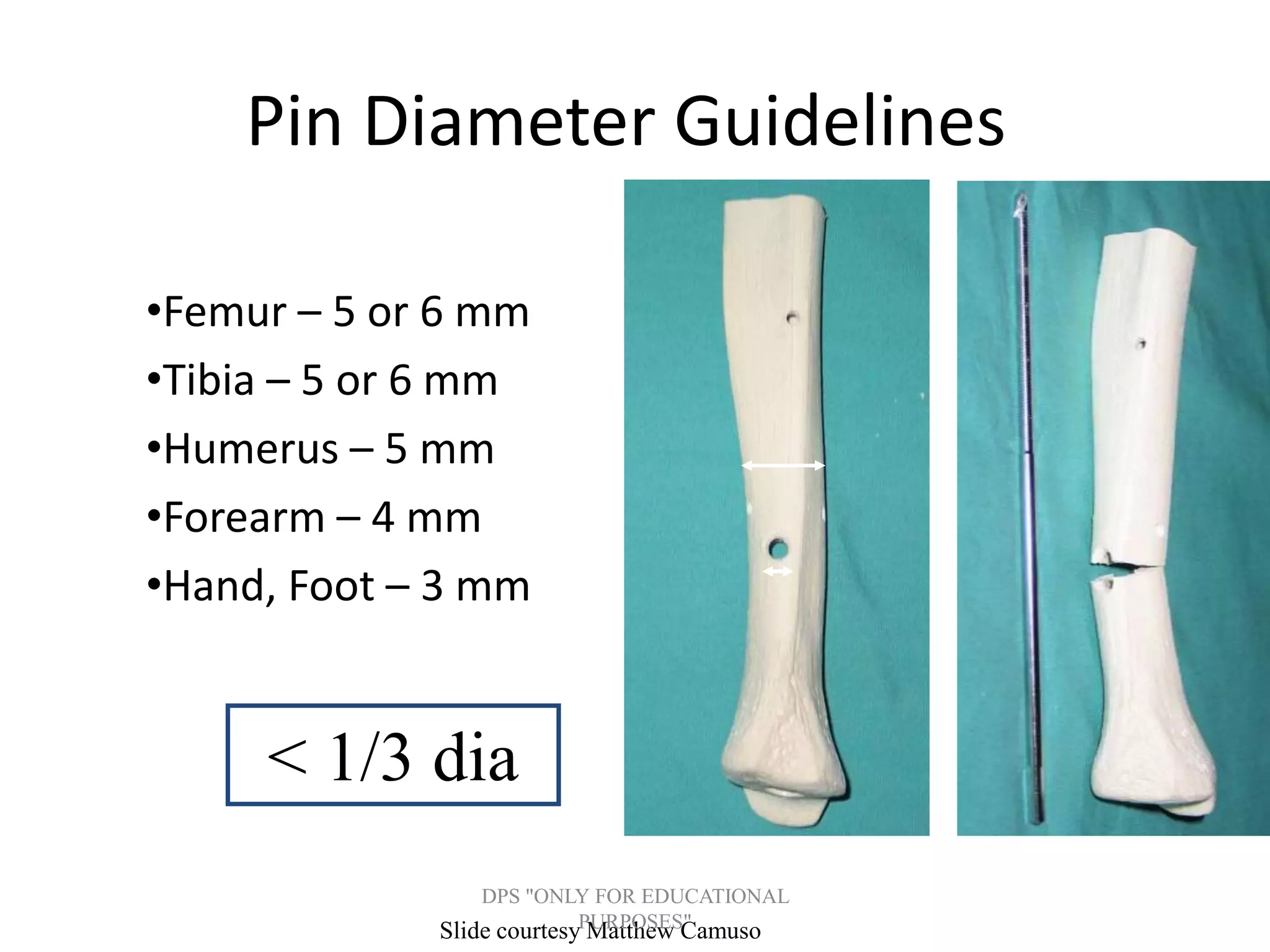
Pin Diameter Guidelines
•Femur – 5 or 6 mm
•Tibia – 5 or 6 mm
•Humerus – 5 mm
•Forearm – 4 mm
•Hand, Foot – 3 mm
Slide courtesy Matthew Camuso
< 1/3 dia
DPS "ONLY FOR EDUCATIONAL
PURPOSES"
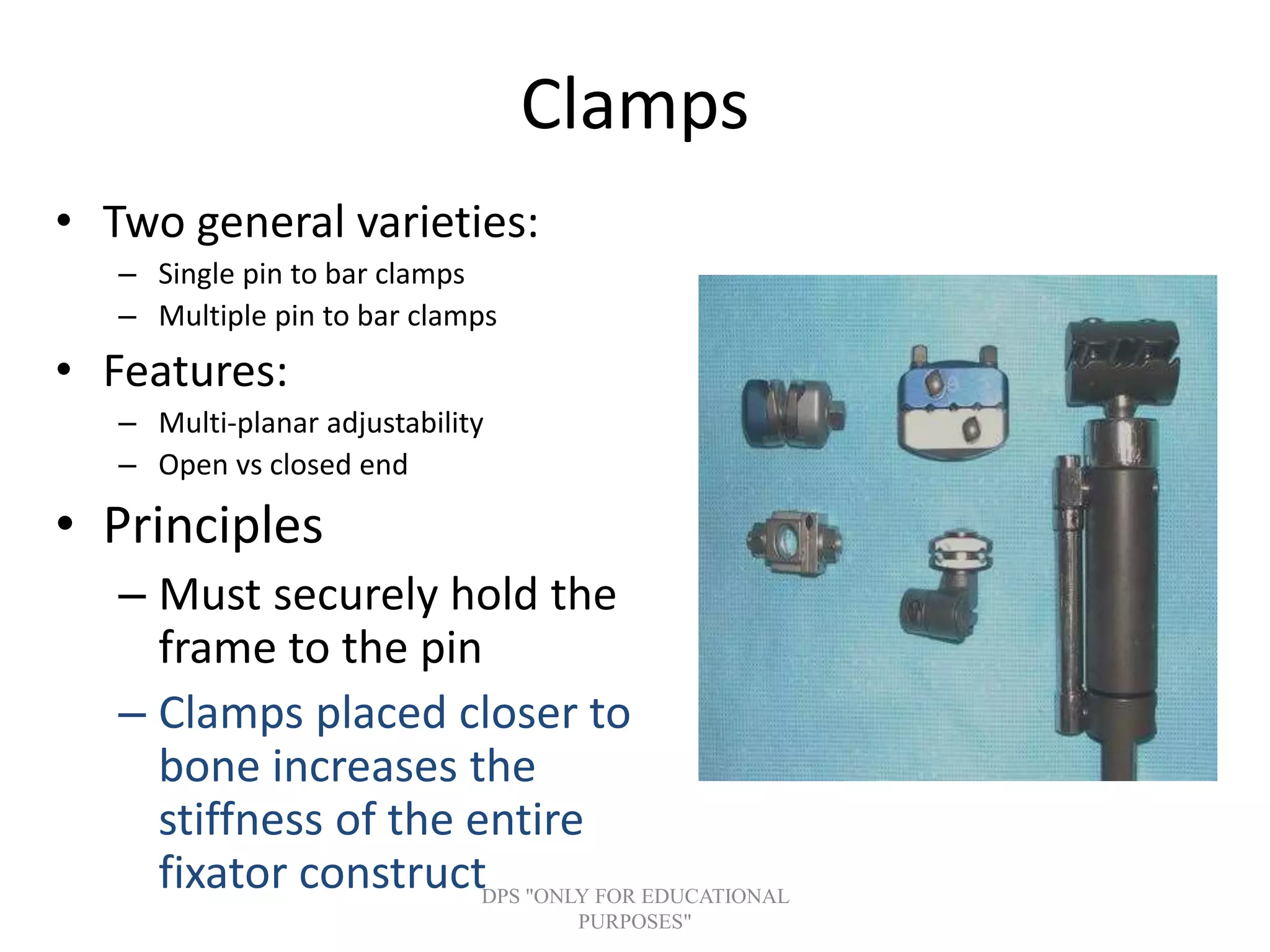
Clamps
• Two general varieties:
– Single pin to bar clamps
– Multiple pin to bar clamps
• Features:
– Multi-planar adjustability
– Open vs closed end
• Principles
– Must securely hold the
frame to the pin
– Clamps placed closer to
bone increases the
stiffness of the entire
fixator constructDPS "ONLY FOR EDUCATIONAL
PURPOSES"
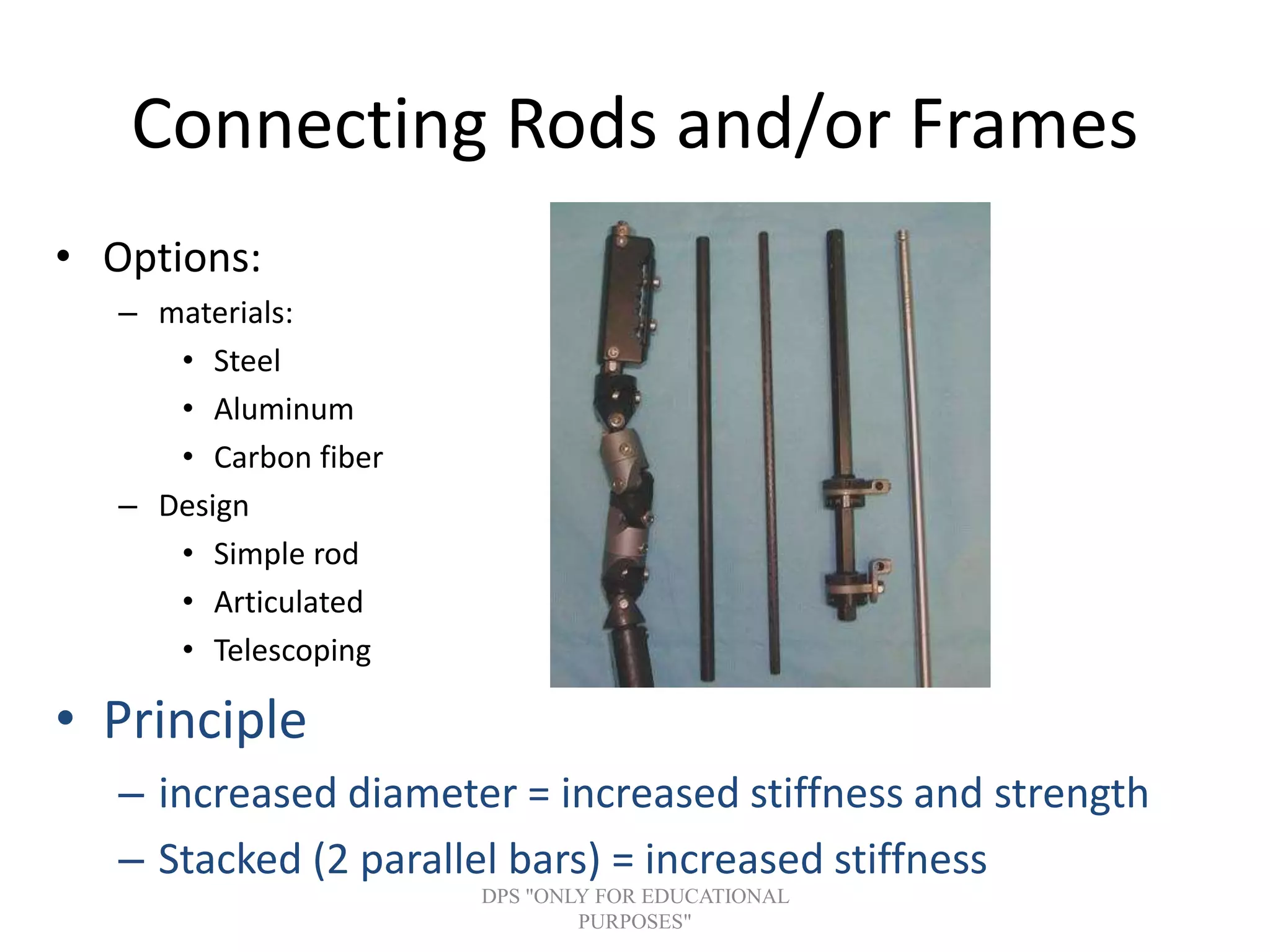
Connecting Rods and/or Frames
• Options:
– materials:
• Steel
• Aluminum
• Carbon fiber
– Design
• Simple rod
• Articulated
• Telescoping
• Principle
– increased diameter = increased stiffness and strength
– Stacked (2 parallel bars) = increased stiffness
DPS "ONLY FOR EDUCATIONAL
PURPOSES"
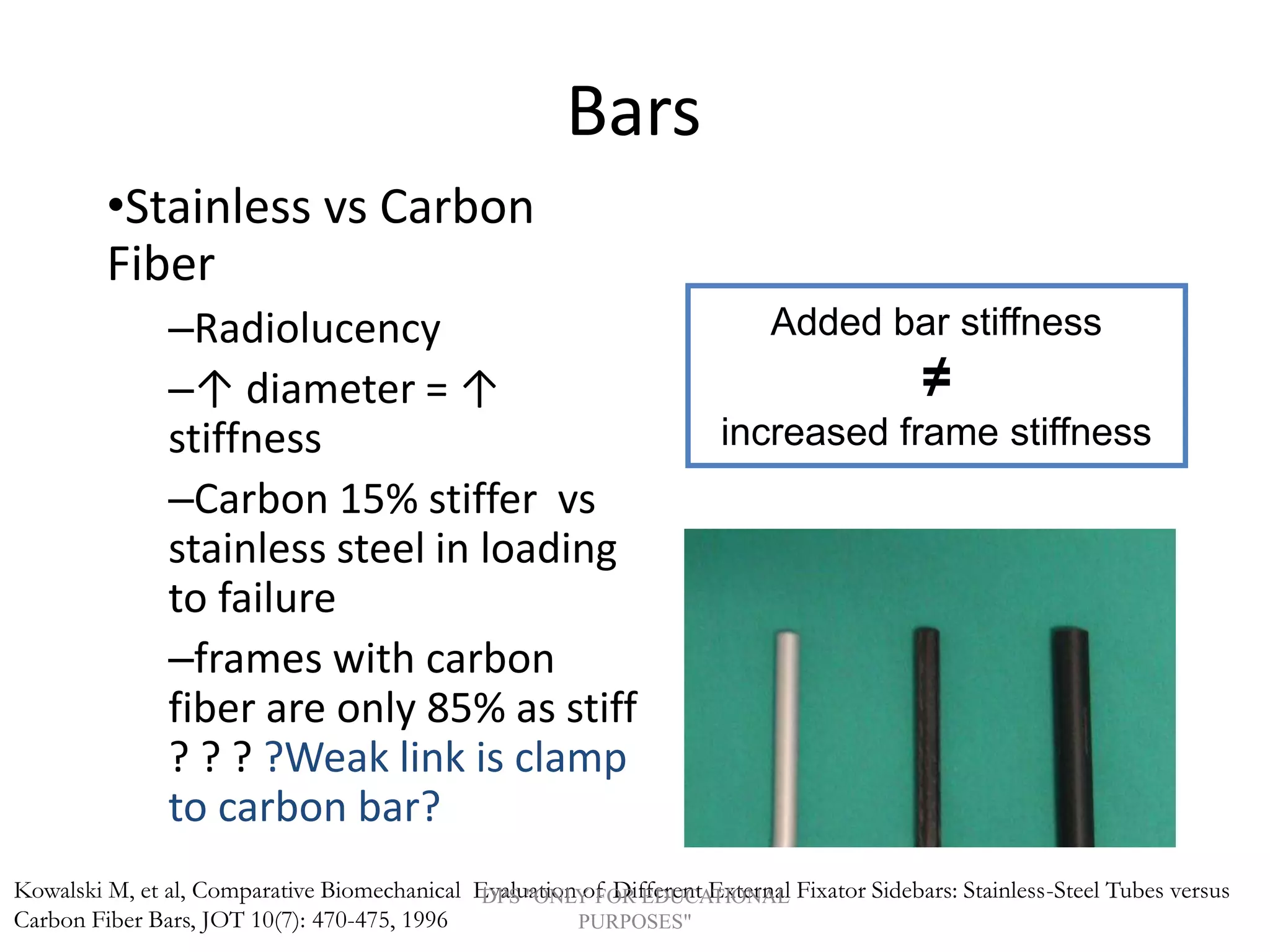
Bars
•Stainless vs Carbon
Fiber
–Radiolucency
–↑ diameter = ↑
stiffness
–Carbon 15% stiffer vs
stainless steel in loading
to failure
–frames with carbon
fiber are only 85% as stiff
? ? ? ?Weak link is clamp
to carbon bar?
Kowalski M, et al, Comparative Biomechanical Evaluation of Different External Fixator Sidebars: Stainless-Steel Tubes versus
Carbon Fiber Bars, JOT 10(7): 470-475, 1996
Added bar stiffness
≠
increased frame stiffness
DPS "ONLY FOR EDUCATIONAL
PURPOSES"
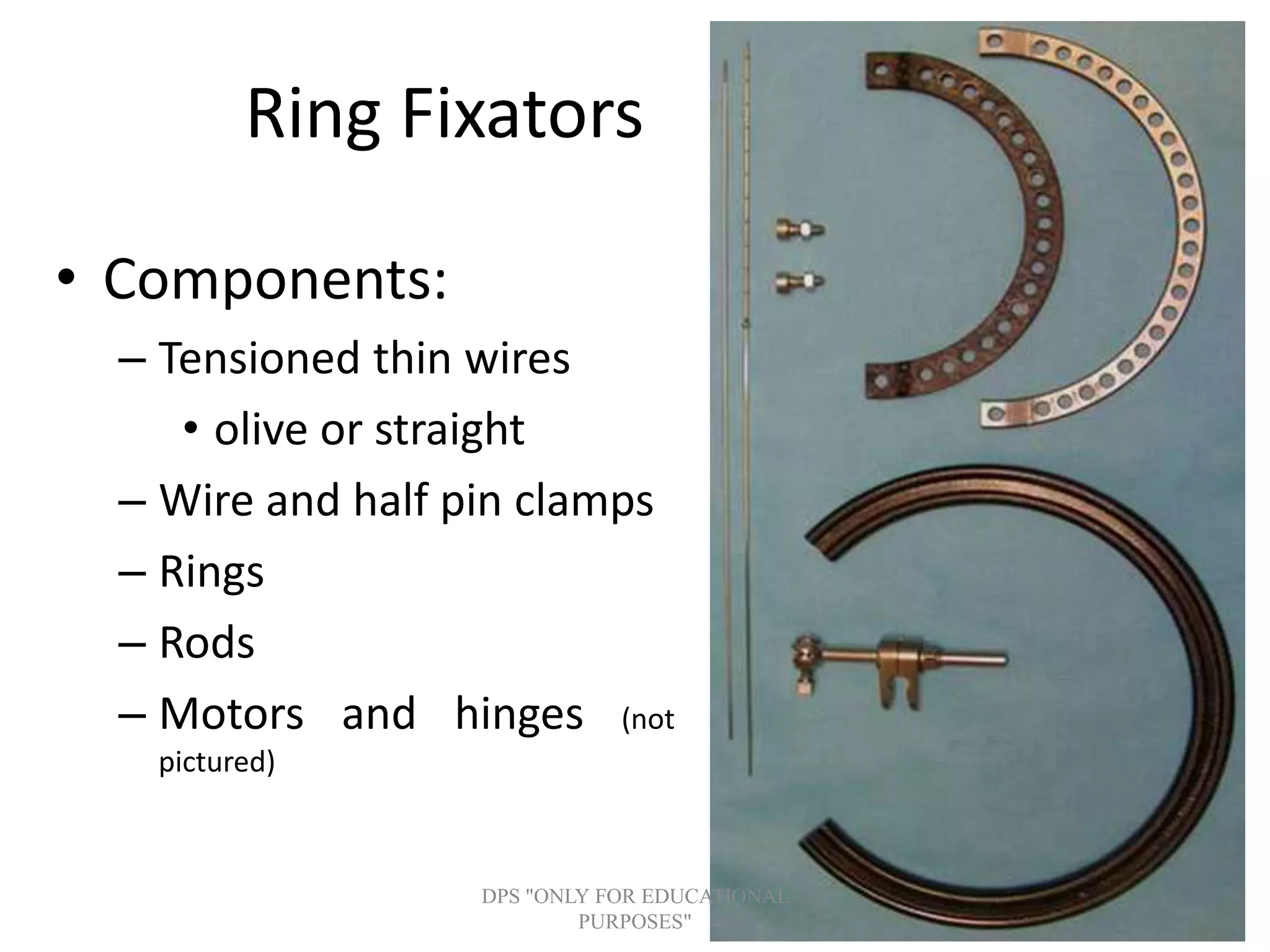
Ring Fixators
• Components:
– Tensioned thin wires
• olive or straight
– Wire and half pin clamps
– Rings
– Rods
– Motors and hinges (not
pictured)
DPS "ONLY FOR EDUCATIONAL
PURPOSES"
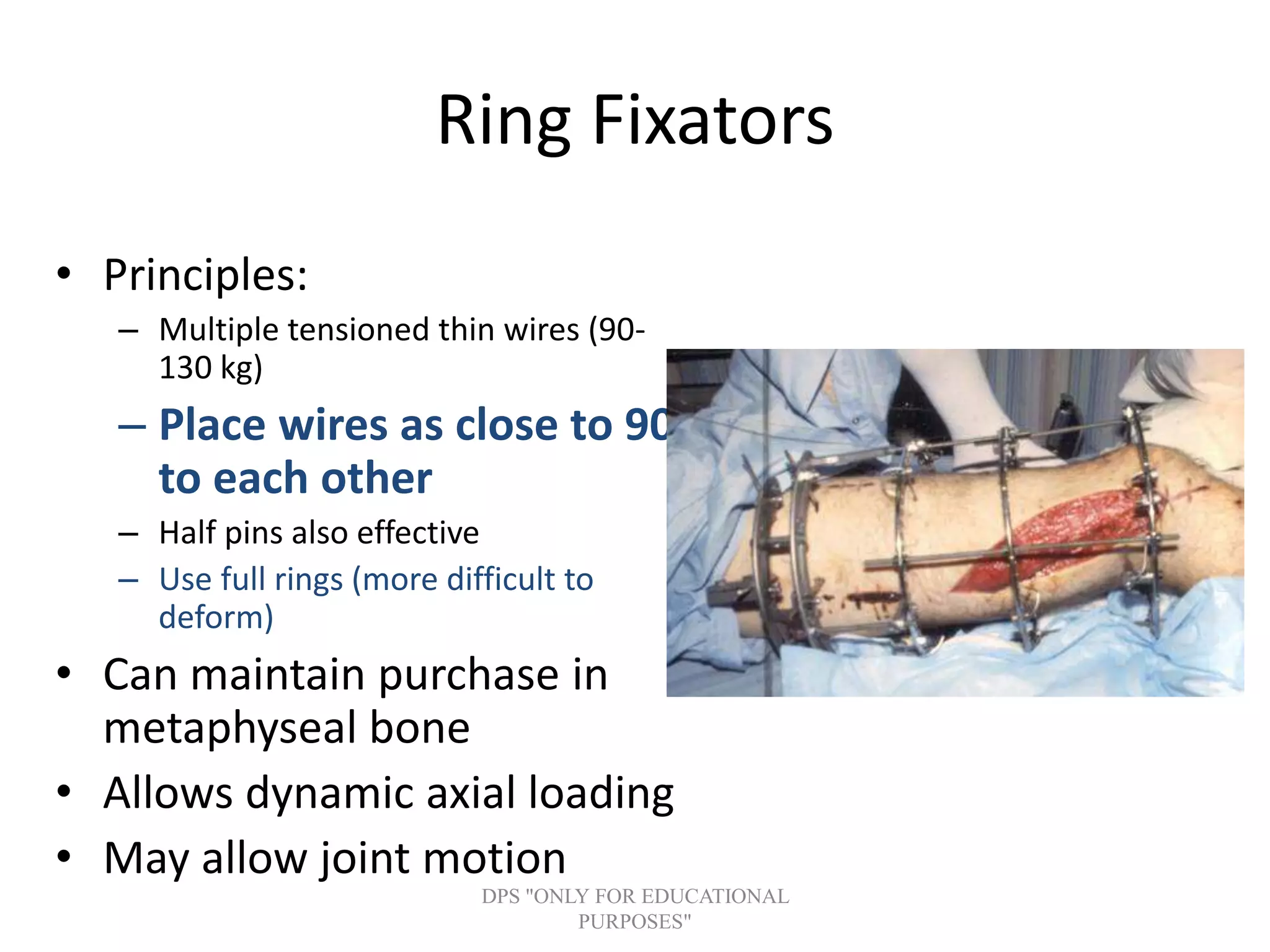
Ring Fixators
• Principles:
– Multiple tensioned thin wires (90-
130 kg)
– Place wires as close to 90o
to each other
– Half pins also effective
– Use full rings (more difficult to
deform)
• Can maintain purchase in
metaphyseal bone
• Allows dynamic axial loading
• May allow joint motion
DPS "ONLY FOR EDUCATIONAL
PURPOSES"
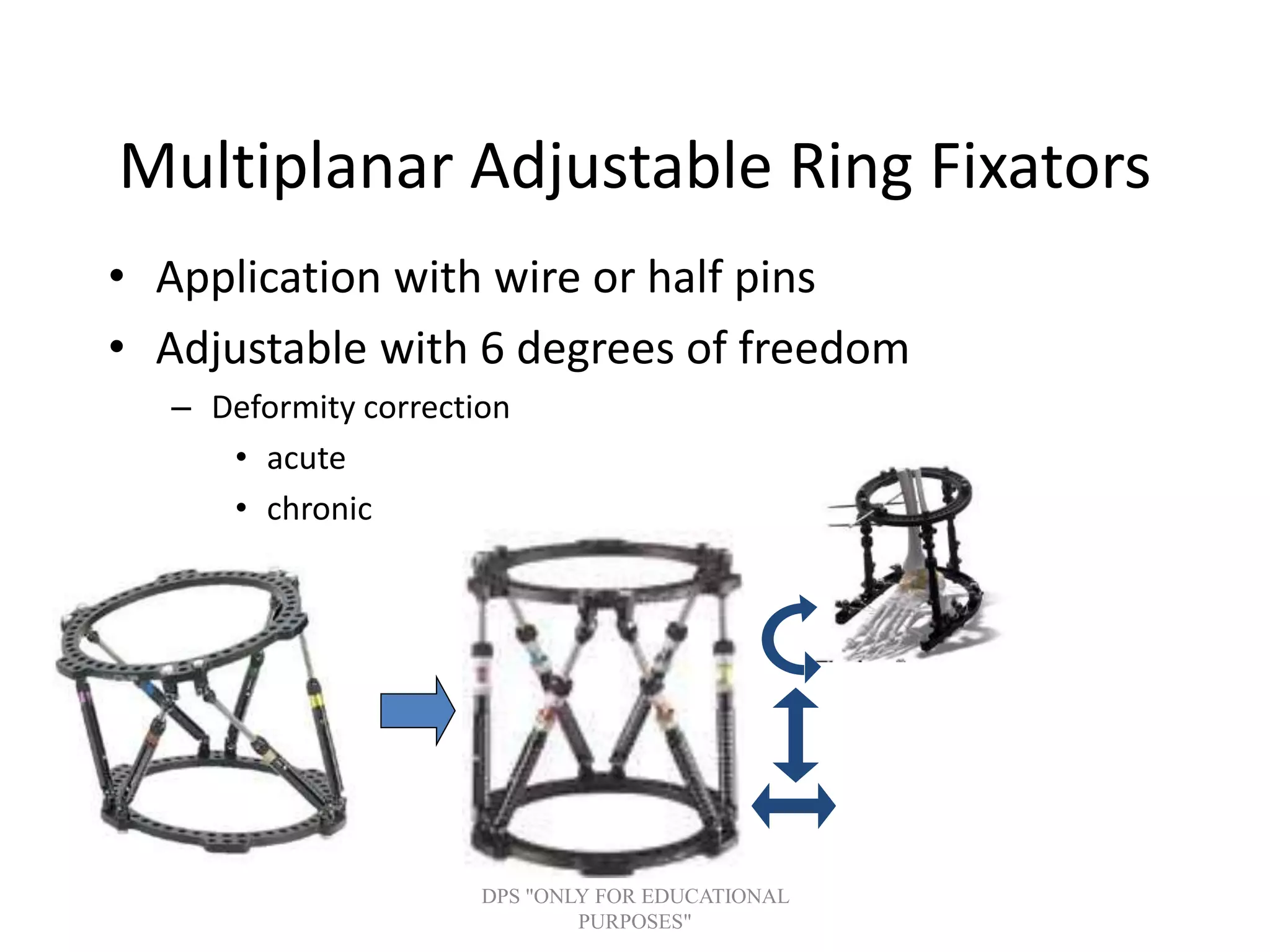
Multiplanar Adjustable Ring Fixators
• Application with wire or half pins
• Adjustable with 6 degrees of freedom
– Deformity correction
• acute
• chronic
DPS "ONLY FOR EDUCATIONAL
PURPOSES"
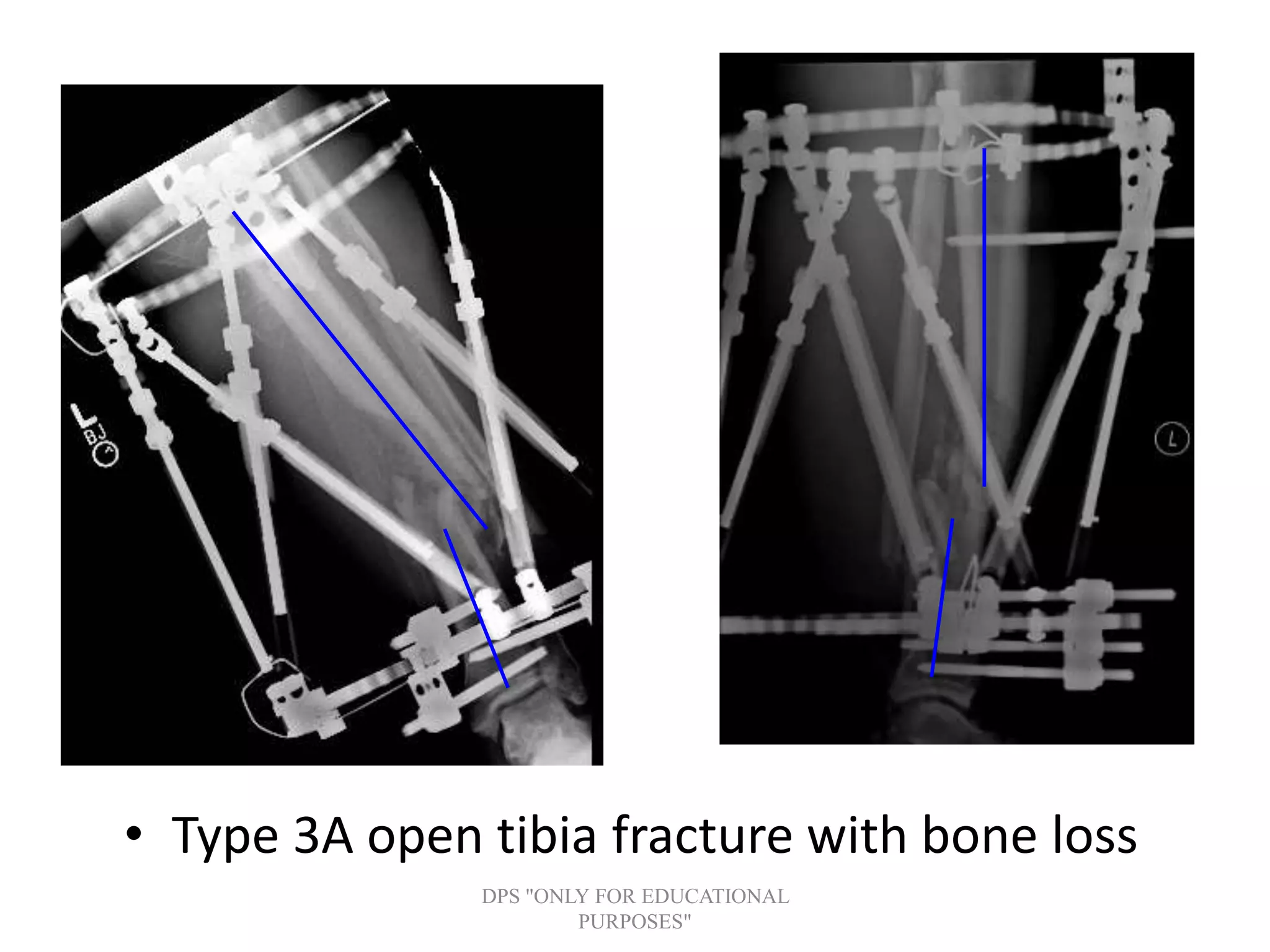
• Type 3A open tibia fracture with bone loss
DPS "ONLY FOR EDUCATIONAL
PURPOSES"
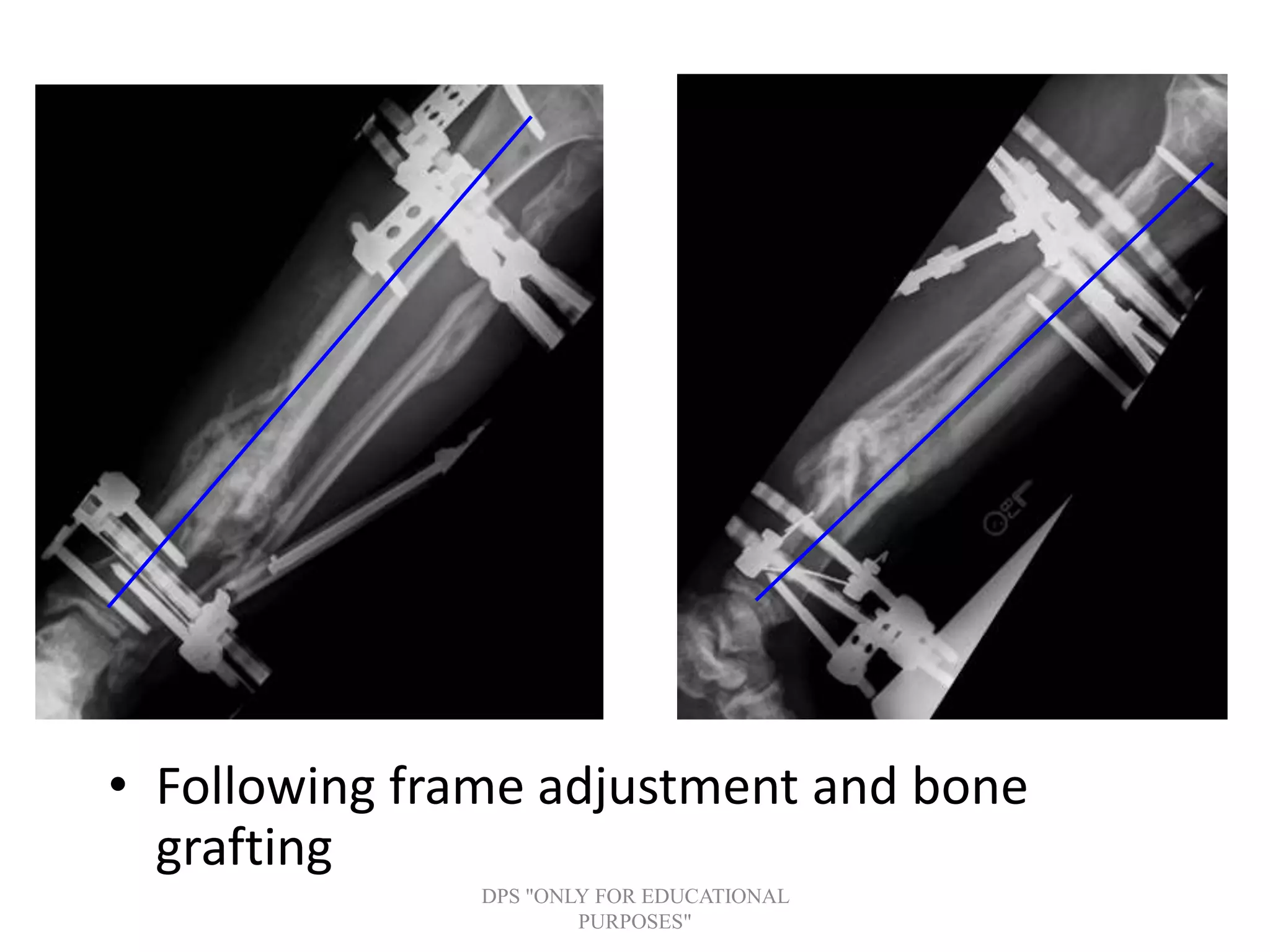
• Following frame adjustment and bone
grafting
DPS "ONLY FOR EDUCATIONAL
PURPOSES"
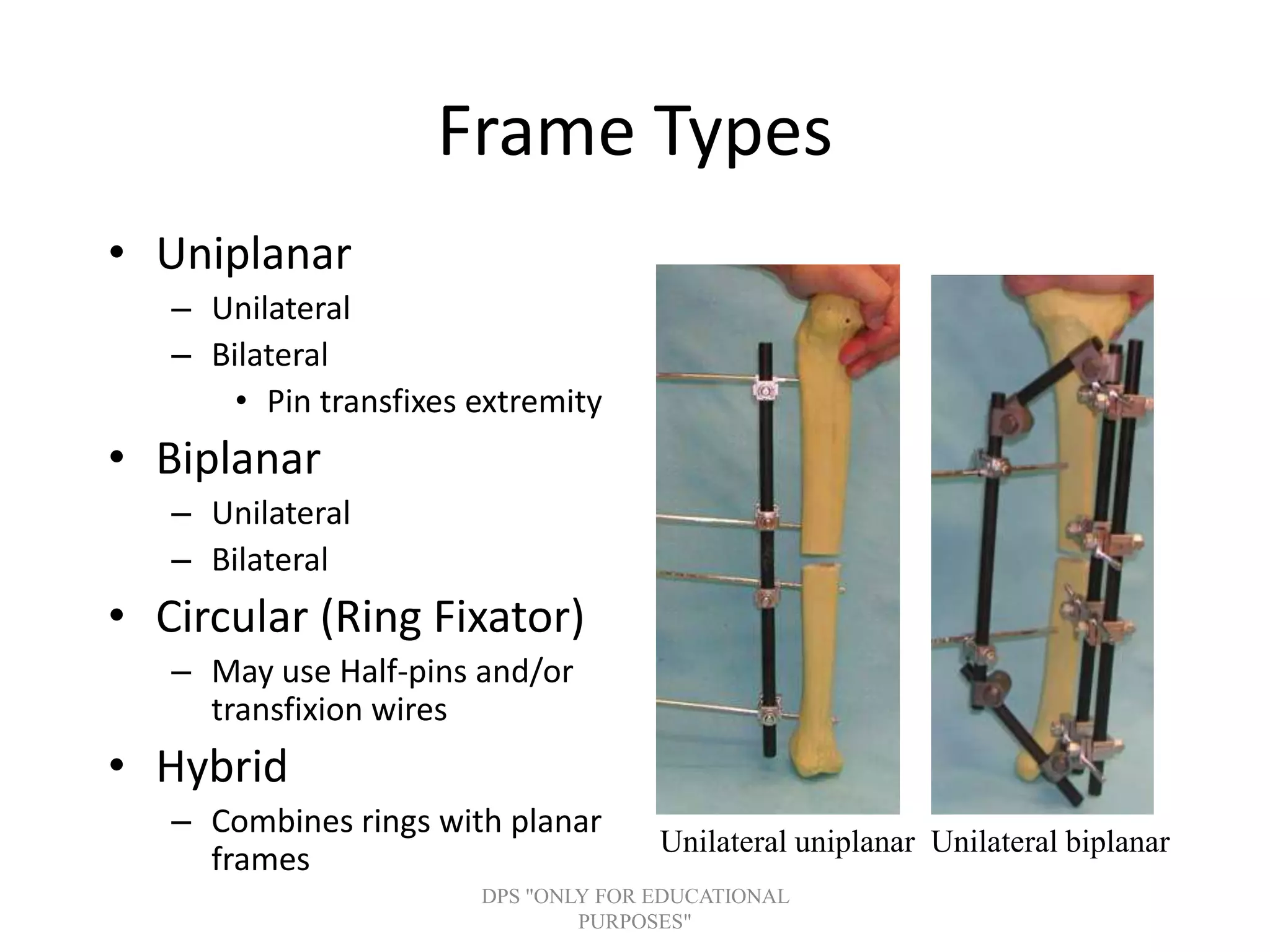
Frame Types
• Uniplanar
– Unilateral
– Bilateral
• Pin transfixes extremity
• Biplanar
– Unilateral
– Bilateral
• Circular (Ring Fixator)
– May use Half-pins and/or
transfixion wires
• Hybrid
– Combines rings with planar
frames
Unilateral uniplanar Unilateral biplanar
DPS "ONLY FOR EDUCATIONAL
PURPOSES"
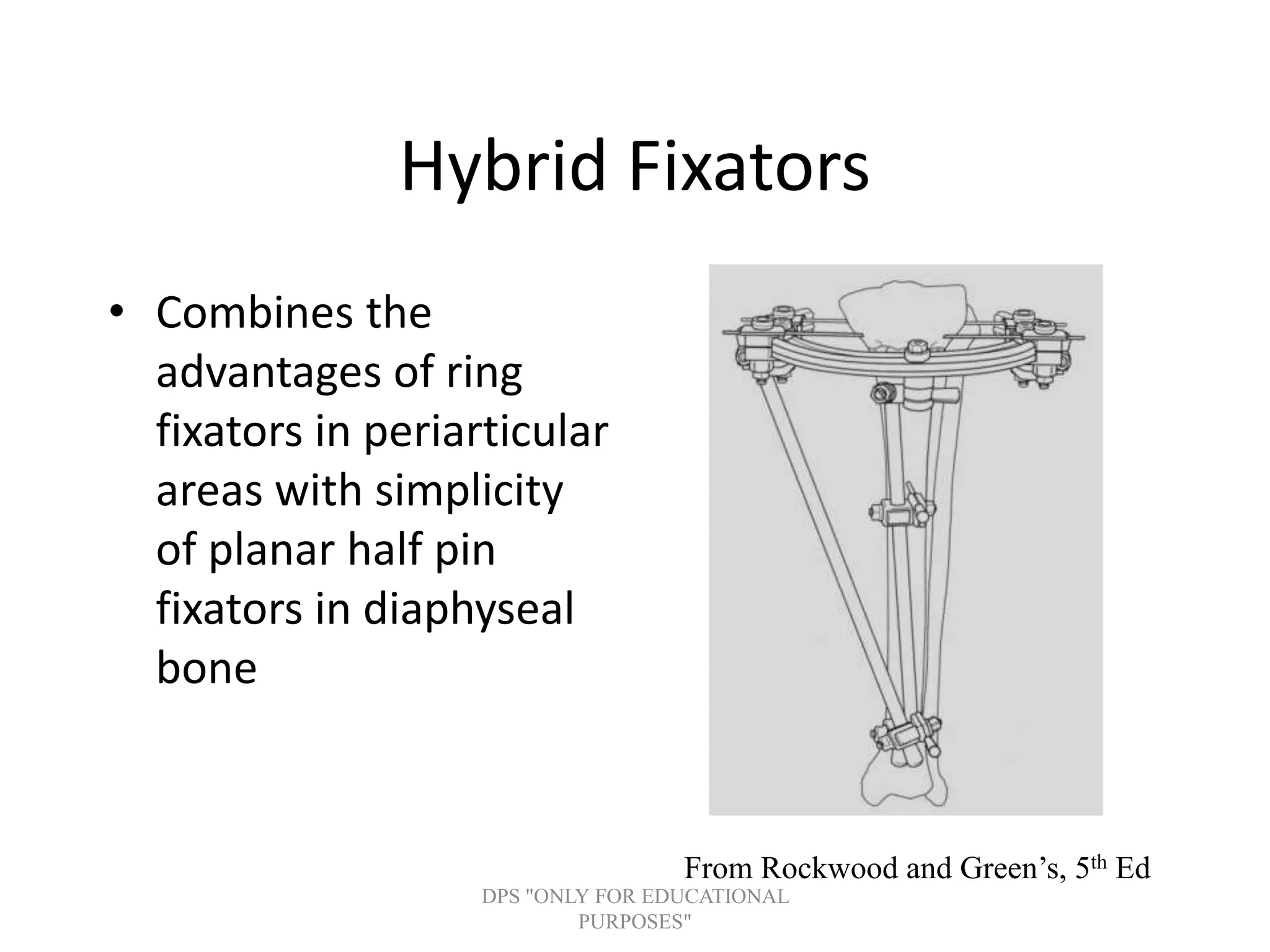
Hybrid Fixators
• Combines the
advantages of ring
fixators in periarticular
areas with simplicity
of planar half pin
fixators in diaphyseal
bone
From Rockwood and Green’s, 5th Ed
DPS "ONLY FOR EDUCATIONAL
PURPOSES"
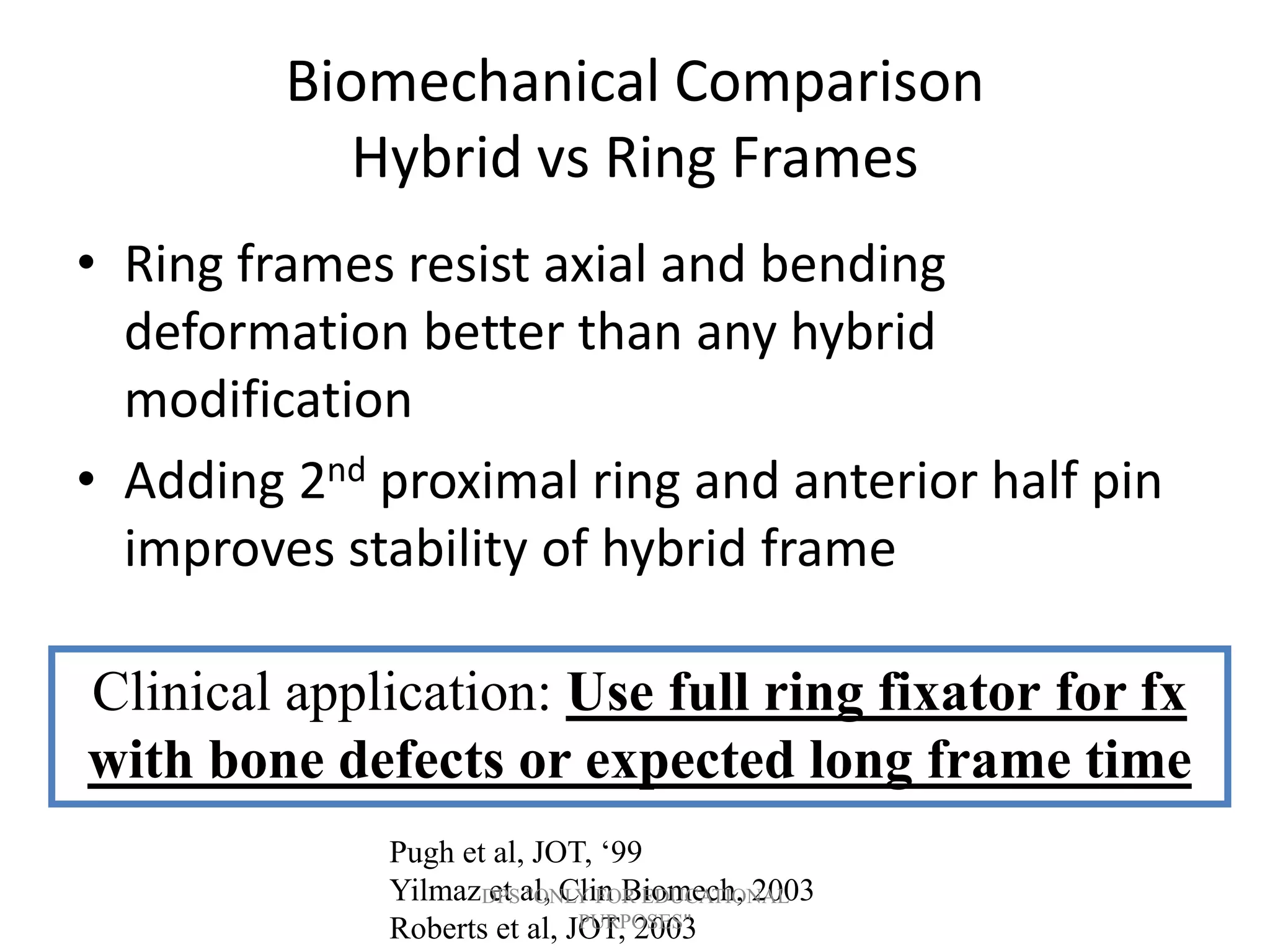
Biomechanical Comparison
Hybrid vs Ring Frames
• Ring frames resist axial and bending
deformation better than any hybrid
modification
• Adding 2nd proximal ring and anterior half pin
improves stability of hybrid frame
Pugh et al, JOT, ‘99
Yilmaz et al, Clin Biomech, 2003
Roberts et al, JOT, 2003
Clinical application: Use full ring fixator for fx
with bone defects or expected long frame time
DPS "ONLY FOR EDUCATIONAL
PURPOSES"
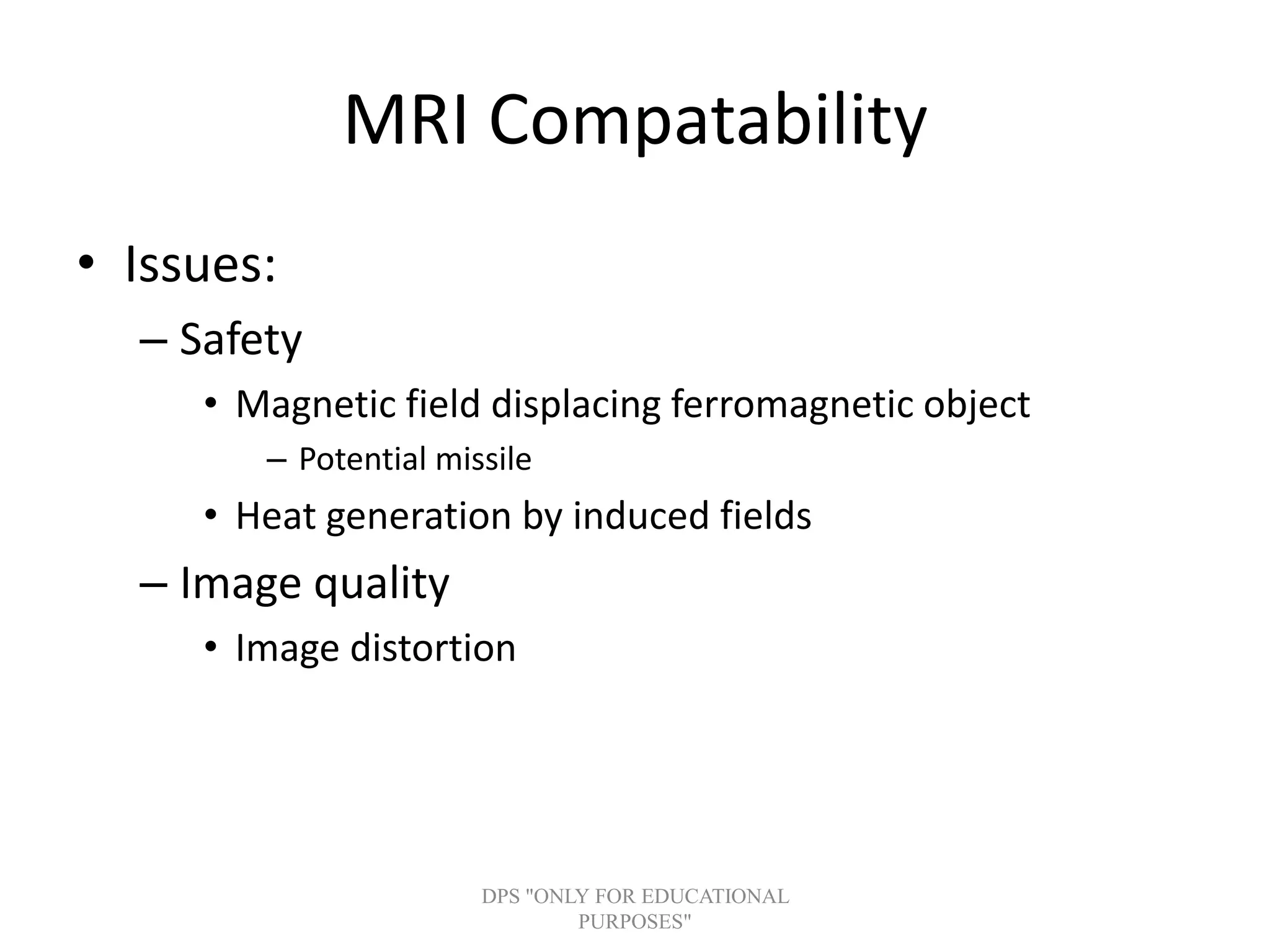
MRI Compatability
• Issues:
– Safety
• Magnetic field displacing ferromagnetic object
– Potential missile
• Heat generation by induced fields
– Image quality
• Image distortion
DPS "ONLY FOR EDUCATIONAL
PURPOSES"
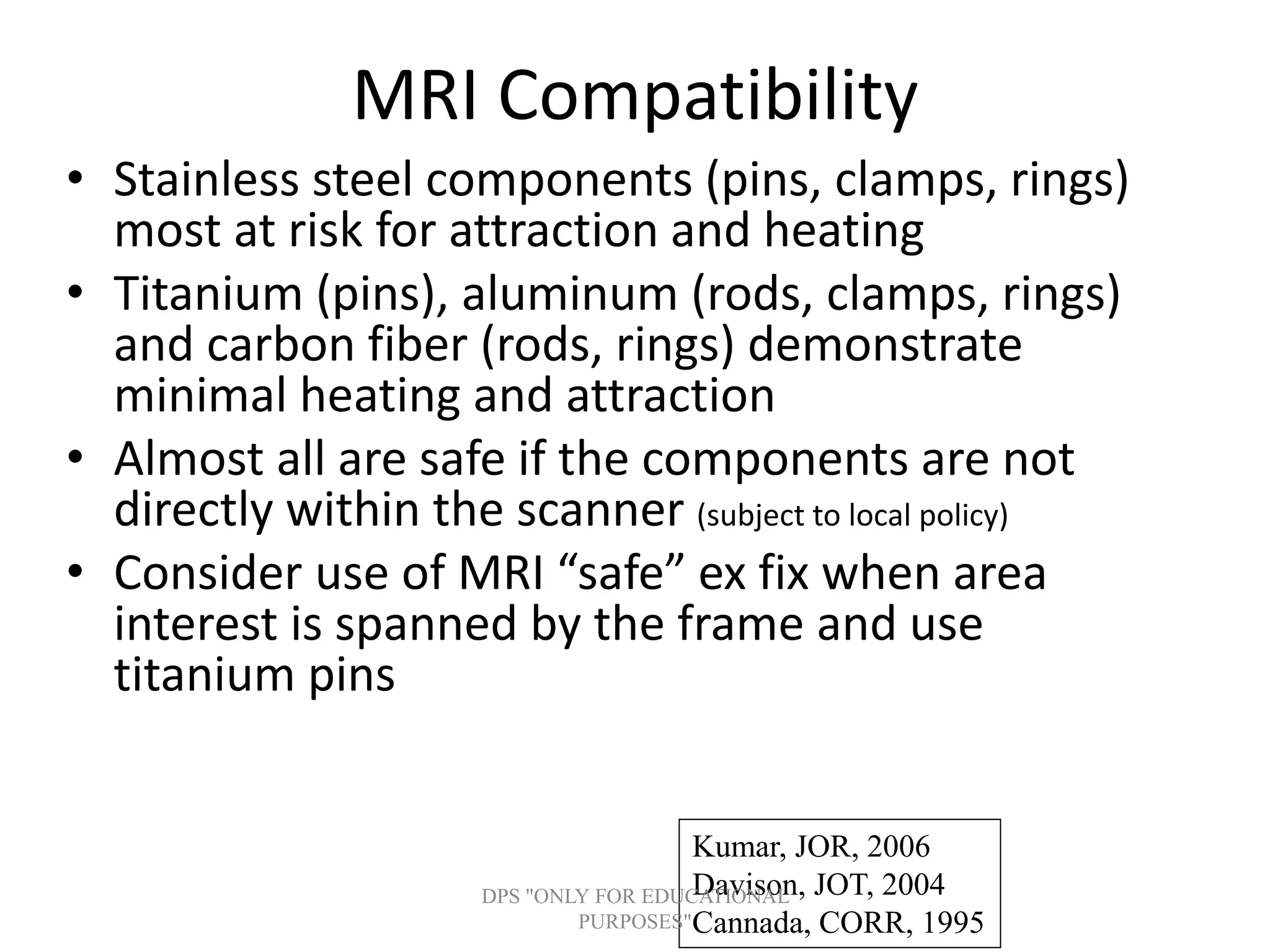
MRI Compatibility
• Stainless steel components (pins, clamps, rings)
most at risk for attraction and heating
• Titanium (pins), aluminum (rods, clamps, rings)
and carbon fiber (rods, rings) demonstrate
minimal heating and attraction
• Almost all are safe if the components are not
directly within the scanner (subject to local policy)
• Consider use of MRI “safe” ex fix when area
interest is spanned by the frame and use
titanium pins
Kumar, JOR, 2006
Davison, JOT, 2004
Cannada, CORR, 1995
DPS "ONLY FOR EDUCATIONAL
PURPOSES"
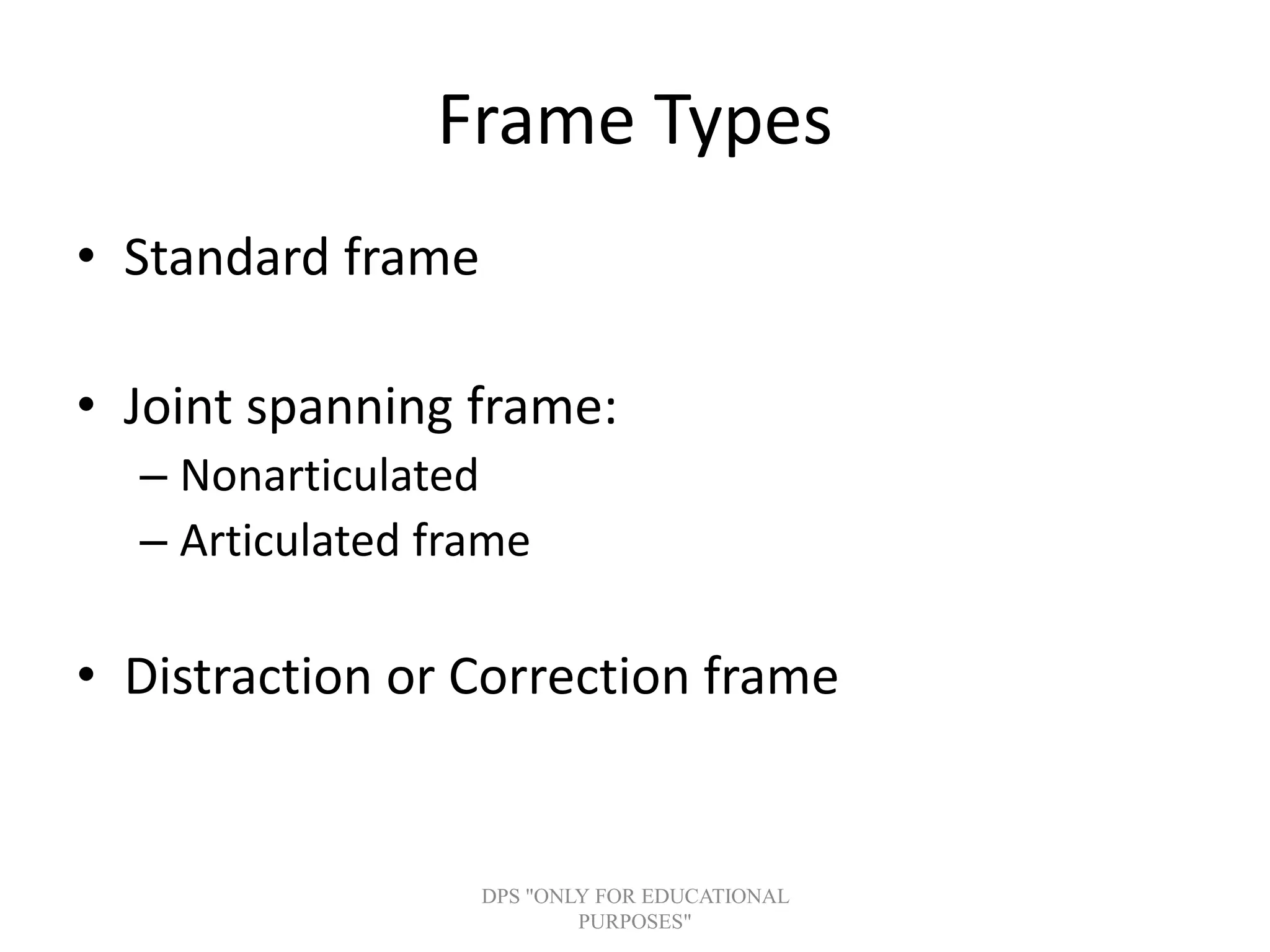
Frame Types
• Standard frame
• Joint spanning frame:
– Nonarticulated
– Articulated frame
• Distraction or Correction frame
DPS "ONLY FOR EDUCATIONAL
PURPOSES"
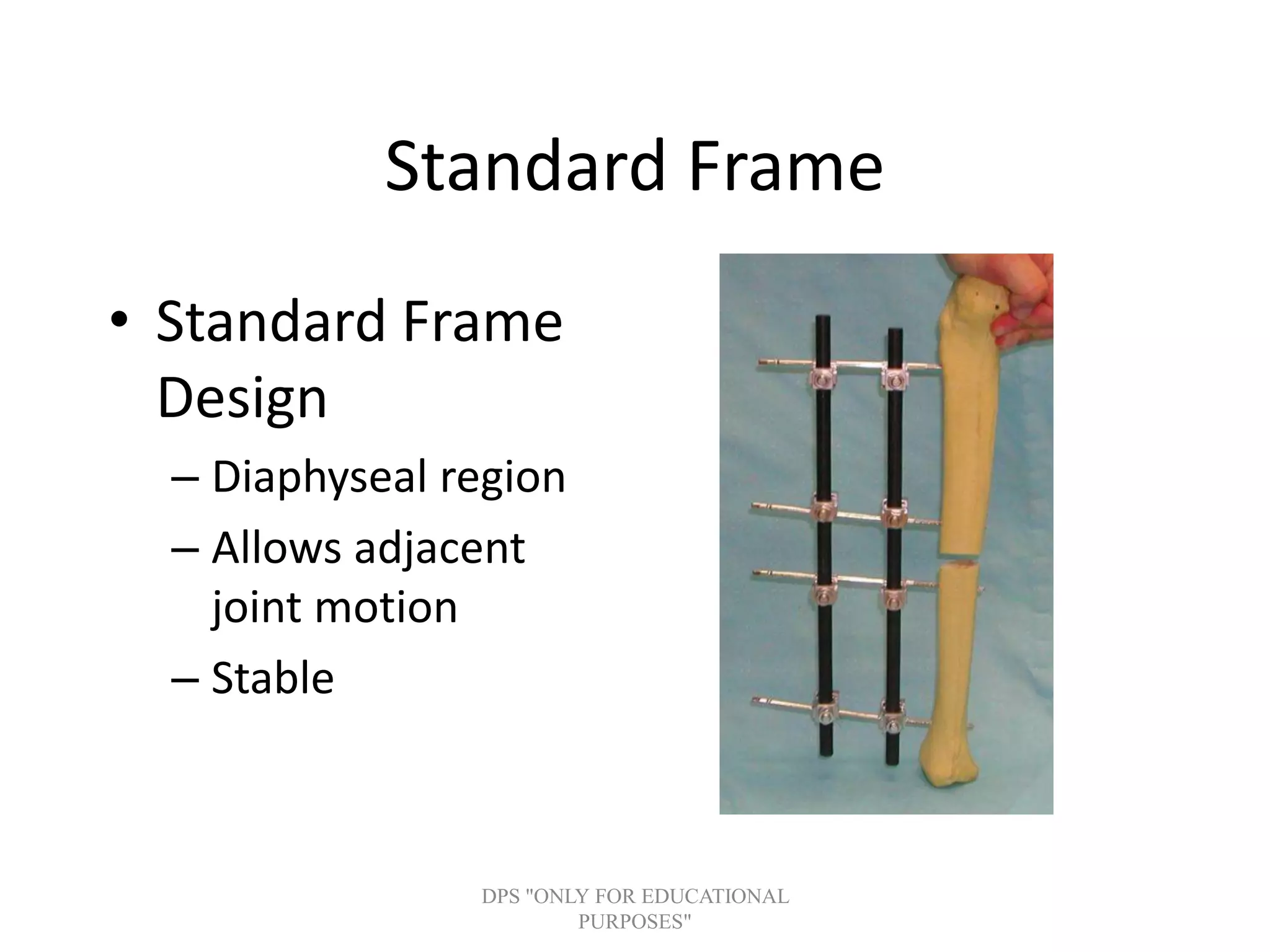
Standard Frame
• Standard Frame
Design
– Diaphyseal region
– Allows adjacent
joint motion
– Stable
DPS "ONLY FOR EDUCATIONAL
PURPOSES"
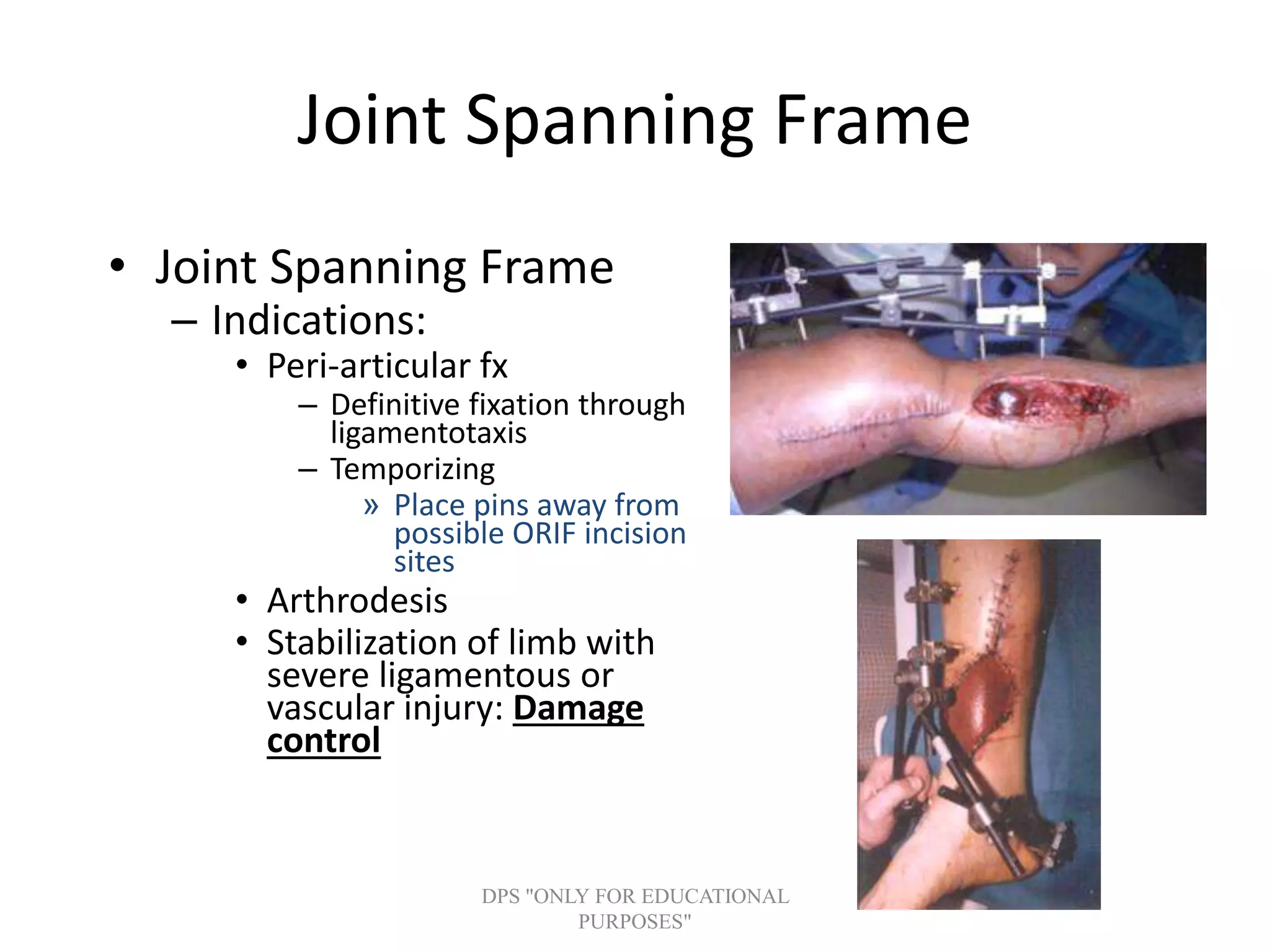
Joint Spanning Frame
• Joint Spanning Frame
– Indications:
• Peri-articular fx
– Definitive fixation through
ligamentotaxis
– Temporizing
» Place pins away from
possible ORIF incision
sites
• Arthrodesis
• Stabilization of limb with
severe ligamentous or
vascular injury: Damage
control
DPS "ONLY FOR EDUCATIONAL
PURPOSES"
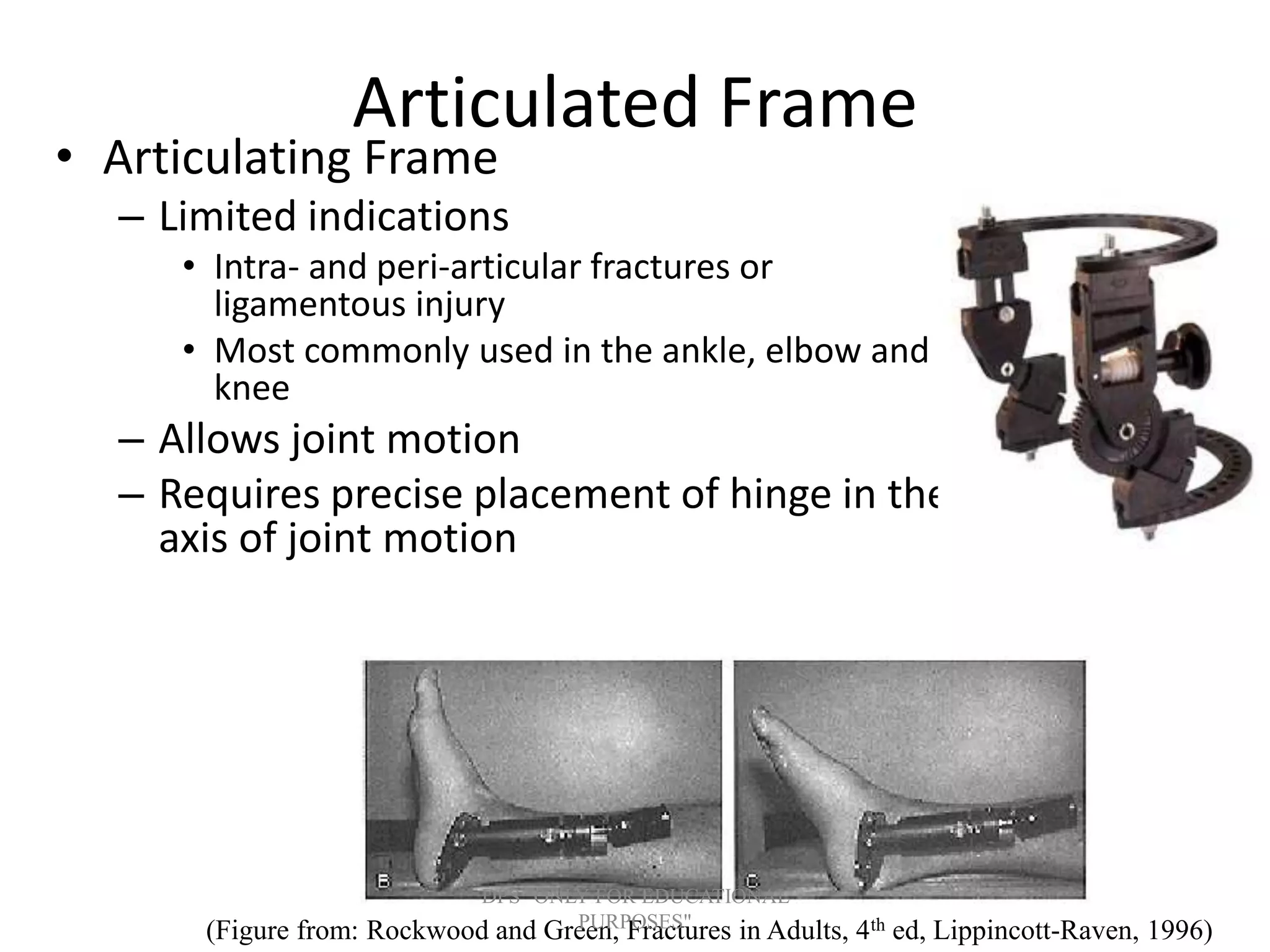
Articulated Frame
• Articulating Frame
– Limited indications
• Intra- and peri-articular fractures or
ligamentous injury
• Most commonly used in the ankle, elbow and
knee
– Allows joint motion
– Requires precise placement of hinge in the
axis of joint motion
(Figure from: Rockwood and Green, Fractures in Adults, 4th ed, Lippincott-Raven, 1996)
DPS "ONLY FOR EDUCATIONAL
PURPOSES"
Correction of Deformity or Defects
• May use unilateral or ring frames
• Simple deformities may use simple frames
• Complex deformities require more complex
frames
• All require careful planning
DPS "ONLY FOR EDUCATIONAL
PURPOSES"
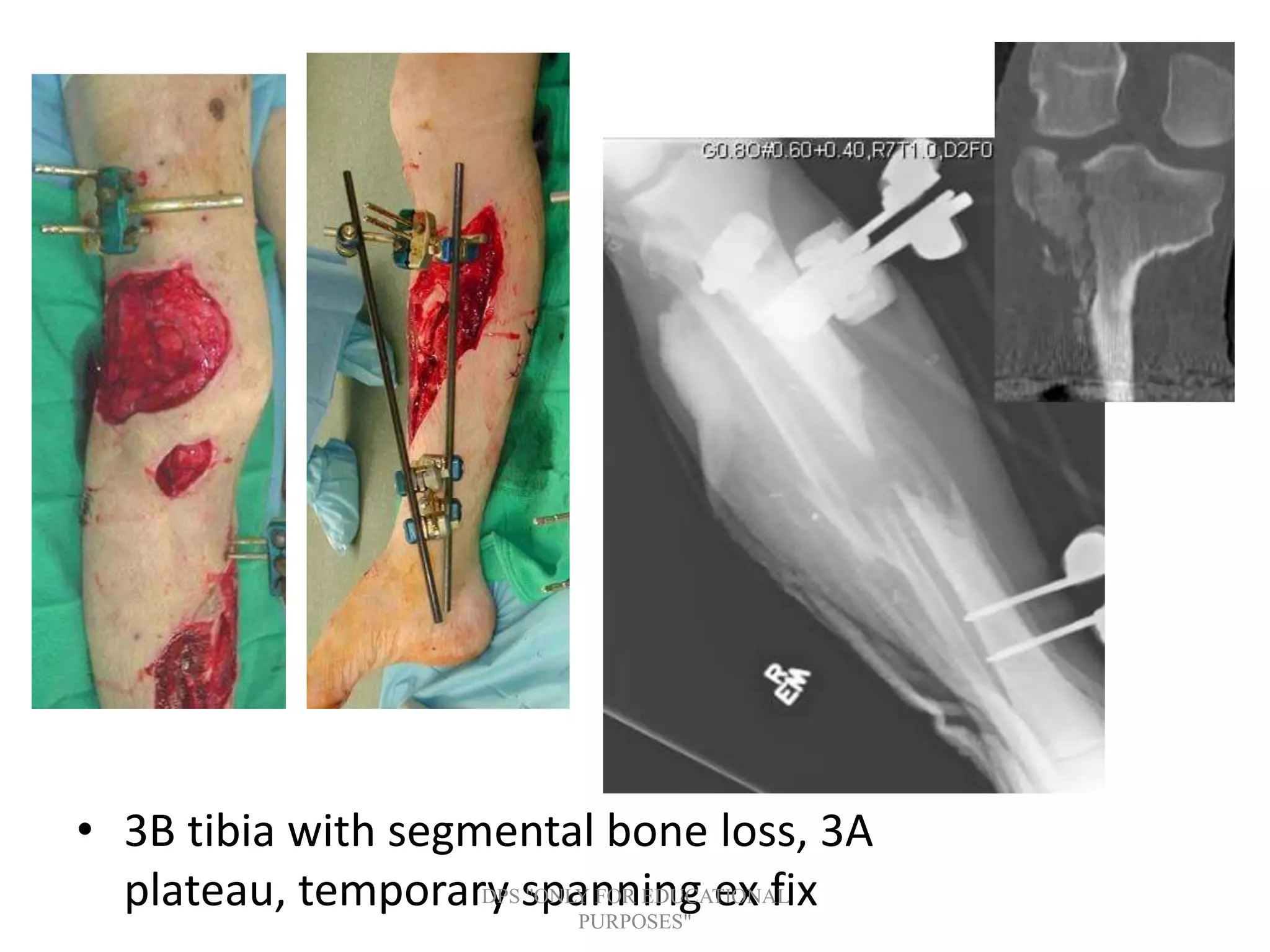
• 3B tibia with segmental bone loss, 3A
plateau, temporary spanning ex fixDPS "ONLY FOR EDUCATIONAL
PURPOSES"
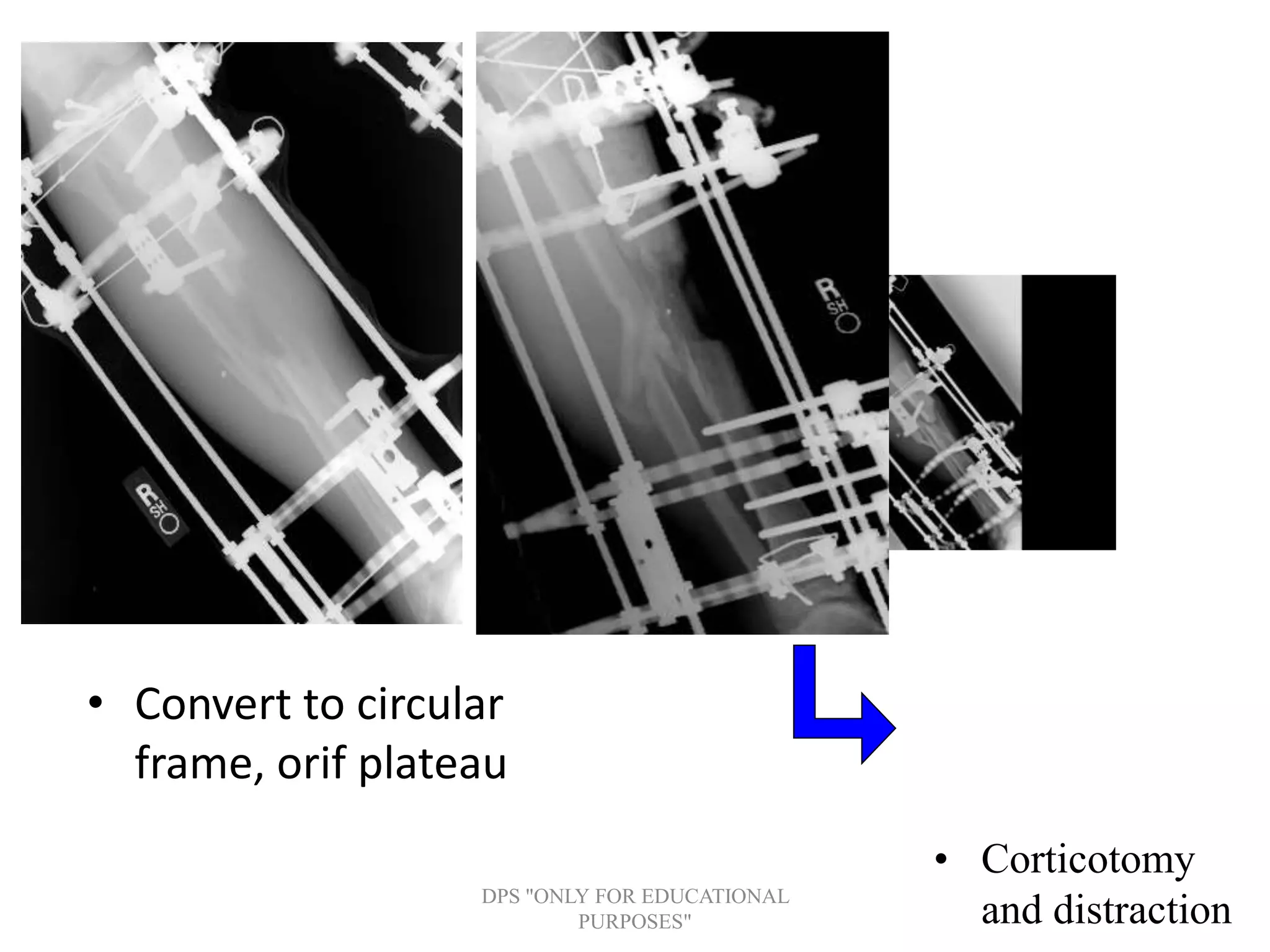
• Convert to circular
frame, orif plateau
• Corticotomy
and distractionDPS "ONLY FOR EDUCATIONAL
PURPOSES"
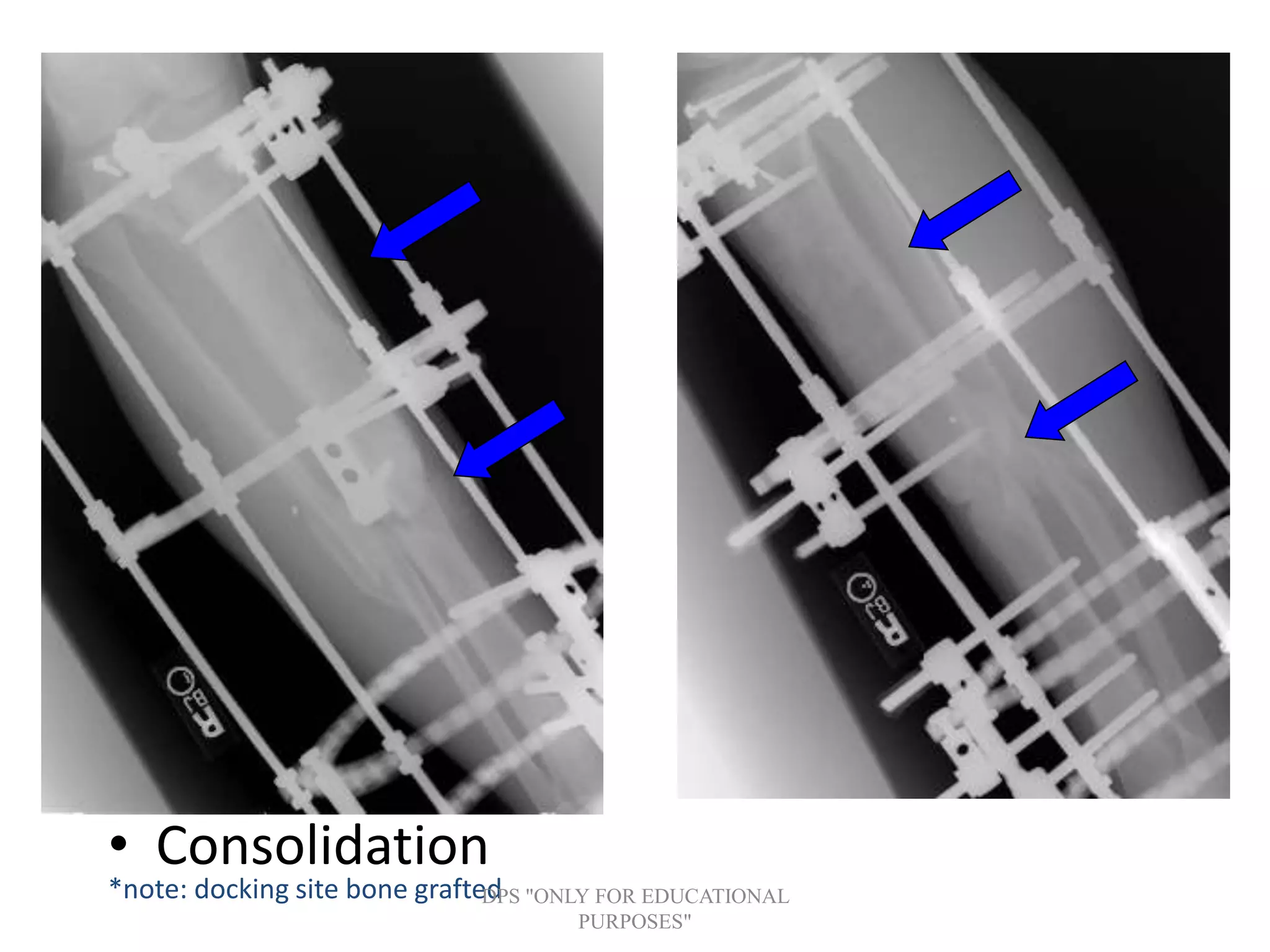
• Consolidation
*note: docking site bone graftedDPS "ONLY FOR EDUCATIONAL
PURPOSES"
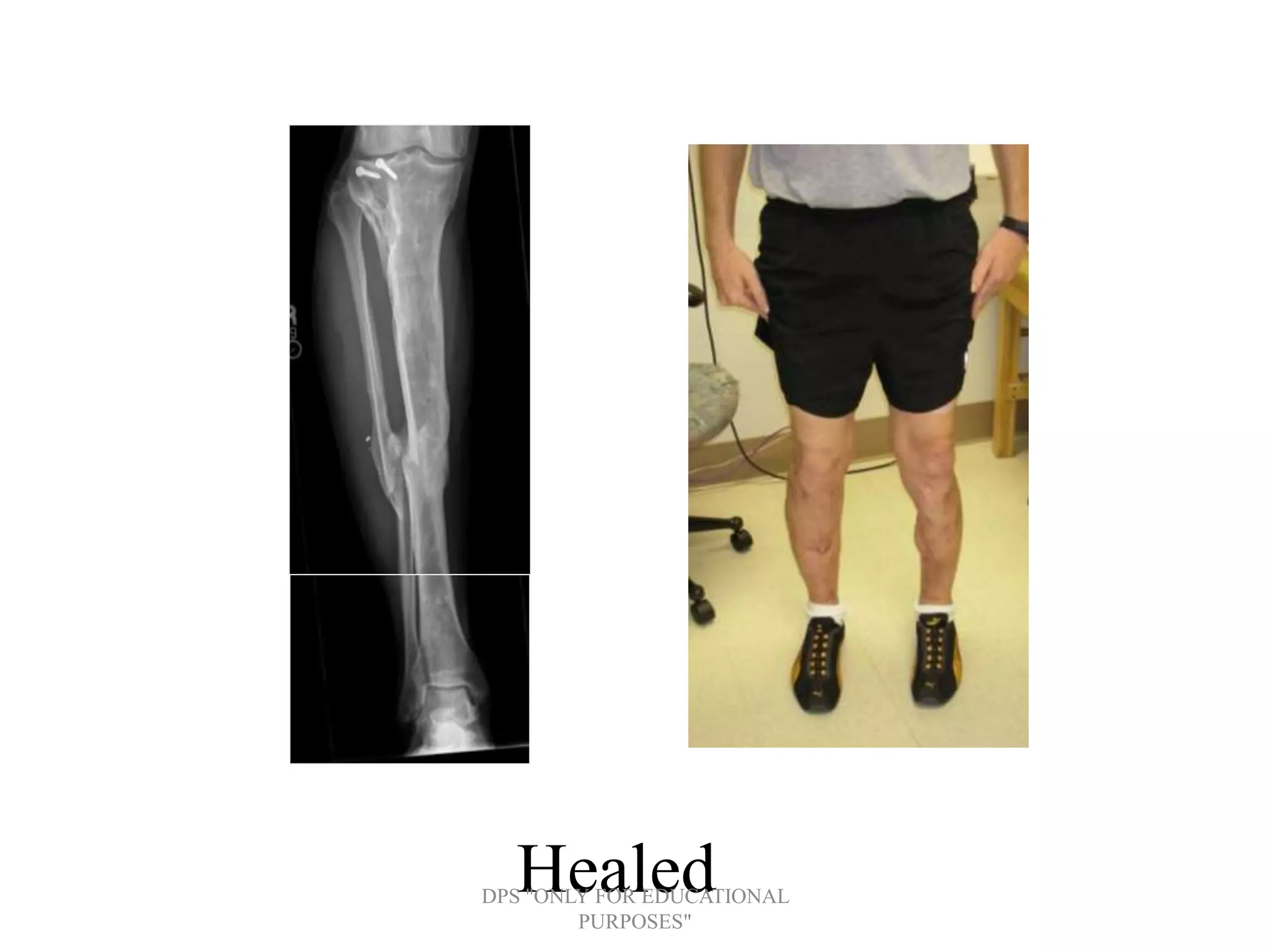
HealedDPS "ONLY FOR EDUCATIONAL
PURPOSES"
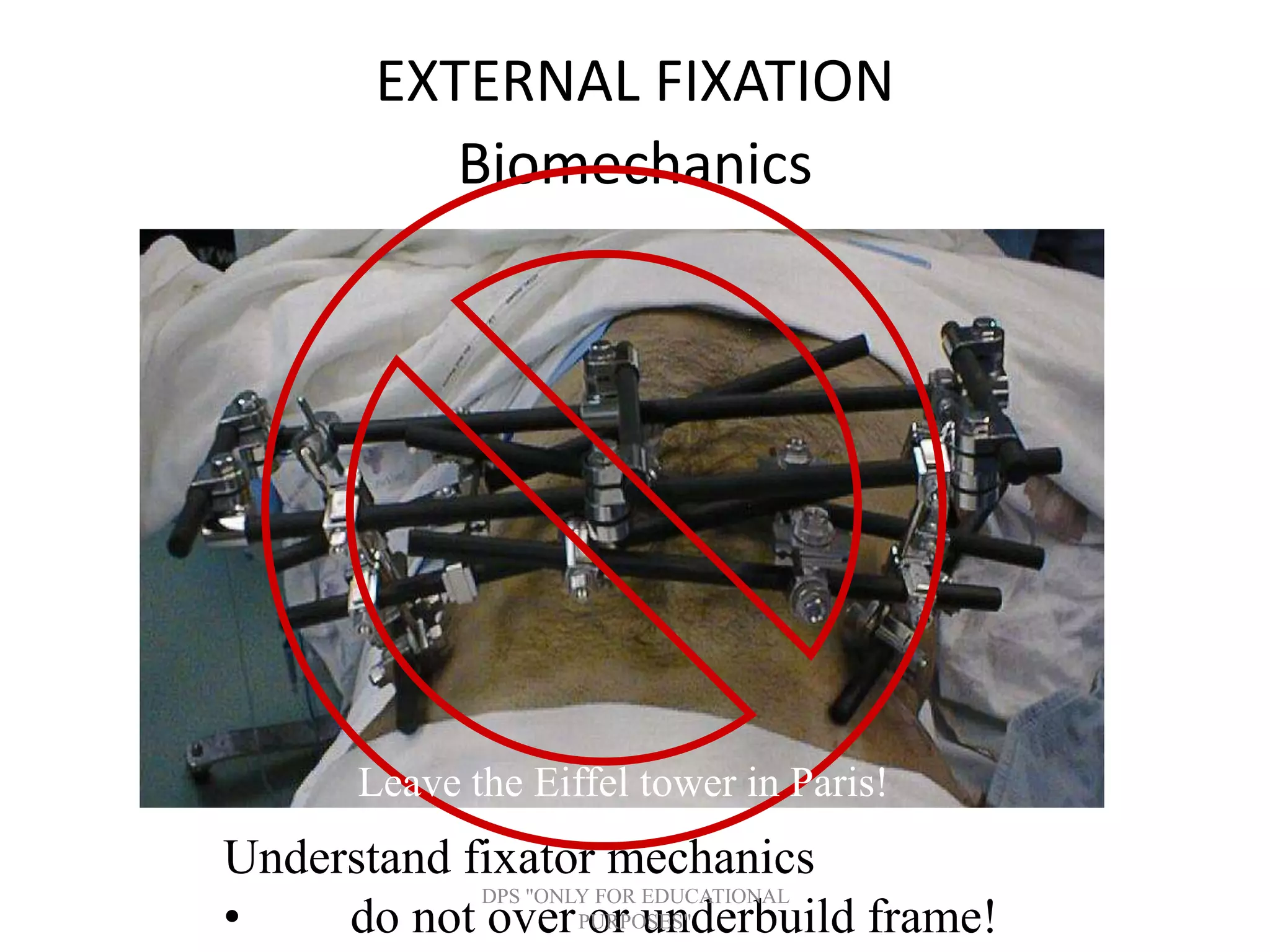
EXTERNAL FIXATION
Biomechanics
Understand fixator mechanics
• do not over or underbuild frame!
Leave the Eiffel tower in Paris!
DPS "ONLY FOR EDUCATIONAL
PURPOSES"
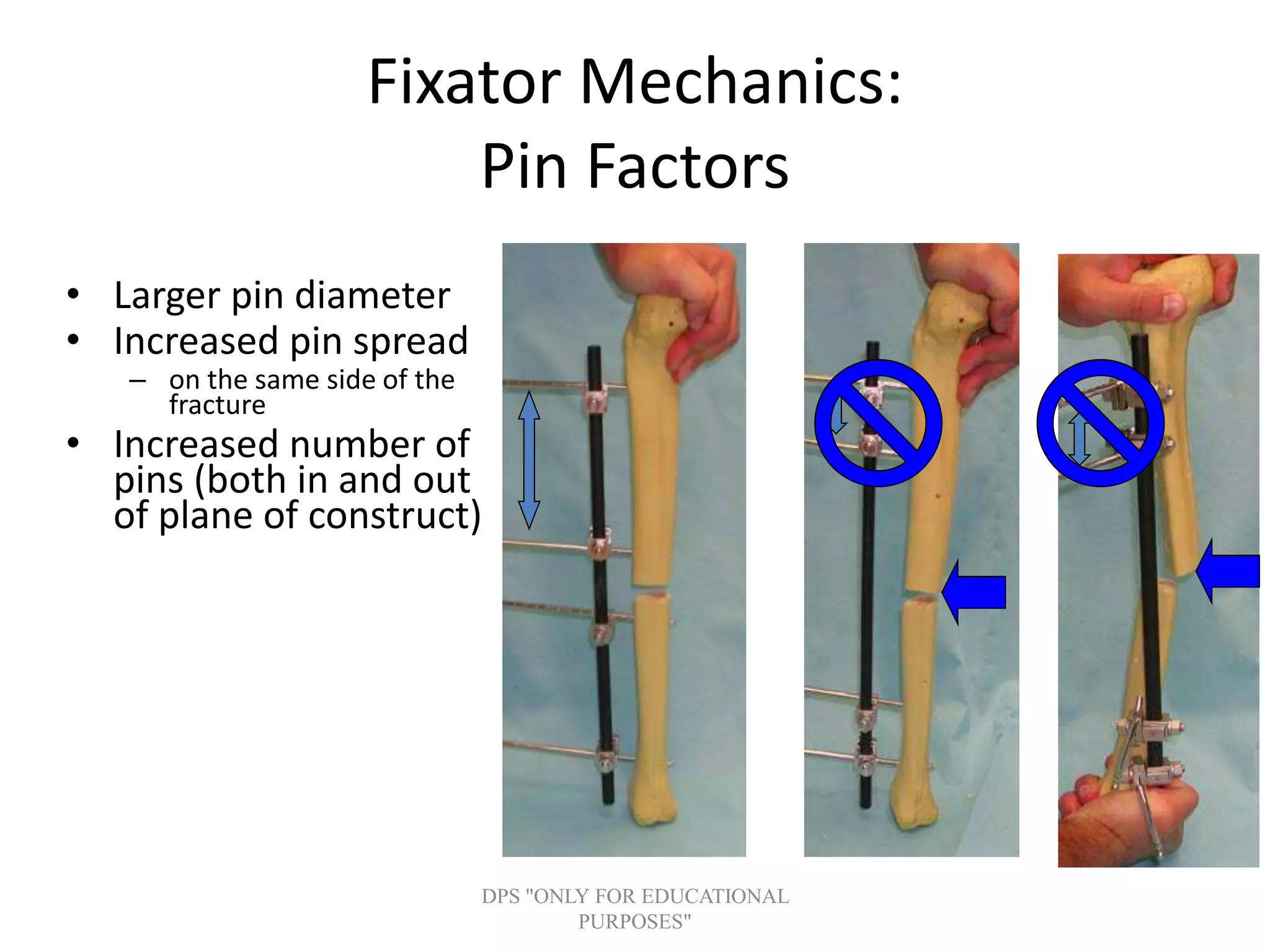
Fixator Mechanics:
Pin Factors
• Larger pin diameter
• Increased pin spread
– on the same side of the
fracture
• Increased number of
pins (both in and out
of plane of construct)
DPS "ONLY FOR EDUCATIONAL
PURPOSES"
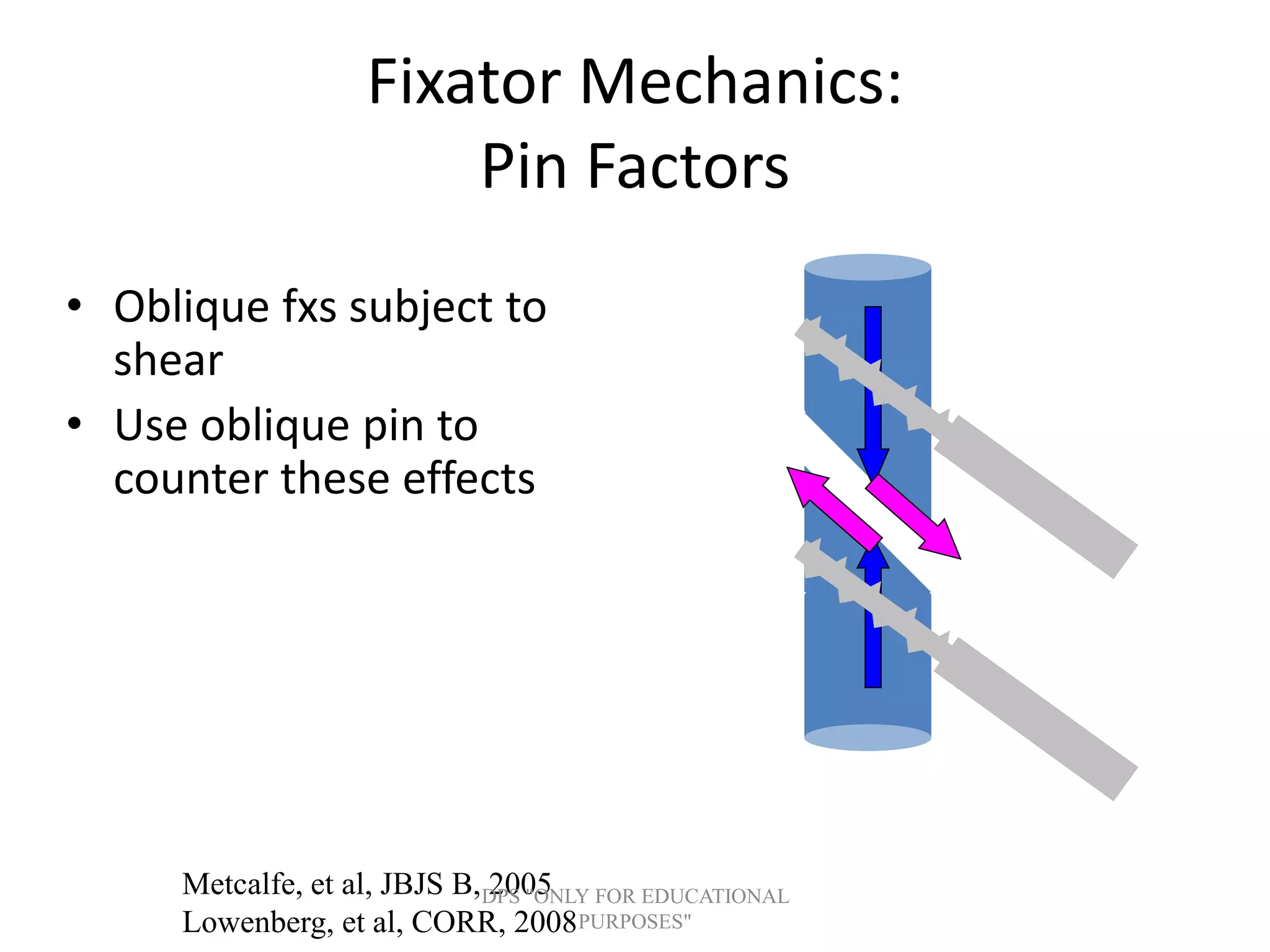
Fixator Mechanics:
Pin Factors
• Oblique fxs subject to
shear
• Use oblique pin to
counter these effects
Metcalfe, et al, JBJS B, 2005
Lowenberg, et al, CORR, 2008
DPS "ONLY FOR EDUCATIONAL
PURPOSES"
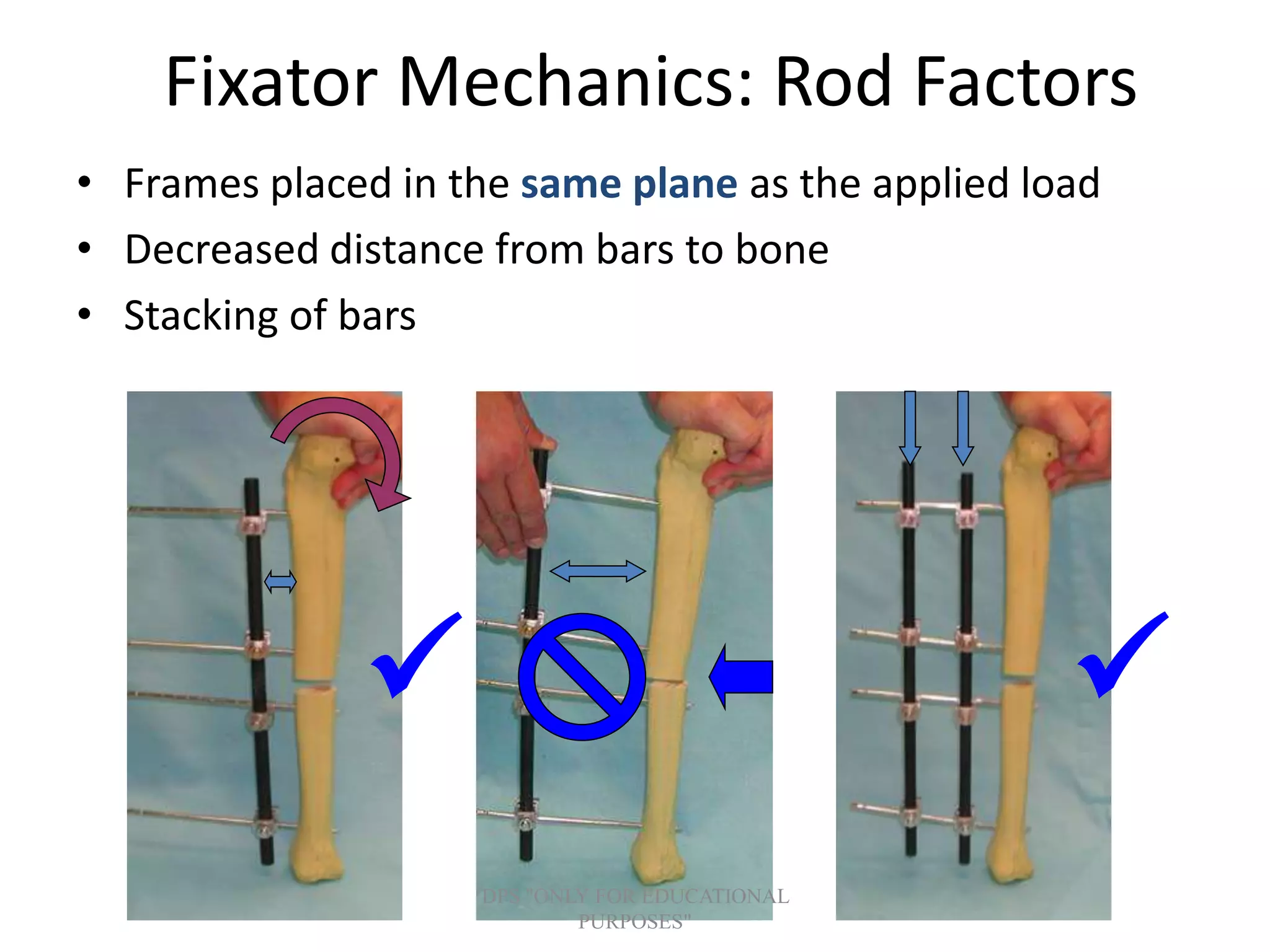
Fixator Mechanics: Rod Factors
• Frames placed in the same plane as the applied load
• Decreased distance from bars to bone
• Stacking of bars

DPS "ONLY FOR EDUCATIONAL
PURPOSES"
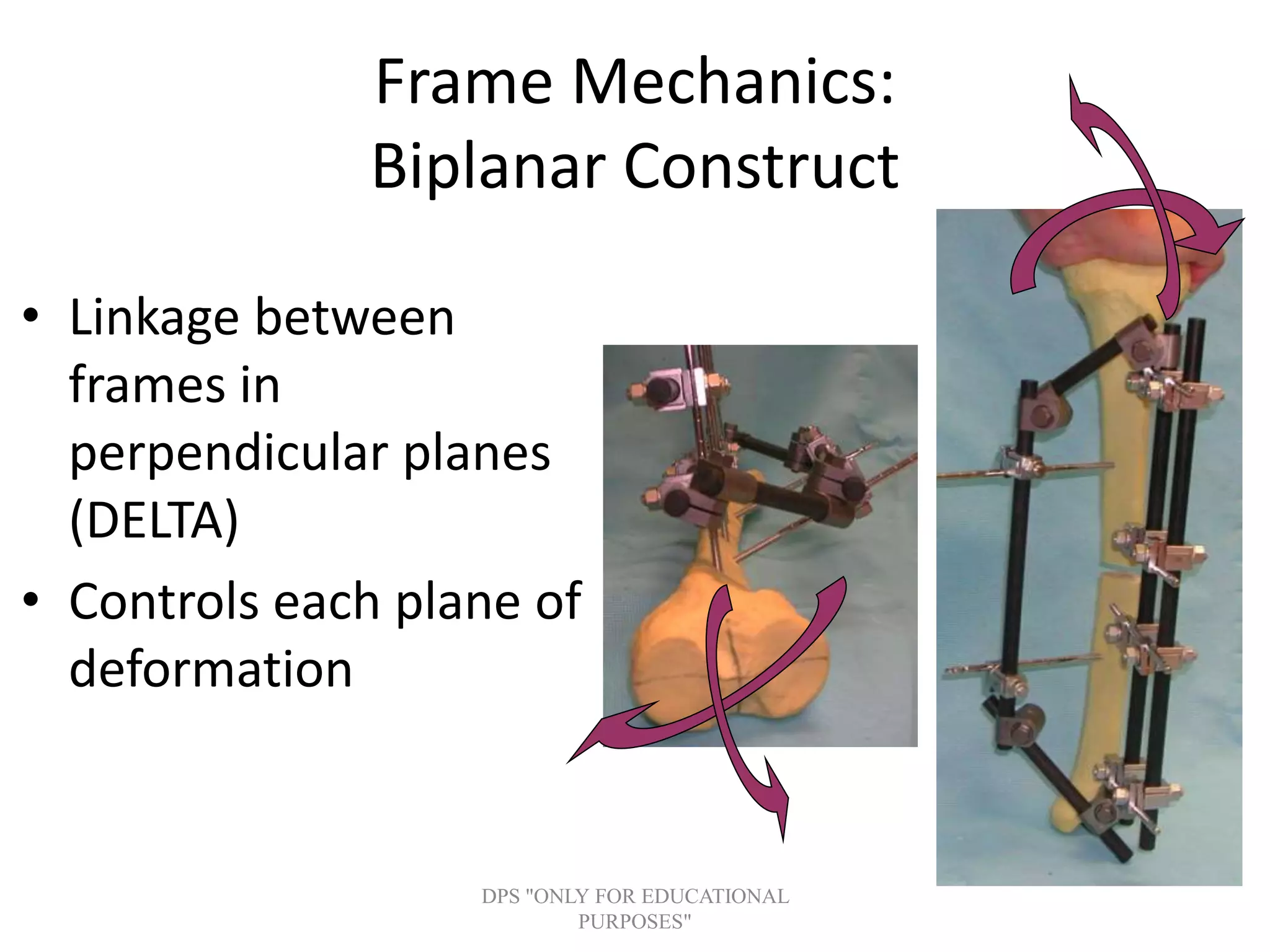
Frame Mechanics:
Biplanar Construct
• Linkage between
frames in
perpendicular planes
(DELTA)
• Controls each plane of
deformation
DPS "ONLY FOR EDUCATIONAL
PURPOSES"
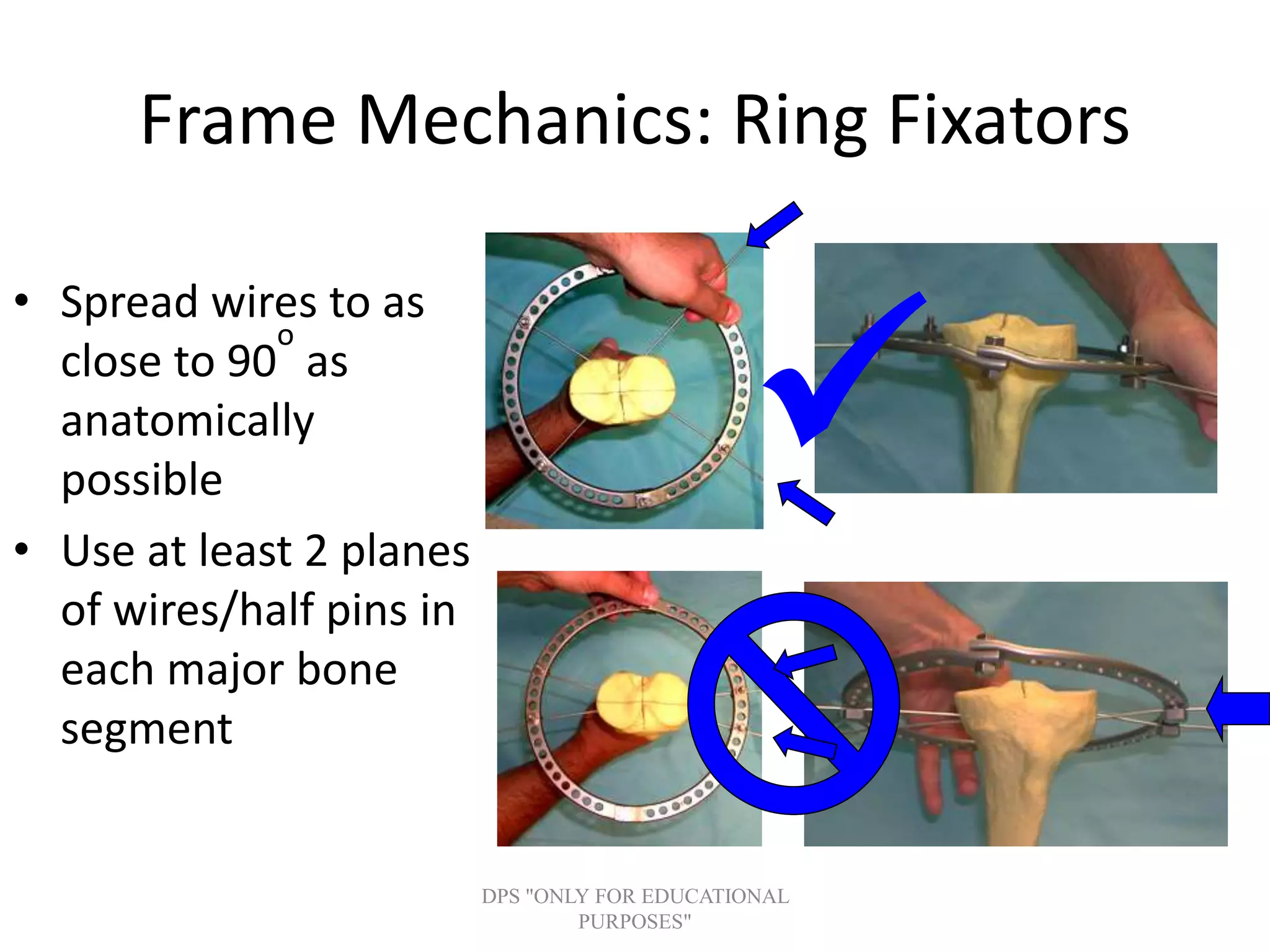
Frame Mechanics: Ring Fixators
• Spread wires to as
close to 90
o
as
anatomically
possible
• Use at least 2 planes
of wires/half pins in
each major bone
segment

DPS "ONLY FOR EDUCATIONAL
PURPOSES"
Modes of Fixation
• Compression
– Sufficient bone stock
– Enhances stability
– Intimate contact of bony ends
– Typically used in arthrodesis or to complete union of a fracture
• Neutralization
– Comminution or bone loss present
– Maintains length and alignment
– Resists external deforming forces
• Distraction
– Reduction through ligamentotaxis
– Temporizing device
– Distraction osteogenesis
DPS "ONLY FOR EDUCATIONAL
PURPOSES"
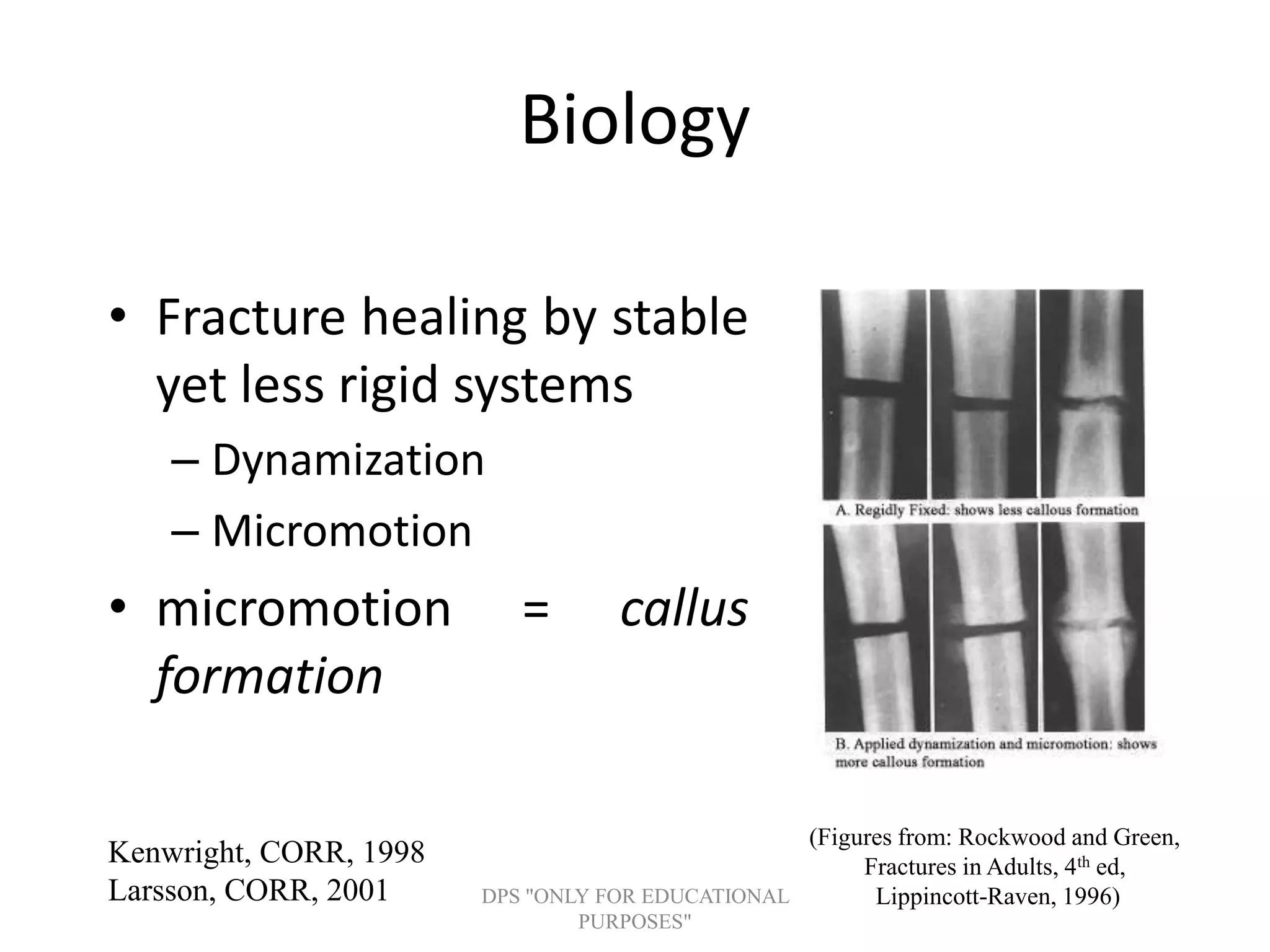
Biology
• Fracture healing by stable
yet less rigid systems
– Dynamization
– Micromotion
• micromotion = callus
formation
(Figures from: Rockwood and Green,
Fractures in Adults, 4th ed,
Lippincott-Raven, 1996)
Kenwright, CORR, 1998
Larsson, CORR, 2001 DPS "ONLY FOR EDUCATIONAL
PURPOSES"
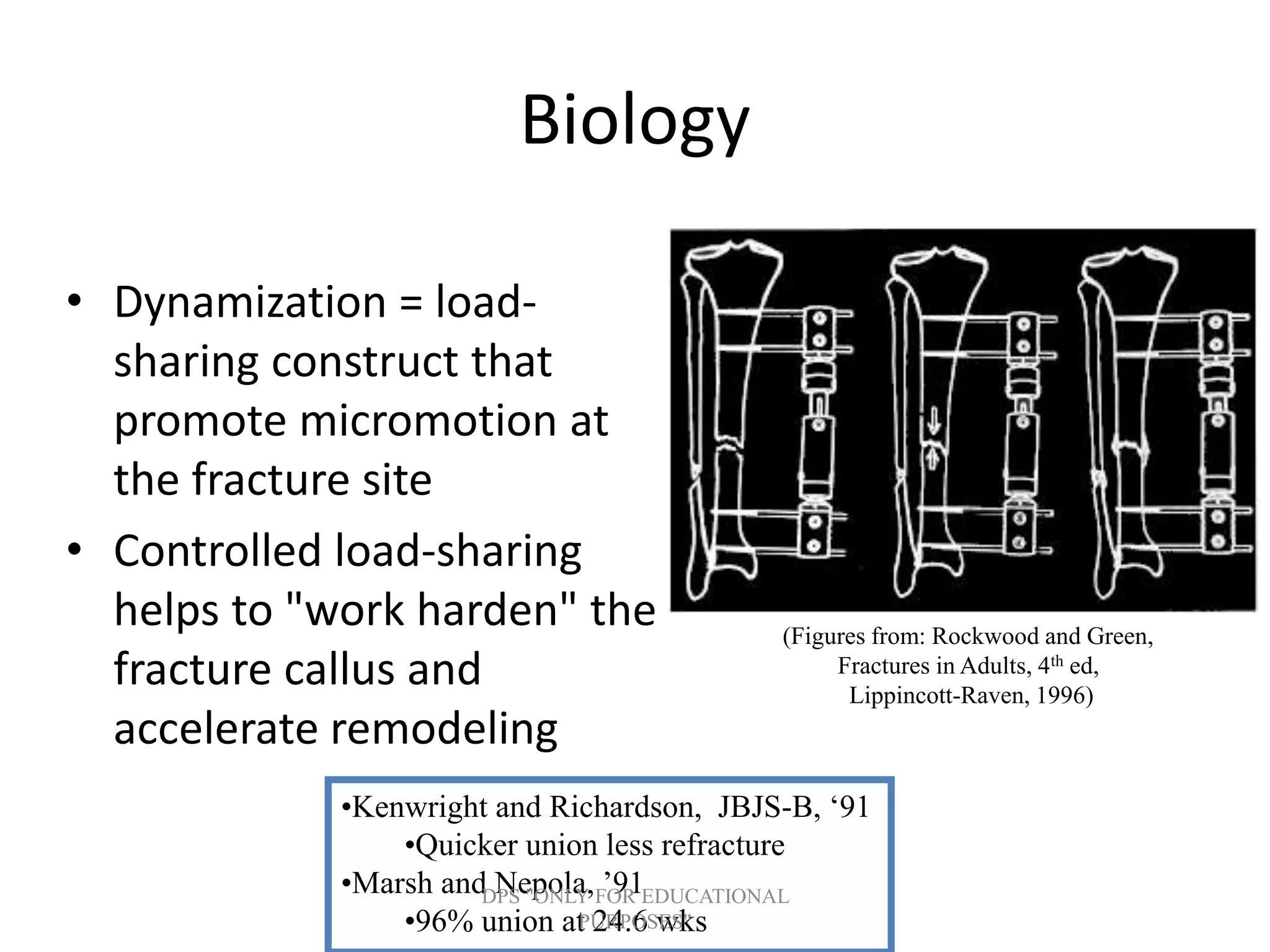
Biology
• Dynamization = load-
sharing construct that
promote micromotion at
the fracture site
• Controlled load-sharing
helps to "work harden" the
fracture callus and
accelerate remodeling
(Figures from: Rockwood and Green,
Fractures in Adults, 4th ed,
Lippincott-Raven, 1996)
•Kenwright and Richardson, JBJS-B, ‘91
•Quicker union less refracture
•Marsh and Nepola, ’91
•96% union at 24.6 wks
DPS "ONLY FOR EDUCATIONAL
PURPOSES"
Anatomic Considerations
• Fundamental knowledge of the anatomy is critical
• Avoidance of major nerves,vessels and organs
(pelvis) is mandatory
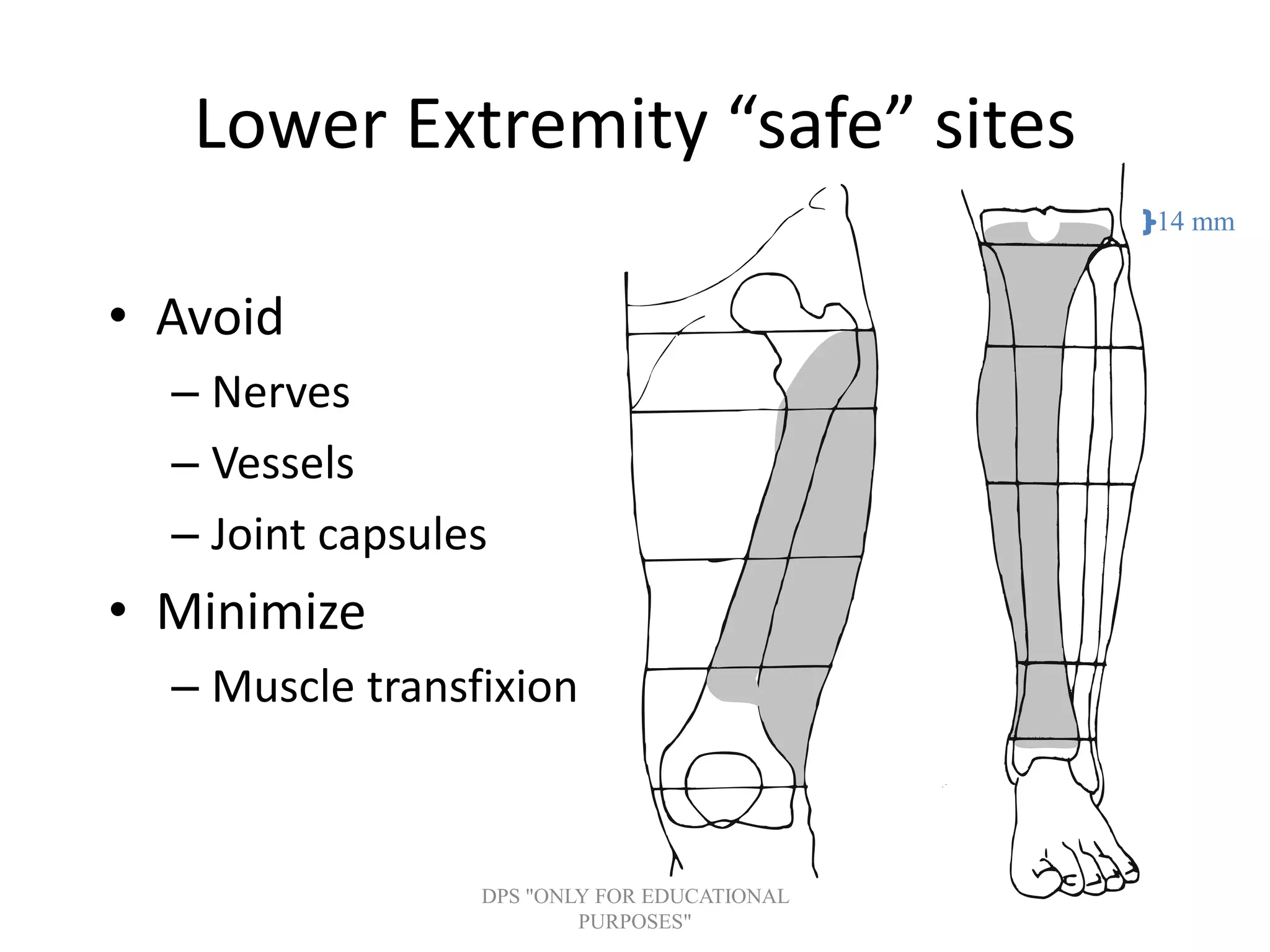
• Avoid joints and joint capsules
– Proximal tibial pins should be placed 14 mm distal to articular surface
to avoid capsular reflection
• Minimize muscle/tendon impalement (especially
those with large excursions)
DPS "ONLY FOR EDUCATIONAL
PURPOSES"
Lower Extremity “safe” sites
• Avoid
– Nerves
– Vessels
– Joint capsules
• Minimize
– Muscle transfixion
14 mm
DPS "ONLY FOR EDUCATIONAL
PURPOSES"
Upper Extremity “Safe” Sites
• Humerus: narrow lanes
– Proximal: axillary n
– Mid: radial nerve
– Distal: radial, median and ulnar n
– Dissect to bone, Use sleeves
• Ulna: safe subcutaneous border, avoid
overpenetration
• Radius: narrow lanes
– Proximal: avoid because radial n and PIN, thick muscle sleeve
– Mid and distal: use dissection to avoid sup. radial n.
DPS "ONLY FOR EDUCATIONAL
PURPOSES"
Damage Control and Temporary Frames
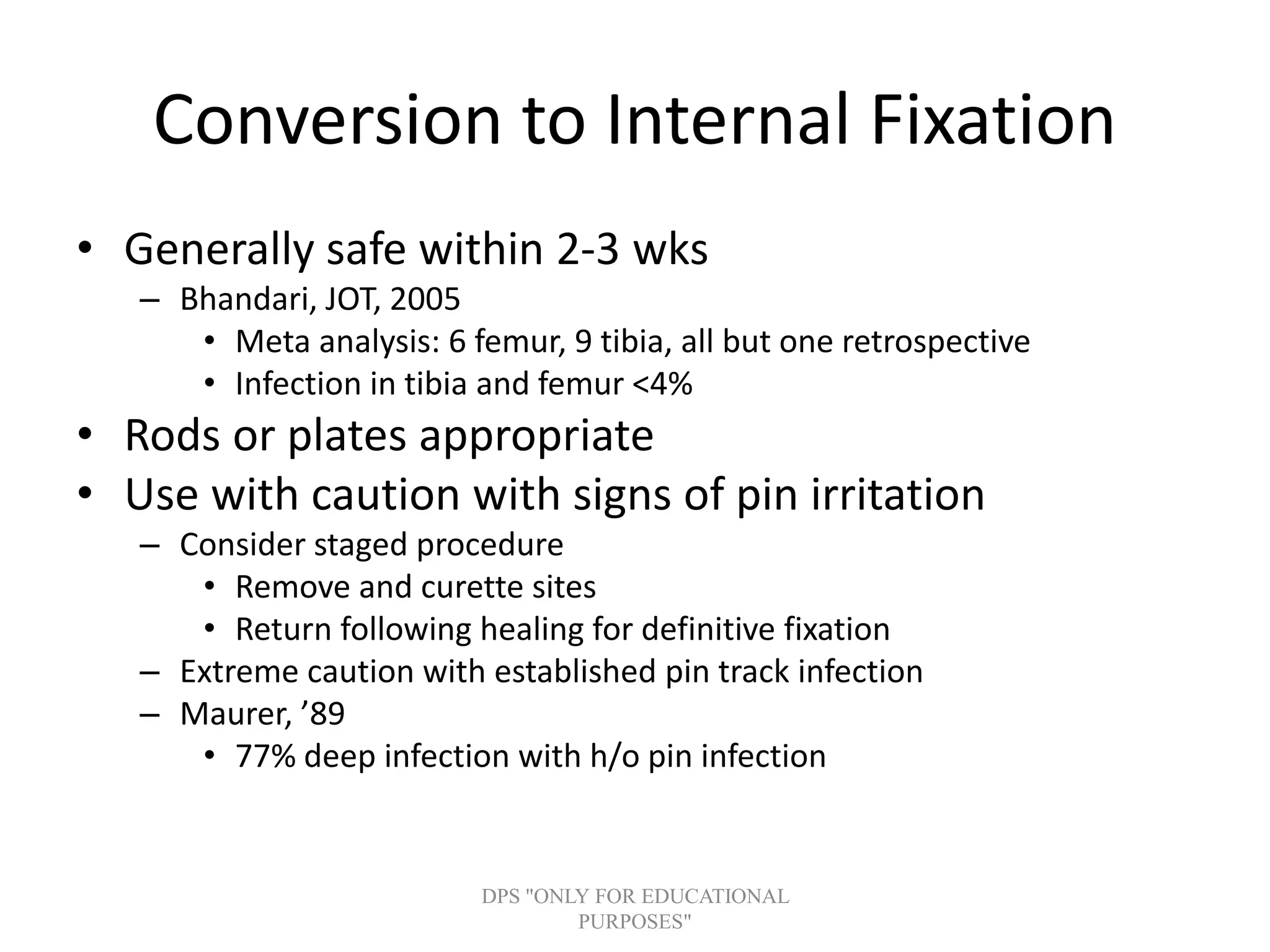
• Initial frame application
rapid
• Enough to stabilize but is
not definitive frame!
• Be aware of definitive
fixation options
– Avoid pins in surgical approach sites
• Depending on clinical
situation may consider
minimal fixation of articular
surface at initial surgery
DPS "ONLY FOR EDUCATIONAL
PURPOSES"
Conversion to Internal Fixation
• Generally safe within 2-3 wks
– Bhandari, JOT, 2005
• Meta analysis: 6 femur, 9 tibia, all but one retrospective
• Infection in tibia and femur <4%
• Rods or plates appropriate
• Use with caution with signs of pin irritation
– Consider staged procedure
• Remove and curette sites
• Return following healing for definitive fixation
– Extreme caution with established pin track infection
– Maurer, ’89
• 77% deep infection with h/o pin infection
DPS "ONLY FOR EDUCATIONAL
PURPOSES"
Evidence
• Femur fx
– Nowotarski, JBJS-A, ’00
• 59 fx (19 open), 54 pts,
• Convert at 7 days (1-49 days)
• 1 infected nonunion, 1 aseptic
nonunion
– Scalea, J Trauma, ’00
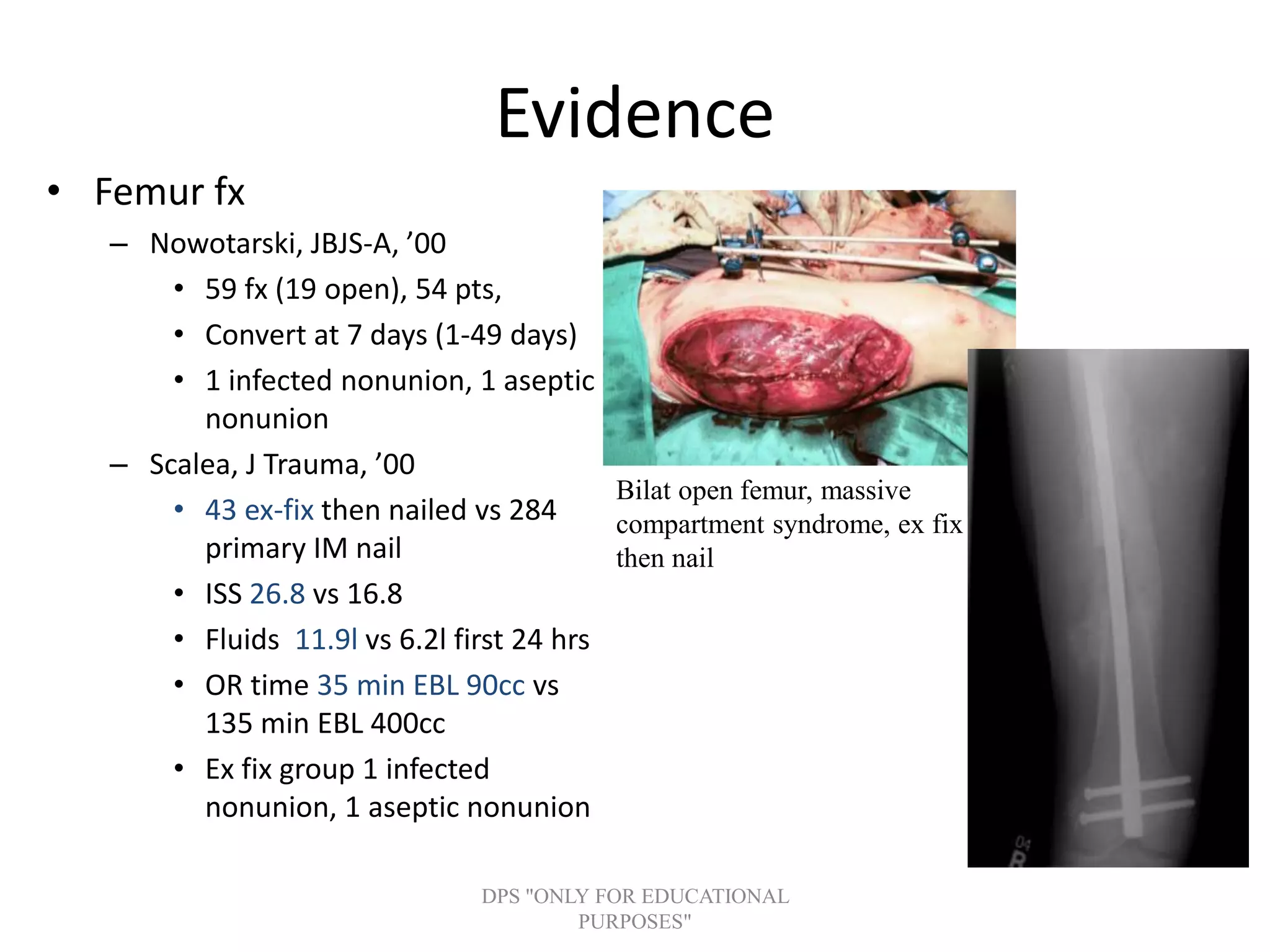
• 43 ex-fix then nailed vs 284
primary IM nail
• ISS 26.8 vs 16.8
• Fluids 11.9l vs 6.2l first 24 hrs
• OR time 35 min EBL 90cc vs
135 min EBL 400cc
• Ex fix group 1 infected
nonunion, 1 aseptic nonunion
Bilat open femur, massive
compartment syndrome, ex fix
then nail
DPS "ONLY FOR EDUCATIONAL
PURPOSES"
Evidence
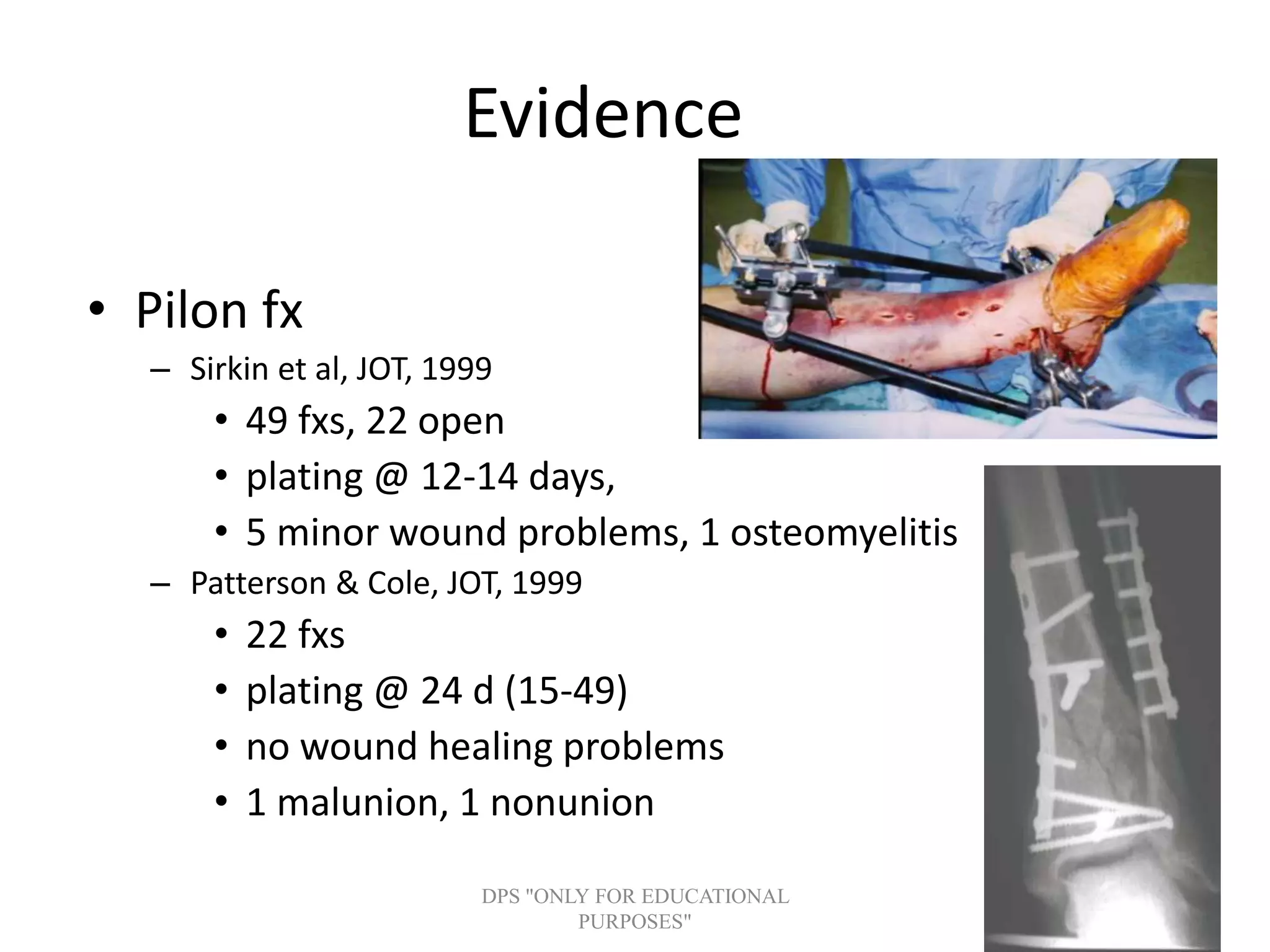
• Pilon fx
– Sirkin et al, JOT, 1999
• 49 fxs, 22 open
• plating @ 12-14 days,
• 5 minor wound problems, 1 osteomyelitis
– Patterson & Cole, JOT, 1999
• 22 fxs
• plating @ 24 d (15-49)
• no wound healing problems
• 1 malunion, 1 nonunion
DPS "ONLY FOR EDUCATIONAL
PURPOSES"
Complications
• Pin-track infection/loosening
• Frame or Pin/Wire Failure
• Malunion
• Non-union
• Soft-tissue impalement
• Compartment syndrome
DPS "ONLY FOR EDUCATIONAL
PURPOSES"
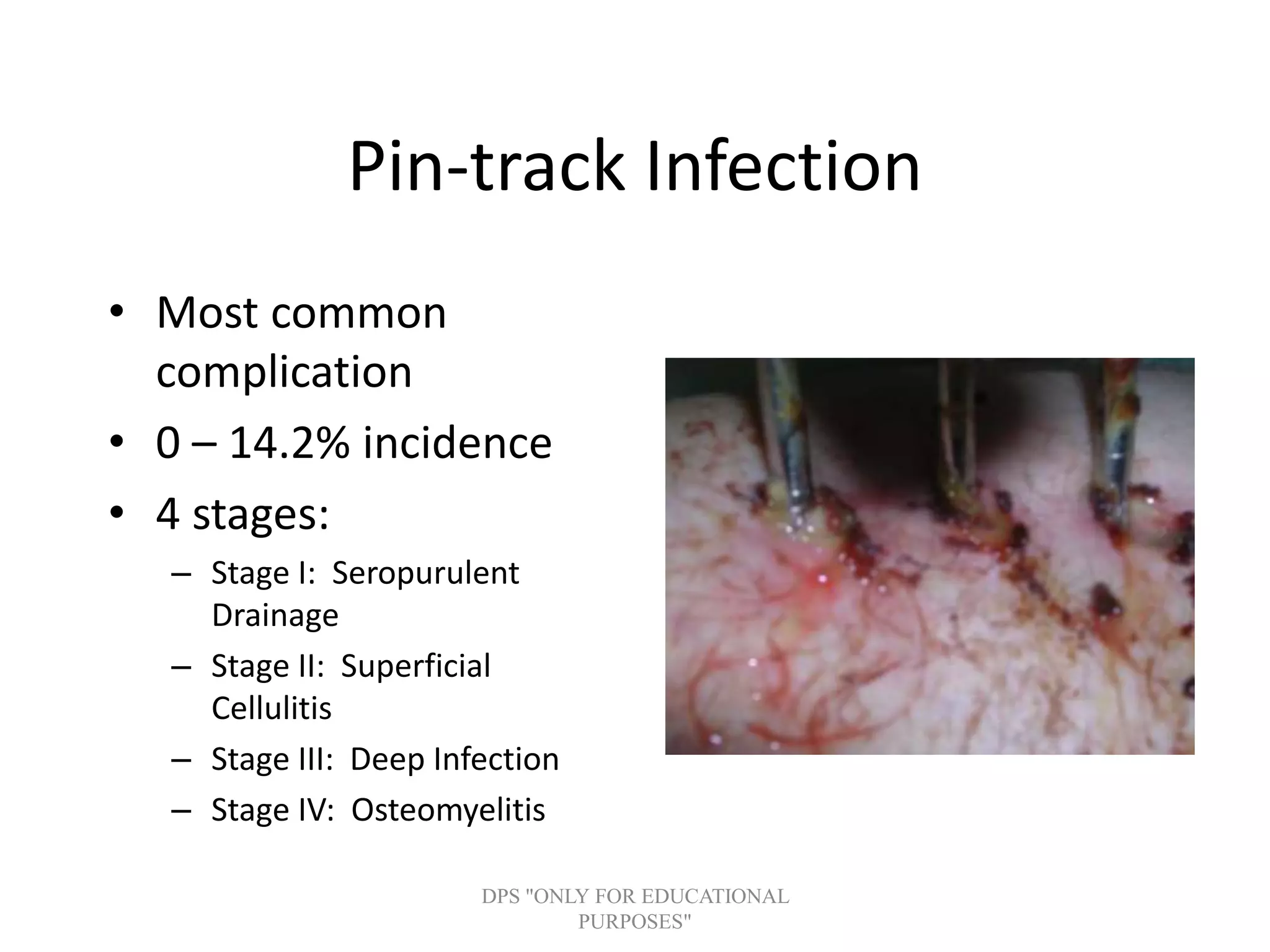
Pin-track Infection
• Most common
complication
• 0 – 14.2% incidence
• 4 stages:
– Stage I: Seropurulent
Drainage
– Stage II: Superficial
Cellulitis
– Stage III: Deep Infection
– Stage IV: Osteomyelitis
DPS "ONLY FOR EDUCATIONAL
PURPOSES"
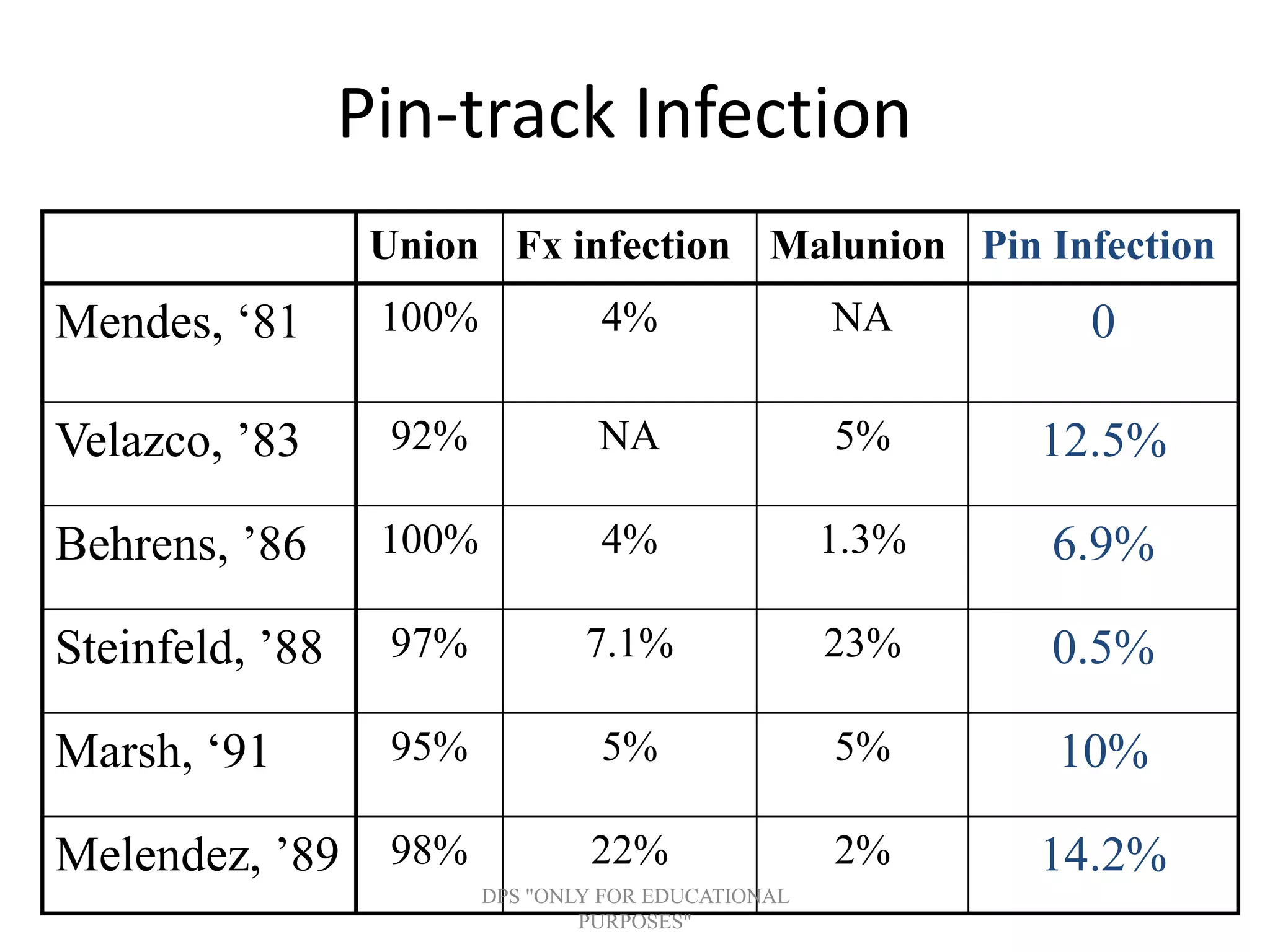
Pin-track Infection
Union Fx infection Malunion Pin Infection
Mendes, ‘81 100% 4% NA 0
Velazco, ’83 92% NA 5% 12.5%
Behrens, ’86 100% 4% 1.3% 6.9%
Steinfeld, ’88 97% 7.1% 23% 0.5%
Marsh, ‘91 95% 5% 5% 10%
Melendez, ’89 98% 22% 2% 14.2%
DPS "ONLY FOR EDUCATIONAL
PURPOSES"
Pin-track Infection
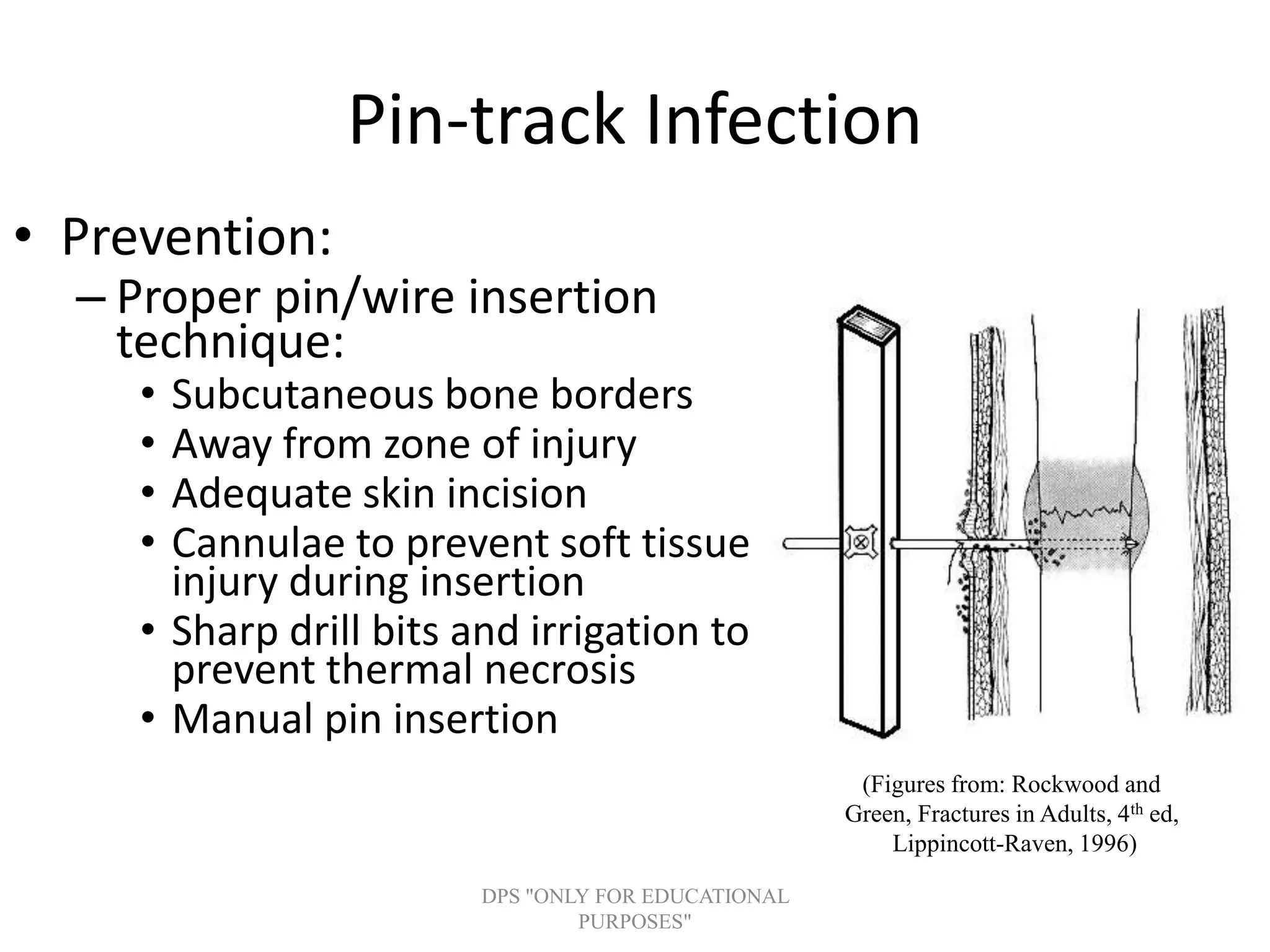
• Prevention:
– Proper pin/wire insertion
technique:
• Subcutaneous bone borders
• Away from zone of injury
• Adequate skin incision
• Cannulae to prevent soft tissue
injury during insertion
• Sharp drill bits and irrigation to
prevent thermal necrosis
• Manual pin insertion
(Figures from: Rockwood and
Green, Fractures in Adults, 4th ed,
Lippincott-Raven, 1996)
DPS "ONLY FOR EDUCATIONAL
PURPOSES"
Pin-track Infection
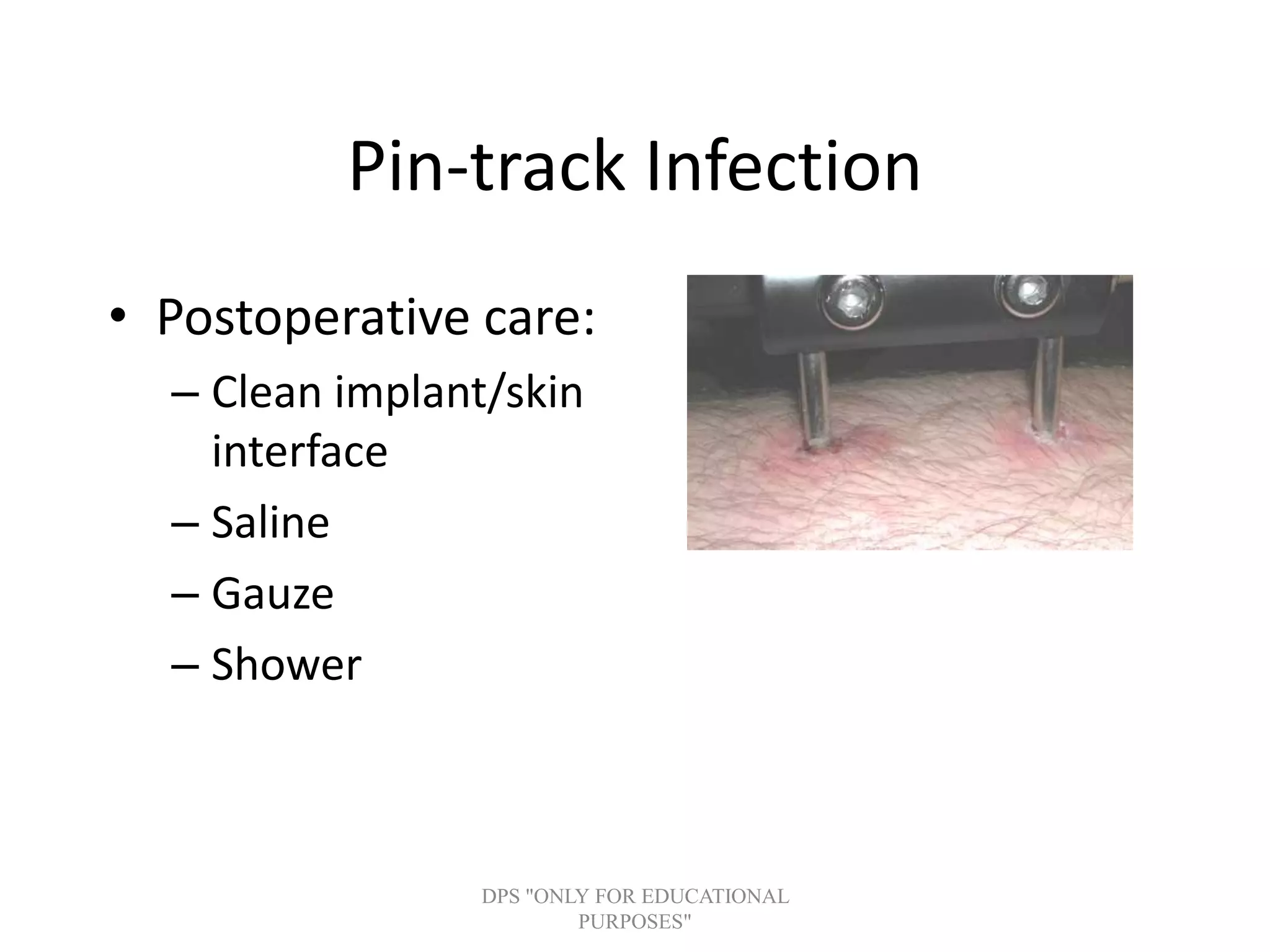
• Postoperative care:
– Clean implant/skin
interface
– Saline
– Gauze
– Shower
DPS "ONLY FOR EDUCATIONAL
PURPOSES"
Pin-track Infection
• Treatment:
– Stage I: aggressive pin-site care and oral
cephalosporin
– Stage II: same as Stage I and +/- Parenteral Abx
– Stage III: Removal/exchange of pin plus Parenteral
Abx
– Stage IV: same as Stage III, culture pin site for
offending organism, specific IV Abx for 10 to 14
days, surgical debridement of pin site
DPS "ONLY FOR EDUCATIONAL
PURPOSES"
Pin Loosening
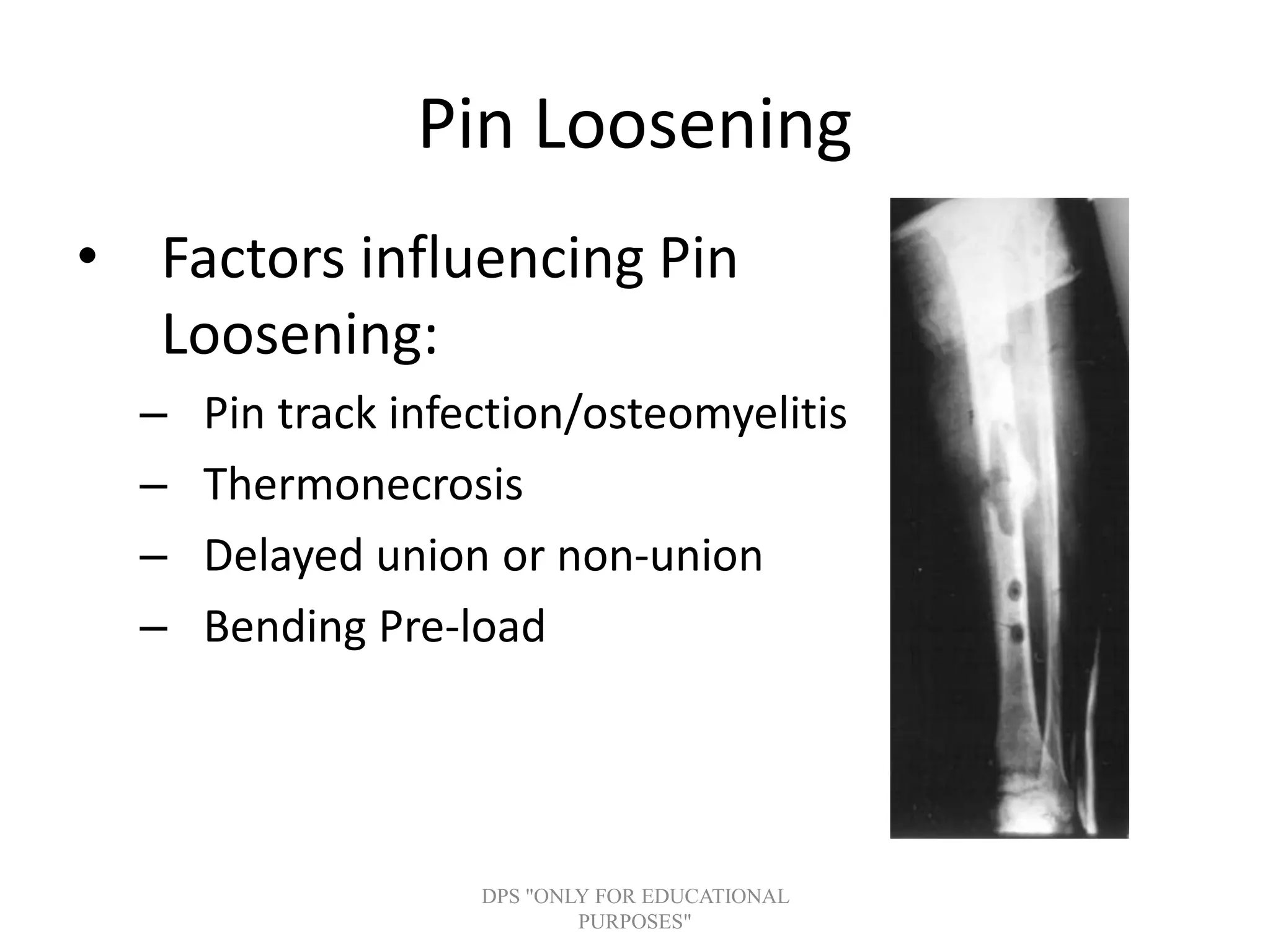
• Factors influencing Pin
Loosening:
– Pin track infection/osteomyelitis
– Thermonecrosis
– Delayed union or non-union
– Bending Pre-load
DPS "ONLY FOR EDUCATIONAL
PURPOSES"
Pin Loosening
• Prevention:
– Proper pin/wire insertion techniques
– Radial preload
– Euthermic pin insertion
– Adequate soft-tissue release
– Bone graft early
– Pin coatings
• Treatment:
– Replace/remove loose pin
DPS "ONLY FOR EDUCATIONAL
PURPOSES"
Frame Failure
• Incidence: Rare
• Theoretically can occur with recycling of old
frames
• However, no proof that frames can not be re-
used
DPS "ONLY FOR EDUCATIONAL
PURPOSES"
Malunion
Intra-operative causes:
– Due to poor technique
• Prevention:
– Clear pre-operative planning
– Prep contralateral limb for comparison
– Use fluoroscopic and/or intra-operative films
– Adequate construct
• Treatment:
– Early: Correct deformity and adjust or re-apply frame prior to
bony union
– Late: Reconstructive correction of malunion
DPS "ONLY FOR EDUCATIONAL
PURPOSES"
Malunion
Post-operative causes:
– Due to frame failure
• Prevention:
– Proper follow-up with both clinical and
radiographic check-ups
– Adherence to appropriate weight-bearing
restrictions
– Check and re-tighten frame at periodic intervals
• Treatment:
– Osteotomy/reconstruction
DPS "ONLY FOR EDUCATIONAL
PURPOSES"
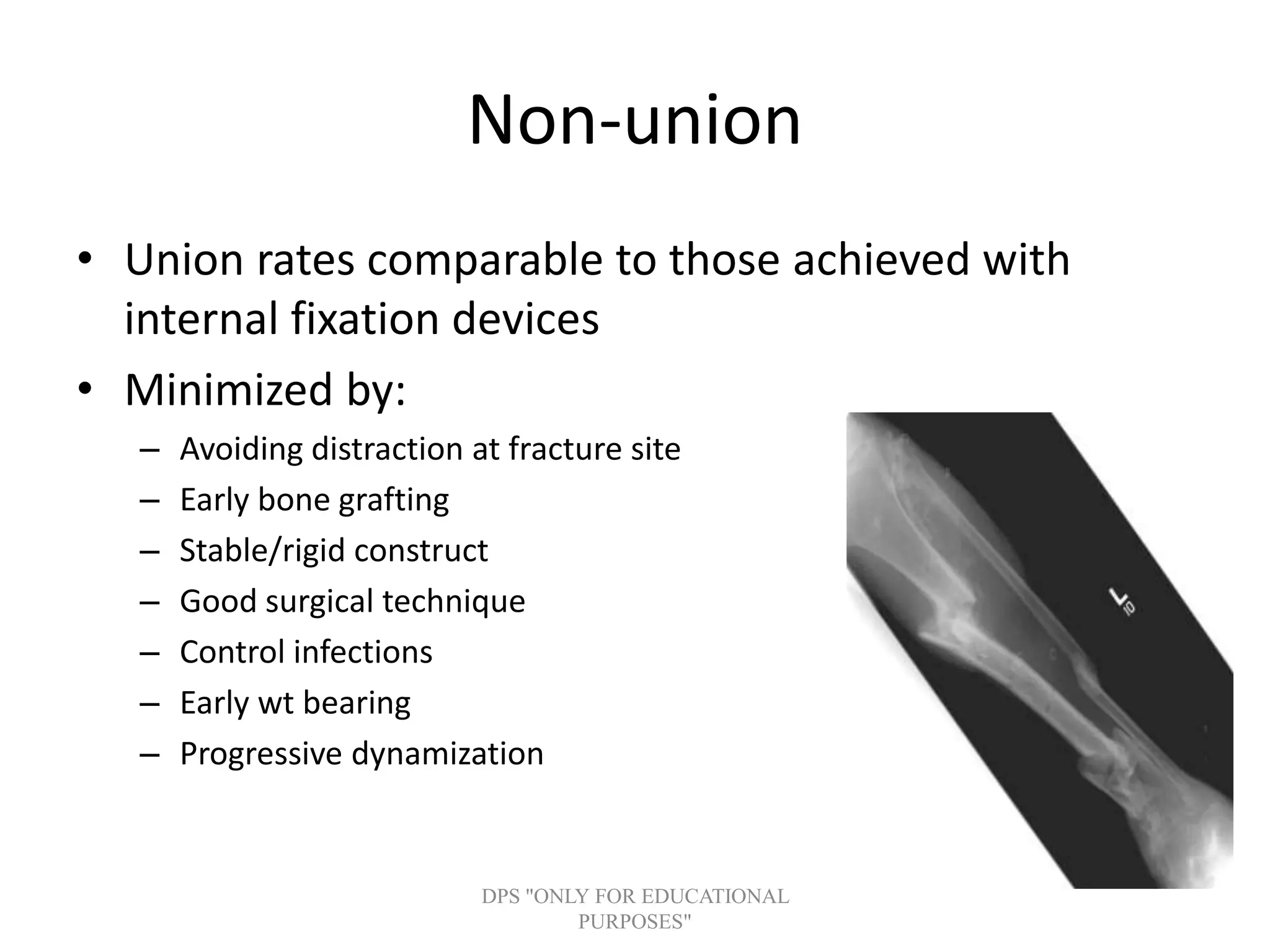
Non-union
• Union rates comparable to those achieved with
internal fixation devices
• Minimized by:
– Avoiding distraction at fracture site
– Early bone grafting
– Stable/rigid construct
– Good surgical technique
– Control infections
– Early wt bearing
– Progressive dynamization
DPS "ONLY FOR EDUCATIONAL
PURPOSES"
Soft-tissue Impalement
• Tethering of soft tissues can result in:
– Loss of motion
– Scarring
– Vessel injury
• Prevention:
– Check ROM intra-operatively
– Avoid piercing muscle or tendons
– Position joint in NEUTRAL
– Early stretching and ROM exercises
DPS "ONLY FOR EDUCATIONAL
PURPOSES"
Compartment Syndrome
• Rare
• Cause:
– Injury related
– pin or wire causing intracompartmental bleeding
• Prevention:
– Clear understanding of the anatomy
– Good technique
– Post-operative vigilance
DPS "ONLY FOR EDUCATIONAL
PURPOSES"
Future Areas of Development
• Pin coatings/sleeves
– Reduce infection
– Reduce pin loosening
• Optimization of dynamization for fracture
healing
• Increasing ease of use/reduced cost
DPS "ONLY FOR EDUCATIONAL
PURPOSES"
Construct Tips
• Chose optimal pin diameter
• Use good insertion technique
• Place clamps and frames close to skin
• Frame in plane of deforming forces
• Stack frame (2 bars)
• Re-use/Recycle components (requires
certified inspection).
Plan ahead!DPS "ONLY FOR EDUCATIONAL
PURPOSES"
References
1. Bhandari M, Zlowodski M, Tornetta P, Schmidt A, Templeman D. Intramedullary Nailing Following External Fixation in Femoral and Tibial Shaft Fractures. Evidence-
Based Orthopaedic Trauma , JOT, 19(2): 40-144, 2005.
2. Cannada LK, Herzenberg JE, Hughes PM, Belkoff S. Safety and Image Artifact of External Fixators and Magnetic Resonance Imaging. CORR, 317, 206-214:1995.
3. Davison BL, Cantu RV, Van Woerkom S. The Magnetic Attraction of Lower Extremity External Fixators in an MRI Suite. JOT, 18 (1): 24-27, 2004.
4. Kenwright J, Richardson JB, Cunningham, et al. Axial movement and tibial fractures. A controlled randomized trial of treatment, JBJS-B, 73 (4): 654-650, 1991.
5. Kenwright J , Gardner T. Mechanical influences on tibial fracture healing. CORR, 355: 179-190,1998.
6. Kowalski, M et al, Comparative Biomechanical Evaluation of Different External Fixator Sidebars: Stainless-Steel Tubes versus Carbon Fiber Bars, JOT 10(7): 470-475,
1996.
7. Kumar R, Lerski RA, Gandy S, Clift BA, Abboud RJ. Safety of orthopedic implants in Magnetic Resonance Imaging: an Experimental Verification. J Orthop Res, 24 (9):
1799-1802, 2006.
8. Larsson S, Kim W, Caja VL, Egger EL, Inoue N, Chao EY. Effect of early axial dynamization on tibial bone healing: a study in dogs. CORR, 388: 240-51, 2001.
9. Lowenberg DW, Nork S, Abruzzo FM. The correlation of shearing force with fracture line migration for progressive fracture obliquities stabilized by external fixation in
the tibial model. CORR, 466:2947–2954, 2008.
10. Marsh JL. Nepola JV, Wuest TK, Osteen D, Cox K, Oppenheim W. Unilateral External Fixation Until Healing with the Dynamic Axial Fixator for Severe Open Tibial
Fractures. Review of Two Consecutive Series , JOT, 5(3): 341-348, 1991.
11. Maurer DJ, Merkow RL, Gustilo RB. Infection after intramedullary nailing of severe open tibial fractures initially treated with external fixation. JBJS-A, 71(6), 835-838,
1989.
12. Metcalfe AJ, Saleh M, Yang L. Techniques for improving stability in oblique fractures treated by circular fixation with particular reference to the sagittal plane. JBJS B,
87 (6): 868-872, 2005.
13. Moroni A, Faldini C, Marchetti S, Manca M, Consoli V, Giannini S. Improvement of the Bone-Pin Interface Strength in Osteoporotic Bone with Use of Hydroxyapatite-
Coated Tapered External-Fixation Pins: A Prospective, Randomized Clinical Study of Wrist Fractures . JBJS –A, 83:717-721, 2001.
14. Moroni A, Faldini C. Pegreffi F. Hoang-Kim A. Vannini F. Giannini S. Dynamic Hip Screw versus External Fixation for Treatment of Osteoporotic Pertrochanteric
Fractures, J BJS-A. 87:753-759, 2005.
15. Moroni A. Faldini C. Rocca M. Stea S. Giannini S. Improvement of the bone-screw interface strength with hydroxyapatite-coated and titanium-coated AO/ASIF cortical
screws. J OT. 16(4): 257-63, 2002 .
16. Nowotarski PJ, Turen CH, Brumback RJ, Scarboro JM, Conversion of External Fixation to Intramedullary Nailing for Fractures of the Shaft of the Femur in Multiply
Injured Patients, JBJS-A, 82:781-788, 2000.
17. Patterson MJ, Cole J. Two-Staged Delayed Open Reduction and Internal Fixation of Severe Pilon Fractures. JOT, 13(2): 85-91, 1999.
18. Pugh K.J, Wolinsky PR, Dawson JM, Stahlman GC. The Biomechanics of Hybrid External Fixation. JOT. 13(1):20-26, 1999.
19. Roberts C, Dodds JC, Perry K, Beck D, Seligson D, Voor M. Hybrid External Fixation of the Proximal Tibia: Strategies to Improve Frame Stability. JOT, 17(6):415-420,
2003.
20. Scalea TM, Boswell SA, Scott JD, Mitchell KA, Kramer ME, Pollak AN. External Fixation as a Bridge to Intramedullary Nailing for Patients with Multiple Injuries and with
Femur Fractures: Damage Control Orthopedics. J Trauma, 48(4):613-623, 2000.
21. Sirkin M, Sanders R, DiPasquale T, Herscovici, A Staged Protocol for Soft Tissue Management in the Treatment of Complex Pilon Fractures. JOT, 13(2): 78-84, 1999.
22. Yilmaz E, Belhan O, Karakurt L, Arslan N, Serin E. Mechanical performance of hybrid Ilizarov external fixator in comparison with Ilizarov circular external fixator. Clin
Biomech, 18 (6): 518, 2003.
DPS "ONLY FOR EDUCATIONAL
PURPOSES"

Principles of external fixator

  • 1.
    Principles of ExternalFixation DR. D. P. SWAMI DPS "ONLY FOR EDUCATIONAL PURPOSES"
  • 2.
    Overview • Indications • Advantagesand disadvantages • Mechanics • Biology • Complications DPS "ONLY FOR EDUCATIONAL PURPOSES"
  • 3.
    Indications • Definitive fxcare: • Open fractures • Peri-articular fractures • Pediatric fractures • Temporary fx care • “Damage control” – Long bone fracture temporization • Pelvic ring injury • Periarticular fractures – Pilon fracture • Malunion/nonunion • Arthrodesis • Osteomyelitis • Limb deformity/length inequality • Congenital • Acquired DPS "ONLY FOR EDUCATIONAL PURPOSES"
  • 4.
    Advantages • Minimally invasive •Flexibility (build to fit) • Quick application • Useful both as a temporizing or definitive stabilization device • Reconstructive and salvage applications Complex 3-C humerus fx DPS "ONLY FOR EDUCATIONAL PURPOSES"
  • 5.
    Disadvantages • Mechanical – Distractionof fracture site – Inadequate immobilization – Pin-bone interface failure – Weight/bulk – Refracture (pediatric femur) • Biologic – Infection (pin track) • May preclude conversion to IM nailing or internal fixation – Neurovascular injury – Tethering of muscle – Soft tissue contracture May result in malunion/nonunion, loss of function DPS "ONLY FOR EDUCATIONAL PURPOSES"
  • 6.
    Components of theEx-fix • Pins • Clamps • Connecting rods DPS "ONLY FOR EDUCATIONAL PURPOSES"
  • 7.
    < 1/3 dia Pins •Principle: The pin is the critical link between the bone and the frame – Pin diameter • Bending stiffness proportional to r4 • 5mm pin 144% stiffer than 4mm pin – Pin insertion technique respecting bone and soft tissue DPS "ONLY FOR EDUCATIONAL PURPOSES"
  • 8.
    Pins • Various diameters,lengths, and designs – 2.5 mm pin – 4 mm short thread pin – 5 mm predrilled pin – 6 mm tapered or conical pin – 5 mm self-drilling and self tapping pin – 5 mm centrally threaded pin • Materials – Stainless steel – Titanium • More biocompatible • Less stiff DPS "ONLY FOR EDUCATIONAL PURPOSES"
  • 9.
    Pin Geometry ‘Blunt’ pins -Straight - Conical Self Drilling and Tapping DPS "ONLY FOR EDUCATIONAL PURPOSES"
  • 10.
    Pin coatings • Recentdevelopment of various coatings (Chlorohexidine, Silver, Hydroxyapatite) – Improve fixation to bone – Decrease infection – Moroni, JOT, ’02 • Animal study, HA pin 13X higher extraction torque vs stainless and titanium and equal to insertion torque – Moroni, JBJS A, ’05 • 0/50 pts pin infection in tx of pertrochanteric fx DPS "ONLY FOR EDUCATIONAL PURPOSES"
  • 11.
    Pin Insertion Technique 1.Incise skin 2. Spread soft tissues to bone 3. Use sharp drill with sleeve 4. Irrigate while drilling 5. Place appropriate pin using sleeve Avoid soft tissue damage and bone thermal necrosisDPS "ONLY FOR EDUCATIONAL PURPOSES"
  • 12.
    Pin insertion • Selfdrilling pin considerations – Short drill flutes • thermal necrosis • stripping of near cortex with far cortex contact – Quick insertion – Useful for short term applications vs. DPS "ONLY FOR EDUCATIONAL PURPOSES"
  • 13.
    Pin Length •Half Pins –singlepoint of entry –Engage two cortices •Transfixation Pins –Bilateral, uniplanar fixation –lower stresses at pin bone interface –Limited anatomic sites (nv injury) –Traveling traction Courtesy Matthew Camuso DPS "ONLY FOR EDUCATIONAL PURPOSES"
  • 14.
    Pin Diameter Guidelines •Femur– 5 or 6 mm •Tibia – 5 or 6 mm •Humerus – 5 mm •Forearm – 4 mm •Hand, Foot – 3 mm Slide courtesy Matthew Camuso < 1/3 dia DPS "ONLY FOR EDUCATIONAL PURPOSES"
  • 15.
    Clamps • Two generalvarieties: – Single pin to bar clamps – Multiple pin to bar clamps • Features: – Multi-planar adjustability – Open vs closed end • Principles – Must securely hold the frame to the pin – Clamps placed closer to bone increases the stiffness of the entire fixator constructDPS "ONLY FOR EDUCATIONAL PURPOSES"
  • 16.
    Connecting Rods and/orFrames • Options: – materials: • Steel • Aluminum • Carbon fiber – Design • Simple rod • Articulated • Telescoping • Principle – increased diameter = increased stiffness and strength – Stacked (2 parallel bars) = increased stiffness DPS "ONLY FOR EDUCATIONAL PURPOSES"
  • 17.
    Bars •Stainless vs Carbon Fiber –Radiolucency –↑diameter = ↑ stiffness –Carbon 15% stiffer vs stainless steel in loading to failure –frames with carbon fiber are only 85% as stiff ? ? ? ?Weak link is clamp to carbon bar? Kowalski M, et al, Comparative Biomechanical Evaluation of Different External Fixator Sidebars: Stainless-Steel Tubes versus Carbon Fiber Bars, JOT 10(7): 470-475, 1996 Added bar stiffness ≠ increased frame stiffness DPS "ONLY FOR EDUCATIONAL PURPOSES"
  • 18.
    Ring Fixators • Components: –Tensioned thin wires • olive or straight – Wire and half pin clamps – Rings – Rods – Motors and hinges (not pictured) DPS "ONLY FOR EDUCATIONAL PURPOSES"
  • 19.
    Ring Fixators • Principles: –Multiple tensioned thin wires (90- 130 kg) – Place wires as close to 90o to each other – Half pins also effective – Use full rings (more difficult to deform) • Can maintain purchase in metaphyseal bone • Allows dynamic axial loading • May allow joint motion DPS "ONLY FOR EDUCATIONAL PURPOSES"
  • 20.
    Multiplanar Adjustable RingFixators • Application with wire or half pins • Adjustable with 6 degrees of freedom – Deformity correction • acute • chronic DPS "ONLY FOR EDUCATIONAL PURPOSES"
  • 21.
    • Type 3Aopen tibia fracture with bone loss DPS "ONLY FOR EDUCATIONAL PURPOSES"
  • 22.
    • Following frameadjustment and bone grafting DPS "ONLY FOR EDUCATIONAL PURPOSES"
  • 23.
    Frame Types • Uniplanar –Unilateral – Bilateral • Pin transfixes extremity • Biplanar – Unilateral – Bilateral • Circular (Ring Fixator) – May use Half-pins and/or transfixion wires • Hybrid – Combines rings with planar frames Unilateral uniplanar Unilateral biplanar DPS "ONLY FOR EDUCATIONAL PURPOSES"
  • 24.
    Hybrid Fixators • Combinesthe advantages of ring fixators in periarticular areas with simplicity of planar half pin fixators in diaphyseal bone From Rockwood and Green’s, 5th Ed DPS "ONLY FOR EDUCATIONAL PURPOSES"
  • 25.
    Biomechanical Comparison Hybrid vsRing Frames • Ring frames resist axial and bending deformation better than any hybrid modification • Adding 2nd proximal ring and anterior half pin improves stability of hybrid frame Pugh et al, JOT, ‘99 Yilmaz et al, Clin Biomech, 2003 Roberts et al, JOT, 2003 Clinical application: Use full ring fixator for fx with bone defects or expected long frame time DPS "ONLY FOR EDUCATIONAL PURPOSES"
  • 26.
    MRI Compatability • Issues: –Safety • Magnetic field displacing ferromagnetic object – Potential missile • Heat generation by induced fields – Image quality • Image distortion DPS "ONLY FOR EDUCATIONAL PURPOSES"
  • 27.
    MRI Compatibility • Stainlesssteel components (pins, clamps, rings) most at risk for attraction and heating • Titanium (pins), aluminum (rods, clamps, rings) and carbon fiber (rods, rings) demonstrate minimal heating and attraction • Almost all are safe if the components are not directly within the scanner (subject to local policy) • Consider use of MRI “safe” ex fix when area interest is spanned by the frame and use titanium pins Kumar, JOR, 2006 Davison, JOT, 2004 Cannada, CORR, 1995 DPS "ONLY FOR EDUCATIONAL PURPOSES"
  • 28.
    Frame Types • Standardframe • Joint spanning frame: – Nonarticulated – Articulated frame • Distraction or Correction frame DPS "ONLY FOR EDUCATIONAL PURPOSES"
  • 29.
    Standard Frame • StandardFrame Design – Diaphyseal region – Allows adjacent joint motion – Stable DPS "ONLY FOR EDUCATIONAL PURPOSES"
  • 30.
    Joint Spanning Frame •Joint Spanning Frame – Indications: • Peri-articular fx – Definitive fixation through ligamentotaxis – Temporizing » Place pins away from possible ORIF incision sites • Arthrodesis • Stabilization of limb with severe ligamentous or vascular injury: Damage control DPS "ONLY FOR EDUCATIONAL PURPOSES"
  • 31.
    Articulated Frame • ArticulatingFrame – Limited indications • Intra- and peri-articular fractures or ligamentous injury • Most commonly used in the ankle, elbow and knee – Allows joint motion – Requires precise placement of hinge in the axis of joint motion (Figure from: Rockwood and Green, Fractures in Adults, 4th ed, Lippincott-Raven, 1996) DPS "ONLY FOR EDUCATIONAL PURPOSES"
  • 32.
    Correction of Deformityor Defects • May use unilateral or ring frames • Simple deformities may use simple frames • Complex deformities require more complex frames • All require careful planning DPS "ONLY FOR EDUCATIONAL PURPOSES"
  • 33.
    • 3B tibiawith segmental bone loss, 3A plateau, temporary spanning ex fixDPS "ONLY FOR EDUCATIONAL PURPOSES"
  • 34.
    • Convert tocircular frame, orif plateau • Corticotomy and distractionDPS "ONLY FOR EDUCATIONAL PURPOSES"
  • 35.
    • Consolidation *note: dockingsite bone graftedDPS "ONLY FOR EDUCATIONAL PURPOSES"
  • 36.
    HealedDPS "ONLY FOREDUCATIONAL PURPOSES"
  • 37.
    EXTERNAL FIXATION Biomechanics Understand fixatormechanics • do not over or underbuild frame! Leave the Eiffel tower in Paris! DPS "ONLY FOR EDUCATIONAL PURPOSES"
  • 38.
    Fixator Mechanics: Pin Factors •Larger pin diameter • Increased pin spread – on the same side of the fracture • Increased number of pins (both in and out of plane of construct) DPS "ONLY FOR EDUCATIONAL PURPOSES"
  • 39.
    Fixator Mechanics: Pin Factors •Oblique fxs subject to shear • Use oblique pin to counter these effects Metcalfe, et al, JBJS B, 2005 Lowenberg, et al, CORR, 2008 DPS "ONLY FOR EDUCATIONAL PURPOSES"
  • 40.
    Fixator Mechanics: RodFactors • Frames placed in the same plane as the applied load • Decreased distance from bars to bone • Stacking of bars  DPS "ONLY FOR EDUCATIONAL PURPOSES"
  • 41.
    Frame Mechanics: Biplanar Construct •Linkage between frames in perpendicular planes (DELTA) • Controls each plane of deformation DPS "ONLY FOR EDUCATIONAL PURPOSES"
  • 42.
    Frame Mechanics: RingFixators • Spread wires to as close to 90 o as anatomically possible • Use at least 2 planes of wires/half pins in each major bone segment  DPS "ONLY FOR EDUCATIONAL PURPOSES"
  • 43.
    Modes of Fixation •Compression – Sufficient bone stock – Enhances stability – Intimate contact of bony ends – Typically used in arthrodesis or to complete union of a fracture • Neutralization – Comminution or bone loss present – Maintains length and alignment – Resists external deforming forces • Distraction – Reduction through ligamentotaxis – Temporizing device – Distraction osteogenesis DPS "ONLY FOR EDUCATIONAL PURPOSES"
  • 44.
    Biology • Fracture healingby stable yet less rigid systems – Dynamization – Micromotion • micromotion = callus formation (Figures from: Rockwood and Green, Fractures in Adults, 4th ed, Lippincott-Raven, 1996) Kenwright, CORR, 1998 Larsson, CORR, 2001 DPS "ONLY FOR EDUCATIONAL PURPOSES"
  • 45.
    Biology • Dynamization =load- sharing construct that promote micromotion at the fracture site • Controlled load-sharing helps to "work harden" the fracture callus and accelerate remodeling (Figures from: Rockwood and Green, Fractures in Adults, 4th ed, Lippincott-Raven, 1996) •Kenwright and Richardson, JBJS-B, ‘91 •Quicker union less refracture •Marsh and Nepola, ’91 •96% union at 24.6 wks DPS "ONLY FOR EDUCATIONAL PURPOSES"
  • 46.
    Anatomic Considerations • Fundamentalknowledge of the anatomy is critical • Avoidance of major nerves,vessels and organs (pelvis) is mandatory • Avoid joints and joint capsules – Proximal tibial pins should be placed 14 mm distal to articular surface to avoid capsular reflection • Minimize muscle/tendon impalement (especially those with large excursions) DPS "ONLY FOR EDUCATIONAL PURPOSES"
  • 47.
    Lower Extremity “safe”sites • Avoid – Nerves – Vessels – Joint capsules • Minimize – Muscle transfixion 14 mm DPS "ONLY FOR EDUCATIONAL PURPOSES"
  • 48.
    Upper Extremity “Safe”Sites • Humerus: narrow lanes – Proximal: axillary n – Mid: radial nerve – Distal: radial, median and ulnar n – Dissect to bone, Use sleeves • Ulna: safe subcutaneous border, avoid overpenetration • Radius: narrow lanes – Proximal: avoid because radial n and PIN, thick muscle sleeve – Mid and distal: use dissection to avoid sup. radial n. DPS "ONLY FOR EDUCATIONAL PURPOSES"
  • 49.
    Damage Control andTemporary Frames • Initial frame application rapid • Enough to stabilize but is not definitive frame! • Be aware of definitive fixation options – Avoid pins in surgical approach sites • Depending on clinical situation may consider minimal fixation of articular surface at initial surgery DPS "ONLY FOR EDUCATIONAL PURPOSES"
  • 50.
    Conversion to InternalFixation • Generally safe within 2-3 wks – Bhandari, JOT, 2005 • Meta analysis: 6 femur, 9 tibia, all but one retrospective • Infection in tibia and femur <4% • Rods or plates appropriate • Use with caution with signs of pin irritation – Consider staged procedure • Remove and curette sites • Return following healing for definitive fixation – Extreme caution with established pin track infection – Maurer, ’89 • 77% deep infection with h/o pin infection DPS "ONLY FOR EDUCATIONAL PURPOSES"
  • 51.
    Evidence • Femur fx –Nowotarski, JBJS-A, ’00 • 59 fx (19 open), 54 pts, • Convert at 7 days (1-49 days) • 1 infected nonunion, 1 aseptic nonunion – Scalea, J Trauma, ’00 • 43 ex-fix then nailed vs 284 primary IM nail • ISS 26.8 vs 16.8 • Fluids 11.9l vs 6.2l first 24 hrs • OR time 35 min EBL 90cc vs 135 min EBL 400cc • Ex fix group 1 infected nonunion, 1 aseptic nonunion Bilat open femur, massive compartment syndrome, ex fix then nail DPS "ONLY FOR EDUCATIONAL PURPOSES"
  • 52.
    Evidence • Pilon fx –Sirkin et al, JOT, 1999 • 49 fxs, 22 open • plating @ 12-14 days, • 5 minor wound problems, 1 osteomyelitis – Patterson & Cole, JOT, 1999 • 22 fxs • plating @ 24 d (15-49) • no wound healing problems • 1 malunion, 1 nonunion DPS "ONLY FOR EDUCATIONAL PURPOSES"
  • 53.
    Complications • Pin-track infection/loosening •Frame or Pin/Wire Failure • Malunion • Non-union • Soft-tissue impalement • Compartment syndrome DPS "ONLY FOR EDUCATIONAL PURPOSES"
  • 54.
    Pin-track Infection • Mostcommon complication • 0 – 14.2% incidence • 4 stages: – Stage I: Seropurulent Drainage – Stage II: Superficial Cellulitis – Stage III: Deep Infection – Stage IV: Osteomyelitis DPS "ONLY FOR EDUCATIONAL PURPOSES"
  • 55.
    Pin-track Infection Union Fxinfection Malunion Pin Infection Mendes, ‘81 100% 4% NA 0 Velazco, ’83 92% NA 5% 12.5% Behrens, ’86 100% 4% 1.3% 6.9% Steinfeld, ’88 97% 7.1% 23% 0.5% Marsh, ‘91 95% 5% 5% 10% Melendez, ’89 98% 22% 2% 14.2% DPS "ONLY FOR EDUCATIONAL PURPOSES"
  • 56.
    Pin-track Infection • Prevention: –Proper pin/wire insertion technique: • Subcutaneous bone borders • Away from zone of injury • Adequate skin incision • Cannulae to prevent soft tissue injury during insertion • Sharp drill bits and irrigation to prevent thermal necrosis • Manual pin insertion (Figures from: Rockwood and Green, Fractures in Adults, 4th ed, Lippincott-Raven, 1996) DPS "ONLY FOR EDUCATIONAL PURPOSES"
  • 57.
    Pin-track Infection • Postoperativecare: – Clean implant/skin interface – Saline – Gauze – Shower DPS "ONLY FOR EDUCATIONAL PURPOSES"
  • 58.
    Pin-track Infection • Treatment: –Stage I: aggressive pin-site care and oral cephalosporin – Stage II: same as Stage I and +/- Parenteral Abx – Stage III: Removal/exchange of pin plus Parenteral Abx – Stage IV: same as Stage III, culture pin site for offending organism, specific IV Abx for 10 to 14 days, surgical debridement of pin site DPS "ONLY FOR EDUCATIONAL PURPOSES"
  • 59.
    Pin Loosening • Factorsinfluencing Pin Loosening: – Pin track infection/osteomyelitis – Thermonecrosis – Delayed union or non-union – Bending Pre-load DPS "ONLY FOR EDUCATIONAL PURPOSES"
  • 60.
    Pin Loosening • Prevention: –Proper pin/wire insertion techniques – Radial preload – Euthermic pin insertion – Adequate soft-tissue release – Bone graft early – Pin coatings • Treatment: – Replace/remove loose pin DPS "ONLY FOR EDUCATIONAL PURPOSES"
  • 61.
    Frame Failure • Incidence:Rare • Theoretically can occur with recycling of old frames • However, no proof that frames can not be re- used DPS "ONLY FOR EDUCATIONAL PURPOSES"
  • 62.
    Malunion Intra-operative causes: – Dueto poor technique • Prevention: – Clear pre-operative planning – Prep contralateral limb for comparison – Use fluoroscopic and/or intra-operative films – Adequate construct • Treatment: – Early: Correct deformity and adjust or re-apply frame prior to bony union – Late: Reconstructive correction of malunion DPS "ONLY FOR EDUCATIONAL PURPOSES"
  • 63.
    Malunion Post-operative causes: – Dueto frame failure • Prevention: – Proper follow-up with both clinical and radiographic check-ups – Adherence to appropriate weight-bearing restrictions – Check and re-tighten frame at periodic intervals • Treatment: – Osteotomy/reconstruction DPS "ONLY FOR EDUCATIONAL PURPOSES"
  • 64.
    Non-union • Union ratescomparable to those achieved with internal fixation devices • Minimized by: – Avoiding distraction at fracture site – Early bone grafting – Stable/rigid construct – Good surgical technique – Control infections – Early wt bearing – Progressive dynamization DPS "ONLY FOR EDUCATIONAL PURPOSES"
  • 65.
    Soft-tissue Impalement • Tetheringof soft tissues can result in: – Loss of motion – Scarring – Vessel injury • Prevention: – Check ROM intra-operatively – Avoid piercing muscle or tendons – Position joint in NEUTRAL – Early stretching and ROM exercises DPS "ONLY FOR EDUCATIONAL PURPOSES"
  • 66.
    Compartment Syndrome • Rare •Cause: – Injury related – pin or wire causing intracompartmental bleeding • Prevention: – Clear understanding of the anatomy – Good technique – Post-operative vigilance DPS "ONLY FOR EDUCATIONAL PURPOSES"
  • 67.
    Future Areas ofDevelopment • Pin coatings/sleeves – Reduce infection – Reduce pin loosening • Optimization of dynamization for fracture healing • Increasing ease of use/reduced cost DPS "ONLY FOR EDUCATIONAL PURPOSES"
  • 68.
    Construct Tips • Choseoptimal pin diameter • Use good insertion technique • Place clamps and frames close to skin • Frame in plane of deforming forces • Stack frame (2 bars) • Re-use/Recycle components (requires certified inspection). Plan ahead!DPS "ONLY FOR EDUCATIONAL PURPOSES"
  • 69.
    References 1. Bhandari M,Zlowodski M, Tornetta P, Schmidt A, Templeman D. Intramedullary Nailing Following External Fixation in Femoral and Tibial Shaft Fractures. Evidence- Based Orthopaedic Trauma , JOT, 19(2): 40-144, 2005. 2. Cannada LK, Herzenberg JE, Hughes PM, Belkoff S. Safety and Image Artifact of External Fixators and Magnetic Resonance Imaging. CORR, 317, 206-214:1995. 3. Davison BL, Cantu RV, Van Woerkom S. The Magnetic Attraction of Lower Extremity External Fixators in an MRI Suite. JOT, 18 (1): 24-27, 2004. 4. Kenwright J, Richardson JB, Cunningham, et al. Axial movement and tibial fractures. A controlled randomized trial of treatment, JBJS-B, 73 (4): 654-650, 1991. 5. Kenwright J , Gardner T. Mechanical influences on tibial fracture healing. CORR, 355: 179-190,1998. 6. Kowalski, M et al, Comparative Biomechanical Evaluation of Different External Fixator Sidebars: Stainless-Steel Tubes versus Carbon Fiber Bars, JOT 10(7): 470-475, 1996. 7. Kumar R, Lerski RA, Gandy S, Clift BA, Abboud RJ. Safety of orthopedic implants in Magnetic Resonance Imaging: an Experimental Verification. J Orthop Res, 24 (9): 1799-1802, 2006. 8. Larsson S, Kim W, Caja VL, Egger EL, Inoue N, Chao EY. Effect of early axial dynamization on tibial bone healing: a study in dogs. CORR, 388: 240-51, 2001. 9. Lowenberg DW, Nork S, Abruzzo FM. The correlation of shearing force with fracture line migration for progressive fracture obliquities stabilized by external fixation in the tibial model. CORR, 466:2947–2954, 2008. 10. Marsh JL. Nepola JV, Wuest TK, Osteen D, Cox K, Oppenheim W. Unilateral External Fixation Until Healing with the Dynamic Axial Fixator for Severe Open Tibial Fractures. Review of Two Consecutive Series , JOT, 5(3): 341-348, 1991. 11. Maurer DJ, Merkow RL, Gustilo RB. Infection after intramedullary nailing of severe open tibial fractures initially treated with external fixation. JBJS-A, 71(6), 835-838, 1989. 12. Metcalfe AJ, Saleh M, Yang L. Techniques for improving stability in oblique fractures treated by circular fixation with particular reference to the sagittal plane. JBJS B, 87 (6): 868-872, 2005. 13. Moroni A, Faldini C, Marchetti S, Manca M, Consoli V, Giannini S. Improvement of the Bone-Pin Interface Strength in Osteoporotic Bone with Use of Hydroxyapatite- Coated Tapered External-Fixation Pins: A Prospective, Randomized Clinical Study of Wrist Fractures . JBJS –A, 83:717-721, 2001. 14. Moroni A, Faldini C. Pegreffi F. Hoang-Kim A. Vannini F. Giannini S. Dynamic Hip Screw versus External Fixation for Treatment of Osteoporotic Pertrochanteric Fractures, J BJS-A. 87:753-759, 2005. 15. Moroni A. Faldini C. Rocca M. Stea S. Giannini S. Improvement of the bone-screw interface strength with hydroxyapatite-coated and titanium-coated AO/ASIF cortical screws. J OT. 16(4): 257-63, 2002 . 16. Nowotarski PJ, Turen CH, Brumback RJ, Scarboro JM, Conversion of External Fixation to Intramedullary Nailing for Fractures of the Shaft of the Femur in Multiply Injured Patients, JBJS-A, 82:781-788, 2000. 17. Patterson MJ, Cole J. Two-Staged Delayed Open Reduction and Internal Fixation of Severe Pilon Fractures. JOT, 13(2): 85-91, 1999. 18. Pugh K.J, Wolinsky PR, Dawson JM, Stahlman GC. The Biomechanics of Hybrid External Fixation. JOT. 13(1):20-26, 1999. 19. Roberts C, Dodds JC, Perry K, Beck D, Seligson D, Voor M. Hybrid External Fixation of the Proximal Tibia: Strategies to Improve Frame Stability. JOT, 17(6):415-420, 2003. 20. Scalea TM, Boswell SA, Scott JD, Mitchell KA, Kramer ME, Pollak AN. External Fixation as a Bridge to Intramedullary Nailing for Patients with Multiple Injuries and with Femur Fractures: Damage Control Orthopedics. J Trauma, 48(4):613-623, 2000. 21. Sirkin M, Sanders R, DiPasquale T, Herscovici, A Staged Protocol for Soft Tissue Management in the Treatment of Complex Pilon Fractures. JOT, 13(2): 78-84, 1999. 22. Yilmaz E, Belhan O, Karakurt L, Arslan N, Serin E. Mechanical performance of hybrid Ilizarov external fixator in comparison with Ilizarov circular external fixator. Clin Biomech, 18 (6): 518, 2003. DPS "ONLY FOR EDUCATIONAL PURPOSES"