Supracondylar
fractures of
Humerus in children
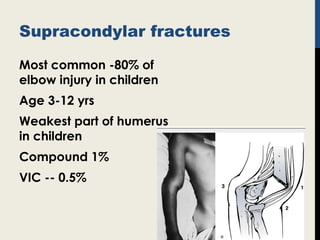
Supracondylar fractures
Most common -80% of
elbow injury in children
Age 3-12 yrs
Weakest part of humerus
in children
Compound 1%
VIC -- 0.5%
TYPES
Extension type 95%
Flexion type
EXTENSION TYPE
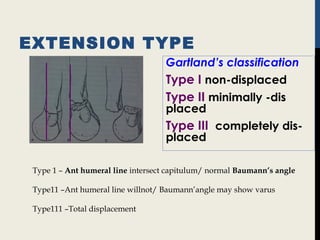
Gartland’s classification
Type I non-displaced
Type II minimally -dis
placed
Type III completely dis-
placed
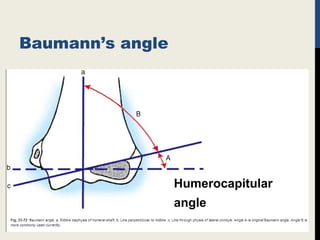
Type 1 – Ant humeral line intersect capitulum/ normal Baumann’s angle
Type11 –Ant humeral line willnot/ Baumann’angle may show varus
Type111 –Total displacement
Baumann’s angle
Humerocapitular
angle
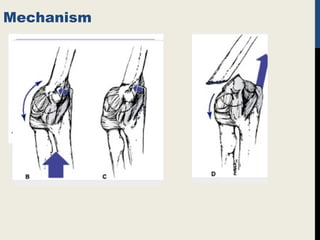
Mechanism
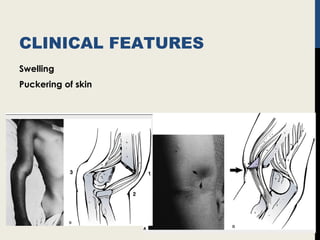
CLINICAL FEATURES
Swelling
Puckering of skin
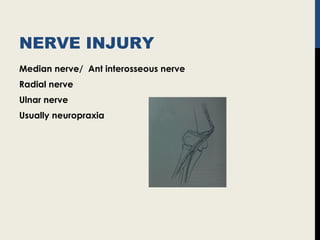
NERVE INJURY
Median nerve/ Ant interosseous nerve
Radial nerve
Ulnar nerve
Usually neuropraxia
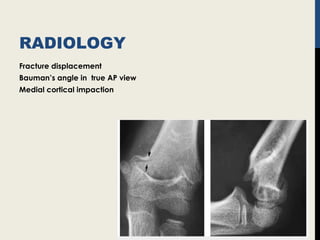
RADIOLOGY
Fracture displacement
Bauman’s angle in true AP view
Medial cortical impaction
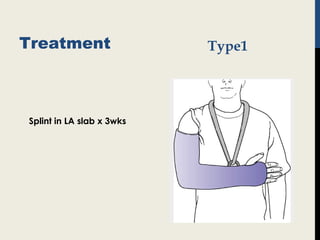
Treatment
Splint in LA slab x 3wks
Type1
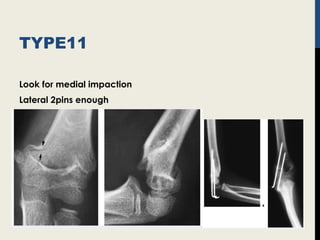
TYPE11
Look for medial impaction
Lateral 2pins enough
Thickness of pin
1.6 mm for younger children
1.8–2.0 mm for older children
Pin configuration
[lateral]
Parallel pins
Crossed pins
Medial pin transcapitular
Instability – 3rd
pin
Newton’s study
AO recommendation
TYPE 111
CMR LA POP if fail K-wire fixation
In August 1995, an audit into the outcome following the
treatment of Gartland’s type III supracondylar fractures was
conducted
52.5% chance of re-operation
50% chance of developing cubitus varus deformity
CMR and closed pinning
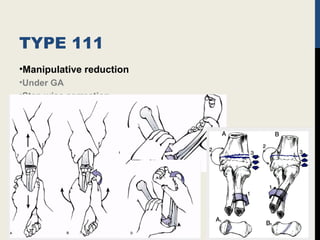
TYPE 111
•Manipulative reduction
•Under GA
•Step wise correction
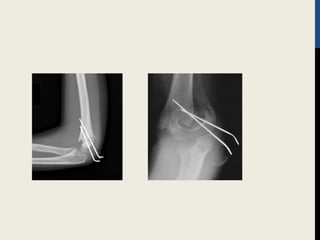
Type 111– 1 lateral pin + 1medial pin
Crossed Pin Vs parallel
lateral pins in Type 111
medial pin post to ant -- lateral ant to post
angulated superiorly approximately 40 deg
engage the opposite cortex
Instability test – add k-wire on lateral side
Ziont’s study
AO recommendation
Medial pin -- ulnar
nerve injury
Extension of elbow 60 deg flexion after lateral pin
Palpate nerve in groove
Small incision over pin entry blunt dissection
Using drill sleeve.
VASCULAR INJURY
Brachial artery injury / vascular
insufficiency
Assess by color, warmth, capillary refill
Angiogram ? NO
Need emergency reduction and pinning
Pulse is absent 12-15% but vascular repair is needed only in
1-2% [Rockwood and Green]
No pulse after reduction in 15mts
Pink warm hand –observation
Cold pale hand Intraoperative ANGIOGRAPHY
Exploration of artery and vascular repair
Open reduction
Vascular repair
Compound injury
Unreducable situation –posterolateral displacement
interposition of soft tissue
Approach controversial
COMPLICATIONS
Compartment syndrome
Myositis ossificans
Avascular necrosis of trochlea
Angular deformities – CUBITUS VARUS
CUBITUS VARUS
AETIOLOGY
Malunion on s.c.fx  coronal angulation aggravated
by malrotation and hyper extension --- static deformity
Growth disturbance 20% of growth
[5yr old 1 yr growth is 2mm]
Avascular necrosis of trochlea rare cause
CMR &LA POP Cubitus varus --50% of cases.
CMR and closed pinning -- 6.6%
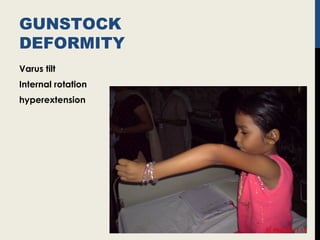
GUNSTOCK
DEFORMITY
Varus tilt
Internal rotation
hyperextension
Problems
Cosmetic problem
Risk of fracture
Posterior shoulder instability
Tardy ulnar palsy
May have throwing problems
Clinical
Evident only in full extension and supination
Three bony point relationship
Olecranon- med epicondyle distance get reduced
Triceps shift medially
Narrow ulnar tunnel
Internal rotation of shoulder more than opposite side.
Remodeling
Cubitus varus -- little potential for correction
Hyper extension may remodel
Attenborough-- 'once a varus always a varus'.
OSTEOTOMY
These are broadly divided into four groups:
1.Medial open wedge,
2.Lateral closing wedge with rotatory correction,
3.Lateral closing wedge without rotatory correction,
4.Dome ,Pentalateral or Oblique or Step-cut osteotomy.
TIMING OSTEOTOMY
The true extent of varus can be assessed with the elbow
fully extended and forearm supinated
Corrective osteotomy after elbow regained full extension
PREOP PLANNING
Fixation
Screws
TB Wiring
Plate and screws
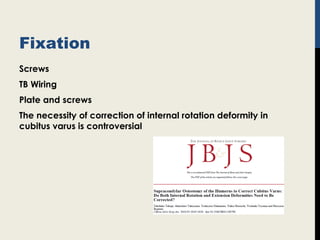
The necessity of correction of internal rotation deformity in
cubitus varus is controversial
Complications
Loss of correction
Lateral bony prominence – cosmetic problem
Stiffness
Recurrence of deformity
Nerve injury
Thank You
supra condylar fracture humerus

supra condylar fracture humerus

Editor's Notes

  • #9 Look at FPL Pointing index sensation in children unreliable