Disorders of upper limb
SHOULDER DISORDERS
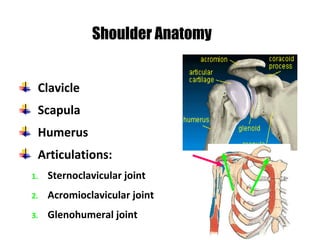
Clavicle
Scapula
Humerus
Articulations:
1. Sternoclavicular joint
2. Acromioclavicular joint
3. Glenohumeral joint
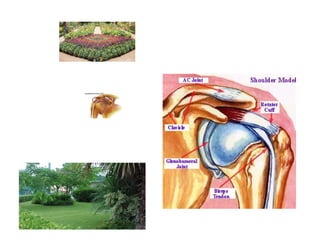
Shoulder Anatomy
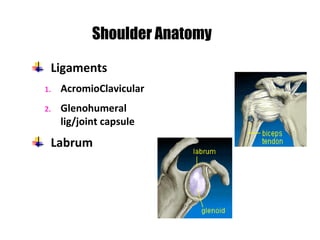
Ligaments
1. AcromioClavicular
2. Glenohumeral
lig/joint capsule
Labrum
Shoulder Anatomy
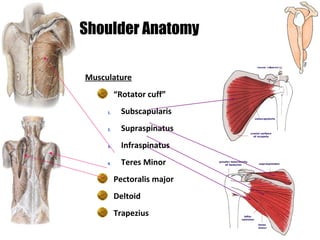
Musculature
“Rotator cuff”
1. Subscapularis
2. Supraspinatus
3. Infraspinatus
4. Teres Minor
Pectoralis major
Deltoid
Trapezius
Shoulder Anatomy
•
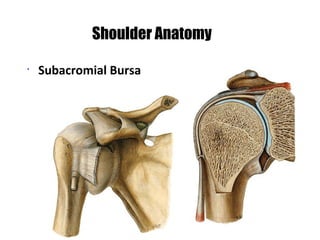
Subacromial Bursa
Shoulder Anatomy
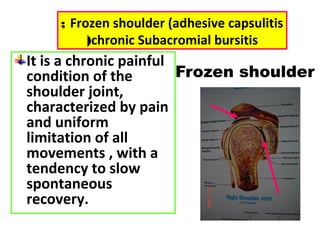
It is a chronic painful
condition of the
shoulder joint,
characterized by pain
and uniform
limitation of all
movements , with a
tendency to slow
spontaneous
recovery.
Frozen shoulder (adhesive capsulitis;
chronic Subacromial bursitis(
Frozen shoulder
Symptoms of primary frozen shoulder have been
divided into 3 phases:
1. Painful phase (there is a gradual onset of
diffuse shoulder pain lasting from weeks to
months. )
2. Stiffening phase (progressive loss of motion
that may last up to 1 year. Most patients lose
glenohumeral external rotation, internal
rotation, and abduction during this phase. )
3. Thawing phase (gradual motion improvement).
This phase may take up to 9 months for the
motion improvement for the patient to regain
a functional ROM.
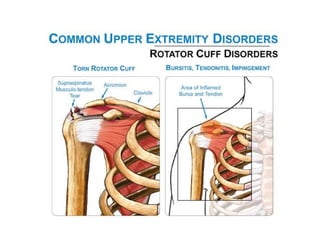
It is clinical conditions, including:
1. Subacromial bursitis
2. Calcifying tendinitis
3. Partial rotator cuff tears.
Adhesive capsulitis (frozen shoulder syndrome ;FSS)
P
r
o
g
r
e
s
s
i
v
e
p
a
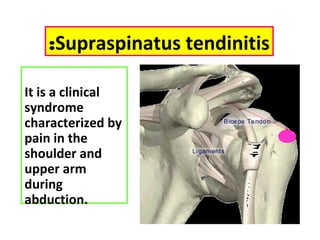
It is a clinical
syndrome
characterized by
pain in the
shoulder and
upper arm
during
abduction.
Supraspinatus tendinitis:
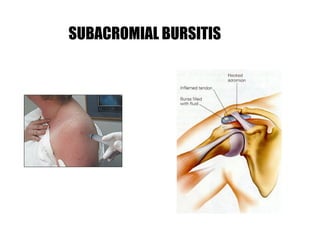
SUBACROMIAL BURSITIS
ELBOW DISORDERS
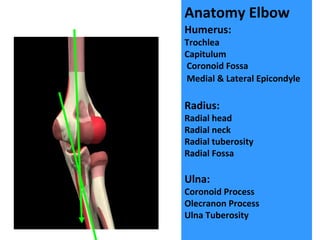
Anatomy Elbow
Humerus:
Trochlea
Capitulum
Coronoid Fossa
Medial & Lateral Epicondyle
Radius:
Radial head
Radial neck
Radial tuberosity
Radial Fossa
Ulna:
Coronoid Process
Olecranon Process
Ulna Tuberosity
ELBOW DISORDERS
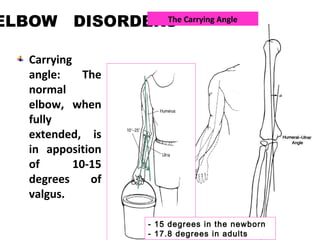
Carrying
angle: The
normal
elbow, when
fully
extended, is
in apposition
of 10-15
degrees of
valgus.
The Carrying Angle
- 15 degrees in the newborn
- 17.8 degrees in adults
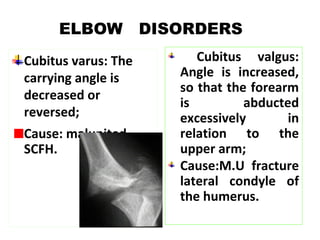
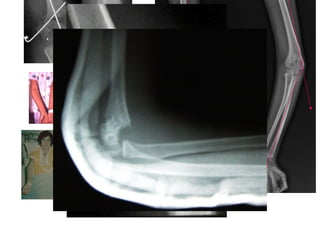
Cubitus varus: The
carrying angle is
decreased or
reversed;
Cause: malunited
SCFH.
ELBOW DISORDERS
Cubitus valgus:
Angle is increased,
so that the forearm
is abducted
excessively in
relation to the
upper arm;
Cause:M.U fracture
lateral condyle of
the humerus.
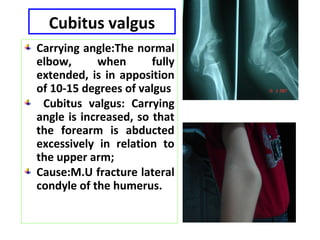
Cubitus valgus
Carrying angle:The normal
elbow, when fully
extended, is in apposition
of 10-15 degrees of valgus
Cubitus valgus: Carrying
angle is increased, so that
the forearm is abducted
excessively in relation to
the upper arm;
Cause:M.U fracture lateral
condyle of the humerus.
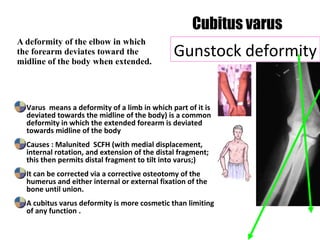
A deformity of the elbow in which
the forearm deviates toward the
midline of the body when extended.
Varus means a deformity of a limb in which part of it is
deviated towards the midline of the body) is a common
deformity in which the extended forearm is deviated
towards midline of the body
Causes : Malunited SCFH (with medial displacement,
internal rotation, and extension of the distal fragment;
this then permits distal fragment to tilt into varus;)
It can be corrected via a corrective osteotomy of the
humerus and either internal or external fixation of the
bone until union.
A cubitus varus deformity is more cosmetic than limiting
of any function .
Cubitus varus
Gunstock deformity
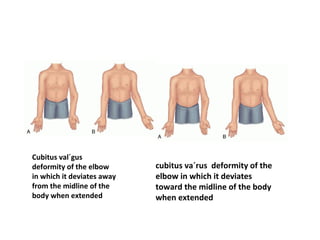
Cubitus val´gus
deformity of the elbow
in which it deviates away
from the midline of the
body when extended
cubitus va´rus deformity of the
elbow in which it deviates
toward the midline of the body
when extended
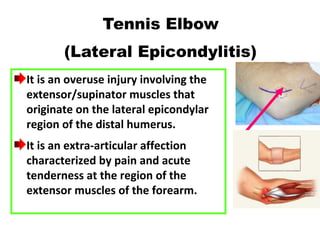
It is an overuse injury involving the
extensor/supinator muscles that
originate on the lateral epicondylar
region of the distal humerus.
It is an extra-articular affection
characterized by pain and acute
tenderness at the region of the
extensor muscles of the forearm.
Tennis Elbow
(Lateral Epicondylitis)
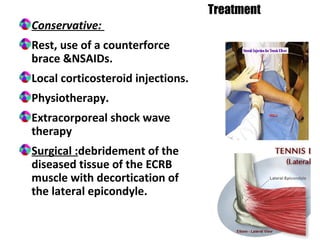
Conservative:
Rest, use of a counterforce
brace &NSAIDs.
Local corticosteroid injections.
Physiotherapy.
Extracorporeal shock wave
therapy
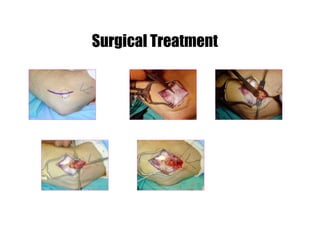
Surgical :debridement of the
diseased tissue of the ECRB
muscle with decortication of
the lateral epicondyle.
Treatment
Surgical Treatment
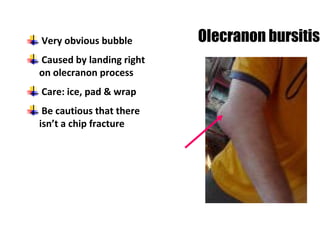
Very obvious bubble
Caused by landing right
on olecranon process
Care: ice, pad & wrap
Be cautious that there
isn’t a chip fracture
Olecranon bursitis
Forearm, Wrist &
Hand Disorders
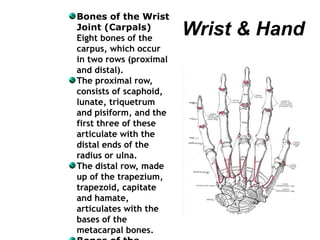
Wrist & Hand
Bones of the Wrist
Joint (Carpals)
Eight bones of the
carpus, which occur
in two rows (proximal
and distal).
The proximal row,
consists of scaphoid,
lunate, triquetrum
and pisiform, and the
first three of these
articulate with the
distal ends of the
radius or ulna.
The distal row, made
up of the trapezium,
trapezoid, capitate
and hamate,
articulates with the
bases of the
metacarpal bones.
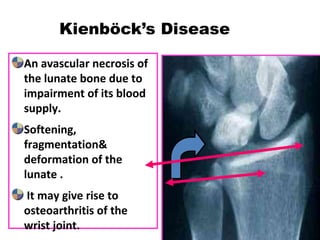
An avascular necrosis of
the lunate bone due to
impairment of its blood
supply.
Softening,
fragmentation&
deformation of the
lunate .
It may give rise to
osteoarthritis of the
wrist joint.
Kienböck’s Disease
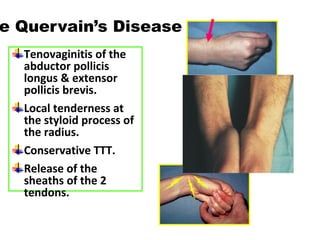
Tenovaginitis of the
abductor pollicis
longus & extensor
pollicis brevis.
Local tenderness at
the styloid process of
the radius.
Conservative TTT.
Release of the
sheaths of the 2
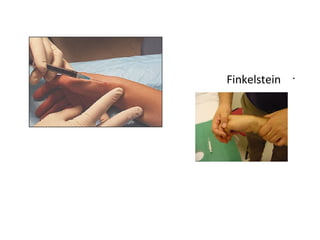
tendons.
e Quervain’s Disease
•
Finkelstein
Women >Men
Age : 55-60 years .
The most commonly affected
digit is the thumb, followed by
the ring, long, little, and index
fingers.
More frequent in patients with
rheumatoid arthritis or
diabetes mellitus
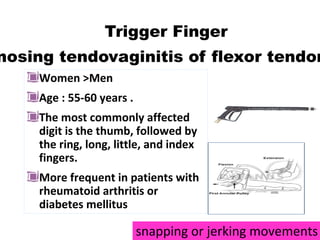
Trigger Finger
nosing tendovaginitis of flexor tendon
snapping or jerking movements
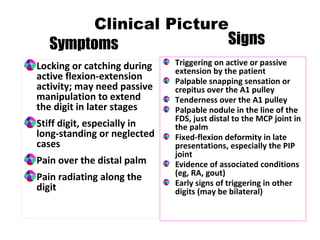
Locking or catching during
active flexion-extension
activity; may need passive
manipulation to extend
the digit in later stages
Stiff digit, especially in
long-standing or neglected
cases
Pain over the distal palm
Pain radiating along the
digit
Clinical Picture
Triggering on active or passive
extension by the patient
Palpable snapping sensation or
crepitus over the A1 pulley
Tenderness over the A1 pulley
Palpable nodule in the line of the
FDS, just distal to the MCP joint in
the palm
Fixed-flexion deformity in late
presentations, especially the PIP
joint
Evidence of associated conditions
(eg, RA, gout)
Early signs of triggering in other
digits (may be bilateral)
SignsSymptoms
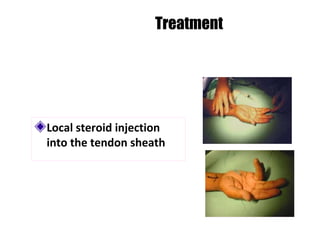
Local steroid injection
into the tendon sheath
Treatment
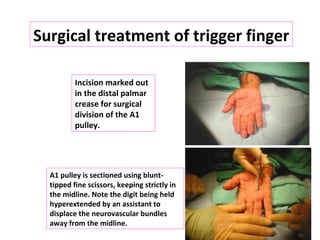
Incision marked out
in the distal palmar
crease for surgical
division of the A1
pulley.
A1 pulley is sectioned using blunt-
tipped fine scissors, keeping strictly in
the midline. Note the digit being held
hyperextended by an assistant to
displace the neurovascular bundles
away from the midline.
Surgical treatment of trigger finger
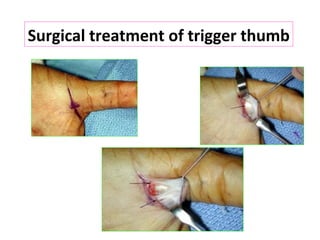
Surgical treatment of trigger thumb
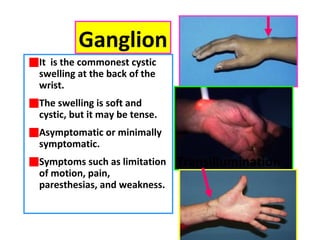
It is the commonest cystic
swelling at the back of the
wrist.
The swelling is soft and
cystic, but it may be tense.
Asymptomatic or minimally
symptomatic.
Symptoms such as limitation
of motion, pain,
paresthesias, and weakness.
Ganglion
Transillumination
Mucoid degeneration of collagen and
connective tissues.
Trauma or tissue irritation. Modified synovial
cells lining the synovial-capsular interface are
stimulated to produce mucin. Mucin dissects
along the attached joint ligament and capsule to
form capsular ducts, which function as valvelike
structures producing lakes. The ducts and lakes
of mucin eventually coalesce to form a solitary
ganglion cyst (Angelides ,1999).
Etiology
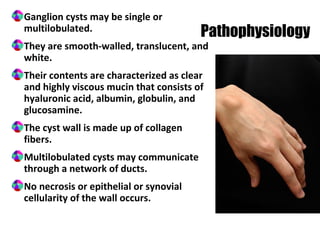
Ganglion cysts may be single or
multilobulated.
They are smooth-walled, translucent, and
white.
Their contents are characterized as clear
and highly viscous mucin that consists of
hyaluronic acid, albumin, globulin, and
glucosamine.
The cyst wall is made up of collagen
fibers.
Multilobulated cysts may communicate
through a network of ducts.
No necrosis or epithelial or synovial
cellularity of the wall occurs.
Pathophysiology
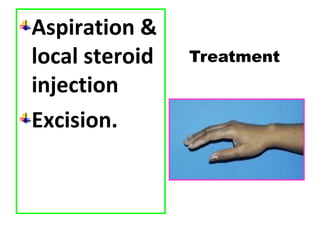
Aspiration &
local steroid
injection
Excision.
Treatment
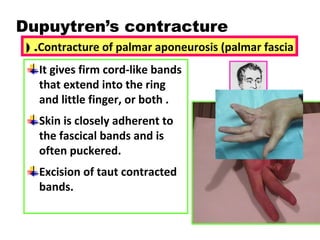
It gives firm cord-like bands
that extend into the ring
and little finger, or both .
Skin is closely adherent to
the fascical bands and is
often puckered.
Excision of taut contracted
bands.
Dupuytren’s contracture
Contracture of palmar aponeurosis (palmar fascia( .
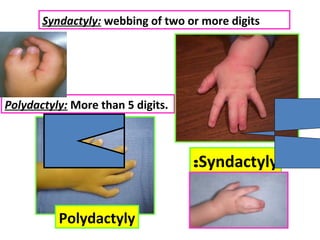
Syndactyly:
Polydactyly
Syndactyly: webbing of two or more digits
Polydactyly: More than 5 digits.
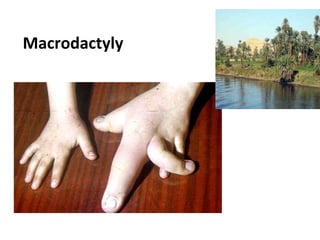
Macrodactyly
Compression Neuropathy
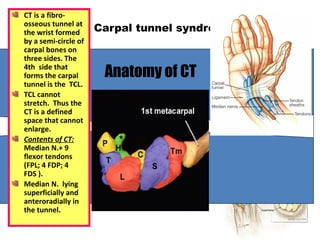
CT is a fibro-
osseous tunnel at
the wrist formed
by a semi-circle of
carpal bones on
three sides. The
4th side that
forms the carpal
tunnel is the TCL.
TCL cannot
stretch. Thus the
CT is a defined
space that cannot
enlarge.
Contents of CT:
Median N.+ 9
flexor tendons
(FPL; 4 FDP; 4
FDS ).
Median N. lying
superficially and
anteroradially in
the tunnel.
Anatomy of CT
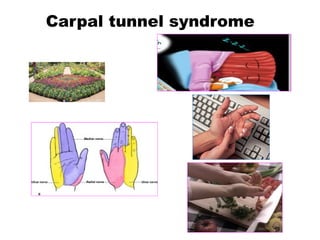
Carpal tunnel syndrome
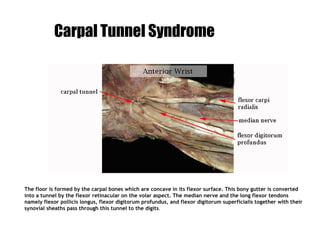
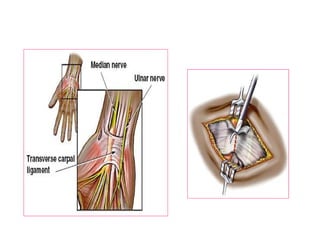
The floor is formed by the carpal bones which are concave in its flexor surface. This bony gutter is converted
into a tunnel by the flexor retinacular on the volar aspect. The median nerve and the long flexor tendons
namely flexor pollicis longus, flexor digitorum profundus, and flexor digitorum superficialis together with their
synovial sheaths pass through this tunnel to the digits.
Carpal Tunnel Syndrome
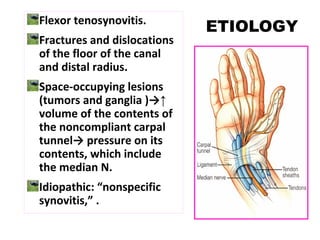
Flexor tenosynovitis.
Fractures and dislocations
of the floor of the canal
and distal radius.
Space-occupying lesions
(tumors and ganglia )→↑
volume of the contents of
the noncompliant carpal
tunnel→ pressure on its
contents, which include
the median N.
Idiopathic: “nonspecific
synovitis,” .
ETIOLOGY
Compression of the median nerve
within the carpal tunnel
Both hands or the dominant hand
Pain & Numbness in the Distribution of
the median nerves may occur
intermittently during the daytime
and/or at night and awaken one from
sleep.
Patient thinks the hands have "poor
circulation" and shake the hands in an
attempt to "restore circulation".
Treatment:
NSAIDs; wrist splint, local injectionm.
Decompression of the median nerve.
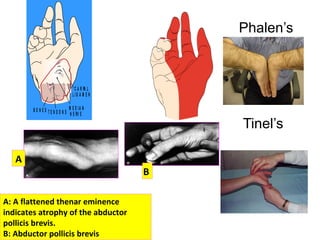
Carpal tunnel syndrome
Tinel’s
Phalen’s
M E D IA N
N E RV E
C A R PA L
L IG A M E N T
T E N D O N SB O N E S
A: A flattened thenar eminence
indicates atrophy of the abductor
pollicis brevis.
B: Abductor pollicis brevis
A
B
Carpal tunnel syndrome
§ Nerve conduction studies show reduce nerve
conduction velocities across wrist
CTS
§
Management
§
Avoidance of precipitating activity
§
Night time splints
§
Local steroid injection
§
Surgery – division of flexor retinaculum and
decompression of carpal tunnel (80% success)
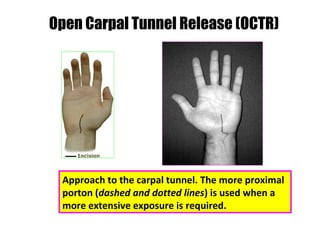
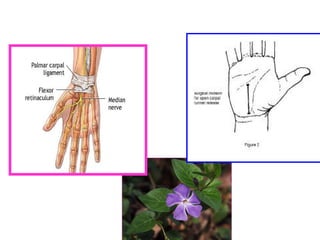
Approach to the carpal tunnel. The more proximal
porton (dashed and dotted lines) is used when a
more extensive exposure is required.
Open Carpal Tunnel Release (OCTR)
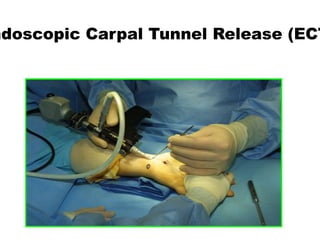
ndoscopic Carpal Tunnel Release (ECT
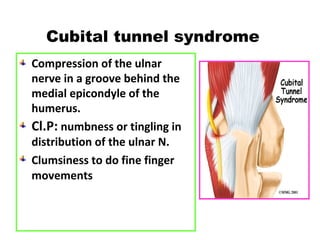
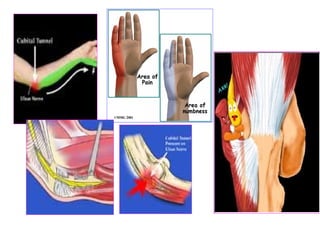
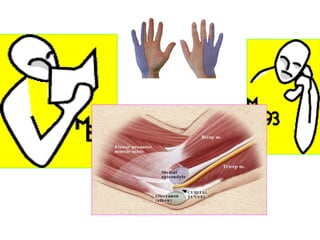
Compression of the ulnar
nerve in a groove behind the
medial epicondyle of the
humerus.
Cl.P: numbness or tingling in
distribution of the ulnar N.
Clumsiness to do fine finger
movements
Cubital tunnel syndrome
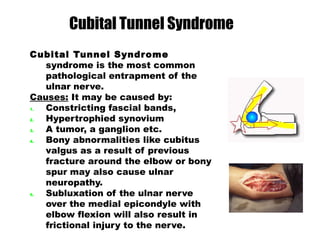
Cubital Tunnel Syndrome
syndrome is the most common
pathological entrapment of the
ulnar nerve.
Causes: It may be caused by:
1. Constricting fascial bands,
2. Hypertrophied synovium
3. A tumor, a ganglion etc.
4. Bony abnormalities like cubitus
valgus as a result of previous
fracture around the elbow or bony
spur may also cause ulnar
neuropathy.
5. Subluxation of the ulnar nerve
over the medial epicondyle with
elbow flexion will also result in
frictional injury to the nerve.
Cubital Tunnel Syndrome
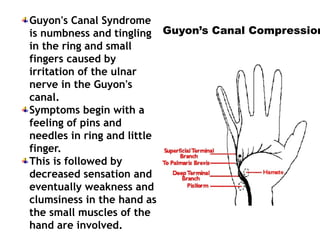
Guyon's Canal Syndrome
is numbness and tingling
in the ring and small
fingers caused by
irritation of the ulnar
nerve in the Guyon's
canal.
Symptoms begin with a
feeling of pins and
needles in ring and little
finger.
This is followed by
decreased sensation and
eventually weakness and
clumsiness in the hand as
the small muscles of the
hand are involved.
Guyon’s Canal Compression

Disorders of upper limb

  • 1.
  • 2.
  • 3.
    Clavicle Scapula Humerus Articulations: 1. Sternoclavicular joint 2.Acromioclavicular joint 3. Glenohumeral joint Shoulder Anatomy
  • 4.
  • 5.
    Musculature “Rotator cuff” 1. Subscapularis 2.Supraspinatus 3. Infraspinatus 4. Teres Minor Pectoralis major Deltoid Trapezius Shoulder Anatomy
  • 6.
  • 7.
    It is achronic painful condition of the shoulder joint, characterized by pain and uniform limitation of all movements , with a tendency to slow spontaneous recovery. Frozen shoulder (adhesive capsulitis; chronic Subacromial bursitis( Frozen shoulder
  • 8.
    Symptoms of primaryfrozen shoulder have been divided into 3 phases: 1. Painful phase (there is a gradual onset of diffuse shoulder pain lasting from weeks to months. ) 2. Stiffening phase (progressive loss of motion that may last up to 1 year. Most patients lose glenohumeral external rotation, internal rotation, and abduction during this phase. ) 3. Thawing phase (gradual motion improvement). This phase may take up to 9 months for the motion improvement for the patient to regain a functional ROM.
  • 9.
    It is clinicalconditions, including: 1. Subacromial bursitis 2. Calcifying tendinitis 3. Partial rotator cuff tears. Adhesive capsulitis (frozen shoulder syndrome ;FSS) P r o g r e s s i v e p a
  • 10.
    It is aclinical syndrome characterized by pain in the shoulder and upper arm during abduction. Supraspinatus tendinitis:
  • 12.
  • 14.
  • 15.
    Anatomy Elbow Humerus: Trochlea Capitulum Coronoid Fossa Medial& Lateral Epicondyle Radius: Radial head Radial neck Radial tuberosity Radial Fossa Ulna: Coronoid Process Olecranon Process Ulna Tuberosity
  • 16.
    ELBOW DISORDERS Carrying angle: The normal elbow,when fully extended, is in apposition of 10-15 degrees of valgus. The Carrying Angle - 15 degrees in the newborn - 17.8 degrees in adults
  • 17.
    Cubitus varus: The carryingangle is decreased or reversed; Cause: malunited SCFH. ELBOW DISORDERS Cubitus valgus: Angle is increased, so that the forearm is abducted excessively in relation to the upper arm; Cause:M.U fracture lateral condyle of the humerus.
  • 18.
    Cubitus valgus Carrying angle:Thenormal elbow, when fully extended, is in apposition of 10-15 degrees of valgus Cubitus valgus: Carrying angle is increased, so that the forearm is abducted excessively in relation to the upper arm; Cause:M.U fracture lateral condyle of the humerus.
  • 19.
    A deformity ofthe elbow in which the forearm deviates toward the midline of the body when extended. Varus means a deformity of a limb in which part of it is deviated towards the midline of the body) is a common deformity in which the extended forearm is deviated towards midline of the body Causes : Malunited SCFH (with medial displacement, internal rotation, and extension of the distal fragment; this then permits distal fragment to tilt into varus;) It can be corrected via a corrective osteotomy of the humerus and either internal or external fixation of the bone until union. A cubitus varus deformity is more cosmetic than limiting of any function . Cubitus varus Gunstock deformity
  • 21.
    Cubitus val´gus deformity ofthe elbow in which it deviates away from the midline of the body when extended cubitus va´rus deformity of the elbow in which it deviates toward the midline of the body when extended
  • 22.
    It is anoveruse injury involving the extensor/supinator muscles that originate on the lateral epicondylar region of the distal humerus. It is an extra-articular affection characterized by pain and acute tenderness at the region of the extensor muscles of the forearm. Tennis Elbow (Lateral Epicondylitis)
  • 23.
    Conservative: Rest, use ofa counterforce brace &NSAIDs. Local corticosteroid injections. Physiotherapy. Extracorporeal shock wave therapy Surgical :debridement of the diseased tissue of the ECRB muscle with decortication of the lateral epicondyle. Treatment
  • 24.
  • 25.
    Very obvious bubble Causedby landing right on olecranon process Care: ice, pad & wrap Be cautious that there isn’t a chip fracture Olecranon bursitis
  • 26.
  • 27.
    Wrist & Hand Bonesof the Wrist Joint (Carpals) Eight bones of the carpus, which occur in two rows (proximal and distal). The proximal row, consists of scaphoid, lunate, triquetrum and pisiform, and the first three of these articulate with the distal ends of the radius or ulna. The distal row, made up of the trapezium, trapezoid, capitate and hamate, articulates with the bases of the metacarpal bones.
  • 28.
    An avascular necrosisof the lunate bone due to impairment of its blood supply. Softening, fragmentation& deformation of the lunate . It may give rise to osteoarthritis of the wrist joint. Kienböck’s Disease
  • 29.
    Tenovaginitis of the abductorpollicis longus & extensor pollicis brevis. Local tenderness at the styloid process of the radius. Conservative TTT. Release of the sheaths of the 2 tendons. e Quervain’s Disease
  • 30.
  • 31.
    Women >Men Age :55-60 years . The most commonly affected digit is the thumb, followed by the ring, long, little, and index fingers. More frequent in patients with rheumatoid arthritis or diabetes mellitus Trigger Finger nosing tendovaginitis of flexor tendon snapping or jerking movements
  • 32.
    Locking or catchingduring active flexion-extension activity; may need passive manipulation to extend the digit in later stages Stiff digit, especially in long-standing or neglected cases Pain over the distal palm Pain radiating along the digit Clinical Picture Triggering on active or passive extension by the patient Palpable snapping sensation or crepitus over the A1 pulley Tenderness over the A1 pulley Palpable nodule in the line of the FDS, just distal to the MCP joint in the palm Fixed-flexion deformity in late presentations, especially the PIP joint Evidence of associated conditions (eg, RA, gout) Early signs of triggering in other digits (may be bilateral) SignsSymptoms
  • 33.
    Local steroid injection intothe tendon sheath Treatment
  • 34.
    Incision marked out inthe distal palmar crease for surgical division of the A1 pulley. A1 pulley is sectioned using blunt- tipped fine scissors, keeping strictly in the midline. Note the digit being held hyperextended by an assistant to displace the neurovascular bundles away from the midline. Surgical treatment of trigger finger
  • 35.
    Surgical treatment oftrigger thumb
  • 36.
    It is thecommonest cystic swelling at the back of the wrist. The swelling is soft and cystic, but it may be tense. Asymptomatic or minimally symptomatic. Symptoms such as limitation of motion, pain, paresthesias, and weakness. Ganglion Transillumination
  • 37.
    Mucoid degeneration ofcollagen and connective tissues. Trauma or tissue irritation. Modified synovial cells lining the synovial-capsular interface are stimulated to produce mucin. Mucin dissects along the attached joint ligament and capsule to form capsular ducts, which function as valvelike structures producing lakes. The ducts and lakes of mucin eventually coalesce to form a solitary ganglion cyst (Angelides ,1999). Etiology
  • 38.
    Ganglion cysts maybe single or multilobulated. They are smooth-walled, translucent, and white. Their contents are characterized as clear and highly viscous mucin that consists of hyaluronic acid, albumin, globulin, and glucosamine. The cyst wall is made up of collagen fibers. Multilobulated cysts may communicate through a network of ducts. No necrosis or epithelial or synovial cellularity of the wall occurs. Pathophysiology
  • 39.
  • 40.
    It gives firmcord-like bands that extend into the ring and little finger, or both . Skin is closely adherent to the fascical bands and is often puckered. Excision of taut contracted bands. Dupuytren’s contracture Contracture of palmar aponeurosis (palmar fascia( .
  • 41.
    Syndactyly: Polydactyly Syndactyly: webbing oftwo or more digits Polydactyly: More than 5 digits.
  • 42.
  • 43.
  • 44.
    CT is afibro- osseous tunnel at the wrist formed by a semi-circle of carpal bones on three sides. The 4th side that forms the carpal tunnel is the TCL. TCL cannot stretch. Thus the CT is a defined space that cannot enlarge. Contents of CT: Median N.+ 9 flexor tendons (FPL; 4 FDP; 4 FDS ). Median N. lying superficially and anteroradially in the tunnel. Anatomy of CT Carpal tunnel syndrome
  • 45.
    The floor isformed by the carpal bones which are concave in its flexor surface. This bony gutter is converted into a tunnel by the flexor retinacular on the volar aspect. The median nerve and the long flexor tendons namely flexor pollicis longus, flexor digitorum profundus, and flexor digitorum superficialis together with their synovial sheaths pass through this tunnel to the digits. Carpal Tunnel Syndrome
  • 46.
    Flexor tenosynovitis. Fractures anddislocations of the floor of the canal and distal radius. Space-occupying lesions (tumors and ganglia )→↑ volume of the contents of the noncompliant carpal tunnel→ pressure on its contents, which include the median N. Idiopathic: “nonspecific synovitis,” . ETIOLOGY
  • 47.
    Compression of themedian nerve within the carpal tunnel Both hands or the dominant hand Pain & Numbness in the Distribution of the median nerves may occur intermittently during the daytime and/or at night and awaken one from sleep. Patient thinks the hands have "poor circulation" and shake the hands in an attempt to "restore circulation". Treatment: NSAIDs; wrist splint, local injectionm. Decompression of the median nerve. Carpal tunnel syndrome
  • 48.
    Tinel’s Phalen’s M E DIA N N E RV E C A R PA L L IG A M E N T T E N D O N SB O N E S A: A flattened thenar eminence indicates atrophy of the abductor pollicis brevis. B: Abductor pollicis brevis A B
  • 49.
  • 50.
    § Nerve conductionstudies show reduce nerve conduction velocities across wrist CTS § Management § Avoidance of precipitating activity § Night time splints § Local steroid injection § Surgery – division of flexor retinaculum and decompression of carpal tunnel (80% success)
  • 51.
    Approach to thecarpal tunnel. The more proximal porton (dashed and dotted lines) is used when a more extensive exposure is required. Open Carpal Tunnel Release (OCTR)
  • 54.
  • 55.
    Compression of theulnar nerve in a groove behind the medial epicondyle of the humerus. Cl.P: numbness or tingling in distribution of the ulnar N. Clumsiness to do fine finger movements Cubital tunnel syndrome
  • 56.
    Cubital Tunnel Syndrome syndromeis the most common pathological entrapment of the ulnar nerve. Causes: It may be caused by: 1. Constricting fascial bands, 2. Hypertrophied synovium 3. A tumor, a ganglion etc. 4. Bony abnormalities like cubitus valgus as a result of previous fracture around the elbow or bony spur may also cause ulnar neuropathy. 5. Subluxation of the ulnar nerve over the medial epicondyle with elbow flexion will also result in frictional injury to the nerve. Cubital Tunnel Syndrome
  • 59.
    Guyon's Canal Syndrome isnumbness and tingling in the ring and small fingers caused by irritation of the ulnar nerve in the Guyon's canal. Symptoms begin with a feeling of pins and needles in ring and little finger. This is followed by decreased sensation and eventually weakness and clumsiness in the hand as the small muscles of the hand are involved. Guyon’s Canal Compression

Editor's Notes

  • #49 <number>
  • #51 <number>