© RKM
The world neverThe world never
looked the same againlooked the same again
……
© RKM
Fact FileFact File
Analysis of form
When and what?
Why CubismCubism?
Which artists?
Web search
Click on the buttons
to find out more
3D Relief work
© RKM
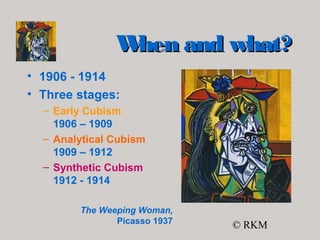
When and what?When and what?
• 1906 - 1914
• Three stages:
– Early Cubism
1906 – 1909
– Analytical Cubism
1909 – 1912
– Synthetic Cubism
1912 - 1914
The Weeping Woman,
Picasso 1937
© RKM
Early Cubism:
depiction of the whole
structure of the object and
its position in space,
combining different
viewpoints.
The Vase, Bowl, Lemon,
Picasso 1907
© RKM
Analytical Cubism:
breaking down of the
subject and the space
around it into angular
planes or facets that
record different viewpoints
and information; no
interest in colour or
texture
Clarinet and Bottle of Rum on
a mantelpiece, Braque 1911
© RKM
Synthetic Cubism:
collages of interlocked
fragments of newspaper,
wallpaper, and labels with
fragments of painting,
drawing and writing;
colour reintroduced &
texture & pattern
Bottle, Glass, Guitar and
newspaper, Picasso 1913
Back to
questions
© RKM
ThreeThree CubistsCubists
Click on a picture
to see more
Back to main
questions
© RKM
Pablo PicassoPablo Picasso 1881- 19731881- 1973
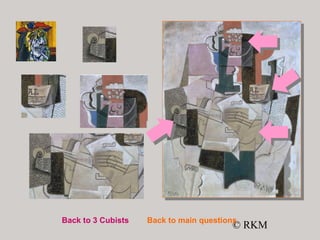
Bowl of Fruit, Violin and Bottle,
1914
Click to look more closely at the
painting
“We all know that art
is not truth. Art is a
lie that makes us
realise the truth ..”
“We all know that art
is not truth. Art is a
lie that makes us
realise the truth ..”
© RKM
Back to main questionsBack to 3 Cubists
© RKM
Georges BraqueGeorges Braque 1882- 19631882- 1963
Clarinet and Bottle of Rum on
a mantelpiece, 1911
“When we created Cubism,
we had no intention of
creating Cubism, but of
expressing what was
inside us.”
“When we created Cubism,
we had no intention of
creating Cubism, but of
expressing what was
inside us.”
Back to 3 Cubists
© RKM
Juan Gris 1887 - 1927Juan Gris 1887 - 1927
Still Life (The Violin), 1913
Back to main questions
Back to 3 Cubists
© RKM
Why Cubism?Why Cubism?
“Braque scorns form,
reduces everything –
figures and objects –
to geometric diagrams,
to cubes!”
Louis Vauxcelles,
art critic, 1908
Back to main
questions
Violin and Pitcher, Braque, 1910
© RKM
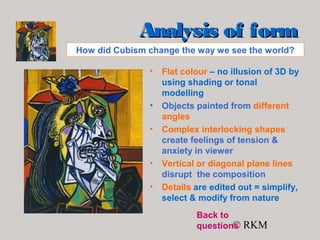
Analysis of formAnalysis of form
• Flat colour – no illusion of 3D by
using shading or tonal
modelling
• Objects painted from different
angles
• Complex interlocking shapes
create feelings of tension &
anxiety in viewer
• Vertical or diagonal plane lines
disrupt the composition
• Details are edited out = simplify,
select & modify from nature
How did Cubism change the way we see the world?
Back to
questions
© RKM
Web searchWeb search
www.tate.org.uk
• Type the artist’s name into the search
+“biography”, then choose > Works
http://www.ibiblio.org/wm/paint/glo/cubism/
• The Web Museum Paris
www.artchive.com
• Look up Cubism
Back to
questions
When you have finished looking at the presentation,
choose one of the three artists’ and find answers to
the questions in your web search about his life and
painting. Use the links below to start your search:
© RKM
Cubist Relief workCubist Relief work
Still Life, Picasso 1914
[mixed media]
Violin, Picasso 1915
[folded canvas]
© RKM
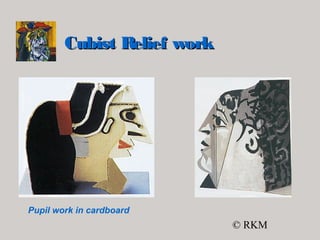
Cubist Relief workCubist Relief work
Pupil work in cardboard
© RKM
Cubist Relief workCubist Relief work
Student work
Back to
questions

Cubism

  • 1.
    © RKM The worldneverThe world never looked the same againlooked the same again ……
  • 2.
    © RKM Fact FileFactFile Analysis of form When and what? Why CubismCubism? Which artists? Web search Click on the buttons to find out more 3D Relief work
  • 3.
    © RKM When andwhat?When and what? • 1906 - 1914 • Three stages: – Early Cubism 1906 – 1909 – Analytical Cubism 1909 – 1912 – Synthetic Cubism 1912 - 1914 The Weeping Woman, Picasso 1937
  • 4.
    © RKM Early Cubism: depictionof the whole structure of the object and its position in space, combining different viewpoints. The Vase, Bowl, Lemon, Picasso 1907
  • 5.
    © RKM Analytical Cubism: breakingdown of the subject and the space around it into angular planes or facets that record different viewpoints and information; no interest in colour or texture Clarinet and Bottle of Rum on a mantelpiece, Braque 1911
  • 6.
    © RKM Synthetic Cubism: collagesof interlocked fragments of newspaper, wallpaper, and labels with fragments of painting, drawing and writing; colour reintroduced & texture & pattern Bottle, Glass, Guitar and newspaper, Picasso 1913 Back to questions
  • 7.
    © RKM ThreeThree CubistsCubists Clickon a picture to see more Back to main questions
  • 8.
    © RKM Pablo PicassoPabloPicasso 1881- 19731881- 1973 Bowl of Fruit, Violin and Bottle, 1914 Click to look more closely at the painting “We all know that art is not truth. Art is a lie that makes us realise the truth ..” “We all know that art is not truth. Art is a lie that makes us realise the truth ..”
  • 9.
    © RKM Back tomain questionsBack to 3 Cubists
  • 10.
    © RKM Georges BraqueGeorgesBraque 1882- 19631882- 1963 Clarinet and Bottle of Rum on a mantelpiece, 1911 “When we created Cubism, we had no intention of creating Cubism, but of expressing what was inside us.” “When we created Cubism, we had no intention of creating Cubism, but of expressing what was inside us.” Back to 3 Cubists
  • 11.
    © RKM Juan Gris1887 - 1927Juan Gris 1887 - 1927 Still Life (The Violin), 1913 Back to main questions Back to 3 Cubists
  • 12.
    © RKM Why Cubism?WhyCubism? “Braque scorns form, reduces everything – figures and objects – to geometric diagrams, to cubes!” Louis Vauxcelles, art critic, 1908 Back to main questions Violin and Pitcher, Braque, 1910
  • 13.
    © RKM Analysis offormAnalysis of form • Flat colour – no illusion of 3D by using shading or tonal modelling • Objects painted from different angles • Complex interlocking shapes create feelings of tension & anxiety in viewer • Vertical or diagonal plane lines disrupt the composition • Details are edited out = simplify, select & modify from nature How did Cubism change the way we see the world? Back to questions
  • 14.
    © RKM Web searchWebsearch www.tate.org.uk • Type the artist’s name into the search +“biography”, then choose > Works http://www.ibiblio.org/wm/paint/glo/cubism/ • The Web Museum Paris www.artchive.com • Look up Cubism Back to questions When you have finished looking at the presentation, choose one of the three artists’ and find answers to the questions in your web search about his life and painting. Use the links below to start your search:
  • 15.
    © RKM Cubist ReliefworkCubist Relief work Still Life, Picasso 1914 [mixed media] Violin, Picasso 1915 [folded canvas]
  • 16.
    © RKM Cubist ReliefworkCubist Relief work Pupil work in cardboard
  • 17.
    © RKM Cubist ReliefworkCubist Relief work Student work Back to questions