Cubism
    Cubism was a truly revolutionary style of modern art developed by Pablo
    Picasso and Georges Braque.
It was the first style of abstract art which evolved at the beginning of the 20th
century in response to a world that was changing with unprecedented speed.
Cubism was an attempt by artists to revitalize the tired traditions of Western art
which they believed had run their course.


The Cubists challenged conventional forms of representation, such as
perspective, which had been the rule since the Renaissance. Their aim was to
develop a new way of seeing which reflected the modern age.
CUBISM
•Fitting all angles of a three-
 dimensional object in the
 same two-dimensional picture
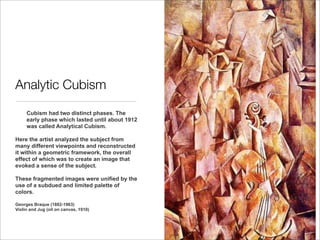
Analytic Cubism
     Cubism had two distinct phases. The
     early phase which lasted until about 1912
     was called Analytical Cubism.

Here the artist analyzed the subject from
many different viewpoints and reconstructed
it within a geometric framework, the overall
effect of which was to create an image that
evoked a sense of the subject.

These fragmented images were unified by the
use of a subdued and limited palette of
colors.

Georges Braque (1882-1963)
Violin and Jug (oil on canvas, 1910)
Synthetic Cubism
     Influenced by the introduction of bold
     and simple collage shapes, Synthetic
     Cubism moved away from the unified
     monochrome surfaces of Analytic
     Cubism to a more direct, colorful and
     decorative style.

Although synthetic cubist images appear
more abstract in their use of simplified
forms, the other elements of their
composition are applied quite traditionally.
Interchanging lines, colors, patterns and
textures, that switch from geometric to
freehand, dark to light, positive to negative
and plain to patterned, advance and recede
in rhythms across the picture plane.

Pablo Picasso (1881-1973)
Still Life with Mandolin and Guitar (oil on canvas, 1924)
Fruit Dish   Georges Braque, 1908
Head of a Woman

Georges Braque, 1909
Violin and
Newspaper
(Musical Forms)

Georges Braque, 1912
Still Life with Music Scroll   Georges Braque, 1937
The Echo   Georges Braque, 1954
Composition with Skull

Pablo Picasso, 1908
Head of a Woman

Pablo Picasso, 1908
Bread and dish with
fruits on the table

Pablo Picasso, 1909
Woman and pears
(Fernande)

Pablo Picasso, 1909
Guitar

Pablo Picasso, 1912
The Student

Pablo Picasso, 1919
Untitled

Pablo Picasso, 1937
Plaster Head and Arm   Pablo Picasso, 1925
Bullfight   Pablo Picasso, 1934
Crying Woman

Pablo Picasso, 1937
Bottles and Knife

Juan Gris, 1911
Blue Landscape

Nathan Altman, 1912
Portrait of a
Philosopher

Lyubov Popova, 1915
Music	

Jury Annenkov
1922
Still Life with Violin

Gino Severini, 1964

Cubism

  • 1.
    Cubism Cubism was a truly revolutionary style of modern art developed by Pablo Picasso and Georges Braque. It was the first style of abstract art which evolved at the beginning of the 20th century in response to a world that was changing with unprecedented speed. Cubism was an attempt by artists to revitalize the tired traditions of Western art which they believed had run their course. The Cubists challenged conventional forms of representation, such as perspective, which had been the rule since the Renaissance. Their aim was to develop a new way of seeing which reflected the modern age.
  • 2.
    CUBISM •Fitting all anglesof a three- dimensional object in the same two-dimensional picture
  • 3.
    Analytic Cubism Cubism had two distinct phases. The early phase which lasted until about 1912 was called Analytical Cubism. Here the artist analyzed the subject from many different viewpoints and reconstructed it within a geometric framework, the overall effect of which was to create an image that evoked a sense of the subject. These fragmented images were unified by the use of a subdued and limited palette of colors. Georges Braque (1882-1963) Violin and Jug (oil on canvas, 1910)
  • 4.
    Synthetic Cubism Influenced by the introduction of bold and simple collage shapes, Synthetic Cubism moved away from the unified monochrome surfaces of Analytic Cubism to a more direct, colorful and decorative style. Although synthetic cubist images appear more abstract in their use of simplified forms, the other elements of their composition are applied quite traditionally. Interchanging lines, colors, patterns and textures, that switch from geometric to freehand, dark to light, positive to negative and plain to patterned, advance and recede in rhythms across the picture plane. Pablo Picasso (1881-1973) Still Life with Mandolin and Guitar (oil on canvas, 1924)
  • 5.
    Fruit Dish Georges Braque, 1908
  • 6.
    Head of aWoman Georges Braque, 1909
  • 7.
  • 8.
    Still Life withMusic Scroll Georges Braque, 1937
  • 9.
    The Echo Georges Braque, 1954
  • 10.
  • 11.
    Head of aWoman Pablo Picasso, 1908
  • 12.
    Bread and dishwith fruits on the table Pablo Picasso, 1909
  • 13.
  • 14.
  • 15.
  • 16.
  • 17.
    Plaster Head andArm Pablo Picasso, 1925
  • 18.
    Bullfight Pablo Picasso, 1934
  • 19.
  • 20.
  • 21.
  • 22.
  • 23.
  • 24.
    Still Life withViolin Gino Severini, 1964