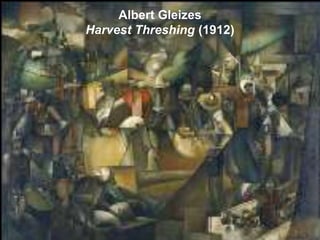
Cubism was an influential early 20th century avant-garde art movement that revolutionized European painting and sculpture. [1] Key figures in its development were Pablo Picasso and Georges Braque, who between 1907-1914 in Paris experimented with analyzing subject matter into geometric forms and reconstructing scenes from multiple viewpoints. [2] This new style was a radical departure from traditional perspective that focused on flat, two-dimensional surfaces and depicted subject matter in an abstracted form. [3] Cubism opened the door to further modern art movements such as Futurism, Dada, and Surrealism that also rejected normal realistic rules of art.