CUBE
CUBOID
AND
CYLINDER
MADE BY KS SRIRANJINI
CLASS 8 C
ROLL NO 17
Basic information on Cube
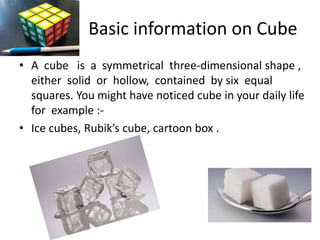
• A cube is a symmetrical three-dimensional shape ,
either solid or hollow, contained by six equal
squares. You might have noticed cube in your daily life
for example :-
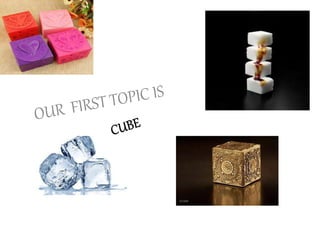
• Ice cubes, Rubik’s cube, cartoon box .
Elements of a cube
• A cube has following
elements
• Faces = 6
• Edges = 12
• Vertices= 8
• Length , breadth and
height of a cube is
same.
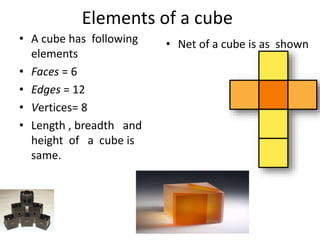
• Net of a cube is as shown
 A is the length of the side of each
edge of the cube
In words, the surface area of a
cube is the area of the six squares
that cover it. The area of one of
them is a*a, or a 2 . Since these are
all the same, you can multiply one
of them by six, so the surface area
of a cube is 6 times one of the
sides squared.
 THE FORMULA TO CALCULATE THE
SURFACE AREA OF CUBE IS
A=6a2
Surface area of cube.
Volume of cube
• How to find the volume of a cube
• Recall that a cube has all edges the same length (See Cube
definition). The volume of a cube is found by multiplying the
length of any edge by itself twice. So if the length of an edge is
4,the volume is 4 x 4 x 4 = 64
• Or as a formula:
• volume = s3where:
s is the length of any edge of the cube.
• In the figure above, drag the orange dot to resize the cube. From
the edge length shown, calculate the volume of the cube and verify
that it agrees with the calculation in the figure.
• When we write volume = s3, strictly speaking this should be read
as "s to the power 3", but because it is used to calculate the
volume of cubes it is usually spoken as "s cubed".
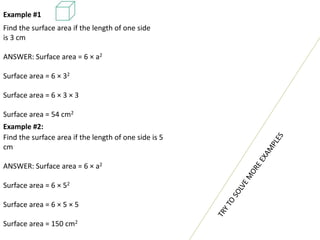
Example #1
Find the surface area if the length of one side
is 3 cm
ANSWER: Surface area = 6 × a2
Surface area = 6 × 32
Surface area = 6 × 3 × 3
Surface area = 54 cm2
Example #2:
Find the surface area if the length of one side is 5
cm
ANSWER: Surface area = 6 × a2
Surface area = 6 × 52
Surface area = 6 × 5 × 5
Surface area = 150 cm2
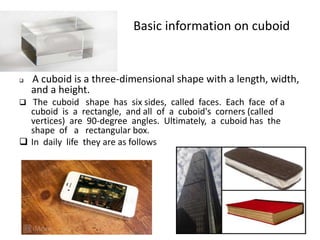
Basic information on cuboid
 A cuboid is a three-dimensional shape with a length, width,
and a height.
 The cuboid shape has six sides, called faces. Each face of a
cuboid is a rectangle, and all of a cuboid's corners (called
vertices) are 90-degree angles. Ultimately, a cuboid has the
shape of a rectangular box.
 In daily life they are as follows
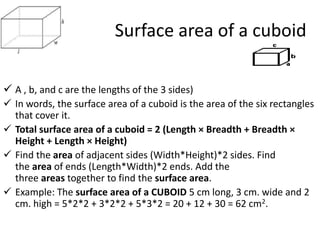
Surface area of a cuboid
 A , b, and c are the lengths of the 3 sides)
 In words, the surface area of a cuboid is the area of the six rectangles
that cover it.
 Total surface area of a cuboid = 2 (Length × Breadth + Breadth ×
Height + Length × Height)
 Find the area of adjacent sides (Width*Height)*2 sides. Find
the area of ends (Length*Width)*2 ends. Add the
three areas together to find the surface area.
 Example: The surface area of a CUBOID 5 cm long, 3 cm. wide and 2
cm. high = 5*2*2 + 3*2*2 + 5*3*2 = 20 + 12 + 30 = 62 cm2.
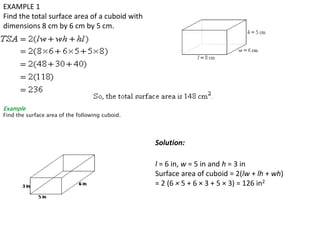
EXAMPLE 1
Find the total surface area of a cuboid with
dimensions 8 cm by 6 cm by 5 cm.
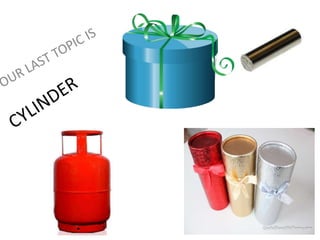
Example
Find the surface area of the following cuboid.
Solution:
l = 6 in, w = 5 in and h = 3 in
Surface area of cuboid = 2(lw + lh + wh)
= 2 (6 × 5 + 6 × 3 + 5 × 3) = 126 in2
BASIC INFORMATION ON CYLINDER
 A solid object with:
• two identical flat ends that are circular or elliptical
• and one curved side.
It has a flat base and a flat top. The base is the same as the top, and also in-
between. It has one curved side
• Height: The height h is the perpendicular distance between the bases. It
is important to use the perpendicular height (or 'altitude') when calculating
the volume of an oblique cylinder.
• Radius: The radius r of a cylinder is the radius of a base. If you are given the
diameter instead, remember to halve it.
• Axis: A line joining the center of each base.
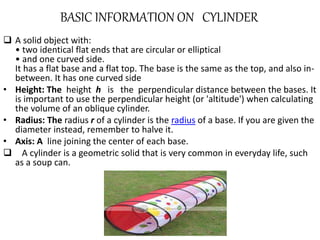
 A cylinder is a geometric solid that is very common in everyday life, such
as a soup can.
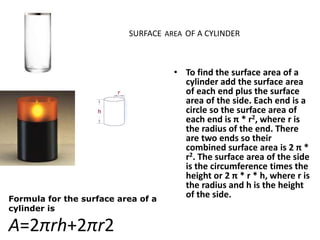
SURFACE AREA OF A CYLINDER
• To find the surface area of a
cylinder add the surface area
of each end plus the surface
area of the side. Each end is a
circle so the surface area of
each end is π * r2, where r is
the radius of the end. There
are two ends so their
combined surface area is 2 π *
r2. The surface area of the side
is the circumference times the
height or 2 π * r * h, where r is
the radius and h is the height
of the side.Formula for the surface area of a
cylinder is
A=2πrh+2πr2
Howto findthe volumeof a cylinder
• Although a cylinder is technically not a prism, it shares
many of the properties of a prism. Like prisms, the
volume is found by multiplying the area of one end of
the cylinder (base) by its height.
• Since the end (base) of a cylinder is a circle, the area of
that circle is given by the formula:
• Multiplying by the height h we get
• where:
π is Pi, approximately 3.142
r is the radius of the circular end of the cylinder
h height of the cylinder
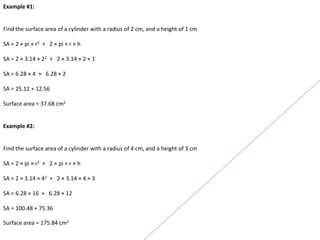
Example #1:
Find the surface area of a cylinder with a radius of 2 cm, and a height of 1 cm
SA = 2 × pi × r2 + 2 × pi × r × h
SA = 2 × 3.14 × 22 + 2 × 3.14 × 2 × 1
SA = 6.28 × 4 + 6.28 × 2
SA = 25.12 + 12.56
Surface area = 37.68 cm2
Example #2:
Find the surface area of a cylinder with a radius of 4 cm, and a height of 3 cm
SA = 2 × pi × r2 + 2 × pi × r × h
SA = 2 × 3.14 × 42 + 2 × 3.14 × 4 × 3
SA = 6.28 × 16 + 6.28 × 12
SA = 100.48 + 75.36
Surface area = 175.84 cm2
Cube, cuboid and cylinder

Cube, cuboid and cylinder

  • 1.
    CUBE CUBOID AND CYLINDER MADE BY KSSRIRANJINI CLASS 8 C ROLL NO 17
  • 3.
    Basic information onCube • A cube is a symmetrical three-dimensional shape , either solid or hollow, contained by six equal squares. You might have noticed cube in your daily life for example :- • Ice cubes, Rubik’s cube, cartoon box .
  • 4.
    Elements of acube • A cube has following elements • Faces = 6 • Edges = 12 • Vertices= 8 • Length , breadth and height of a cube is same. • Net of a cube is as shown
  • 5.
     A isthe length of the side of each edge of the cube In words, the surface area of a cube is the area of the six squares that cover it. The area of one of them is a*a, or a 2 . Since these are all the same, you can multiply one of them by six, so the surface area of a cube is 6 times one of the sides squared.  THE FORMULA TO CALCULATE THE SURFACE AREA OF CUBE IS A=6a2 Surface area of cube.
  • 6.
    Volume of cube •How to find the volume of a cube • Recall that a cube has all edges the same length (See Cube definition). The volume of a cube is found by multiplying the length of any edge by itself twice. So if the length of an edge is 4,the volume is 4 x 4 x 4 = 64 • Or as a formula: • volume = s3where: s is the length of any edge of the cube. • In the figure above, drag the orange dot to resize the cube. From the edge length shown, calculate the volume of the cube and verify that it agrees with the calculation in the figure. • When we write volume = s3, strictly speaking this should be read as "s to the power 3", but because it is used to calculate the volume of cubes it is usually spoken as "s cubed".
  • 7.
    Example #1 Find thesurface area if the length of one side is 3 cm ANSWER: Surface area = 6 × a2 Surface area = 6 × 32 Surface area = 6 × 3 × 3 Surface area = 54 cm2 Example #2: Find the surface area if the length of one side is 5 cm ANSWER: Surface area = 6 × a2 Surface area = 6 × 52 Surface area = 6 × 5 × 5 Surface area = 150 cm2
  • 9.
    Basic information oncuboid  A cuboid is a three-dimensional shape with a length, width, and a height.  The cuboid shape has six sides, called faces. Each face of a cuboid is a rectangle, and all of a cuboid's corners (called vertices) are 90-degree angles. Ultimately, a cuboid has the shape of a rectangular box.  In daily life they are as follows
  • 10.
    Surface area ofa cuboid  A , b, and c are the lengths of the 3 sides)  In words, the surface area of a cuboid is the area of the six rectangles that cover it.  Total surface area of a cuboid = 2 (Length × Breadth + Breadth × Height + Length × Height)  Find the area of adjacent sides (Width*Height)*2 sides. Find the area of ends (Length*Width)*2 ends. Add the three areas together to find the surface area.  Example: The surface area of a CUBOID 5 cm long, 3 cm. wide and 2 cm. high = 5*2*2 + 3*2*2 + 5*3*2 = 20 + 12 + 30 = 62 cm2.
  • 11.
    EXAMPLE 1 Find thetotal surface area of a cuboid with dimensions 8 cm by 6 cm by 5 cm. Example Find the surface area of the following cuboid. Solution: l = 6 in, w = 5 in and h = 3 in Surface area of cuboid = 2(lw + lh + wh) = 2 (6 × 5 + 6 × 3 + 5 × 3) = 126 in2
  • 13.
    BASIC INFORMATION ONCYLINDER  A solid object with: • two identical flat ends that are circular or elliptical • and one curved side. It has a flat base and a flat top. The base is the same as the top, and also in- between. It has one curved side • Height: The height h is the perpendicular distance between the bases. It is important to use the perpendicular height (or 'altitude') when calculating the volume of an oblique cylinder. • Radius: The radius r of a cylinder is the radius of a base. If you are given the diameter instead, remember to halve it. • Axis: A line joining the center of each base.  A cylinder is a geometric solid that is very common in everyday life, such as a soup can.
  • 14.
    SURFACE AREA OFA CYLINDER • To find the surface area of a cylinder add the surface area of each end plus the surface area of the side. Each end is a circle so the surface area of each end is π * r2, where r is the radius of the end. There are two ends so their combined surface area is 2 π * r2. The surface area of the side is the circumference times the height or 2 π * r * h, where r is the radius and h is the height of the side.Formula for the surface area of a cylinder is A=2πrh+2πr2
  • 15.
    Howto findthe volumeofa cylinder • Although a cylinder is technically not a prism, it shares many of the properties of a prism. Like prisms, the volume is found by multiplying the area of one end of the cylinder (base) by its height. • Since the end (base) of a cylinder is a circle, the area of that circle is given by the formula: • Multiplying by the height h we get • where: π is Pi, approximately 3.142 r is the radius of the circular end of the cylinder h height of the cylinder
  • 16.
    Example #1: Find thesurface area of a cylinder with a radius of 2 cm, and a height of 1 cm SA = 2 × pi × r2 + 2 × pi × r × h SA = 2 × 3.14 × 22 + 2 × 3.14 × 2 × 1 SA = 6.28 × 4 + 6.28 × 2 SA = 25.12 + 12.56 Surface area = 37.68 cm2 Example #2: Find the surface area of a cylinder with a radius of 4 cm, and a height of 3 cm SA = 2 × pi × r2 + 2 × pi × r × h SA = 2 × 3.14 × 42 + 2 × 3.14 × 4 × 3 SA = 6.28 × 16 + 6.28 × 12 SA = 100.48 + 75.36 Surface area = 175.84 cm2