Class 8
Square and square roots
Prepared by:
Sharda Chauhan
TGT Maths
Square Number
The number you get when you multiply by itself.
Example: 4 x 4 = 16, So 16 is the square
number.
0 (= 0 x 0)
4 (= 2 x 2)
9 (= 3 x 3)
16 (= 4 x 4)
Squares
Square and square root of the number
If a number ends with 2, 3, 7 and 8 at unit’s
place. So it must not be a square number.
Example: 132, 72 , 28
If a number ends with 1, 4, 5, 6 and 9 at unit’s
place. So it may be a square number.
Example: 1) 16 (Yes) 16 = 4 x 4
2) 15 (No) As it ends with 5.
Perfect squares
Perfect Squares:
3 and 5 are not perfect squares but 9 and 25 are perfect squares.
1) 12
2) 92
1 x 1 = 1 & 9 x 9 = 81
If a number has 1 or 9 in the unit’s place,
Then it’s square ends with 1.
3) 22
4) 82
2 x 2 = 4 & 8 x 8 = 64
If a number has 2 or 8 in the unit’s place,
Then it’s square ends with 4.
Property of unit digit of a square number.
5) 32
6) 72
3 x 3 = 9 & 7 x 7 = 49
If a number has 3 or 7 in the unit’s place,
Then it’s square ends with 9.
7) 42
8) 62
4 x 4 = 16 & 6 x 6 = 36
If a number has 4 or 6 in the unit’s place,
Then it’s square ends with 6.
Even and Odd Numbers
If a number is odd so it’s square is also odd, if
a number is even so it’s square is also even.
Example:
5) 49 = 72
1) 16 = 42
2) 25 = 52
( Even )
( Odd )
( Odd )
3) 121 = 112 ( Odd )
4) 144 = 122 ( Even )
Even and odd squares
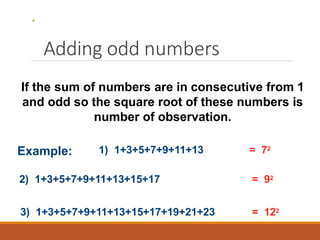
If the sum of numbers are in consecutive from 1
and odd so the square root of these numbers is
number of observation.
Example: 1) 1+3+5+7+9+11+13 = 72
2) 1+3+5+7+9+11+13+15+17 = 92
3) 1+3+5+7+9+11+13+15+17+19+21+23 = 122
Adding odd numbers
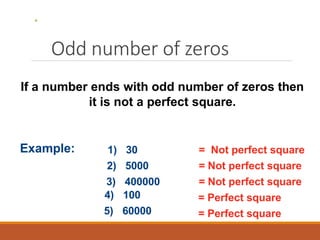
Odd number of zeros
If a number ends with odd number of zeros then
it is not a perfect square.
Example: 1) 30
2) 5000
3) 400000
4) 100
5) 60000
= Not perfect square
= Perfect square
= Perfect square
If a number contain 1 zero at the end, so 2 zeros
will have its square. It means the number
contains zeros will double zeros of its square.
Example: 1) 302
2) 50002
3) 4002
4) 100002
5) 6000002
= 2 zeros
= 6 zeros
= 4 zeros
= 8 zeros
= 10 zeros
Zeros in the square number
Numbers between square
numbers
We can find some numbers between two
consecutive square numbers. By finding the
square numbers of any two number.
Between 12 (=1) and 22 (=4)
there are two non square numbers
Between 22 (=4) and 32 (=9)
there are four non square numbers.
= 2, 3.
= 5, 6, 7, 8, 9.
Example:
The non square numbers is 1 less than the
difference of two consecutive squares.
(n - 1) – n
1) 9 (=32) and 16 (=42)
2) 16 (=42) and 25 (=52)
3) 25 (=52) and 36 (=62)
4) 36 (=32) and 49 (=72)
5) 49 (=72) and 64 (=82)
= (16 - 1) – 9 = 6
= (25 - 1) – 16 = 8
= (36 - 1) – 25 = 10
= (49 - 1) – 36 = 12
= (64 - 1) – 49 = 14
Non square numbers
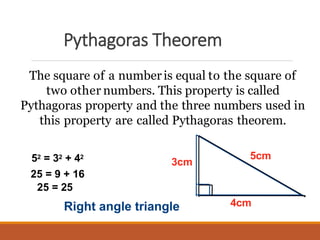
Pythagoras Theorem
The square of a numberis equal to the square of
two other numbers. This property is called
Pythagoras property and the three numbers used in
this property are called Pythagoras theorem.
5cm
3cm
4cm
52 = 32 + 42
25 = 9 + 16
25 = 25
Right angle triangle
The formula to finding more such triplets.
(2m2) + (m2 -1) = (m2 +1)
Example: 1) 62 + 82 = 102
36 + 64 = 100
100 = 100
So 6, 8, 10 are
Pythagorean triplets.
1) 32 + 42 = 52
9 + 16 = 25
25 = 25
So 3, 4, 5 are
Pythagorean triplets.
Pythagorean Triplets
1) Pythagorean triplet whose smallest member is
12.
Finding Pythagorean triplets
1) 2m = 12
M = 6
2) 62 – 1
36 -1 = 35
3) 62 + 1
36 +1 = 37
Check: 122 + 352 = 372
144 + 1225 = 1369
1369 = 1369
So 12, 35, 37 are
Pythagorean triplets.
2) Pythagorean triplet whose member is 5.
2) 2 x 3 = 6
1) m2 – 1 = 5
m2 = 6
m = 6/2 = 3
3) 32 + 1
9 +1 = 10
Check:
52 + 62 = 102
25 + 36 = 100
100 = 100
So 5, 6, 10 are
Pythagorean triplets.
Finding square roots
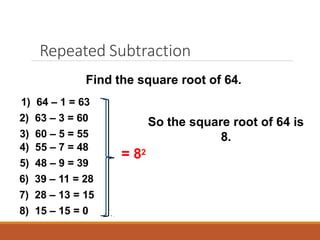
Repeated Subtraction
The subtraction of odd numbers consequently
to the number. Still we get 0. So the number of
observation we subtract to the number is the
square root of that number.
Repeated Subtraction
1) 64 – 1 = 63
2) 63 – 3 = 60
3) 60 – 5 = 55
4) 55 – 7 = 48
5) 48 – 9 = 39
6) 39 – 11 = 28
7) 28 – 13 = 15
8) 15 – 15 = 0
= 82
Find the square root of 64.
So the square root of 64 is
8.
Find the square root of 89.
1) 89 – 1 = 88
2) 88 – 3 = 85
3) 85 – 5 = 80
4) 80 – 7 = 73
5) 73 – 9 = 64
6) 64 – 11 = 53
7) 53 – 13 = 40
8) 40 – 15 = 25
9) 25 – 17 = 8
If something is remaining
from the subtraction. So, it
is not the perfect square.
Prime factorization
2 256
2 128
2 64
2 32
2 16
2 8
2 4
2 2
1
256 = 2 x 2 x 2 x 2 x
2 x 2 x 2 x 2
= 16
2 x 2 x 2 x 2
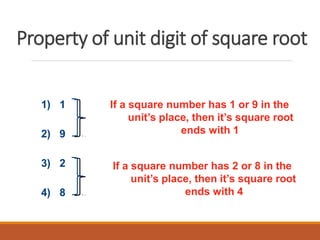
Property of unit digit of square root
1) 1
2) 9
If a square number has 1 or 9 in the
unit’s place, then it’s square root
ends with 1
If a square number has 2 or 8 in the
unit’s place, then it’s square root
ends with 4
3) 2
4) 8
5) 3 If a square number has 3 or 7 in the
unit’s place, then it’s square root
ends with 9.
6) 7
7) 4
8) 6
If a square number has 4 or 6 in the
unit’s place, Then it’s square root
ends with 6.
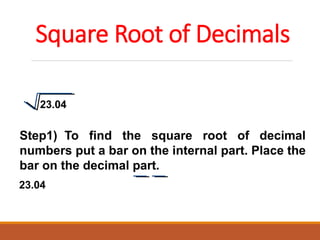
Square Root of Decimals
23.04
Step1) To find the square root of decimal
numbers put a bar on the internal part. Place the
bar on the decimal part.
23.04
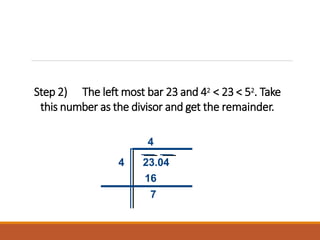
Step 2) The left most bar 23 and 42 < 23 < 52. Take
this number as the divisor and get the remainder.
4
4 23.04
16
7
Step 3) The remainder is 7. Write the number
under the next bar to the right of this remainder,
to get 704. Double the divisor and enter it with a
blank on its right.
4
4 23.04
16
8_ 704
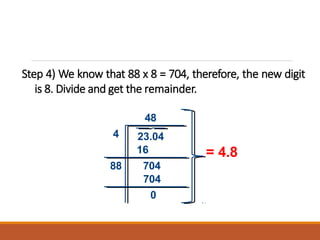
Step 4) We know that 88 x 8 = 704, therefore, the new digit
is 8. Divide and get the remainder.
48
4 23.04
16
88 704
704
0
= 4.8
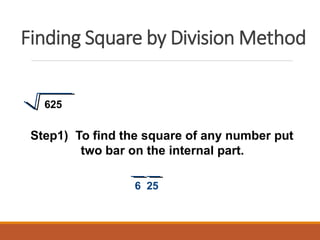
Finding Square by Division Method
625
Step1) To find the square of any number put
two bar on the internal part.
6 25
Step 2) Find the largest number whose square is less than or
equal to the number under the extreme left bar ( 22 < 52 < 32 ).
Take this number as the divisor. Divide and get the remainder.
2
2 6 25
4
2
Step 3) The remainder is 7. Write the number
under the next bar to the right of this remainder,
to get 225. Double the divisor and enter it with a
blank on its right.
2
2 6 25
4
4_ 225
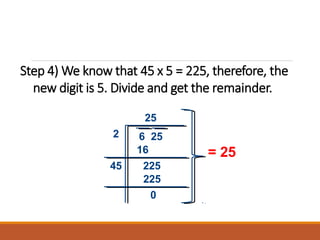
Step 4) We know that 45 x 5 = 225, therefore, the
new digit is 5. Divide and get the remainder.
25
2 6 25
16
45 225
225
0
= 25
Estimating Square root
In all such cases we need to estimate the
square root.
125 < 122
We know that 112 <
121 < 125 < 144
So 121 is much closer to 125 than 144, therefore
11 is the estimating square root of 125.
Quiz
Q1) Which one of the following number is a
perfect squares:
a) 622
b) 393
c) 5778
d) 625
Answer: d) 625
Q2) Check which of the following is not a perfect
square :
a) 81000
b) 8100
c) 900
d) 6250000
Answer: a) 81000
Q3) Which of the following perfect square numbers,
is the square of an odd number:
a) 289
b) 400
c) 900
d) 1600
Answer: a) 289
Q4) Which of the following perfect square numbers,
is the square of an even number:
a) 361
b) 625
c) 4096
d) 2601
Answer: c) 4096
Q5) How many natural numbers lie between squares
of 11 and 12.
a) 22
b) 23
c) 24
d) 25
Answer: a) 22
112 , 122 (144 - 1) - 121 = 22
Q6) Find the unit digit of (564)2
a) 2
b) 4
c) 6
d) 8
Answer: c) 6
Q7) Find the unit digit of square root of (1521)?
a) 1 or 9
b) 4 or 6
c) 2 or 7
d) 8 or 5
Answer: a) 1 or 9
Q8) 1 + 3 + 5 +7 + 9 + 11 + 13 + 15 is a perfect square
of number:
a) 8
b) 7
c) 6
d) 9
Answer: b) 8
Q9) What is the formula to find Pythagorean triplets:
a) (m) + (m2-1) = (m2+1)
b) (2m) + (m2-1) = (m2+1)
c) (2m) + (m-1) = (m+1)
d) (2m) + (m2) = (m2+1)
Answer: b) (2m) + (m2-1) = (m2+1)
Q10) Can a prime number be perfect square:
GUESS
False !
Q11) If a number is odd so it’s square is also
odd:
True !
THANKYOU!

square and square root class8.pptx

  • 1.
    Class 8 Square andsquare roots Prepared by: Sharda Chauhan TGT Maths
  • 2.
    Square Number The numberyou get when you multiply by itself. Example: 4 x 4 = 16, So 16 is the square number. 0 (= 0 x 0) 4 (= 2 x 2) 9 (= 3 x 3) 16 (= 4 x 4)
  • 3.
  • 4.
    Square and squareroot of the number
  • 5.
    If a numberends with 2, 3, 7 and 8 at unit’s place. So it must not be a square number. Example: 132, 72 , 28 If a number ends with 1, 4, 5, 6 and 9 at unit’s place. So it may be a square number. Example: 1) 16 (Yes) 16 = 4 x 4 2) 15 (No) As it ends with 5. Perfect squares
  • 6.
    Perfect Squares: 3 and5 are not perfect squares but 9 and 25 are perfect squares.
  • 7.
    1) 12 2) 92 1x 1 = 1 & 9 x 9 = 81 If a number has 1 or 9 in the unit’s place, Then it’s square ends with 1. 3) 22 4) 82 2 x 2 = 4 & 8 x 8 = 64 If a number has 2 or 8 in the unit’s place, Then it’s square ends with 4. Property of unit digit of a square number.
  • 8.
    5) 32 6) 72 3x 3 = 9 & 7 x 7 = 49 If a number has 3 or 7 in the unit’s place, Then it’s square ends with 9. 7) 42 8) 62 4 x 4 = 16 & 6 x 6 = 36 If a number has 4 or 6 in the unit’s place, Then it’s square ends with 6.
  • 9.
    Even and OddNumbers
  • 10.
    If a numberis odd so it’s square is also odd, if a number is even so it’s square is also even. Example: 5) 49 = 72 1) 16 = 42 2) 25 = 52 ( Even ) ( Odd ) ( Odd ) 3) 121 = 112 ( Odd ) 4) 144 = 122 ( Even ) Even and odd squares
  • 11.
    If the sumof numbers are in consecutive from 1 and odd so the square root of these numbers is number of observation. Example: 1) 1+3+5+7+9+11+13 = 72 2) 1+3+5+7+9+11+13+15+17 = 92 3) 1+3+5+7+9+11+13+15+17+19+21+23 = 122 Adding odd numbers
  • 12.
    Odd number ofzeros If a number ends with odd number of zeros then it is not a perfect square. Example: 1) 30 2) 5000 3) 400000 4) 100 5) 60000 = Not perfect square = Not perfect square = Not perfect square = Perfect square = Perfect square
  • 13.
    If a numbercontain 1 zero at the end, so 2 zeros will have its square. It means the number contains zeros will double zeros of its square. Example: 1) 302 2) 50002 3) 4002 4) 100002 5) 6000002 = 2 zeros = 6 zeros = 4 zeros = 8 zeros = 10 zeros Zeros in the square number
  • 14.
    Numbers between square numbers Wecan find some numbers between two consecutive square numbers. By finding the square numbers of any two number. Between 12 (=1) and 22 (=4) there are two non square numbers Between 22 (=4) and 32 (=9) there are four non square numbers. = 2, 3. = 5, 6, 7, 8, 9.
  • 15.
    Example: The non squarenumbers is 1 less than the difference of two consecutive squares. (n - 1) – n 1) 9 (=32) and 16 (=42) 2) 16 (=42) and 25 (=52) 3) 25 (=52) and 36 (=62) 4) 36 (=32) and 49 (=72) 5) 49 (=72) and 64 (=82) = (16 - 1) – 9 = 6 = (25 - 1) – 16 = 8 = (36 - 1) – 25 = 10 = (49 - 1) – 36 = 12 = (64 - 1) – 49 = 14 Non square numbers
  • 17.
    Pythagoras Theorem The squareof a numberis equal to the square of two other numbers. This property is called Pythagoras property and the three numbers used in this property are called Pythagoras theorem. 5cm 3cm 4cm 52 = 32 + 42 25 = 9 + 16 25 = 25 Right angle triangle
  • 18.
    The formula tofinding more such triplets. (2m2) + (m2 -1) = (m2 +1) Example: 1) 62 + 82 = 102 36 + 64 = 100 100 = 100 So 6, 8, 10 are Pythagorean triplets. 1) 32 + 42 = 52 9 + 16 = 25 25 = 25 So 3, 4, 5 are Pythagorean triplets. Pythagorean Triplets
  • 19.
    1) Pythagorean tripletwhose smallest member is 12. Finding Pythagorean triplets 1) 2m = 12 M = 6 2) 62 – 1 36 -1 = 35 3) 62 + 1 36 +1 = 37 Check: 122 + 352 = 372 144 + 1225 = 1369 1369 = 1369 So 12, 35, 37 are Pythagorean triplets.
  • 20.
    2) Pythagorean tripletwhose member is 5. 2) 2 x 3 = 6 1) m2 – 1 = 5 m2 = 6 m = 6/2 = 3 3) 32 + 1 9 +1 = 10 Check: 52 + 62 = 102 25 + 36 = 100 100 = 100 So 5, 6, 10 are Pythagorean triplets.
  • 21.
    Finding square roots RepeatedSubtraction The subtraction of odd numbers consequently to the number. Still we get 0. So the number of observation we subtract to the number is the square root of that number.
  • 22.
    Repeated Subtraction 1) 64– 1 = 63 2) 63 – 3 = 60 3) 60 – 5 = 55 4) 55 – 7 = 48 5) 48 – 9 = 39 6) 39 – 11 = 28 7) 28 – 13 = 15 8) 15 – 15 = 0 = 82 Find the square root of 64. So the square root of 64 is 8.
  • 23.
    Find the squareroot of 89. 1) 89 – 1 = 88 2) 88 – 3 = 85 3) 85 – 5 = 80 4) 80 – 7 = 73 5) 73 – 9 = 64 6) 64 – 11 = 53 7) 53 – 13 = 40 8) 40 – 15 = 25 9) 25 – 17 = 8 If something is remaining from the subtraction. So, it is not the perfect square.
  • 24.
    Prime factorization 2 256 2128 2 64 2 32 2 16 2 8 2 4 2 2 1 256 = 2 x 2 x 2 x 2 x 2 x 2 x 2 x 2 = 16 2 x 2 x 2 x 2
  • 25.
    Property of unitdigit of square root 1) 1 2) 9 If a square number has 1 or 9 in the unit’s place, then it’s square root ends with 1 If a square number has 2 or 8 in the unit’s place, then it’s square root ends with 4 3) 2 4) 8
  • 26.
    5) 3 Ifa square number has 3 or 7 in the unit’s place, then it’s square root ends with 9. 6) 7 7) 4 8) 6 If a square number has 4 or 6 in the unit’s place, Then it’s square root ends with 6.
  • 27.
    Square Root ofDecimals 23.04 Step1) To find the square root of decimal numbers put a bar on the internal part. Place the bar on the decimal part. 23.04
  • 28.
    Step 2) Theleft most bar 23 and 42 < 23 < 52. Take this number as the divisor and get the remainder. 4 4 23.04 16 7
  • 29.
    Step 3) Theremainder is 7. Write the number under the next bar to the right of this remainder, to get 704. Double the divisor and enter it with a blank on its right. 4 4 23.04 16 8_ 704
  • 30.
    Step 4) Weknow that 88 x 8 = 704, therefore, the new digit is 8. Divide and get the remainder. 48 4 23.04 16 88 704 704 0 = 4.8
  • 31.
    Finding Square byDivision Method 625 Step1) To find the square of any number put two bar on the internal part. 6 25
  • 32.
    Step 2) Findthe largest number whose square is less than or equal to the number under the extreme left bar ( 22 < 52 < 32 ). Take this number as the divisor. Divide and get the remainder. 2 2 6 25 4 2
  • 33.
    Step 3) Theremainder is 7. Write the number under the next bar to the right of this remainder, to get 225. Double the divisor and enter it with a blank on its right. 2 2 6 25 4 4_ 225
  • 34.
    Step 4) Weknow that 45 x 5 = 225, therefore, the new digit is 5. Divide and get the remainder. 25 2 6 25 16 45 225 225 0 = 25
  • 35.
    Estimating Square root Inall such cases we need to estimate the square root. 125 < 122 We know that 112 < 121 < 125 < 144 So 121 is much closer to 125 than 144, therefore 11 is the estimating square root of 125.
  • 37.
    Quiz Q1) Which oneof the following number is a perfect squares: a) 622 b) 393 c) 5778 d) 625 Answer: d) 625
  • 38.
    Q2) Check whichof the following is not a perfect square : a) 81000 b) 8100 c) 900 d) 6250000 Answer: a) 81000
  • 39.
    Q3) Which ofthe following perfect square numbers, is the square of an odd number: a) 289 b) 400 c) 900 d) 1600 Answer: a) 289
  • 40.
    Q4) Which ofthe following perfect square numbers, is the square of an even number: a) 361 b) 625 c) 4096 d) 2601 Answer: c) 4096
  • 41.
    Q5) How manynatural numbers lie between squares of 11 and 12. a) 22 b) 23 c) 24 d) 25 Answer: a) 22 112 , 122 (144 - 1) - 121 = 22
  • 42.
    Q6) Find theunit digit of (564)2 a) 2 b) 4 c) 6 d) 8 Answer: c) 6
  • 43.
    Q7) Find theunit digit of square root of (1521)? a) 1 or 9 b) 4 or 6 c) 2 or 7 d) 8 or 5 Answer: a) 1 or 9
  • 44.
    Q8) 1 +3 + 5 +7 + 9 + 11 + 13 + 15 is a perfect square of number: a) 8 b) 7 c) 6 d) 9 Answer: b) 8
  • 45.
    Q9) What isthe formula to find Pythagorean triplets: a) (m) + (m2-1) = (m2+1) b) (2m) + (m2-1) = (m2+1) c) (2m) + (m-1) = (m+1) d) (2m) + (m2) = (m2+1) Answer: b) (2m) + (m2-1) = (m2+1)
  • 46.
    Q10) Can aprime number be perfect square: GUESS False ! Q11) If a number is odd so it’s square is also odd: True !
  • 47.