Cuboids
Shape and Space
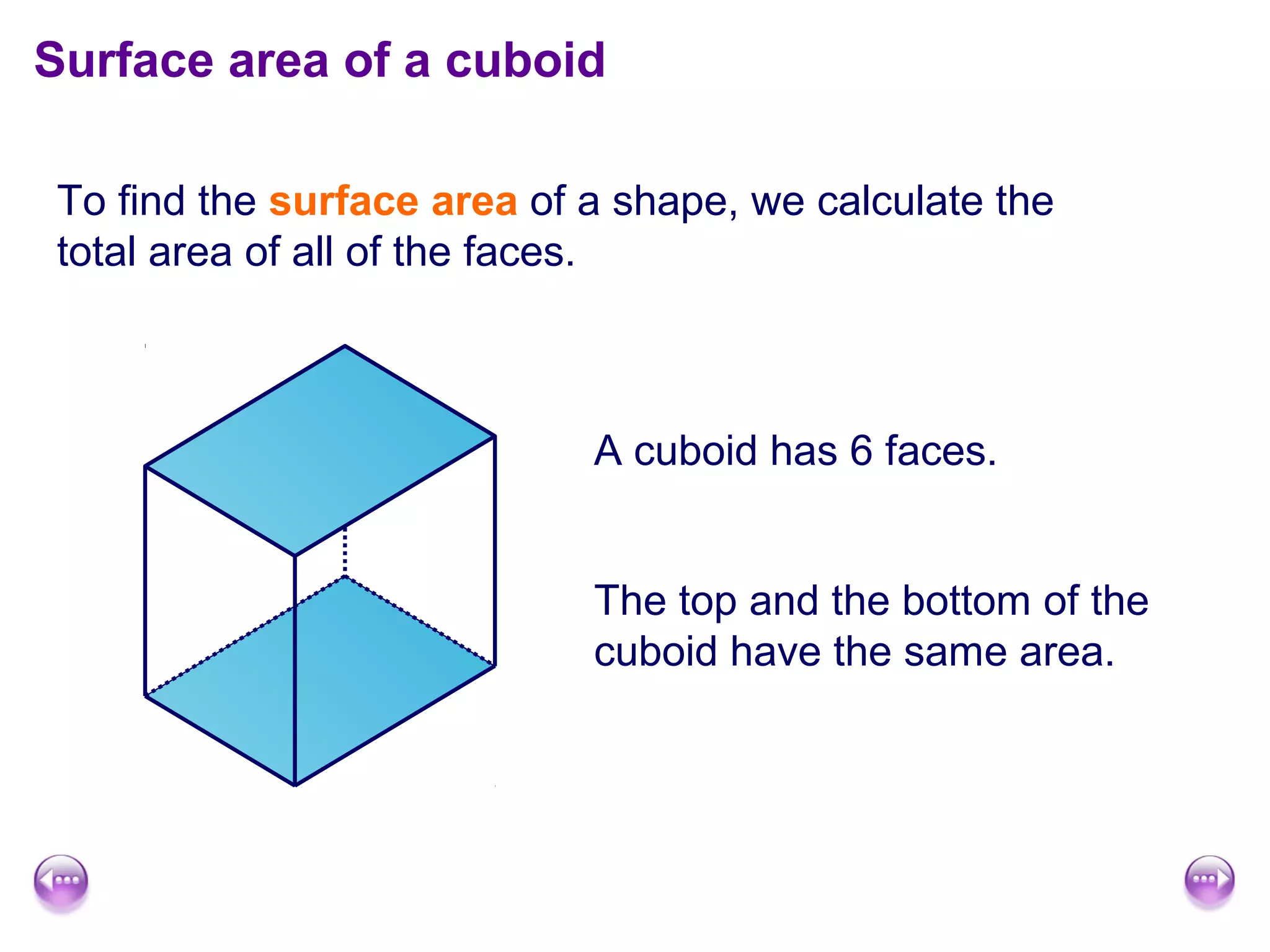
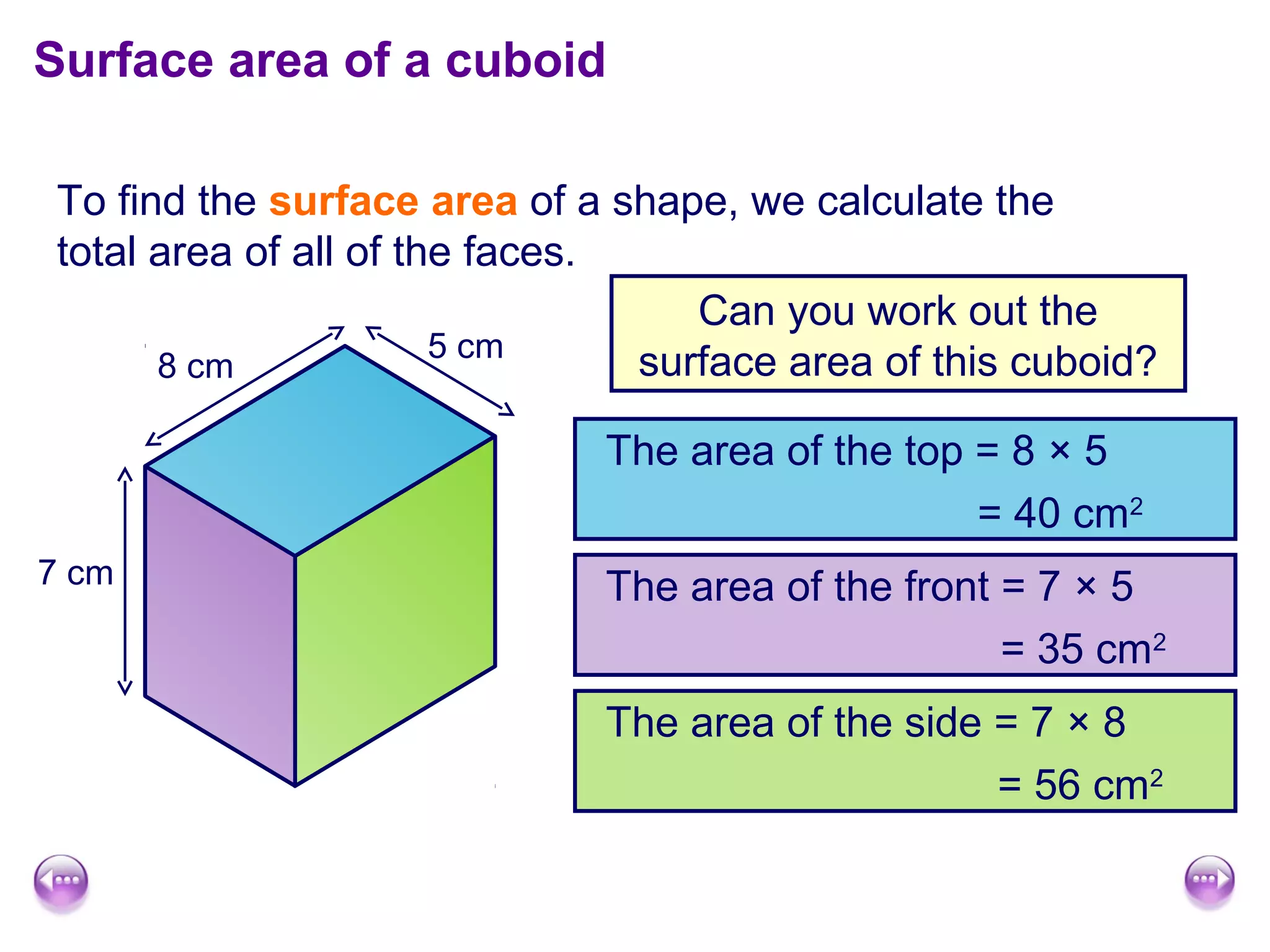
To find the surface area of a shape, we calculate the
total area of all of the faces.
A cuboid has 6 faces.
The top and the bottom of the
cuboid have the same area.
Surface area of a cuboid
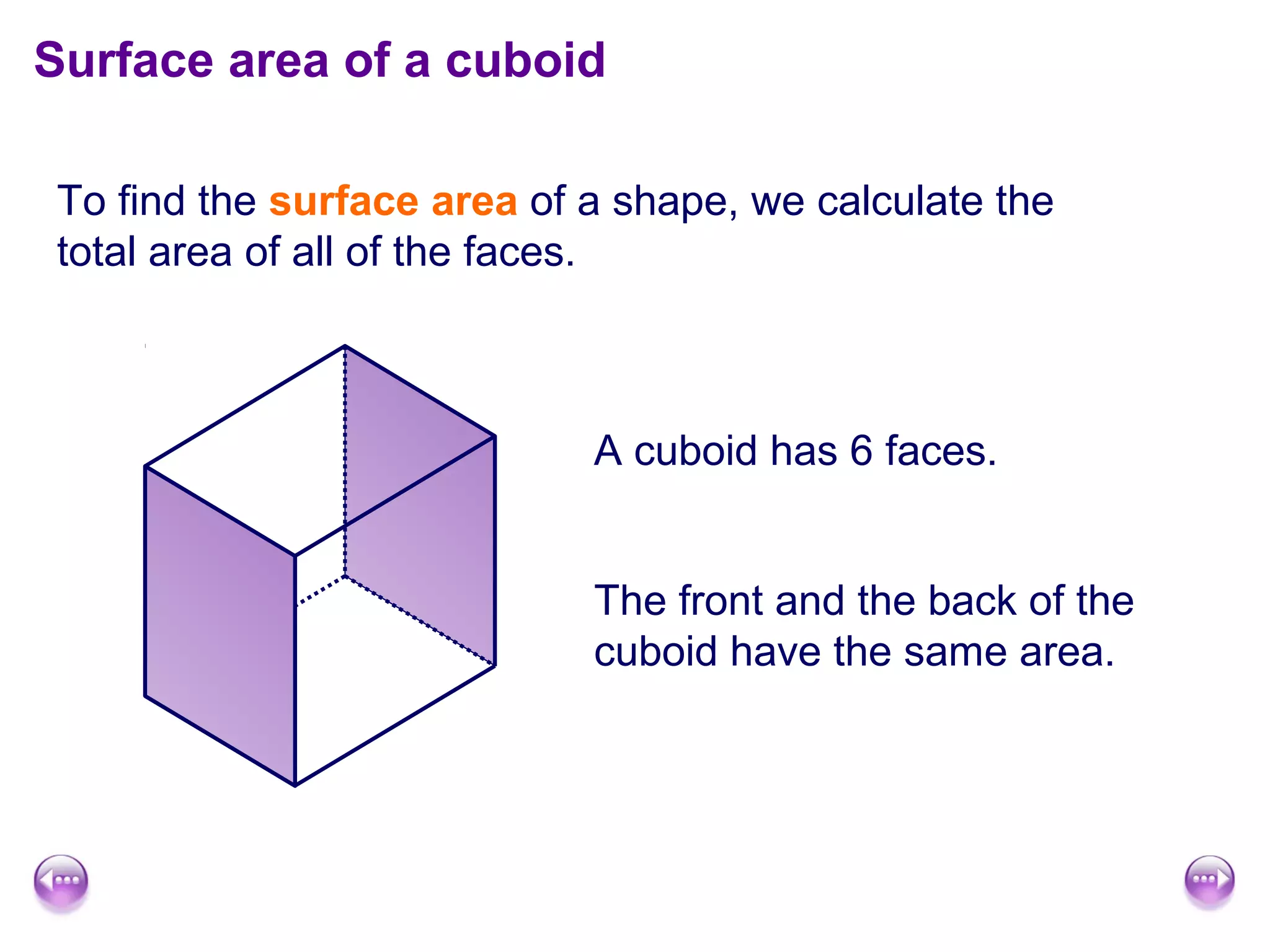
To find the surface area of a shape, we calculate the
total area of all of the faces.
A cuboid has 6 faces.
The front and the back of the
cuboid have the same area.
Surface area of a cuboid
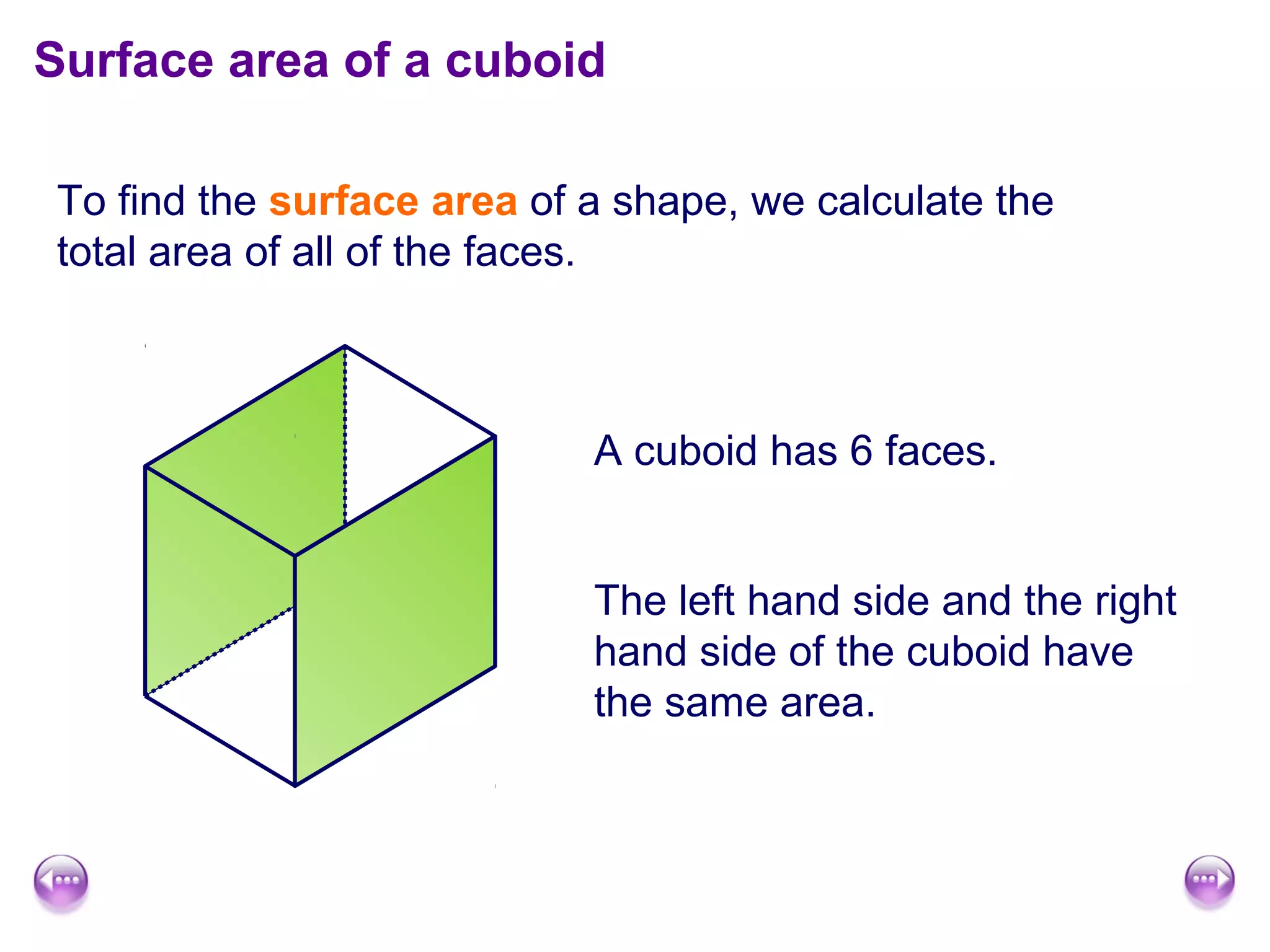
To find the surface area of a shape, we calculate the
total area of all of the faces.
A cuboid has 6 faces.
The left hand side and the right
hand side of the cuboid have
the same area.
Surface area of a cuboid
To find the surface area of a shape, we calculate the
total area of all of the faces.
Can you work out the
surface area of this cuboid?
Surface area of a cuboid
7 cm
8 cm
5 cm
The area of the top = 8 × 5
= 40 cm2
The area of the front = 7 × 5
= 35 cm2
The area of the side = 7 × 8
= 56 cm2
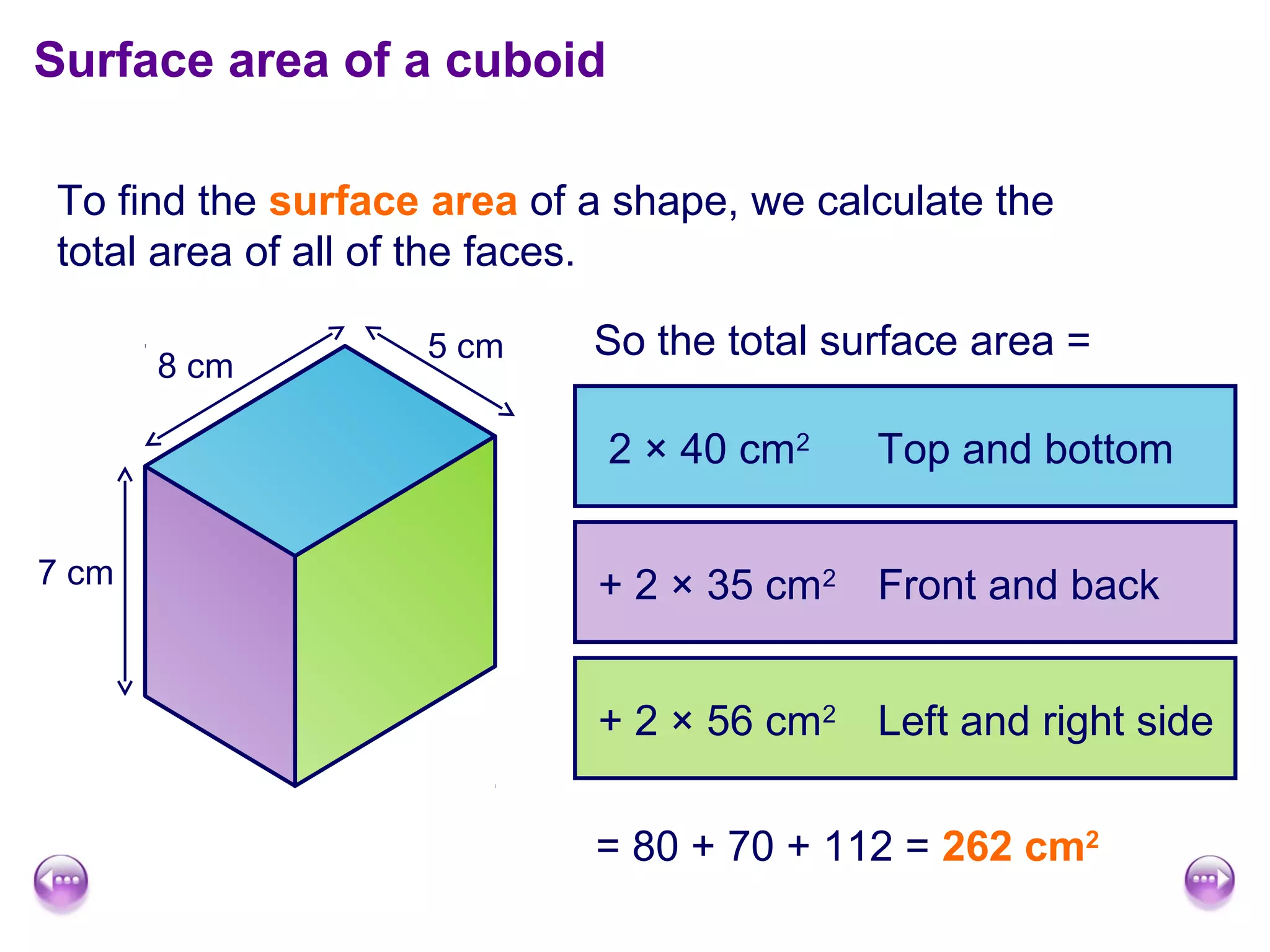
To find the surface area of a shape, we calculate the
total area of all of the faces.
So the total surface area =
Surface area of a cuboid
7 cm
8 cm
5 cm
2 × 40 cm2
+ 2 × 35 cm2
+ 2 × 56 cm2
Top and bottom
Front and back
Left and right side
= 80 + 70 + 112 = 262 cm2
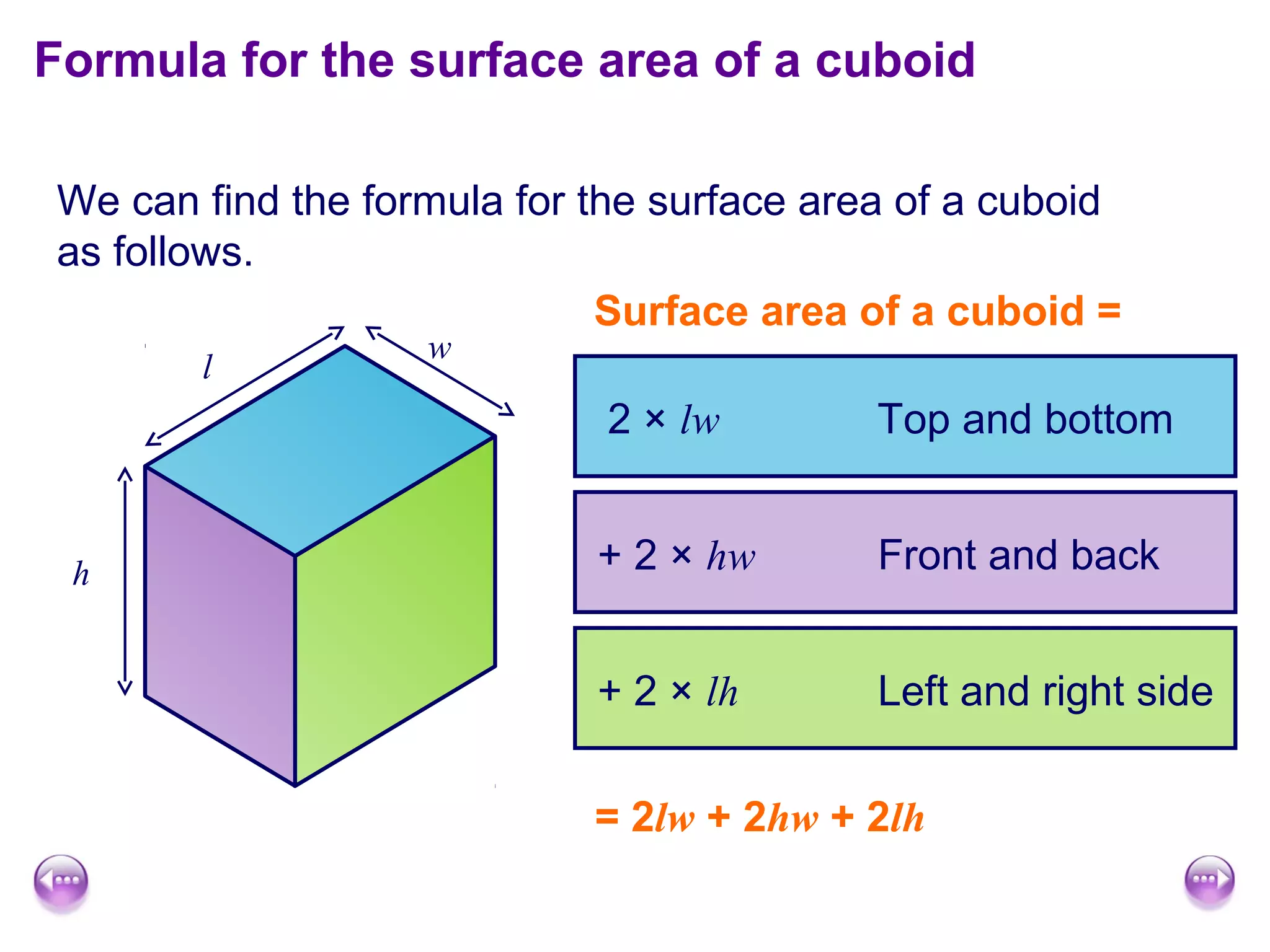
We can find the formula for the surface area of a cuboid
as follows.
Surface area of a cuboid =
Formula for the surface area of a cuboid
h
l
w
2 × lw Top and bottom
+ 2 × hw Front and back
+ 2 × lh Left and right side
= 2lw + 2hw + 2lh
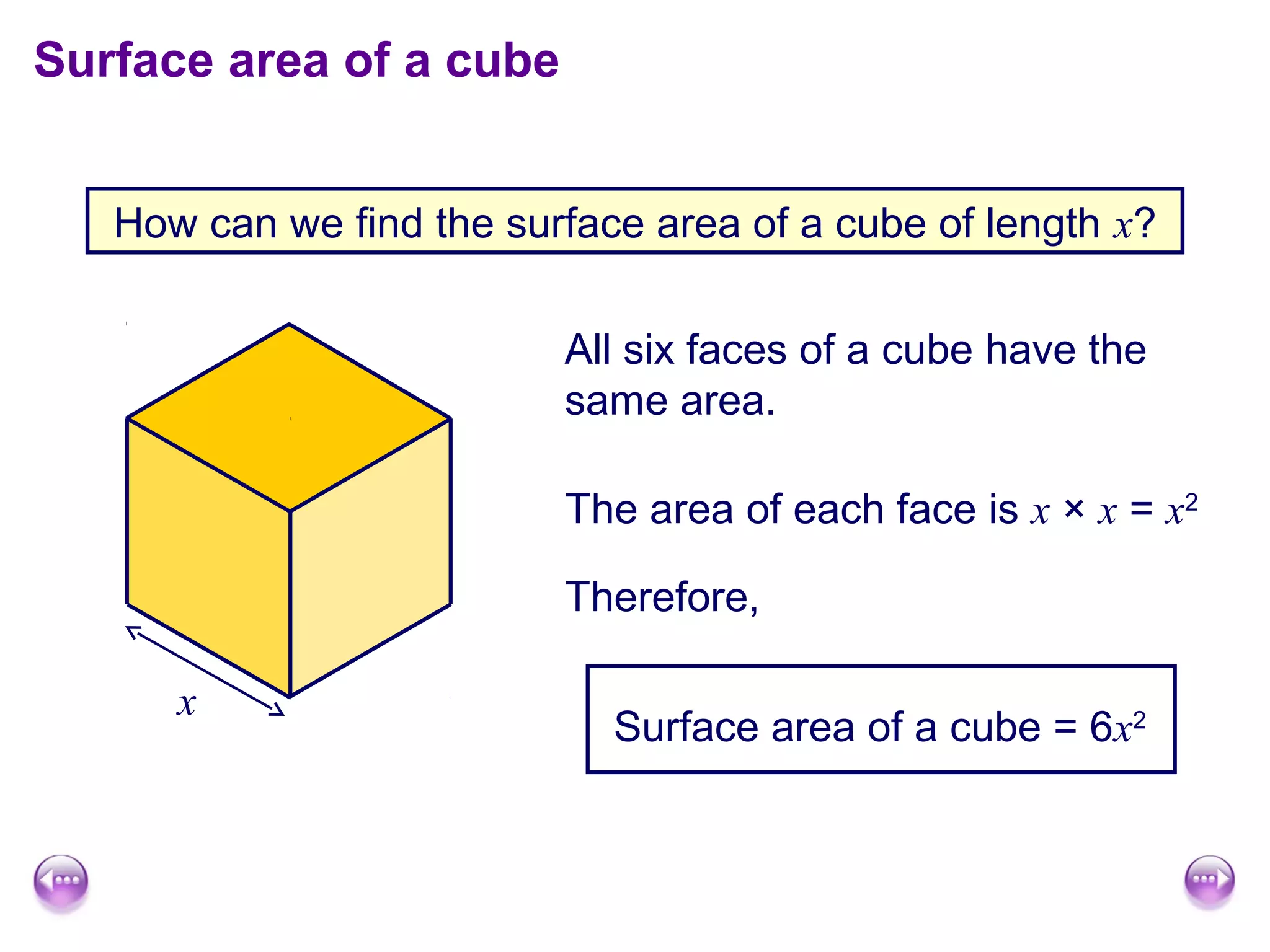
How can we find the surface area of a cube of length x?
Surface area of a cube
x
All six faces of a cube have the
same area.
The area of each face is x × x = x2
Therefore,
Surface area of a cube = 6x2
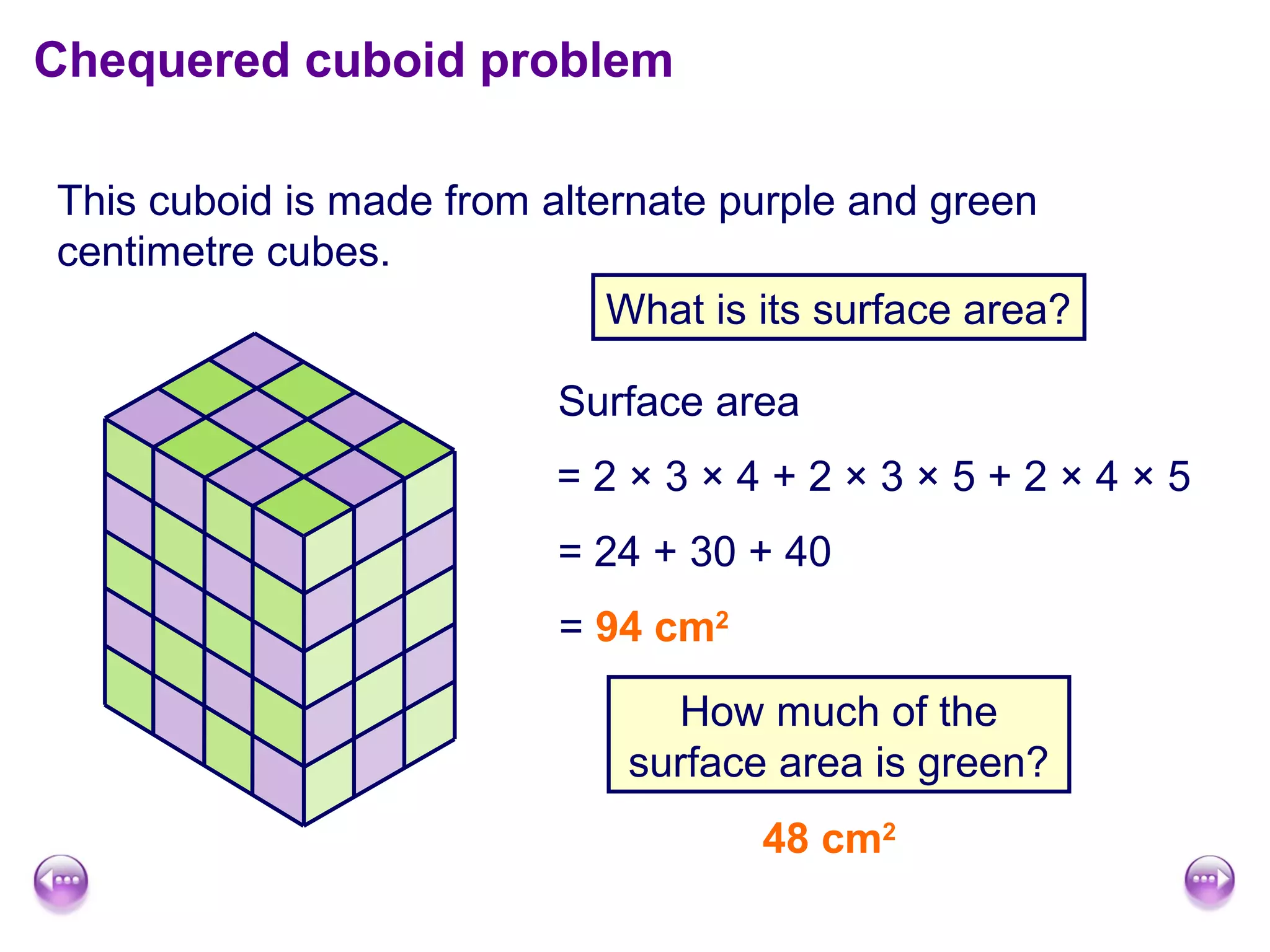
This cuboid is made from alternate purple and green
centimetre cubes.
Chequered cuboid problem
What is its surface area?
Surface area
= 2 × 3 × 4 + 2 × 3 × 5 + 2 × 4 × 5
= 24 + 30 + 40
= 94 cm2
How much of the
surface area is green?
48 cm2
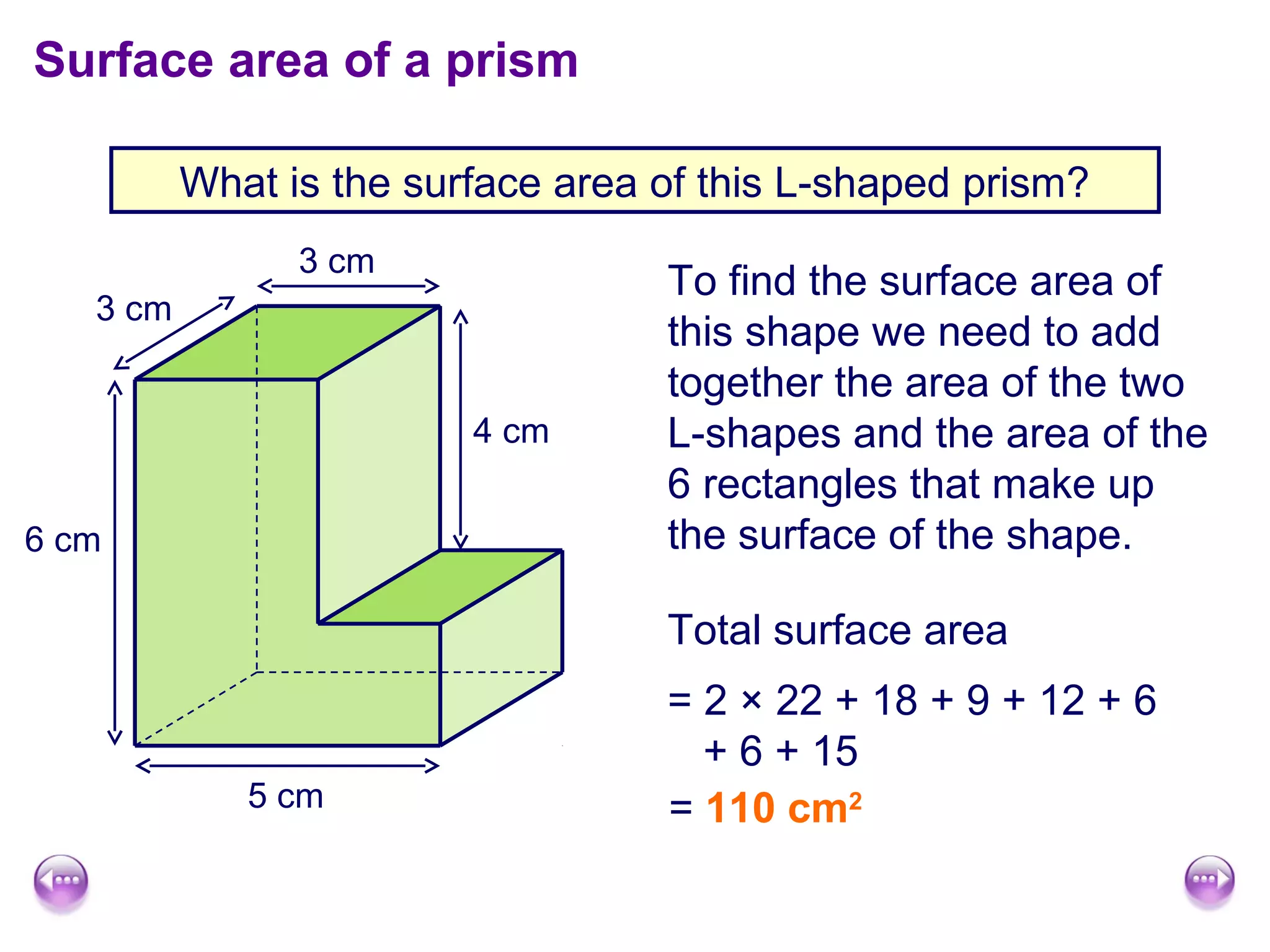
What is the surface area of this L-shaped prism?
Surface area of a prism
6 cm
5 cm
3 cm
4 cm
3 cm
To find the surface area of
this shape we need to add
together the area of the two
L-shapes and the area of the
6 rectangles that make up
the surface of the shape.
Total surface area
= 2 × 22 + 18 + 9 + 12 + 6
+ 6 + 15
= 110 cm2
5 cm
6 cm
3 cm
6 cm
3 cm3 cm
3 cm
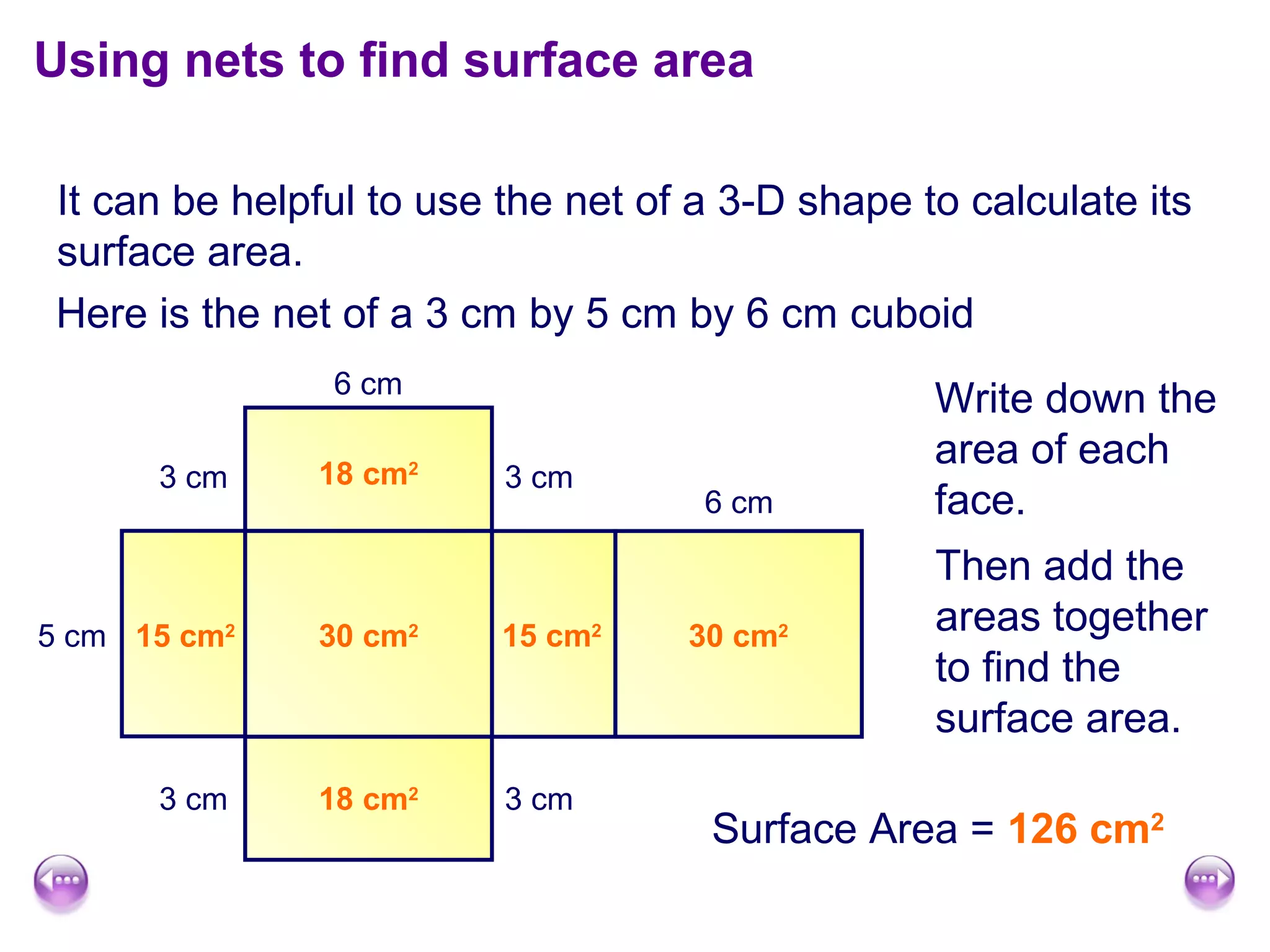
It can be helpful to use the net of a 3-D shape to calculate its
surface area.
Using nets to find surface area
Here is the net of a 3 cm by 5 cm by 6 cm cuboid
Write down the
area of each
face.
15 cm2
15 cm2
18 cm2
30 cm2
30 cm2
18 cm2
Then add the
areas together
to find the
surface area.
Surface Area = 126 cm2
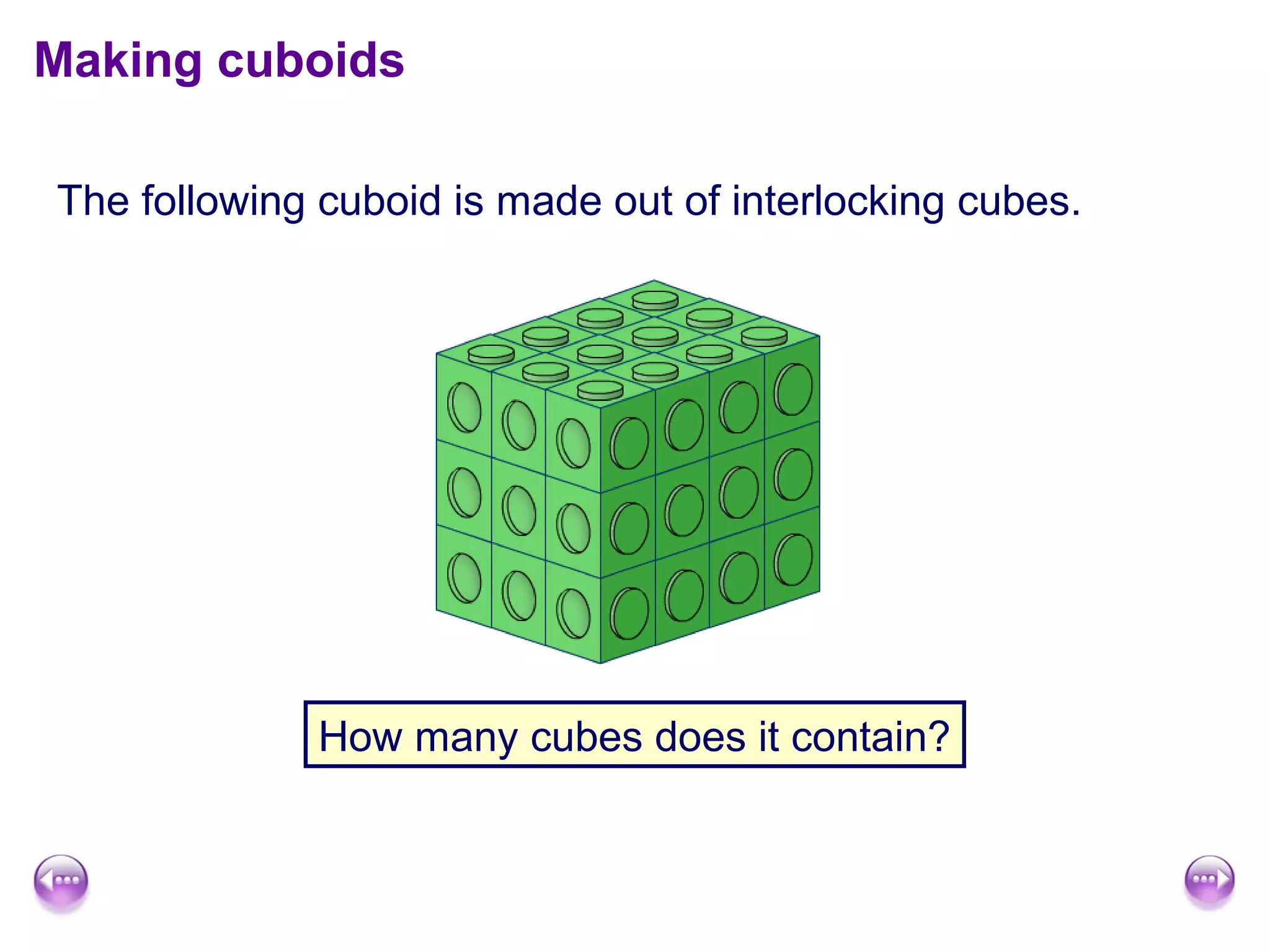
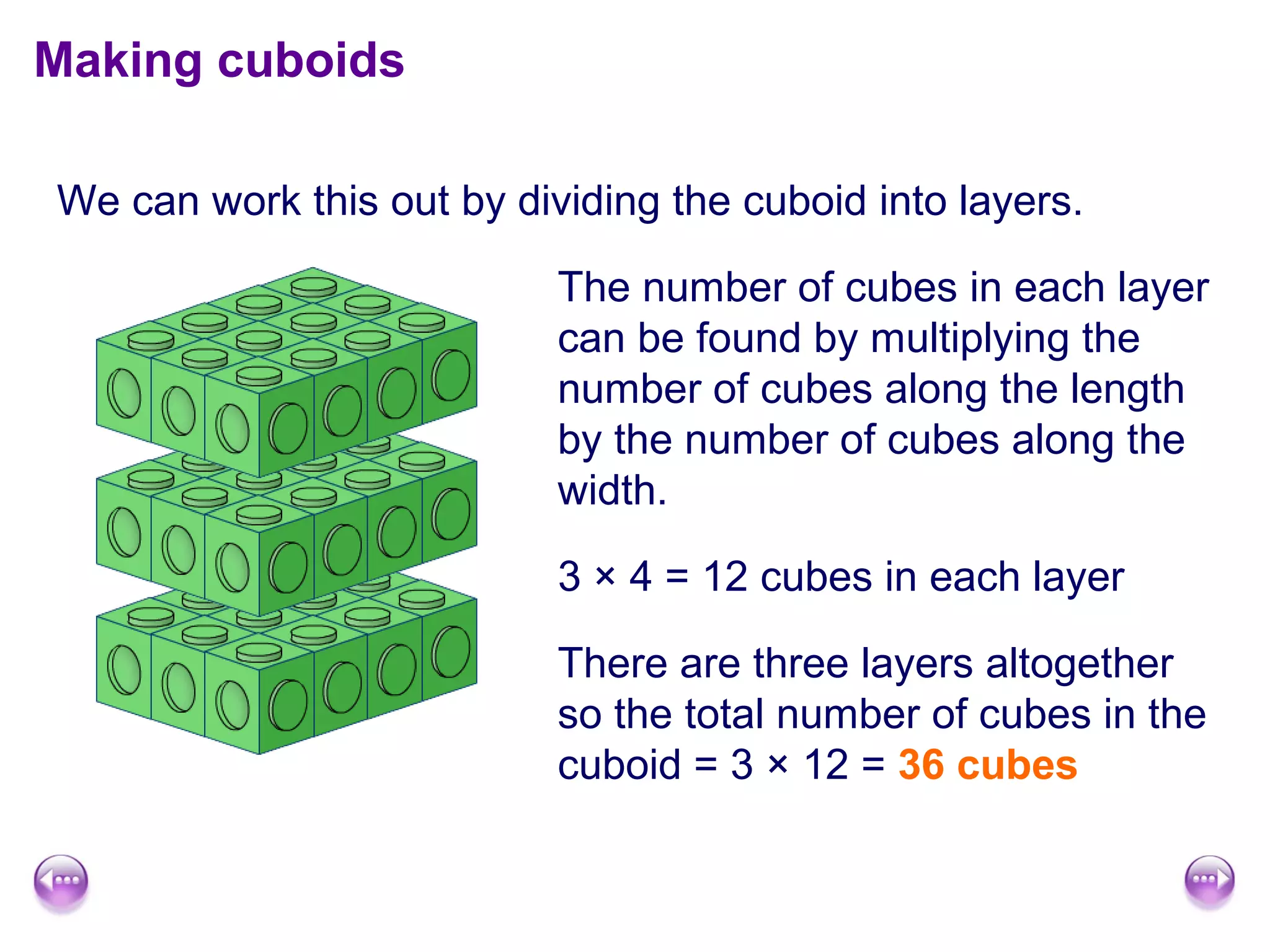
The following cuboid is made out of interlocking cubes.
Making cuboids
How many cubes does it contain?
We can work this out by dividing the cuboid into layers.
Making cuboids
The number of cubes in each layer
can be found by multiplying the
number of cubes along the length
by the number of cubes along the
width.
3 × 4 = 12 cubes in each layer
There are three layers altogether
so the total number of cubes in the
cuboid = 3 × 12 = 36 cubes
The amount of space that a three-dimensional object takes
up is called its volume.
Making cuboids
For example, we can use mm3
, cm3
, m3
or km3
.
The 3
tells us that there are three dimensions, length, width
and height.
Volume is measured in cubic units.
Liquid volume or capacity is measured in ml, l, pints or
gallons.
Volume of a cuboid
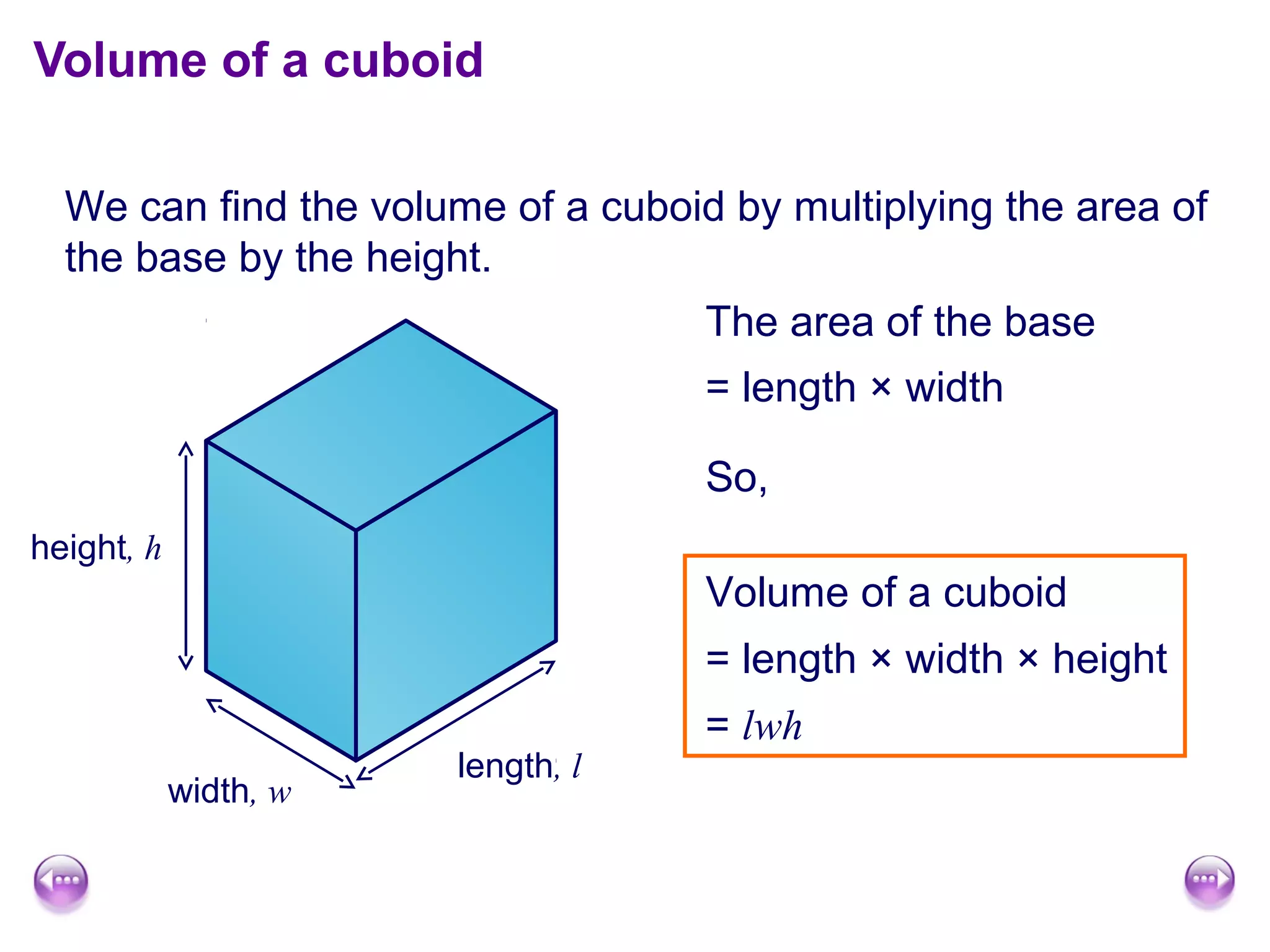
We can find the volume of a cuboid by multiplying the area of
the base by the height.
Volume of a cuboid
= length × width × height
= lwh
height, h
length, l
width, w
The area of the base
= length × width
So,
Volume of a cuboid
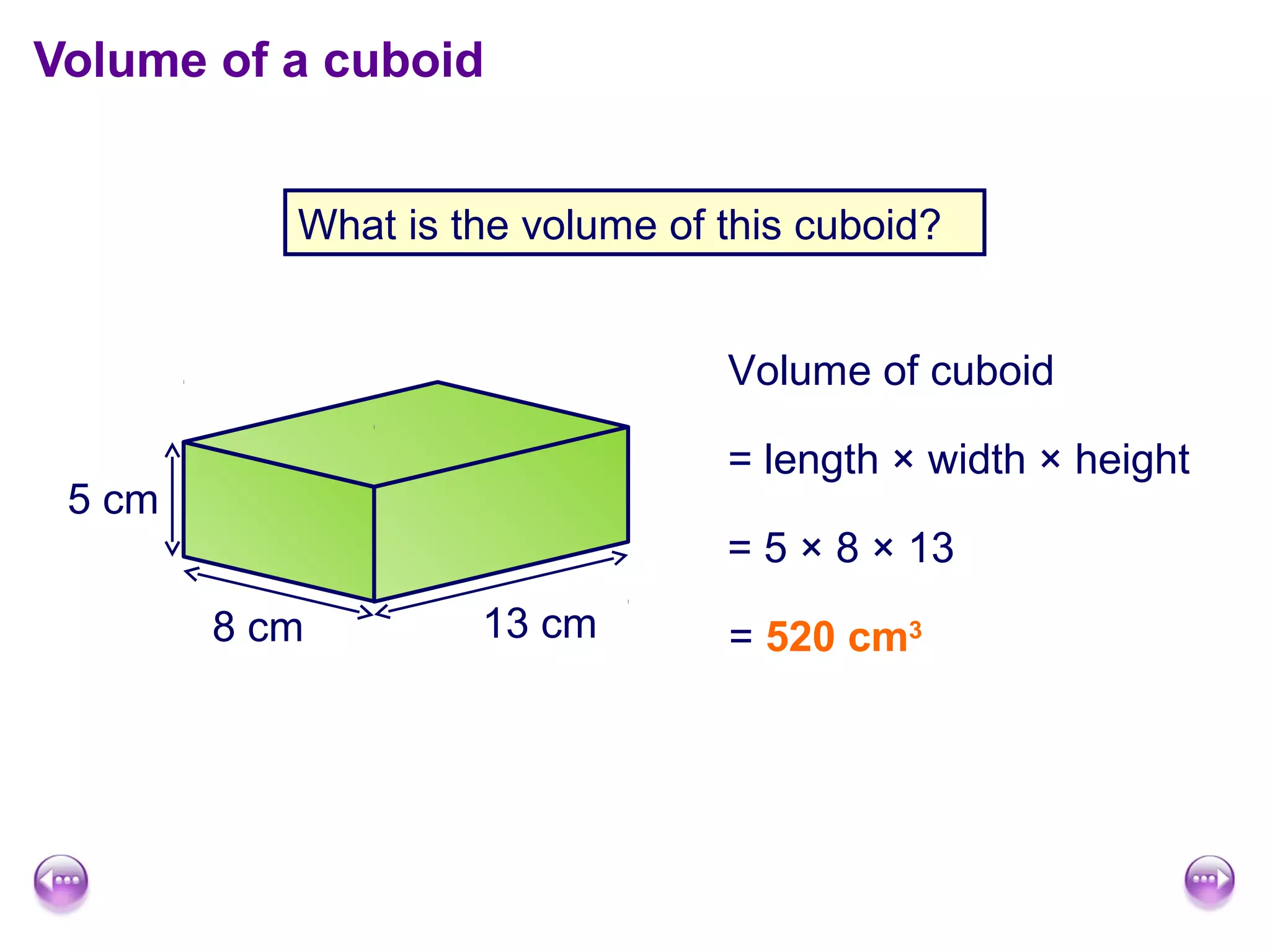
What is the volume of this cuboid?
Volume of cuboid
= length × width × height
= 5 × 8 × 13
= 520 cm3
5 cm
8 cm 13 cm
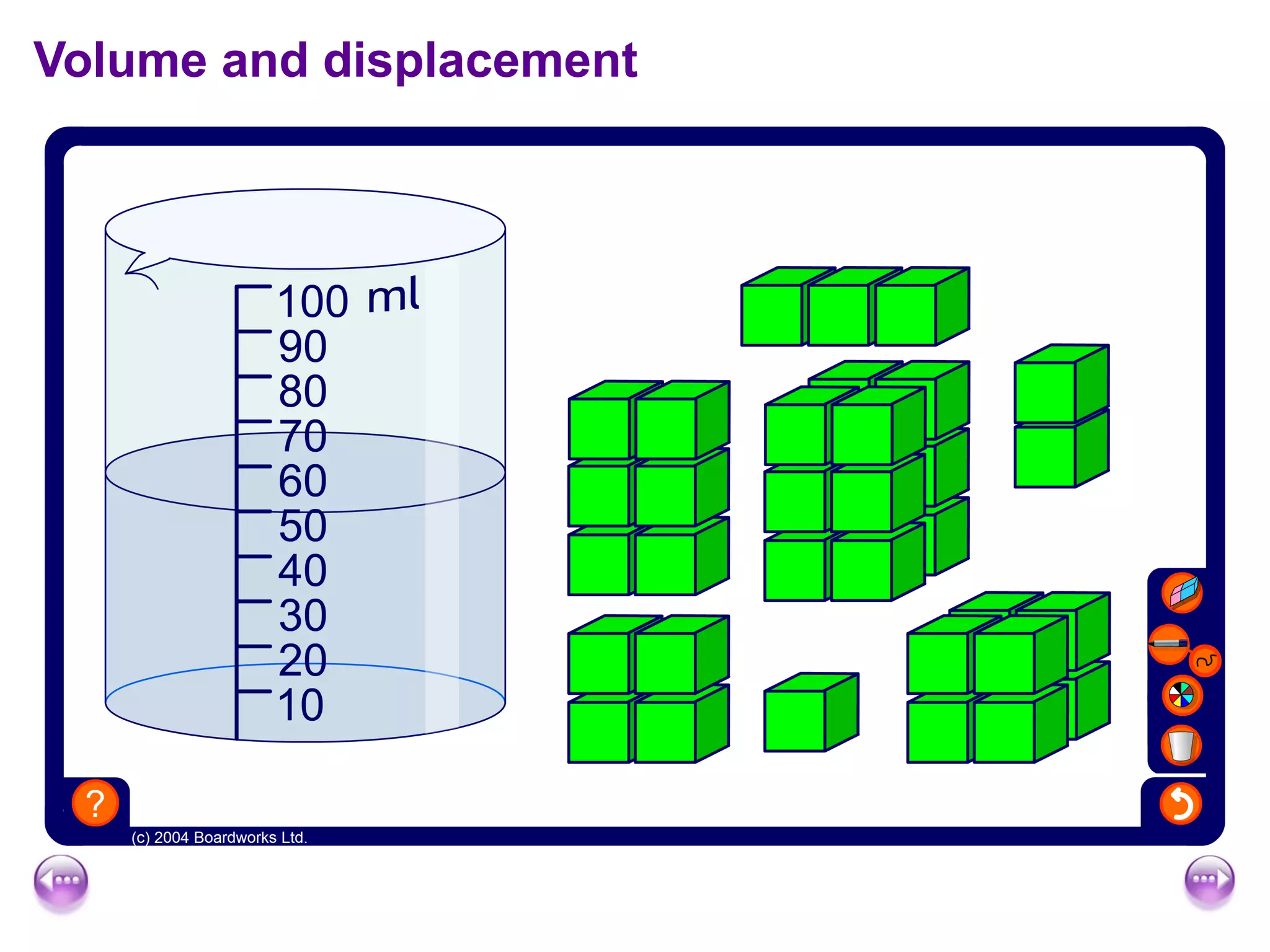
Volume and displacement
By dropping cubes and cuboids into a measuring cylinder
half filled with water we can see the connection between the
volume of the shape and the volume of the water displaced.
1 ml of water has a volume of 1 cm3
For example, if an object is dropped into a measuring
cylinder and displaces 5 ml of water then the volume of the
object is 5 cm3
.
What is the volume of 1 litre of water?
1 litre of water has a volume of 1000 cm3
.
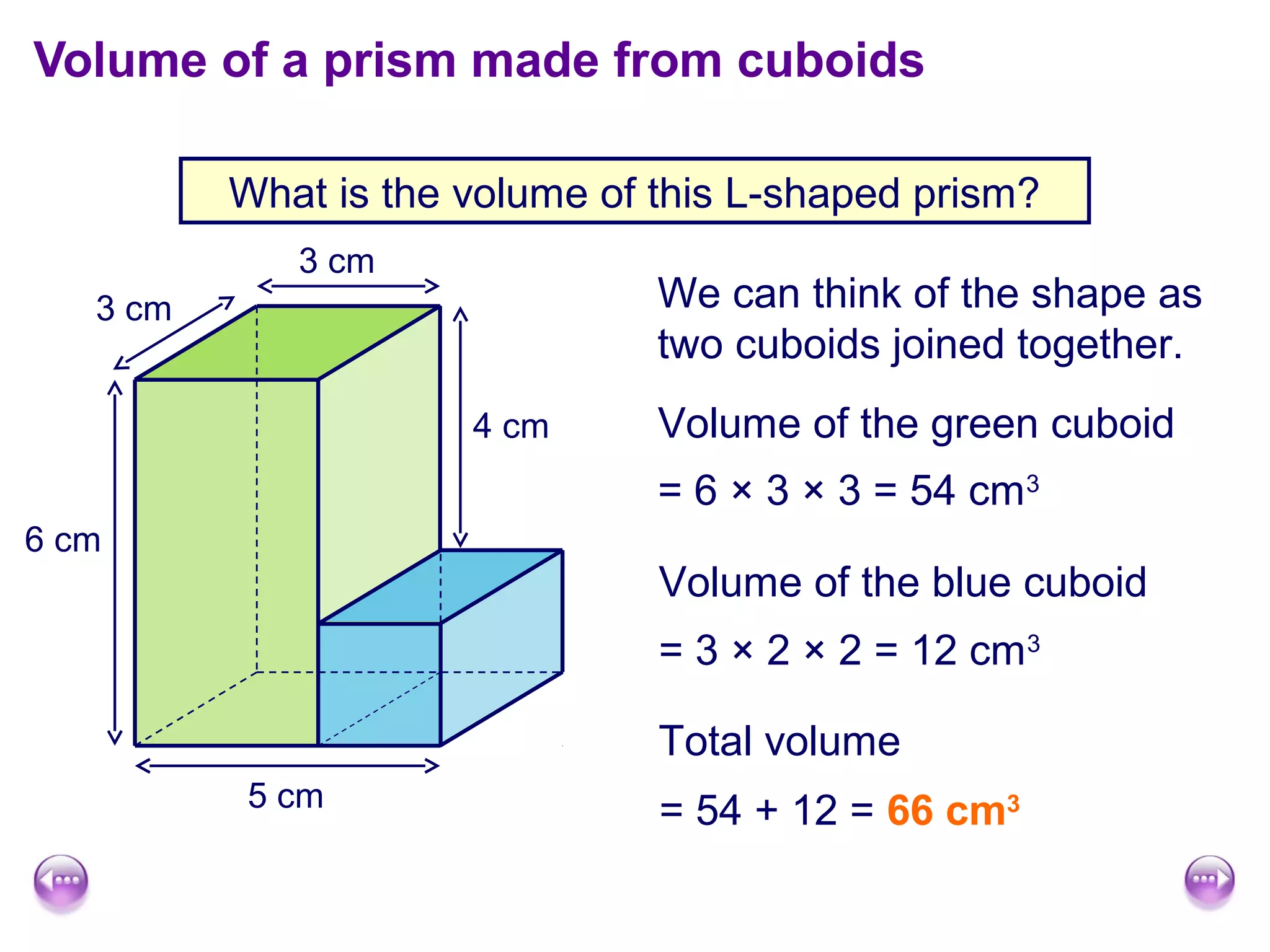
What is the volume of this L-shaped prism?
Volume of a prism made from cuboids
6 cm
5 cm
3 cm
4 cm
3 cm
We can think of the shape as
two cuboids joined together.
Volume of the green cuboid
= 6 × 3 × 3 = 54 cm3
Volume of the blue cuboid
= 3 × 2 × 2 = 12 cm3
Total volume
= 54 + 12 = 66 cm3
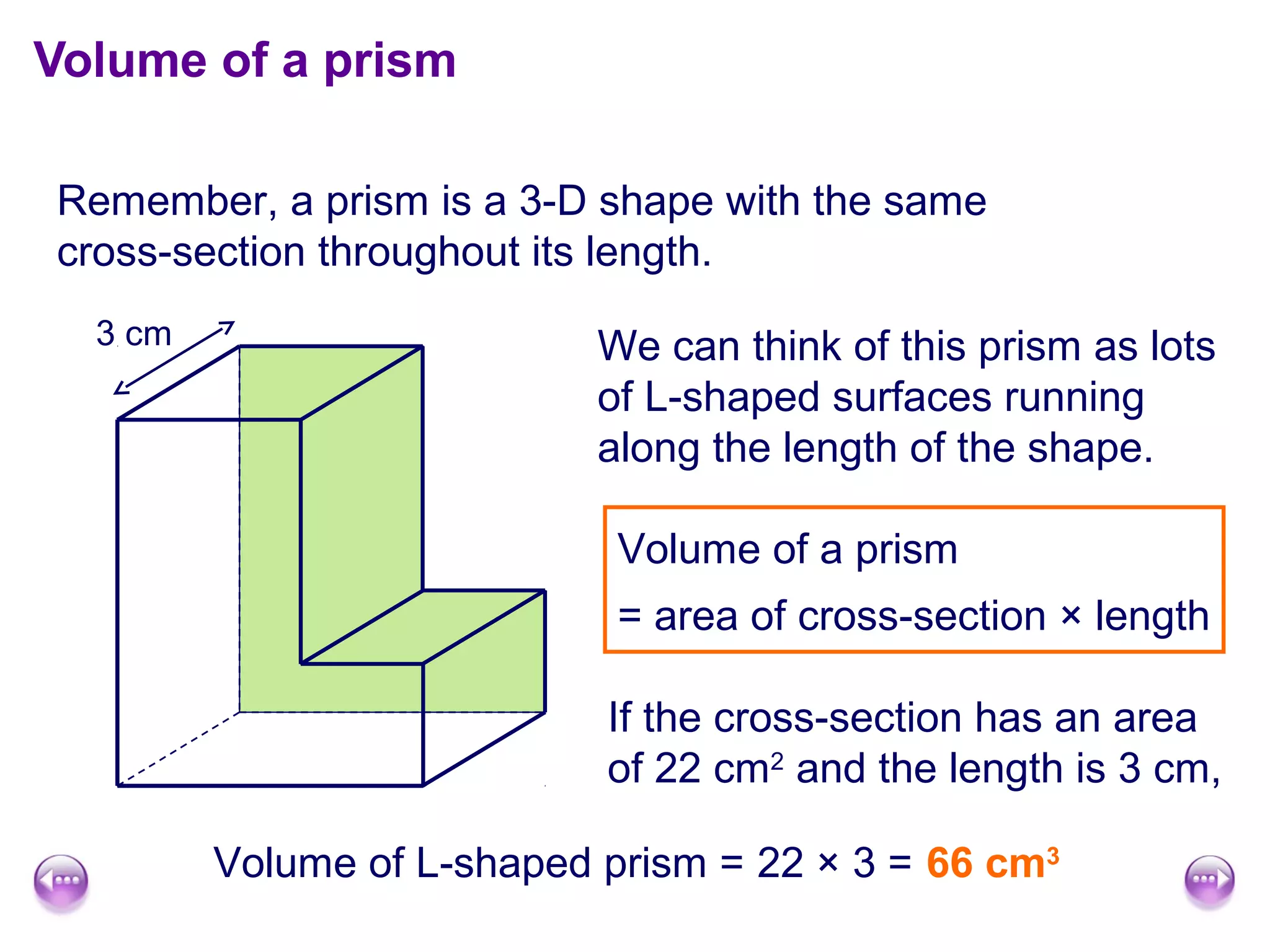
Remember, a prism is a 3-D shape with the same
cross-section throughout its length.
Volume of a prism
We can think of this prism as lots
of L-shaped surfaces running
along the length of the shape.
Volume of a prism
= area of cross-section × length
If the cross-section has an area
of 22 cm2
and the length is 3 cm,
Volume of L-shaped prism = 22 × 3 = 66 cm3
3 cm
Volume of a prism
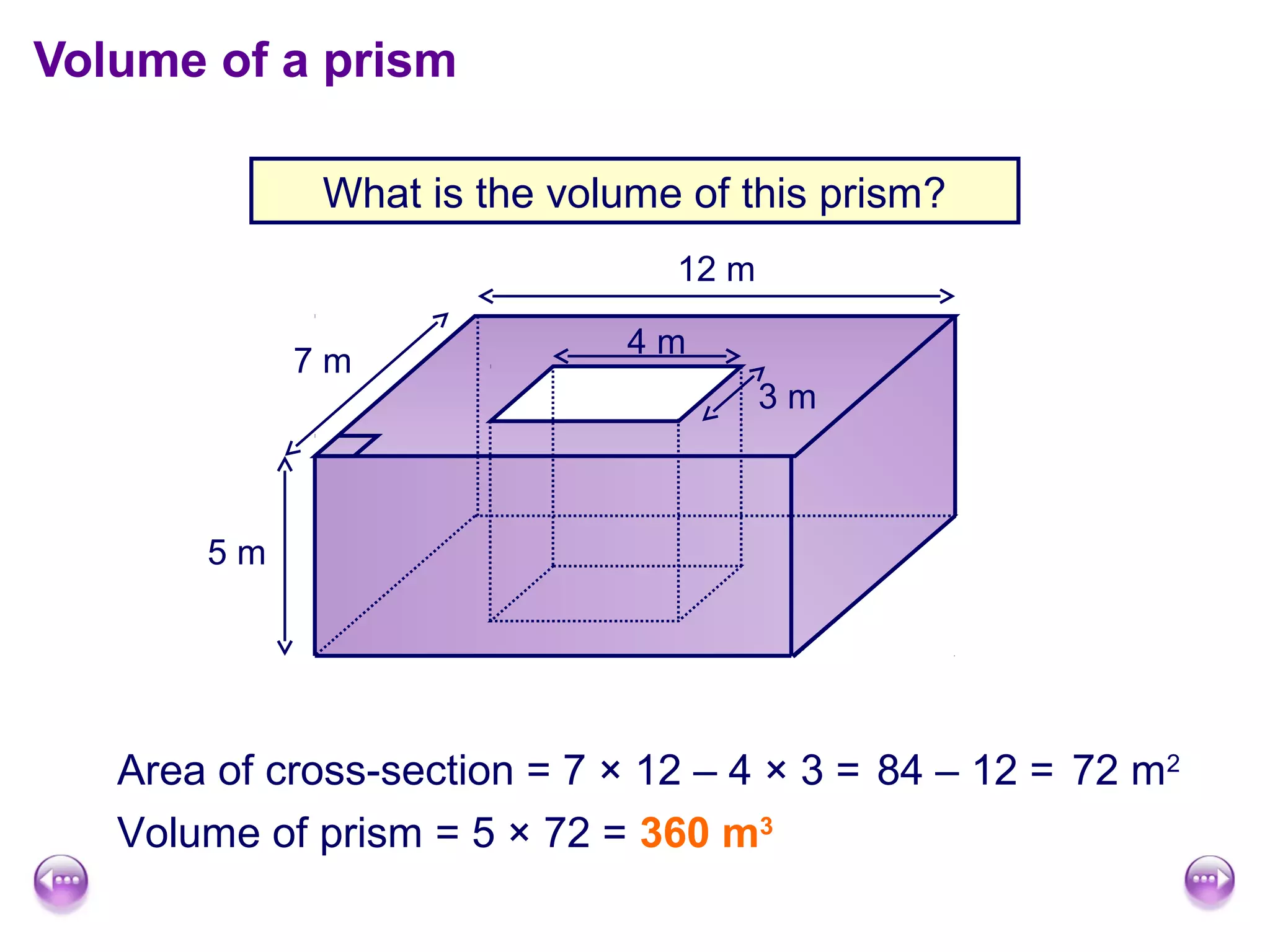
Area of cross-section = 7 × 12 – 4 × 3 = 84 – 12 =
Volume of prism = 5 × 72 = 360 m3
3 m
4 m
12 m
7 m
5 m
72 m2
What is the volume of this prism?

Surface area and volume of cuboids

  • 1.
  • 2.
    To find thesurface area of a shape, we calculate the total area of all of the faces. A cuboid has 6 faces. The top and the bottom of the cuboid have the same area. Surface area of a cuboid
  • 3.
    To find thesurface area of a shape, we calculate the total area of all of the faces. A cuboid has 6 faces. The front and the back of the cuboid have the same area. Surface area of a cuboid
  • 4.
    To find thesurface area of a shape, we calculate the total area of all of the faces. A cuboid has 6 faces. The left hand side and the right hand side of the cuboid have the same area. Surface area of a cuboid
  • 5.
    To find thesurface area of a shape, we calculate the total area of all of the faces. Can you work out the surface area of this cuboid? Surface area of a cuboid 7 cm 8 cm 5 cm The area of the top = 8 × 5 = 40 cm2 The area of the front = 7 × 5 = 35 cm2 The area of the side = 7 × 8 = 56 cm2
  • 6.
    To find thesurface area of a shape, we calculate the total area of all of the faces. So the total surface area = Surface area of a cuboid 7 cm 8 cm 5 cm 2 × 40 cm2 + 2 × 35 cm2 + 2 × 56 cm2 Top and bottom Front and back Left and right side = 80 + 70 + 112 = 262 cm2
  • 7.
    We can findthe formula for the surface area of a cuboid as follows. Surface area of a cuboid = Formula for the surface area of a cuboid h l w 2 × lw Top and bottom + 2 × hw Front and back + 2 × lh Left and right side = 2lw + 2hw + 2lh
  • 8.
    How can wefind the surface area of a cube of length x? Surface area of a cube x All six faces of a cube have the same area. The area of each face is x × x = x2 Therefore, Surface area of a cube = 6x2
  • 9.
    This cuboid ismade from alternate purple and green centimetre cubes. Chequered cuboid problem What is its surface area? Surface area = 2 × 3 × 4 + 2 × 3 × 5 + 2 × 4 × 5 = 24 + 30 + 40 = 94 cm2 How much of the surface area is green? 48 cm2
  • 10.
    What is thesurface area of this L-shaped prism? Surface area of a prism 6 cm 5 cm 3 cm 4 cm 3 cm To find the surface area of this shape we need to add together the area of the two L-shapes and the area of the 6 rectangles that make up the surface of the shape. Total surface area = 2 × 22 + 18 + 9 + 12 + 6 + 6 + 15 = 110 cm2
  • 11.
    5 cm 6 cm 3cm 6 cm 3 cm3 cm 3 cm It can be helpful to use the net of a 3-D shape to calculate its surface area. Using nets to find surface area Here is the net of a 3 cm by 5 cm by 6 cm cuboid Write down the area of each face. 15 cm2 15 cm2 18 cm2 30 cm2 30 cm2 18 cm2 Then add the areas together to find the surface area. Surface Area = 126 cm2
  • 12.
    The following cuboidis made out of interlocking cubes. Making cuboids How many cubes does it contain?
  • 13.
    We can workthis out by dividing the cuboid into layers. Making cuboids The number of cubes in each layer can be found by multiplying the number of cubes along the length by the number of cubes along the width. 3 × 4 = 12 cubes in each layer There are three layers altogether so the total number of cubes in the cuboid = 3 × 12 = 36 cubes
  • 14.
    The amount ofspace that a three-dimensional object takes up is called its volume. Making cuboids For example, we can use mm3 , cm3 , m3 or km3 . The 3 tells us that there are three dimensions, length, width and height. Volume is measured in cubic units. Liquid volume or capacity is measured in ml, l, pints or gallons.
  • 15.
    Volume of acuboid We can find the volume of a cuboid by multiplying the area of the base by the height. Volume of a cuboid = length × width × height = lwh height, h length, l width, w The area of the base = length × width So,
  • 16.
    Volume of acuboid What is the volume of this cuboid? Volume of cuboid = length × width × height = 5 × 8 × 13 = 520 cm3 5 cm 8 cm 13 cm
  • 17.
  • 18.
    Volume and displacement Bydropping cubes and cuboids into a measuring cylinder half filled with water we can see the connection between the volume of the shape and the volume of the water displaced. 1 ml of water has a volume of 1 cm3 For example, if an object is dropped into a measuring cylinder and displaces 5 ml of water then the volume of the object is 5 cm3 . What is the volume of 1 litre of water? 1 litre of water has a volume of 1000 cm3 .
  • 19.
    What is thevolume of this L-shaped prism? Volume of a prism made from cuboids 6 cm 5 cm 3 cm 4 cm 3 cm We can think of the shape as two cuboids joined together. Volume of the green cuboid = 6 × 3 × 3 = 54 cm3 Volume of the blue cuboid = 3 × 2 × 2 = 12 cm3 Total volume = 54 + 12 = 66 cm3
  • 20.
    Remember, a prismis a 3-D shape with the same cross-section throughout its length. Volume of a prism We can think of this prism as lots of L-shaped surfaces running along the length of the shape. Volume of a prism = area of cross-section × length If the cross-section has an area of 22 cm2 and the length is 3 cm, Volume of L-shaped prism = 22 × 3 = 66 cm3 3 cm
  • 21.
    Volume of aprism Area of cross-section = 7 × 12 – 4 × 3 = 84 – 12 = Volume of prism = 5 × 72 = 360 m3 3 m 4 m 12 m 7 m 5 m 72 m2 What is the volume of this prism?

Editor's Notes

  • #2 The aim of this unit is to teach pupils to: Identify and use the geometric properties of triangles, quadrilaterals and other polygons to solve problems; explain and justify inferences and deductions using mathematical reasoning Understand congruence and similarity Identify and use the properties of circles Material in this unit is linked to the Key Stage 3 Framework supplement of examples pp 184-197.
  • #3 Discuss the meaning of surface area. The important thing to remember is that although surface area is found for three-dimensional shapes, surface area only has two dimensions. It is therefore measured in square units.
  • #7 Stress the importance to work systematically when finding the surface area to ensure that no faces have been left out. We can also work out the surface area of a cuboid by drawing its net (see slide 51). This may be easier for some pupils because they would be able to see every face rather than visualizing it.
  • #8 Pupils should write this formula down.
  • #9 As pupils to use this formula to find the surface area of a cube of side length 5 cm. 6 × 52 = 6 × 25 = 150 cm2. Repeat for other numbers. As a more challenging question tell pupils that a cube has a surface area of 96 cm2. Ask them how we could work out its side length using inverse operations.
  • #10 Discuss how to work out the surface area that is green. Ask pupils how we could write the proportion of the surface area that is green as a fraction, as a decimal and as a percentage.
  • #11 Discuss ways to find the surface area of this solid. We could use a net of this prism to help find the area of each face.
  • #12 Links: S3 3-D shapes – nets S6 Construction and Loci – constructing nets
  • #15 Link: S7 Measures – units of volume and capacity
  • #18 Ask pupils how we could use water in a measuring cylinder to find the volume of an object. Tell pupils that 1 cm3 of water will displace 1 ml of water in the beaker. Demonstrate this by dropping each cuboid into the beaker, and recording how the level of the water changes. Use this slide to demonstrate how volume is linked to capacity. Links: S7 Measures – units of volume and capacity S7 Measures – reading scales
  • #19 Ask pupils to give the dimensions of a cube that would hold 1 litre of water. This would be a 10 cm by 10 cm by 10 cm cube. Ask pupils how many litres of water we could fit into a metre cube. (1000 litres). A litre of water has a weight of 1 kg. A metre cube would therefore hold 1 tonne of water! Link: S7 Measures – units of volume and capacity
  • #20 Compare this with slide 50, which finds the surface area of the same shape.