AREA OF QUADRILATERALS AND
POLYGONS
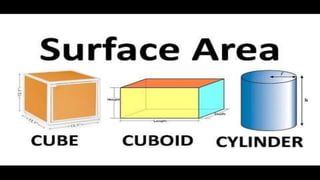
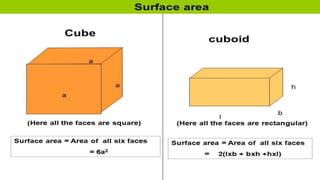
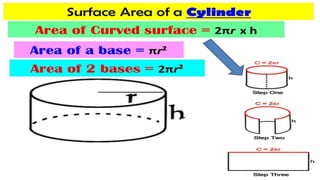
SURFACE AREA OF SOLIDS
VOLUME OF SOLIDS
WHAT WE WILL LEARN ?
 THE AMOUNT OF SPACE INSIDE THE BOUNDARY OF TWO
DIMENSIONAL SHAPE
THE DISTANCE AROUND THE OUTSIDE OF TWO DIMENSIONAL SHAPE
 `
FOR
PERIMETER
ADD UP
LENGTH
OF ALL SIDS
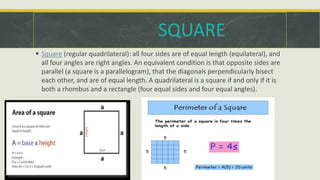
 Square (regular quadrilateral): all four sides are of equal length (equilateral), and
all four angles are right angles. An equivalent condition is that opposite sides are
parallel (a square is a parallelogram), that the diagonals perpendicularly bisect
each other, and are of equal length. A quadrilateral is a square if and only if it is
both a rhombus and a rectangle (four equal sides and four equal angles).
SQUARE
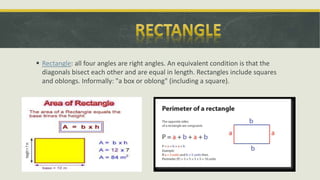
 Rectangle: all four angles are right angles. An equivalent condition is that the
diagonals bisect each other and are equal in length. Rectangles include squares
and oblongs. Informally: "a box or oblong" (including a square).
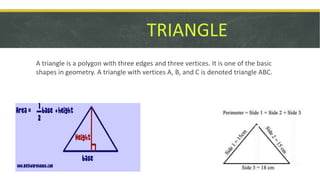
TRIANGLE
A triangle is a polygon with three edges and three vertices. It is one of the basic
shapes in geometry. A triangle with vertices A, B, and C is denoted triangle ABC.
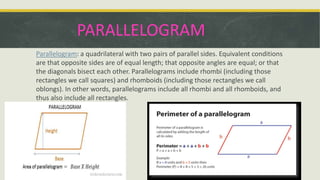
PARALLELOGRAM
Parallelogram: a quadrilateral with two pairs of parallel sides. Equivalent conditions
are that opposite sides are of equal length; that opposite angles are equal; or that
the diagonals bisect each other. Parallelograms include rhombi (including those
rectangles we call squares) and rhomboids (including those rectangles we call
oblongs). In other words, parallelograms include all rhombi and all rhomboids, and
thus also include all rectangles.
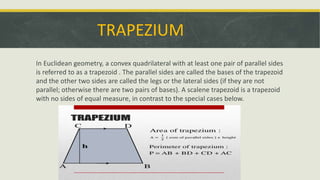
TRAPEZIUM
In Euclidean geometry, a convex quadrilateral with at least one pair of parallel sides
is referred to as a trapezoid . The parallel sides are called the bases of the trapezoid
and the other two sides are called the legs or the lateral sides (if they are not
parallel; otherwise there are two pairs of bases). A scalene trapezoid is a trapezoid
with no sides of equal measure, in contrast to the special cases below.
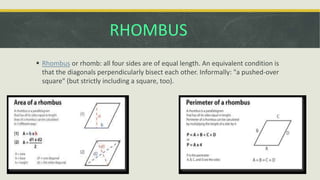
RHOMBUS
 Rhombus or rhomb: all four sides are of equal length. An equivalent condition is
that the diagonals perpendicularly bisect each other. Informally: "a pushed-over
square" (but strictly including a square, too).
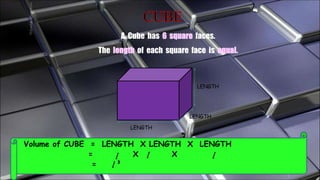
Volume of CUBE = LENGTH X LENGTH X LENGTH
= X X
= ³
LENGTH
LENGTH
LENGTH
A Cube has 6 square faces.
The length of each square face is equal.
l
lll
CUBOID
A cuboid also has 6 faces but NOT all the
faces are equal
Length
Breadth
Height
Volume of CUBOID = LENGTH X BREADTH X HEIGHT
= X Xl b h
Mensuration PPT CLASS 8 NCERT

Mensuration PPT CLASS 8 NCERT

  • 3.
    AREA OF QUADRILATERALSAND POLYGONS SURFACE AREA OF SOLIDS VOLUME OF SOLIDS WHAT WE WILL LEARN ?
  • 4.
     THE AMOUNTOF SPACE INSIDE THE BOUNDARY OF TWO DIMENSIONAL SHAPE THE DISTANCE AROUND THE OUTSIDE OF TWO DIMENSIONAL SHAPE  ` FOR PERIMETER ADD UP LENGTH OF ALL SIDS
  • 5.
     Square (regularquadrilateral): all four sides are of equal length (equilateral), and all four angles are right angles. An equivalent condition is that opposite sides are parallel (a square is a parallelogram), that the diagonals perpendicularly bisect each other, and are of equal length. A quadrilateral is a square if and only if it is both a rhombus and a rectangle (four equal sides and four equal angles). SQUARE
  • 6.
     Rectangle: allfour angles are right angles. An equivalent condition is that the diagonals bisect each other and are equal in length. Rectangles include squares and oblongs. Informally: "a box or oblong" (including a square).
  • 7.
    TRIANGLE A triangle isa polygon with three edges and three vertices. It is one of the basic shapes in geometry. A triangle with vertices A, B, and C is denoted triangle ABC.
  • 8.
    PARALLELOGRAM Parallelogram: a quadrilateralwith two pairs of parallel sides. Equivalent conditions are that opposite sides are of equal length; that opposite angles are equal; or that the diagonals bisect each other. Parallelograms include rhombi (including those rectangles we call squares) and rhomboids (including those rectangles we call oblongs). In other words, parallelograms include all rhombi and all rhomboids, and thus also include all rectangles.
  • 9.
    TRAPEZIUM In Euclidean geometry,a convex quadrilateral with at least one pair of parallel sides is referred to as a trapezoid . The parallel sides are called the bases of the trapezoid and the other two sides are called the legs or the lateral sides (if they are not parallel; otherwise there are two pairs of bases). A scalene trapezoid is a trapezoid with no sides of equal measure, in contrast to the special cases below.
  • 10.
    RHOMBUS  Rhombus orrhomb: all four sides are of equal length. An equivalent condition is that the diagonals perpendicularly bisect each other. Informally: "a pushed-over square" (but strictly including a square, too).
  • 15.
    Volume of CUBE= LENGTH X LENGTH X LENGTH = X X = ³ LENGTH LENGTH LENGTH A Cube has 6 square faces. The length of each square face is equal. l lll
  • 16.
    CUBOID A cuboid alsohas 6 faces but NOT all the faces are equal Length Breadth Height Volume of CUBOID = LENGTH X BREADTH X HEIGHT = X Xl b h