Mrs. Brenda Rodriguez
5th and 6th Grade Math
Menu
• Objectives
• Instructions
• Theme: “Perimeter and Area”
• Activities
• Glossary
Objective
• Finding the perimeter and area of a
rectangle and square using formulas.
Instructions
• Find the perimeter of rectangles and squares with
the given dimensions.
• Find the area of rectangles and squares with the
given dimensions.
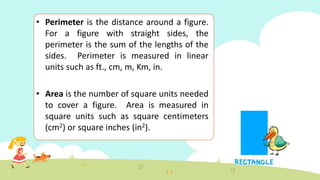
• Perimeter is the distance around a figure.
For a figure with straight sides, the
perimeter is the sum of the lengths of the
sides. Perimeter is measured in linear
units such as ft., cm, m, Km, in.
• Area is the number of square units needed
to cover a figure. Area is measured in
square units such as square centimeters
(cm2) or square inches (in2).
Perimeter Formulas
• The perimeter of some polygons can be given
as a formula.
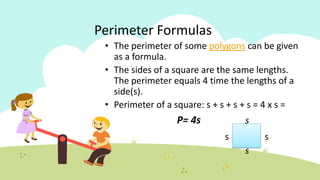
• The sides of a square are the same lengths.
The perimeter equals 4 time the lengths of a
side(s).
• Perimeter of a square: s + s + s + s = 4 x s =
P= 4s s
s s
s
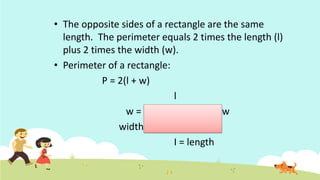
• The opposite sides of a rectangle are the same
length. The perimeter equals 2 times the length (l)
plus 2 times the width (w).
• Perimeter of a rectangle:
P = 2(l + w)
l
w = w
width
I = length
Perimeter Activity
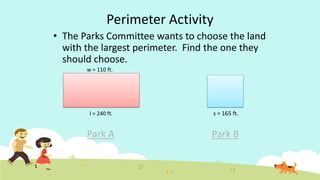
• The Parks Committee wants to choose the land
with the largest perimeter. Find the one they
should choose.
w = 110 ft.
l = 240 ft. s = 165 ft.
Park A Park B
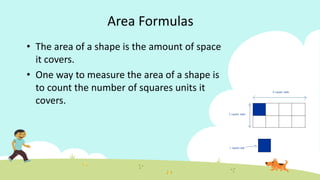
• The area of a shape is the amount of space
it covers.
• One way to measure the area of a shape is
to count the number of squares units it
covers.
Area Formulas
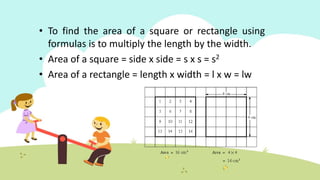
• To find the area of a square or rectangle using
formulas is to multiply the length by the width.
• Area of a square = side x side = s x s = s2
• Area of a rectangle = length x width = l x w = lw
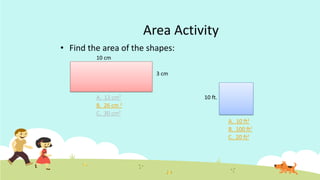
Area Activity
• Find the area of the shapes:
10 cm
3 cm
A. 13 cm2 10 ft.
B. 26 cm 2
C. 30 cm2
A. 10 ft2
B. 100 ft2
C. 20 ft2
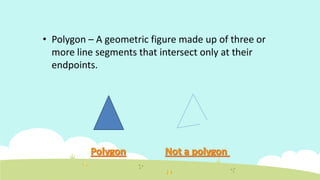
• Polygon – A geometric figure made up of three or
more line segments that intersect only at their
endpoints.
Answer
Answer
Answer
Answer

Perimeter & area presentation

  • 1.
    Mrs. Brenda Rodriguez 5thand 6th Grade Math
  • 2.
    Menu • Objectives • Instructions •Theme: “Perimeter and Area” • Activities • Glossary
  • 3.
    Objective • Finding theperimeter and area of a rectangle and square using formulas.
  • 4.
    Instructions • Find theperimeter of rectangles and squares with the given dimensions. • Find the area of rectangles and squares with the given dimensions.
  • 5.
    • Perimeter isthe distance around a figure. For a figure with straight sides, the perimeter is the sum of the lengths of the sides. Perimeter is measured in linear units such as ft., cm, m, Km, in. • Area is the number of square units needed to cover a figure. Area is measured in square units such as square centimeters (cm2) or square inches (in2).
  • 6.
    Perimeter Formulas • Theperimeter of some polygons can be given as a formula. • The sides of a square are the same lengths. The perimeter equals 4 time the lengths of a side(s). • Perimeter of a square: s + s + s + s = 4 x s = P= 4s s s s s
  • 7.
    • The oppositesides of a rectangle are the same length. The perimeter equals 2 times the length (l) plus 2 times the width (w). • Perimeter of a rectangle: P = 2(l + w) l w = w width I = length
  • 8.
    Perimeter Activity • TheParks Committee wants to choose the land with the largest perimeter. Find the one they should choose. w = 110 ft. l = 240 ft. s = 165 ft. Park A Park B
  • 9.
    • The areaof a shape is the amount of space it covers. • One way to measure the area of a shape is to count the number of squares units it covers. Area Formulas
  • 10.
    • To findthe area of a square or rectangle using formulas is to multiply the length by the width. • Area of a square = side x side = s x s = s2 • Area of a rectangle = length x width = l x w = lw
  • 11.
    Area Activity • Findthe area of the shapes: 10 cm 3 cm A. 13 cm2 10 ft. B. 26 cm 2 C. 30 cm2 A. 10 ft2 B. 100 ft2 C. 20 ft2
  • 12.
    • Polygon –A geometric figure made up of three or more line segments that intersect only at their endpoints.
  • 13.
  • 14.
  • 15.
  • 16.