Central Sterile
Services in a Hospital
Dr. Syed Amin Tabish
FRCP, FACP, FAMS, MD (AIIMS)
Postdoc Fellowship, Bristol University (England)
Doctorate in Educational Leadership (USA)
 The Central Sterile Supply
Department is responsible
for preparing medical/
surgical supplies and
equipment so that they are
sterile and ready for use in
patient care
 The Sterile Processing
Department (Central Supply, or
Sterile Supply as it is also
known), comprises that service
within the hospital in which
medical/surgical supplies and
equipment, both sterile and
nonsterile, are cleaned,
prepared, processed, stored,
and issued for patient care
The work of scientists W.B. Underwood
and J.J. Perkins was instrumental in
encouraging health care facilities to
establish a separate and distinct
department, the Sterile Processing
Department, with specialized expertise
and direct responsibility for providing
clean and sterile medical/surgical
supplies and equipment to patient care
areas.
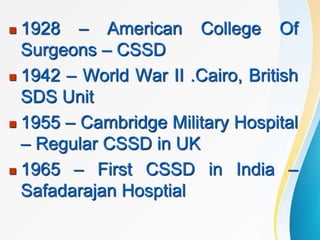
 1928 – American College Of
Surgeons – CSSD
 1942 – World War II .Cairo, British
SDS Unit
 1955 – Cambridge Military Hospital
– Regular CSSD in UK
 1965 – First CSSD in India –
Safadarajan Hosptial
CSSD
• Sterile Processing Departments are
typically divided into four major areas to
accomplish the functions of
decontamination, assembly and sterile
processing, sterile storage, and
distribution.
• In the decontamination area, reusable
equipment, instruments, and supplies are
cleaned and decontaminated by means of
manual or mechanical cleaning processes
and chemical disinfection.
CSSD (contd)
• Clean items are received in the assembly and
packaging area from the decontamination area
and are then assembled and prepared for
issue, storage, or further processing (like
sterilization).
• After assembly or sterilization, items are
transferred to the sterile storage area until its
time for them to be issued.
• Several major functions are carried out in the
distribution area: case cart preparation and
delivery; exchange cart inventory,
replenishment and delivery
Steps in the Decontamination Process
• Transport
• Attire
• Sorting
• Soaking
• Washing [Detergent, Equipment, Ultrasonic, Inspection]
Types of Packaging
• Textiles
• Nonwovens
• Pouch packaging
• Rigid container systems
Sterilisation Process
• Bacterial spores are the most resistant of
all living organisms because of their
capacity to withstand external destructive
agents. Although the physical or chemical
process by which all pathogenic and
nonpathogenic microorganisms, including
spores, are destroyed is not absolute,
supplies and equipment are considered
sterile when necessary conditions have
been met during a sterilization process.
Objective
 To provide sterilized material
from a central department where
sterilizing process is carried out
under properly controlled
conditions
To alleviate the burden of work of
the nursing personnel, there by
enabling them to devote more of
their time to patient care .
Advantages
1. Bacteriological safe sterilization.
2. Less expensive.
3. Elimination of unsound practices &
establishment of standard procedures.
4. Assurance of adequate supply of sterile
products immediately and constantly available
for sometime as well as emergency use
5. Conservation of trained staff.
6. Better quality control
7. Better good of material flow
8. Prolonged life by proper care of equipment
Items Commonly handled by CSSD:
1. Syringes
2. Procedure Sets
Lumbar puncture ; sternal puncture ; venesection ;
paracentesis ; aspiration ; catheterization ;
tracheotomy ; suturing ; dressing ; biopsy ; incision &
drainage ; aortography ; cardiac resuscitation ; etc
3. Needles
4. Gloves
5. I.V.Fluids.
6. Treatment Trays.
7. O.T Instruments.
8. O.T. Linen
9. Infusion Fluids for Renal Dialysis
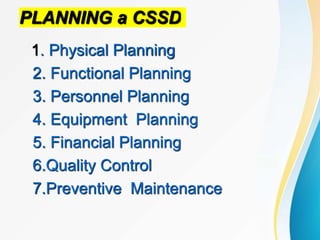
PLANNING a CSSD
1. Physical Planning
2. Functional Planning
3. Personnel Planning
4. Equipment Planning
5. Financial Planning
6.Quality Control
7.Preventive Maintenance
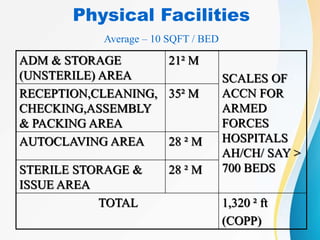
ADM & STORAGE
(UNSTERILE) AREA
21² M
SCALES OF
ACCN FOR
ARMED
FORCES
HOSPITALS
AH/CH/ SAY >
700 BEDS
RECEPTION,CLEANING,
CHECKING,ASSEMBLY
& PACKING AREA
35² M
AUTOCLAVING AREA 28 ² M
STERILE STORAGE &
ISSUE AREA
28 ² M
TOTAL 1,320 ² ft
(COPP)
Physical Facilities
Average – 10 SQFT / BED
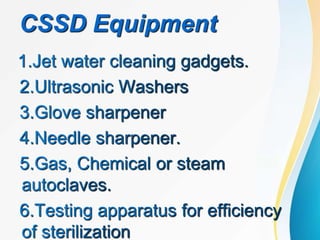
CSSD Equipment
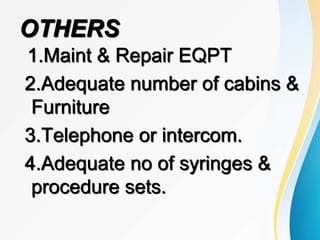
OTHERS
1.Maint & Repair EQPT
2.Adequate number of cabins &
Furniture
3.Telephone or intercom.
4.Adequate no of syringes &
procedure sets.
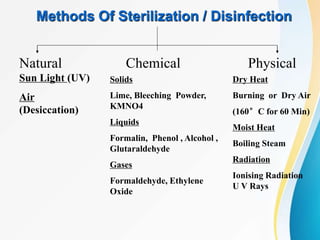
Methods Of Sterilization / Disinfection
Natural Chemical Physical
Sun Light (UV)
Air
(Desiccation)
Solids
Lime, Bleeching Powder,
KMNO4
Liquids
Formalin, Phenol , Alcohol ,
Glutaraldehyde
Gases
Formaldehyde, Ethylene
Oxide
Dry Heat
Burning or Dry Air
(160°C for 60 Min)
Moist Heat
Boiling Steam
Radiation
Ionising Radiation
U V Rays
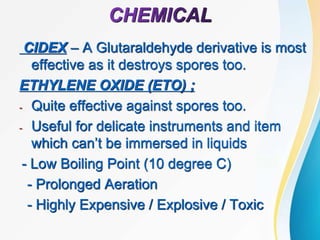
CIDEX – A Glutaraldehyde derivative is most
effective as it destroys spores too.
ETHYLENE OXIDE (ETO) ;
- Quite effective against spores too.
- Useful for delicate instruments and item
which can’t be immersed in liquids
- Low Boiling Point (10 degree C)
- Prolonged Aeration
- Highly Expensive / Explosive / Toxic
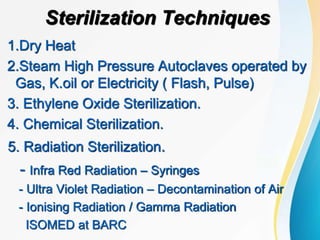
Sterilization Techniques
1.Dry Heat
2.Steam High Pressure Autoclaves operated by
Gas, K.oil or Electricity ( Flash, Pulse)
3. Ethylene Oxide Sterilization.
4. Chemical Sterilization.
5. Radiation Sterilization.
- Infra Red Radiation – Syringes
- Ultra Violet Radiation – Decontamination of Air
- Ionising Radiation / Gamma Radiation
ISOMED at BARC
STERILISATION
It is a process of freeing an article
from all living organisms including
bacteria ,fungal spores and viruses.
A material is pronounced sterile if it
achieves 99.99% kill of bacterial
spores.
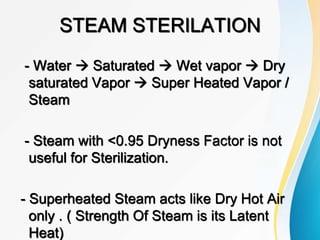
STEAM STERILATION
- Water  Saturated  Wet vapor  Dry
saturated Vapor  Super Heated Vapor /
Steam
- Steam with <0.95 Dryness Factor is not
useful for Sterilization.
- Superheated Steam acts like Dry Hot Air
only . ( Strength Of Steam is its Latent
Heat)
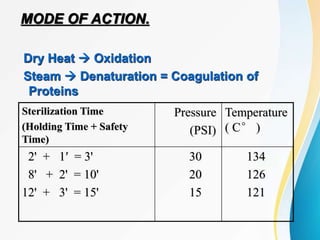
MODE OF ACTION.
Dry Heat  Oxidation
Steam  Denaturation = Coagulation of
Proteins
Sterilization Time
(Holding Time + Safety
Time)
Pressure
(PSI)
Temperature
( C° )
2' + 1′ = 3'
8' + 2' = 10'
12' + 3' = 15'
30
20
15
134
126
121
TYPES OF AUTO CLAVING MACHINES
1. Downward Displacement
2. Vacuum Assisted.
3. Pulsed Steam Dilution
TESTS FOR EFFICENCY OF STERILISATION
1. Specially treated paper strip.
2. Pressure sensitive tape to be fixed to the
final fold
3. Brown indicator tubes - (very expensive)
4. Biological. Green strip containing bacteria
(Color must change to black)
5. Cellophane wrapped tablet
containing
- Lactose - 75%
- Starch - 24%
- Magnesium Trisilicate – 1% (Tablet
turns brown during autoclaving)
6. Microbiological examination of finished
products.
7. Thermo - couples .
ADVANTAGES OF STEAM STERILISATION
1. Rapid heating & penetration of
loads
2. Destruction of all forms of
microbial life
3. No residual toxicity
4. No damage to supplies being
sterilised
5. Easy Quality Control
6. Economical & Reliable
This method is unsuitable for heat sensitive and
non- permeable material
RADIATION STERILISATION ;
‘ ISO MED ‘ at ‘BARC’ Trombay; dose -
2.5 Mega Rhontgen; Source – Cobalt-
60 /Caesium – 137/ Electron Beam
(generated by linear accelerator)
Reliable, can penetrate all types of
packing. Large & diverse shaped
articles can be sterilised. No residual
radio activity at 2.5 mega rhontgens.
Glass becomes dark, cotton looses
tensile property, food gets undesirable
flavor. Not practicable in hospitals
DISTRIBUTION SYSTEMS :
1. Regular issue of one day’s
requirement.
2. Clean for dirty exchange.
3. Milk round system (topping up
predetermined stock level)
4. As on required basis. (Grocery
system)
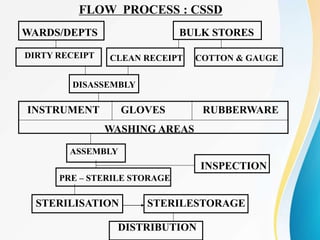
FLOW PROCESS : CSSD
WARDS/DEPTS BULK STORES
DIRTY RECEIPT CLEAN RECEIPT COTTON & GAUGE
DISASSEMBLY
INSTRUMENT GLOVES RUBBERWARE
WASHING AREAS
ASSEMBLY
PRE – STERILE STORAGE
INSPECTION
STERILISATION STERILESTORAGE
DISTRIBUTION
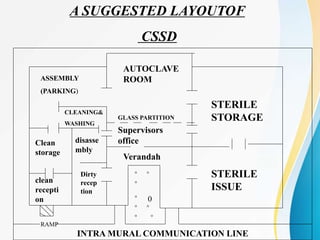
A SUGGESTED LAYOUTOF
CSSD
INTRA MURAL COMMUNICATION LINE
RAMP
ASSEMBLY
(PARKING)
CLEANING&
WASHING
AUTOCLAVE
ROOM
GLASS PARTITION
STERILE
STORAGE
STERILE
ISSUE
clean
recepti
on
Clean
storage
Supervisors
office
Verandah
disasse
mbly
Dirty
recep
tion
° °
°
° 0
° °
° °
Thermal Death Time (TDT)
 TDT is the time required to kill a known
population of microorganisms in a
specific suspension at a particular
temperature
 Increasing temperature decreases TDT
 Lowering the temperature increases
TDT
 Acidic or basic pHs decrease TDT
 Fats and oils slow penetration and
increase TDT
Administrative Monitoring
• Decontaminating, terminally sterilizing, and cleaning
all reusable items; disposing of disposable items.
• Packaging and labeling of items.
• Loading and unloading the sterilizer.
• Operating the sterilizer.
• Monitoring and maintaining records of each cycle.
• Adhering to safety precautions and preventive
maintenance protocol.
• Storing of sterile items.
• Handling sterile items ready for use.
• Making sterile transfer to a sterile field.

CSSD.ppt

  • 1.
    Central Sterile Services ina Hospital Dr. Syed Amin Tabish FRCP, FACP, FAMS, MD (AIIMS) Postdoc Fellowship, Bristol University (England) Doctorate in Educational Leadership (USA)
  • 2.
     The CentralSterile Supply Department is responsible for preparing medical/ surgical supplies and equipment so that they are sterile and ready for use in patient care
  • 3.
     The SterileProcessing Department (Central Supply, or Sterile Supply as it is also known), comprises that service within the hospital in which medical/surgical supplies and equipment, both sterile and nonsterile, are cleaned, prepared, processed, stored, and issued for patient care
  • 4.
    The work ofscientists W.B. Underwood and J.J. Perkins was instrumental in encouraging health care facilities to establish a separate and distinct department, the Sterile Processing Department, with specialized expertise and direct responsibility for providing clean and sterile medical/surgical supplies and equipment to patient care areas.
  • 5.
     1928 –American College Of Surgeons – CSSD  1942 – World War II .Cairo, British SDS Unit  1955 – Cambridge Military Hospital – Regular CSSD in UK  1965 – First CSSD in India – Safadarajan Hosptial
  • 6.
    CSSD • Sterile ProcessingDepartments are typically divided into four major areas to accomplish the functions of decontamination, assembly and sterile processing, sterile storage, and distribution. • In the decontamination area, reusable equipment, instruments, and supplies are cleaned and decontaminated by means of manual or mechanical cleaning processes and chemical disinfection.
  • 7.
    CSSD (contd) • Cleanitems are received in the assembly and packaging area from the decontamination area and are then assembled and prepared for issue, storage, or further processing (like sterilization). • After assembly or sterilization, items are transferred to the sterile storage area until its time for them to be issued. • Several major functions are carried out in the distribution area: case cart preparation and delivery; exchange cart inventory, replenishment and delivery
  • 8.
    Steps in theDecontamination Process • Transport • Attire • Sorting • Soaking • Washing [Detergent, Equipment, Ultrasonic, Inspection] Types of Packaging • Textiles • Nonwovens • Pouch packaging • Rigid container systems
  • 9.
    Sterilisation Process • Bacterialspores are the most resistant of all living organisms because of their capacity to withstand external destructive agents. Although the physical or chemical process by which all pathogenic and nonpathogenic microorganisms, including spores, are destroyed is not absolute, supplies and equipment are considered sterile when necessary conditions have been met during a sterilization process.
  • 10.
    Objective  To providesterilized material from a central department where sterilizing process is carried out under properly controlled conditions To alleviate the burden of work of the nursing personnel, there by enabling them to devote more of their time to patient care .
  • 11.
    Advantages 1. Bacteriological safesterilization. 2. Less expensive. 3. Elimination of unsound practices & establishment of standard procedures. 4. Assurance of adequate supply of sterile products immediately and constantly available for sometime as well as emergency use 5. Conservation of trained staff. 6. Better quality control 7. Better good of material flow 8. Prolonged life by proper care of equipment
  • 12.
    Items Commonly handledby CSSD: 1. Syringes 2. Procedure Sets Lumbar puncture ; sternal puncture ; venesection ; paracentesis ; aspiration ; catheterization ; tracheotomy ; suturing ; dressing ; biopsy ; incision & drainage ; aortography ; cardiac resuscitation ; etc 3. Needles 4. Gloves 5. I.V.Fluids. 6. Treatment Trays. 7. O.T Instruments. 8. O.T. Linen 9. Infusion Fluids for Renal Dialysis
  • 13.
    PLANNING a CSSD 1.Physical Planning 2. Functional Planning 3. Personnel Planning 4. Equipment Planning 5. Financial Planning 6.Quality Control 7.Preventive Maintenance
  • 14.
    ADM & STORAGE (UNSTERILE)AREA 21² M SCALES OF ACCN FOR ARMED FORCES HOSPITALS AH/CH/ SAY > 700 BEDS RECEPTION,CLEANING, CHECKING,ASSEMBLY & PACKING AREA 35² M AUTOCLAVING AREA 28 ² M STERILE STORAGE & ISSUE AREA 28 ² M TOTAL 1,320 ² ft (COPP) Physical Facilities Average – 10 SQFT / BED
  • 15.
  • 16.
    OTHERS 1.Maint & RepairEQPT 2.Adequate number of cabins & Furniture 3.Telephone or intercom. 4.Adequate no of syringes & procedure sets.
  • 17.
    Methods Of Sterilization/ Disinfection Natural Chemical Physical Sun Light (UV) Air (Desiccation) Solids Lime, Bleeching Powder, KMNO4 Liquids Formalin, Phenol , Alcohol , Glutaraldehyde Gases Formaldehyde, Ethylene Oxide Dry Heat Burning or Dry Air (160°C for 60 Min) Moist Heat Boiling Steam Radiation Ionising Radiation U V Rays
  • 18.
    CIDEX – AGlutaraldehyde derivative is most effective as it destroys spores too. ETHYLENE OXIDE (ETO) ; - Quite effective against spores too. - Useful for delicate instruments and item which can’t be immersed in liquids - Low Boiling Point (10 degree C) - Prolonged Aeration - Highly Expensive / Explosive / Toxic
  • 19.
    Sterilization Techniques 1.Dry Heat 2.SteamHigh Pressure Autoclaves operated by Gas, K.oil or Electricity ( Flash, Pulse) 3. Ethylene Oxide Sterilization. 4. Chemical Sterilization. 5. Radiation Sterilization. - Infra Red Radiation – Syringes - Ultra Violet Radiation – Decontamination of Air - Ionising Radiation / Gamma Radiation ISOMED at BARC
  • 20.
    STERILISATION It is aprocess of freeing an article from all living organisms including bacteria ,fungal spores and viruses. A material is pronounced sterile if it achieves 99.99% kill of bacterial spores.
  • 21.
    STEAM STERILATION - Water Saturated  Wet vapor  Dry saturated Vapor  Super Heated Vapor / Steam - Steam with <0.95 Dryness Factor is not useful for Sterilization. - Superheated Steam acts like Dry Hot Air only . ( Strength Of Steam is its Latent Heat)
  • 22.
    MODE OF ACTION. DryHeat  Oxidation Steam  Denaturation = Coagulation of Proteins Sterilization Time (Holding Time + Safety Time) Pressure (PSI) Temperature ( C° ) 2' + 1′ = 3' 8' + 2' = 10' 12' + 3' = 15' 30 20 15 134 126 121
  • 23.
    TYPES OF AUTOCLAVING MACHINES 1. Downward Displacement 2. Vacuum Assisted. 3. Pulsed Steam Dilution
  • 24.
    TESTS FOR EFFICENCYOF STERILISATION 1. Specially treated paper strip. 2. Pressure sensitive tape to be fixed to the final fold 3. Brown indicator tubes - (very expensive) 4. Biological. Green strip containing bacteria (Color must change to black)
  • 25.
    5. Cellophane wrappedtablet containing - Lactose - 75% - Starch - 24% - Magnesium Trisilicate – 1% (Tablet turns brown during autoclaving) 6. Microbiological examination of finished products. 7. Thermo - couples .
  • 26.
    ADVANTAGES OF STEAMSTERILISATION 1. Rapid heating & penetration of loads 2. Destruction of all forms of microbial life 3. No residual toxicity 4. No damage to supplies being sterilised 5. Easy Quality Control 6. Economical & Reliable This method is unsuitable for heat sensitive and non- permeable material
  • 27.
    RADIATION STERILISATION ; ‘ISO MED ‘ at ‘BARC’ Trombay; dose - 2.5 Mega Rhontgen; Source – Cobalt- 60 /Caesium – 137/ Electron Beam (generated by linear accelerator) Reliable, can penetrate all types of packing. Large & diverse shaped articles can be sterilised. No residual radio activity at 2.5 mega rhontgens. Glass becomes dark, cotton looses tensile property, food gets undesirable flavor. Not practicable in hospitals
  • 28.
    DISTRIBUTION SYSTEMS : 1.Regular issue of one day’s requirement. 2. Clean for dirty exchange. 3. Milk round system (topping up predetermined stock level) 4. As on required basis. (Grocery system)
  • 29.
    FLOW PROCESS :CSSD WARDS/DEPTS BULK STORES DIRTY RECEIPT CLEAN RECEIPT COTTON & GAUGE DISASSEMBLY INSTRUMENT GLOVES RUBBERWARE WASHING AREAS ASSEMBLY PRE – STERILE STORAGE INSPECTION STERILISATION STERILESTORAGE DISTRIBUTION
  • 30.
    A SUGGESTED LAYOUTOF CSSD INTRAMURAL COMMUNICATION LINE RAMP ASSEMBLY (PARKING) CLEANING& WASHING AUTOCLAVE ROOM GLASS PARTITION STERILE STORAGE STERILE ISSUE clean recepti on Clean storage Supervisors office Verandah disasse mbly Dirty recep tion ° ° ° ° 0 ° ° ° °
  • 31.
    Thermal Death Time(TDT)  TDT is the time required to kill a known population of microorganisms in a specific suspension at a particular temperature  Increasing temperature decreases TDT  Lowering the temperature increases TDT  Acidic or basic pHs decrease TDT  Fats and oils slow penetration and increase TDT
  • 32.
    Administrative Monitoring • Decontaminating,terminally sterilizing, and cleaning all reusable items; disposing of disposable items. • Packaging and labeling of items. • Loading and unloading the sterilizer. • Operating the sterilizer. • Monitoring and maintaining records of each cycle. • Adhering to safety precautions and preventive maintenance protocol. • Storing of sterile items. • Handling sterile items ready for use. • Making sterile transfer to a sterile field.