CENTRAL STERILE SUPPLY
DEPARTMENT & FLASH
STERILIZATION
Dr. Nilanjana Mukherjee
MD Microbiology
Dr. V.M.G.M.C. Solapur
BPMT OT NOTES
CENTRAL STERILE SUPPLY DEPARTMENT
(CSSD)
★ Integrated place in health care facility(HCF)- sterilization of medical devices, equipments and
consumables.
★ Located close to ER, ward, OT. LR- water, steam and compressed air supply
★ Two variants-
CSSD- centralized- dealing with reprocessing of items of entire health care facility
Theatre sterile service unit (TSSU)- CSSD + smaller specialized sterilization units- decentralized
and located near OTs. No longer used unless specific reasons like remote OT.
OBJECTIVES
a. To provide sterilized material.
b. Contributing to a reduction in the incidence of hospital infection.
c. To avoid duplication of costly equipment.
d. To maintain record of effectiveness of cleaning, disinfection and sterilization process.
e. To monitor and enforce controls necessary to prevent cross infection.
f. To maintain an inventory of supplies and equipment.
g. To stay updated regarding developments in the field.
h. To provide a safe environment for the patients and staff.
SIZE OF CSSD
NO OF BEDS IN HCF SIZE
>300 Beds >7 sq feet/bed
100-300 Beds 8-9 sq feet/bed
<100 Beds >10 sq feet/bed
Other factors-
★ Single use device policy- Reuse- bigger space
★ Endoscope reprocessing
★ Plasma Sterilization/ETO
★ Containers
★ Cleaning method- manual larger space
★ No of shifts and employees per shift
★ Type of sterilizers used- front loading single door- larger space
LAYOUT & WORKFLOW
UNIDIRECTIONAL WORKFLOW
ACCESSORY AREA
Entrance and corridors, staff changing rooms.
DECONTAMINATION AREA
Dirty items collected- manual cleaning/automated washer systems
INSPECTION, ASSEMBLY, AND PACKING AREA(IAP)
Items enclosed in package or containers- increased penetration of sterilant, removal, protect from
contamination and damage
(contd.)
STERILIZATION AREA
Steam/ETO/Plasma sterilizer
STERILE STORAGE AREA
Items stored after sterilization- issue devices to OTs and various other areas on demand
Other areas-
★ Administration area
★ Storage- devices, chemicals and packaging materials, etc.
REQUIREMENTS
★ Air quality- free of microorganisms, chemical or dirt. Particulate air filter of 1.0 um pore size.
★ Water quality- soft, low mineral and salt content. Demineralized water ideal.
★ Surfaces, ceilings, walls, floors- continuous, smooth, no slippery, washable
★ Ventilation- Mechanical or controlled ventilation ideal
- 20 air changes/hr
- Dirty area→ negative pressure (air entry dilute) Sterile/clean area→ positive pressure (prevent air
entry)
★ Relative humidity- 40-50%
★ Ambient temperature- 15-25oC- dissipate heat generated by equipment.
TRANSPORTATION
★ Containers with used items- biohazard label
★ Sterile and unsterile items- separate dedicated lifts/ dumb waiters
★ CSSD separate building- separate vehicles for sterile & unsterile items.
★ Separate closed containers in dedicated trolleys.
★ Reception counters far away from each other (decontamination & sterile
area respectively)
★ Personnel handling- PPE
dumb waiter
RECEIVING AREA
★ Used item from various departments of the hospital are shifted to CSSD for cleaning and
sterilization.
★ Should have access to outside through a window with a counter.
★ The items (Specially for instruments in trays) are counted and Received.
★ Thereafter, the instruments are inspected and blunt/unsuitable Instruments are
segregated/discarded.
★ Necessary entries are made for records.
★ Thereafter, the items are shifted to Cleaning area.
CLEANING AREA
★ The instruments are washed either manually or in machines.
★ For manual washing, sinks with water supply and working counters are
organized. detergents and brushes of various sizes and shapes are required in
this area.
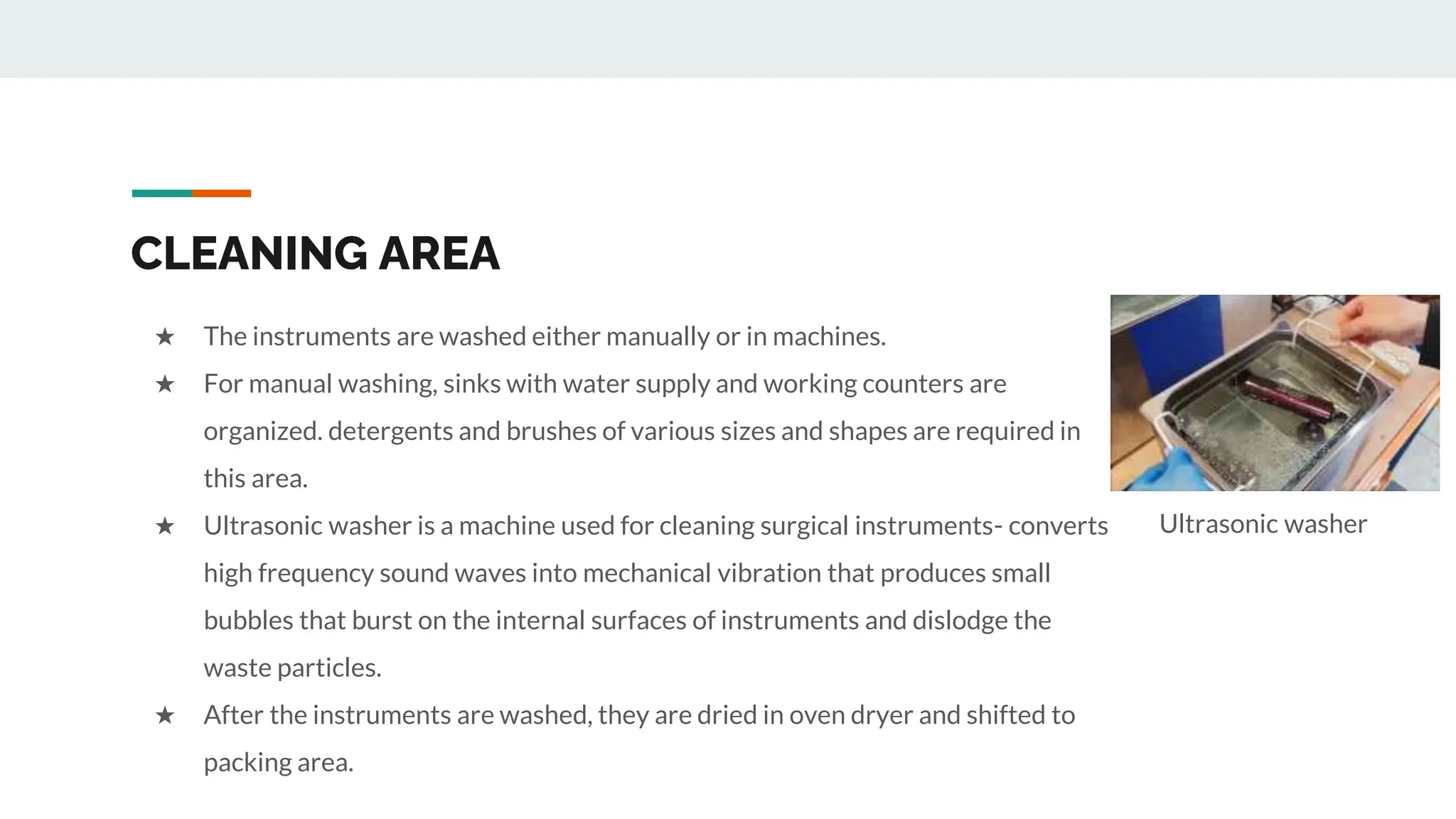
★ Ultrasonic washer is a machine used for cleaning surgical instruments- converts
high frequency sound waves into mechanical vibration that produces small
bubbles that burst on the internal surfaces of instruments and dislodge the
waste particles.
★ After the instruments are washed, they are dried in oven dryer and shifted to
packing area.
Ultrasonic washer
PACKING AREA
★ Clean and dry instruments are packed sterilization, so that they are not contaminated before while
handling after they are sterilized.
★ Most of the instruments are packed in trays (tray assembly) that are wrapped with double layer of
cotton cloth,paper envelopes; plastic bags (eto bags) are used for packing the items for eto
sterilization.
★ Packs are labeled indicating date of sterilization and date of expiry (wherever possible).
★ Sealing machine is used for the sealing the plastic bags in which instruments are packed.
★ After packing and sealing, the instruments are shifted for sterilization.
FLASH STERILIZATION
Special type of autoclave( downward displacement high speed steam
sterilizers) that has a very short sterilization cycle.
Immediate use system sterilization
Fast sterilization- non porous, non cannulated surgical instruments in
unwrapped condition- for immediate use.
STERILIZATION- Steam/ETO/Plasma sterilizer
INDICATION-
Process instruments for extremely urgent use (in OT) - eg only available instrument dropped on the floor
STERILIZING CONDITION-
134oC for 3-10 mins
DISADVANTAGES-
Not for routine- without packaging- no drying- instruments very hot and went in OT- recontamination
CONTRAINDICATIONS-
Never be used for implants, suction tubing or cannulas- others not validated to be sterilized by this
method.
STORAGE AND DISTRIBUTION AREA
★ After sterilization, the items are temporarily stored in a clean store (on racks) from where they are
distributed to user departments.
★ It should be away from the receiving area and may comprise of a window with counter.
★ In modern hospitals, there may be a separate lift for transporting the sterile materials to user
departments.
WORKFLOW
STAFF
★ CSSD is usually manned by following staffs:
★ CSSD In charge/ Manager: Supervises activities of cssd.
★ CSSD Technicians: Operate the autoclave and eto machines.
★ CSSD Assistants: Perform the cleaning and packing, gauge
cutting and cotton ball making.
★ Clerk or storekeeper: To manage the inventory and sterile
stores.
★ Housekeeping staff.
CONCLUSION
In most healthcare facilities, the Central Sterile Supply Department (CSSD) plays a key role in providing
the items required to deliver quality patient care.
A well planned, well managed and well staffed CSSD can ensure an infection free environment of hospital
and save valuable life and money.
THANK YOU

CENTRAL STERILE SUPPLY DEPARTMENT & FLASH STERILIZATION.pptx

  • 1.
    CENTRAL STERILE SUPPLY DEPARTMENT& FLASH STERILIZATION Dr. Nilanjana Mukherjee MD Microbiology Dr. V.M.G.M.C. Solapur BPMT OT NOTES
  • 2.
    CENTRAL STERILE SUPPLYDEPARTMENT (CSSD) ★ Integrated place in health care facility(HCF)- sterilization of medical devices, equipments and consumables. ★ Located close to ER, ward, OT. LR- water, steam and compressed air supply ★ Two variants- CSSD- centralized- dealing with reprocessing of items of entire health care facility Theatre sterile service unit (TSSU)- CSSD + smaller specialized sterilization units- decentralized and located near OTs. No longer used unless specific reasons like remote OT.
  • 3.
    OBJECTIVES a. To providesterilized material. b. Contributing to a reduction in the incidence of hospital infection. c. To avoid duplication of costly equipment. d. To maintain record of effectiveness of cleaning, disinfection and sterilization process. e. To monitor and enforce controls necessary to prevent cross infection. f. To maintain an inventory of supplies and equipment. g. To stay updated regarding developments in the field. h. To provide a safe environment for the patients and staff.
  • 4.
    SIZE OF CSSD NOOF BEDS IN HCF SIZE >300 Beds >7 sq feet/bed 100-300 Beds 8-9 sq feet/bed <100 Beds >10 sq feet/bed Other factors- ★ Single use device policy- Reuse- bigger space ★ Endoscope reprocessing ★ Plasma Sterilization/ETO ★ Containers ★ Cleaning method- manual larger space ★ No of shifts and employees per shift ★ Type of sterilizers used- front loading single door- larger space
  • 5.
  • 8.
    UNIDIRECTIONAL WORKFLOW ACCESSORY AREA Entranceand corridors, staff changing rooms. DECONTAMINATION AREA Dirty items collected- manual cleaning/automated washer systems INSPECTION, ASSEMBLY, AND PACKING AREA(IAP) Items enclosed in package or containers- increased penetration of sterilant, removal, protect from contamination and damage (contd.)
  • 9.
    STERILIZATION AREA Steam/ETO/Plasma sterilizer STERILESTORAGE AREA Items stored after sterilization- issue devices to OTs and various other areas on demand Other areas- ★ Administration area ★ Storage- devices, chemicals and packaging materials, etc.
  • 10.
    REQUIREMENTS ★ Air quality-free of microorganisms, chemical or dirt. Particulate air filter of 1.0 um pore size. ★ Water quality- soft, low mineral and salt content. Demineralized water ideal. ★ Surfaces, ceilings, walls, floors- continuous, smooth, no slippery, washable ★ Ventilation- Mechanical or controlled ventilation ideal - 20 air changes/hr - Dirty area→ negative pressure (air entry dilute) Sterile/clean area→ positive pressure (prevent air entry) ★ Relative humidity- 40-50% ★ Ambient temperature- 15-25oC- dissipate heat generated by equipment.
  • 11.
    TRANSPORTATION ★ Containers withused items- biohazard label ★ Sterile and unsterile items- separate dedicated lifts/ dumb waiters ★ CSSD separate building- separate vehicles for sterile & unsterile items. ★ Separate closed containers in dedicated trolleys. ★ Reception counters far away from each other (decontamination & sterile area respectively) ★ Personnel handling- PPE dumb waiter
  • 12.
    RECEIVING AREA ★ Useditem from various departments of the hospital are shifted to CSSD for cleaning and sterilization. ★ Should have access to outside through a window with a counter. ★ The items (Specially for instruments in trays) are counted and Received. ★ Thereafter, the instruments are inspected and blunt/unsuitable Instruments are segregated/discarded. ★ Necessary entries are made for records. ★ Thereafter, the items are shifted to Cleaning area.
  • 13.
    CLEANING AREA ★ Theinstruments are washed either manually or in machines. ★ For manual washing, sinks with water supply and working counters are organized. detergents and brushes of various sizes and shapes are required in this area. ★ Ultrasonic washer is a machine used for cleaning surgical instruments- converts high frequency sound waves into mechanical vibration that produces small bubbles that burst on the internal surfaces of instruments and dislodge the waste particles. ★ After the instruments are washed, they are dried in oven dryer and shifted to packing area. Ultrasonic washer
  • 14.
    PACKING AREA ★ Cleanand dry instruments are packed sterilization, so that they are not contaminated before while handling after they are sterilized. ★ Most of the instruments are packed in trays (tray assembly) that are wrapped with double layer of cotton cloth,paper envelopes; plastic bags (eto bags) are used for packing the items for eto sterilization. ★ Packs are labeled indicating date of sterilization and date of expiry (wherever possible). ★ Sealing machine is used for the sealing the plastic bags in which instruments are packed. ★ After packing and sealing, the instruments are shifted for sterilization.
  • 15.
    FLASH STERILIZATION Special typeof autoclave( downward displacement high speed steam sterilizers) that has a very short sterilization cycle. Immediate use system sterilization Fast sterilization- non porous, non cannulated surgical instruments in unwrapped condition- for immediate use. STERILIZATION- Steam/ETO/Plasma sterilizer
  • 16.
    INDICATION- Process instruments forextremely urgent use (in OT) - eg only available instrument dropped on the floor STERILIZING CONDITION- 134oC for 3-10 mins DISADVANTAGES- Not for routine- without packaging- no drying- instruments very hot and went in OT- recontamination CONTRAINDICATIONS- Never be used for implants, suction tubing or cannulas- others not validated to be sterilized by this method.
  • 17.
    STORAGE AND DISTRIBUTIONAREA ★ After sterilization, the items are temporarily stored in a clean store (on racks) from where they are distributed to user departments. ★ It should be away from the receiving area and may comprise of a window with counter. ★ In modern hospitals, there may be a separate lift for transporting the sterile materials to user departments.
  • 18.
  • 19.
    STAFF ★ CSSD isusually manned by following staffs: ★ CSSD In charge/ Manager: Supervises activities of cssd. ★ CSSD Technicians: Operate the autoclave and eto machines. ★ CSSD Assistants: Perform the cleaning and packing, gauge cutting and cotton ball making. ★ Clerk or storekeeper: To manage the inventory and sterile stores. ★ Housekeeping staff.
  • 20.
    CONCLUSION In most healthcarefacilities, the Central Sterile Supply Department (CSSD) plays a key role in providing the items required to deliver quality patient care. A well planned, well managed and well staffed CSSD can ensure an infection free environment of hospital and save valuable life and money.
  • 21.