CSSD
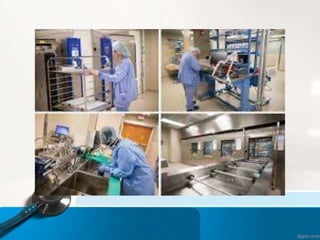
The Central Sterile Supply Department
(CSSD) comprises that service within a
hospital which receives, stores, sterilise,
disinfect, processes, packs, distributes
and controls professional supplies and
equipment, both sterile and non-sterile to
and from all departments of the hospital for
the care and safety of patients as per
standard protocol.
By custom food, medicines, laundry,
supply of blood are not included in
activities of CSSD.
Objective and Functions
a.To provide sterilized material.
b.To maintain record of effectiveness of cleaning,
disinfection and sterilization process.
c.To provide a safe environment for the patients and
staff.
d.Contributing to a reduction in the incidence of hospital
infection.
Designing of CSSD
• Size and location of CSSD varies
• It should be located as close as possible to Operation
theatres, Accidents and Emergency department and
wards
• The CSSD layout should be designed for a unidirectional
flow
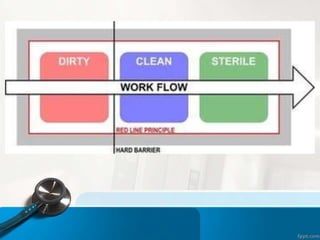
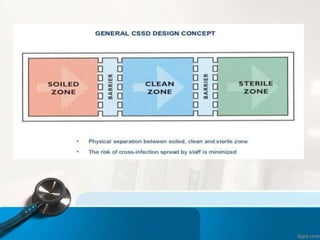
CSSD should have three zones for a smooth work
flow:
• The soiled area
• The clean area
• The sterile area
PLANNING of CSSD
- The materials/ items from contaminated and sterile
areas should not get mixed.
- There should be physical barrier between clean and dirty
areas.
- The floor should be smooth, impervious, non skid and
robust.
- Relative humidity should be maintained at 45±5 %
should be maintained at positive
area
- The clean
pressures.
-The work area should be made of marble/granite/stainless
steel.
-The sterilization must be planned for autoclaving by steam
as well as by gas.
Location
• The CSSD should be close to the casualty,
Operation Theatre and wards which are the largest
consumer of the sterilized material.
• In multistoried buildings, CSSD may be planned in
the lower floor right under the Operation Theatre,
where vertical movement will be the quickest possible
movement of the material.
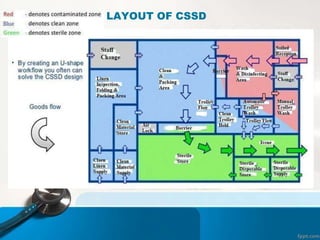
LAYOUT OF CSSD
WORK FLOW
➢MAJOR ACTIVITIES IN A CSSD:
❖RECEIVING THE USED ITEMS FROM
DEPARTMENTS
❖CLEANING
❖PACKING
❖STERILIZING
❖STORING (TEMPORARY)
❖DISTRIBUTING TO USER DEPARTMENTS
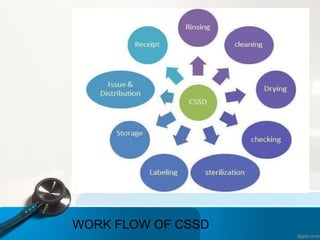
WORK FLOW OF CSSD
1.Steam sterilizer with Double door system
2. Ultrasonic Cleaner
3.Instruments Dryer
4.Ethylene oxide machine
5.Sealing machine (rolling)
6.Water gun & air gun
7.Assembling tables and Racks
RECEIVING AREA
• Used item from various departments of the hospital are
shifted to CSSD for cleaning and sterilization.
• Ideally, the items that get soiled with blood or body
fluid should be decontaminated with Sodium
Hypochloride solution in the user department itself
before sending to CSSD.
• The Receiving Area of CSSD should have access to
outside through a window with a counter.
• The items (Specially for instruments in trays) are
counted and Received.
• Thereafter, the instruments are inspected and
blunt/unsuitable Instruments are segregated/discarded.
•Necessary entries are made for records.
•Thereafter, the items are shifted to Cleaning area.
CLEANING AREA
• HERE THE INSTRUMENTS ARE WASHED EITHER MANUALLY
OR IN MACHINES.
• FOR MANUAL WASHING, SINKS WITH WATER SUPPLY AND
WORKING COUNTERS ARE ORGANIZED. DETERGENTS AND
BRUSHES OF VARIOUS SIZES AND SHAPES ARE REQUIRED IN
THIS AREA.
• ULTRASONIC WASHER IS A MACHINE USED FOR CLEANING
SURGICAL INSTRUMENTS. IT CONVERTS HIGH FREQUENCY
SOUND WAVES INTO MECHANICAL VIBRATION THAT
PRODUCES SMALL BUBBLES THAT BURST ON THE INTERNAL
SURFACES OF INSTRUMENTS AND DISLODGE THE WASTE
PARTICLES.
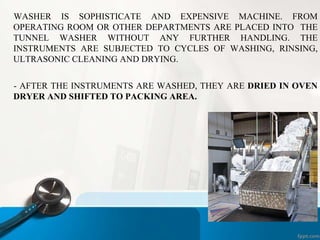
WASHER IS SOPHISTICATE AND EXPENSIVE MACHINE. FROM
OPERATING ROOM OR OTHER DEPARTMENTS ARE PLACED INTO THE
TUNNEL WASHER WITHOUT ANY FURTHER HANDLING. THE
INSTRUMENTS ARE SUBJECTED TO CYCLES OF WASHING, RINSING,
ULTRASONIC CLEANING AND DRYING.
- AFTER THE INSTRUMENTS ARE WASHED, THEY ARE DRIED IN OVEN
DRYER AND SHIFTED TO PACKING AREA.
PACKING AREA
- CLEAN AND DRY INSTRUMENTS ARE PACKED
STERILIZATION, SO THAT THEY ARE NOT CONTAMINATED
BEFORE
WHILE
HANDLING AFTER THEY ARE STERILIZED. MOST OF THE
INSTRUMENTS ARE PACKED IN TRAYS (TRAY ASSEMBLY) THAT ARE
WRAPPED WITH DOUBLE LAYER OF COTTON CLOTH. PAPER
ENVELOPES ARE ALSO AVAILABLE FOR PACKING THE INSTRUMENTS.
THESE ARE EQUALLY EFFECTIVE BUT EXPANSIVE. PLASTIC BAGS
(ETO BAGS) ARE USED FOR PACKING THE ITEMS FOR ETO
STERILIZATION. THE PACKS ARE LABELED INDICATING DATE OF
STERILIZATION AND DATE OF EXPIRY (WHEREVER POSSIBLE).
- SEALING MACHINE IS USED FOR THE SEALING THE PLASTIC BAGS
IN WHICH INSTRUMENTS ARE PACKED. AFTER PACKING AND
SEALING, THE INSTRUMENTS ARE SHIFTED FOR STERILIZATION.
STERILIZING AREA
STERILIZATION IS DONE BY EITHER OF THE TWO METHODS IN CSSD:
❖STEAM STERILIZATION BYAUTOCLAVES
❖GAS STERILIZATION BY ETO (ETHYLENE OXIDE) MACHINES
❑AUTOCLAVE: STEAM UNDER PRESSURE IS THE MOST COST-
EFFECTIVE METHOD OF STERILIZATION, “AUTOCLAVE” GENERATES
STEAM AT A TEMPERATURE OF 121 DEGREE CENTIGRADE UNDER
15 POUNDS OF PRESSURE. AN EXPOSURE OF 20 MINUTES IS
REQUIRED FOR STERILIZATION.
❑FLASH STERILIZER: THIS IS A SPECIAL TYPE OF AUTOCLAVE THAT
HAS A VERY SHORT STERILIZATION CYCLE OF ABOUT 3 - 5 MINUTES
BECAUSE OF ITS ABILITY TO RAISE THE TEMPERATURE TO 132
DEGREE CENTIGRADE.
❑ ETO STERILIZER: THE ITEMS LIKE CARDIAC CATHETERS ARE
THERMO SENSITIVE AND THEREFORE CANNOT BE STERILIZED BY
STEAM. SUCH ITEMS ARE STERILIZED BY ETHYLENE OXIDE (ETO)
GAS STERILIZATION. THE ETO IS AN EXPANSIVE AND TOXIC GAS. IT
IS ABSOLUTELY NECESSARY TO ENSURE THAT THESE ITEMS ARE
MADE FREE OF GAS MOLECULES BEFORE USING THEM ON A
PATIENT. THIS IS ACHIEVED BY SUBJECTING THE ITEMS TO FORCED
VENTILATION. THE ENTIRE CYCLE MAY TAKE ABOUT 8- 12 HRS.
STORE
AFTER STERILIZATION, THE ITEMS ARE TEMPORARILY
STORED IN A CLEAN STORE (ON RACKS) FROM WHERE
THEY ARE DISTRIBUTED TO USER DEPARTMENTS
DISTRIBUTION AREA
-IT SHOULD BE AWAY FROM THE RECEIVING AREA AND
MAY COMPRISE OF A WINDOW WITHCOUNTER.
-IN MODERN HOSPITALS, THERE MAY BE A SEPARATE
LIFT FOR TRANSPORTING THE STERILE MATERIALS TO
USER DEPARTMENTS.
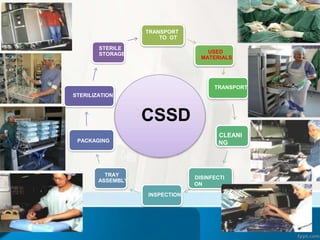
TRANSPORT
TO OT
USED
MATERIALS
TRANSPORT
CLEANI
NG
DISINFECTI
ON
INSPECTION
TRAY
ASSEMBLY
PACKAGING
STERILIZATION
STERILE
STORAGE
CSSD
SHELF LIFE
1. Shelf life of a sterile pack depends on the quality of the
wrapper, storage conditions, and conditions during transport
and amount of handling.
2. Shelf life is given as follows:
a.Linen packed trays or sets - 4 days
b.Medical grade paper packing - 15 days
c.Non woven packing material - 3 months
d. Peel pouch packing - 6 months
3. Sterile materials should be issued in a closed cabinet trolley
to OT and clean-decontaminated trolley to wards to minimize
contamination
4. Arrangement of sterile packs should be in sequence of their
expiry date.
STAFF
•CSSD IS USUALLY MANNED BY FOLLOWING STAFFS:
-CSSD IN CHARGE/ MANAGER: SUPERVISES ACTIVITIES OF CSSD.
-CSSD TECHNICIANS: OPERATE THE AUTOCLAVE AND ETO
MACHINES.
- CSSD ASSISTANTS: PERFORM THE CLEANING AND PACKING, GAUGE
CUTTING AND COTTON BALL MAKING.
-CLERK OR STOREKEEPER: TO MANAGE THE INVENTORY AND
STERILE STORES.
-HOUSEKEEPING STAFF.
ROLE OF CSSD MANAGER
•MAINTENANCE AND
REPAIR OF EQUIPMENT
.MANAGEMENT OF
SUPPLIES AND
CONSUMABLE
•ENSURE QUALITY OF
STERILIZATION
•ENSURE PROPER
DISTRIBUTION
AND TRANSPORT
• COST CONTROL MEASURE,TO
ANALYZE AND REDUCETHE
NUMBER OF CYCLE
• RECORD KEEPING AND DATA
ANALYSIS
• OPTIMAL UTILIZATION OF
MANPOWER AND EQUIPMENT
• MOTIVATION OF STAFF AND
TRAINING
• INTER DEPARTMENTAL
COORDINATION
Quality Assurance
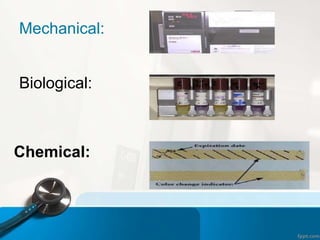
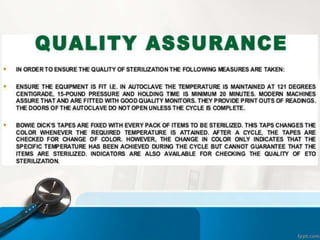
• Mechanical Indicators:
MONITORING RECORD TIME, TEMPERATURE, HUMIDITY AND
PRESSURE DURING THE STERILIZATION CYCLE.
•Chemical Indicators:
DEVICES WITH A SENSITIVE CHEMICAL OR DYE TO MONITOR ONE
OR MORE PARAMETERS OF A STERILIZATION CYCLE.
•Biological Indicators:
EMPLOY THE PRINCIPLE OF INHIBITION OF GROWTH OF
MICROORGANISM OF HIGH RESISTANCE.
Mechanical:
Biological:
Chemical:
Conclusion
In most healthcare facilities, the Central Sterile
Supply Department (CSSD) plays a key role in
providing the items required to deliver quality
patient care. A well planned, well managed and well
staffed CSSD can ensure an infection free
environment of hospital and save valuable
life and money.

5. CSSD PPT.pptx

  • 1.
  • 2.
    The Central SterileSupply Department (CSSD) comprises that service within a hospital which receives, stores, sterilise, disinfect, processes, packs, distributes and controls professional supplies and equipment, both sterile and non-sterile to and from all departments of the hospital for the care and safety of patients as per standard protocol.
  • 3.
    By custom food,medicines, laundry, supply of blood are not included in activities of CSSD.
  • 4.
    Objective and Functions a.Toprovide sterilized material. b.To maintain record of effectiveness of cleaning, disinfection and sterilization process. c.To provide a safe environment for the patients and staff. d.Contributing to a reduction in the incidence of hospital infection.

  • 5.
    Designing of CSSD •Size and location of CSSD varies • It should be located as close as possible to Operation theatres, Accidents and Emergency department and wards • The CSSD layout should be designed for a unidirectional flow
  • 6.
    CSSD should havethree zones for a smooth work flow: • The soiled area • The clean area • The sterile area
  • 9.
    PLANNING of CSSD -The materials/ items from contaminated and sterile areas should not get mixed. - There should be physical barrier between clean and dirty areas. - The floor should be smooth, impervious, non skid and robust. - Relative humidity should be maintained at 45±5 %
  • 10.
    should be maintainedat positive area - The clean pressures. -The work area should be made of marble/granite/stainless steel. -The sterilization must be planned for autoclaving by steam as well as by gas.
  • 11.
    Location • The CSSDshould be close to the casualty, Operation Theatre and wards which are the largest consumer of the sterilized material. • In multistoried buildings, CSSD may be planned in the lower floor right under the Operation Theatre, where vertical movement will be the quickest possible movement of the material.
  • 12.
  • 14.
    WORK FLOW ➢MAJOR ACTIVITIESIN A CSSD: ❖RECEIVING THE USED ITEMS FROM DEPARTMENTS ❖CLEANING ❖PACKING ❖STERILIZING ❖STORING (TEMPORARY) ❖DISTRIBUTING TO USER DEPARTMENTS
  • 15.
  • 16.
    1.Steam sterilizer withDouble door system 2. Ultrasonic Cleaner 3.Instruments Dryer 4.Ethylene oxide machine 5.Sealing machine (rolling) 6.Water gun & air gun 7.Assembling tables and Racks
  • 17.
    RECEIVING AREA • Useditem from various departments of the hospital are shifted to CSSD for cleaning and sterilization. • Ideally, the items that get soiled with blood or body fluid should be decontaminated with Sodium Hypochloride solution in the user department itself before sending to CSSD.
  • 18.
    • The ReceivingArea of CSSD should have access to outside through a window with a counter. • The items (Specially for instruments in trays) are counted and Received. • Thereafter, the instruments are inspected and blunt/unsuitable Instruments are segregated/discarded. •Necessary entries are made for records. •Thereafter, the items are shifted to Cleaning area.
  • 19.
    CLEANING AREA • HERETHE INSTRUMENTS ARE WASHED EITHER MANUALLY OR IN MACHINES. • FOR MANUAL WASHING, SINKS WITH WATER SUPPLY AND WORKING COUNTERS ARE ORGANIZED. DETERGENTS AND BRUSHES OF VARIOUS SIZES AND SHAPES ARE REQUIRED IN THIS AREA. • ULTRASONIC WASHER IS A MACHINE USED FOR CLEANING SURGICAL INSTRUMENTS. IT CONVERTS HIGH FREQUENCY SOUND WAVES INTO MECHANICAL VIBRATION THAT PRODUCES SMALL BUBBLES THAT BURST ON THE INTERNAL SURFACES OF INSTRUMENTS AND DISLODGE THE WASTE PARTICLES.
  • 21.
    WASHER IS SOPHISTICATEAND EXPENSIVE MACHINE. FROM OPERATING ROOM OR OTHER DEPARTMENTS ARE PLACED INTO THE TUNNEL WASHER WITHOUT ANY FURTHER HANDLING. THE INSTRUMENTS ARE SUBJECTED TO CYCLES OF WASHING, RINSING, ULTRASONIC CLEANING AND DRYING. - AFTER THE INSTRUMENTS ARE WASHED, THEY ARE DRIED IN OVEN DRYER AND SHIFTED TO PACKING AREA.
  • 22.
    PACKING AREA - CLEANAND DRY INSTRUMENTS ARE PACKED STERILIZATION, SO THAT THEY ARE NOT CONTAMINATED BEFORE WHILE HANDLING AFTER THEY ARE STERILIZED. MOST OF THE INSTRUMENTS ARE PACKED IN TRAYS (TRAY ASSEMBLY) THAT ARE WRAPPED WITH DOUBLE LAYER OF COTTON CLOTH. PAPER ENVELOPES ARE ALSO AVAILABLE FOR PACKING THE INSTRUMENTS. THESE ARE EQUALLY EFFECTIVE BUT EXPANSIVE. PLASTIC BAGS (ETO BAGS) ARE USED FOR PACKING THE ITEMS FOR ETO STERILIZATION. THE PACKS ARE LABELED INDICATING DATE OF STERILIZATION AND DATE OF EXPIRY (WHEREVER POSSIBLE). - SEALING MACHINE IS USED FOR THE SEALING THE PLASTIC BAGS IN WHICH INSTRUMENTS ARE PACKED. AFTER PACKING AND SEALING, THE INSTRUMENTS ARE SHIFTED FOR STERILIZATION.
  • 23.
    STERILIZING AREA STERILIZATION ISDONE BY EITHER OF THE TWO METHODS IN CSSD: ❖STEAM STERILIZATION BYAUTOCLAVES ❖GAS STERILIZATION BY ETO (ETHYLENE OXIDE) MACHINES ❑AUTOCLAVE: STEAM UNDER PRESSURE IS THE MOST COST- EFFECTIVE METHOD OF STERILIZATION, “AUTOCLAVE” GENERATES STEAM AT A TEMPERATURE OF 121 DEGREE CENTIGRADE UNDER 15 POUNDS OF PRESSURE. AN EXPOSURE OF 20 MINUTES IS REQUIRED FOR STERILIZATION. ❑FLASH STERILIZER: THIS IS A SPECIAL TYPE OF AUTOCLAVE THAT HAS A VERY SHORT STERILIZATION CYCLE OF ABOUT 3 - 5 MINUTES BECAUSE OF ITS ABILITY TO RAISE THE TEMPERATURE TO 132 DEGREE CENTIGRADE.
  • 24.
    ❑ ETO STERILIZER:THE ITEMS LIKE CARDIAC CATHETERS ARE THERMO SENSITIVE AND THEREFORE CANNOT BE STERILIZED BY STEAM. SUCH ITEMS ARE STERILIZED BY ETHYLENE OXIDE (ETO) GAS STERILIZATION. THE ETO IS AN EXPANSIVE AND TOXIC GAS. IT IS ABSOLUTELY NECESSARY TO ENSURE THAT THESE ITEMS ARE MADE FREE OF GAS MOLECULES BEFORE USING THEM ON A PATIENT. THIS IS ACHIEVED BY SUBJECTING THE ITEMS TO FORCED VENTILATION. THE ENTIRE CYCLE MAY TAKE ABOUT 8- 12 HRS.
  • 25.
    STORE AFTER STERILIZATION, THEITEMS ARE TEMPORARILY STORED IN A CLEAN STORE (ON RACKS) FROM WHERE THEY ARE DISTRIBUTED TO USER DEPARTMENTS
  • 26.
    DISTRIBUTION AREA -IT SHOULDBE AWAY FROM THE RECEIVING AREA AND MAY COMPRISE OF A WINDOW WITHCOUNTER. -IN MODERN HOSPITALS, THERE MAY BE A SEPARATE LIFT FOR TRANSPORTING THE STERILE MATERIALS TO USER DEPARTMENTS.
  • 27.
  • 28.
    SHELF LIFE 1. Shelflife of a sterile pack depends on the quality of the wrapper, storage conditions, and conditions during transport and amount of handling. 2. Shelf life is given as follows: a.Linen packed trays or sets - 4 days b.Medical grade paper packing - 15 days c.Non woven packing material - 3 months d. Peel pouch packing - 6 months 3. Sterile materials should be issued in a closed cabinet trolley to OT and clean-decontaminated trolley to wards to minimize contamination 4. Arrangement of sterile packs should be in sequence of their expiry date.
  • 29.
    STAFF •CSSD IS USUALLYMANNED BY FOLLOWING STAFFS: -CSSD IN CHARGE/ MANAGER: SUPERVISES ACTIVITIES OF CSSD. -CSSD TECHNICIANS: OPERATE THE AUTOCLAVE AND ETO MACHINES. - CSSD ASSISTANTS: PERFORM THE CLEANING AND PACKING, GAUGE CUTTING AND COTTON BALL MAKING. -CLERK OR STOREKEEPER: TO MANAGE THE INVENTORY AND STERILE STORES. -HOUSEKEEPING STAFF.
  • 30.
    ROLE OF CSSDMANAGER •MAINTENANCE AND REPAIR OF EQUIPMENT .MANAGEMENT OF SUPPLIES AND CONSUMABLE •ENSURE QUALITY OF STERILIZATION •ENSURE PROPER DISTRIBUTION AND TRANSPORT • COST CONTROL MEASURE,TO ANALYZE AND REDUCETHE NUMBER OF CYCLE • RECORD KEEPING AND DATA ANALYSIS • OPTIMAL UTILIZATION OF MANPOWER AND EQUIPMENT • MOTIVATION OF STAFF AND TRAINING • INTER DEPARTMENTAL COORDINATION
  • 31.
    Quality Assurance • MechanicalIndicators: MONITORING RECORD TIME, TEMPERATURE, HUMIDITY AND PRESSURE DURING THE STERILIZATION CYCLE. •Chemical Indicators: DEVICES WITH A SENSITIVE CHEMICAL OR DYE TO MONITOR ONE OR MORE PARAMETERS OF A STERILIZATION CYCLE. •Biological Indicators: EMPLOY THE PRINCIPLE OF INHIBITION OF GROWTH OF MICROORGANISM OF HIGH RESISTANCE.
  • 32.
  • 35.
    Conclusion In most healthcarefacilities, the Central Sterile Supply Department (CSSD) plays a key role in providing the items required to deliver quality patient care. A well planned, well managed and well staffed CSSD can ensure an infection free environment of hospital and save valuable life and money.