CONTENTS
• Definition
• Aim
• Functions and Activities
• Advantages
• Planning of CSSD
• Rule of Thumb
• Layout Design Principle
• Structural Designing
• Equipment
• Staffing
• Sterilization
• Flow Pattern
• Quality Control
• Management Process
Definition
“as that service, with in the hospital, catering
for the sterile supplies to all departments ,
both to specialized units as well as general
wards and OPDs.”
AIM
• Centralizing the activities of receipt, cleaning, assembly,
sterilization, storage and distribution of sterilized materials
from a central department where safe sterilization is done under
controlled conditions with adequate managerial and technical
supervision at an optimum cost.
• To provide an efficient, economic, continuous and quality supply
of sterilized material to various areas of the hospital to deliver
quality and infection free patient care.
• Contributes to reduction in hospital infection rate
• To reduce the burden of work of the nursing personnel, there by
enabling them to devote more of their time to patient care .
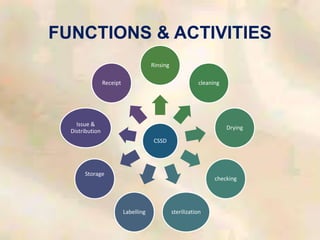
FUNCTIONS & ACTIVITIES
CSSD
Rinsing
cleaning
Drying
checking
sterilization
Labelling
Storage
Issue &
Distribution
Receipt
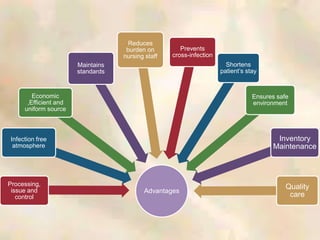
Advantages
Processing,
issue and
control
Infection free
atmosphere
Economic
,Efficient and
uniform source
Maintains
standards
Reduces
burden on
nursing staff
Prevents
cross-infection
Shortens
patient’s stay
Ensures safe
environment
Inventory
Maintenance
Quality
care
PLANNING OF CSSD
The CSSD can broadly be classified into two parts
Central
unit
Peripheral
unit
-Responsible for receiving dirty
Utilities cleaning, processing,
Sterilization, storage and supply
- Mainly responsible for distribution
to various areas of hospital.
- TSSU (Theater Sterile Supply Unit)
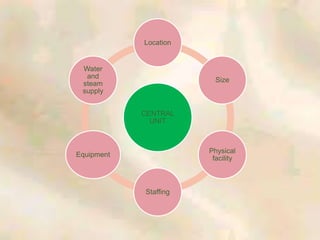
CENTRAL
UNIT
Location
Size
Physical
facility
Staffing
Equipment
Water
and
steam
supply
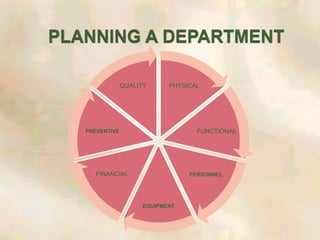
PHYSICAL
FUNCTIONAL
PERSONNEL
EQUIPMENT
FINANCIAL
PREVENTIVE
QUALITY
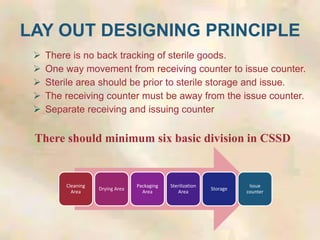
LAY OUT DESIGNING PRINCIPLE
 There is no back tracking of sterile goods.
 One way movement from receiving counter to issue counter.
 Sterile area should be prior to sterile storage and issue.
 The receiving counter must be away from the issue counter.
 Separate receiving and issuing counter
There should minimum six basic division in CSSD
Cleaning
Area
Drying Area
Packaging
Area
Sterilization
Area
Storage
Issue
counter
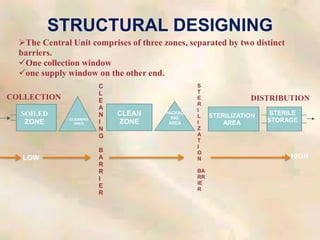
STRUCTURAL DESIGNING
The Central Unit comprises of three zones, separated by two distinct
barriers.
One collection window
one supply window on the other end.
SOILED
ZONE CLEANING
AREA
CLEAN
ZONE
PACKAG
ING
AREA
STERILIZATION
AREA
C
L
E
A
N
I
N
G
B
A
R
R
I
E
R
S
T
E
R
I
L
I
Z
A
T
I
O
N
BA
RR
IE
R
STERILE
STORAGE
COLLECTION DISTRIBUTION
LOW HIGH
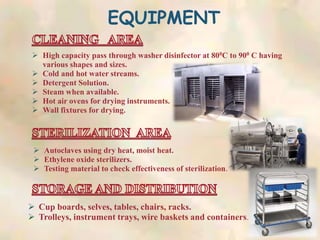
EQUIPMENT
 High capacity pass through washer disinfector at 800C to 900 C having
various shapes and sizes.
 Cold and hot water streams.
 Detergent Solution.
 Steam when available.
 Hot air ovens for drying instruments.
 Wall fixtures for drying.
 Autoclaves using dry heat, moist heat.
 Ethylene oxide sterilizers.
 Testing material to check effectiveness of sterilization.
 Cup boards, selves, tables, chairs, racks.
 Trolleys, instrument trays, wire baskets and containers.
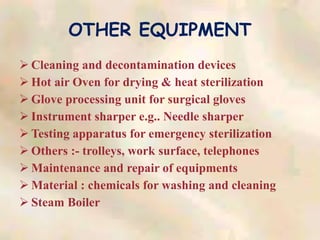
OTHER EQUIPMENT
 Cleaning and decontamination devices
 Hot air Oven for drying & heat sterilization
 Glove processing unit for surgical gloves
 Instrument sharper e.g.. Needle sharper
 Testing apparatus for emergency sterilization
 Others :- trolleys, work surface, telephones
 Maintenance and repair of equipments
 Material : chemicals for washing and cleaning
 Steam Boiler
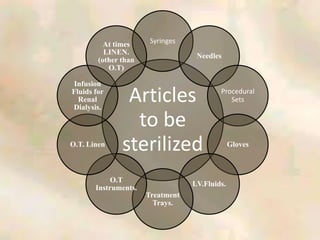
Articles
to be
sterilized
Syringes
Needles
Procedural
Sets
Gloves
I.V.Fluids.
Treatment
Trays.
O.T
Instruments.
O.T. Linen
Infusion
Fluids for
Renal
Dialysis.
At times
LINEN.
(other than
O.T)
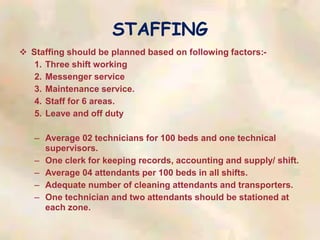
STAFFING
 Staffing should be planned based on following factors:-
1. Three shift working
2. Messenger service
3. Maintenance service.
4. Staff for 6 areas.
5. Leave and off duty
– Average 02 technicians for 100 beds and one technical
supervisors.
– One clerk for keeping records, accounting and supply/ shift.
– Average 04 attendants per 100 beds in all shifts.
– Adequate number of cleaning attendants and transporters.
– One technician and two attendants should be stationed at
each zone.
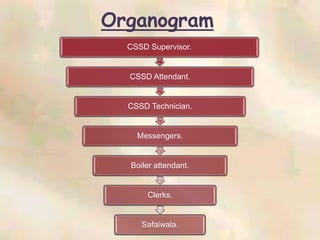
Organogram
CSSD Supervisor.
CSSD Attendant.
CSSD Technician.
Messengers.
Boiler attendant.
Clerks.
Safaiwala.
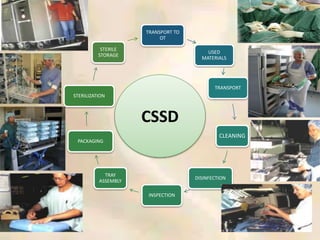
TRANSPORT TO
OT
USED
MATERIALS
TRANSPORT
CLEANING
DISINFECTION
INSPECTION
TRAY
ASSEMBLY
PACKAGING
STERILIZATION
STERILE
STORAGE
CSSD
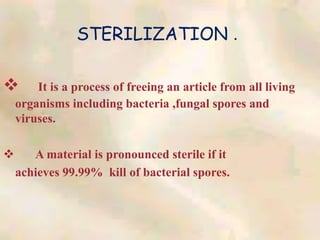
STERILIZATION .
 It is a process of freeing an article from all living
organisms including bacteria ,fungal spores and
viruses.
 A material is pronounced sterile if it
achieves 99.99% kill of bacterial spores.
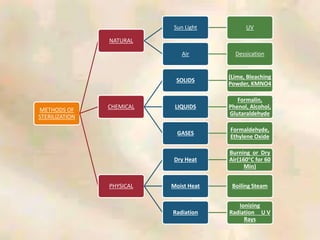
METHODS OF
STERILIZATION
NATURAL
Sun Light UV
Air Dessication
CHEMICAL
SOLIDS
(Lime, Bleaching
Powder, KMNO4
LIQUIDS
Formalin,
Phenol, Alcohol,
Glutaraldehyde
GASES
Formaldehyde,
Ethylene Oxide
PHYSICAL
Dry Heat
Burning or Dry
Air(160°C for 60
Min)
Moist Heat Boiling Steam
Radiation
Ionizing
Radiation U V
Rays
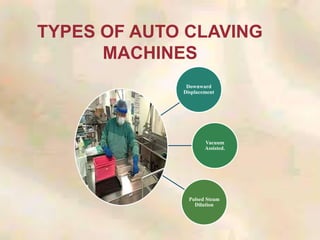
TYPES OF AUTO CLAVING
MACHINES
Downward
Displacement
Vacuum
Assisted.
Pulsed Steam
Dilution
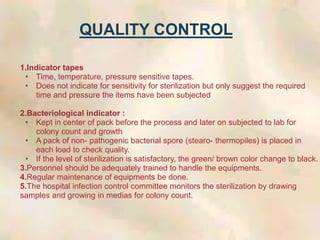
1.Indicator tapes
• Time, temperature, pressure sensitive tapes.
• Does not indicate for sensitivity for sterilization but only suggest the required
time and pressure the items have been subjected
2.Bacteriological indicator :
• Kept in center of pack before the process and later on subjected to lab for
colony count and growth
• A pack of non- pathogenic bacterial spore (stearo- thermopiles) is placed in
each load to check quality.
• If the level of sterilization is satisfactory, the green/ brown color change to black.
3.Personnel should be adequately trained to handle the equipments.
4.Regular maintenance of equipments be done.
5.The hospital infection control committee monitors the sterilization by drawing
samples and growing in medias for colony count.
QUALITY CONTROL
STORAGE
• After sterilization the sterilized items are kept in different racks as
per labeling.
• Supplied as per the demand of different area.
• To ensure continuous availability of sterile supply five times of
daily requirement should be available in storage.
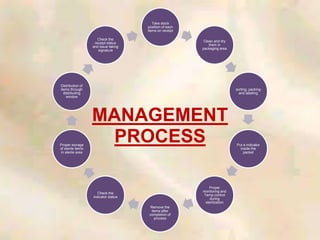
Take stock
position of each
items on receipt
Clean and dry
them in
packaging area
sorting, packing
and labeling
Put a indicator
inside the
packet
Proper
monitoring and
Temp control
during
sterilization
Remove the
items after
completion of
process
Check the
indicator status
Proper storage
of sterile items
in sterile area
Distribution of
items through
distributing
window
Check the
receipt status
and issue taking
signature
MANAGEMENT
PROCESS
THANK YOU !!

CSSD central sterile supply department and services

  • 1.
    CONTENTS • Definition • Aim •Functions and Activities • Advantages • Planning of CSSD • Rule of Thumb • Layout Design Principle • Structural Designing • Equipment • Staffing • Sterilization • Flow Pattern • Quality Control • Management Process
  • 2.
    Definition “as that service,with in the hospital, catering for the sterile supplies to all departments , both to specialized units as well as general wards and OPDs.”
  • 3.
    AIM • Centralizing theactivities of receipt, cleaning, assembly, sterilization, storage and distribution of sterilized materials from a central department where safe sterilization is done under controlled conditions with adequate managerial and technical supervision at an optimum cost. • To provide an efficient, economic, continuous and quality supply of sterilized material to various areas of the hospital to deliver quality and infection free patient care. • Contributes to reduction in hospital infection rate • To reduce the burden of work of the nursing personnel, there by enabling them to devote more of their time to patient care .
  • 4.
  • 5.
    Advantages Processing, issue and control Infection free atmosphere Economic ,Efficientand uniform source Maintains standards Reduces burden on nursing staff Prevents cross-infection Shortens patient’s stay Ensures safe environment Inventory Maintenance Quality care
  • 6.
    PLANNING OF CSSD TheCSSD can broadly be classified into two parts Central unit Peripheral unit -Responsible for receiving dirty Utilities cleaning, processing, Sterilization, storage and supply - Mainly responsible for distribution to various areas of hospital. - TSSU (Theater Sterile Supply Unit)
  • 7.
  • 8.
  • 9.
    LAY OUT DESIGNINGPRINCIPLE  There is no back tracking of sterile goods.  One way movement from receiving counter to issue counter.  Sterile area should be prior to sterile storage and issue.  The receiving counter must be away from the issue counter.  Separate receiving and issuing counter There should minimum six basic division in CSSD Cleaning Area Drying Area Packaging Area Sterilization Area Storage Issue counter
  • 10.
    STRUCTURAL DESIGNING The CentralUnit comprises of three zones, separated by two distinct barriers. One collection window one supply window on the other end. SOILED ZONE CLEANING AREA CLEAN ZONE PACKAG ING AREA STERILIZATION AREA C L E A N I N G B A R R I E R S T E R I L I Z A T I O N BA RR IE R STERILE STORAGE COLLECTION DISTRIBUTION LOW HIGH
  • 11.
    EQUIPMENT  High capacitypass through washer disinfector at 800C to 900 C having various shapes and sizes.  Cold and hot water streams.  Detergent Solution.  Steam when available.  Hot air ovens for drying instruments.  Wall fixtures for drying.  Autoclaves using dry heat, moist heat.  Ethylene oxide sterilizers.  Testing material to check effectiveness of sterilization.  Cup boards, selves, tables, chairs, racks.  Trolleys, instrument trays, wire baskets and containers.
  • 12.
    OTHER EQUIPMENT  Cleaningand decontamination devices  Hot air Oven for drying & heat sterilization  Glove processing unit for surgical gloves  Instrument sharper e.g.. Needle sharper  Testing apparatus for emergency sterilization  Others :- trolleys, work surface, telephones  Maintenance and repair of equipments  Material : chemicals for washing and cleaning  Steam Boiler
  • 13.
  • 14.
    STAFFING  Staffing shouldbe planned based on following factors:- 1. Three shift working 2. Messenger service 3. Maintenance service. 4. Staff for 6 areas. 5. Leave and off duty – Average 02 technicians for 100 beds and one technical supervisors. – One clerk for keeping records, accounting and supply/ shift. – Average 04 attendants per 100 beds in all shifts. – Adequate number of cleaning attendants and transporters. – One technician and two attendants should be stationed at each zone.
  • 15.
    Organogram CSSD Supervisor. CSSD Attendant. CSSDTechnician. Messengers. Boiler attendant. Clerks. Safaiwala.
  • 16.
  • 17.
    STERILIZATION .  Itis a process of freeing an article from all living organisms including bacteria ,fungal spores and viruses.  A material is pronounced sterile if it achieves 99.99% kill of bacterial spores.
  • 18.
    METHODS OF STERILIZATION NATURAL Sun LightUV Air Dessication CHEMICAL SOLIDS (Lime, Bleaching Powder, KMNO4 LIQUIDS Formalin, Phenol, Alcohol, Glutaraldehyde GASES Formaldehyde, Ethylene Oxide PHYSICAL Dry Heat Burning or Dry Air(160°C for 60 Min) Moist Heat Boiling Steam Radiation Ionizing Radiation U V Rays
  • 19.
    TYPES OF AUTOCLAVING MACHINES Downward Displacement Vacuum Assisted. Pulsed Steam Dilution
  • 20.
    1.Indicator tapes • Time,temperature, pressure sensitive tapes. • Does not indicate for sensitivity for sterilization but only suggest the required time and pressure the items have been subjected 2.Bacteriological indicator : • Kept in center of pack before the process and later on subjected to lab for colony count and growth • A pack of non- pathogenic bacterial spore (stearo- thermopiles) is placed in each load to check quality. • If the level of sterilization is satisfactory, the green/ brown color change to black. 3.Personnel should be adequately trained to handle the equipments. 4.Regular maintenance of equipments be done. 5.The hospital infection control committee monitors the sterilization by drawing samples and growing in medias for colony count. QUALITY CONTROL
  • 21.
    STORAGE • After sterilizationthe sterilized items are kept in different racks as per labeling. • Supplied as per the demand of different area. • To ensure continuous availability of sterile supply five times of daily requirement should be available in storage.
  • 22.
    Take stock position ofeach items on receipt Clean and dry them in packaging area sorting, packing and labeling Put a indicator inside the packet Proper monitoring and Temp control during sterilization Remove the items after completion of process Check the indicator status Proper storage of sterile items in sterile area Distribution of items through distributing window Check the receipt status and issue taking signature MANAGEMENT PROCESS
  • 23.