1
“ A STUDY ON THE EFFICIENCY OF CSSD IN
A MULTISPECIALITY HOSPITAL”
A PROJECT REPORT
Under the guidance of
Mr. Rajnish Pal
_____________________________
Submitted by
Megha Milind Sawant
______________________________
in partial fulfillment of the requirement
for the award of the degree Of
MBA
IN
Healthcare Services
2015
2
ACKNOWLEDGEMENT
I thank the people who had helped and supported me during the
making of this Project and the report.
I would like to express my special thanks of gratitude to Mr.
Ajaykumar Pande, Director- Operations & Supply chain/ HR
Head, Lilavati Hospital & Research Centre, for his co-operation
and support
My deepest thanks to Ms. Ancy Jacob (Asst. Manager-OT) and Ms.
Gauri Bhatia(General Manager-CSSD), Lilavati Hospital &
Research Centre, for their support and guidance in this project. I
thank Mr. Avinash Tivrekar(Shift-in Charge -CSSD), for
explaining me the workflow of CSSD department.
I would also thank my Institution without whom this project would
have been distant reality.
I thank my guide Mr. Rajnish Pal, for his guidance. I also thank
Mr. Santosh Bhoir and Mr. Subhash Shetty -Halo Technologies
for their all-time guidance.
3
I would like to express my deepest and special thanks to my friend
& my colleague, Geeta Dilip Arekar for her continuous support,
guidance, for imparting her knowledge and expertise in this study
and who have greatly assisted me by correcting copy, reading proof
and helping me making necessary correction when needed.
My thanks and appreciation to the people of Operation Theatre
department, Lilavati Hospital & Research Centre, of who have
willingly helped me out with their abilities and gave valuable time
and feedback to this project
I express my thanks to the Learning Centre, Halo Technologies and
my faculties for their guidance, help and support.
I also extend my heartfelt thanks to my family, my well wishers, my
friends and those people who helped me for the successful
completion of this project
Place : MUMBAI (Megha M Sawant)
Date : 08/10/2015 (1311003326)
4
5
BONAFIDE CERTIFICATE
Certified that this project report titled “ A STUDY ON THE
EFFICIENCY OF CSSD IN A MULTISPECIALITY HOSPITAL” is
the bonafide work of “Megha Milind Sawant” who carried out the
project work under my supervision.
Learning Center Faculty/ Head of the Department
Date : 08/10/2015
Place : Mumbai
6
DECLARATION
I, Megha Milind Sawant hereby declare that the report of the project
entitled “ A STUDY ON THE EFFICIENCY OF CSSD IN A
MULTISPECIALITY HOSPITAL” has not presented as of any other
academic work to get my degree or certificate except Sikkim
Manipal University for the fulfilment of the requirements for the
degree of MBA.
Name : Megha Milind Sawant
7
OBJECTIVE OF THE STUDY
 The objective of the project were mainly to study the sterility,
its importance in an organisation.
 To develop CSSD Safety Checklist.
 To implement CSSD Safety Checklist to monitor and enforce
quality and safety controls necessary in CSDD prosessing
such as Rinsing, Cleaning, Drying, Inspection and Assembly,
Packing, Labelling, Sterilization, Storage,
Distribution to reduce the incidence of hospital infection and
improve patient care.
 To ensure precisely operating and monitoring of special
sterilization
 To avoid duplication of costly equipment's, which may be in
frequently used.
 To stay updated regarding developments in the field in the
interest of efficiency, economy, accuracy and provision of
better patient care
8
 The main purpose of my study is to render a better
understanding of the concept “Quality and Safety in CSSD”
 To understand the planning and operation of CSSD
 To establish & ensure highest standard of sterilization of
equipments, instruments and other patient care supplies to
ensure maximum prevention of infection and enhancing
quality & safety by developing effective safety checklist for
CSSD.
 To develop working knowledge of functions and activities of
the department
This project is vital to me in a significant way. It does have
important role in multispecialty Hospital
9
QUALITY :
Quality is determined by customers and, therefore, the success of
CSSD depends upon their satisfaction. Anyone who has an
expectation about the products or services of CSSD is a “customer.”
This includes surgical services personnel, physicians, patients,
diagnostic imaging technicians and other medical personnel, and
delivery staff. Quality (or lack of quality) can have dramatic
consequences on the health and safety of personnel and patients.
How well quality products and services are provided will impact the
operation of the department and have a direct impact on the
hospital’s financial success.
Quality relates to the “degree or grade of excellence of a product or
service.”
10
MISSION AND ACTIVITIES OF CSSD
11
THE SCOPE OF SERVICES
The Central Sterile Supply Department, as a specialized centre,
offers the following services:
 Disinfection, mechanical treatment, and special treatment of all
medical supplies in automatic washers with adjustable and
controlled parameters. The machine-controlled washing is carried
out in a closed system and uses thermal-chemical or thermal
disinfection. The quality of pre-sterilization preparation is checked
and performed by means of smears taken from the medical
material. The Institute of Public Health in Ostrava implements the
evaluations of the smears.
 Organizing and completing surgical instruments
Surgical instruments are organized and completed into sets by
qualified nurses.
 Medical supplies are packed into special single-use or reusable
sterile packs. The employees are qualified to choose and use the
correct ones.
 The employees carry out a visual control and check if surgery room
cloths are complete. They prepare and pack the cloths either in
12
single item packs or set packs according to requirements of
individual surgery rooms or other stations and centers.
 Moist heat sterilization is used for medical products that are made
of metal, are porous, hollow or otherwise thermo stable. The
sterilizing medium is saturated water vapor, which transmits
thermal energy by condensing on medical products.
 Ethylene oxide sterilization is used for thermo labile reusable
medical supplies ( made of plastic ). The sterilization medium is a
mixture of ethylene oxide and vapor that penetrates well. This moist
sterilizing process requires a period of post sterilization aeration to
remove toxic residues.
 Plasma sterilization is used for thermo labile reusable medical
supplies ( made of plastic ). The sterilization medium is a low
temperature plasma created in a high frequency electromagnetic
field that interacts with vapors of 58 percent hydrogen peroxide in a
high vacuum. Plasma sterilization is a dry sterilization process.
All sterilization processes are carried out in modern machines with
controlled parameters and written records providing details of the
sterilization processes. All sterilization processes are rigidly
monitored by both chemical and biological indicators.
13
 Final inspection :The employees of the department carry out final
inspections, which are regulated by an employee´s code. The
department takes care of the delivery of the sterile medical supplies.
14
1. Definition
2. Aim & Objective
3. History & Development
4. CSSD Policies
5. Functions & Activities
6. Safety Practices for CSSD
7. Methods of Distribution of Supplies
8. Planning
9. Location
10. Layout Design
11. Design of CSSD
12. Structural Design
13. Equipment
14. Staffing
15. Quality Control
16. Operation
17. Workflow
18. Need for Sterile Barrier System
15
19. Sterilization
Dry Heat Sterilization
Steam Sterilization
ETO (Ethylene Oxide Sterilizers)
Methods of Sterilization
20. Autoclave
21. Types of Autoclaves
22. Uses of Autoclave
23. Storage
16
CSSD - Central Sterile Supply Department
17
1. DEFINITION
The Central Sterile Supply Department (CSSD) is a specialised area
responsible for the collection, decontamination, assembling,
packing, sterilisation, storing and distribution of sterile goods and
equipment to patient care areas.
It is an integrated place in our hospital facility that performs
sterilization and other actions on medical devices, equipments, for
subsequent use by health workers in the operating theatre of the
hospital.
The operations usually consist of cleaning of previously used
devices, like stainless steel tools, with a sterilizing liquid. After
drying the device on a stand (not by hand or cloth) it gets wrapped
in a specialized paper bag, tape-sealed and then sterilized by gas or
in a steam autoclave.
This department provides an efficient, economic, continuous and
quality supply of sterilized material to various areas of the hospital
to deliver quality and infection free patient care.
CSSD is a crucial function in any hospital that when integrated
with a hospital ERP helps in automating the workflow in
18
sterilization of hospital equipments viz., surgical tools and
instruments, syringes, catheters/tubes/other rubber goods, lab
equipments in various departments and procedure sets.
Central Sterile Supply Department (CSSD) is the most essential
feature of the hospital. It aims at centralising the activities of
receipt, cleaning, assembly, sterilisation, storage and distribution of
sterilised materials from a central department where
bacteriologically safe sterilisation is done under controlled
conditions with adequate managerial and technical supervision at
an optimum cost. It contributes to reduction in hospital infection
rate.
19
2. AIMS AND OBJECTIVES
The CSSD aims at assuming total responsibility for processing
hospital items thereby assuring that all of them receive the same
degree of cleaning and sterilization. It also contributes to the
educational program within the hospital relating to infection control
and develops a cost-effective program by cost analysis of personnel,
supplies and equipment. The CSSD is to provide an efficient,
economic, continuous and quality supply of sterilized material to
various areas of the hospital to deliver quality and infection free
patient care.
20
The main objectives of the Central Sterile Supply Department
are:-
 To provide sterilized material from a central department where
sterilizing practice is conducted under conditions, which are
controlled, thereby contributing to a reduction in the incidence
of hospital infection.
 To take some of the work of the Nursing staff so that they can
devote more time to their patients.
 To avoid duplication of costly equipment's, which may be
infrequently used.
 To maintain record of effectiveness of cleaning, disinfection
and sterilization process.
 To monitor and enforce controls necessary to prevent cross
infection according to infection control policy.
 To maintain an inventory of supplies and equipment.
 To stay updated regarding developments in the field in the
interest of efficiency, economy, accuracy and provision of
better patient care.
 To provide a safe environment for the patients and staff.
21
 To centralize the sterilization activities among the hospital.
 To provide effective and efficient service by providing
customers with right item, at the right place, at the right time,
in the right condition.
 To provide all the departments with an adequate supply of
reliably sterilised material for immediate and emergency use.
The sterilisation process is conducted under controlled
conditions at minimum cost to reduce the incidence of
hospital associated infections.
 To supervise and provide facilities for the bulk-sterilisation of
the materials.
 To pool in the equipment resource of the hospital for
economical and effective utilisation under adequate
managerial and technical supervision.
 To Provide facilities for in-service teaching and training of
nursing and ancillary personnel in the sterilisation practices.
 To undertake operation research techniques for improving
sterilisation practices and to participate in research pertaining
to supply of equipment.
 To provide the most suitable material for the patient care.
22
 To play an effective role in hospital infection control activities.
 To ensure quality control for infection free patient care
 To properly train all employees in optimal processing and
sterilization techniques and aseptic handling of all sterile
items.
 To maintain an accurate record of the effectiveness of the
various processes of cleaning, disinfection and sterilization.
 To maintain quality control parameters for all sterile items,
and methods of sterilization and to document the effectiveness
of each sterilization method.
 To maintain aseptic procedures in order to control the spread
of infection.
23
3. HISTORY AND DEVELOPMENT
 The department used to be called:“Central Sterile Supply
Department” (CSSD)
 First it was located in the Dale Home Building and later was
transferred to the Medical Center to its actual location.
 Besides the sterilization processes that it used to provide, it
used to dispense all medical supplies to the units, prepare and
dispense all solutions (e.g. Normal saline, distilled water, boric
acid…)
 Around year 2006, the Materials Management Department
(MMD) took full responsibility on the delivery of the medical
supplies among the Medical Center.
 In 2010, the centralization of the sterilization activities started:
The department started accommodating the operating room
and all other units that used to perform sterilization activities
on site.
 Working hours were extended until 11:30pm / 7 days per
week, including holidays.
 The staffing was revisited in order to accommodate the
centralization workload without compromising the staff safety,
24
the customer satisfaction and above all without jeopardizing
the patient safety. A manual instrument tracking system was
created for better follow up on the instruments.
 Technical Preparations for centralization were performed
Installation of elevators between the OR and the CSD.
 Closed carts were purchased for the CSD, the OR and some
units to perform the daily rounds in a safe manner that does
not contaminate the hospital environment.
 In olden days the work of Sterilization was carried out in the
Operation Theatre, with the help of sterilizer which were fitted
in the OT itself.
 Many Units too had their own sterilizers.
 Due to concentrating on other work, the practice of
Sterilization was neglected. Items were left in the sterilizer
longer periods of time and thus damaged by overheating, or
kept for a shorter time and properly sterilized resulting in the
risk of infection.
 The operation of the Sterilizer was everyone's business but no
one's responsibility. Thus in 1928,the American College of
25
Surgeons first thought of separating the work of sterilization
from the operation theatre.
 Hence, to establish and maintain standardized sterilization
procedures throughout the institution, a separate centralized
area was designated.
26
4. CSSD POLICIES
CSSD departments may have all or some of the following
responsibilities:
 - Decontamination of instruments for surgery, the delivery
room, emergency department, nursing divisions, clinics,
and/or offsite urgent care facilities, etc.
 - Instrument set assembly and packaging.
 - Sterilization services
 - Patient equipment cleaning, distribution, and billing
 - Case cart system for surgery and/or the delivery room
 - Managing loaner instrumentation and implants
 - OR scheduling and/or billing
 - Cardiac arrest cart processing, stocking and distribution
 - Staffing surgical core areas
 - Surgical instrument purchasing
 - Acquisition of special order implants and supplies
 - Instrument processing within surgery
 - Monitoring operating budgets for other departments within
the facility
27
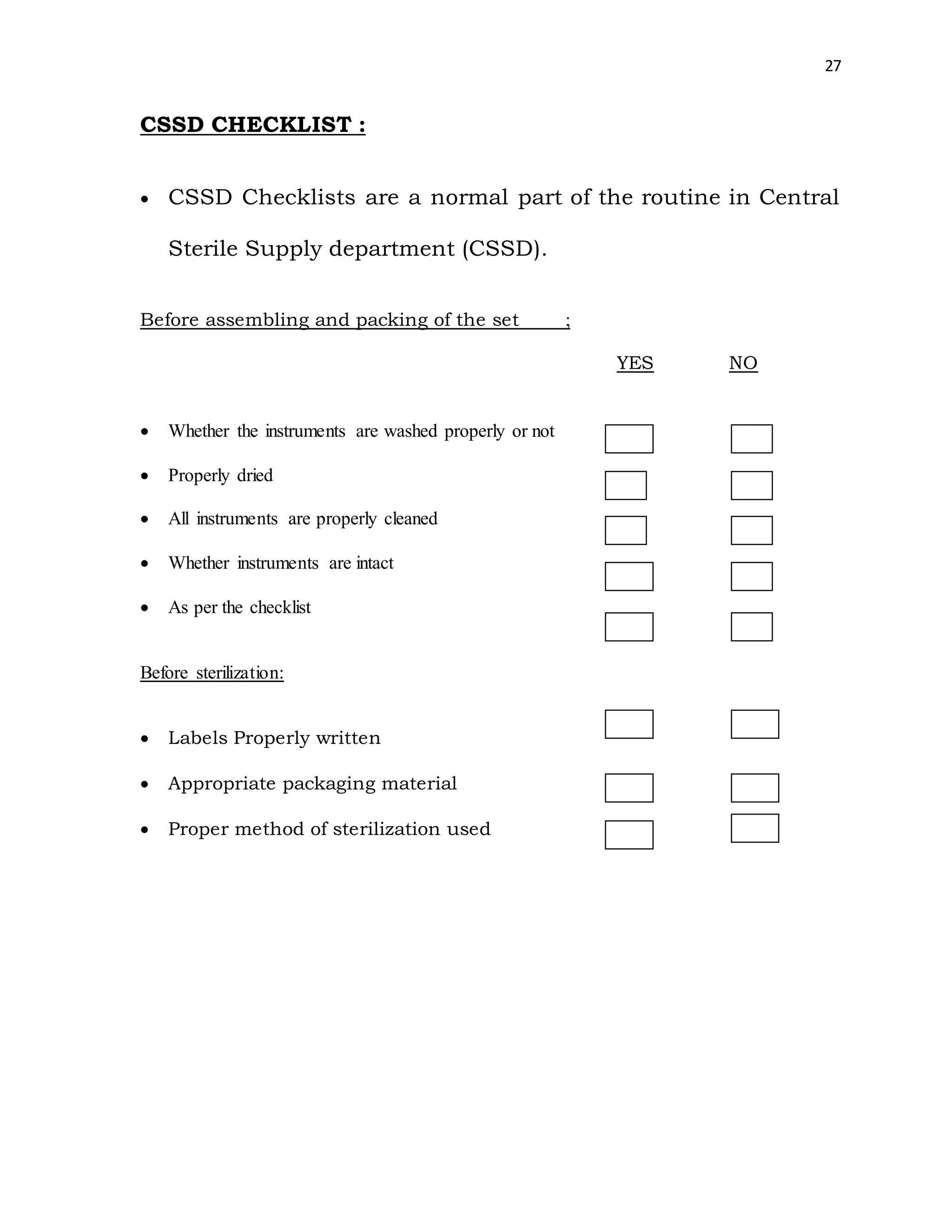
CSSD CHECKLIST :
 CSSD Checklists are a normal part of the routine in Central
Sterile Supply department (CSSD).
Before assembling and packing of the set ;
YES NO
 Whether the instruments are washed properly or not
 Properly dried
 All instruments are properly cleaned
 Whether instruments are intact
 As per the checklist
Before sterilization:
 Labels Properly written
 Appropriate packaging material
 Proper method of sterilization used
28
MISSING INSTRUMENTS / ITEMS
Procedure
• When wash or preparation room staff identifies a missing
instrument or part of an instrument the Operator will immediately
isolate the tray and contact theatre.
• The Operator will ensure that:
 All wash baskets are checked.
 The washer disinfectors are checked
 All transport trolleys are checked.
 The floor areas are checked
 Linen and rubbish sacks are checked
• If located, the missing item will be returned to circulation. If the
item is not located, the set will be held out of circulation until it is
found or, authority from senior theatre staff for it to be replaced, if
possible, the tray put back into circulation or, quarantined.
29
• If the set is required to be put into use without replacing the
instrument, a note must be completed and the sister concerned
sign as authority to proceed.
• The incident must be fully recorded
30
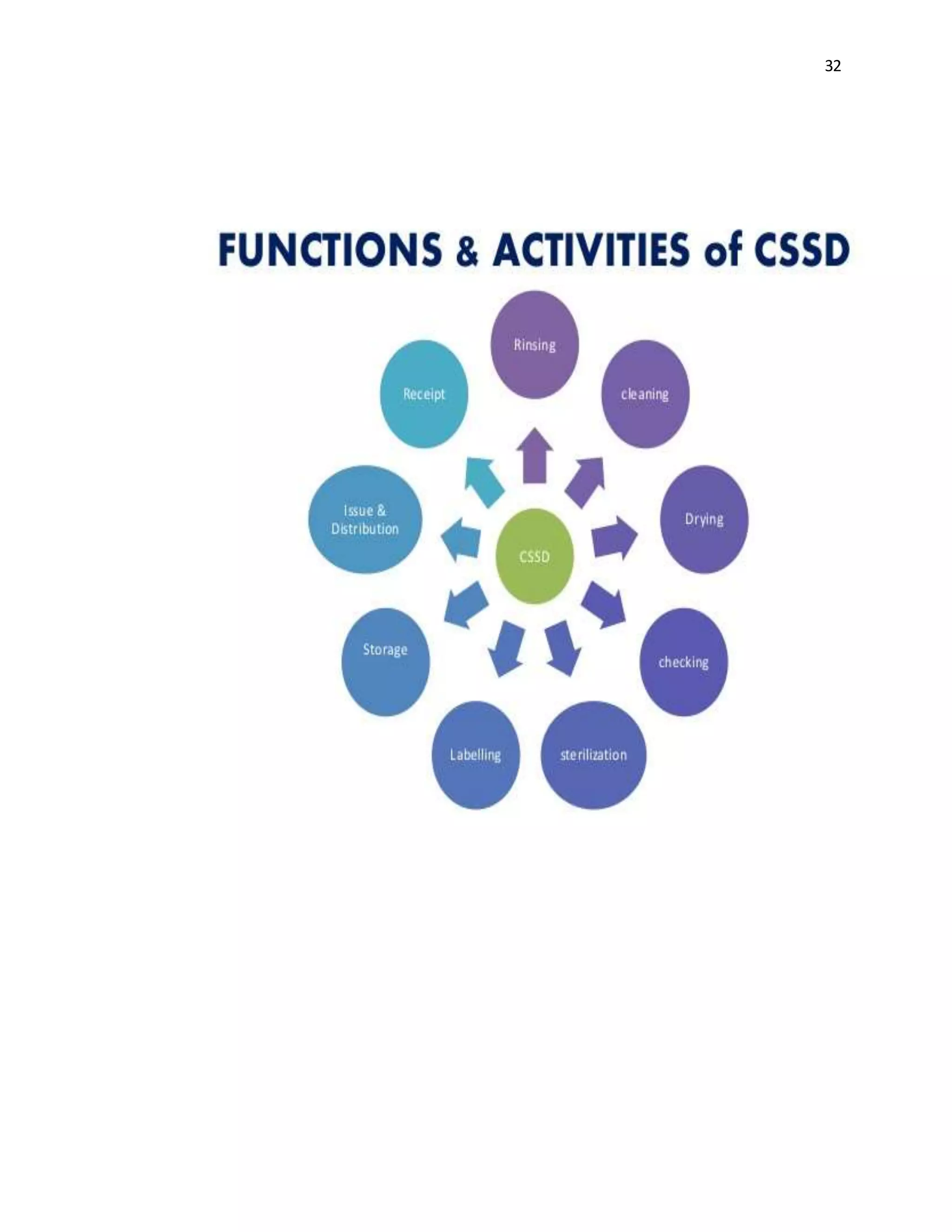
5. FUNCTIONS AND ACTIVITIES
 Records the daily instruments, linen, etc received by various
departments for sterilization.
 Classification of the instruments, linen, etc based on the type
of sterilization technique.
 Locating various items in the CSSD.
 Tagging the items with the date of sterilization.
 Online receipt of requirements from the Operation Theater and
wards.
 Scheduling maintenance of the equipment used for
sterilization.
 Monitoring the quality of sterilization.
 Receipt: This includes receiving the materials, supplies and
equipment, dressings and other specialised surgical items for
processing.
 Cleaning: This function means cleaning of the used
equipments/materials, rubber and plastic goods either
manually or by machines eg., ultrasonic cleaner, jet glove
washing machines, washer disinfectors, anesthetic tubing
31
washers and dryers. This function may also include cleaning
of the delivery trolleys.
 Checking, Assembling and Packaging: It includes checking of
glass items for breakages, needles and instruments for
sharpness and breakages, assembling of the equipment after
washing and drying, making sets and packaging for
sterilization.
 Sterilisation: It renders materials bacteriologically safe for
quality patient care.
 Labeling: Easy identification for prompt and proper use.
 Storage: The function includes storage of sterilised packs,
drums and disposables, dressing materials, spare parts of
machines or sterilisers for routine maintenance and broken/
unserviceable items for condemnation. Paper is fast replacing
linen wrappers. Space should also be provided for storing
distribution trolleys. Sterile store maintains inventory of all
types of sterile packs.
 Issue and Distribution: The function entails issue of the
sterilised packages, dressings, linen, instruments and
disposables to various departments of the hospitals.
32
33
6. SAFETY PRACTICES FOR CSSD
 All staff must receive training covering the OSHA Blood
borne Pathogen Standard and other safety procedures at
least annually.
 The CSSD staff shall be responsible for the prevention of
any accidents in the department.
 Standard precaution including the following
recommendations will be observed:-
- Caution should be taken while handling sharps.
- Contaminated needles should not be recapped.
- Needles should not be bent, broken or manipulated
by hand.
- Sharps must be placed in puncture resistant
containers.
- Hands and other skin surfaces that are
contaminated with potentially infectious fluids
should be immediately and thoroughly washed.
- Eating and drinking is prohibited in the work areas.
 Proper body mechanics must be employed while moving
carts and lifting equipment to avoid back injuries.
34
 Frequent hand washing is required, even though gloves
are worn.
 The CSSD staff shall know the location of Fire Alarm,
Telephone, and extinguisher.
 The CSSD staff shall have a complete understanding of
Hospital program, the Internal and external disaster
plan.
 Electrical Safety:
- Any defective malfunctioning equipment e.g. frayed
wires must be reported To engineering affairs
departments (Biomedical) immediately.
- New equipment must be checked by biomedical
prior to use.
- All electrical equipment must be switched off
immediately after use.
 Always use the safety ladder to access high shelves .be
sure ladder in locked and in a safe place.
 All staff must wear gloves, masks and apron when
handling used instruments and Equipment.
35
 All staff must comply with pertinent regulatory guidelines
and CSSD safety Standards.
 In event of steam leak, the person detecting the leak
must turn off the steam Autoclave and inform the CSSD
manager .Call the biomed technician Immediately.
 For chemicals and solution. Always read the labels and
follow the manufacturer Recommendations when using
any type of solutions.
 Protective devices must be worn as recommended by
manufacturers. Care should Be taken to avoid accidental
splashing when preparing solutions.
 Never lift too much. Make it a teamwork job. Ask for help
if object is heavy for one person.
 Sharps: Do not cover knives or sharp instruments with
cloths or papers. Put Those away when not in use. Do
not try to catch a sharp object - or a glass object - if it
starts to fall. Let it go, then pick it up. 5.16 Dispose of
broken glass at once in proper containers. Do not "dig
into" a wastebasket. Hold it by the sides and empty it
into a proper Container.
36
 Never under any circumstances, leave articles in halls or
passageways (cartons, carts, chairs, etc.).Keep halls and
passageways free from water and other items which have
serious injury potential
 Never use oil or grease on equipment. Do not make
repairs, notify the Engineering Department or supervisor
and report that a repair needs to be done and tag the
equipment as defective
 A Material Safety Data Sheets (MSDS) will be obtained for
each hazardous chemical stored or used in the
department. These documents can be obtained from the
manufacturer, the distributor or through the
Environmental
37
CSSD PERSONNEL ATTIRE
The attire to be worn in the various areas of CSSD is designed to
protect both the worker and the patient. The human body is a
major source of contamination in the workplace environment.
Recommended articles of protective attire are worn to provide a
barrier to contamination that may pass from personnel to patient
and of more concern in the CSSD from patient to personnel.
ATTIRE UNIVERSAL TO ALL AREAS OF THE CSSD
First, all personnel in CSSD should wear clean surgical scrubs or
uniforms, whether working in decontamination, preparation and
packaging, or in a sterile storage area. In addition, they should wear
dedicated shoes - clean shoes that are maintained and worn only in
the hospital. These shoes should have non-skid soles and should be
strong enough to prevent injury if a heavy or sharp item drops on
the foot.
ADDITIONAL ATTIRE NEEDED IN DECONTAMINATION :
Because personnel working in decontamination are exposed to more
“dirt” than counterparts assigned to work in other areas of CSSD,
they require additional protection. Personnel working in
decontamination and performing manual cleaning should wear
38
some type of gown or apron; heavy-duty/household cleaning type
or disposable gloves; and impervious shoe covers or boots. When
aerosol formation is likely, a high-filtration efficiency facemask and
eye protection should be added.
The universal attire for all of these areas : Attire referred to as
Personal Protective Equipment(PPE) is required in the
decontamination area because it is designed to protect employees
from splashes and other means of contamination.
It consists of :
 Hair Covering.
 Eye protection such as goggles or glasses with solid side
shields.
 High filtration efficiency face mask.
 A gown with reinforced sleeves that acts as a barrier to fluids.
 Shoe covers that are skid-resistant.
39
CSSD PERSONNEL ATTIRE
40
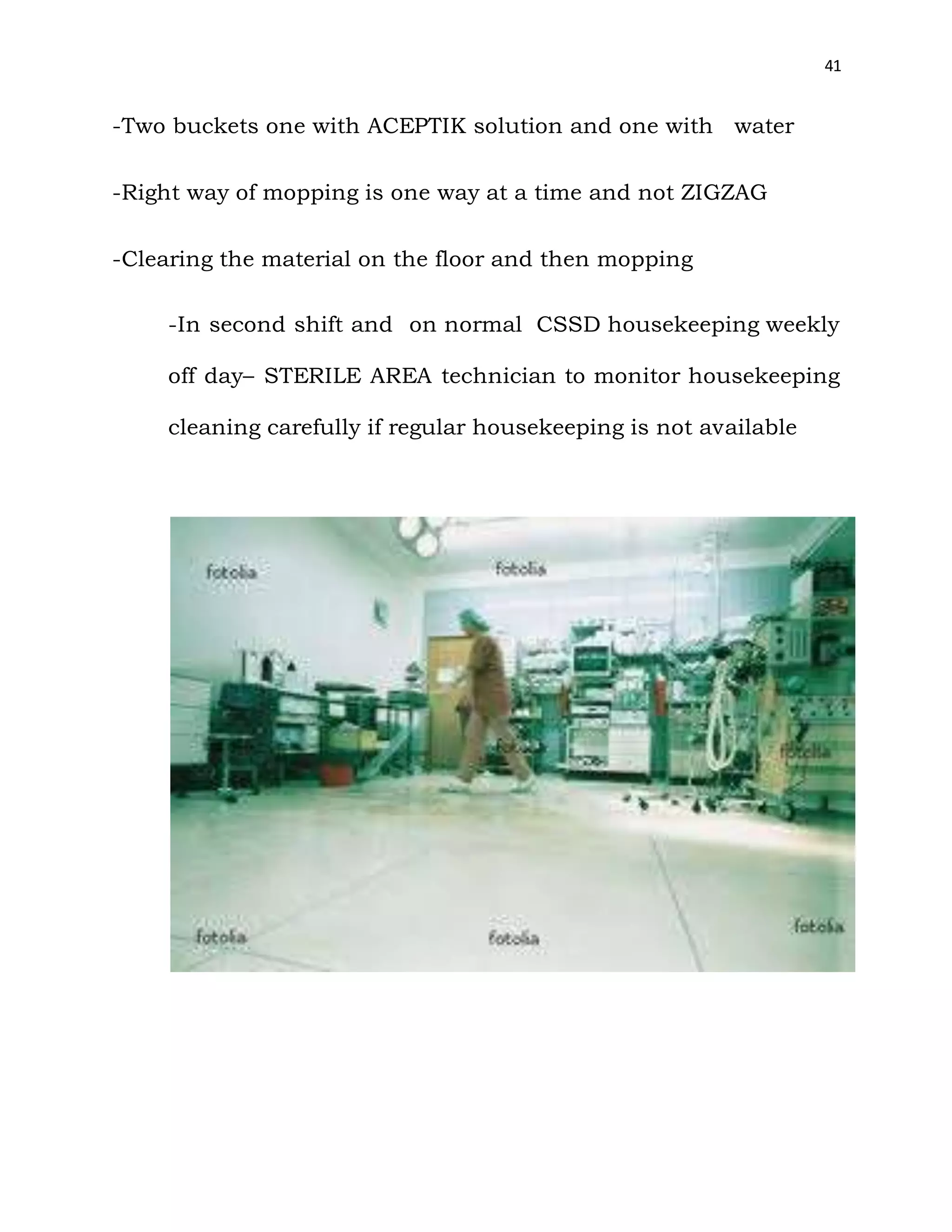
RIGHT METHOD FOR CLEANING OF STERILE AREA DAILY BY
HOUSEKEEPING PERSON
a. Purpose:
To provide, through established practices, policies and
schedules, relevant cleaning measures for the control and
prevention of infection.
b. Policy:
Housekeeping procedures include cleaning and
disinfection/disposal of soiled linen and solid wastes. These
procedures are performed by Housekeeping Services personnel
assigned to the Surgical Services Department. Adequate time
must be allowed between surgical procedures for the proper
cleaning and disinfection of the operating room.
c. Procedure: Following to be checked by Sterile Area
Technician :
-Dedicated mop and bucket with sterile area labeled on it
-Solution used for mopping in sterile area :
–ACEPTIK 50ML in 5 liter water
41
-Two buckets one with ACEPTIK solution and one with water
-Right way of mopping is one way at a time and not ZIGZAG
-Clearing the material on the floor and then mopping
-In second shift and on normal CSSD housekeeping weekly
off day– STERILE AREA technician to monitor housekeeping
cleaning carefully if regular housekeeping is not available
42
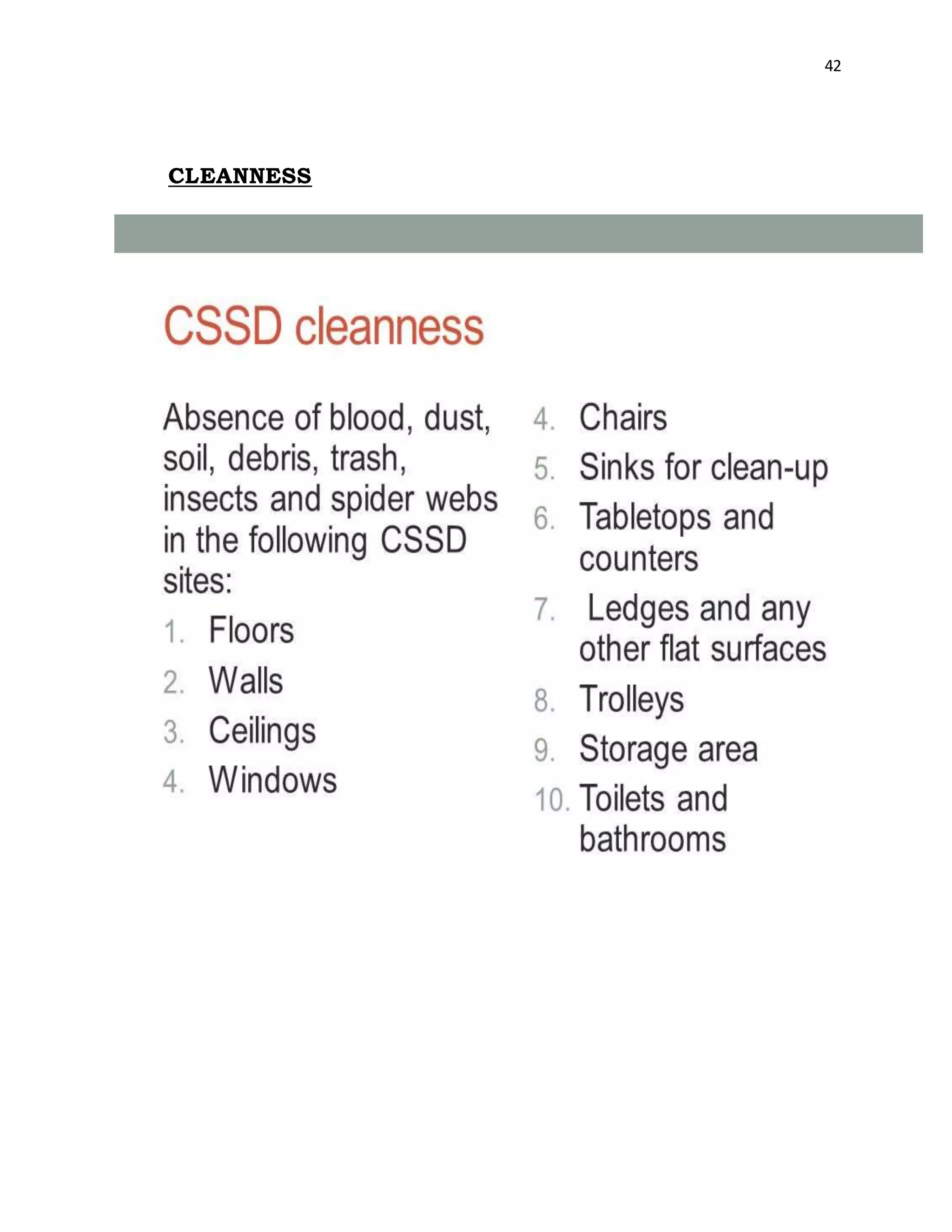
CLEANNESS
43
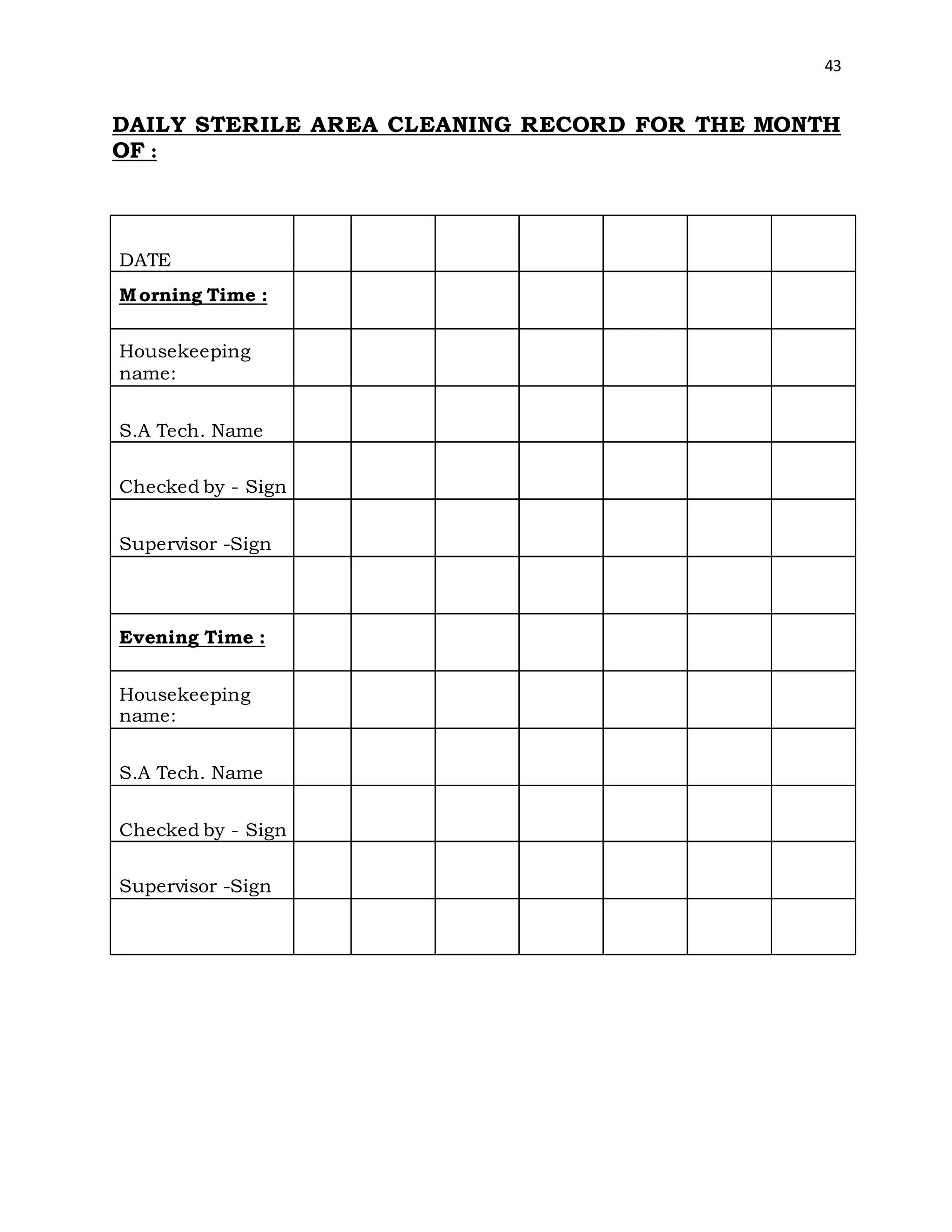
DAILY STERILE AREA CLEANING RECORD FOR THE MONTH
OF :
DATE
Morning Time :
Housekeeping
name:
S.A Tech. Name
Checked by - Sign
Supervisor -Sign
Evening Time :
Housekeeping
name:
S.A Tech. Name
Checked by - Sign
Supervisor -Sign
44
MATERIAL SAFETY DATA SHEET (M S D S ) - SUMMARY
NAME HAZARDS IDENTIFICATION FIRST AID MEASURES
EXTRAN NON-HAZARDOUS
ACEPTIK NON-HAZARDOUS
RAPID MULTI
ENZYME NON-HAZARDOUS
AFTER INHALATION
BACTO SCRUB NON-HAZARDOUS
- GO TO OPEN AREA FOR FRESH
AIR
INHALATION - NO WORRY
SKIN CONTACT-NO WORRY AFTER SKIN CONTACH
-WASH OFF WITH PLENTY OF
WATER
NEODISHER
IP-SPRAY HAZARDOUS
- REMOVE CONTAMINATED
CLOTHING
EXTREMELY FLAMMABLE
(SKIN CONTACT-NO
SPECIAL MEASURES) AFTER EYE CONTACH
- RINSE OUT WITH PLENTY OF
WATER WITH
ETHER HAZARDOUS EYE LID HELD WIDE OPEN.
EXTREMELY FLAMMABLE
IF
IRRITATION/REDNESS/WATERING
PERSISTS
CALL OPTHALMOLOGIST IF
NECESSARY
BACILLOL HAZARDOUS
SKIN CONTACT-NO
SPECIAL AFTER SWALLOWING
MEASURES NECESSARY - IMMEDIATELY CALL PHYSICIAN
ETO
CARTRIDGE HAZARDOUS - FLAMMABLE
INHALATION - GO TO OPEN
AREA FOR
FRESH AIR. IF BREATHING
PROBLEM
CALL THE PHYSICIAN
45
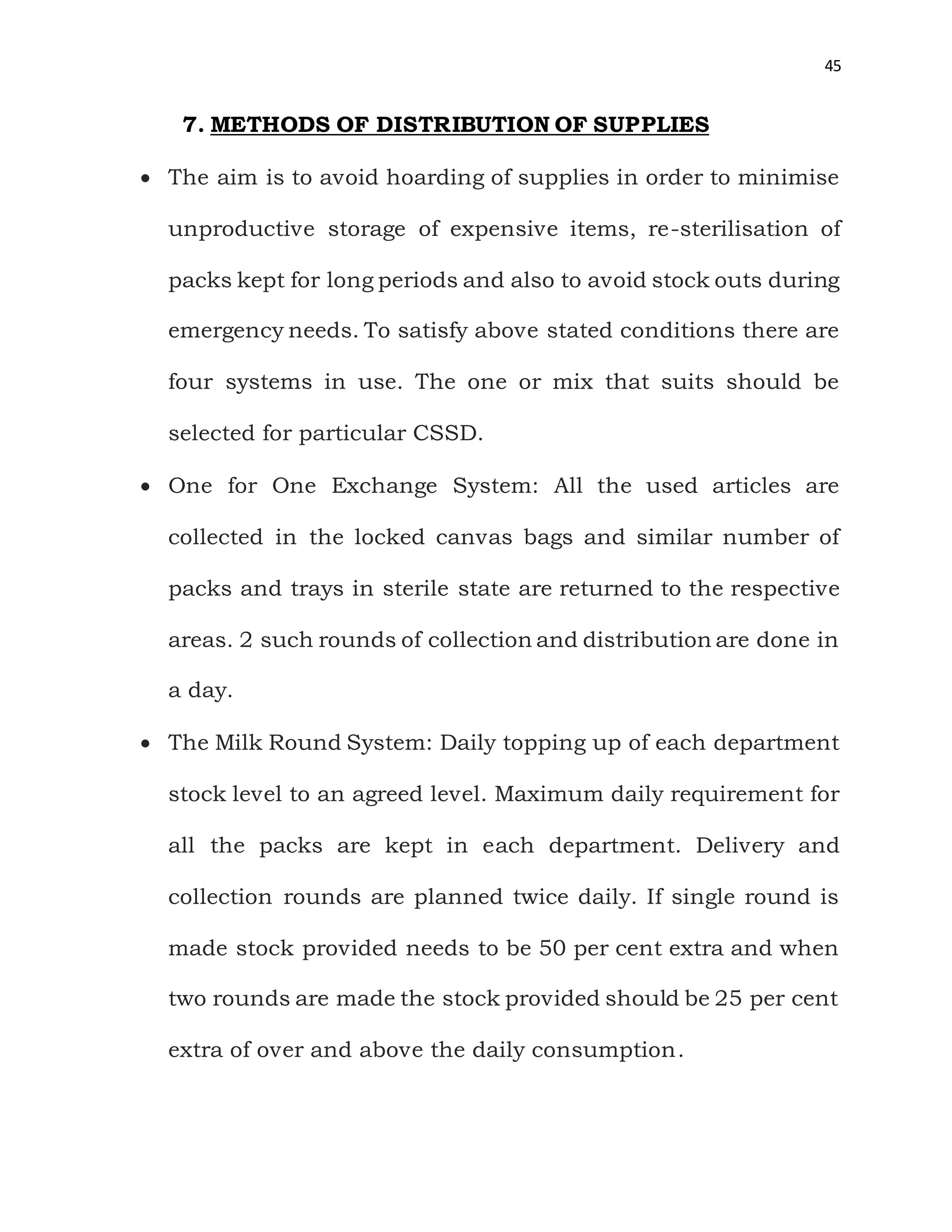
7. METHODS OF DISTRIBUTION OF SUPPLIES
 The aim is to avoid hoarding of supplies in order to minimise
unproductive storage of expensive items, re-sterilisation of
packs kept for long periods and also to avoid stock outs during
emergency needs. To satisfy above stated conditions there are
four systems in use. The one or mix that suits should be
selected for particular CSSD.
 One for One Exchange System: All the used articles are
collected in the locked canvas bags and similar number of
packs and trays in sterile state are returned to the respective
areas. 2 such rounds of collection and distribution are done in
a day.
 The Milk Round System: Daily topping up of each department
stock level to an agreed level. Maximum daily requirement for
all the packs are kept in each department. Delivery and
collection rounds are planned twice daily. If single round is
made stock provided needs to be 50 per cent extra and when
two rounds are made the stock provided should be 25 per cent
extra of over and above the daily consumption.
46
 The Grocery System: The departments send their requisition to
CSSD from where deliveries are made in accordance with the
demand. This system is sometimes not practical as some
departments demand the entire amount of stock from the
CSSD having nothing left for the others. The efficiency of the
system depends on the wisdom and experience of the person
making the indent.
 The Clean for Dirty Exchange System: According to this
system one clean article is issued for each dirty returned to
the CSSD.
 The Sterile Supply Department within a hospital receives
stores, sterilizes and distributes to all departments including
the wards, outpatient department [OPD] and other special
units such as operating theatre [OT]. Major responsibilities of
CSSD include processing and sterilization of syringes, rubber
goods [catheters, tubing], surgical instruments, treatment
trays and sets, dressings etc. it is also responsible for
economic and effective utilization of equipment resources of
the Hospital under controlled supervision
47
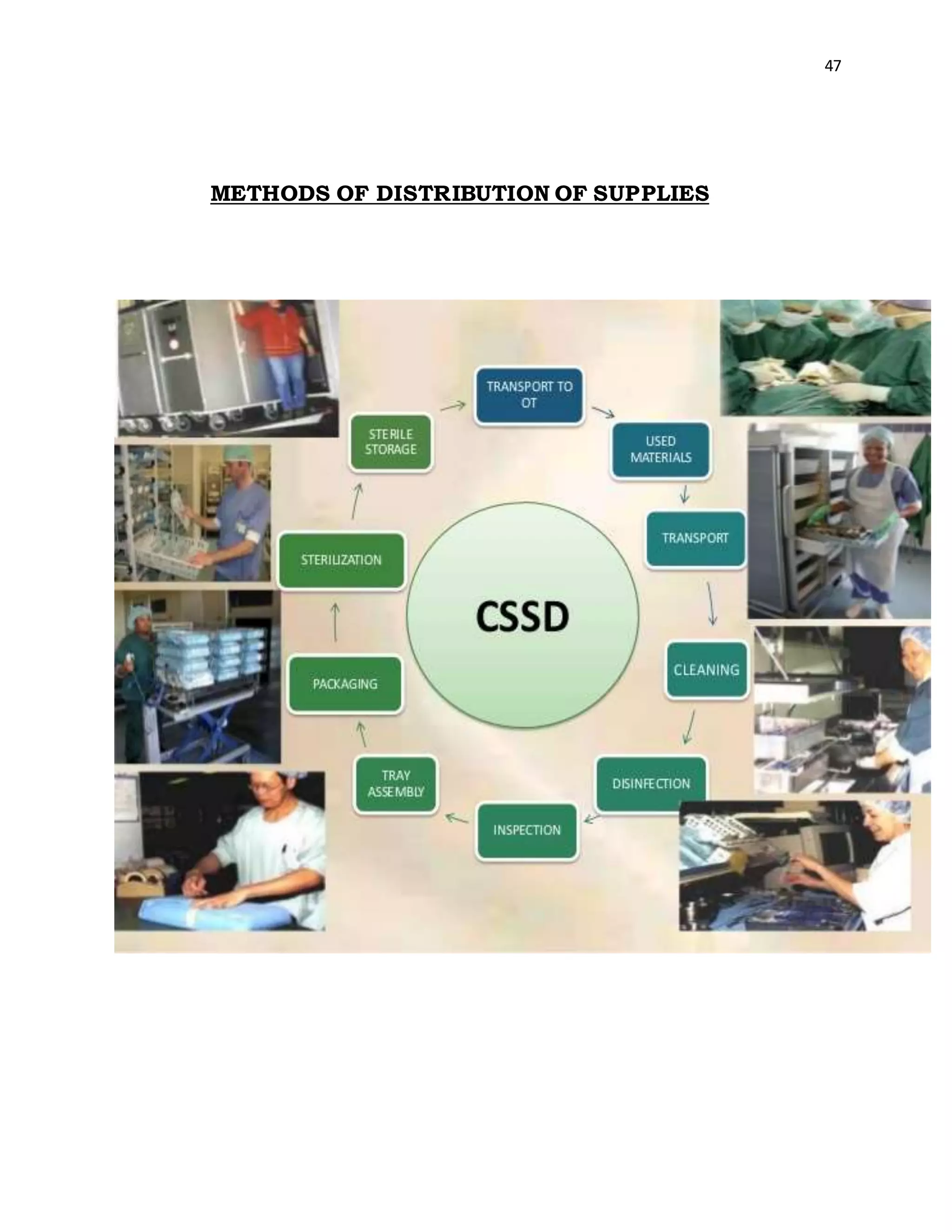
METHODS OF DISTRIBUTION OF SUPPLIES
48
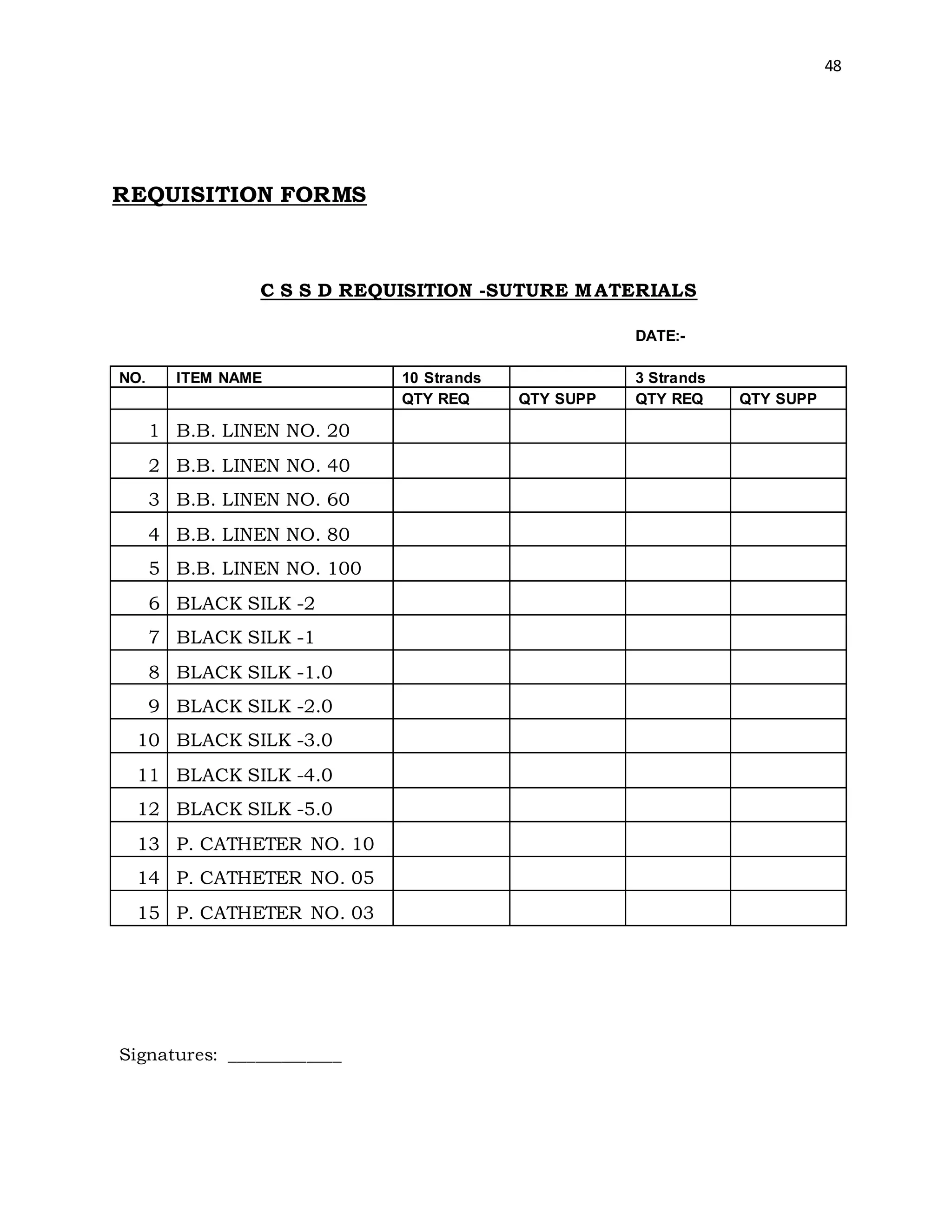
REQUISITION FORMS
C S S D REQUISITION -SUTURE MATERIALS
DATE:-
NO. ITEM NAME 10 Strands 3 Strands
QTY REQ QTY SUPP QTY REQ QTY SUPP
1 B.B. LINEN NO. 20
2 B.B. LINEN NO. 40
3 B.B. LINEN NO. 60
4 B.B. LINEN NO. 80
5 B.B. LINEN NO. 100
6 BLACK SILK -2
7 BLACK SILK -1
8 BLACK SILK -1.0
9 BLACK SILK -2.0
10 BLACK SILK -3.0
11 BLACK SILK -4.0
12 BLACK SILK -5.0
13 P. CATHETER NO. 10
14 P. CATHETER NO. 05
15 P. CATHETER NO. 03
Signatures: _____________
49
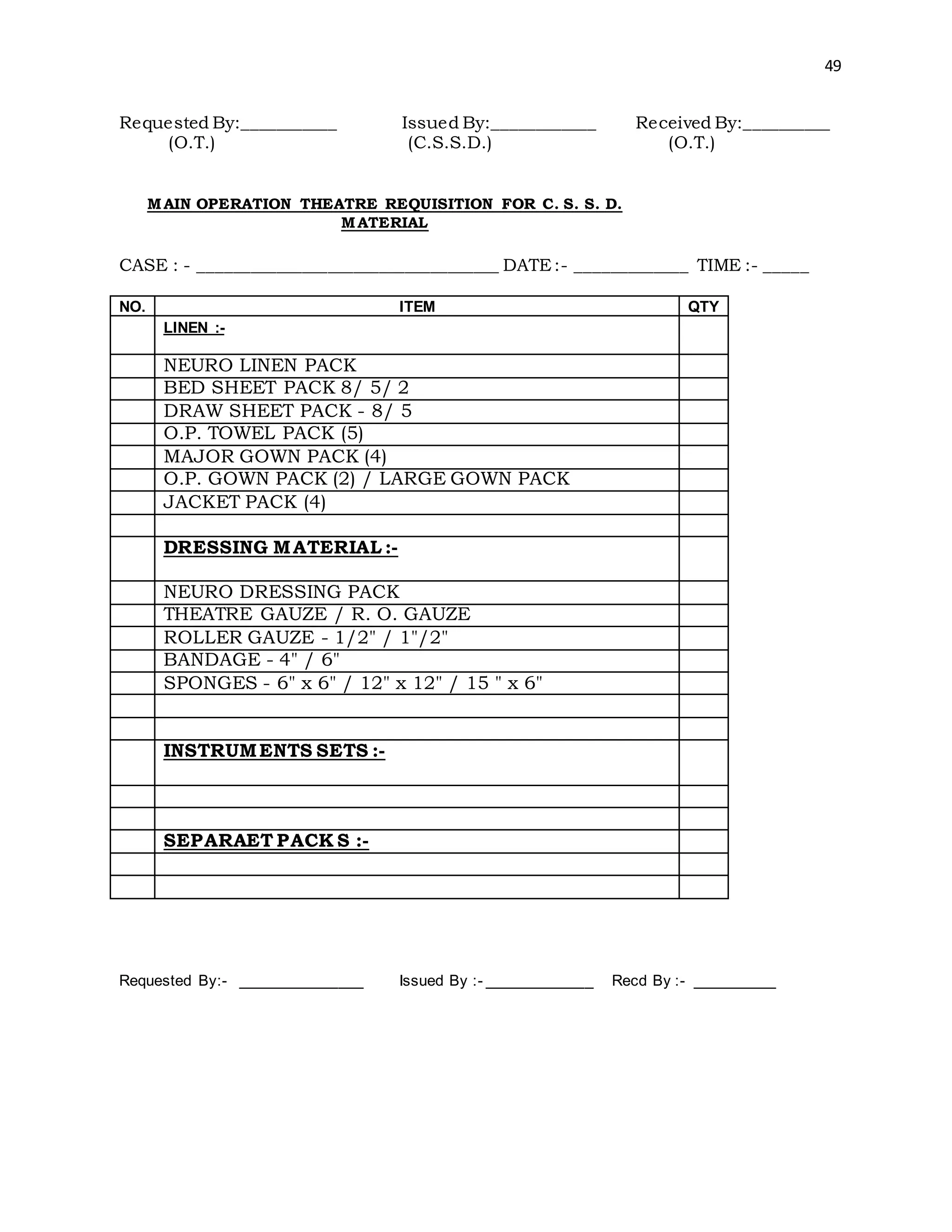
Requested By:___________ Issued By:____________ Received By:__________
(O.T.) (C.S.S.D.) (O.T.)
MAIN OPERATION THEATRE REQUISITION FOR C. S. S. D.
MATERIAL
CASE : - ___________________________________ DATE:- _____________ TIME :- _____
NO. ITEM QTY
LINEN :-
NEURO LINEN PACK
BED SHEET PACK 8/ 5/ 2
DRAW SHEET PACK - 8/ 5
O.P. TOWEL PACK (5)
MAJOR GOWN PACK (4)
O.P. GOWN PACK (2) / LARGE GOWN PACK
JACKET PACK (4)
DRESSING MATERIAL :-
NEURO DRESSING PACK
THEATRE GAUZE / R. O. GAUZE
ROLLER GAUZE - 1/2" / 1"/2"
BANDAGE - 4" / 6"
SPONGES - 6" x 6" / 12" x 12" / 15 " x 6"
INSTRUMENTS SETS :-
SEPARAET PACK S :-
Requested By:- _______________ Issued By :- _____________ Recd By :- __________
50
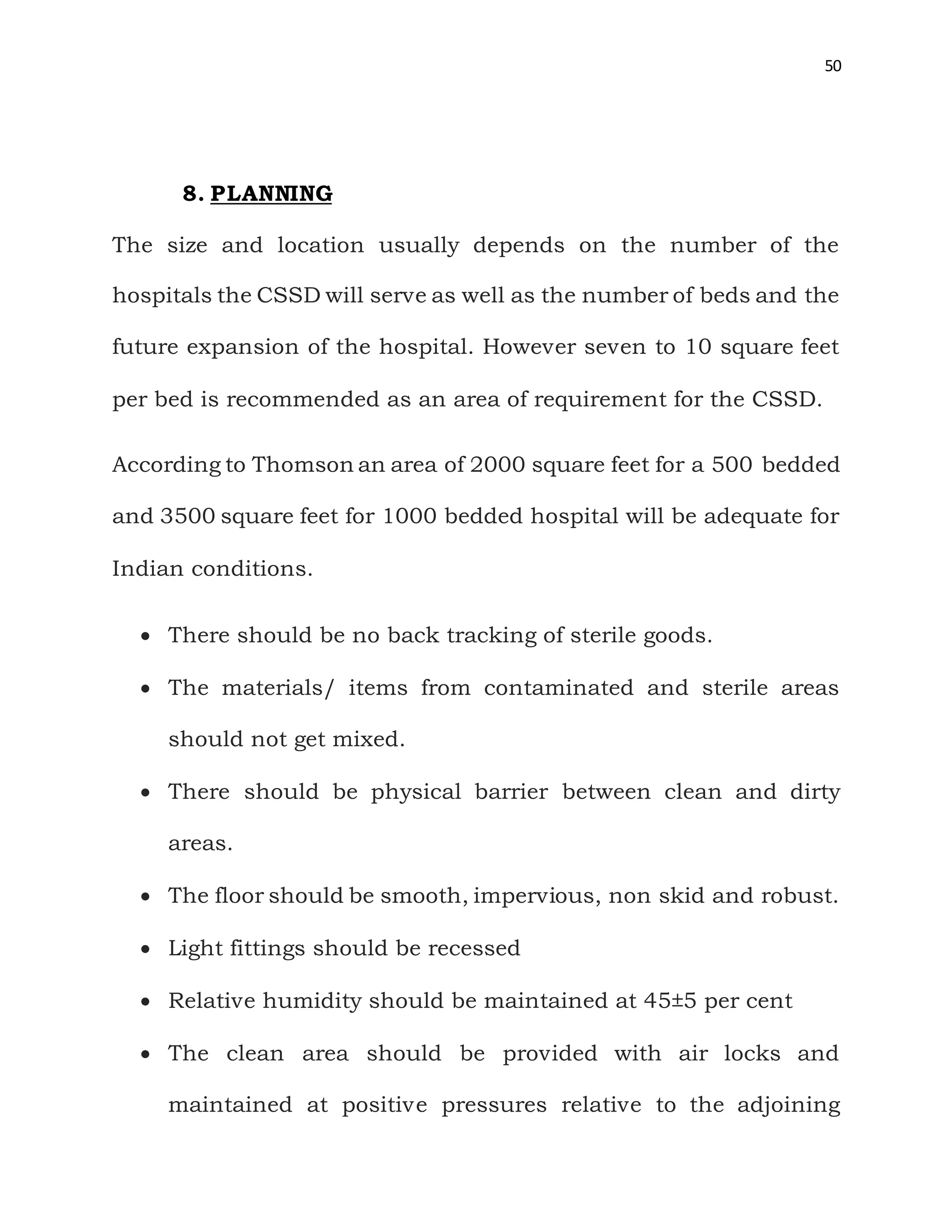
8. PLANNING
The size and location usually depends on the number of the
hospitals the CSSD will serve as well as the number of beds and the
future expansion of the hospital. However seven to 10 square feet
per bed is recommended as an area of requirement for the CSSD.
According to Thomson an area of 2000 square feet for a 500 bedded
and 3500 square feet for 1000 bedded hospital will be adequate for
Indian conditions.
 There should be no back tracking of sterile goods.
 The materials/ items from contaminated and sterile areas
should not get mixed.
 There should be physical barrier between clean and dirty
areas.
 The floor should be smooth, impervious, non skid and robust.
 Light fittings should be recessed
 Relative humidity should be maintained at 45±5 per cent
 The clean area should be provided with air locks and
maintained at positive pressures relative to the adjoining
51
spaces. The minimum ventilation rate should be six to 10 air
changes per hour.
 The work area should be made of marble / granite / stainless
steel
 The sterilization must be planned for autoclaving by steam as
well as by gas since certain items such as rubber, plastic or
delicate instruments cannot be autoclaved
52
9. LOCATION
The CSSD should be close to the causality, operation theatre and
wards which are the largest consumer of the sterilised material. In
multispecialty hospital, the Operation Theaters (OT) requires huge
supplies of sterile surgical instruments and sterile linen which are
the major users of CSSD. The other users of CSSD include ICUs,
emergency and Labor room etc. Therefore, the location of CSSD
should be in proximity to OT where vertical movement will be the
quickest possible movement of the material.
The autoclave machines in the CSSF emit lot of heat, so the facility
should have at least one side exposed to open space.
Because of shortage of space, now a day’s many hospitals establish
the CSSD in the basement. The CSSD can be connected to OT
complex through small elevators
53
10. LAYOUT DESIGN
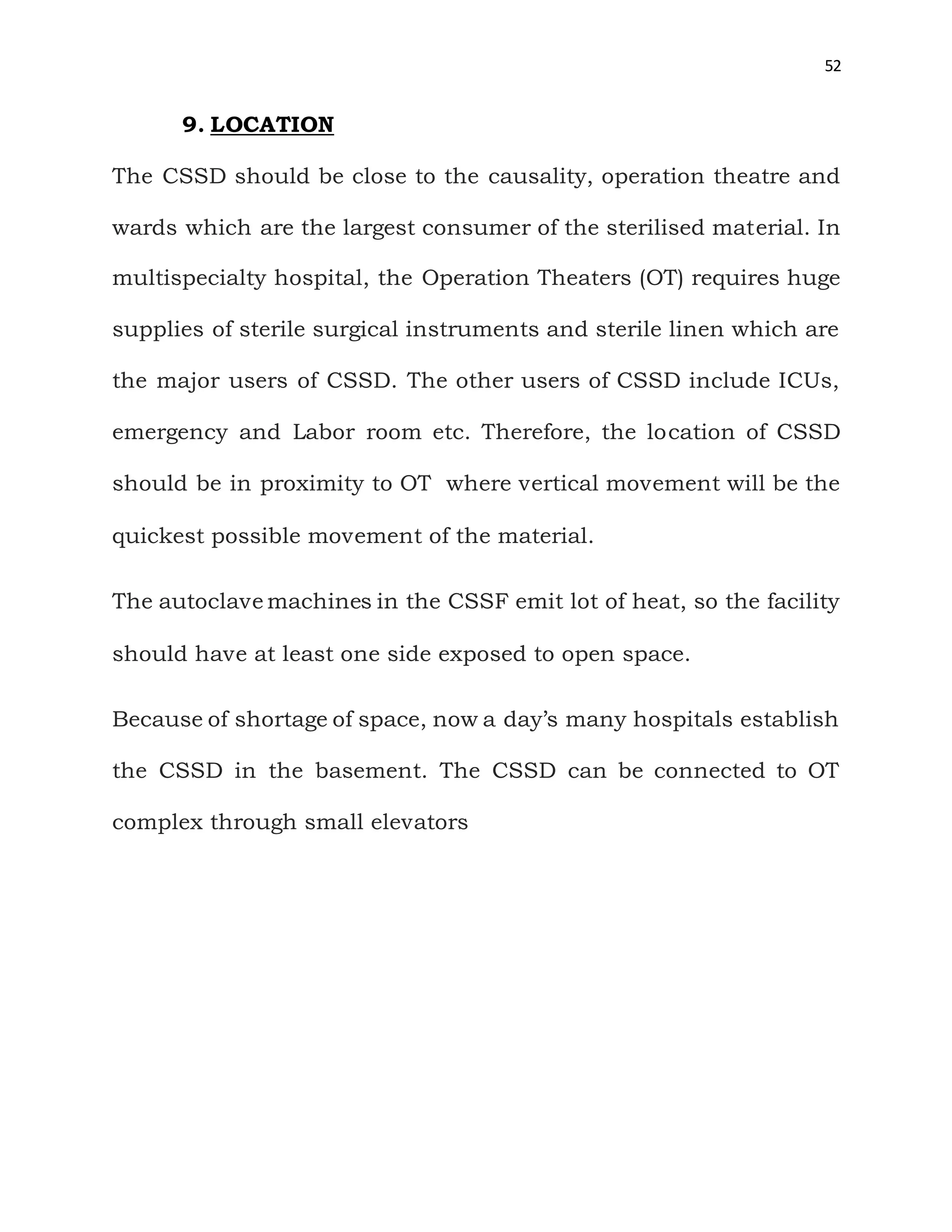
The CSSD should have four zones for a smooth work flow. The
following facilities should be provided in the lay out:
1. Entrance lobby
2. Reception and Cleaning room
3. Glove room
4. Work room (Preparation and assembling of packs)
5. Syringe room
6. Sterilization room
7. Store room
8. Nurses room
9. Staff changing room
10. Cloak room
54
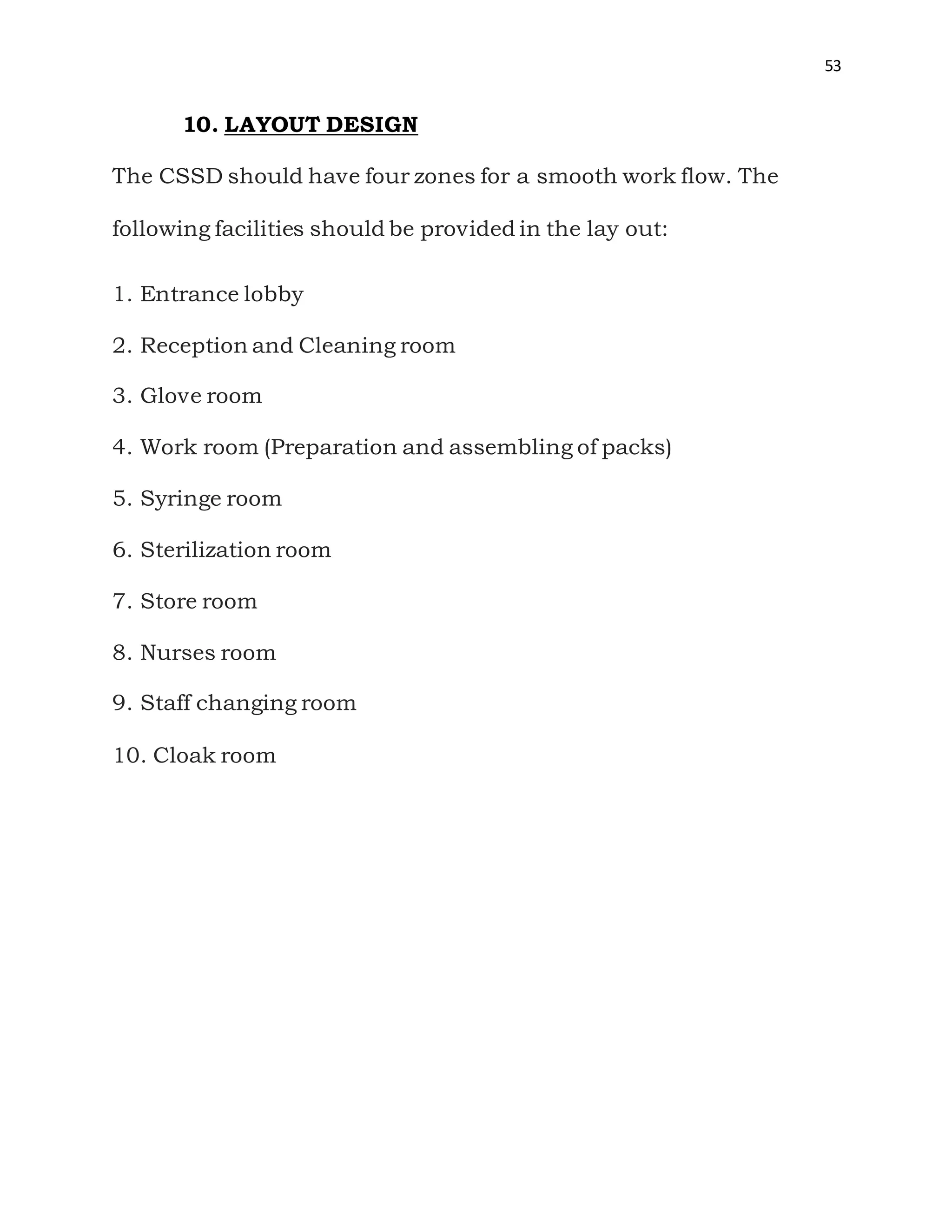
LAYOUT DESIGN
55
LAYOUT
56
ZONES
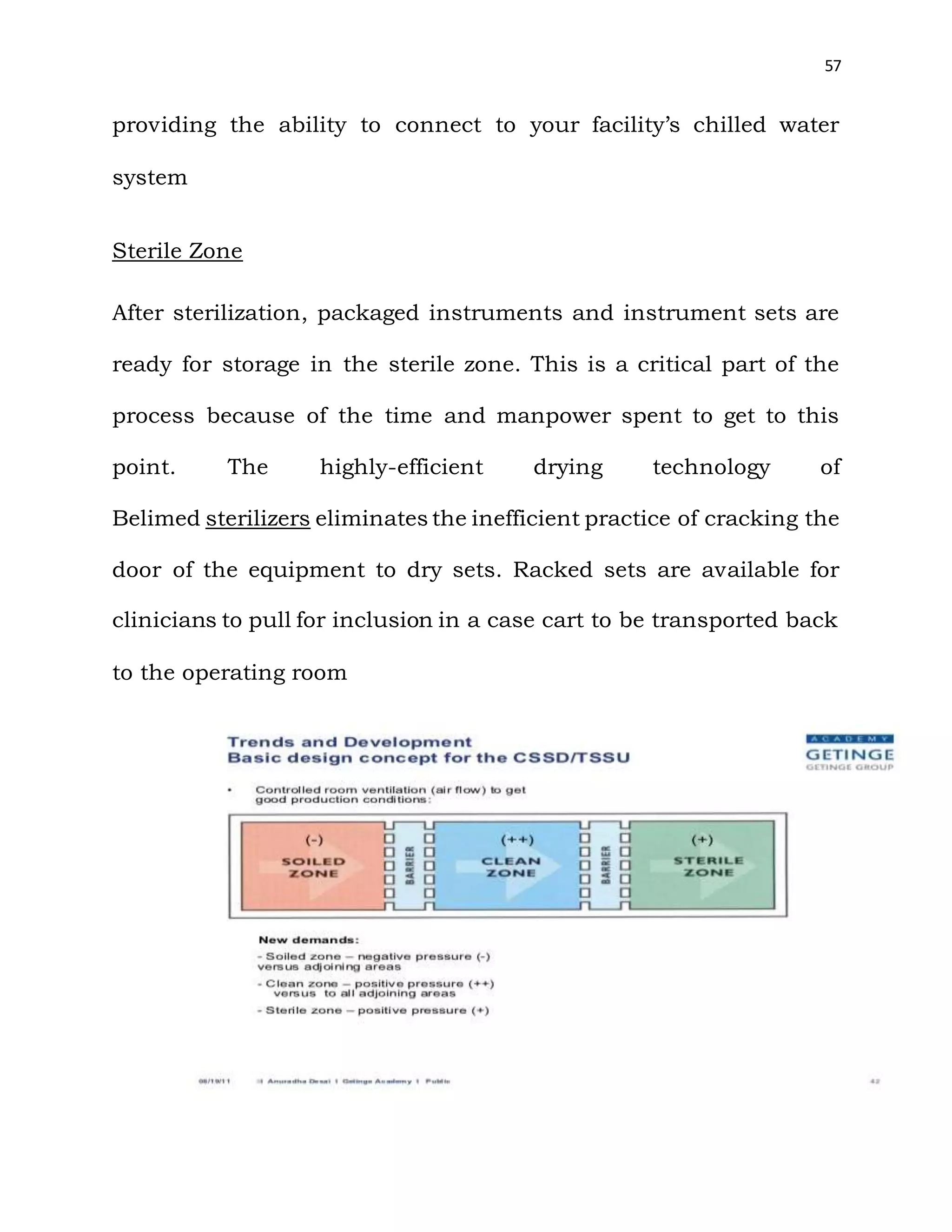
Decontamination Zone
Instruments come to you in the decontamination zone to be
disassembled, sorted, manually pre-cleaned, washed in a sonic, and
readied to be sent through a washer-disinfector. With efficient
equipment and workflow processes, you’ll know each instrument
you process is clean and free of proteins so they are safe to handle
and ready for sterilization.
Clean Zone
In the clean zone, you’re busy sorting medical instruments into
component sets, where they are then inspected, set aside for
maintenance or repair, reassembled and wrapped for terminal
sterilization in a steam autoclave or low-temperature sterilizer. For
the smartest use of space and to ensure operational
efficiency, steam sterilizers from Belimed are available in a variety
of space efficient horizontal and vertical sizes. Each model comes
with the same high quality, unsurpassed resource efficiency by
57
providing the ability to connect to your facility’s chilled water
system
Sterile Zone
After sterilization, packaged instruments and instrument sets are
ready for storage in the sterile zone. This is a critical part of the
process because of the time and manpower spent to get to this
point. The highly-efficient drying technology of
Belimed sterilizers eliminates the inefficient practice of cracking the
door of the equipment to dry sets. Racked sets are available for
clinicians to pull for inclusion in a case cart to be transported back
to the operating room
58
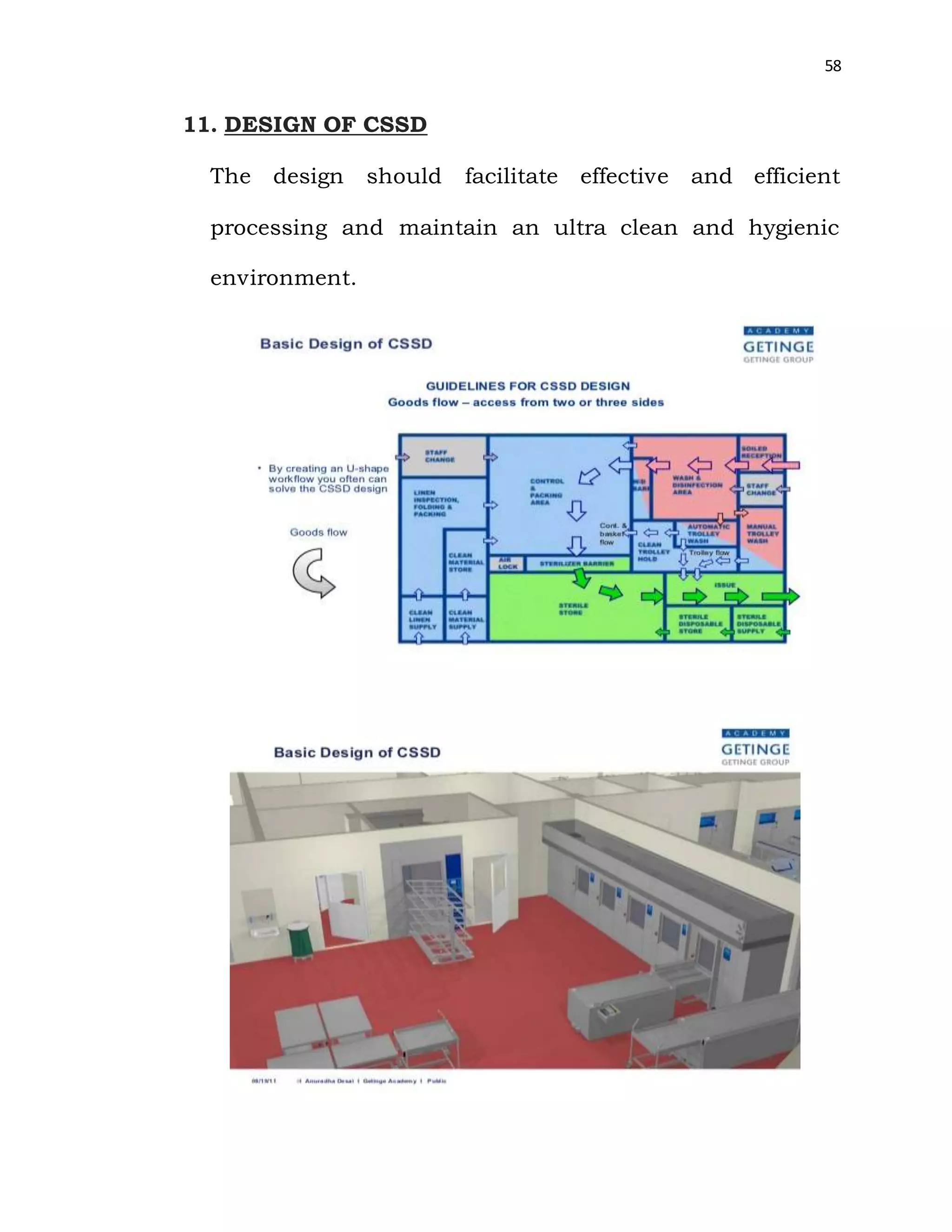
11. DESIGN OF CSSD
The design should facilitate effective and efficient
processing and maintain an ultra clean and hygienic
environment.
59
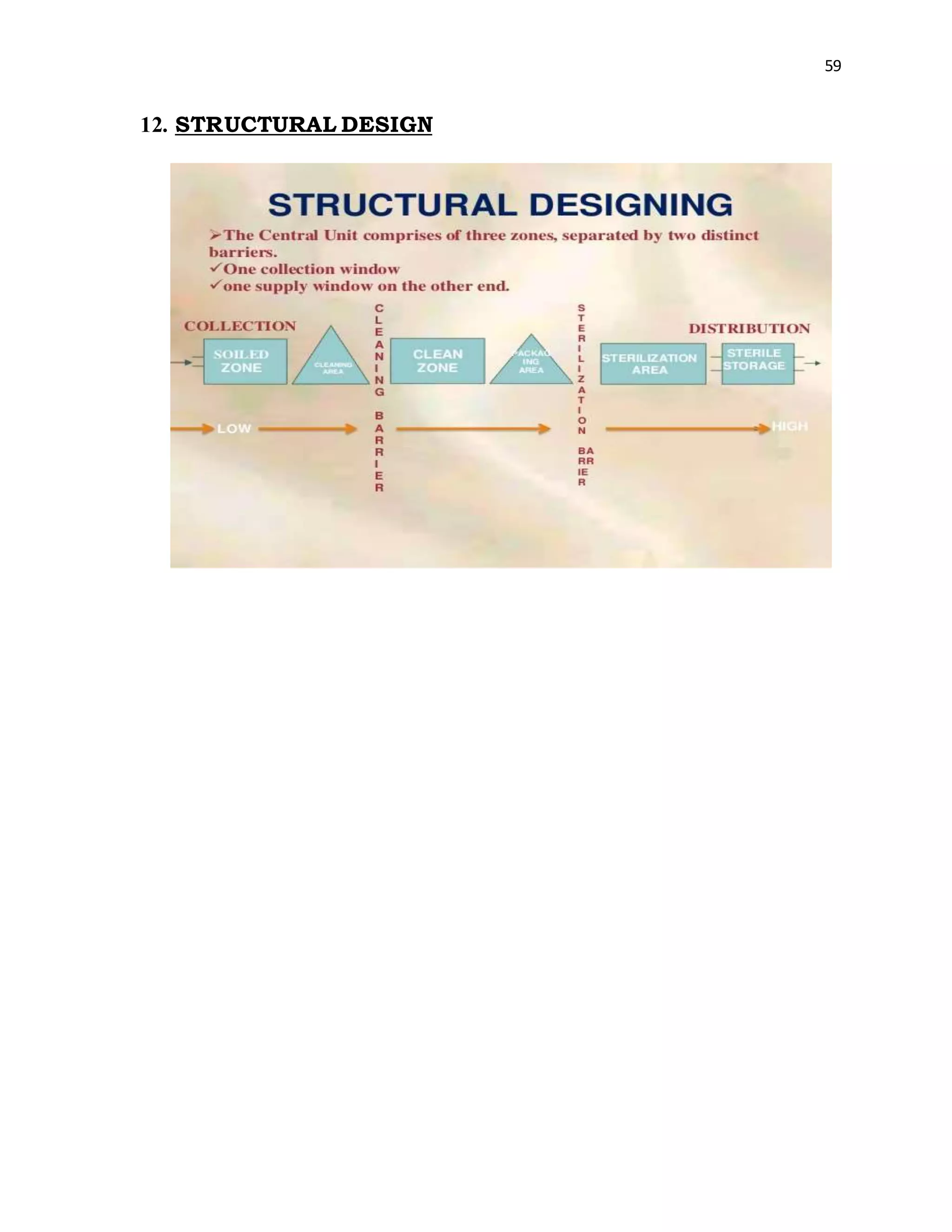
12. STRUCTURAL DESIGN
60
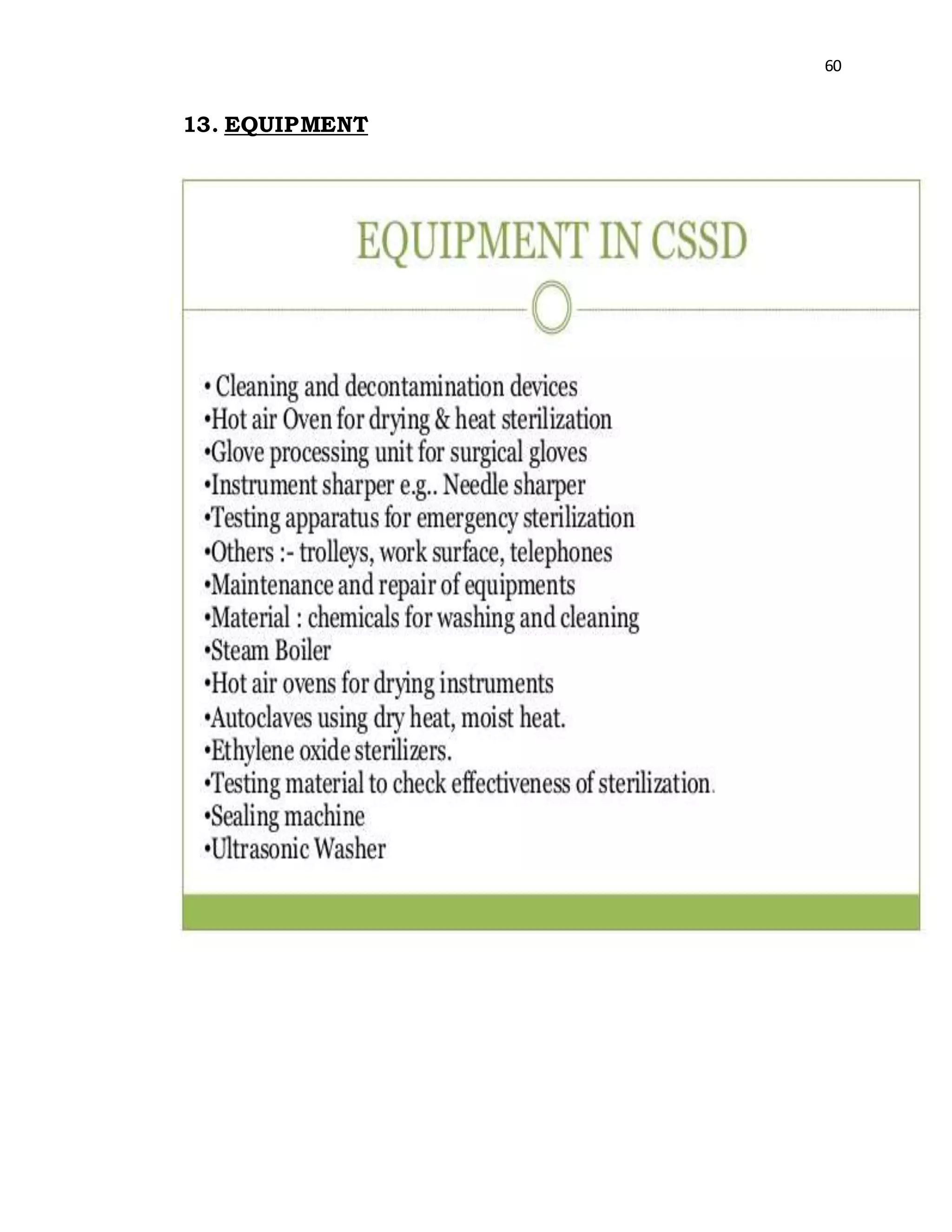
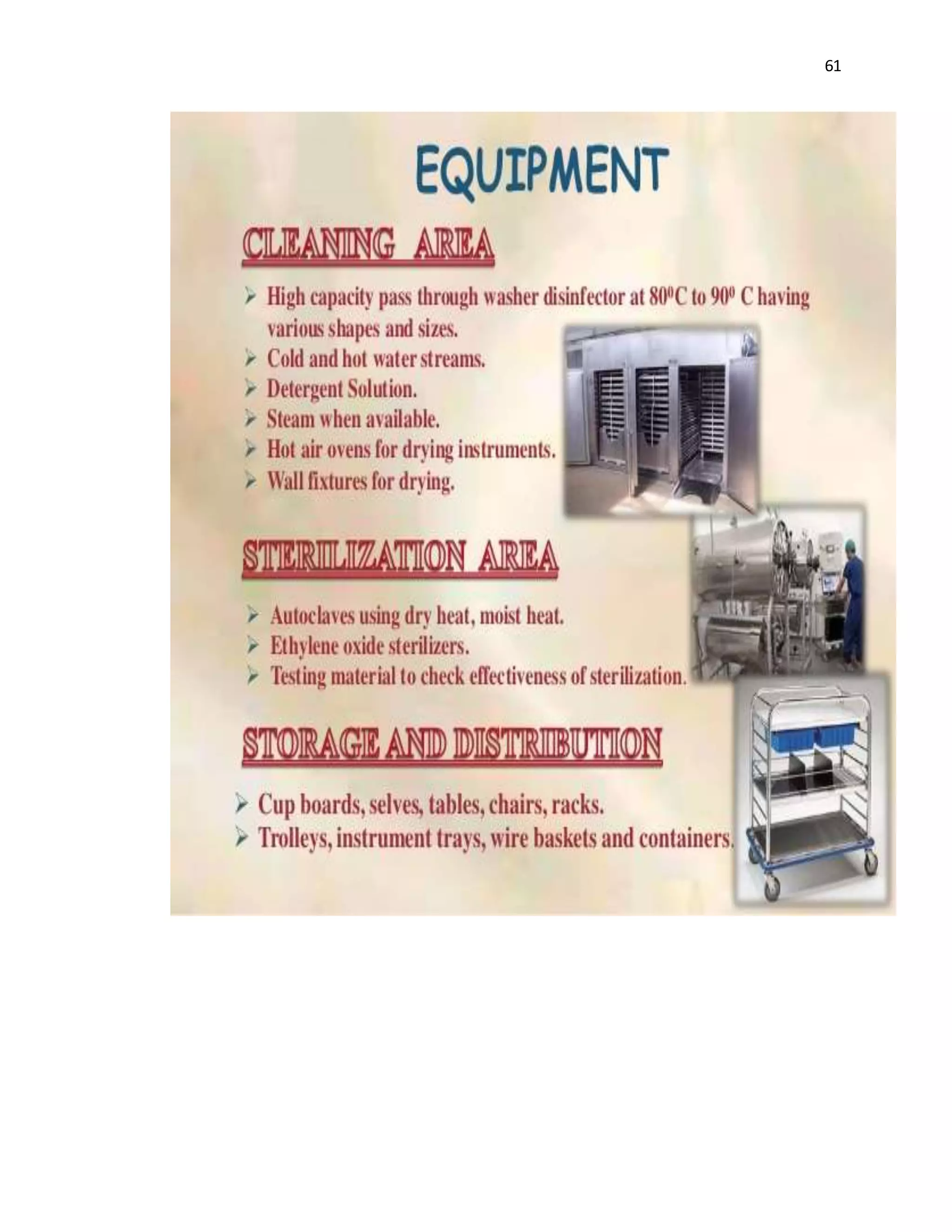
13. EQUIPMENT
61
62
EQUIPMENT PLANNING
63
YEARLY ANALYSIS OF BREAKDOWN OF BIOMEDICAL
EQUIPMENTS
DRIER DISH WASHER
NO PROBLEM ACTION TAKEN PROBLEM ACTION TAKEN
64
VALIDATION OF EQUIPMENT
Procedure
• Ensure all new equipment ordered for CSSD is appropriate and
safe to use
• Copies of any relevant documentation relating to the equipment
must be given to the manager
• Equipment will not be used until it has been validated and an
assurance is given that the equipment will give an acceptable
quality of product and is safe to operate
• The installer / manufacturer should verify in writing that all is in
order by way of a certificate.
• This certificate is to be maintained with the log book for the
equipment
• Equipment will only be used after the necessary training is given
to the staff
• No new or replacement equipment will be used without the
appropriate approval and training
65
14. STAFFING
Staffing should be planned based on following factors:
1. Three shift working
2. Messenger service
3. Maintenance service
4. Staff for 6 areas
5. Leave and off duty
- Average 2 technicians for 100 beds and 1 technical
supervisors
- One clerk for keeping records, accounting and
supply/shift
- Adequate number of cleaning attendants and
transporters
- One technician and two attendants should be stationed
at each zone
66
The staffing pattern in a tertiary care centre for the CSSD should be
as follows:
- One CSSD In-charge
- One CSSD trained technician
- One staff nurse
- CSSD Assistants
- General Duty Workers
67
15. QUALITY CONTROL
1.Indicator tapes
-Time, Temperature, pressure tapes
-Does not indicate for sensitivity for sterilization, but only
suggest the required time and pressure the items have been
subjected
2. Bacteriological indicator
- Kept in centre of pack before the process and later on
subjected to lab for colony count and growth
-A pack of non-pathogenic bacterial spore(stearo-themopiles)
is placed in each load to check quality.
-If the level of sterilization is satisfactory, the green/brown
color change to black
3.Personnel should be adequately trained to handle the
equipments
4.Regular maintenance of equipments be done
5.The hospital infection control committee monitors the
sterilization by drawing samples and going in medias for
colony count.
68
QUALITY ASSURANCE
In order to endure the quality of sterilization, following measures
are there :
-Ensure the equipment is fit i.e in autoclave the temperature is
maintained at 121° centigrade, 15-pound pressure and holding time
is minimum 20 minutes. Modern machines assure that and are
fitted with good quality monitors. They provide print outs of
readings. The doors of the autoclave do not open unless the cycle is
complete
-Bowie Dick’s tapes are fixed with every pack of items to be
sterilized. This tapes changes the color whenever the required
temperature is attained. After a cycle, the tapes are checked for
change of color. However, the change in color only indicates that
the specific temperature has been achieved during the cycle but
cannot guarantee that the items are sterilized. Indicators are also
available for checking the quality of ETO sterilization
-Periodically bacteriological tests are to be done. A capsule
containing Bacillus Stereothermophilus(for autoclave) and Bacillus
Subtilis (for ETO) are put along with the load. These bacteria are
69
considered most resistant to steam or gas respectively. After the
cycle is over these capsules are tested in microbiology lab for
presence of liver organisms. If there are no live organisms in the
capsules, it indicates the sterilization process was effective
- The staffs who work especially in sterilization area, sterile store
and distribution area should change slippers and their dress, and
wash their hands before resuming work.
70
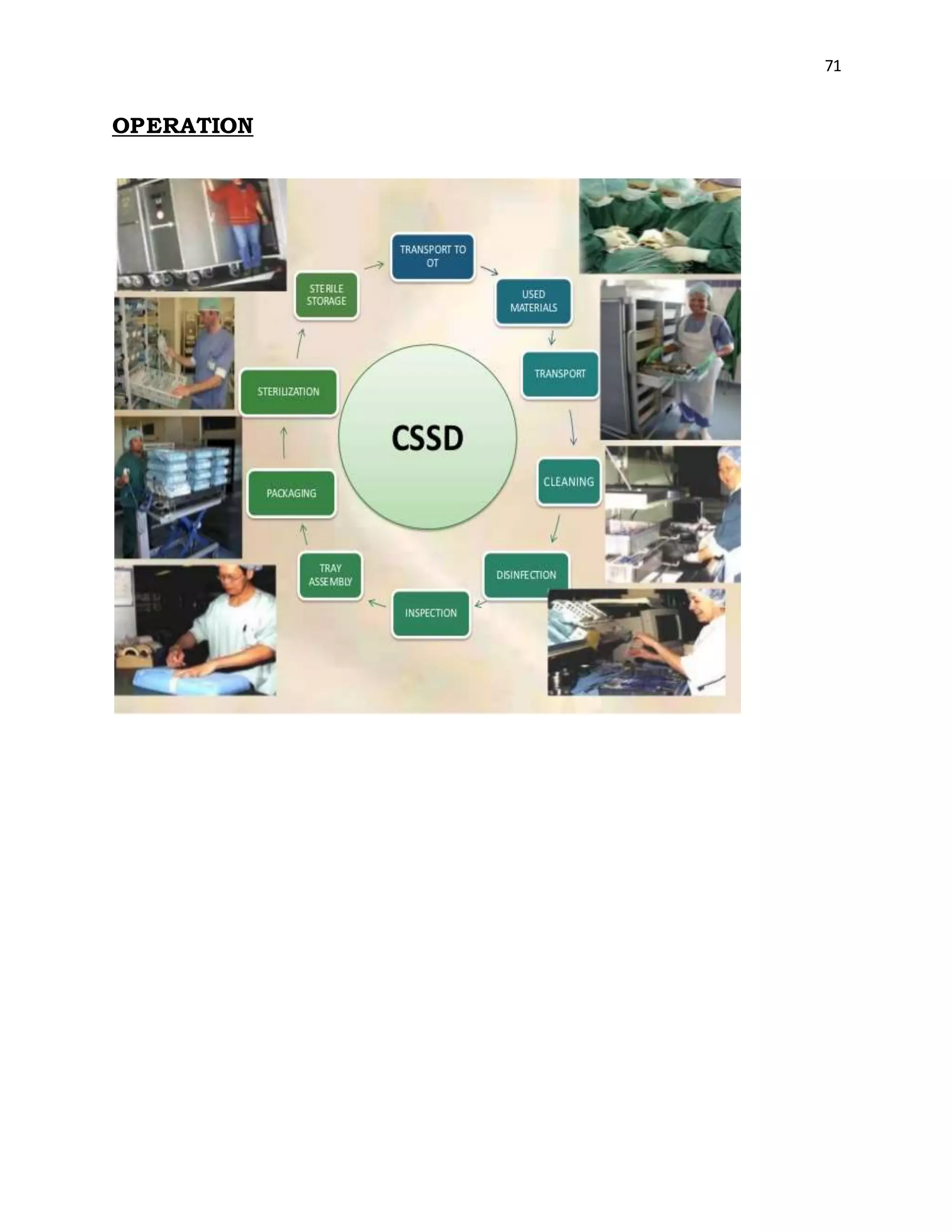
16. OPERATION
- Rising
- Cleaning : manually or ultrasound washer
- Drying : manually or in natural way.
- Inspection and assembly : Damaged item should be
condemned, repairable should be repaired then
assembled
- Packaging : done with linen/draper after drying and
assembling
- Labelling : Done for identification. Date, contents,
identification number, bar codes, initial of person
who carried out sterilization, initial of packers are
used.
71
OPERATION
72
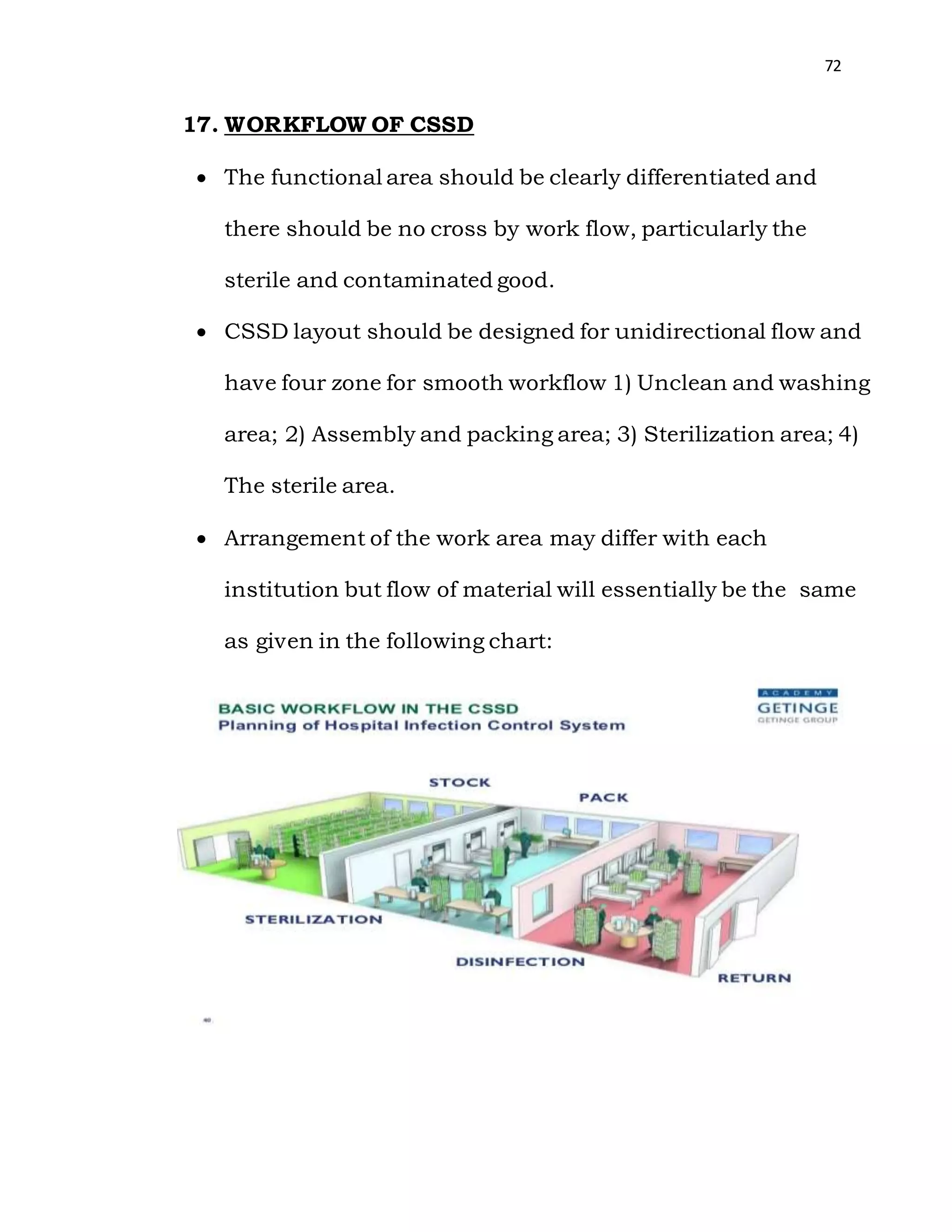
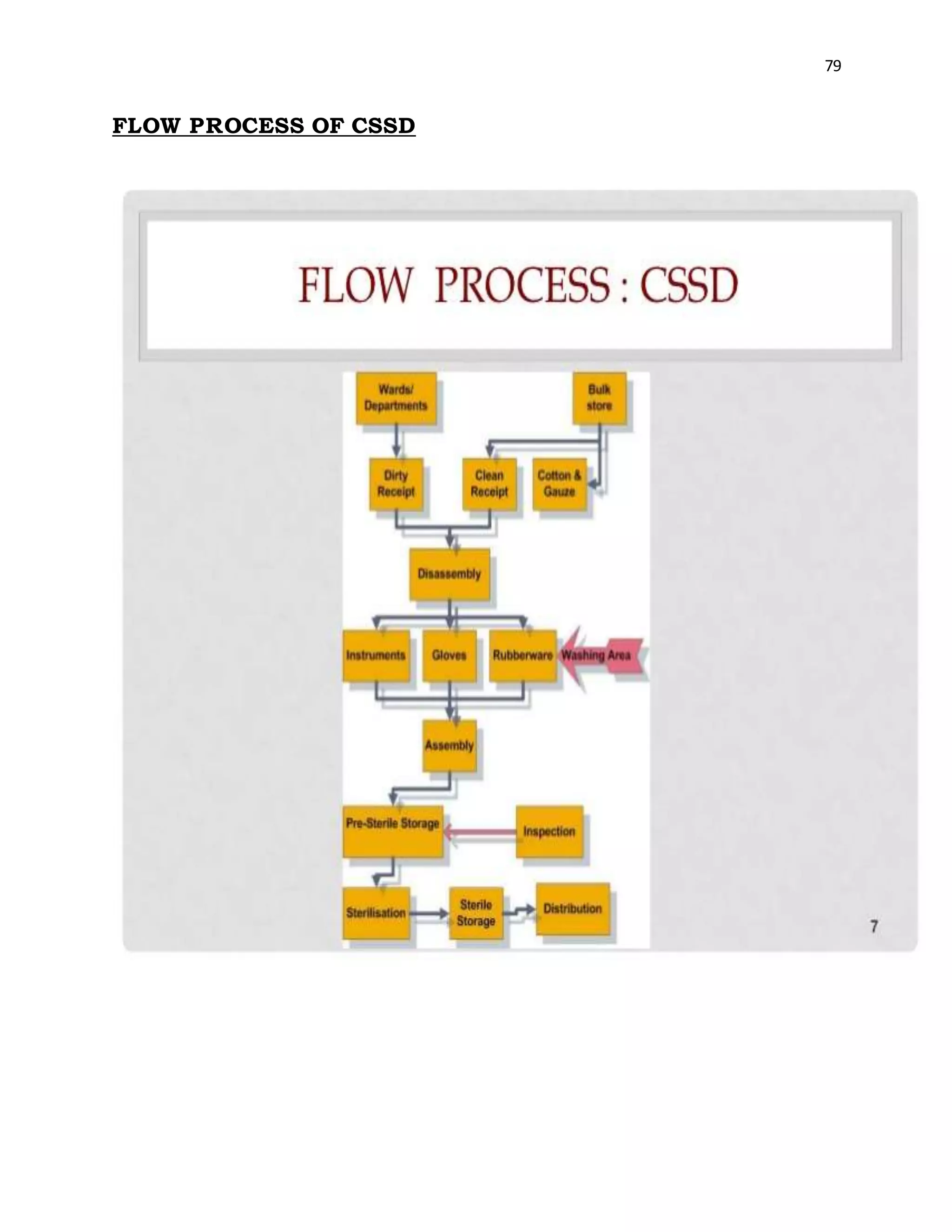
17. WORKFLOW OF CSSD
 The functional area should be clearly differentiated and
there should be no cross by work flow, particularly the
sterile and contaminated good.
 CSSD layout should be designed for unidirectional flow and
have four zone for smooth workflow 1) Unclean and washing
area; 2) Assembly and packing area; 3) Sterilization area; 4)
The sterile area.
 Arrangement of the work area may differ with each
institution but flow of material will essentially be the same
as given in the following chart:
73
18. NEED FOR STERILE BARRIER SYSTEM-PACKING
Why is packing of sterile goods necessary?
Any products that are to be sterilized, have to be packed.
Packaging is essential for maintaining sterility!
At the end of a correct sterilization process, products inside the
sterilizer chamber are sterile. The air in the room where the
sterilizer is installed contains dust particles, which may carry
micro-organisms. So when taking out the sterilised load from the
sterilizer, if not properly packed it will soon be contaminated
again. In addition, usually sterile goods are stored for quite some
time before they are used. Besides, they are transported through
different areas of the hospital to the place where they are to be
finally used. It thus is obvious, that, when not protected, the
goods will definitely be recontaminated by the time they are used.
The goods must therefore be put in a suitable packaging to
prevent re-contamination after sterilization. At the same time the
packaging material should be compatible for sterilizing the goods
it contains. Further advantage of packaging is the protection of
the contents against damage during handling and transportation.
74
Workstation for packaging : Packaging is an activity, which
requires careful attention. Instruments, trays, and packaging
materials need to be handled. That is why a packaging
workstation should be designed in such a way that the work can
be done efficiently, preventing physical problems to the workers.
A table of a suitable size and height, with easy access to all
required materials is indispensable.
Packaging concept for sterile products : Depending on use,
storage and transportation, a sterile product should be packaged
in one or more packaging layers
Primary packaging containing the product : The objective of
primary packaging is to prevent re-contamination of the product
after sterilization. It should provide an effective microbial barrier,
yet it should allow passage of air and the sterilizing agent, e.g.
steam. A primary packaging is sufficient in situations, where
there is no chance of dust being deposited on the pack. For
instance in a dust free storage environment or in those cases
where sterilised material is used immediately. The primary
75
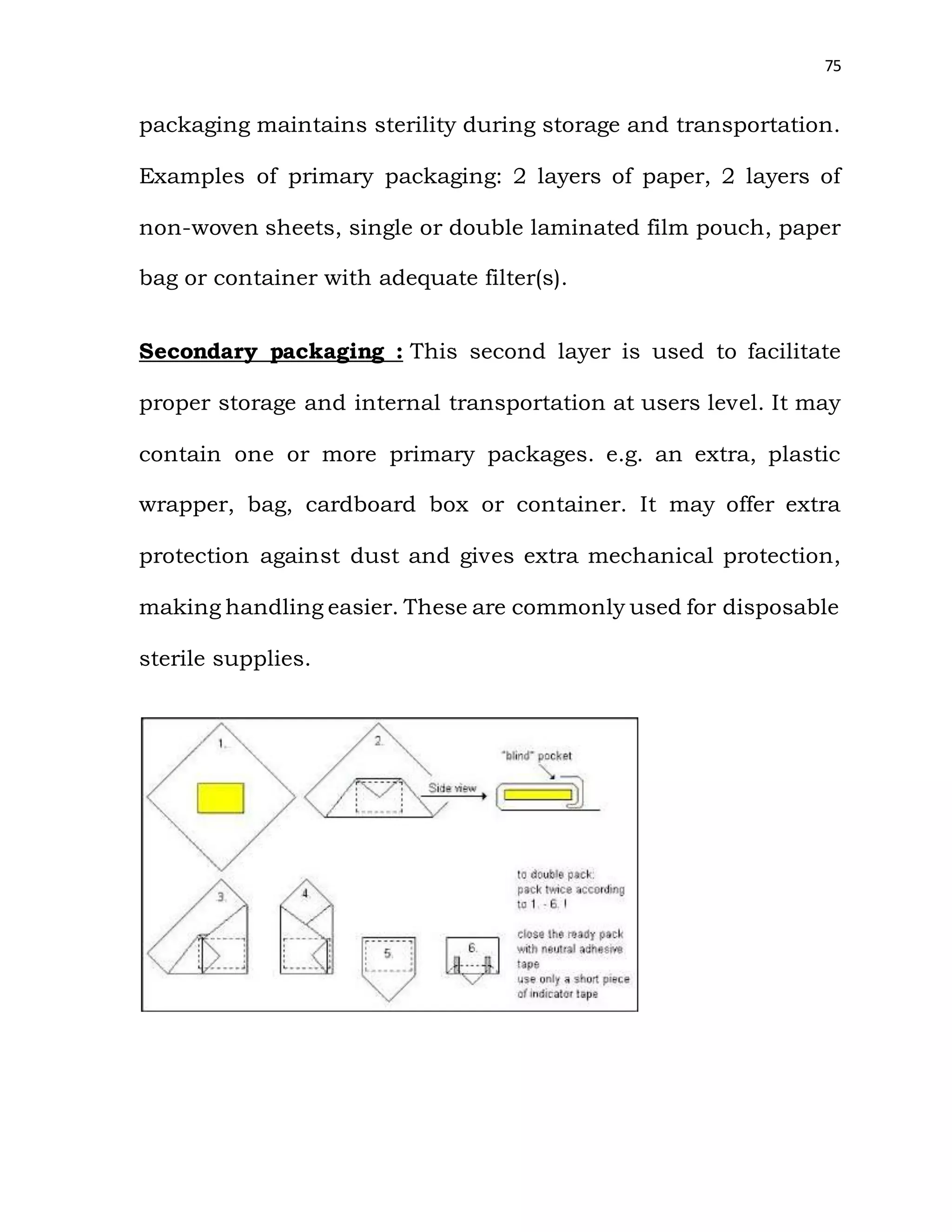
packaging maintains sterility during storage and transportation.
Examples of primary packaging: 2 layers of paper, 2 layers of
non-woven sheets, single or double laminated film pouch, paper
bag or container with adequate filter(s).
Secondary packaging : This second layer is used to facilitate
proper storage and internal transportation at users level. It may
contain one or more primary packages. e.g. an extra, plastic
wrapper, bag, cardboard box or container. It may offer extra
protection against dust and gives extra mechanical protection,
making handling easier. These are commonly used for disposable
sterile supplies.
76
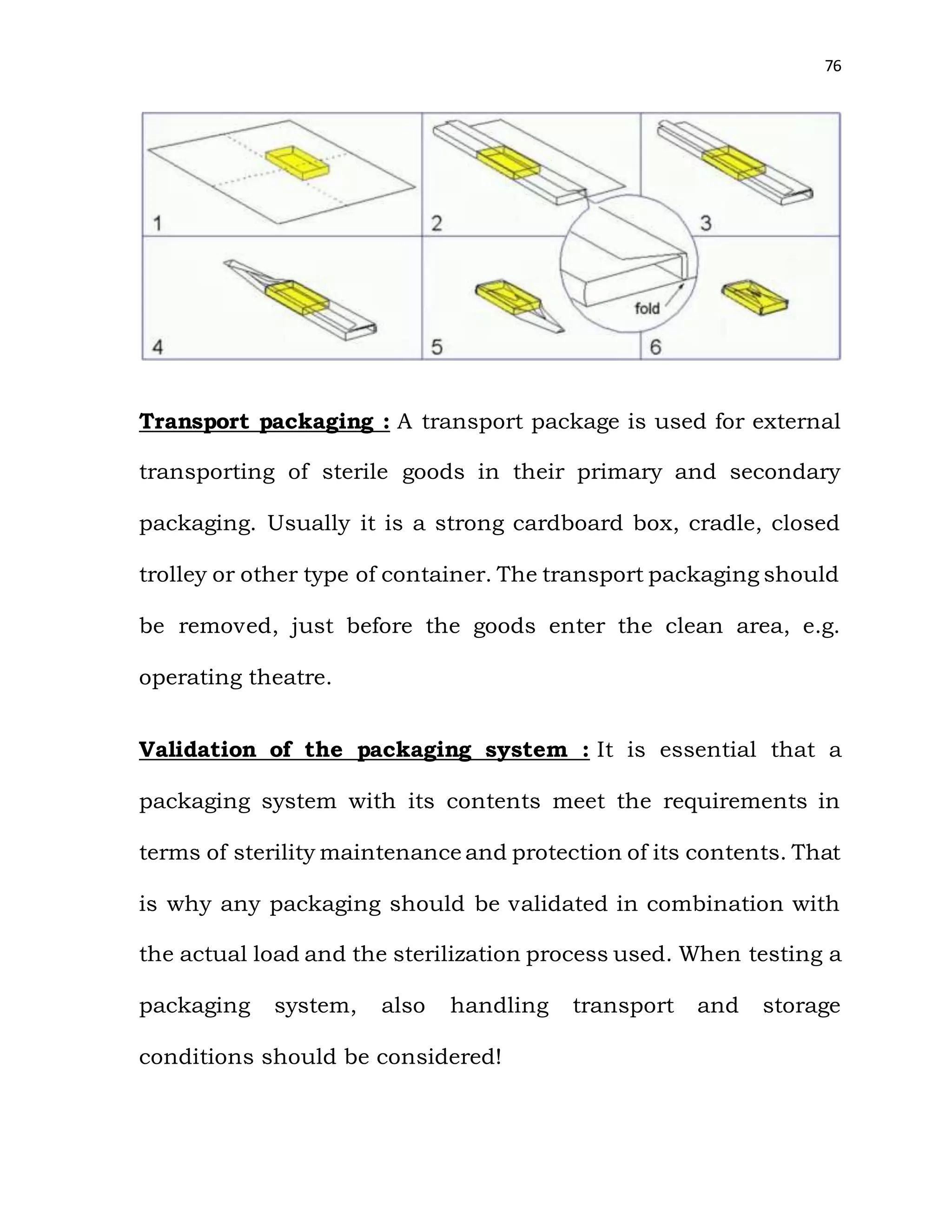
Transport packaging : A transport package is used for external
transporting of sterile goods in their primary and secondary
packaging. Usually it is a strong cardboard box, cradle, closed
trolley or other type of container. The transport packaging should
be removed, just before the goods enter the clean area, e.g.
operating theatre.
Validation of the packaging system : It is essential that a
packaging system with its contents meet the requirements in
terms of sterility maintenance and protection of its contents. That
is why any packaging should be validated in combination with
the actual load and the sterilization process used. When testing a
packaging system, also handling transport and storage
conditions should be considered!
77
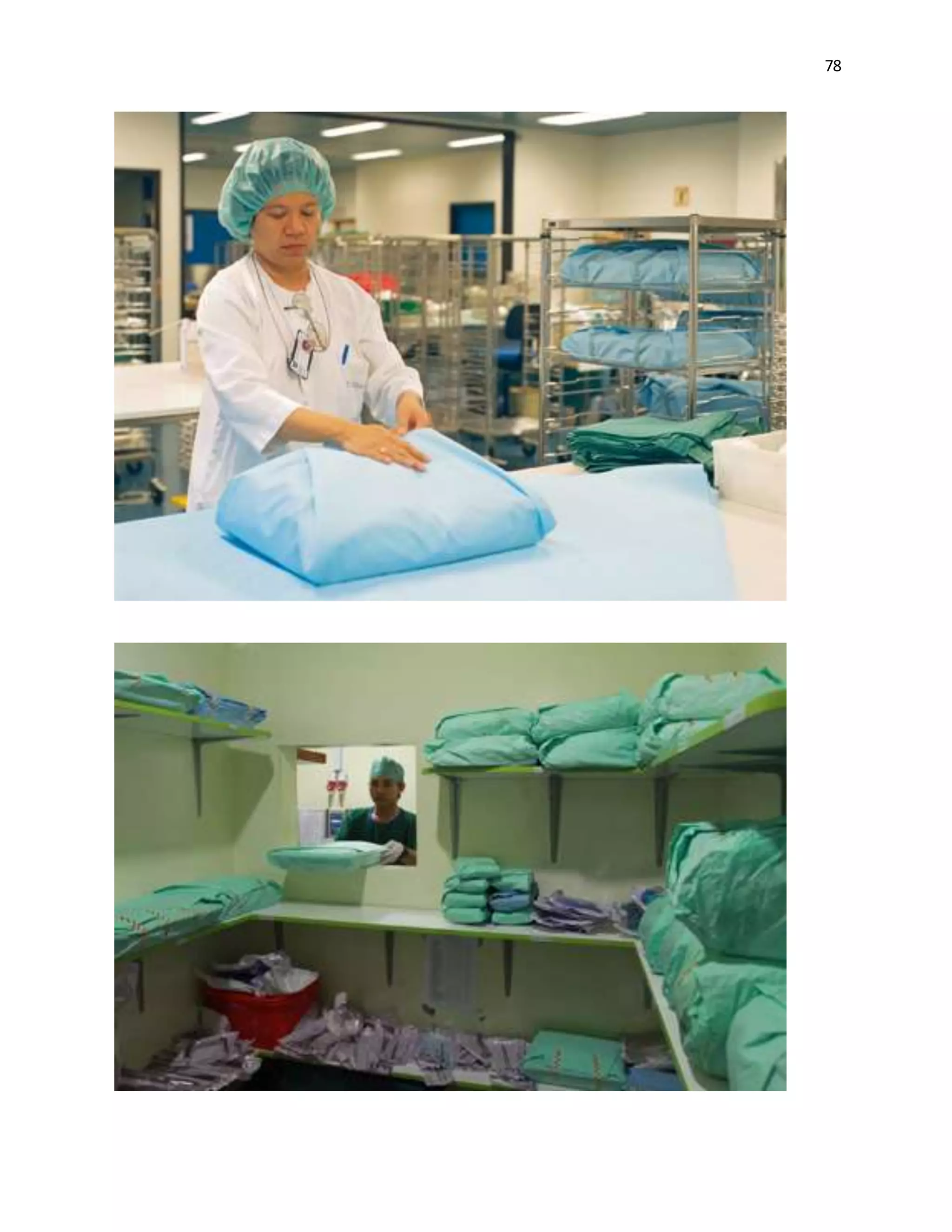
General guidelines for packaging practice :
If in a health facility, where more than one sterilization methods
is used, the accidental exchange of packaging
materials shall be prevented. The packaging should have an
indication showing clearly for which sterilization method it
should be used. Reusable medical supplies that are to be re-
sterilized (e.g. due to passing of the expiry date of a pack, or
because of damaged packaging), should be thoroughly inspected
visually, where necessary cleaned and repacked. Textile should
be reconditioned. The contents of a pack, which was opened by
mistake, should be considered as non-sterile. It should be made
clear that a package was opened. e.g. by clearly damaging the
packaging material. The content of such pack shall be inspected
and when necessary, cleaned. It then is to be repacked and
sterilized. Ensure the manufacturer of hospital reels and pouches
uses only standardized material.
78
79
FLOW PROCESS OF CSSD
80
Cleaning :
Cleaning is the first step in reprocessing a device. The purpose of
cleaning and rinsing is to remove all visible debris from an item and
to reduce the number of particulates, micro-organisms and
potential pathogens. Thorough cleaning and rinsing are vital to the
effectiveness of subsequent microbicidal processes used for
decontamination, disinfection and/or sterilization. Failure to
properly clean an instrument may allow foreign material (for
example soil, organic material including micro-organism and
inorganic matter) located outside and inside of the device to
interfere with effectiveness of subsequent disinfection and/or
sterilization.
81
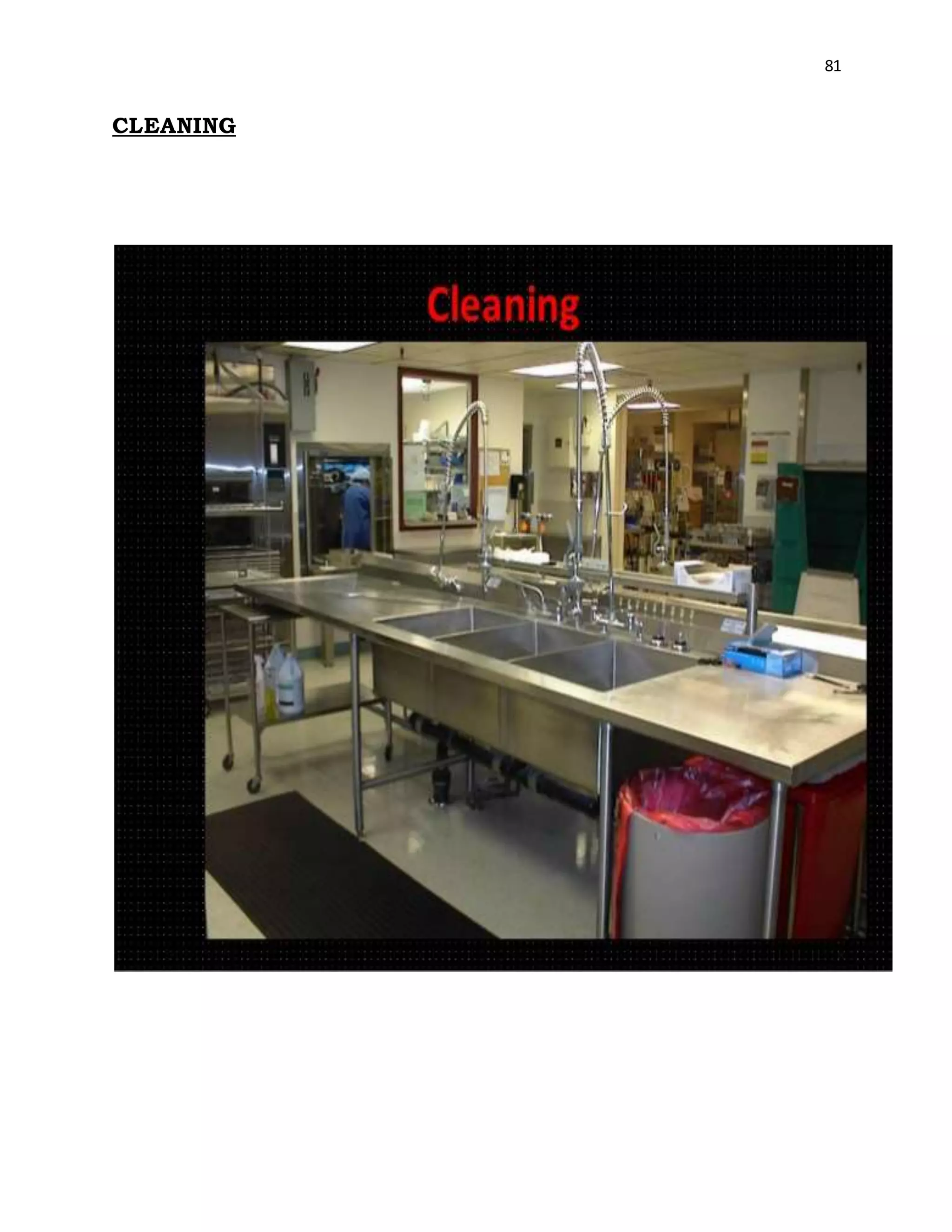
CLEANING
82
TYPES OF CLEANING
MANUAL CLEANING
STEPS : Sorting, Soaking washing, rinsing
Procedure :
a) All items should be dismantled before cleaning.
b) Soaking in detergent for 10 min
c) Thorough brushing with soft brush with long handle keeping
the brush below the surface of water
d) Rinsing with warm water.
DISADVANTAGES OF MANUAL CLEANING
- Not effective enough
- No Standardization
- Subject HCWs to injury from handling sharp Instruments
-Cause minute scratches to the instruments
-Brushes must be disinfected after each use.
83
ULTRASONIC CLEANING
- It is like brushing at a speed higher than the vibrations of
sound. It has the advantage that the cleaning action can take
place at any location in or an instrument where water can
reach
- An ultrasonic cleaner works mostly by energy released from
the collapse of millions of microscopic cavitations near the
dirty surface
- The bubbles made by cavitations collapse forming tiny jets
directed at the surface.
84
TYPES OF CLEANING
85
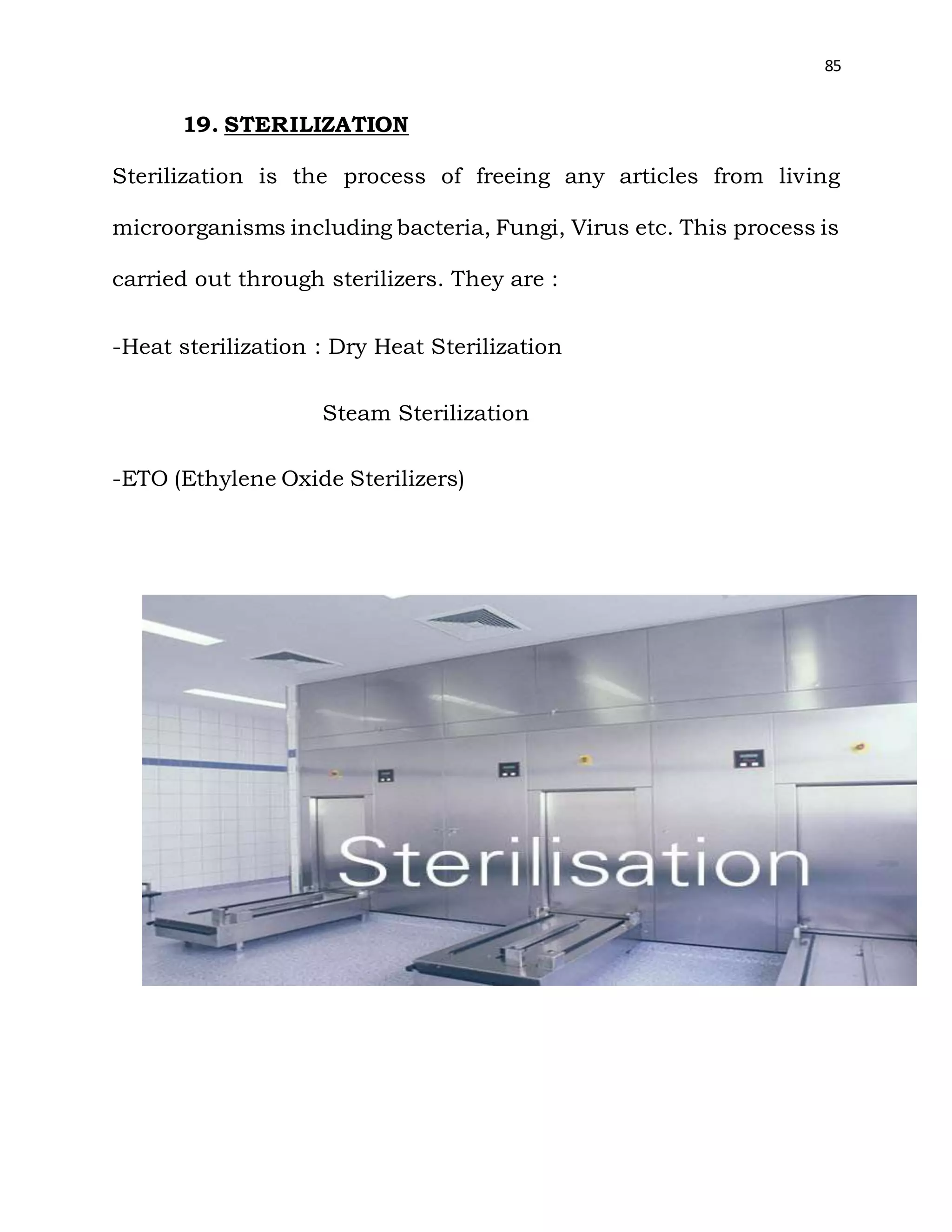
19. STERILIZATION
Sterilization is the process of freeing any articles from living
microorganisms including bacteria, Fungi, Virus etc. This process is
carried out through sterilizers. They are :
-Heat sterilization : Dry Heat Sterilization
Steam Sterilization
-ETO (Ethylene Oxide Sterilizers)
86
CRITERIA
1. There shall be a changing area which include shower facilities,
toilet facilities and lockers in proximity to the decontamination
area.
2. Access to the wash room and to the clean room shall be
through separate dedicated gowning rooms provided with
hand hygiene facilities.
3. The finishes on the walls and other surfaces shall be flush,
smooth, non-linting, water resistant and able to withstand
frequent cleaning.
4. Floors shall be covered in a washable non-slip material which
is securely sealed
5. There shall be adequately lighting.
6. All work surfaces, fittings, fixtures and furniture shall be
made of easily cleanable and disinfected.
7. The workstations shall be of adequate size to accommodate
the wrapping material to be used and shall be height
adjustable
8. There shall be adequate space between workstations for
equipment and staff movement
87
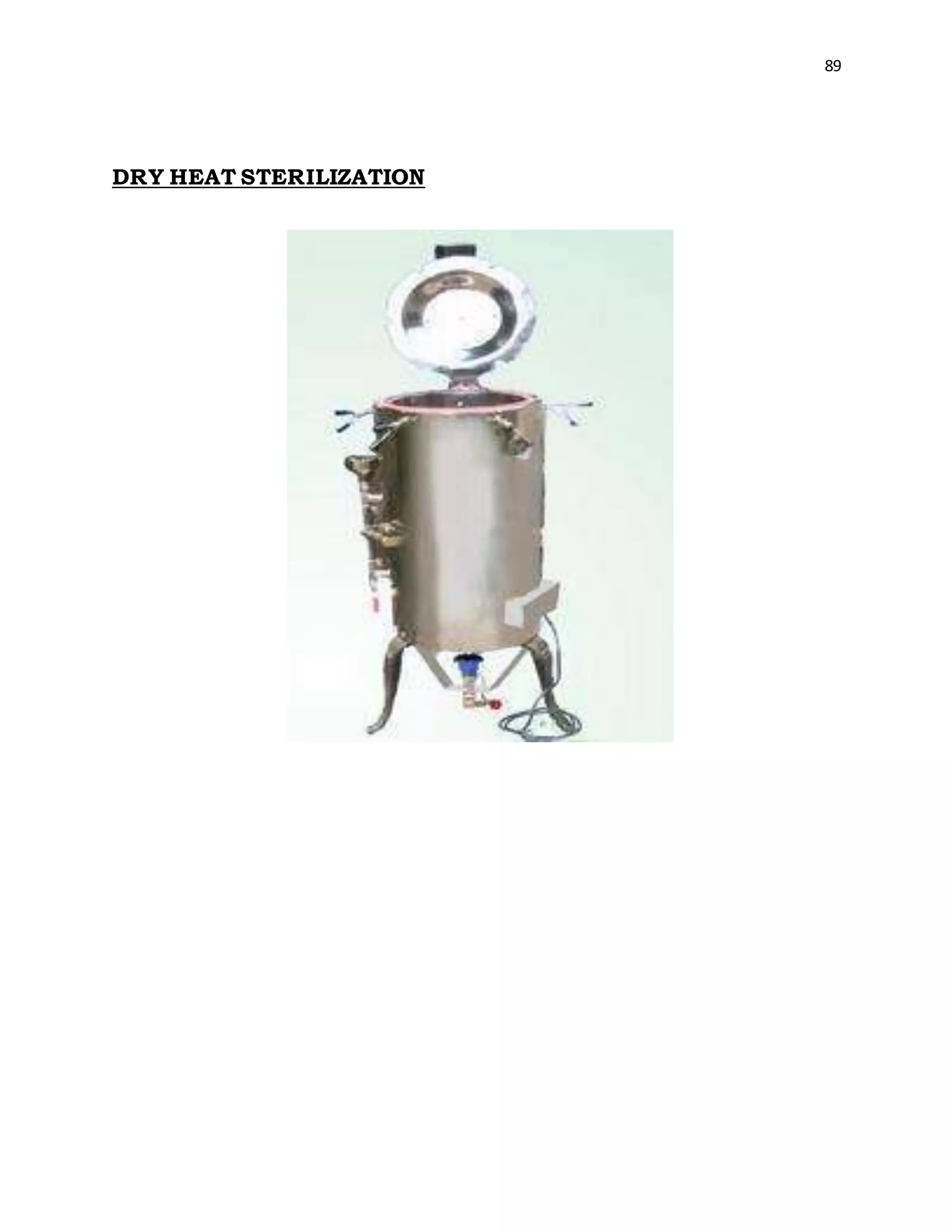
DRY HEAT STERILIZATION
Dry heat is primarily used to sterilize instruments and heat-
resistible glass and instrument parts. The heat transmission by dry
heat is less effective than by airless, saturated steam, because
steam is able to transport the heat better, than just air. Apart from
that, proteins can be easier denaturized in a wet milieu than in a
dry one. This is the reason why higher temperatures and longer
times are needed. The dry heat sterilization is carried out in a
closed chamber. Bigger apparatuses work with circulating air, i.e. a
ventilator circulates the air in order to generate a constant
temperature and a faster heat exchange. According to
pharmacopies and WHO recommendations the temperature should
be between 150 and 250°C with a sterilization time between 30 and
180 min.
The following process parameters are to be chosen due the heat
sensitivity of the goods sterilized:
-3hours,150°C
-2hours,160°C
-30minutes,180°C
88
These values just refer to the actual duration of sterilization. The
heat-up and cool-down times must be added accordingly. To
monitor the dry heat sterilization process, biological indicators
according to EN 866-6 should be used, but their resistance values
reached nowadays in practice are not ideal to monitor dry heat
sterilization processes. There are two reasons for this:
When sterilizing with dry heat the germ B. subtilis 106 (D160°C =
2,5 min) stops growing at 160°C / 30 min, so monitoring at 160°C /
2 h becomes impossible.
89
DRY HEAT STERILIZATION
90
STEAM STERILIZATION
Procedure :-
The steam sterilizer must be operated accordance with the
manufacturer’s instructions.
WaterSaturatedWet vaporDry saturated vaporSuper
Heated Vapor/steam
- Steam with <0.95 Dryness factor is not useful for sterilization
-Superheated Steam acts like Dry Hot Air only(Strength of steam
is its Latent Heat)
91
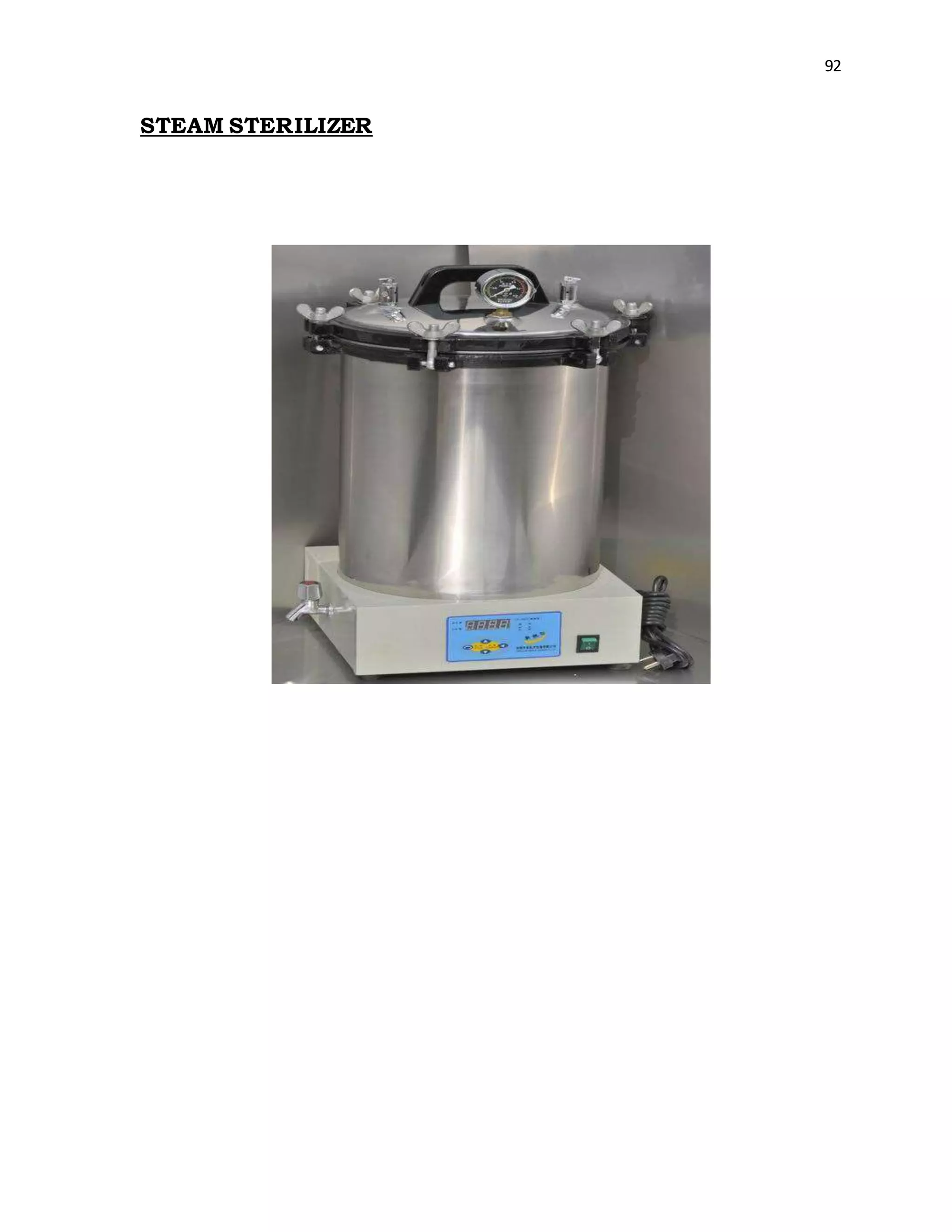
STEAM STERILIZER
It is most commonly used sterilizer because it is safe,
inexpensive and time saving. There should be proper
coordination between pressure, temperature and time. Articles
are subjected to sterilize in 121 Celsius in 10-15 minutes and
134 Celsius in 3 minutes in 20 PSI pressure
The outer layer of micro organism is softened by steam which
coagulates internal portion of organism. In this way steam
sterilization is effective against microorganism.
Machine is operated either by supply of steam through a boiler or
by inbuilt electrical steam generator
They are used for sterilization of glass wares, container vessels,
linen, rubber, OT instruments etc.
92
STEAM STERILIZER
93
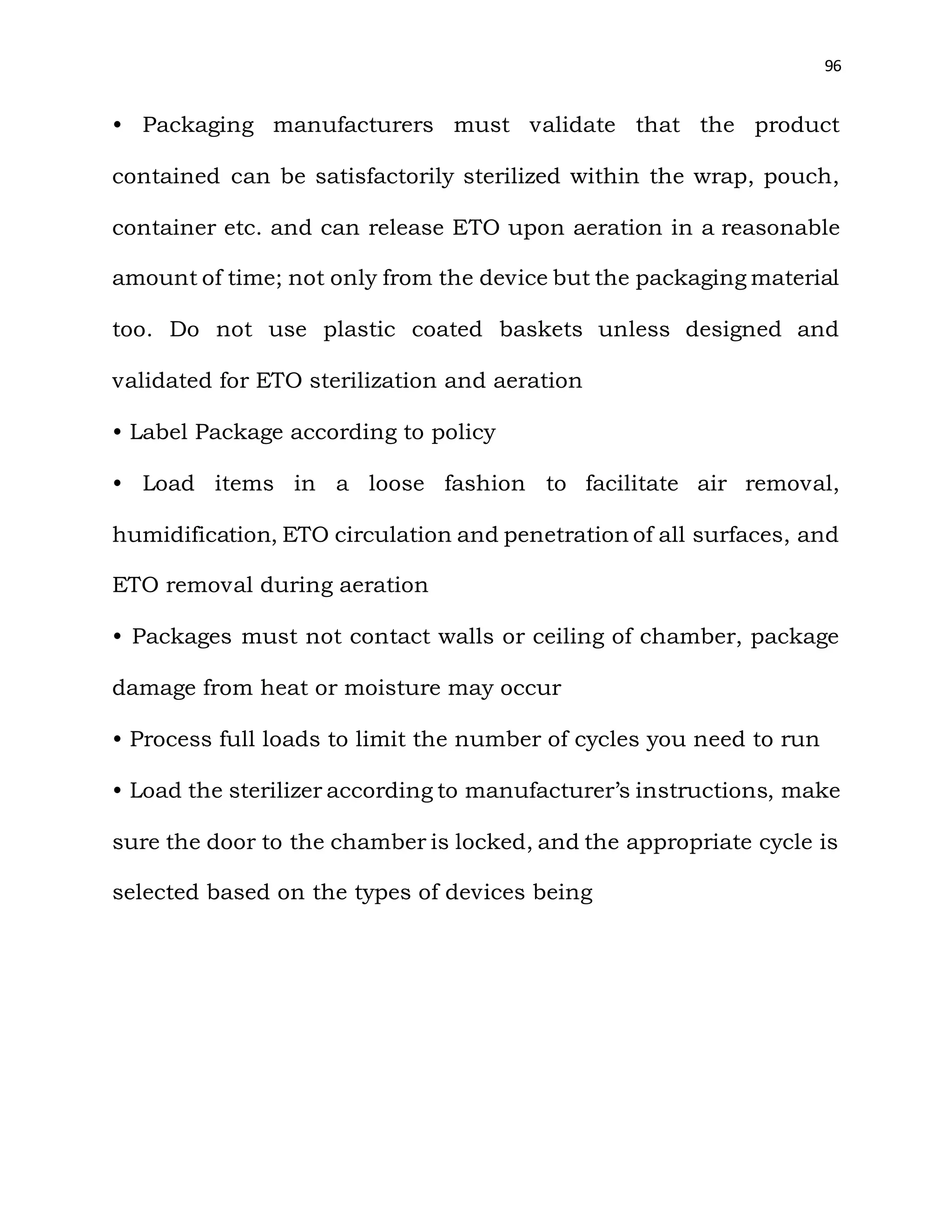
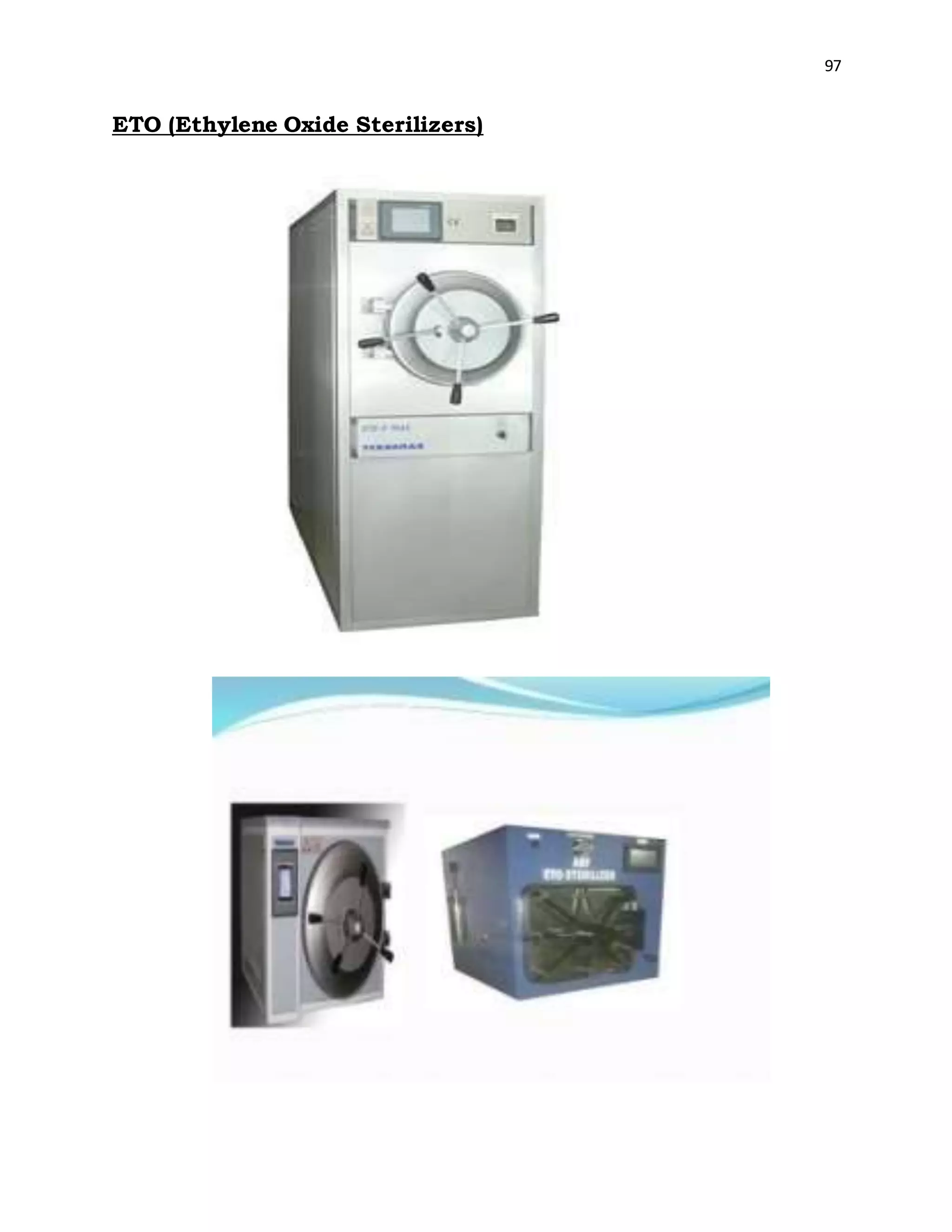
ETO (Ethylene Oxide Sterilizers)
Daily Preparation of ETO Sterilizer
Ensure the work environment is safe for employees
• Replace Load Control Slips Daily or computer printout paper
• Identifying sterilizer, date and initial on load control slip
• It is important that all staff members are aware of the policy and
procedures that relate to ETO sterilization
• Operators must know how to operate the ETO sterilizer safely as
well as the importance of adequate aeration
• Operators need to understand the environment requirements and
safe work practices and must know what the emergency procedures
are in case of a leak or accident
• Operators must understand that regulations have to be followed
• The ETO sterilizer must be operated accordance with the
manufacturer’s instructions
• The ETO sterilizer must be used in a well ventilated controlled
room with dedicated exhausts, emission control, enclosed ETO
sterilizer/aerator room, ventilation, air exchanges and
environmental monitoring provided
94
• Single-use cartridge delivers the appropriate
volume/concentration of ETO
• ETO gas must be stored at the prescribed temperature in a well
ventilated area in a cupboard marked with Hazardous materials
label
• The cycle must be long enough to allow thorough ETO penetration
to kill microorganisms
• The sterilizer operating temperature is usually preset by the
sterilizer manufacturer; there are usually two options: 100F (cold
cycle) 130F (warm cycle)
• The manufacturer of a device is responsible for providing validated
information regarding proper sterilization and aeration of their
products, usually between 1 to 6 hours, depending on the
concentration, humidity, temperature parameters, and the type of
sterilizer
• The ETO cartridge must be discarded in a safe manner according
gas manufacturer/supplier and hospital policies
• Employer must ensure that no employee is exposed to airborne
concentrations of ETO in excess of the concentration recommended
by suppliers.
95
ETO won’t penetrate soil so proper cleaning and decontamination
must be done for the items that will be processed
• Soil and Liquids hinder sterilization efficacy and may result in
harmful residuals being formed: Water + EO = Ethylene Glycol
(Antifreeze); Saline + EO = Ethylene Chlorohydrins (Possible
carcinogen)
• Material compatibility with ETO must be validated by the device
manufacturer
• If plastic instrument containers/trays are used, make sure they
can be sterilized with ETO and aerated. It is important that the ETO
is aerated from the device within and from the plastic container
itself with no cumulative ETO absorption/residual into the plastic
that cannot be satisfactorily removed by each aeration cycle
• Plastic, rubber or silicone mats must have been validated by the
manufacturer for suitability in ETO processing
• Make sure that instrument tip protector manufacturers have
validated their recommendations for the application and use of ETO
• Verify with the manufacturer if color code tape can be used with
ETO
96
• Packaging manufacturers must validate that the product
contained can be satisfactorily sterilized within the wrap, pouch,
container etc. and can release ETO upon aeration in a reasonable
amount of time; not only from the device but the packaging material
too. Do not use plastic coated baskets unless designed and
validated for ETO sterilization and aeration
• Label Package according to policy
• Load items in a loose fashion to facilitate air removal,
humidification, ETO circulation and penetration of all surfaces, and
ETO removal during aeration
• Packages must not contact walls or ceiling of chamber, package
damage from heat or moisture may occur
• Process full loads to limit the number of cycles you need to run
• Load the sterilizer according to manufacturer’s instructions, make
sure the door to the chamber is locked, and the appropriate cycle is
selected based on the types of devices being
97
ETO (Ethylene Oxide Sterilizers)
98
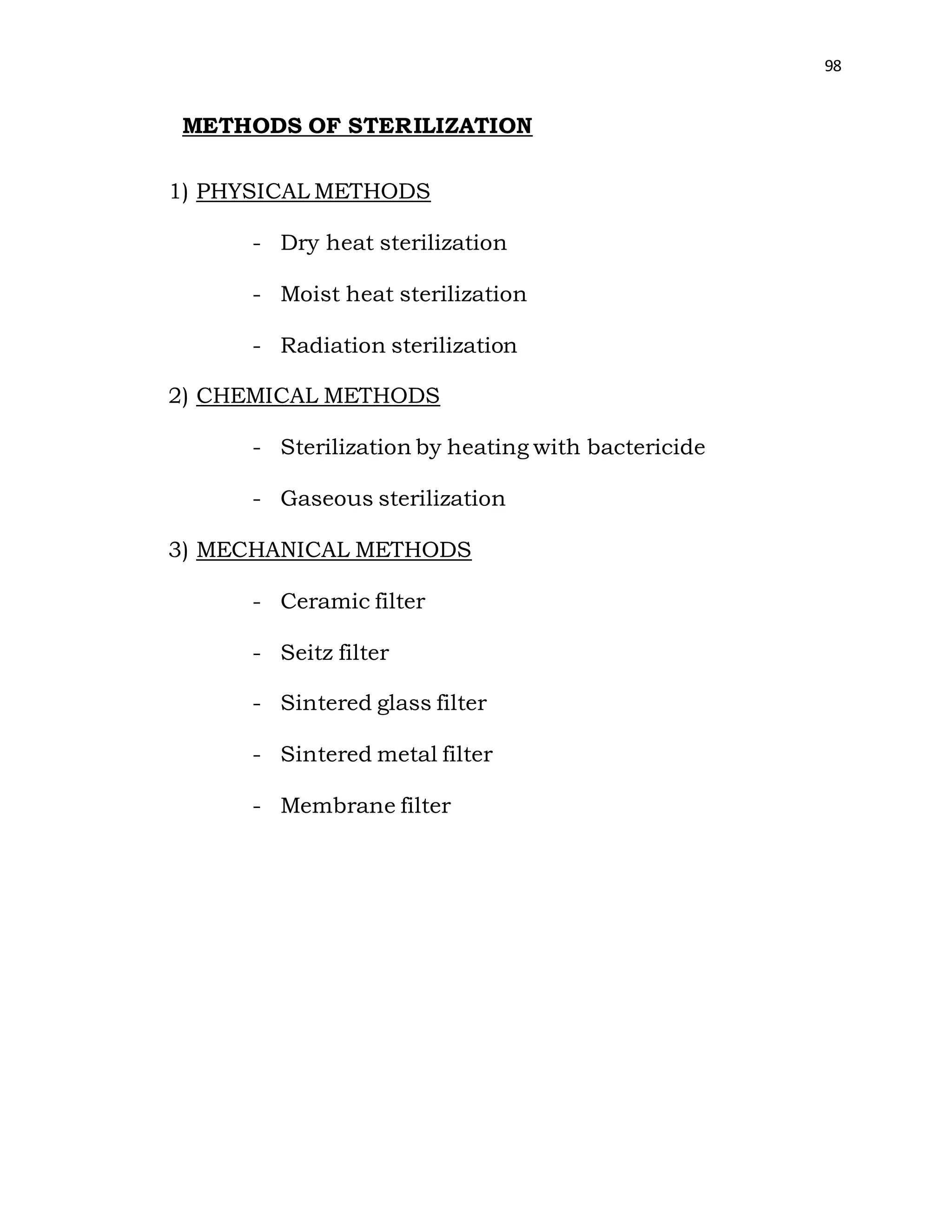
METHODS OF STERILIZATION
1) PHYSICAL METHODS
- Dry heat sterilization
- Moist heat sterilization
- Radiation sterilization
2) CHEMICAL METHODS
- Sterilization by heating with bactericide
- Gaseous sterilization
3) MECHANICAL METHODS
- Ceramic filter
- Seitz filter
- Sintered glass filter
- Sintered metal filter
- Membrane filter
99
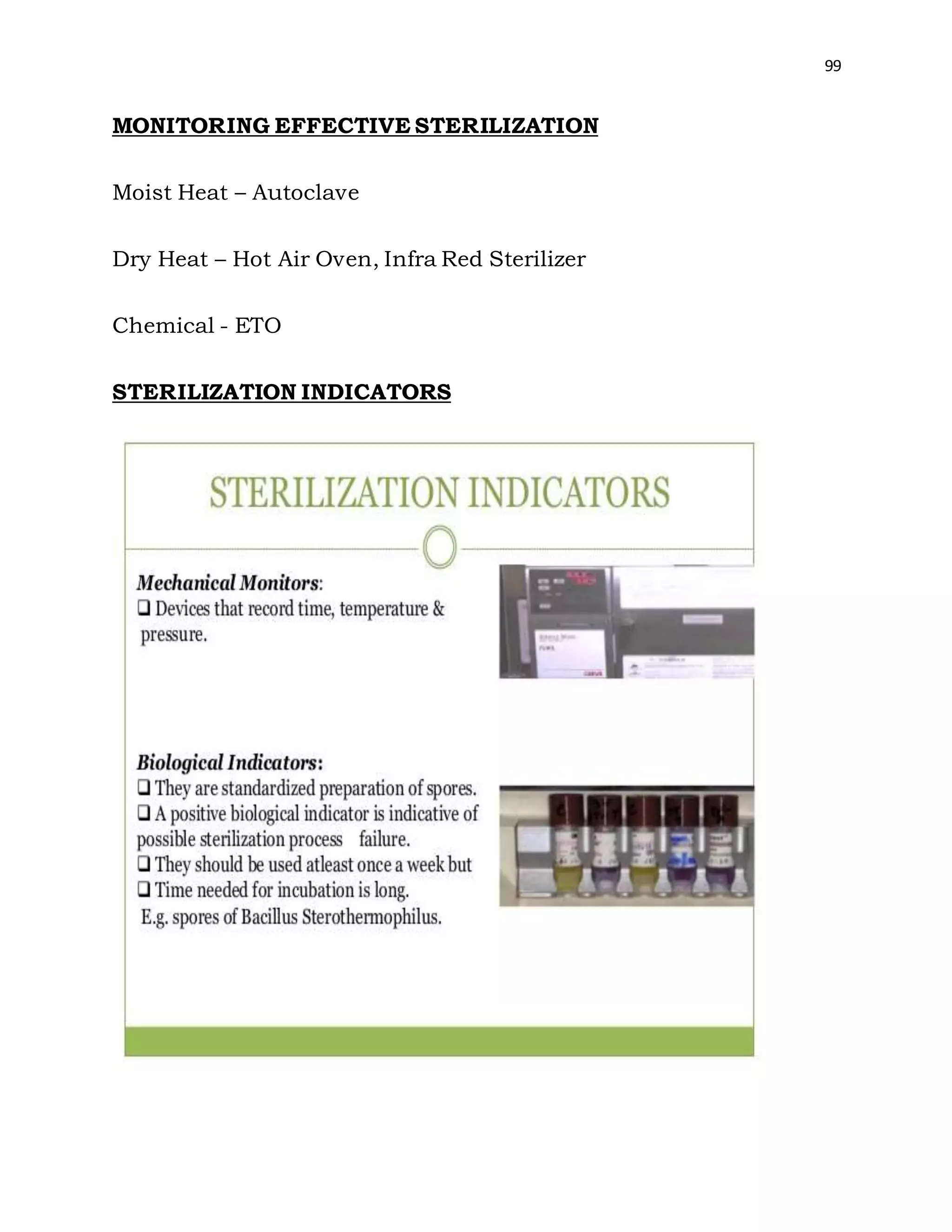
MONITORING EFFECTIVE STERILIZATION
Moist Heat – Autoclave
Dry Heat – Hot Air Oven, Infra Red Sterilizer
Chemical - ETO
STERILIZATION INDICATORS
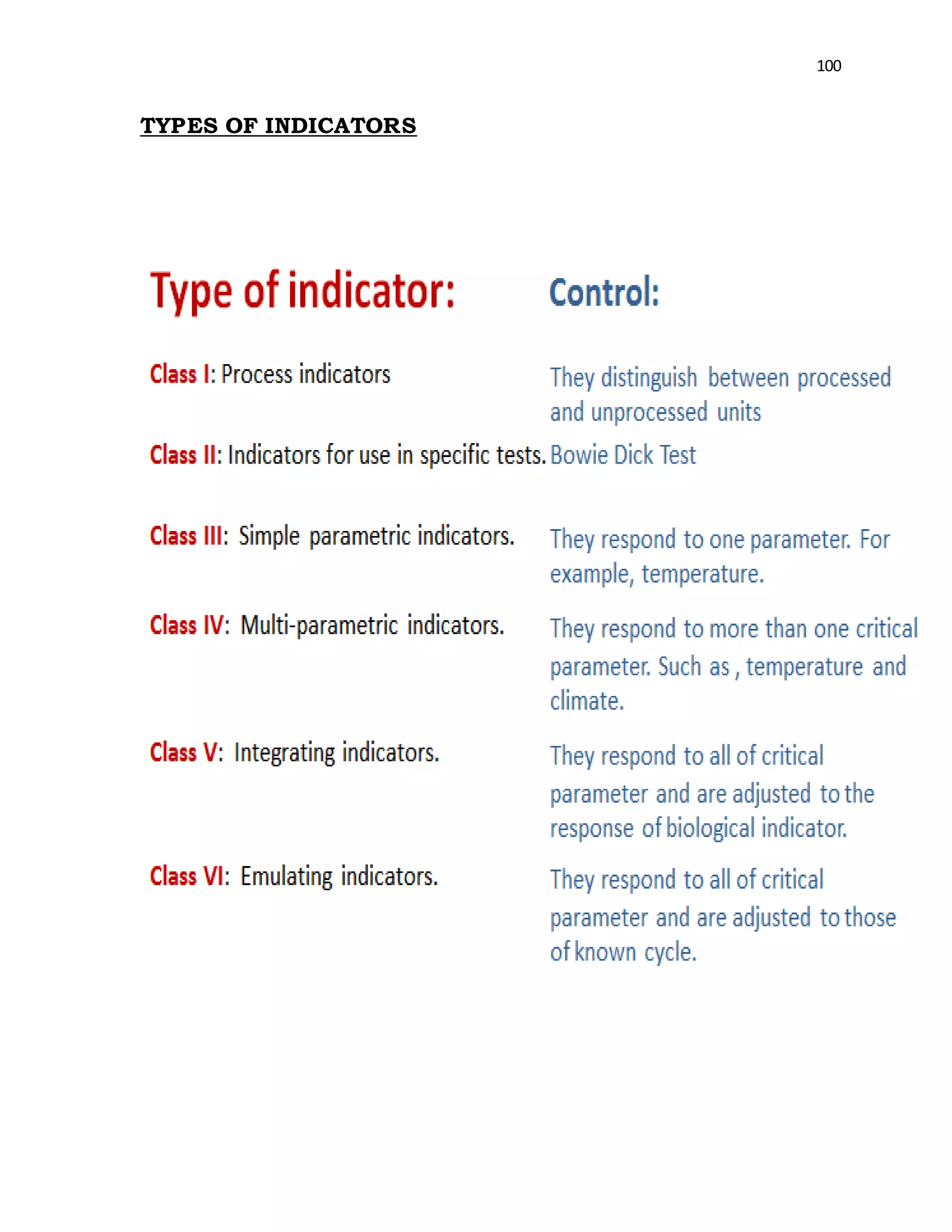
100
TYPES OF INDICATORS
101
THE DELIVERY AND DISTRIBUTIONB OF PROCESSED ITEMS
Procedure
• All items will be checked for sterility before they are released
• The following should be checked when deciding if the pack is still
sterile: -
o Holes or tears
o Wetness or stains
o Broken seals
o Dust
o Evidence of crushing
• All damage items are returned to the decontamination area
• All items issued will be recorded so that a tracking system is
affected
• Various methods can be used in the transport of sterile packaged
items to their point of use.
• This can range from hand carriage (in particular where a
decontamination area is located close or adjacent to a point of use),
102
to the use of trolley’s and other such transport systems for taking
items to a remote location (within a facility or at a different facility).
• Sterile supplies should be transported in covered or enclosed
trolleys with a solid bottom shelf. The solid bottom shelf prevents
microorganism on the floor being picked up by the wheels of the
trolley and then spun upwards onto the sterile packs.
• If items are placed inside plastic or paper bags, they should be
arranged to prevent them from being crushed or damaged during
transport. They all protect medical devices from damage
• Items must be placed onto a clean trolley that can be covered
• Trolleys must not be overloaded
• Soiled items must NOT be loaded onto the same trolley
• Loaded trolleys must not be left to stand
103
RECALL PROCEDURE
Procedure
• In the event of sterilization failure, such as positive biological
indicators/Failed Load Controls or sterilizer malfunction, items
from that test and previous loads after the last known good test
must immediately be recalled.
• All affected trays must be recalled in the event of failed quality
management tests i.e. Biological, Load Control
• A written Recall Procedure must be followed in the event of a
sterilization failure
• The sterilizer must be shut down and all staff must be made
aware that it is out of operation.
• The sterilization record sheets should be checked for a list of
“sterilized” items that need to be recalled.
• The recall procedure should be documented on the sterilization
record sheets listing what items have been retrieved and
reprocessed and which items had already be used and on whom.
Note items that may have already been used on the list.
104
• As it becomes apparent that items need to be recalled
reprocessing personnel will immediately notify users and retrieve
the supplies from storage and from user as soon as possible.
• A recall is usually authorised by the most senior staff member on
the shift.
• Other responsible persons i.e. Infection Control should be advised
of the recall according to hospital policy.
105
20. AUTOCLAVE
What is an Autoclave?
An autoclave is a heated pressure
vessel (pressurized chamber) that sterilizes surgical equipment,
laboratory instruments an liquids, hospital equipment,
pharmaceutical items, and other materials. It can sterilize solids,
liquids, hollows and instruments in a variety of shapes and sizes.
Autoclaves come in different sizes, shapes and functionality. A very
basic autoclave is similar to a pressure cooker, both use the power
of steam to kill bacteria and germs that otherwise survive boiling
water and powerful cleaning detergents. An autoclave used in the
healthcare industry (hospital and dental) is a medical device often
referred to as a sterilizer. In the Laboratory and Pharmaceutical
industries it is referred to as an autoclave.
106
AUTOCLAVE
Working of autoclave :
Steam enters the chamber jacket, pass through an operating valve
enters the rear of the chamber behind a baffle plate
If flows forward and down ward through the chamber and load,
existing at the front bottom.
Pressure regulator maintains pressure in the chamber and in jacket
at a minimum of 15psi, the pressure required for steam to reach
121C. Conditions inside are thermostatically controlled.
107
TYPES OF AUTOCLAVES
Different types of autoclaves :
1.Heat autoclaves : The most common source for autoclaving is
heating. Here the autoclaves should maintain a temperature of at
least 246 for half an hour. Both dry heat or steam heat are used.
For steam heat autoclaves, heated water vapors are used. Dry heat
autoclaves are used for moisture sensitive surgical products or
instruments
2. Gas autoclaves : It is also known as chemicals, gas autoclaves
are use a vapour solution to sterilize its contents. Formaldehyde gas
and Ethylene oxide are the sterilizing agents used in a gas
autoclaves. They consume lesser heat and take lesser time to
complete the cycle.
3. Ultraviolet autoclaves : They produce UV light that kills the
unwanted disease causing organisms.
108
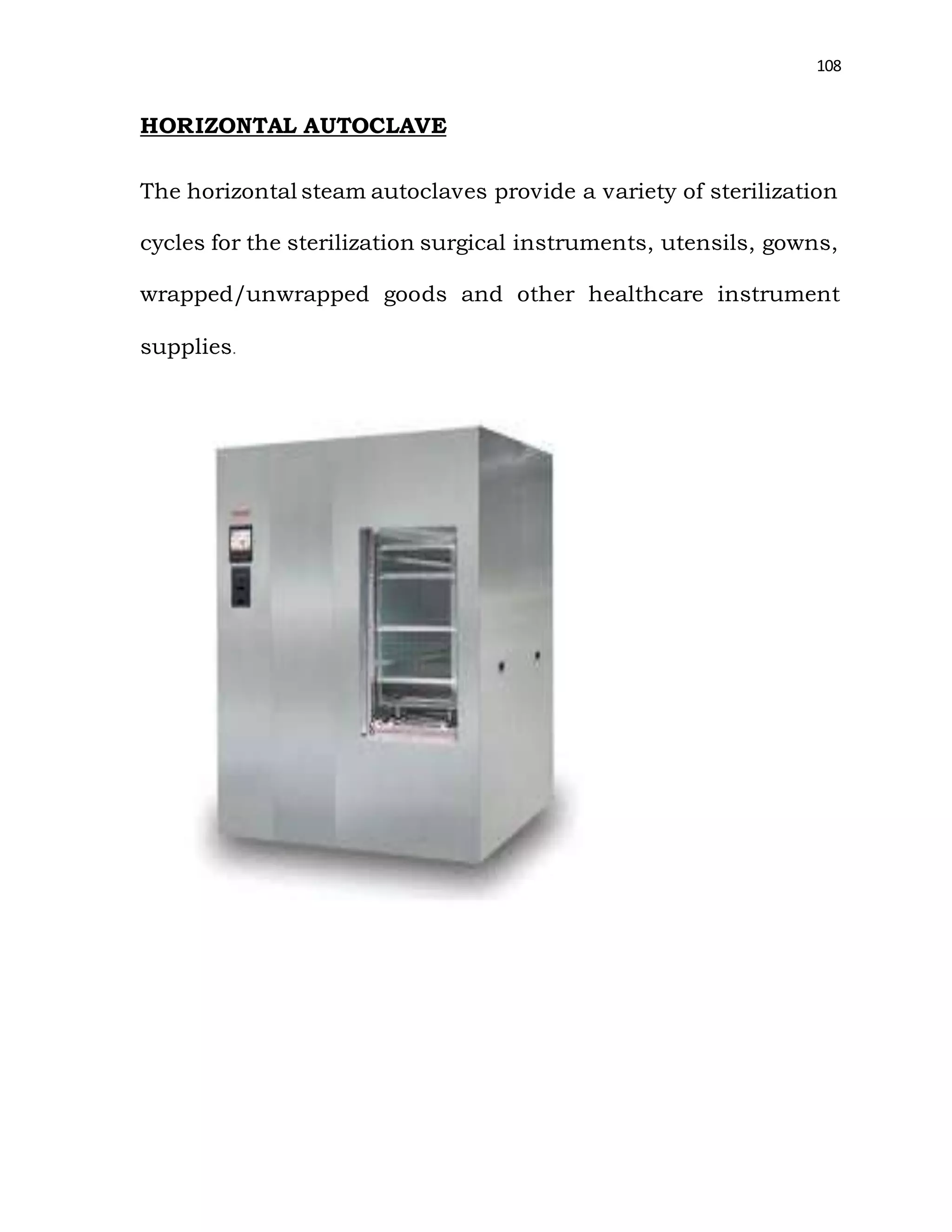
HORIZONTAL AUTOCLAVE
The horizontal steam autoclaves provide a variety of sterilization
cycles for the sterilization surgical instruments, utensils, gowns,
wrapped/unwrapped goods and other healthcare instrument
supplies.
109
USES OF AUTOCLAVE
Sterilization autoclaves are widely used
in microbiology, medicine, podiatry, tattooing, body
piercing, veterinary science, mycology, funeral homes, dentistry,
and prosthetics fabrication. They vary in size and function
depending on the media to be sterilized vary in size and function
depending on the media to be sterilized.
Typical loads include laboratory glassware, other equipment and
waste, surgical instruments and medical waste.
A notable growing application of autoclaves is the pre-disposal
treatment and sterilization of waste material, such as pathogenic
hospital waste. Machines in this category largely operate under the
same principles as conventional autoclaves in that they are able to
neutralize potentially infectious agents by utilizing pressurized
steam and superheated water. A new generation of waste converters
is capable of achieving the same effect without a pressure vessel to
sterilize culture media, rubber material, gowns, dressing, gloves,
110
etc. It is particularly useful for materials which cannot withstand
the higher temperature of a hot air oven.
Autoclaves are also widely used to cure composites and in the
vulcanization of rubber. The high heat and pressure that
autoclaves allow help to ensure that the best possible physical
properties are repeatably attainable.
111
LOADING AND UNLOADING ITEMS FROM THE AUTOCLAVE
Procedure :
 Load according to manufacturer’s instructions
 Wear relevant protective clothing
 Load instruments sets flat in single layer
 Load soft packages on their sides with a hands width between
items
 Load soft packs on top shelf and large instrument trays on
lower shelf
 Load containers according to manufacturer’s instructions
some may be stacked
 Do not allow packs to touch top, bottom or sides of autoclave
 Do not compress packs
 Position peel packs on sides
 Do not overload
 On completion of cycle record according to policy
 Allow autoclave and packs to cool before handling
 Do not touch packs until completely cooled
112
 DO NOT TOUCH HOT RACKS WITHOUT HEAT RESISTANT
GLOVES
 Once cooled check for wet packs, tears, indicator changes etc.
 Store according to policy
 Expected Outcome
 Sterility of packs is not compromised through incorrect
loading and unloading
113
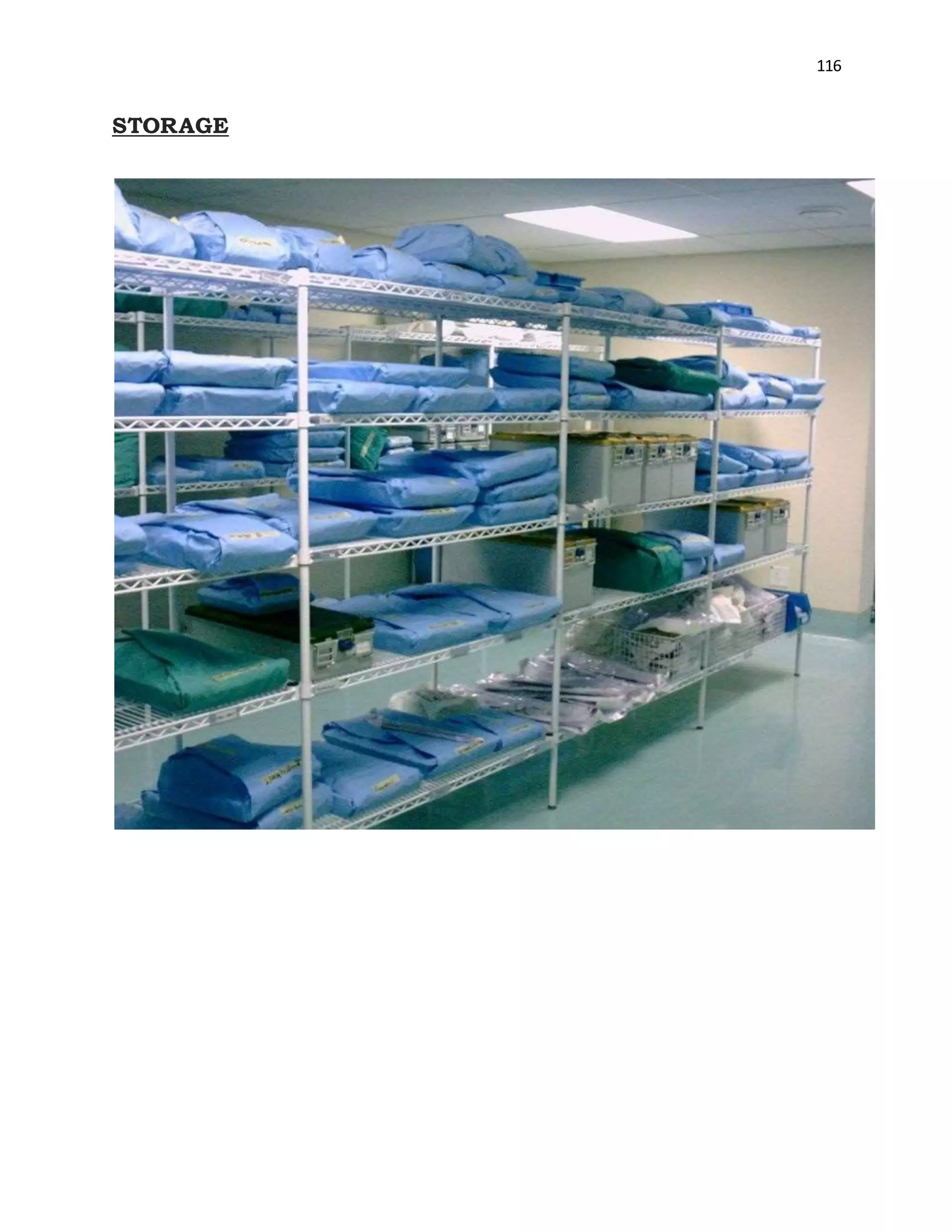
21. STORAGE
After sterilization, it is necessary to store the sterile packages. The
activities of personnel in the storage area and the environment itself
have a great impact on pack sterility. There must be tight inventory
control of storage contents to assure supplies will be available when
needed, that stock is properly rotated, that packs with expired time
sensitive items are cycled out and that the hospital is not wasting
space on seldom used items.
The primary conditions that can adversely affect the ability of a
sterile package to maintain its sterility until it is in the hands of the
user at the point of use include: Moisture and liquid/fluid
contamination. Dirt, dust and debris.
Physical damage to the package including abrasion, cuts, tears,
punctures, broken seals and breakdown of packaging material.
Conditions and procedures can be implemented for storage
requirements and personnel management to significantly reduce
the possibility of these issues from occurring. Storage environments
should be clean, dry and easily accessible by authorized personnel.
114
The room should be under positive pressure to reduce airborne
contamination from air outside the storage area.
The temperature and humidity should be controlled to between
65°F to 72°F and 35% to 75% humidity. The moisture also provides
an excellent opportunity for fungal growth through the packages.
For these reasons, it is also important to keep packs at least 2
inches away from walls, windows and window seals where
condensation can form on interior surfaces of exterior walls. Sterile
packages should not be stored near or under sinks, exposed water
pipes, sewage lines or air conditioning drains. Packs should be kept
8 – 10 inches above the floor to prevent contamination with floor
cleaning agents, spills and inadvertent shoves and kicks. There
should be at least 8 – 10 inches between the highest package and
ceiling to allow for proper air circulation (fire codes may specify 18
inches away from the sprinkler head.) Spacing must also be
planned and maintained such that packages are not touched,
bumped or leaned upon when the room is cleaned or personnel are
storing or retrieving packs. Personnel working in here must follow
hand hygiene policies, wear appropriate attire like clean, freshly
115
laundered clothes with cap and be in good health. He/she should
maintain a high level of personal hygiene including clean hair,
body, nails and clothing. Hand should be washed or hand sanitizers
should be used. Dedicated pair of safety shoes/shoe covers should
be used. Finger nails should be short and no jewellery should be
worn, to avoid rupturing the sterile packets as well as to avoid being
carriers of micro organisms.
116
STORAGE
117
118
BIBLIOGRAPHY
- OFFICE REFERENCES
 Corporate Intranet
- GOOGLE SEARCH
 www.CSSD
 Internet site :www.cssd.com
 CRCST Self-Study lesson Plan

A study on safety quality care in cssd

  • 1.
    1 “ A STUDYON THE EFFICIENCY OF CSSD IN A MULTISPECIALITY HOSPITAL” A PROJECT REPORT Under the guidance of Mr. Rajnish Pal _____________________________ Submitted by Megha Milind Sawant ______________________________ in partial fulfillment of the requirement for the award of the degree Of MBA IN Healthcare Services 2015
  • 2.
    2 ACKNOWLEDGEMENT I thank thepeople who had helped and supported me during the making of this Project and the report. I would like to express my special thanks of gratitude to Mr. Ajaykumar Pande, Director- Operations & Supply chain/ HR Head, Lilavati Hospital & Research Centre, for his co-operation and support My deepest thanks to Ms. Ancy Jacob (Asst. Manager-OT) and Ms. Gauri Bhatia(General Manager-CSSD), Lilavati Hospital & Research Centre, for their support and guidance in this project. I thank Mr. Avinash Tivrekar(Shift-in Charge -CSSD), for explaining me the workflow of CSSD department. I would also thank my Institution without whom this project would have been distant reality. I thank my guide Mr. Rajnish Pal, for his guidance. I also thank Mr. Santosh Bhoir and Mr. Subhash Shetty -Halo Technologies for their all-time guidance.
  • 3.
    3 I would liketo express my deepest and special thanks to my friend & my colleague, Geeta Dilip Arekar for her continuous support, guidance, for imparting her knowledge and expertise in this study and who have greatly assisted me by correcting copy, reading proof and helping me making necessary correction when needed. My thanks and appreciation to the people of Operation Theatre department, Lilavati Hospital & Research Centre, of who have willingly helped me out with their abilities and gave valuable time and feedback to this project I express my thanks to the Learning Centre, Halo Technologies and my faculties for their guidance, help and support. I also extend my heartfelt thanks to my family, my well wishers, my friends and those people who helped me for the successful completion of this project Place : MUMBAI (Megha M Sawant) Date : 08/10/2015 (1311003326)
  • 4.
  • 5.
    5 BONAFIDE CERTIFICATE Certified thatthis project report titled “ A STUDY ON THE EFFICIENCY OF CSSD IN A MULTISPECIALITY HOSPITAL” is the bonafide work of “Megha Milind Sawant” who carried out the project work under my supervision. Learning Center Faculty/ Head of the Department Date : 08/10/2015 Place : Mumbai
  • 6.
    6 DECLARATION I, Megha MilindSawant hereby declare that the report of the project entitled “ A STUDY ON THE EFFICIENCY OF CSSD IN A MULTISPECIALITY HOSPITAL” has not presented as of any other academic work to get my degree or certificate except Sikkim Manipal University for the fulfilment of the requirements for the degree of MBA. Name : Megha Milind Sawant
  • 7.
    7 OBJECTIVE OF THESTUDY  The objective of the project were mainly to study the sterility, its importance in an organisation.  To develop CSSD Safety Checklist.  To implement CSSD Safety Checklist to monitor and enforce quality and safety controls necessary in CSDD prosessing such as Rinsing, Cleaning, Drying, Inspection and Assembly, Packing, Labelling, Sterilization, Storage, Distribution to reduce the incidence of hospital infection and improve patient care.  To ensure precisely operating and monitoring of special sterilization  To avoid duplication of costly equipment's, which may be in frequently used.  To stay updated regarding developments in the field in the interest of efficiency, economy, accuracy and provision of better patient care
  • 8.
    8  The mainpurpose of my study is to render a better understanding of the concept “Quality and Safety in CSSD”  To understand the planning and operation of CSSD  To establish & ensure highest standard of sterilization of equipments, instruments and other patient care supplies to ensure maximum prevention of infection and enhancing quality & safety by developing effective safety checklist for CSSD.  To develop working knowledge of functions and activities of the department This project is vital to me in a significant way. It does have important role in multispecialty Hospital
  • 9.
    9 QUALITY : Quality isdetermined by customers and, therefore, the success of CSSD depends upon their satisfaction. Anyone who has an expectation about the products or services of CSSD is a “customer.” This includes surgical services personnel, physicians, patients, diagnostic imaging technicians and other medical personnel, and delivery staff. Quality (or lack of quality) can have dramatic consequences on the health and safety of personnel and patients. How well quality products and services are provided will impact the operation of the department and have a direct impact on the hospital’s financial success. Quality relates to the “degree or grade of excellence of a product or service.”
  • 10.
  • 11.
    11 THE SCOPE OFSERVICES The Central Sterile Supply Department, as a specialized centre, offers the following services:  Disinfection, mechanical treatment, and special treatment of all medical supplies in automatic washers with adjustable and controlled parameters. The machine-controlled washing is carried out in a closed system and uses thermal-chemical or thermal disinfection. The quality of pre-sterilization preparation is checked and performed by means of smears taken from the medical material. The Institute of Public Health in Ostrava implements the evaluations of the smears.  Organizing and completing surgical instruments Surgical instruments are organized and completed into sets by qualified nurses.  Medical supplies are packed into special single-use or reusable sterile packs. The employees are qualified to choose and use the correct ones.  The employees carry out a visual control and check if surgery room cloths are complete. They prepare and pack the cloths either in
  • 12.
    12 single item packsor set packs according to requirements of individual surgery rooms or other stations and centers.  Moist heat sterilization is used for medical products that are made of metal, are porous, hollow or otherwise thermo stable. The sterilizing medium is saturated water vapor, which transmits thermal energy by condensing on medical products.  Ethylene oxide sterilization is used for thermo labile reusable medical supplies ( made of plastic ). The sterilization medium is a mixture of ethylene oxide and vapor that penetrates well. This moist sterilizing process requires a period of post sterilization aeration to remove toxic residues.  Plasma sterilization is used for thermo labile reusable medical supplies ( made of plastic ). The sterilization medium is a low temperature plasma created in a high frequency electromagnetic field that interacts with vapors of 58 percent hydrogen peroxide in a high vacuum. Plasma sterilization is a dry sterilization process. All sterilization processes are carried out in modern machines with controlled parameters and written records providing details of the sterilization processes. All sterilization processes are rigidly monitored by both chemical and biological indicators.
  • 13.
    13  Final inspection:The employees of the department carry out final inspections, which are regulated by an employee´s code. The department takes care of the delivery of the sterile medical supplies.
  • 14.
    14 1. Definition 2. Aim& Objective 3. History & Development 4. CSSD Policies 5. Functions & Activities 6. Safety Practices for CSSD 7. Methods of Distribution of Supplies 8. Planning 9. Location 10. Layout Design 11. Design of CSSD 12. Structural Design 13. Equipment 14. Staffing 15. Quality Control 16. Operation 17. Workflow 18. Need for Sterile Barrier System
  • 15.
    15 19. Sterilization Dry HeatSterilization Steam Sterilization ETO (Ethylene Oxide Sterilizers) Methods of Sterilization 20. Autoclave 21. Types of Autoclaves 22. Uses of Autoclave 23. Storage
  • 16.
    16 CSSD - CentralSterile Supply Department
  • 17.
    17 1. DEFINITION The CentralSterile Supply Department (CSSD) is a specialised area responsible for the collection, decontamination, assembling, packing, sterilisation, storing and distribution of sterile goods and equipment to patient care areas. It is an integrated place in our hospital facility that performs sterilization and other actions on medical devices, equipments, for subsequent use by health workers in the operating theatre of the hospital. The operations usually consist of cleaning of previously used devices, like stainless steel tools, with a sterilizing liquid. After drying the device on a stand (not by hand or cloth) it gets wrapped in a specialized paper bag, tape-sealed and then sterilized by gas or in a steam autoclave. This department provides an efficient, economic, continuous and quality supply of sterilized material to various areas of the hospital to deliver quality and infection free patient care. CSSD is a crucial function in any hospital that when integrated with a hospital ERP helps in automating the workflow in
  • 18.
    18 sterilization of hospitalequipments viz., surgical tools and instruments, syringes, catheters/tubes/other rubber goods, lab equipments in various departments and procedure sets. Central Sterile Supply Department (CSSD) is the most essential feature of the hospital. It aims at centralising the activities of receipt, cleaning, assembly, sterilisation, storage and distribution of sterilised materials from a central department where bacteriologically safe sterilisation is done under controlled conditions with adequate managerial and technical supervision at an optimum cost. It contributes to reduction in hospital infection rate.
  • 19.
    19 2. AIMS ANDOBJECTIVES The CSSD aims at assuming total responsibility for processing hospital items thereby assuring that all of them receive the same degree of cleaning and sterilization. It also contributes to the educational program within the hospital relating to infection control and develops a cost-effective program by cost analysis of personnel, supplies and equipment. The CSSD is to provide an efficient, economic, continuous and quality supply of sterilized material to various areas of the hospital to deliver quality and infection free patient care.
  • 20.
    20 The main objectivesof the Central Sterile Supply Department are:-  To provide sterilized material from a central department where sterilizing practice is conducted under conditions, which are controlled, thereby contributing to a reduction in the incidence of hospital infection.  To take some of the work of the Nursing staff so that they can devote more time to their patients.  To avoid duplication of costly equipment's, which may be infrequently used.  To maintain record of effectiveness of cleaning, disinfection and sterilization process.  To monitor and enforce controls necessary to prevent cross infection according to infection control policy.  To maintain an inventory of supplies and equipment.  To stay updated regarding developments in the field in the interest of efficiency, economy, accuracy and provision of better patient care.  To provide a safe environment for the patients and staff.
  • 21.
    21  To centralizethe sterilization activities among the hospital.  To provide effective and efficient service by providing customers with right item, at the right place, at the right time, in the right condition.  To provide all the departments with an adequate supply of reliably sterilised material for immediate and emergency use. The sterilisation process is conducted under controlled conditions at minimum cost to reduce the incidence of hospital associated infections.  To supervise and provide facilities for the bulk-sterilisation of the materials.  To pool in the equipment resource of the hospital for economical and effective utilisation under adequate managerial and technical supervision.  To Provide facilities for in-service teaching and training of nursing and ancillary personnel in the sterilisation practices.  To undertake operation research techniques for improving sterilisation practices and to participate in research pertaining to supply of equipment.  To provide the most suitable material for the patient care.
  • 22.
    22  To playan effective role in hospital infection control activities.  To ensure quality control for infection free patient care  To properly train all employees in optimal processing and sterilization techniques and aseptic handling of all sterile items.  To maintain an accurate record of the effectiveness of the various processes of cleaning, disinfection and sterilization.  To maintain quality control parameters for all sterile items, and methods of sterilization and to document the effectiveness of each sterilization method.  To maintain aseptic procedures in order to control the spread of infection.
  • 23.
    23 3. HISTORY ANDDEVELOPMENT  The department used to be called:“Central Sterile Supply Department” (CSSD)  First it was located in the Dale Home Building and later was transferred to the Medical Center to its actual location.  Besides the sterilization processes that it used to provide, it used to dispense all medical supplies to the units, prepare and dispense all solutions (e.g. Normal saline, distilled water, boric acid…)  Around year 2006, the Materials Management Department (MMD) took full responsibility on the delivery of the medical supplies among the Medical Center.  In 2010, the centralization of the sterilization activities started: The department started accommodating the operating room and all other units that used to perform sterilization activities on site.  Working hours were extended until 11:30pm / 7 days per week, including holidays.  The staffing was revisited in order to accommodate the centralization workload without compromising the staff safety,
  • 24.
    24 the customer satisfactionand above all without jeopardizing the patient safety. A manual instrument tracking system was created for better follow up on the instruments.  Technical Preparations for centralization were performed Installation of elevators between the OR and the CSD.  Closed carts were purchased for the CSD, the OR and some units to perform the daily rounds in a safe manner that does not contaminate the hospital environment.  In olden days the work of Sterilization was carried out in the Operation Theatre, with the help of sterilizer which were fitted in the OT itself.  Many Units too had their own sterilizers.  Due to concentrating on other work, the practice of Sterilization was neglected. Items were left in the sterilizer longer periods of time and thus damaged by overheating, or kept for a shorter time and properly sterilized resulting in the risk of infection.  The operation of the Sterilizer was everyone's business but no one's responsibility. Thus in 1928,the American College of
  • 25.
    25 Surgeons first thoughtof separating the work of sterilization from the operation theatre.  Hence, to establish and maintain standardized sterilization procedures throughout the institution, a separate centralized area was designated.
  • 26.
    26 4. CSSD POLICIES CSSDdepartments may have all or some of the following responsibilities:  - Decontamination of instruments for surgery, the delivery room, emergency department, nursing divisions, clinics, and/or offsite urgent care facilities, etc.  - Instrument set assembly and packaging.  - Sterilization services  - Patient equipment cleaning, distribution, and billing  - Case cart system for surgery and/or the delivery room  - Managing loaner instrumentation and implants  - OR scheduling and/or billing  - Cardiac arrest cart processing, stocking and distribution  - Staffing surgical core areas  - Surgical instrument purchasing  - Acquisition of special order implants and supplies  - Instrument processing within surgery  - Monitoring operating budgets for other departments within the facility
  • 27.
    27 CSSD CHECKLIST : CSSD Checklists are a normal part of the routine in Central Sterile Supply department (CSSD). Before assembling and packing of the set ; YES NO  Whether the instruments are washed properly or not  Properly dried  All instruments are properly cleaned  Whether instruments are intact  As per the checklist Before sterilization:  Labels Properly written  Appropriate packaging material  Proper method of sterilization used
  • 28.
    28 MISSING INSTRUMENTS /ITEMS Procedure • When wash or preparation room staff identifies a missing instrument or part of an instrument the Operator will immediately isolate the tray and contact theatre. • The Operator will ensure that:  All wash baskets are checked.  The washer disinfectors are checked  All transport trolleys are checked.  The floor areas are checked  Linen and rubbish sacks are checked • If located, the missing item will be returned to circulation. If the item is not located, the set will be held out of circulation until it is found or, authority from senior theatre staff for it to be replaced, if possible, the tray put back into circulation or, quarantined.
  • 29.
    29 • If theset is required to be put into use without replacing the instrument, a note must be completed and the sister concerned sign as authority to proceed. • The incident must be fully recorded
  • 30.
    30 5. FUNCTIONS ANDACTIVITIES  Records the daily instruments, linen, etc received by various departments for sterilization.  Classification of the instruments, linen, etc based on the type of sterilization technique.  Locating various items in the CSSD.  Tagging the items with the date of sterilization.  Online receipt of requirements from the Operation Theater and wards.  Scheduling maintenance of the equipment used for sterilization.  Monitoring the quality of sterilization.  Receipt: This includes receiving the materials, supplies and equipment, dressings and other specialised surgical items for processing.  Cleaning: This function means cleaning of the used equipments/materials, rubber and plastic goods either manually or by machines eg., ultrasonic cleaner, jet glove washing machines, washer disinfectors, anesthetic tubing
  • 31.
    31 washers and dryers.This function may also include cleaning of the delivery trolleys.  Checking, Assembling and Packaging: It includes checking of glass items for breakages, needles and instruments for sharpness and breakages, assembling of the equipment after washing and drying, making sets and packaging for sterilization.  Sterilisation: It renders materials bacteriologically safe for quality patient care.  Labeling: Easy identification for prompt and proper use.  Storage: The function includes storage of sterilised packs, drums and disposables, dressing materials, spare parts of machines or sterilisers for routine maintenance and broken/ unserviceable items for condemnation. Paper is fast replacing linen wrappers. Space should also be provided for storing distribution trolleys. Sterile store maintains inventory of all types of sterile packs.  Issue and Distribution: The function entails issue of the sterilised packages, dressings, linen, instruments and disposables to various departments of the hospitals.
  • 32.
  • 33.
    33 6. SAFETY PRACTICESFOR CSSD  All staff must receive training covering the OSHA Blood borne Pathogen Standard and other safety procedures at least annually.  The CSSD staff shall be responsible for the prevention of any accidents in the department.  Standard precaution including the following recommendations will be observed:- - Caution should be taken while handling sharps. - Contaminated needles should not be recapped. - Needles should not be bent, broken or manipulated by hand. - Sharps must be placed in puncture resistant containers. - Hands and other skin surfaces that are contaminated with potentially infectious fluids should be immediately and thoroughly washed. - Eating and drinking is prohibited in the work areas.  Proper body mechanics must be employed while moving carts and lifting equipment to avoid back injuries.
  • 34.
    34  Frequent handwashing is required, even though gloves are worn.  The CSSD staff shall know the location of Fire Alarm, Telephone, and extinguisher.  The CSSD staff shall have a complete understanding of Hospital program, the Internal and external disaster plan.  Electrical Safety: - Any defective malfunctioning equipment e.g. frayed wires must be reported To engineering affairs departments (Biomedical) immediately. - New equipment must be checked by biomedical prior to use. - All electrical equipment must be switched off immediately after use.  Always use the safety ladder to access high shelves .be sure ladder in locked and in a safe place.  All staff must wear gloves, masks and apron when handling used instruments and Equipment.
  • 35.
    35  All staffmust comply with pertinent regulatory guidelines and CSSD safety Standards.  In event of steam leak, the person detecting the leak must turn off the steam Autoclave and inform the CSSD manager .Call the biomed technician Immediately.  For chemicals and solution. Always read the labels and follow the manufacturer Recommendations when using any type of solutions.  Protective devices must be worn as recommended by manufacturers. Care should Be taken to avoid accidental splashing when preparing solutions.  Never lift too much. Make it a teamwork job. Ask for help if object is heavy for one person.  Sharps: Do not cover knives or sharp instruments with cloths or papers. Put Those away when not in use. Do not try to catch a sharp object - or a glass object - if it starts to fall. Let it go, then pick it up. 5.16 Dispose of broken glass at once in proper containers. Do not "dig into" a wastebasket. Hold it by the sides and empty it into a proper Container.
  • 36.
    36  Never underany circumstances, leave articles in halls or passageways (cartons, carts, chairs, etc.).Keep halls and passageways free from water and other items which have serious injury potential  Never use oil or grease on equipment. Do not make repairs, notify the Engineering Department or supervisor and report that a repair needs to be done and tag the equipment as defective  A Material Safety Data Sheets (MSDS) will be obtained for each hazardous chemical stored or used in the department. These documents can be obtained from the manufacturer, the distributor or through the Environmental
  • 37.
    37 CSSD PERSONNEL ATTIRE Theattire to be worn in the various areas of CSSD is designed to protect both the worker and the patient. The human body is a major source of contamination in the workplace environment. Recommended articles of protective attire are worn to provide a barrier to contamination that may pass from personnel to patient and of more concern in the CSSD from patient to personnel. ATTIRE UNIVERSAL TO ALL AREAS OF THE CSSD First, all personnel in CSSD should wear clean surgical scrubs or uniforms, whether working in decontamination, preparation and packaging, or in a sterile storage area. In addition, they should wear dedicated shoes - clean shoes that are maintained and worn only in the hospital. These shoes should have non-skid soles and should be strong enough to prevent injury if a heavy or sharp item drops on the foot. ADDITIONAL ATTIRE NEEDED IN DECONTAMINATION : Because personnel working in decontamination are exposed to more “dirt” than counterparts assigned to work in other areas of CSSD, they require additional protection. Personnel working in decontamination and performing manual cleaning should wear
  • 38.
    38 some type ofgown or apron; heavy-duty/household cleaning type or disposable gloves; and impervious shoe covers or boots. When aerosol formation is likely, a high-filtration efficiency facemask and eye protection should be added. The universal attire for all of these areas : Attire referred to as Personal Protective Equipment(PPE) is required in the decontamination area because it is designed to protect employees from splashes and other means of contamination. It consists of :  Hair Covering.  Eye protection such as goggles or glasses with solid side shields.  High filtration efficiency face mask.  A gown with reinforced sleeves that acts as a barrier to fluids.  Shoe covers that are skid-resistant.
  • 39.
  • 40.
    40 RIGHT METHOD FORCLEANING OF STERILE AREA DAILY BY HOUSEKEEPING PERSON a. Purpose: To provide, through established practices, policies and schedules, relevant cleaning measures for the control and prevention of infection. b. Policy: Housekeeping procedures include cleaning and disinfection/disposal of soiled linen and solid wastes. These procedures are performed by Housekeeping Services personnel assigned to the Surgical Services Department. Adequate time must be allowed between surgical procedures for the proper cleaning and disinfection of the operating room. c. Procedure: Following to be checked by Sterile Area Technician : -Dedicated mop and bucket with sterile area labeled on it -Solution used for mopping in sterile area : –ACEPTIK 50ML in 5 liter water
  • 41.
    41 -Two buckets onewith ACEPTIK solution and one with water -Right way of mopping is one way at a time and not ZIGZAG -Clearing the material on the floor and then mopping -In second shift and on normal CSSD housekeeping weekly off day– STERILE AREA technician to monitor housekeeping cleaning carefully if regular housekeeping is not available
  • 42.
  • 43.
    43 DAILY STERILE AREACLEANING RECORD FOR THE MONTH OF : DATE Morning Time : Housekeeping name: S.A Tech. Name Checked by - Sign Supervisor -Sign Evening Time : Housekeeping name: S.A Tech. Name Checked by - Sign Supervisor -Sign
  • 44.
    44 MATERIAL SAFETY DATASHEET (M S D S ) - SUMMARY NAME HAZARDS IDENTIFICATION FIRST AID MEASURES EXTRAN NON-HAZARDOUS ACEPTIK NON-HAZARDOUS RAPID MULTI ENZYME NON-HAZARDOUS AFTER INHALATION BACTO SCRUB NON-HAZARDOUS - GO TO OPEN AREA FOR FRESH AIR INHALATION - NO WORRY SKIN CONTACT-NO WORRY AFTER SKIN CONTACH -WASH OFF WITH PLENTY OF WATER NEODISHER IP-SPRAY HAZARDOUS - REMOVE CONTAMINATED CLOTHING EXTREMELY FLAMMABLE (SKIN CONTACT-NO SPECIAL MEASURES) AFTER EYE CONTACH - RINSE OUT WITH PLENTY OF WATER WITH ETHER HAZARDOUS EYE LID HELD WIDE OPEN. EXTREMELY FLAMMABLE IF IRRITATION/REDNESS/WATERING PERSISTS CALL OPTHALMOLOGIST IF NECESSARY BACILLOL HAZARDOUS SKIN CONTACT-NO SPECIAL AFTER SWALLOWING MEASURES NECESSARY - IMMEDIATELY CALL PHYSICIAN ETO CARTRIDGE HAZARDOUS - FLAMMABLE INHALATION - GO TO OPEN AREA FOR FRESH AIR. IF BREATHING PROBLEM CALL THE PHYSICIAN
  • 45.
    45 7. METHODS OFDISTRIBUTION OF SUPPLIES  The aim is to avoid hoarding of supplies in order to minimise unproductive storage of expensive items, re-sterilisation of packs kept for long periods and also to avoid stock outs during emergency needs. To satisfy above stated conditions there are four systems in use. The one or mix that suits should be selected for particular CSSD.  One for One Exchange System: All the used articles are collected in the locked canvas bags and similar number of packs and trays in sterile state are returned to the respective areas. 2 such rounds of collection and distribution are done in a day.  The Milk Round System: Daily topping up of each department stock level to an agreed level. Maximum daily requirement for all the packs are kept in each department. Delivery and collection rounds are planned twice daily. If single round is made stock provided needs to be 50 per cent extra and when two rounds are made the stock provided should be 25 per cent extra of over and above the daily consumption.
  • 46.
    46  The GrocerySystem: The departments send their requisition to CSSD from where deliveries are made in accordance with the demand. This system is sometimes not practical as some departments demand the entire amount of stock from the CSSD having nothing left for the others. The efficiency of the system depends on the wisdom and experience of the person making the indent.  The Clean for Dirty Exchange System: According to this system one clean article is issued for each dirty returned to the CSSD.  The Sterile Supply Department within a hospital receives stores, sterilizes and distributes to all departments including the wards, outpatient department [OPD] and other special units such as operating theatre [OT]. Major responsibilities of CSSD include processing and sterilization of syringes, rubber goods [catheters, tubing], surgical instruments, treatment trays and sets, dressings etc. it is also responsible for economic and effective utilization of equipment resources of the Hospital under controlled supervision
  • 47.
  • 48.
    48 REQUISITION FORMS C SS D REQUISITION -SUTURE MATERIALS DATE:- NO. ITEM NAME 10 Strands 3 Strands QTY REQ QTY SUPP QTY REQ QTY SUPP 1 B.B. LINEN NO. 20 2 B.B. LINEN NO. 40 3 B.B. LINEN NO. 60 4 B.B. LINEN NO. 80 5 B.B. LINEN NO. 100 6 BLACK SILK -2 7 BLACK SILK -1 8 BLACK SILK -1.0 9 BLACK SILK -2.0 10 BLACK SILK -3.0 11 BLACK SILK -4.0 12 BLACK SILK -5.0 13 P. CATHETER NO. 10 14 P. CATHETER NO. 05 15 P. CATHETER NO. 03 Signatures: _____________
  • 49.
    49 Requested By:___________ IssuedBy:____________ Received By:__________ (O.T.) (C.S.S.D.) (O.T.) MAIN OPERATION THEATRE REQUISITION FOR C. S. S. D. MATERIAL CASE : - ___________________________________ DATE:- _____________ TIME :- _____ NO. ITEM QTY LINEN :- NEURO LINEN PACK BED SHEET PACK 8/ 5/ 2 DRAW SHEET PACK - 8/ 5 O.P. TOWEL PACK (5) MAJOR GOWN PACK (4) O.P. GOWN PACK (2) / LARGE GOWN PACK JACKET PACK (4) DRESSING MATERIAL :- NEURO DRESSING PACK THEATRE GAUZE / R. O. GAUZE ROLLER GAUZE - 1/2" / 1"/2" BANDAGE - 4" / 6" SPONGES - 6" x 6" / 12" x 12" / 15 " x 6" INSTRUMENTS SETS :- SEPARAET PACK S :- Requested By:- _______________ Issued By :- _____________ Recd By :- __________
  • 50.
    50 8. PLANNING The sizeand location usually depends on the number of the hospitals the CSSD will serve as well as the number of beds and the future expansion of the hospital. However seven to 10 square feet per bed is recommended as an area of requirement for the CSSD. According to Thomson an area of 2000 square feet for a 500 bedded and 3500 square feet for 1000 bedded hospital will be adequate for Indian conditions.  There should be no back tracking of sterile goods.  The materials/ items from contaminated and sterile areas should not get mixed.  There should be physical barrier between clean and dirty areas.  The floor should be smooth, impervious, non skid and robust.  Light fittings should be recessed  Relative humidity should be maintained at 45±5 per cent  The clean area should be provided with air locks and maintained at positive pressures relative to the adjoining
  • 51.
    51 spaces. The minimumventilation rate should be six to 10 air changes per hour.  The work area should be made of marble / granite / stainless steel  The sterilization must be planned for autoclaving by steam as well as by gas since certain items such as rubber, plastic or delicate instruments cannot be autoclaved
  • 52.
    52 9. LOCATION The CSSDshould be close to the causality, operation theatre and wards which are the largest consumer of the sterilised material. In multispecialty hospital, the Operation Theaters (OT) requires huge supplies of sterile surgical instruments and sterile linen which are the major users of CSSD. The other users of CSSD include ICUs, emergency and Labor room etc. Therefore, the location of CSSD should be in proximity to OT where vertical movement will be the quickest possible movement of the material. The autoclave machines in the CSSF emit lot of heat, so the facility should have at least one side exposed to open space. Because of shortage of space, now a day’s many hospitals establish the CSSD in the basement. The CSSD can be connected to OT complex through small elevators
  • 53.
    53 10. LAYOUT DESIGN TheCSSD should have four zones for a smooth work flow. The following facilities should be provided in the lay out: 1. Entrance lobby 2. Reception and Cleaning room 3. Glove room 4. Work room (Preparation and assembling of packs) 5. Syringe room 6. Sterilization room 7. Store room 8. Nurses room 9. Staff changing room 10. Cloak room
  • 54.
  • 55.
  • 56.
    56 ZONES Decontamination Zone Instruments cometo you in the decontamination zone to be disassembled, sorted, manually pre-cleaned, washed in a sonic, and readied to be sent through a washer-disinfector. With efficient equipment and workflow processes, you’ll know each instrument you process is clean and free of proteins so they are safe to handle and ready for sterilization. Clean Zone In the clean zone, you’re busy sorting medical instruments into component sets, where they are then inspected, set aside for maintenance or repair, reassembled and wrapped for terminal sterilization in a steam autoclave or low-temperature sterilizer. For the smartest use of space and to ensure operational efficiency, steam sterilizers from Belimed are available in a variety of space efficient horizontal and vertical sizes. Each model comes with the same high quality, unsurpassed resource efficiency by
  • 57.
    57 providing the abilityto connect to your facility’s chilled water system Sterile Zone After sterilization, packaged instruments and instrument sets are ready for storage in the sterile zone. This is a critical part of the process because of the time and manpower spent to get to this point. The highly-efficient drying technology of Belimed sterilizers eliminates the inefficient practice of cracking the door of the equipment to dry sets. Racked sets are available for clinicians to pull for inclusion in a case cart to be transported back to the operating room
  • 58.
    58 11. DESIGN OFCSSD The design should facilitate effective and efficient processing and maintain an ultra clean and hygienic environment.
  • 59.
  • 60.
  • 61.
  • 62.
  • 63.
    63 YEARLY ANALYSIS OFBREAKDOWN OF BIOMEDICAL EQUIPMENTS DRIER DISH WASHER NO PROBLEM ACTION TAKEN PROBLEM ACTION TAKEN
  • 64.
    64 VALIDATION OF EQUIPMENT Procedure •Ensure all new equipment ordered for CSSD is appropriate and safe to use • Copies of any relevant documentation relating to the equipment must be given to the manager • Equipment will not be used until it has been validated and an assurance is given that the equipment will give an acceptable quality of product and is safe to operate • The installer / manufacturer should verify in writing that all is in order by way of a certificate. • This certificate is to be maintained with the log book for the equipment • Equipment will only be used after the necessary training is given to the staff • No new or replacement equipment will be used without the appropriate approval and training
  • 65.
    65 14. STAFFING Staffing shouldbe planned based on following factors: 1. Three shift working 2. Messenger service 3. Maintenance service 4. Staff for 6 areas 5. Leave and off duty - Average 2 technicians for 100 beds and 1 technical supervisors - One clerk for keeping records, accounting and supply/shift - Adequate number of cleaning attendants and transporters - One technician and two attendants should be stationed at each zone
  • 66.
    66 The staffing patternin a tertiary care centre for the CSSD should be as follows: - One CSSD In-charge - One CSSD trained technician - One staff nurse - CSSD Assistants - General Duty Workers
  • 67.
    67 15. QUALITY CONTROL 1.Indicatortapes -Time, Temperature, pressure tapes -Does not indicate for sensitivity for sterilization, but only suggest the required time and pressure the items have been subjected 2. Bacteriological indicator - Kept in centre of pack before the process and later on subjected to lab for colony count and growth -A pack of non-pathogenic bacterial spore(stearo-themopiles) is placed in each load to check quality. -If the level of sterilization is satisfactory, the green/brown color change to black 3.Personnel should be adequately trained to handle the equipments 4.Regular maintenance of equipments be done 5.The hospital infection control committee monitors the sterilization by drawing samples and going in medias for colony count.
  • 68.
    68 QUALITY ASSURANCE In orderto endure the quality of sterilization, following measures are there : -Ensure the equipment is fit i.e in autoclave the temperature is maintained at 121° centigrade, 15-pound pressure and holding time is minimum 20 minutes. Modern machines assure that and are fitted with good quality monitors. They provide print outs of readings. The doors of the autoclave do not open unless the cycle is complete -Bowie Dick’s tapes are fixed with every pack of items to be sterilized. This tapes changes the color whenever the required temperature is attained. After a cycle, the tapes are checked for change of color. However, the change in color only indicates that the specific temperature has been achieved during the cycle but cannot guarantee that the items are sterilized. Indicators are also available for checking the quality of ETO sterilization -Periodically bacteriological tests are to be done. A capsule containing Bacillus Stereothermophilus(for autoclave) and Bacillus Subtilis (for ETO) are put along with the load. These bacteria are
  • 69.
    69 considered most resistantto steam or gas respectively. After the cycle is over these capsules are tested in microbiology lab for presence of liver organisms. If there are no live organisms in the capsules, it indicates the sterilization process was effective - The staffs who work especially in sterilization area, sterile store and distribution area should change slippers and their dress, and wash their hands before resuming work.
  • 70.
    70 16. OPERATION - Rising -Cleaning : manually or ultrasound washer - Drying : manually or in natural way. - Inspection and assembly : Damaged item should be condemned, repairable should be repaired then assembled - Packaging : done with linen/draper after drying and assembling - Labelling : Done for identification. Date, contents, identification number, bar codes, initial of person who carried out sterilization, initial of packers are used.
  • 71.
  • 72.
    72 17. WORKFLOW OFCSSD  The functional area should be clearly differentiated and there should be no cross by work flow, particularly the sterile and contaminated good.  CSSD layout should be designed for unidirectional flow and have four zone for smooth workflow 1) Unclean and washing area; 2) Assembly and packing area; 3) Sterilization area; 4) The sterile area.  Arrangement of the work area may differ with each institution but flow of material will essentially be the same as given in the following chart:
  • 73.
    73 18. NEED FORSTERILE BARRIER SYSTEM-PACKING Why is packing of sterile goods necessary? Any products that are to be sterilized, have to be packed. Packaging is essential for maintaining sterility! At the end of a correct sterilization process, products inside the sterilizer chamber are sterile. The air in the room where the sterilizer is installed contains dust particles, which may carry micro-organisms. So when taking out the sterilised load from the sterilizer, if not properly packed it will soon be contaminated again. In addition, usually sterile goods are stored for quite some time before they are used. Besides, they are transported through different areas of the hospital to the place where they are to be finally used. It thus is obvious, that, when not protected, the goods will definitely be recontaminated by the time they are used. The goods must therefore be put in a suitable packaging to prevent re-contamination after sterilization. At the same time the packaging material should be compatible for sterilizing the goods it contains. Further advantage of packaging is the protection of the contents against damage during handling and transportation.
  • 74.
    74 Workstation for packaging: Packaging is an activity, which requires careful attention. Instruments, trays, and packaging materials need to be handled. That is why a packaging workstation should be designed in such a way that the work can be done efficiently, preventing physical problems to the workers. A table of a suitable size and height, with easy access to all required materials is indispensable. Packaging concept for sterile products : Depending on use, storage and transportation, a sterile product should be packaged in one or more packaging layers Primary packaging containing the product : The objective of primary packaging is to prevent re-contamination of the product after sterilization. It should provide an effective microbial barrier, yet it should allow passage of air and the sterilizing agent, e.g. steam. A primary packaging is sufficient in situations, where there is no chance of dust being deposited on the pack. For instance in a dust free storage environment or in those cases where sterilised material is used immediately. The primary
  • 75.
    75 packaging maintains sterilityduring storage and transportation. Examples of primary packaging: 2 layers of paper, 2 layers of non-woven sheets, single or double laminated film pouch, paper bag or container with adequate filter(s). Secondary packaging : This second layer is used to facilitate proper storage and internal transportation at users level. It may contain one or more primary packages. e.g. an extra, plastic wrapper, bag, cardboard box or container. It may offer extra protection against dust and gives extra mechanical protection, making handling easier. These are commonly used for disposable sterile supplies.
  • 76.
    76 Transport packaging :A transport package is used for external transporting of sterile goods in their primary and secondary packaging. Usually it is a strong cardboard box, cradle, closed trolley or other type of container. The transport packaging should be removed, just before the goods enter the clean area, e.g. operating theatre. Validation of the packaging system : It is essential that a packaging system with its contents meet the requirements in terms of sterility maintenance and protection of its contents. That is why any packaging should be validated in combination with the actual load and the sterilization process used. When testing a packaging system, also handling transport and storage conditions should be considered!
  • 77.
    77 General guidelines forpackaging practice : If in a health facility, where more than one sterilization methods is used, the accidental exchange of packaging materials shall be prevented. The packaging should have an indication showing clearly for which sterilization method it should be used. Reusable medical supplies that are to be re- sterilized (e.g. due to passing of the expiry date of a pack, or because of damaged packaging), should be thoroughly inspected visually, where necessary cleaned and repacked. Textile should be reconditioned. The contents of a pack, which was opened by mistake, should be considered as non-sterile. It should be made clear that a package was opened. e.g. by clearly damaging the packaging material. The content of such pack shall be inspected and when necessary, cleaned. It then is to be repacked and sterilized. Ensure the manufacturer of hospital reels and pouches uses only standardized material.
  • 78.
  • 79.
  • 80.
    80 Cleaning : Cleaning isthe first step in reprocessing a device. The purpose of cleaning and rinsing is to remove all visible debris from an item and to reduce the number of particulates, micro-organisms and potential pathogens. Thorough cleaning and rinsing are vital to the effectiveness of subsequent microbicidal processes used for decontamination, disinfection and/or sterilization. Failure to properly clean an instrument may allow foreign material (for example soil, organic material including micro-organism and inorganic matter) located outside and inside of the device to interfere with effectiveness of subsequent disinfection and/or sterilization.
  • 81.
  • 82.
    82 TYPES OF CLEANING MANUALCLEANING STEPS : Sorting, Soaking washing, rinsing Procedure : a) All items should be dismantled before cleaning. b) Soaking in detergent for 10 min c) Thorough brushing with soft brush with long handle keeping the brush below the surface of water d) Rinsing with warm water. DISADVANTAGES OF MANUAL CLEANING - Not effective enough - No Standardization - Subject HCWs to injury from handling sharp Instruments -Cause minute scratches to the instruments -Brushes must be disinfected after each use.
  • 83.
    83 ULTRASONIC CLEANING - Itis like brushing at a speed higher than the vibrations of sound. It has the advantage that the cleaning action can take place at any location in or an instrument where water can reach - An ultrasonic cleaner works mostly by energy released from the collapse of millions of microscopic cavitations near the dirty surface - The bubbles made by cavitations collapse forming tiny jets directed at the surface.
  • 84.
  • 85.
    85 19. STERILIZATION Sterilization isthe process of freeing any articles from living microorganisms including bacteria, Fungi, Virus etc. This process is carried out through sterilizers. They are : -Heat sterilization : Dry Heat Sterilization Steam Sterilization -ETO (Ethylene Oxide Sterilizers)
  • 86.
    86 CRITERIA 1. There shallbe a changing area which include shower facilities, toilet facilities and lockers in proximity to the decontamination area. 2. Access to the wash room and to the clean room shall be through separate dedicated gowning rooms provided with hand hygiene facilities. 3. The finishes on the walls and other surfaces shall be flush, smooth, non-linting, water resistant and able to withstand frequent cleaning. 4. Floors shall be covered in a washable non-slip material which is securely sealed 5. There shall be adequately lighting. 6. All work surfaces, fittings, fixtures and furniture shall be made of easily cleanable and disinfected. 7. The workstations shall be of adequate size to accommodate the wrapping material to be used and shall be height adjustable 8. There shall be adequate space between workstations for equipment and staff movement
  • 87.
    87 DRY HEAT STERILIZATION Dryheat is primarily used to sterilize instruments and heat- resistible glass and instrument parts. The heat transmission by dry heat is less effective than by airless, saturated steam, because steam is able to transport the heat better, than just air. Apart from that, proteins can be easier denaturized in a wet milieu than in a dry one. This is the reason why higher temperatures and longer times are needed. The dry heat sterilization is carried out in a closed chamber. Bigger apparatuses work with circulating air, i.e. a ventilator circulates the air in order to generate a constant temperature and a faster heat exchange. According to pharmacopies and WHO recommendations the temperature should be between 150 and 250°C with a sterilization time between 30 and 180 min. The following process parameters are to be chosen due the heat sensitivity of the goods sterilized: -3hours,150°C -2hours,160°C -30minutes,180°C
  • 88.
    88 These values justrefer to the actual duration of sterilization. The heat-up and cool-down times must be added accordingly. To monitor the dry heat sterilization process, biological indicators according to EN 866-6 should be used, but their resistance values reached nowadays in practice are not ideal to monitor dry heat sterilization processes. There are two reasons for this: When sterilizing with dry heat the germ B. subtilis 106 (D160°C = 2,5 min) stops growing at 160°C / 30 min, so monitoring at 160°C / 2 h becomes impossible.
  • 89.
  • 90.
    90 STEAM STERILIZATION Procedure :- Thesteam sterilizer must be operated accordance with the manufacturer’s instructions. WaterSaturatedWet vaporDry saturated vaporSuper Heated Vapor/steam - Steam with <0.95 Dryness factor is not useful for sterilization -Superheated Steam acts like Dry Hot Air only(Strength of steam is its Latent Heat)
  • 91.
    91 STEAM STERILIZER It ismost commonly used sterilizer because it is safe, inexpensive and time saving. There should be proper coordination between pressure, temperature and time. Articles are subjected to sterilize in 121 Celsius in 10-15 minutes and 134 Celsius in 3 minutes in 20 PSI pressure The outer layer of micro organism is softened by steam which coagulates internal portion of organism. In this way steam sterilization is effective against microorganism. Machine is operated either by supply of steam through a boiler or by inbuilt electrical steam generator They are used for sterilization of glass wares, container vessels, linen, rubber, OT instruments etc.
  • 92.
  • 93.
    93 ETO (Ethylene OxideSterilizers) Daily Preparation of ETO Sterilizer Ensure the work environment is safe for employees • Replace Load Control Slips Daily or computer printout paper • Identifying sterilizer, date and initial on load control slip • It is important that all staff members are aware of the policy and procedures that relate to ETO sterilization • Operators must know how to operate the ETO sterilizer safely as well as the importance of adequate aeration • Operators need to understand the environment requirements and safe work practices and must know what the emergency procedures are in case of a leak or accident • Operators must understand that regulations have to be followed • The ETO sterilizer must be operated accordance with the manufacturer’s instructions • The ETO sterilizer must be used in a well ventilated controlled room with dedicated exhausts, emission control, enclosed ETO sterilizer/aerator room, ventilation, air exchanges and environmental monitoring provided
  • 94.
    94 • Single-use cartridgedelivers the appropriate volume/concentration of ETO • ETO gas must be stored at the prescribed temperature in a well ventilated area in a cupboard marked with Hazardous materials label • The cycle must be long enough to allow thorough ETO penetration to kill microorganisms • The sterilizer operating temperature is usually preset by the sterilizer manufacturer; there are usually two options: 100F (cold cycle) 130F (warm cycle) • The manufacturer of a device is responsible for providing validated information regarding proper sterilization and aeration of their products, usually between 1 to 6 hours, depending on the concentration, humidity, temperature parameters, and the type of sterilizer • The ETO cartridge must be discarded in a safe manner according gas manufacturer/supplier and hospital policies • Employer must ensure that no employee is exposed to airborne concentrations of ETO in excess of the concentration recommended by suppliers.
  • 95.
    95 ETO won’t penetratesoil so proper cleaning and decontamination must be done for the items that will be processed • Soil and Liquids hinder sterilization efficacy and may result in harmful residuals being formed: Water + EO = Ethylene Glycol (Antifreeze); Saline + EO = Ethylene Chlorohydrins (Possible carcinogen) • Material compatibility with ETO must be validated by the device manufacturer • If plastic instrument containers/trays are used, make sure they can be sterilized with ETO and aerated. It is important that the ETO is aerated from the device within and from the plastic container itself with no cumulative ETO absorption/residual into the plastic that cannot be satisfactorily removed by each aeration cycle • Plastic, rubber or silicone mats must have been validated by the manufacturer for suitability in ETO processing • Make sure that instrument tip protector manufacturers have validated their recommendations for the application and use of ETO • Verify with the manufacturer if color code tape can be used with ETO
  • 96.
    96 • Packaging manufacturersmust validate that the product contained can be satisfactorily sterilized within the wrap, pouch, container etc. and can release ETO upon aeration in a reasonable amount of time; not only from the device but the packaging material too. Do not use plastic coated baskets unless designed and validated for ETO sterilization and aeration • Label Package according to policy • Load items in a loose fashion to facilitate air removal, humidification, ETO circulation and penetration of all surfaces, and ETO removal during aeration • Packages must not contact walls or ceiling of chamber, package damage from heat or moisture may occur • Process full loads to limit the number of cycles you need to run • Load the sterilizer according to manufacturer’s instructions, make sure the door to the chamber is locked, and the appropriate cycle is selected based on the types of devices being
  • 97.
  • 98.
    98 METHODS OF STERILIZATION 1)PHYSICAL METHODS - Dry heat sterilization - Moist heat sterilization - Radiation sterilization 2) CHEMICAL METHODS - Sterilization by heating with bactericide - Gaseous sterilization 3) MECHANICAL METHODS - Ceramic filter - Seitz filter - Sintered glass filter - Sintered metal filter - Membrane filter
  • 99.
    99 MONITORING EFFECTIVE STERILIZATION MoistHeat – Autoclave Dry Heat – Hot Air Oven, Infra Red Sterilizer Chemical - ETO STERILIZATION INDICATORS
  • 100.
  • 101.
    101 THE DELIVERY ANDDISTRIBUTIONB OF PROCESSED ITEMS Procedure • All items will be checked for sterility before they are released • The following should be checked when deciding if the pack is still sterile: - o Holes or tears o Wetness or stains o Broken seals o Dust o Evidence of crushing • All damage items are returned to the decontamination area • All items issued will be recorded so that a tracking system is affected • Various methods can be used in the transport of sterile packaged items to their point of use. • This can range from hand carriage (in particular where a decontamination area is located close or adjacent to a point of use),
  • 102.
    102 to the useof trolley’s and other such transport systems for taking items to a remote location (within a facility or at a different facility). • Sterile supplies should be transported in covered or enclosed trolleys with a solid bottom shelf. The solid bottom shelf prevents microorganism on the floor being picked up by the wheels of the trolley and then spun upwards onto the sterile packs. • If items are placed inside plastic or paper bags, they should be arranged to prevent them from being crushed or damaged during transport. They all protect medical devices from damage • Items must be placed onto a clean trolley that can be covered • Trolleys must not be overloaded • Soiled items must NOT be loaded onto the same trolley • Loaded trolleys must not be left to stand
  • 103.
    103 RECALL PROCEDURE Procedure • Inthe event of sterilization failure, such as positive biological indicators/Failed Load Controls or sterilizer malfunction, items from that test and previous loads after the last known good test must immediately be recalled. • All affected trays must be recalled in the event of failed quality management tests i.e. Biological, Load Control • A written Recall Procedure must be followed in the event of a sterilization failure • The sterilizer must be shut down and all staff must be made aware that it is out of operation. • The sterilization record sheets should be checked for a list of “sterilized” items that need to be recalled. • The recall procedure should be documented on the sterilization record sheets listing what items have been retrieved and reprocessed and which items had already be used and on whom. Note items that may have already been used on the list.
  • 104.
    104 • As itbecomes apparent that items need to be recalled reprocessing personnel will immediately notify users and retrieve the supplies from storage and from user as soon as possible. • A recall is usually authorised by the most senior staff member on the shift. • Other responsible persons i.e. Infection Control should be advised of the recall according to hospital policy.
  • 105.
    105 20. AUTOCLAVE What isan Autoclave? An autoclave is a heated pressure vessel (pressurized chamber) that sterilizes surgical equipment, laboratory instruments an liquids, hospital equipment, pharmaceutical items, and other materials. It can sterilize solids, liquids, hollows and instruments in a variety of shapes and sizes. Autoclaves come in different sizes, shapes and functionality. A very basic autoclave is similar to a pressure cooker, both use the power of steam to kill bacteria and germs that otherwise survive boiling water and powerful cleaning detergents. An autoclave used in the healthcare industry (hospital and dental) is a medical device often referred to as a sterilizer. In the Laboratory and Pharmaceutical industries it is referred to as an autoclave.
  • 106.
    106 AUTOCLAVE Working of autoclave: Steam enters the chamber jacket, pass through an operating valve enters the rear of the chamber behind a baffle plate If flows forward and down ward through the chamber and load, existing at the front bottom. Pressure regulator maintains pressure in the chamber and in jacket at a minimum of 15psi, the pressure required for steam to reach 121C. Conditions inside are thermostatically controlled.
  • 107.
    107 TYPES OF AUTOCLAVES Differenttypes of autoclaves : 1.Heat autoclaves : The most common source for autoclaving is heating. Here the autoclaves should maintain a temperature of at least 246 for half an hour. Both dry heat or steam heat are used. For steam heat autoclaves, heated water vapors are used. Dry heat autoclaves are used for moisture sensitive surgical products or instruments 2. Gas autoclaves : It is also known as chemicals, gas autoclaves are use a vapour solution to sterilize its contents. Formaldehyde gas and Ethylene oxide are the sterilizing agents used in a gas autoclaves. They consume lesser heat and take lesser time to complete the cycle. 3. Ultraviolet autoclaves : They produce UV light that kills the unwanted disease causing organisms.
  • 108.
    108 HORIZONTAL AUTOCLAVE The horizontalsteam autoclaves provide a variety of sterilization cycles for the sterilization surgical instruments, utensils, gowns, wrapped/unwrapped goods and other healthcare instrument supplies.
  • 109.
    109 USES OF AUTOCLAVE Sterilizationautoclaves are widely used in microbiology, medicine, podiatry, tattooing, body piercing, veterinary science, mycology, funeral homes, dentistry, and prosthetics fabrication. They vary in size and function depending on the media to be sterilized vary in size and function depending on the media to be sterilized. Typical loads include laboratory glassware, other equipment and waste, surgical instruments and medical waste. A notable growing application of autoclaves is the pre-disposal treatment and sterilization of waste material, such as pathogenic hospital waste. Machines in this category largely operate under the same principles as conventional autoclaves in that they are able to neutralize potentially infectious agents by utilizing pressurized steam and superheated water. A new generation of waste converters is capable of achieving the same effect without a pressure vessel to sterilize culture media, rubber material, gowns, dressing, gloves,
  • 110.
    110 etc. It isparticularly useful for materials which cannot withstand the higher temperature of a hot air oven. Autoclaves are also widely used to cure composites and in the vulcanization of rubber. The high heat and pressure that autoclaves allow help to ensure that the best possible physical properties are repeatably attainable.
  • 111.
    111 LOADING AND UNLOADINGITEMS FROM THE AUTOCLAVE Procedure :  Load according to manufacturer’s instructions  Wear relevant protective clothing  Load instruments sets flat in single layer  Load soft packages on their sides with a hands width between items  Load soft packs on top shelf and large instrument trays on lower shelf  Load containers according to manufacturer’s instructions some may be stacked  Do not allow packs to touch top, bottom or sides of autoclave  Do not compress packs  Position peel packs on sides  Do not overload  On completion of cycle record according to policy  Allow autoclave and packs to cool before handling  Do not touch packs until completely cooled
  • 112.
    112  DO NOTTOUCH HOT RACKS WITHOUT HEAT RESISTANT GLOVES  Once cooled check for wet packs, tears, indicator changes etc.  Store according to policy  Expected Outcome  Sterility of packs is not compromised through incorrect loading and unloading
  • 113.
    113 21. STORAGE After sterilization,it is necessary to store the sterile packages. The activities of personnel in the storage area and the environment itself have a great impact on pack sterility. There must be tight inventory control of storage contents to assure supplies will be available when needed, that stock is properly rotated, that packs with expired time sensitive items are cycled out and that the hospital is not wasting space on seldom used items. The primary conditions that can adversely affect the ability of a sterile package to maintain its sterility until it is in the hands of the user at the point of use include: Moisture and liquid/fluid contamination. Dirt, dust and debris. Physical damage to the package including abrasion, cuts, tears, punctures, broken seals and breakdown of packaging material. Conditions and procedures can be implemented for storage requirements and personnel management to significantly reduce the possibility of these issues from occurring. Storage environments should be clean, dry and easily accessible by authorized personnel.
  • 114.
    114 The room shouldbe under positive pressure to reduce airborne contamination from air outside the storage area. The temperature and humidity should be controlled to between 65°F to 72°F and 35% to 75% humidity. The moisture also provides an excellent opportunity for fungal growth through the packages. For these reasons, it is also important to keep packs at least 2 inches away from walls, windows and window seals where condensation can form on interior surfaces of exterior walls. Sterile packages should not be stored near or under sinks, exposed water pipes, sewage lines or air conditioning drains. Packs should be kept 8 – 10 inches above the floor to prevent contamination with floor cleaning agents, spills and inadvertent shoves and kicks. There should be at least 8 – 10 inches between the highest package and ceiling to allow for proper air circulation (fire codes may specify 18 inches away from the sprinkler head.) Spacing must also be planned and maintained such that packages are not touched, bumped or leaned upon when the room is cleaned or personnel are storing or retrieving packs. Personnel working in here must follow hand hygiene policies, wear appropriate attire like clean, freshly
  • 115.
    115 laundered clothes withcap and be in good health. He/she should maintain a high level of personal hygiene including clean hair, body, nails and clothing. Hand should be washed or hand sanitizers should be used. Dedicated pair of safety shoes/shoe covers should be used. Finger nails should be short and no jewellery should be worn, to avoid rupturing the sterile packets as well as to avoid being carriers of micro organisms.
  • 116.
  • 117.
  • 118.
    118 BIBLIOGRAPHY - OFFICE REFERENCES Corporate Intranet - GOOGLE SEARCH  www.CSSD  Internet site :www.cssd.com  CRCST Self-Study lesson Plan