Pune Adventist Hospital
Safe transfer of patients
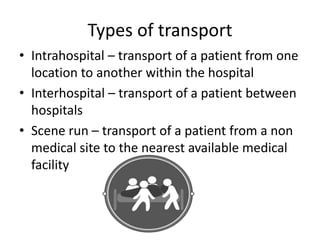
Types of transport
• Intrahospital – transport of a patient from one
location to another within the hospital
• Interhospital – transport of a patient between
hospitals
• Scene run – transport of a patient from a non
medical site to the nearest available medical
facility
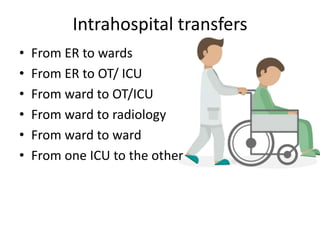
Intrahospital transfers
• From ER to wards
• From ER to OT/ ICU
• From ward to OT/ICU
• From ward to radiology
• From ward to ward
• From one ICU to the other
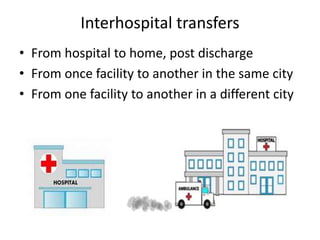
Interhospital transfers
• From hospital to home, post discharge
• From once facility to another in the same city
• From one facility to another in a different city
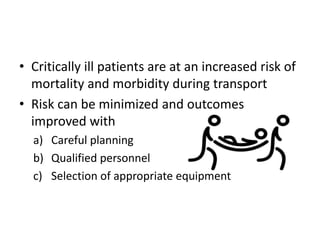
• Critically ill patients are at an increased risk of
mortality and morbidity during transport
• Risk can be minimized and outcomes
improved with
a) Careful planning
b) Qualified personnel
c) Selection of appropriate equipment
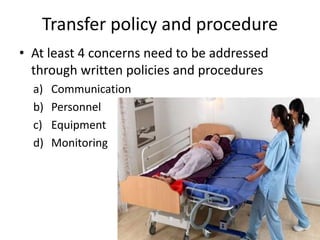
Transfer policy and procedure
• At least 4 concerns need to be addressed
through written policies and procedures
a) Communication
b) Personnel
c) Equipment
d) Monitoring
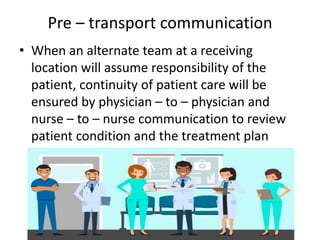
Pre – transport communication
• When an alternate team at a receiving
location will assume responsibility of the
patient, continuity of patient care will be
ensured by physician – to – physician and
nurse – to – nurse communication to review
patient condition and the treatment plan
• Before transport, the receiving location
confirms that it is ready to receive the patient
• The responsible physician is made aware of
the transport
• Documentation in the medical record includes
the indications for transport and patient
status throughout the time away from the unit
of origin
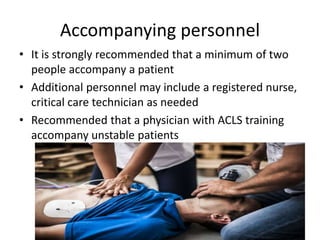
Accompanying personnel
• It is strongly recommended that a minimum of two
people accompany a patient
• Additional personnel may include a registered nurse,
critical care technician as needed
• Recommended that a physician with ACLS training
accompany unstable patients
Accompanying equipment
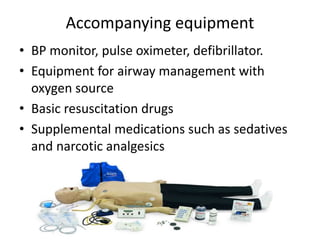
• BP monitor, pulse oximeter, defibrillator.
• Equipment for airway management with
oxygen source
• Basic resuscitation drugs
• Supplemental medications such as sedatives
and narcotic analgesics
Accompanying equipment
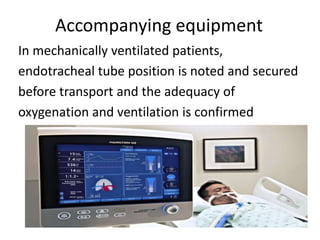
In mechanically ventilated patients,
endotracheal tube position is noted and secured
before transport and the adequacy of
oxygenation and ventilation is confirmed
Accompanying equipment
• All battery – operated equipment is fully
charged and capable of functioning for the
duration of the transport
Monitoring during transport
• All patients receive the same level of basic
physiological monitoring as they had in their
ward/ ICU
• At a minimum, continuous vital signs and
pulse oximetry monitoring
Nurses role in transfer of a patient
Action Rationale
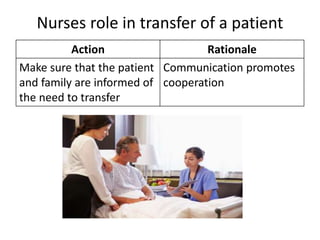
Make sure that the patient
and family are informed of
the need to transfer
Communication promotes
cooperation
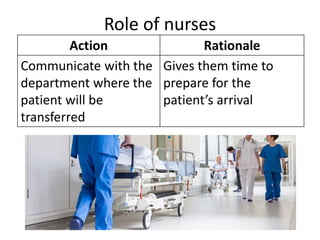
Role of nurses
Action Rationale
Communicate with the
department where the
patient will be
transferred
Gives them time to
prepare for the
patient’s arrival
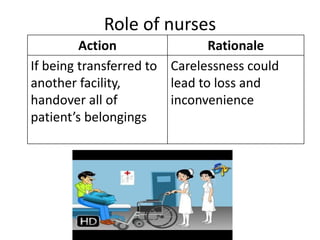
Role of nurses
Action Rationale
If being transferred to
another facility,
handover all of
patient’s belongings
Carelessness could
lead to loss and
inconvenience
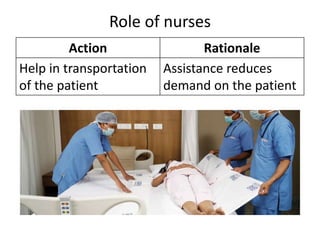
Role of nurses
Action Rationale
Help in transportation
of the patient
Assistance reduces
demand on the patient
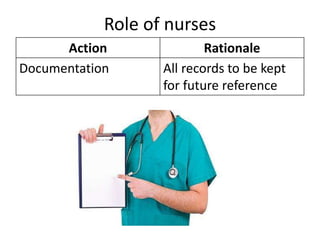
Role of nurses
Action Rationale
Documentation All records to be kept
for future reference
Patient transfer

Patient transfer

  • 1.
    Pune Adventist Hospital Safetransfer of patients
  • 2.
    Types of transport •Intrahospital – transport of a patient from one location to another within the hospital • Interhospital – transport of a patient between hospitals • Scene run – transport of a patient from a non medical site to the nearest available medical facility
  • 3.
    Intrahospital transfers • FromER to wards • From ER to OT/ ICU • From ward to OT/ICU • From ward to radiology • From ward to ward • From one ICU to the other
  • 4.
    Interhospital transfers • Fromhospital to home, post discharge • From once facility to another in the same city • From one facility to another in a different city
  • 5.
    • Critically illpatients are at an increased risk of mortality and morbidity during transport • Risk can be minimized and outcomes improved with a) Careful planning b) Qualified personnel c) Selection of appropriate equipment
  • 6.
    Transfer policy andprocedure • At least 4 concerns need to be addressed through written policies and procedures a) Communication b) Personnel c) Equipment d) Monitoring
  • 7.
    Pre – transportcommunication • When an alternate team at a receiving location will assume responsibility of the patient, continuity of patient care will be ensured by physician – to – physician and nurse – to – nurse communication to review patient condition and the treatment plan
  • 8.
    • Before transport,the receiving location confirms that it is ready to receive the patient • The responsible physician is made aware of the transport
  • 9.
    • Documentation inthe medical record includes the indications for transport and patient status throughout the time away from the unit of origin
  • 10.
    Accompanying personnel • Itis strongly recommended that a minimum of two people accompany a patient • Additional personnel may include a registered nurse, critical care technician as needed • Recommended that a physician with ACLS training accompany unstable patients
  • 11.
    Accompanying equipment • BPmonitor, pulse oximeter, defibrillator. • Equipment for airway management with oxygen source • Basic resuscitation drugs • Supplemental medications such as sedatives and narcotic analgesics
  • 12.
    Accompanying equipment In mechanicallyventilated patients, endotracheal tube position is noted and secured before transport and the adequacy of oxygenation and ventilation is confirmed
  • 13.
    Accompanying equipment • Allbattery – operated equipment is fully charged and capable of functioning for the duration of the transport
  • 14.
    Monitoring during transport •All patients receive the same level of basic physiological monitoring as they had in their ward/ ICU • At a minimum, continuous vital signs and pulse oximetry monitoring
  • 15.
    Nurses role intransfer of a patient Action Rationale Make sure that the patient and family are informed of the need to transfer Communication promotes cooperation
  • 16.
    Role of nurses ActionRationale Communicate with the department where the patient will be transferred Gives them time to prepare for the patient’s arrival
  • 17.
    Role of nurses ActionRationale If being transferred to another facility, handover all of patient’s belongings Carelessness could lead to loss and inconvenience
  • 18.
    Role of nurses ActionRationale Help in transportation of the patient Assistance reduces demand on the patient
  • 19.
    Role of nurses ActionRationale Documentation All records to be kept for future reference