CENTRAL STERILE SERVICE DEPARTMENT
It is a Service,
with in the hospital,
catering for the sterile supplies
to all departments ,
both to specialized units,
general wards and OPDs.
ƒMission of CSSD
‰Timely delivery of sterile goods
‰Quality
‰Efficiency (line process)
ƒActivities of the CSSD
‰Cleaning
‰Disinfection of semi- / non critical items
‰Sterilization of critical items (high risk for infection)
‰Supply of sterile materials
a. Contributing to a reduction in the incidence of
hospital infection.
b. To avoid duplication of costly equipment.
c. To maintain recordof
effectiveness of cleaning, disinfection
and sterilization process.
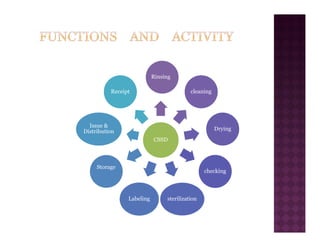
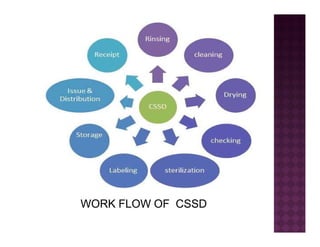
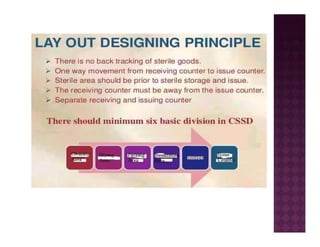
CSSD
Rinsing
cleaning
Drying
checking
sterilization
Labeling
Storage
Issue &
Distribution
Receipt
• Receiving and sorting soiled materials used in the
hospital.
• Determining whether the item should be reused or
discarded.
• Carry out the process of decontamination or disinfection
prior to sterilization.
• Carry out specialized cleaning of equipments and
supplies.
• Inspecting and testing instruments, equipments and
linen.
• Assembling treatments trays, instrument sets, linen
packs, etc.
• Packing all materials for sterilization.
• Sterilizing.
• Labeling and dating materials.
• Storing and controlling inventory.
• Issuing and distributing.
• Size and location of CSSD varies
• 7 to 10 square feet per bed is recommended
• It should be located as close as possible to
Operation theatres,
• Accidents and Emergency department and
wards
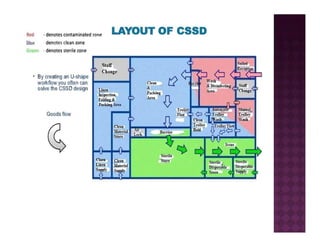
• The CSSD layout should be designed for a
unidirectional flow
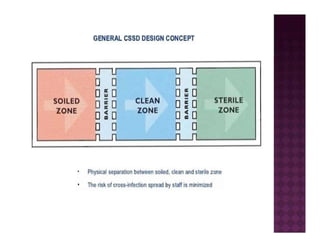
CSSD should have four zones for a smooth work
flow:
a. The unclean and washing area
b. The assembly and packing area
c. The sterilization area
d. The sterile area
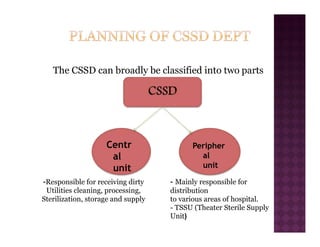
The CSSD can broadly be classified into two parts
Centr
al
unit
Peripher
al
unit
-Responsible for receiving dirty
Utilities cleaning, processing,
Sterilization, storage and supply
- Mainly responsible for
distribution
to various areas of hospital.
- TSSU (Theater Sterile Supply
Unit)
- The materials/itemsfrom contaminated
and sterile areas should not get mixed.
- There should be physical
barrier between clean
and dirty areas.
- The floor should be smooth, non skid &
robust.
- Relative humidity should be maintained at
45±5 %
- The clean area should be maintained at
positive pressures.
- The minimum ventilation rate
should be 6-10 air changes / hour.
- The work area should be made of
marble / granite / stainless steel.
- The sterilization must be planned for
autoclaving by steam as well as by gas.
• The CSSD should be close to the casualty,
Operation Theatre and
wards which are the largest consumer of the
sterilized material.
• In multistoried buildings,
• CSSD may be planned in the lower floor right
under the Operation Theatre,
• where vertical movement will be the quickest
possible movement of the material.
•Cleaning and decontamination devices
•Hot air Oven for drying & heat sterilization
•Glove processing unit for surgical gloves
•Instrument sharper e.g.. Needle sharper
•Testing apparatus for emergency sterilization
•Others :- trolleys, work surface, telephones
•Maintenance and repair of equipments
•Material : chemicals for washing and
cleaning
•Steam Boiler
•Hot air ovens for drying instruments
•Autoclaves using dry heat, moist heat.
•Ethylene oxide sterilizers.
•Testing material to check effectiveness of
sterilization.
•Sealing machine
•Ultrasonic Washer
•It is a process of freeing an article from
all living organisms including bacteria,
fungal spores and viruses.
•A material is pronounced sterile if it
achieves 99.99%kill of bacterial spores.
• Dry Heat
• Steam High Pressure-Autoclaves operated
by Gas, K.oil or Electricity (Flash, Pulse)
• Ethylene Oxide Sterilization.
• Chemical Sterilization.
• Radiation Sterilization.
• Infra Red Radiation – Syringes
• Ultra Violet Radiation – Decontamination
of Air
• Ionizing Radiation / Gamma Radiation
CIDEX
•A Glutaraldehyde derivative is most effective as it destroys spores too.
•It is high level disinfectant. It kills spores within 12 hrs and viruses
within 10min.
•Widely used because of their excellent biocidal properties, activity in the
presence of organic matter,
•non corrosiveness and noncoagulation of proteinaceous material
Hydrogen peroxide
•It is an effective bacteriocidal, fungicidal, viricidal and sporicidal.
•It is commercially available as 3% solution but can be used upto 25%
concentration.
•It is non corrosive and not inactivated by organic matter but irritant to skin
and eyes lutaraldehyde derivative is most effective as it destroys spores too.
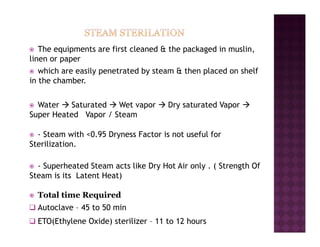
€ The equipments are first cleaned & the packaged in muslin,
linen or paper
€ which are easily penetrated by steam & then placed on shelf
in the chamber.
€ Water Æ Saturated Æ Wet vapor Æ Dry saturated Vapor Æ
Super Heated Vapor / Steam
€ - Steam with <0.95 Dryness Factor is not useful for
Sterilization.
€ - Superheated Steam acts like Dry Hot Air only . ( Strength Of
Steam is its Latent Heat)
€ Total time Required
‰ Autoclave – 45 to 50 min
‰ ETO(Ethylene Oxide) sterilizer – 11 to 12 hours
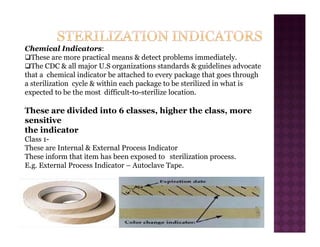
Chemical Indicators:
‰These are more practical means & detect problems immediately.
‰The CDC & all major U.S organizations standards & guidelines advocate
that a chemical indicator be attached to every package that goes through
a sterilization cycle & within each package to be sterilized in what is
expected to be the most difficult-to-sterilize location.
These are divided into 6 classes, higher the class, more
sensitive
the indicator
Class 1-
These are Internal & External Process Indicator
These inform that item has been exposed to sterilization process.
E.g. External Process Indicator – Autoclave Tape.
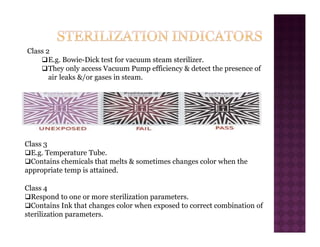
Class 2
‰E.g. Bowie-Dick test for vacuum steam sterilizer.
‰They only access Vacuum Pump efficiency & detect the presence of
air leaks &/or gases in steam.
Class 3
‰E.g. Temperature Tube.
‰Contains chemicals that melts & sometimes changes color when the
appropriate temp is attained.
Class 4
‰Respond to one or more sterilization parameters.
‰Contains Ink that changes color when exposed to correct combination of
sterilization parameters.
Class 5
‰Known as Integrating Indicators or Integrators
‰Respond to all parameters of sterilization over a specified range of
temperatures.
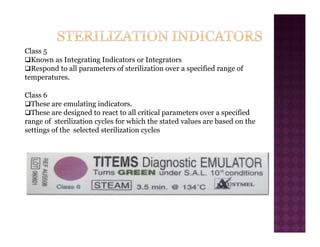
Class 6
‰These are emulating indicators.
‰These are designed to react to all critical parameters over a specified
range of sterilization cycles for which the stated values are based on the
settings of the selected sterilization cycles
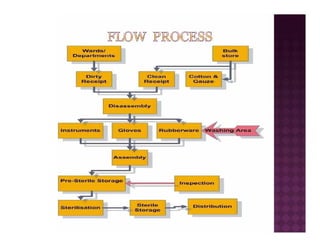
WORK FLOW OF CSSD
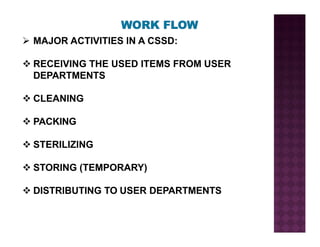
¾ MAJOR ACTIVITIES IN A CSSD:
™ RECEIVING THE USED ITEMS FROM USER
DEPARTMENTS
™ CLEANING
™ PACKING
™ STERILIZING
™ STORING (TEMPORARY)
™ DISTRIBUTING TO USER DEPARTMENTS
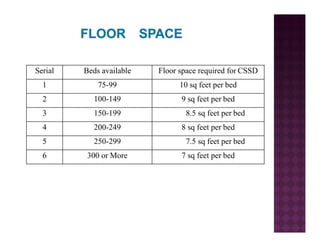
Serial Beds available Floor space required for CSSD
1 75-99 10 sq feet per bed
2 100-149 9 sq feet per bed
3 150-199 8.5 sq feet per bed
4 200-249 8 sq feet per bed
5 250-299 7.5 sq feet per bed
6 300 or More 7 sq feet per bed
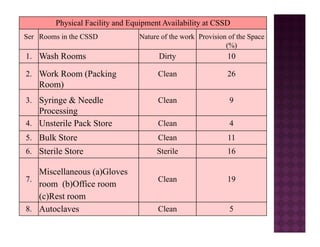
Physical Facility and Equipment Availability at CSSD
Ser Rooms in the CSSD Nature of the work Provision of the Space
(%)
1. Wash Rooms Dirty 10
2. Work Room (Packing
Room)
Clean 26
3. Syringe & Needle
Processing
Clean 9
4. Unsterile Pack Store Clean 4
5. Bulk Store Clean 11
6. Sterile Store Sterile 16
7.
Miscellaneous (a)Gloves
room (b)Office room
(c)Rest room
Clean 19
8. Autoclaves Clean 5
• After sterilization the sterilized items are
• kept in different racks as per labeling.
• Supplied as per the demand of different
area.
• To ensure continuous availability of sterile
supply five times of
daily requirement should be available in
storage.
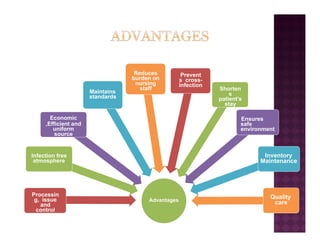
Advantages
Processin
g, issue
and
control
Infection free
atmosphere
Economic
,Efficient and
uniform
source
Maintains
standards
Reduces
burden on
nursing
staff
Prevent
s cross-
infection
Shorten
s
patient’s
stay
Ensures
safe
environment
Inventory
Maintenance
Quality
care
1. Bacteriological safe sterilization.
2. Less expensive.
3. Elimination of unsound practices &
establishment of standard procedures.
4. Assurance of adequate supply of sterile
products immediately and constantly
available for sometime as well as
emergency use.
5. Conservation of trained staff.
6. Better quality control
7. Better good of material flow
8. Prolonged life by proper care of equipment
DHA_Anita_MHA2_Paper2_Unit 3.1.pdf

DHA_Anita_MHA2_Paper2_Unit 3.1.pdf

  • 1.
  • 2.
    It is aService, with in the hospital, catering for the sterile supplies to all departments , both to specialized units, general wards and OPDs.
  • 3.
    ƒMission of CSSD ‰Timelydelivery of sterile goods ‰Quality ‰Efficiency (line process) ƒActivities of the CSSD ‰Cleaning ‰Disinfection of semi- / non critical items ‰Sterilization of critical items (high risk for infection) ‰Supply of sterile materials
  • 4.
    a. Contributing toa reduction in the incidence of hospital infection. b. To avoid duplication of costly equipment. c. To maintain recordof effectiveness of cleaning, disinfection and sterilization process.
  • 5.
  • 6.
    • Receiving andsorting soiled materials used in the hospital. • Determining whether the item should be reused or discarded. • Carry out the process of decontamination or disinfection prior to sterilization. • Carry out specialized cleaning of equipments and supplies. • Inspecting and testing instruments, equipments and linen. • Assembling treatments trays, instrument sets, linen packs, etc. • Packing all materials for sterilization. • Sterilizing. • Labeling and dating materials. • Storing and controlling inventory. • Issuing and distributing.
  • 7.
    • Size andlocation of CSSD varies • 7 to 10 square feet per bed is recommended • It should be located as close as possible to Operation theatres, • Accidents and Emergency department and wards • The CSSD layout should be designed for a unidirectional flow
  • 8.
    CSSD should havefour zones for a smooth work flow: a. The unclean and washing area b. The assembly and packing area c. The sterilization area d. The sterile area
  • 11.
    The CSSD canbroadly be classified into two parts Centr al unit Peripher al unit -Responsible for receiving dirty Utilities cleaning, processing, Sterilization, storage and supply - Mainly responsible for distribution to various areas of hospital. - TSSU (Theater Sterile Supply Unit)
  • 12.
    - The materials/itemsfromcontaminated and sterile areas should not get mixed. - There should be physical barrier between clean and dirty areas. - The floor should be smooth, non skid & robust. - Relative humidity should be maintained at 45±5 %
  • 13.
    - The cleanarea should be maintained at positive pressures. - The minimum ventilation rate should be 6-10 air changes / hour. - The work area should be made of marble / granite / stainless steel. - The sterilization must be planned for autoclaving by steam as well as by gas.
  • 14.
    • The CSSDshould be close to the casualty, Operation Theatre and wards which are the largest consumer of the sterilized material. • In multistoried buildings, • CSSD may be planned in the lower floor right under the Operation Theatre, • where vertical movement will be the quickest possible movement of the material.
  • 15.
    •Cleaning and decontaminationdevices •Hot air Oven for drying & heat sterilization •Glove processing unit for surgical gloves •Instrument sharper e.g.. Needle sharper •Testing apparatus for emergency sterilization •Others :- trolleys, work surface, telephones •Maintenance and repair of equipments •Material : chemicals for washing and cleaning
  • 16.
    •Steam Boiler •Hot airovens for drying instruments •Autoclaves using dry heat, moist heat. •Ethylene oxide sterilizers. •Testing material to check effectiveness of sterilization. •Sealing machine •Ultrasonic Washer
  • 17.
    •It is aprocess of freeing an article from all living organisms including bacteria, fungal spores and viruses. •A material is pronounced sterile if it achieves 99.99%kill of bacterial spores.
  • 18.
    • Dry Heat •Steam High Pressure-Autoclaves operated by Gas, K.oil or Electricity (Flash, Pulse) • Ethylene Oxide Sterilization. • Chemical Sterilization. • Radiation Sterilization. • Infra Red Radiation – Syringes • Ultra Violet Radiation – Decontamination of Air • Ionizing Radiation / Gamma Radiation
  • 19.
    CIDEX •A Glutaraldehyde derivativeis most effective as it destroys spores too. •It is high level disinfectant. It kills spores within 12 hrs and viruses within 10min. •Widely used because of their excellent biocidal properties, activity in the presence of organic matter, •non corrosiveness and noncoagulation of proteinaceous material Hydrogen peroxide •It is an effective bacteriocidal, fungicidal, viricidal and sporicidal. •It is commercially available as 3% solution but can be used upto 25% concentration. •It is non corrosive and not inactivated by organic matter but irritant to skin and eyes lutaraldehyde derivative is most effective as it destroys spores too.
  • 20.
    € The equipmentsare first cleaned & the packaged in muslin, linen or paper € which are easily penetrated by steam & then placed on shelf in the chamber. € Water Æ Saturated Æ Wet vapor Æ Dry saturated Vapor Æ Super Heated Vapor / Steam € - Steam with <0.95 Dryness Factor is not useful for Sterilization. € - Superheated Steam acts like Dry Hot Air only . ( Strength Of Steam is its Latent Heat) € Total time Required ‰ Autoclave – 45 to 50 min ‰ ETO(Ethylene Oxide) sterilizer – 11 to 12 hours
  • 21.
    Chemical Indicators: ‰These aremore practical means & detect problems immediately. ‰The CDC & all major U.S organizations standards & guidelines advocate that a chemical indicator be attached to every package that goes through a sterilization cycle & within each package to be sterilized in what is expected to be the most difficult-to-sterilize location. These are divided into 6 classes, higher the class, more sensitive the indicator Class 1- These are Internal & External Process Indicator These inform that item has been exposed to sterilization process. E.g. External Process Indicator – Autoclave Tape.
  • 22.
    Class 2 ‰E.g. Bowie-Dicktest for vacuum steam sterilizer. ‰They only access Vacuum Pump efficiency & detect the presence of air leaks &/or gases in steam. Class 3 ‰E.g. Temperature Tube. ‰Contains chemicals that melts & sometimes changes color when the appropriate temp is attained. Class 4 ‰Respond to one or more sterilization parameters. ‰Contains Ink that changes color when exposed to correct combination of sterilization parameters.
  • 23.
    Class 5 ‰Known asIntegrating Indicators or Integrators ‰Respond to all parameters of sterilization over a specified range of temperatures. Class 6 ‰These are emulating indicators. ‰These are designed to react to all critical parameters over a specified range of sterilization cycles for which the stated values are based on the settings of the selected sterilization cycles
  • 25.
  • 26.
    ¾ MAJOR ACTIVITIESIN A CSSD: ™ RECEIVING THE USED ITEMS FROM USER DEPARTMENTS ™ CLEANING ™ PACKING ™ STERILIZING ™ STORING (TEMPORARY) ™ DISTRIBUTING TO USER DEPARTMENTS
  • 27.
    Serial Beds availableFloor space required for CSSD 1 75-99 10 sq feet per bed 2 100-149 9 sq feet per bed 3 150-199 8.5 sq feet per bed 4 200-249 8 sq feet per bed 5 250-299 7.5 sq feet per bed 6 300 or More 7 sq feet per bed
  • 30.
    Physical Facility andEquipment Availability at CSSD Ser Rooms in the CSSD Nature of the work Provision of the Space (%) 1. Wash Rooms Dirty 10 2. Work Room (Packing Room) Clean 26 3. Syringe & Needle Processing Clean 9 4. Unsterile Pack Store Clean 4 5. Bulk Store Clean 11 6. Sterile Store Sterile 16 7. Miscellaneous (a)Gloves room (b)Office room (c)Rest room Clean 19 8. Autoclaves Clean 5
  • 31.
    • After sterilizationthe sterilized items are • kept in different racks as per labeling. • Supplied as per the demand of different area. • To ensure continuous availability of sterile supply five times of daily requirement should be available in storage.
  • 32.
    Advantages Processin g, issue and control Infection free atmosphere Economic ,Efficientand uniform source Maintains standards Reduces burden on nursing staff Prevent s cross- infection Shorten s patient’s stay Ensures safe environment Inventory Maintenance Quality care
  • 33.
    1. Bacteriological safesterilization. 2. Less expensive. 3. Elimination of unsound practices & establishment of standard procedures. 4. Assurance of adequate supply of sterile products immediately and constantly available for sometime as well as emergency use. 5. Conservation of trained staff. 6. Better quality control 7. Better good of material flow 8. Prolonged life by proper care of equipment