Topic           : Networking and LAN
    Sub topic   : Describe CSMA
.


                                       1
Objectives
On completion of this period , you would be able to
know about
• CSMA ( Carrier Sense Multiple Access)
   • Types of CSMA
         –   Persistent CSMA
         –   Non Persistent CSMA
         –   CSMA / CD
   • Comparison


                                                      2
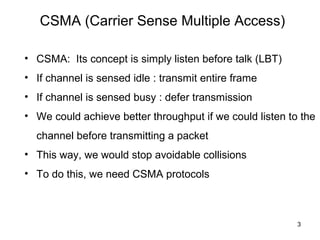
CSMA (Carrier Sense Multiple Access)

• CSMA: Its concept is simply listen before talk (LBT)
• If channel is sensed idle : transmit entire frame
• If channel is sensed busy : defer transmission
• We could achieve better throughput if we could listen to the
  channel before transmitting a packet
• This way, we would stop avoidable collisions
• To do this, we need CSMA protocols


                                                          3
Assumptions with CSMA Networks


• Constant length packets
• No errors, except those caused by collisions
• No capture effect
• Each host can sense the transmissions of all other hosts
• The propagation delay is small compared to the
  transmission time


                                                        4
CSMA              (cont’d)


• There are several types of CSMA protocols


      – 1-Persistent CSMA


      – Non-Persistent CSMA


      – P-Persistent CSMA


                                              5
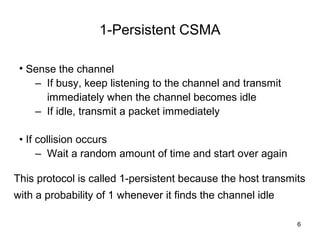
1-Persistent CSMA

 • Sense the channel
    – If busy, keep listening to the channel and transmit
      immediately when the channel becomes idle
    – If idle, transmit a packet immediately

 • If collision occurs
      – Wait a random amount of time and start over again

This protocol is called 1-persistent because the host transmits
with a probability of 1 whenever it finds the channel idle

                                                             6
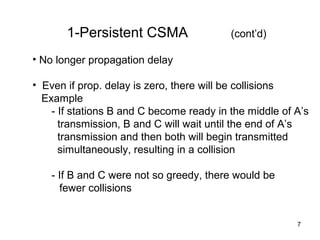
1-Persistent CSMA                  (cont’d)

• No longer propagation delay

• Even if prop. delay is zero, there will be collisions
  Example
    - If stations B and C become ready in the middle of A’s
      transmission, B and C will wait until the end of A’s
      transmission and then both will begin transmitted
      simultaneously, resulting in a collision

    - If B and C were not so greedy, there would be
      fewer collisions


                                                        7
Non-Persistent CSMA

• Sense the channel
      – If busy, wait a random amount of time and sense
        the channel again
      – If idle, transmit a packet immediately

• If collision occurs
         – wait a random amount of time and start all over
            again

       Merits
• Better channel utilization
• Longer delays
• Reduces chances of collision
• Reduces efficiency
                                                             8
Tradeoff between 1- and Non
           Persistent CSMA
• If only B becomes ready in the middle of A’s
  transmission
    – 1-Persistent: B succeeds as soon as A ends
    – Non-Persistent B may have to wait

• If B and C become ready in the middle of A’s
   transmission
     – 1-Persistent B and C collide
     – Non-Persistent B and C probably do not collide


                                                        9
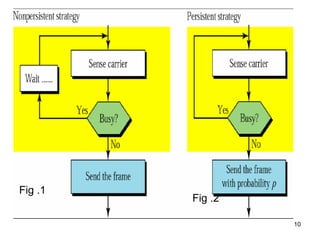
Fig .1
         Fig .2

                  10
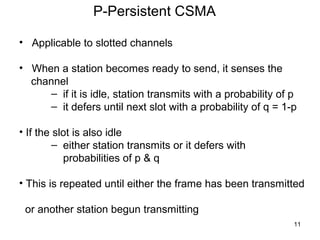
P-Persistent CSMA

• Applicable to slotted channels

• When a station becomes ready to send, it senses the
  channel
     – if it is idle, station transmits with a probability of p
     – it defers until next slot with a probability of q = 1-p

• If the slot is also idle
         – either station transmits or it defers with
           probabilities of p & q

• This is repeated until either the frame has been transmitted

 or another station begun transmitting
                                                              11
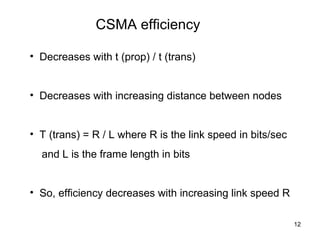
CSMA efficiency

• Decreases with t (prop) / t (trans)


• Decreases with increasing distance between nodes


• T (trans) = R / L where R is the link speed in bits/sec
  and L is the frame length in bits


• So, efficiency decreases with increasing link speed R

                                                            12
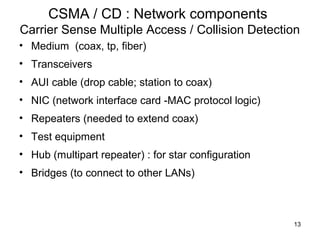
CSMA / CD : Network components
Carrier Sense Multiple Access / Collision Detection
• Medium (coax, tp, fiber)
• Transceivers
• AUI cable (drop cable; station to coax)
• NIC (network interface card -MAC protocol logic)
• Repeaters (needed to extend coax)
• Test equipment
• Hub (multipart repeater) : for star configuration
• Bridges (to connect to other LANs)


                                                      13
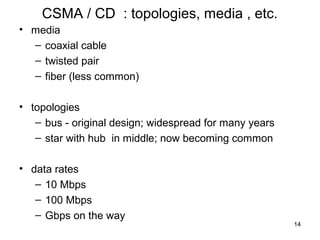
CSMA / CD : topologies, media , etc.
• media
  – coaxial cable
  – twisted pair
  – fiber (less common)

• topologies
   – bus - original design; widespread for many years
   – star with hub in middle; now becoming common

• data rates
   – 10 Mbps
   – 100 Mbps
   – Gbps on the way
                                                        14
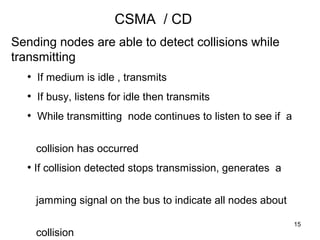
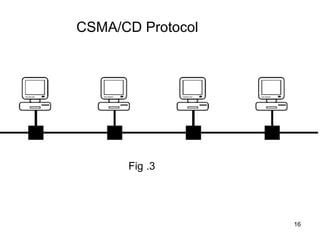
CSMA / CD
Sending nodes are able to detect collisions while
transmitting
  • If medium is idle , transmits
  • If busy, listens for idle then transmits
  • While transmitting node continues to listen to see if a

    collision has occurred
  • If collision detected stops transmission, generates a

    jamming signal on the bus to indicate all nodes about

                                                              15
    collision
CSMA/CD Protocol


      Fig .3


                   16
CSMA/CD Protocol

• All hosts transmit & receive on one channel
• Packets are of variable size
• When a host has a packet to transmit


   1. Carrier Sense: Check that the line is idle before
     transmitting
   2. Collision Detection: Detect collision as soon as
     possible If a collision is detected, stop transmitting;
     wait a random time, sense the channel again
                                                               17
Summary

In this class, you have learnt about
 • Types of CSMA
       – Persistent CSMA
       – Non Persistent CSMA


 • CSMA / CD


                                       18
Quiz
1. ____________ helps Ethernet to recover from
  simultaneous transmissions causing errors


      (a) CSMA /CD
      (b) CSM
      (c) CD
      (d) Collisions


                                                 19
Quiz


2. Which one is applicable to slotted channel ?

        (a) 1- persistent CSMA
         (b) P- Persistent CSMA
         (c) Non – Persistent CSMA
         (d) All of the above


                                                  20
Frequently Asked Questions

1. Describe Persistent and Non Persistent CSMA


2. Compare Persistent and Non Persistent CSMA


3. Describe CSMA / CD


                                                 21

Csma

  • 1.
    Topic : Networking and LAN Sub topic : Describe CSMA . 1
  • 2.
    Objectives On completion ofthis period , you would be able to know about • CSMA ( Carrier Sense Multiple Access) • Types of CSMA – Persistent CSMA – Non Persistent CSMA – CSMA / CD • Comparison 2
  • 3.
    CSMA (Carrier SenseMultiple Access) • CSMA: Its concept is simply listen before talk (LBT) • If channel is sensed idle : transmit entire frame • If channel is sensed busy : defer transmission • We could achieve better throughput if we could listen to the channel before transmitting a packet • This way, we would stop avoidable collisions • To do this, we need CSMA protocols 3
  • 4.
    Assumptions with CSMANetworks • Constant length packets • No errors, except those caused by collisions • No capture effect • Each host can sense the transmissions of all other hosts • The propagation delay is small compared to the transmission time 4
  • 5.
    CSMA (cont’d) • There are several types of CSMA protocols – 1-Persistent CSMA – Non-Persistent CSMA – P-Persistent CSMA 5
  • 6.
    1-Persistent CSMA •Sense the channel – If busy, keep listening to the channel and transmit immediately when the channel becomes idle – If idle, transmit a packet immediately • If collision occurs – Wait a random amount of time and start over again This protocol is called 1-persistent because the host transmits with a probability of 1 whenever it finds the channel idle 6
  • 7.
    1-Persistent CSMA (cont’d) • No longer propagation delay • Even if prop. delay is zero, there will be collisions Example - If stations B and C become ready in the middle of A’s transmission, B and C will wait until the end of A’s transmission and then both will begin transmitted simultaneously, resulting in a collision - If B and C were not so greedy, there would be fewer collisions 7
  • 8.
    Non-Persistent CSMA • Sensethe channel – If busy, wait a random amount of time and sense the channel again – If idle, transmit a packet immediately • If collision occurs – wait a random amount of time and start all over again Merits • Better channel utilization • Longer delays • Reduces chances of collision • Reduces efficiency 8
  • 9.
    Tradeoff between 1-and Non Persistent CSMA • If only B becomes ready in the middle of A’s transmission – 1-Persistent: B succeeds as soon as A ends – Non-Persistent B may have to wait • If B and C become ready in the middle of A’s transmission – 1-Persistent B and C collide – Non-Persistent B and C probably do not collide 9
  • 10.
    Fig .1 Fig .2 10
  • 11.
    P-Persistent CSMA • Applicableto slotted channels • When a station becomes ready to send, it senses the channel – if it is idle, station transmits with a probability of p – it defers until next slot with a probability of q = 1-p • If the slot is also idle – either station transmits or it defers with probabilities of p & q • This is repeated until either the frame has been transmitted or another station begun transmitting 11
  • 12.
    CSMA efficiency • Decreaseswith t (prop) / t (trans) • Decreases with increasing distance between nodes • T (trans) = R / L where R is the link speed in bits/sec and L is the frame length in bits • So, efficiency decreases with increasing link speed R 12
  • 13.
    CSMA / CD: Network components Carrier Sense Multiple Access / Collision Detection • Medium (coax, tp, fiber) • Transceivers • AUI cable (drop cable; station to coax) • NIC (network interface card -MAC protocol logic) • Repeaters (needed to extend coax) • Test equipment • Hub (multipart repeater) : for star configuration • Bridges (to connect to other LANs) 13
  • 14.
    CSMA / CD: topologies, media , etc. • media – coaxial cable – twisted pair – fiber (less common) • topologies – bus - original design; widespread for many years – star with hub in middle; now becoming common • data rates – 10 Mbps – 100 Mbps – Gbps on the way 14
  • 15.
    CSMA / CD Sendingnodes are able to detect collisions while transmitting • If medium is idle , transmits • If busy, listens for idle then transmits • While transmitting node continues to listen to see if a collision has occurred • If collision detected stops transmission, generates a jamming signal on the bus to indicate all nodes about 15 collision
  • 16.
  • 17.
    CSMA/CD Protocol • Allhosts transmit & receive on one channel • Packets are of variable size • When a host has a packet to transmit 1. Carrier Sense: Check that the line is idle before transmitting 2. Collision Detection: Detect collision as soon as possible If a collision is detected, stop transmitting; wait a random time, sense the channel again 17
  • 18.
    Summary In this class,you have learnt about • Types of CSMA – Persistent CSMA – Non Persistent CSMA • CSMA / CD 18
  • 19.
    Quiz 1. ____________ helpsEthernet to recover from simultaneous transmissions causing errors (a) CSMA /CD (b) CSM (c) CD (d) Collisions 19
  • 20.
    Quiz 2. Which oneis applicable to slotted channel ? (a) 1- persistent CSMA (b) P- Persistent CSMA (c) Non – Persistent CSMA (d) All of the above 20
  • 21.
    Frequently Asked Questions 1.Describe Persistent and Non Persistent CSMA 2. Compare Persistent and Non Persistent CSMA 3. Describe CSMA / CD 21