CARRIER SENSE MULTIPLE ACCESS [CSMA]
 PREPARED BY : MUSKAN DHAWAN
 YOUTUBE CHANNEL : IT Hub by Muskan Dhawan
 E-MAIL ID : muskan.dhawan99@gmail.com
CSMA ( carrier sense multiple access )
 CSMA is media access control (MAC) Protocol .
 Aim: avoid collision of signals during transmission.
 Working : it sense or listens whether the shared channel for transmission is
busy or not, and transmits if the channel is not busy .
 Here single cable connects multiple nodes .
Working:
when a station has frames to transmit , it attempt to detect presence of the
carrier signal from the other nodes connected to shared channel. If a carrier
signal is detect, it implies that a transmission is in progress .
the transmission waits till the ongoing transmission
executes to completion , and then initiates its own transmission.
Since, the nodes detect for a transmission before sending their own frames,
collision of frame is reduced.
Worst case: if two nodes detect an idle channel at the same time , they may
simultaneously initiate transmission and signals will collide .
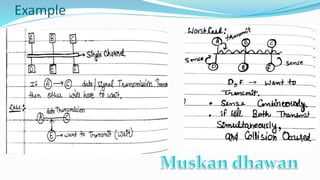
Example
 1 –persistent
 Sense the channel
_ if busy , keep listening to the channel nd transmit immediately
when the channel
becomes idle.
_ if idle , transmit a packet immediately.
 if collision occures
_ wait a random amount of time and start over again.
This is an aggressive transmission algorithm.
Here host transmit with a probability of 1.
That’s why its called 1 persistent.
 Non persistent
• Sense the channel
_ if busy , wait a random amount of time and sense the
channel again.
_ if idle , transition a packet immediately.
° if collision occures
Merits
 Better channel utilization
 longer delays
 reduce chance of collision
 Reduce efficiency
condition
 If only B becomes ready in the middle of A’s transmission
_ 1- persistent : B succeed as soon as A ends .
_ non persistent : B may have to wait.
 if B and C becomes ready in the middle of A’s transmission
_ 1 – persistent: B and C collide
_ Non-persistent : B and C probably do not collide
P-persistent CSMA
Hybrid Approach
 This approach is between 1-persistent and non-persistent CSMA access modes.
 When the transmitting node is ready to transmit data ,it sense the transmission
medium for idle or busy . If idle then it transmits immediately. If busy then it
sense the transmission medium continuously until it becomes idle., then
transmits with probability ( p). If the node doesn’t transmit (the probability of
the event is 1-p) it wait until the next available time slot.
 If the transmission medium is not busy it transmits again with the same
probability [p]. This probabilistic hold-off repeats until the frame is finally
transmitted or when the medium is Found to become busy again ( some other
node has already started transmitting) then whole logic cycle repeated.
 P – persistent CSMA used in wi-fi.
THANKYO
U

CSMA IN COMPUTER NETWORK

  • 1.
    CARRIER SENSE MULTIPLEACCESS [CSMA]  PREPARED BY : MUSKAN DHAWAN  YOUTUBE CHANNEL : IT Hub by Muskan Dhawan  E-MAIL ID : muskan.dhawan99@gmail.com
  • 2.
    CSMA ( carriersense multiple access )  CSMA is media access control (MAC) Protocol .  Aim: avoid collision of signals during transmission.  Working : it sense or listens whether the shared channel for transmission is busy or not, and transmits if the channel is not busy .  Here single cable connects multiple nodes . Working: when a station has frames to transmit , it attempt to detect presence of the carrier signal from the other nodes connected to shared channel. If a carrier signal is detect, it implies that a transmission is in progress . the transmission waits till the ongoing transmission executes to completion , and then initiates its own transmission. Since, the nodes detect for a transmission before sending their own frames, collision of frame is reduced. Worst case: if two nodes detect an idle channel at the same time , they may simultaneously initiate transmission and signals will collide .
  • 3.
  • 4.
     1 –persistent Sense the channel _ if busy , keep listening to the channel nd transmit immediately when the channel becomes idle. _ if idle , transmit a packet immediately.  if collision occures _ wait a random amount of time and start over again. This is an aggressive transmission algorithm. Here host transmit with a probability of 1. That’s why its called 1 persistent.
  • 5.
     Non persistent •Sense the channel _ if busy , wait a random amount of time and sense the channel again. _ if idle , transition a packet immediately. ° if collision occures Merits  Better channel utilization  longer delays  reduce chance of collision  Reduce efficiency
  • 6.
    condition  If onlyB becomes ready in the middle of A’s transmission _ 1- persistent : B succeed as soon as A ends . _ non persistent : B may have to wait.  if B and C becomes ready in the middle of A’s transmission _ 1 – persistent: B and C collide _ Non-persistent : B and C probably do not collide
  • 8.
    P-persistent CSMA Hybrid Approach This approach is between 1-persistent and non-persistent CSMA access modes.  When the transmitting node is ready to transmit data ,it sense the transmission medium for idle or busy . If idle then it transmits immediately. If busy then it sense the transmission medium continuously until it becomes idle., then transmits with probability ( p). If the node doesn’t transmit (the probability of the event is 1-p) it wait until the next available time slot.  If the transmission medium is not busy it transmits again with the same probability [p]. This probabilistic hold-off repeats until the frame is finally transmitted or when the medium is Found to become busy again ( some other node has already started transmitting) then whole logic cycle repeated.  P – persistent CSMA used in wi-fi.
  • 9.