Protocols :
ALOHA, CSMA , CSMA/CD, &
CSMA/CA
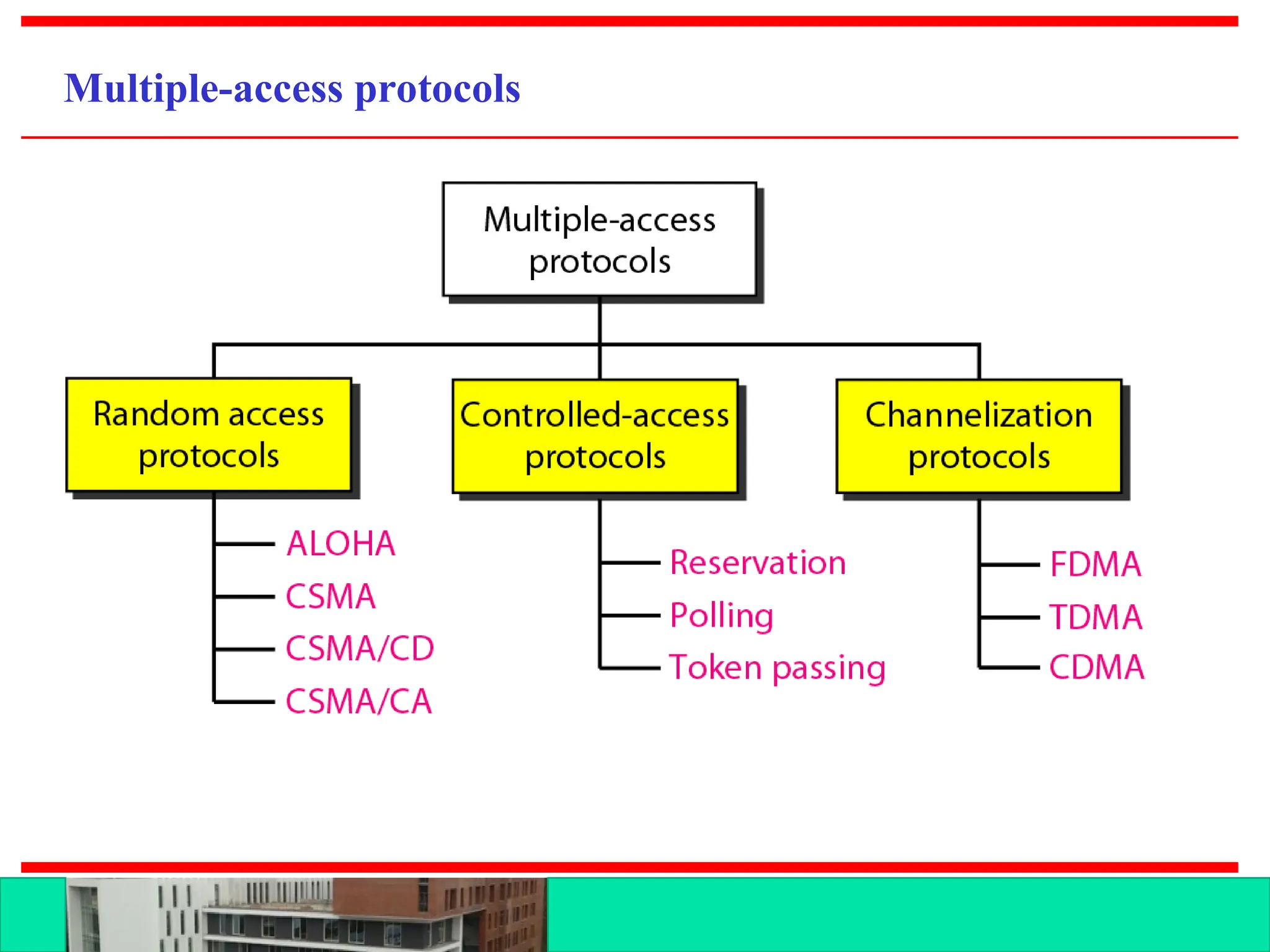
Multiple-access protocols
RANDOM ACCESS
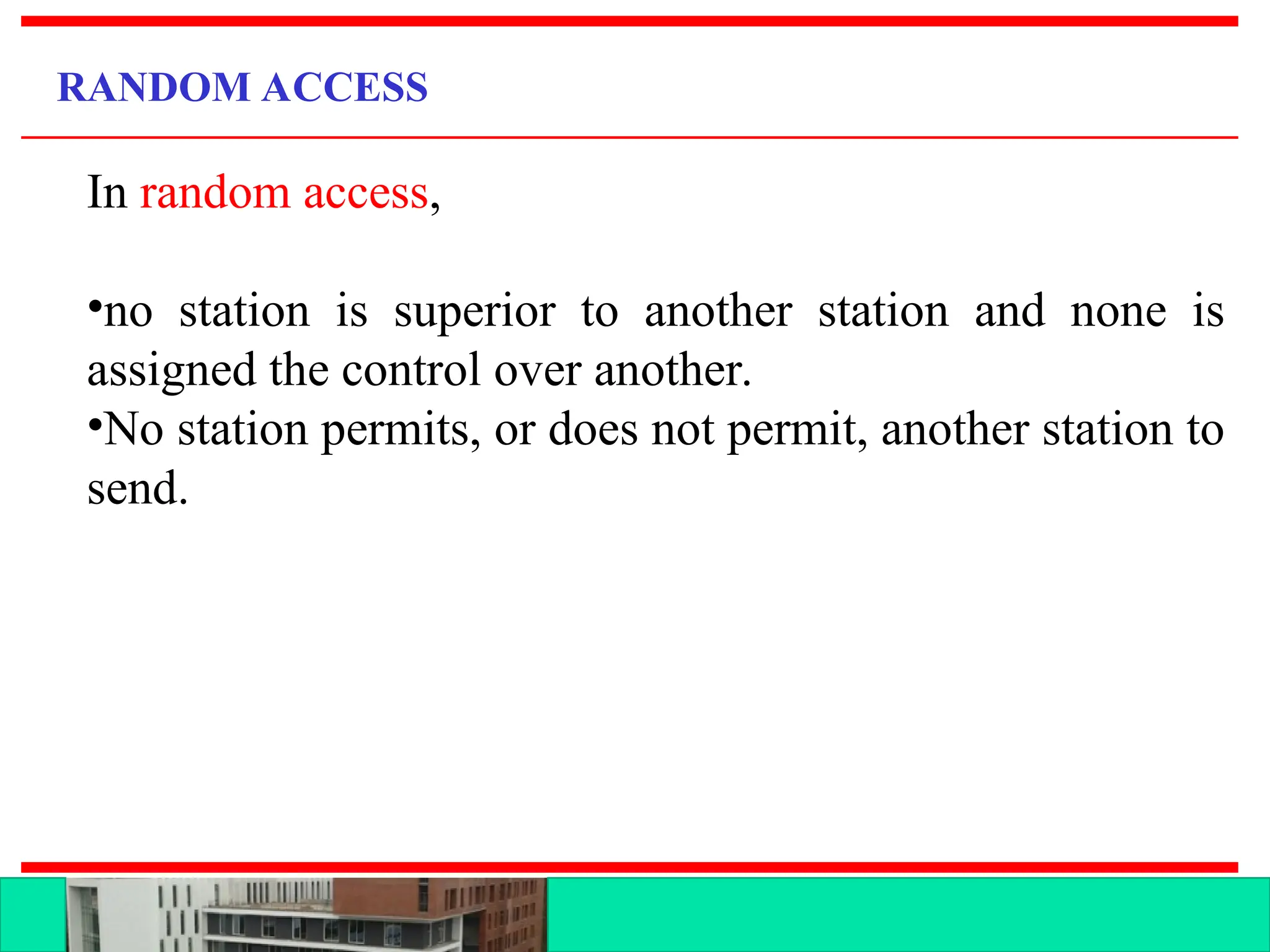
In random access,
•no station is superior to another station and none is
assigned the control over another.
•No station permits, or does not permit, another station to
send.
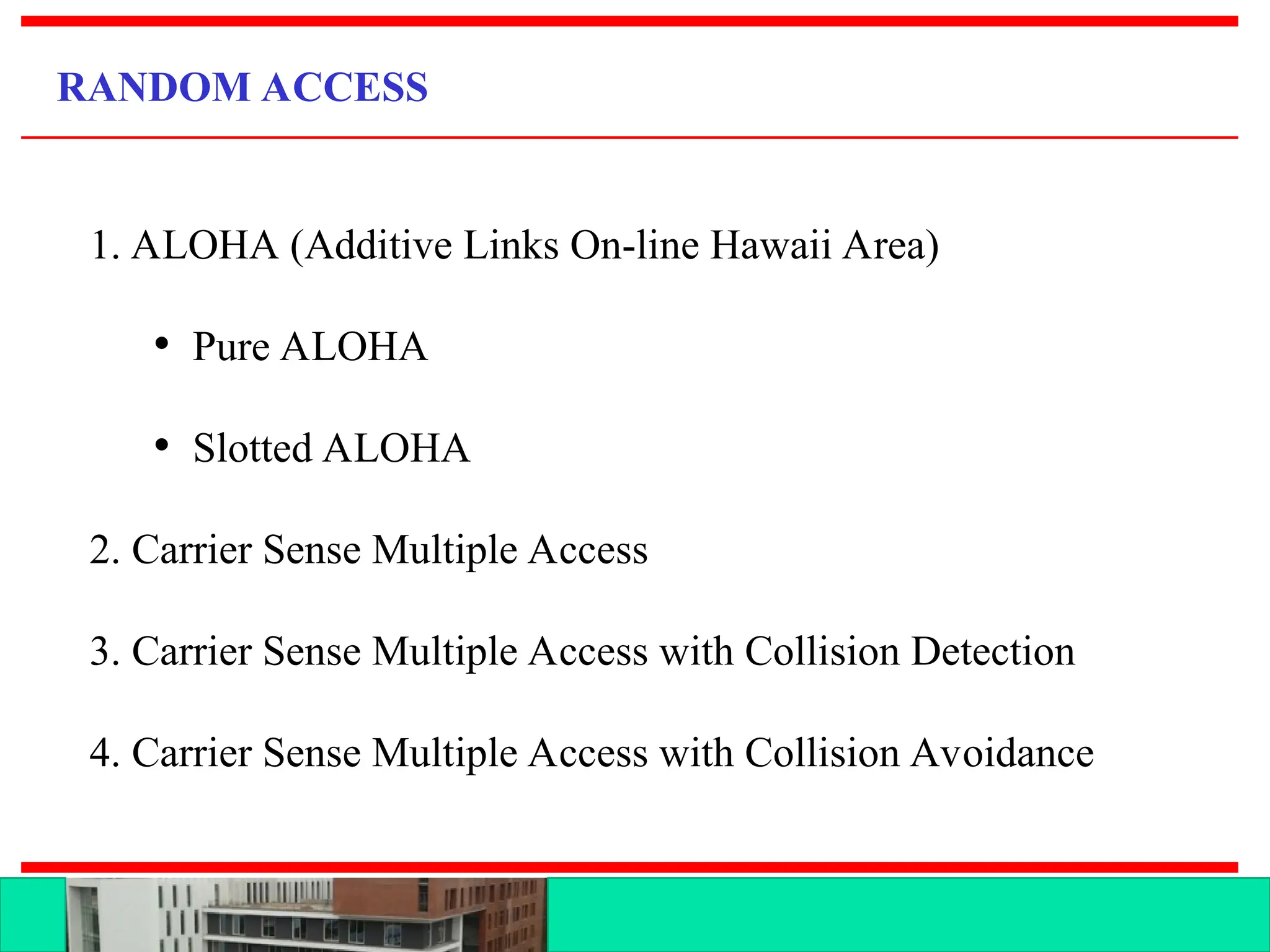
RANDOM ACCESS
1. ALOHA (Additive Links On-line Hawaii Area)
• Pure ALOHA
• Slotted ALOHA
2. Carrier Sense Multiple Access
3. Carrier Sense Multiple Access with Collision Detection
4. Carrier Sense Multiple Access with Collision Avoidance
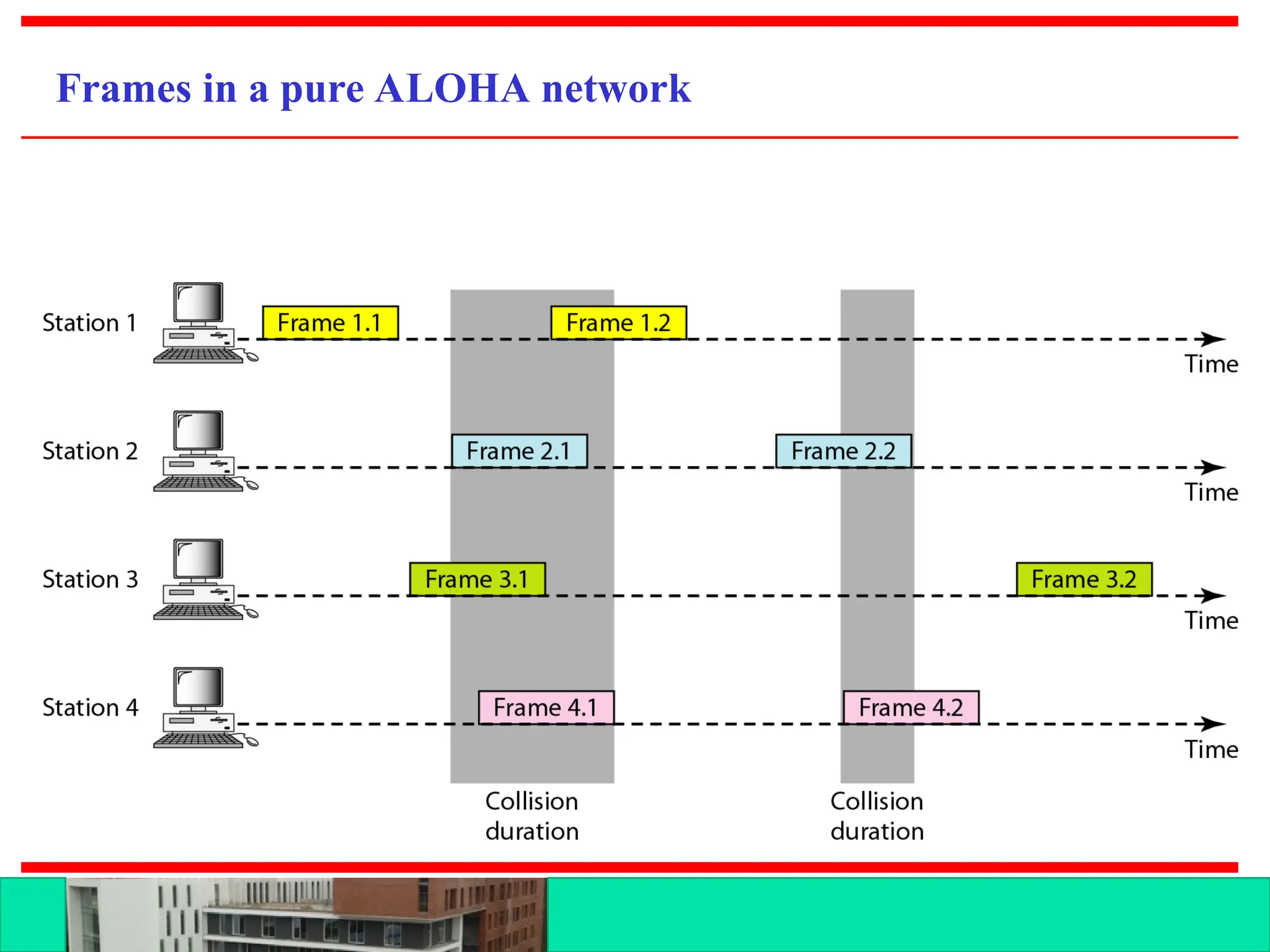
Frames in a pure ALOHA network
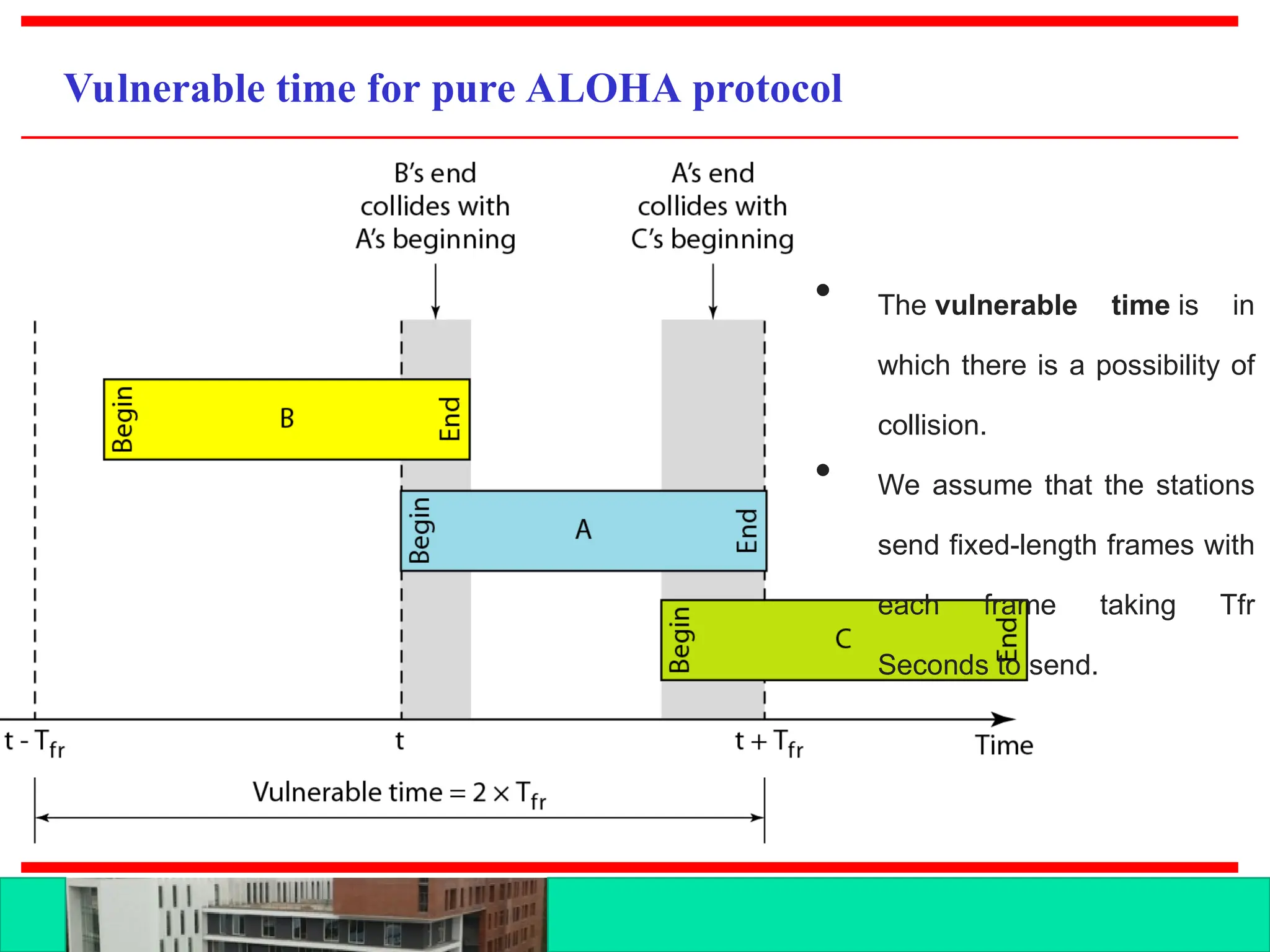
Vulnerable time for pure ALOHA protocol
• The vulnerable time is in
which there is a possibility of
collision.
• We assume that the stations
send fixed-length frames with
each frame taking Tfr
Seconds to send.
The total period of time when collision might occur
for a packet is called vulnerable period.
The throughput for pure ALOHA is
S = G × e −2G
.
The maximum throughput
Smax = 0.184 when G= (1/2).
Note
Frames in a slotted ALOHA network
The throughput for slotted ALOHA is
S = G × e−G
.
The maximum throughput
Smax = 0.368 when G = 1.
Note
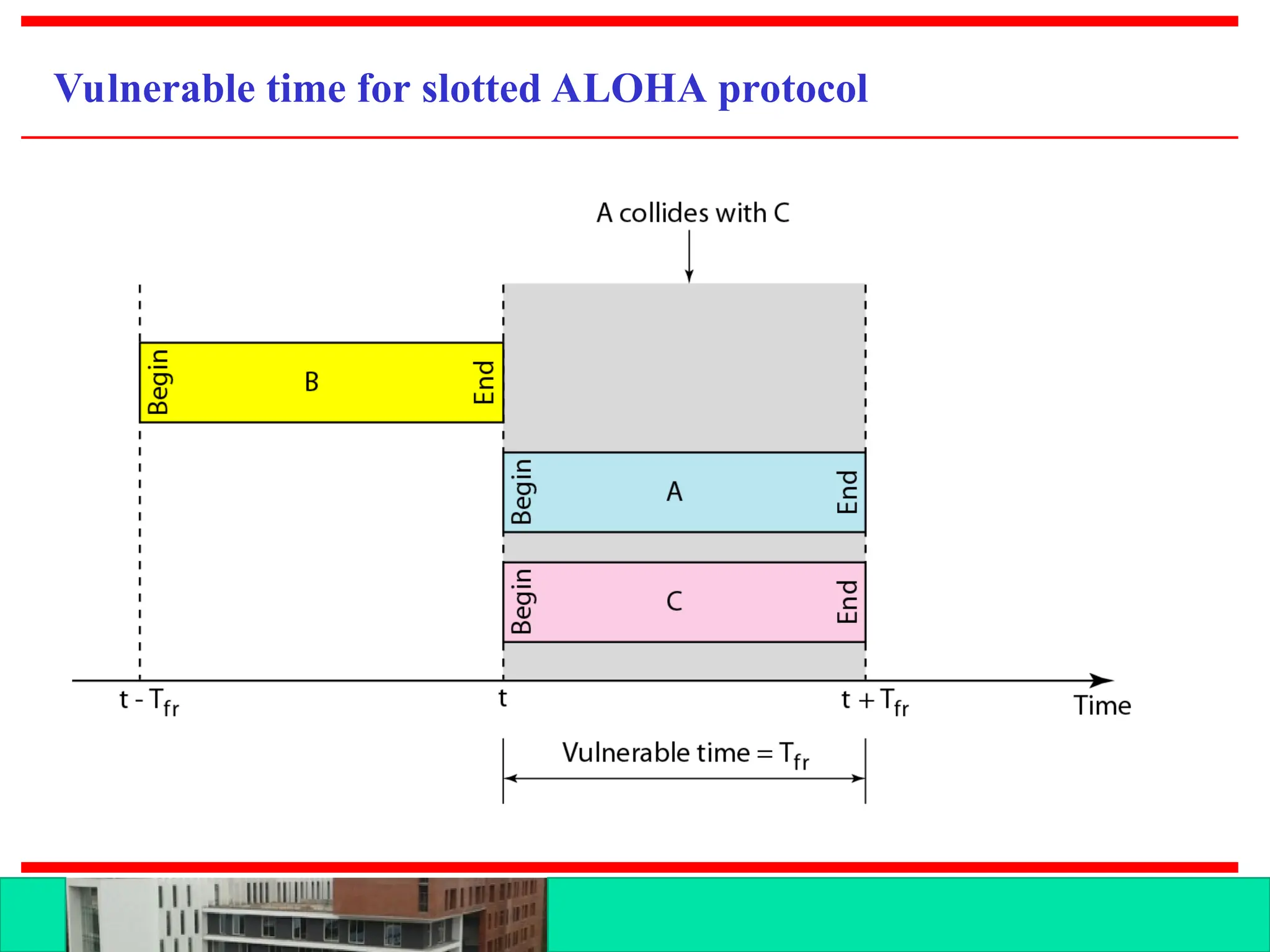
Vulnerable time for slotted ALOHA protocol
Carrier Sense multiple access (CSMA)
• Carrier Sensed Multiple Access (CSMA) : CSMA is a network access method used on shared network
topologies such as Ethernet to control access to the network. Devices attached to the network cable listen
(carrier sense) before transmitting. If the channel is in use, devices wait before transmitting.
There Are Three Different Type of CSMA Protocols
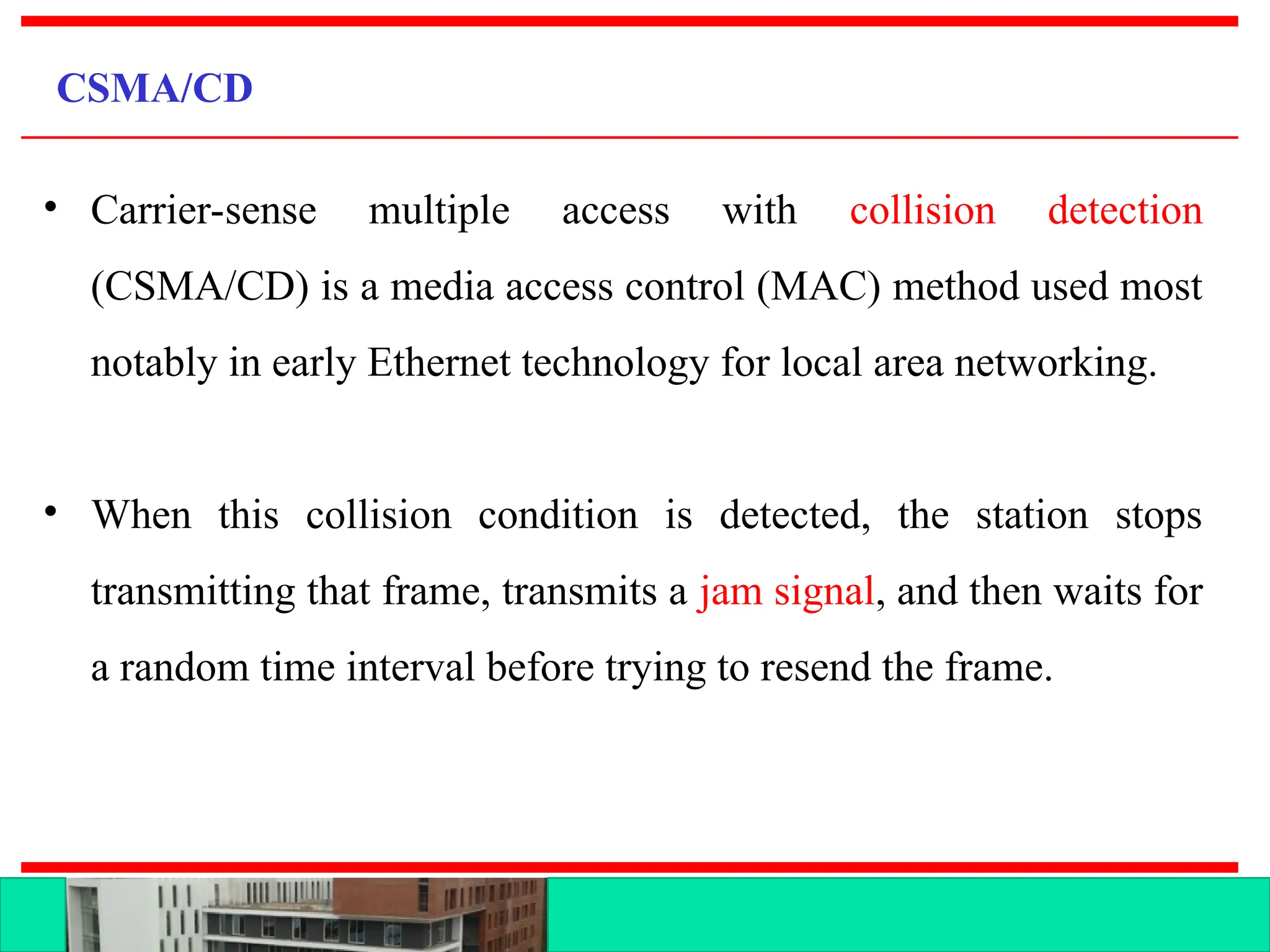
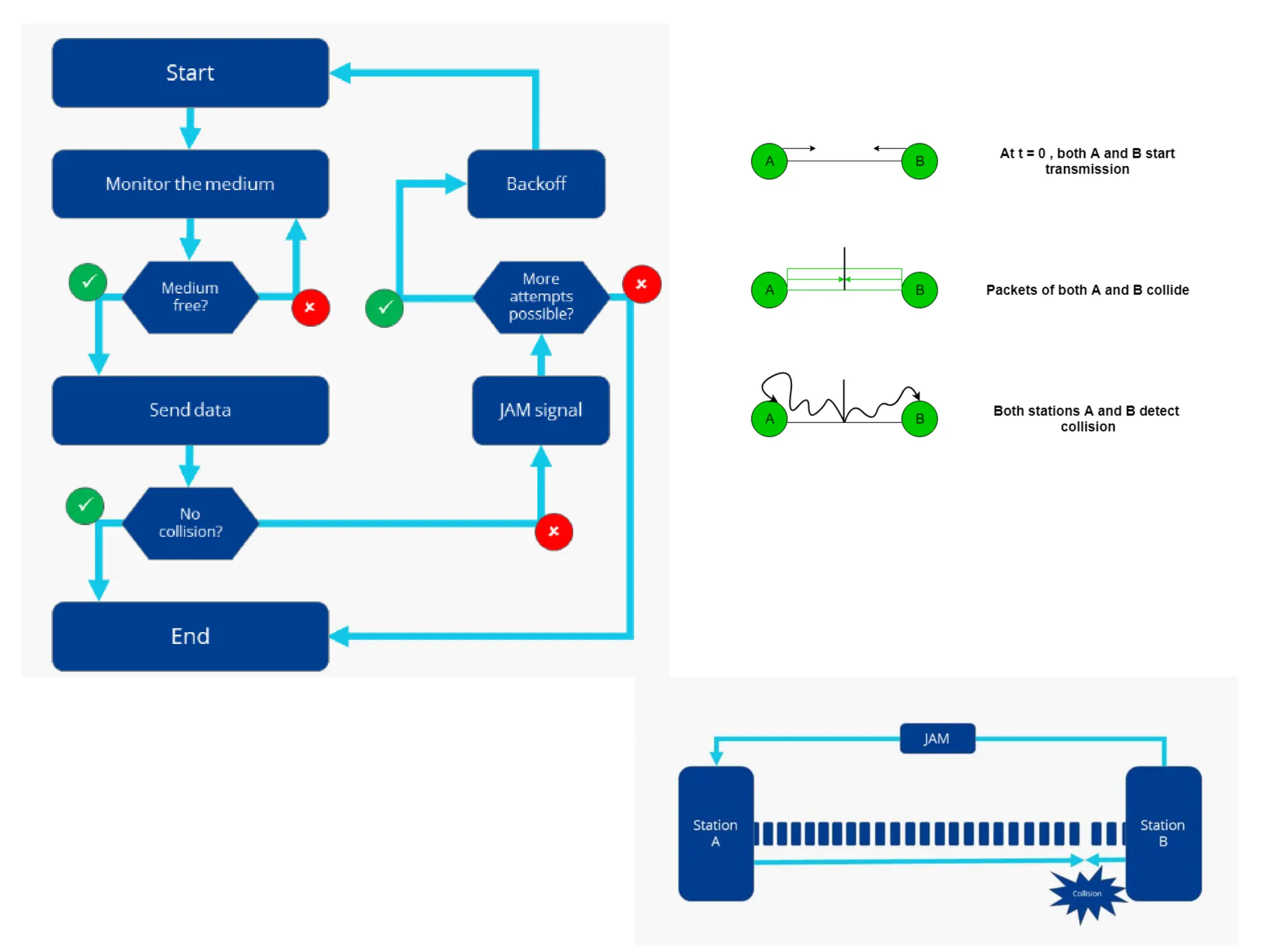
CSMA/CD
• Carrier-sense multiple access with collision detection
(CSMA/CD) is a media access control (MAC) method used most
notably in early Ethernet technology for local area networking.
• When this collision condition is detected, the station stops
transmitting that frame, transmits a jam signal, and then waits for
a random time interval before trying to resend the frame.
CSMA/CA
• CSMA/CD stands for Carrier Sense Multiple Access / Collision
Avoidance is a network protocol for carrier transmission.
• Like CSMA/CD it is also operated in the medium access control
layer.
• Unlike CSMA/CD(that is effective after a collision) CSMA / CA
is effective before a collision.
RTS (Request to Send)
CTS (Clear to Send)
DIFS = distributed inter frame spacing
SIFS = spacing between transmission and ACK
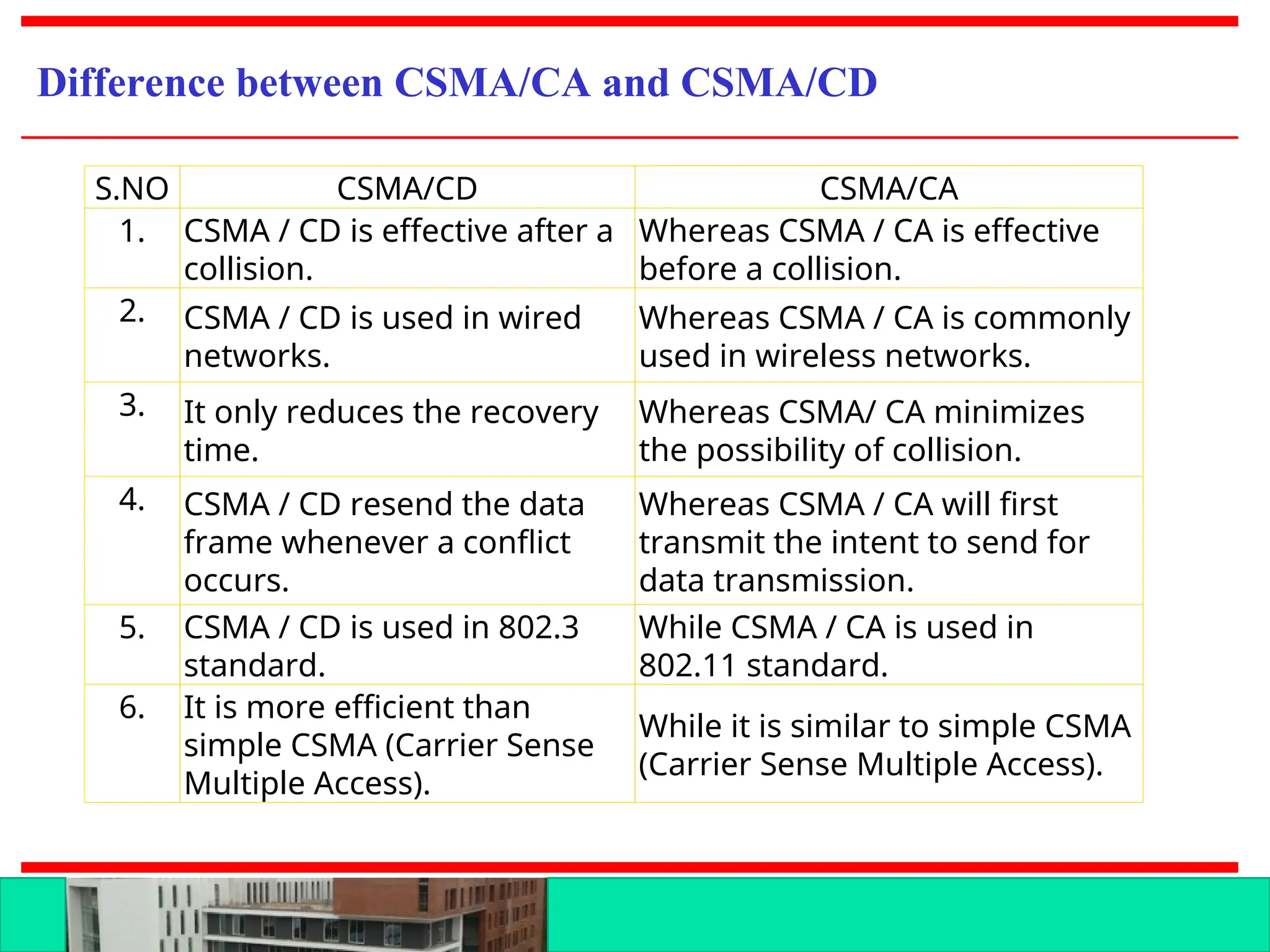
Difference between CSMA/CA and CSMA/CD
S.NO CSMA/CD CSMA/CA
1. CSMA / CD is effective after a
collision.
Whereas CSMA / CA is effective
before a collision.
2. CSMA / CD is used in wired
networks.
Whereas CSMA / CA is commonly
used in wireless networks.
3. It only reduces the recovery
time.
Whereas CSMA/ CA minimizes
the possibility of collision.
4. CSMA / CD resend the data
frame whenever a conflict
occurs.
Whereas CSMA / CA will first
transmit the intent to send for
data transmission.
5. CSMA / CD is used in 802.3
standard.
While CSMA / CA is used in
802.11 standard.
6. It is more efficient than
simple CSMA (Carrier Sense
Multiple Access).
While it is similar to simple CSMA
(Carrier Sense Multiple Access).

1.4. ALOHA, CSMA , CSMACD, CSMACA .ppt

  • 1.
    Protocols : ALOHA, CSMA, CSMA/CD, & CSMA/CA
  • 2.
  • 3.
    RANDOM ACCESS In randomaccess, •no station is superior to another station and none is assigned the control over another. •No station permits, or does not permit, another station to send.
  • 4.
    RANDOM ACCESS 1. ALOHA(Additive Links On-line Hawaii Area) • Pure ALOHA • Slotted ALOHA 2. Carrier Sense Multiple Access 3. Carrier Sense Multiple Access with Collision Detection 4. Carrier Sense Multiple Access with Collision Avoidance
  • 5.
    Frames in apure ALOHA network
  • 6.
    Vulnerable time forpure ALOHA protocol • The vulnerable time is in which there is a possibility of collision. • We assume that the stations send fixed-length frames with each frame taking Tfr Seconds to send.
  • 7.
    The total periodof time when collision might occur for a packet is called vulnerable period.
  • 8.
    The throughput forpure ALOHA is S = G × e −2G . The maximum throughput Smax = 0.184 when G= (1/2). Note
  • 9.
    Frames in aslotted ALOHA network
  • 10.
    The throughput forslotted ALOHA is S = G × e−G . The maximum throughput Smax = 0.368 when G = 1. Note
  • 11.
    Vulnerable time forslotted ALOHA protocol
  • 12.
    Carrier Sense multipleaccess (CSMA) • Carrier Sensed Multiple Access (CSMA) : CSMA is a network access method used on shared network topologies such as Ethernet to control access to the network. Devices attached to the network cable listen (carrier sense) before transmitting. If the channel is in use, devices wait before transmitting.
  • 13.
    There Are ThreeDifferent Type of CSMA Protocols
  • 14.
    CSMA/CD • Carrier-sense multipleaccess with collision detection (CSMA/CD) is a media access control (MAC) method used most notably in early Ethernet technology for local area networking. • When this collision condition is detected, the station stops transmitting that frame, transmits a jam signal, and then waits for a random time interval before trying to resend the frame.
  • 16.
    CSMA/CA • CSMA/CD standsfor Carrier Sense Multiple Access / Collision Avoidance is a network protocol for carrier transmission. • Like CSMA/CD it is also operated in the medium access control layer. • Unlike CSMA/CD(that is effective after a collision) CSMA / CA is effective before a collision.
  • 17.
    RTS (Request toSend) CTS (Clear to Send)
  • 18.
    DIFS = distributedinter frame spacing SIFS = spacing between transmission and ACK
  • 19.
    Difference between CSMA/CAand CSMA/CD S.NO CSMA/CD CSMA/CA 1. CSMA / CD is effective after a collision. Whereas CSMA / CA is effective before a collision. 2. CSMA / CD is used in wired networks. Whereas CSMA / CA is commonly used in wireless networks. 3. It only reduces the recovery time. Whereas CSMA/ CA minimizes the possibility of collision. 4. CSMA / CD resend the data frame whenever a conflict occurs. Whereas CSMA / CA will first transmit the intent to send for data transmission. 5. CSMA / CD is used in 802.3 standard. While CSMA / CA is used in 802.11 standard. 6. It is more efficient than simple CSMA (Carrier Sense Multiple Access). While it is similar to simple CSMA (Carrier Sense Multiple Access).