BY
SALMAN KALIM
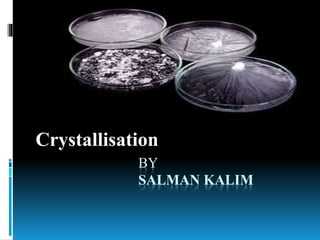
Crystallisation
WHAT IS CRYSTALLISATION:
 Crystallization is the
(natural or artificial)
process by which a solid
forms, where the atoms
or molecules are highly
organized into a
structure known
as a crystal.
Cont…
 In other words crystallisation is a separation
technique that is used to separate a solid that has
dissolved in a liquid.
Method:
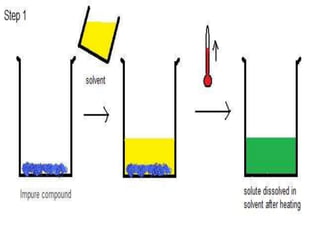
 The solution is warmed in an open container ,
allowing the solvent to evaporate ,leaving a
saturated solution.
 As the saturated solution is allowed to cool, the
solid will separate out the solution and crystals
will start to grow. The crystals can be collected
and allowed to dry.
Size of crystals:
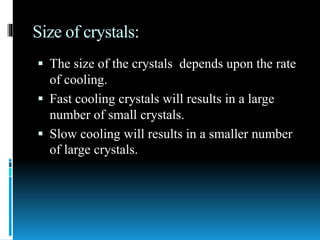
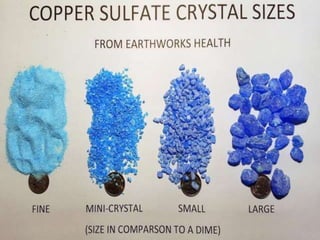
 The size of the crystals depends upon the rate
of cooling.
 Fast cooling crystals will results in a large
number of small crystals.
 Slow cooling will results in a smaller number
of large crystals.
Objectives and applications
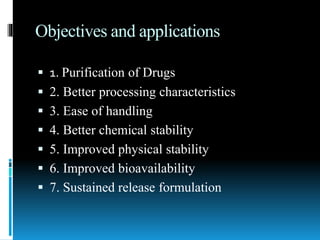
 1. Purification of Drugs
 2. Better processing characteristics
 3. Ease of handling
 4. Better chemical stability
 5. Improved physical stability
 6. Improved bioavailability
 7. Sustained release formulation
Theory of crystallization:
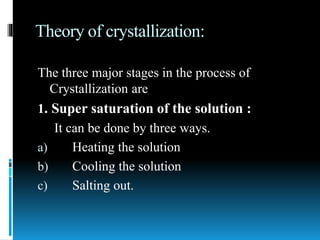
The three major stages in the process of
Crystallization are
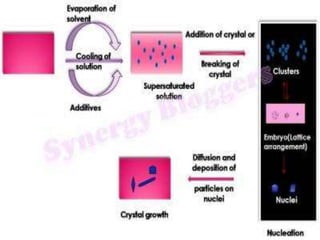
1. Super saturation of the solution :
It can be done by three ways.
a) Heating the solution
b) Cooling the solution
c) Salting out.
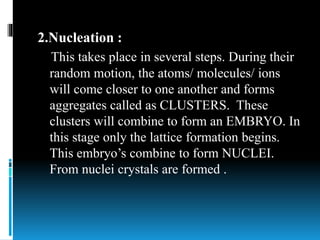
2.Nucleation :
This takes place in several steps. During their
random motion, the atoms/ molecules/ ions
will come closer to one another and forms
aggregates called as CLUSTERS. These
clusters will combine to form an EMBRYO. In
this stage only the lattice formation begins.
This embryo’s combine to form NUCLEI.
From nuclei crystals are formed .
3 .Crystal Growth :
Once the crystals are formed, nuclei formation stoped
and crystal growth begins.
General factors that affect nucleation
and growth kinetics:
Supersaturation
Solvent
Temperature
Impurities
Solution viscosity, surface tension
Crystallization crystallizers:
 Draft tube baffle technology:
This type of crystallization is especially
designed for low viscosity products when a
narrow crystal size distribution is expected.
Super saturated product enters into a chamber
containing the massecuite (mixture of solids
and solution). Instantaneously, the product
crystallizes around the crystals that are already
inside the vessel so that the solution reaches
the saturation point.
Conti…
 Inside the chamber, a stirrer creates a high
circulation flow in order to give a good
repartition of the crystals in the massecuite .
On the side of the vessel, baffles create a quiet
zone where an upward flow brings the
smallest crystals out of the vessels. They are
re-melted and put back in the vessel.
Crystallizers:
 Forced circulation crystallization:
The design of such a crystallization unit is
very similar to a forced circulation evaporator.
A vertical tubular heat exchanger is only
preferred due to the high viscosity of the
massecuite. This type of crystallization unit is
designed for the crystallization of salts out of
effluent.
Recrystallization:
 Recrystallization is defined as the process in
which grains of a crystal structure come in a
new structure or new crystal shape.
 A precise definition of recrystallization is
difficult to state as the process is strongly
related to several other processes, most
notably recovery and grain growth.

what is crystallisation?

  • 1.
  • 2.
    WHAT IS CRYSTALLISATION: Crystallization is the (natural or artificial) process by which a solid forms, where the atoms or molecules are highly organized into a structure known as a crystal.
  • 3.
    Cont…  In otherwords crystallisation is a separation technique that is used to separate a solid that has dissolved in a liquid. Method:  The solution is warmed in an open container , allowing the solvent to evaporate ,leaving a saturated solution.  As the saturated solution is allowed to cool, the solid will separate out the solution and crystals will start to grow. The crystals can be collected and allowed to dry.
  • 4.
    Size of crystals: The size of the crystals depends upon the rate of cooling.  Fast cooling crystals will results in a large number of small crystals.  Slow cooling will results in a smaller number of large crystals.
  • 6.
    Objectives and applications 1. Purification of Drugs  2. Better processing characteristics  3. Ease of handling  4. Better chemical stability  5. Improved physical stability  6. Improved bioavailability  7. Sustained release formulation
  • 7.
    Theory of crystallization: Thethree major stages in the process of Crystallization are 1. Super saturation of the solution : It can be done by three ways. a) Heating the solution b) Cooling the solution c) Salting out.
  • 9.
    2.Nucleation : This takesplace in several steps. During their random motion, the atoms/ molecules/ ions will come closer to one another and forms aggregates called as CLUSTERS. These clusters will combine to form an EMBRYO. In this stage only the lattice formation begins. This embryo’s combine to form NUCLEI. From nuclei crystals are formed .
  • 10.
    3 .Crystal Growth: Once the crystals are formed, nuclei formation stoped and crystal growth begins.
  • 12.
    General factors thataffect nucleation and growth kinetics: Supersaturation Solvent Temperature Impurities Solution viscosity, surface tension
  • 13.
    Crystallization crystallizers:  Drafttube baffle technology: This type of crystallization is especially designed for low viscosity products when a narrow crystal size distribution is expected. Super saturated product enters into a chamber containing the massecuite (mixture of solids and solution). Instantaneously, the product crystallizes around the crystals that are already inside the vessel so that the solution reaches the saturation point.
  • 14.
    Conti…  Inside thechamber, a stirrer creates a high circulation flow in order to give a good repartition of the crystals in the massecuite . On the side of the vessel, baffles create a quiet zone where an upward flow brings the smallest crystals out of the vessels. They are re-melted and put back in the vessel.
  • 15.
    Crystallizers:  Forced circulationcrystallization: The design of such a crystallization unit is very similar to a forced circulation evaporator. A vertical tubular heat exchanger is only preferred due to the high viscosity of the massecuite. This type of crystallization unit is designed for the crystallization of salts out of effluent.
  • 16.
    Recrystallization:  Recrystallization isdefined as the process in which grains of a crystal structure come in a new structure or new crystal shape.  A precise definition of recrystallization is difficult to state as the process is strongly related to several other processes, most notably recovery and grain growth.

Editor's Notes

  • #10 Birth of new crystal