Presented by
Dr. Neelam
Department of chemistry
Crystal Field Theory
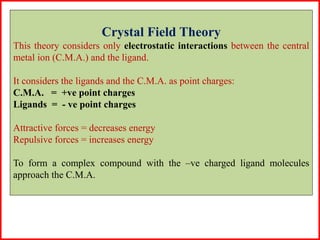
This theory considers only electrostatic interactions between the central
metal ion (C.M.A.) and the ligand.
It considers the ligands and the C.M.A. as point charges:
C.M.A. = +ve point charges
Ligands = - ve point charges
Attractive forces = decreases energy
Repulsive forces = increases energy
To form a complex compound with the –ve charged ligand molecules
approach the C.M.A.
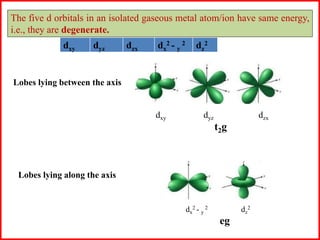
dxy dyz dzx
t2g
Lobes lying between the axis
Lobes lying along the axis
dx
2 - y
2 dz
2
eg
The five d orbitals in an isolated gaseous metal atom/ion have same energy,
i.e., they are degenerate.
dxy dyz dzx dx
2 - y
2 dz
2
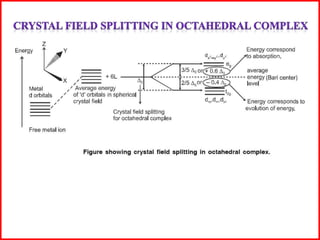
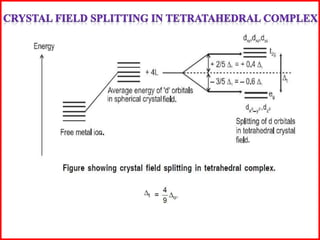
Splitting of d orbital into two different set of orbitals in presence of the repulsive
field created by the approaching ligands .
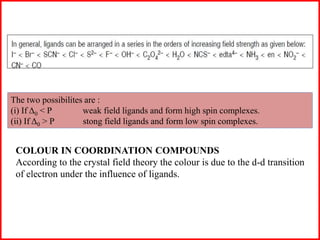
The two possibilites are :
(i) If Δ0 < P weak field ligands and form high spin complexes.
(ii) If Δ0 > P stong field ligands and form low spin complexes.
COLOUR IN COORDINATION COMPOUNDS
According to the crystal field theory the colour is due to the d-d transition
of electron under the influence of ligands.
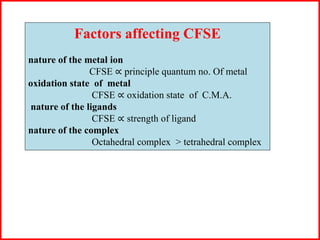
Factors affecting CFSE
nature of the metal ion
CFSE ∝ principle quantum no. Of metal
oxidation state of metal
CFSE ∝ oxidation state of C.M.A.
nature of the ligands
CFSE ∝ strength of ligand
nature of the complex
Octahedral complex > tetrahedral complex
Limitations of crystal field theory
(1) It considers only the metal ion d-orbitals and gives no consideration at
all to other metal orbitals (such as s, px, py and pz orbitals).
(2) It is unable to account satisfactorily for the relative strengths of
ligands. For example it gives no explanation as to why H2O is a stronger
ligand than OH– in the spectrochemical series.
(3) Account to this theory, the bond between the metal and ligands are
purely ionic. It gives no account on the partly covalent nature of the metal
ligand bonds.
(4) The CFT cannot account for the π-bonding in complexes.
(5) The theory failed to explain color in compound having d0 configuration
For ex. KMnO4 , K2Cr2O7
10

Crystal field Theory

  • 1.
  • 2.
    Crystal Field Theory Thistheory considers only electrostatic interactions between the central metal ion (C.M.A.) and the ligand. It considers the ligands and the C.M.A. as point charges: C.M.A. = +ve point charges Ligands = - ve point charges Attractive forces = decreases energy Repulsive forces = increases energy To form a complex compound with the –ve charged ligand molecules approach the C.M.A.
  • 3.
    dxy dyz dzx t2g Lobeslying between the axis Lobes lying along the axis dx 2 - y 2 dz 2 eg The five d orbitals in an isolated gaseous metal atom/ion have same energy, i.e., they are degenerate. dxy dyz dzx dx 2 - y 2 dz 2
  • 4.
    Splitting of dorbital into two different set of orbitals in presence of the repulsive field created by the approaching ligands .
  • 7.
    The two possibilitesare : (i) If Δ0 < P weak field ligands and form high spin complexes. (ii) If Δ0 > P stong field ligands and form low spin complexes. COLOUR IN COORDINATION COMPOUNDS According to the crystal field theory the colour is due to the d-d transition of electron under the influence of ligands.
  • 8.
    Factors affecting CFSE natureof the metal ion CFSE ∝ principle quantum no. Of metal oxidation state of metal CFSE ∝ oxidation state of C.M.A. nature of the ligands CFSE ∝ strength of ligand nature of the complex Octahedral complex > tetrahedral complex
  • 9.
    Limitations of crystalfield theory (1) It considers only the metal ion d-orbitals and gives no consideration at all to other metal orbitals (such as s, px, py and pz orbitals). (2) It is unable to account satisfactorily for the relative strengths of ligands. For example it gives no explanation as to why H2O is a stronger ligand than OH– in the spectrochemical series. (3) Account to this theory, the bond between the metal and ligands are purely ionic. It gives no account on the partly covalent nature of the metal ligand bonds. (4) The CFT cannot account for the π-bonding in complexes. (5) The theory failed to explain color in compound having d0 configuration For ex. KMnO4 , K2Cr2O7
  • 10.