BONDING IN
COORDINATION
COMPOUNDS
 Effective Atomic Number Rule
 Valence Bond Theory
 Crystal Field Theory
 Modified CFT also known as Ligand Field Theory
 Molecular Orbital Theory
EFFECTIVE ATOMIC
NUMBER (EAN) RULE
 The formation of a complex was described as an acid-
base reaction according to Lewis. The sum of electrons
on the central atom (Lewis acid) including those
donated from the ligans (Lewis base) should be equal to
the number of electrons on a noble gas.
VALENCE BOND
THEORY
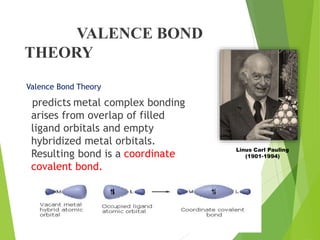
Valence Bond Theory
predicts metal complex bonding
arises from overlap of filled
ligand orbitals and empty
hybridized metal orbitals.
Resulting bond is a coordinate
covalent bond.
Linus Carl Pauling
(1901-1994)
Isomerism
 1.Structural Isomerism
In this isomerism. isomers have different bonding pattern. Different
types of structural isomers are
 (i) Linkage isomerism This type of isomerism is shown by the
coordination compounds having ambidentate ligands.
e.g.,[Co(NH3)5(NO2)]Cl and [Co(NH3)5(ONO)]Cl or pentaammine
nitrito- N Cobalt (III) chloride and pentaammine nitrito-O-Cobalt (III)
chloride.
 (ii) Coordination isomerism This type of isomerism arises from the
interchange of ligands between cationic and anionic complexes of
different metal ions present in a complex,
 e.g.,[Cr(NH3)6] [Co(CN)6]and [Co(NH3)6] [Cr(CN)6]
Isomerism
 (iii) Ionisation isomerism This isomerism arise due
to exchange of ionisable anion with an anionic
ligand. e.g. [Co(NH3)5SO4]Br and [Co(NH3)5Br]SO4.
 (iv) Solvate isomerism This is also known as
hydrate isomerism. In this isomerism, water is
taken as solvent. It has different number of water
molecules in the coordination sphere and outside
it.
e.g..[Co(H2O)6]Cl3, [Co(H2O)4Cl2]Cl·2H2O,
[Co(H2O)3Cl3]. 3H2O
2. Stereoisomerism
 Stereoisomers have the same chemical formula and chemical bonds but they
have different spatial arrangement. These are of two types :
 i) Geometrical isomerism
Geometrical isomers are of two types i.e., cis and trans isomers.
This isomensm is common in complexes with coordination number 4 and 6.
 Geometrical isomerism in complexes with coordination number 4
(i) Tetrahedral complexes do not show geometrical isomerism.
(ii) Square planar complexes of formula [MX2L2] (X and L are unidentate) show
geometrical isomerism. The two X ligands may be arranged adjacent to each
other in a cis isomer, or opposite to each other in a trans isomer, e.g.,
Square planar complexes of formula
[MX2L2]
Square planar complexes of
formula [MABXL]
(iii) Square planar complex of the type [MABXL] (where A, B, X, L, are unidentate ligands)shows three isomers, two cis and one
trans.
e.g., [Pt(NH3) (Br)(Cl)(Py)].
 Geometrical isomerism in complexes with coordination number 6
Octahedral complexes of formula [MX2L4], in which the two X ligands may be
oriented cis ortrans to each other, e.g., [Co(NH3)4Cl2]+
 Geometrical isomerism in complexes with coordination number 6
 Octahedral complexes of formula [MX2A2], where X are unidentate ligands
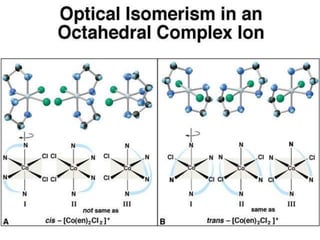
and A are bidentate ligand. form cis and trans isomers, e.g., [CoCl2(en)2]+
+ +
trans
cis
 Geometrical isomerism in complexes with coordination number 6
In octahedral complexes of formula [MA3X3], if three donor atoms of the same
ligands occupy adjacent positions at the corners of an octahedral face. it is known
as facial (fac) isomer, when the positions are around the meridian of the
octahedron, it is known as meridional (mer)isomer. e.g.,
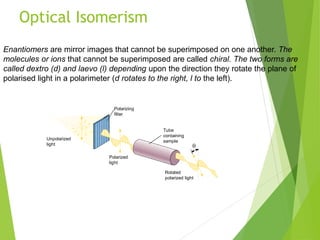
Optical Isomerism
20_446
Unpolarized
light
Polarizing
filter
Polarized
light
Tube
containing
sample

Rotated
polarized light
Enantiomers are mirror images that cannot be superimposed on one another. The
molecules or ions that cannot be superimposed are called chiral. The two forms are
called dextro (d) and laevo (l) depending upon the direction they rotate the plane of
polarised light in a polarimeter (d rotates to the right, l to the left).
Stereo Isomerism in
[[Fe(NH3)4Cl2]
TETRAHEDRAL
GEOMETRY
[CoCl4]-2
Co Ground state
Co2+
in
[CoCl4]-2
SQUARE PLANAR GEOMETRY
Ni
3d 4p
4s
Ni2+
dsp2
Gives [Ni(CN)4]2– all paired electrons, which makes it
diamagnetic and weakly repelled by magnets.

2
4
[Ni(CN) ]

2
4
[Ni(CN) ]
OCTAHEDRAL sp3d2
GEOMETRY
Gives [CoF6]3– four unpaired electrons, which makes it
paramagnetic and is called a high-spin complex.
[CoF6]3–
Ground State
(Outer Orbital Complex)
OCTAHEDRAL d2sp3 GEOMETRY
Fe+3
3d 4p
4s
d2sp3
CN– Strong ligand
(Inner orbital complex)
3–
6
[Fe(CN) ]
3–
6
[Fe(CN) ]
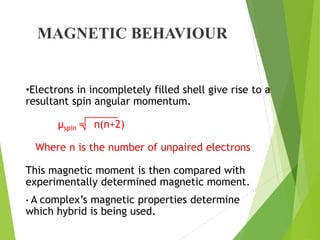
MAGNETIC BEHAVIOUR
•Electrons in incompletely filled shell give rise to a
resultant spin angular momentum.
µspin = n(n+2)
Where n is the number of unpaired electrons
This magnetic moment is then compared with
experimentally determined magnetic moment.
• A complex’s magnetic properties determine
which hybrid is being used.
LIMITATIONS OF V.B.T
 Magnetic moment alone cannot distinguish between the
two steriochemistries sp3d2, sp3 .
 Cannot account for colour of complexes.
 May predict magnetic property wrongly.
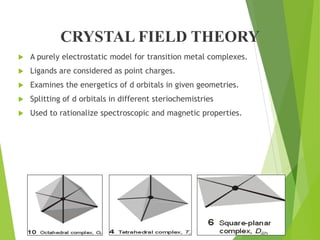
CRYSTAL FIELD THEORY
 A purely electrostatic model for transition metal complexes.
 Ligands are considered as point charges.
 Examines the energetics of d orbitals in given geometries.
 Splitting of d orbitals in different steriochemistries
 Used to rationalize spectroscopic and magnetic properties.
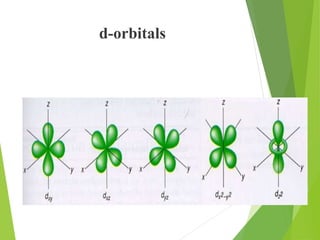
d-orbitals
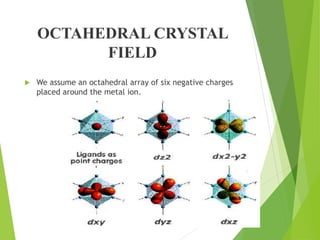
OCTAHEDRAL CRYSTAL
FIELD
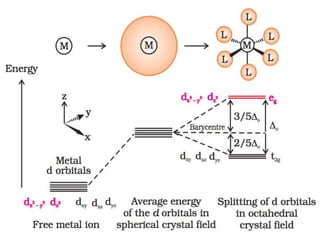
 We assume an octahedral array of six negative charges
placed around the metal ion.
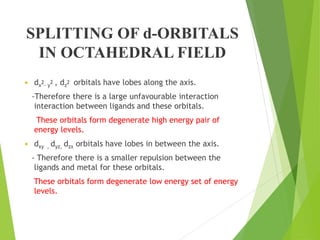
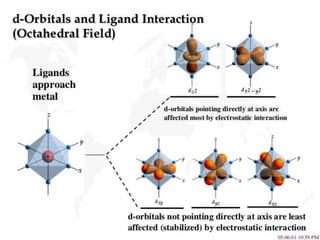
SPLITTING OF d-ORBITALS
IN OCTAHEDRAL FIELD
 dx
2
- y
2 , dz
2 orbitals have lobes along the axis.
-Therefore there is a large unfavourable interaction
interaction between ligands and these orbitals.
These orbitals form degenerate high energy pair of
energy levels.
 dxy , dyz, dzx orbitals have lobes in between the axis.
- Therefore there is a smaller repulsion between the
ligands and metal for these orbitals.
These orbitals form degenerate low energy set of energy
levels.
TETRAHEDRAL FIELD
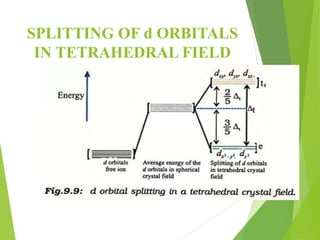
SPLITTING OF d ORBITALS
IN TETRAHEDRAL FIELD
Contd…
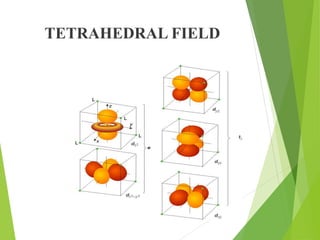
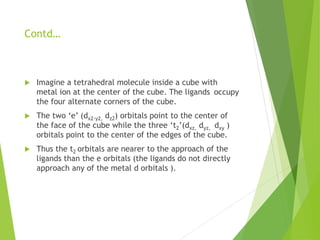
 Imagine a tetrahedral molecule inside a cube with
metal ion at the center of the cube. The ligands occupy
the four alternate corners of the cube.
 The two ‘e’ (dx2-y2, dz2) orbitals point to the center of
the face of the cube while the three ‘t2’(dxz, dyz, dxy )
orbitals point to the center of the edges of the cube.
 Thus the t2 orbitals are nearer to the approach of the
ligands than the e orbitals (the ligands do not directly
approach any of the metal d orbitals ).
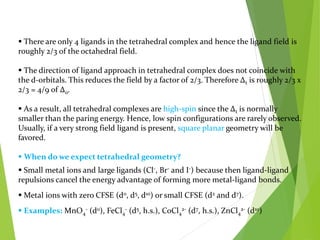
 There are only 4 ligands in the tetrahedral complex and hence the ligand field is
roughly 2/3 of the octahedral field.
 The direction of ligand approach in tetrahedral complex does not coincide with
the d-orbitals. This reduces the field by a factor of 2/3. Therefore Δt is roughly 2/3 x
2/3 = 4/9 of Δo.
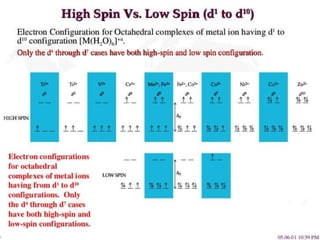
 As a result, all tetrahedral complexes are high-spin since the Δt is normally
smaller than the paring energy. Hence, low spin configurations are rarely observed.
Usually, if a very strong field ligand is present, square planar geometry will be
favored.
 When do we expect tetrahedral geometry?
 Small metal ions and large ligands (Cl-, Br- and I-) because then ligand-ligand
repulsions cancel the energy advantage of forming more metal-ligand bonds.
 Metal ions with zero CFSE (d0, d5, d10) or small CFSE (d2 and d7).
 Examples: MnO4
- (d0), FeCl4
- (d5, h.s.), CoCl4
2- (d7, h.s.), ZnCl4
2- (d10)
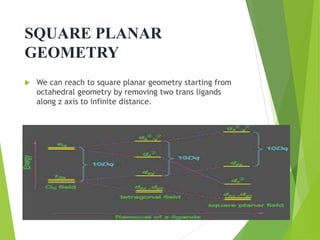
SQUARE PLANAR
GEOMETRY
 We can reach to square planar geometry starting from
octahedral geometry by removing two trans ligands
along z axis to infinite distance.
CRYSTAL FIELD STABILISATION
ENERGY( C.F.S.E)
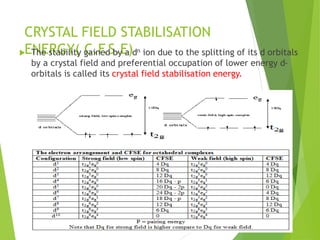
 The stability gained by a dn ion due to the splitting of its d orbitals
by a crystal field and preferential occupation of lower energy d-
orbitals is called its crystal field stabilisation energy.
Variation of 10 Dq
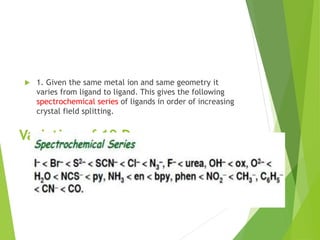
 1. Given the same metal ion and same geometry it
varies from ligand to ligand. This gives the following
spectrochemical series of ligands in order of increasing
crystal field splitting.
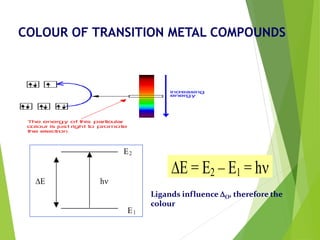
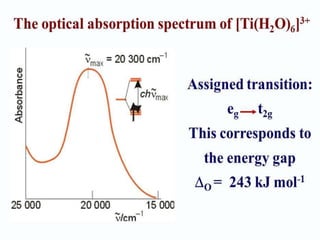
COLOUR OF TRANSITION METAL COMPOUNDS
E2
E h
E1
E = E2 – E1 = h
Ligands influence O, therefore the
colour
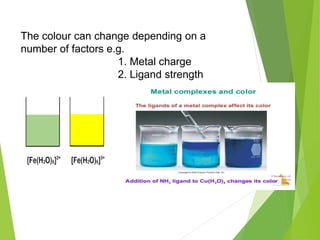
The colour can change depending on a
number of factors e.g.
1. Metal charge
2. Ligand strength
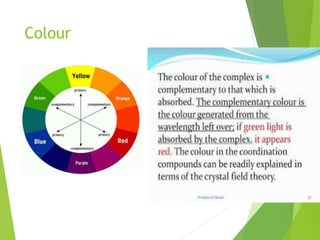
Colour
 1. For a required geometry the VBT hybridises
suitable metal orbitals. On the contrary C.F Theory
invokes no mixing of metal orbitals. Instead a
steriochemistry is assumed, the ligands are placed at
these steriochemical positions and then the
energetics and hence the distribution of the metal
ion d- electrons in the five d-orbitals are examined.
 2.VBT of necessity has to promote some d-electrons
to higher quantum shells particularly in the case of
d7, d8, d9 ions in inner orbital octahedral cases. CFT
merely reorganises the available d-electrons in the
t2g and eg levels although they are not equienergetic.
Contd….
 3. VBT assumes overlap of filled ligand orbital with empty hybrid orbitals
of the metal ion i.e. Covalence is assumed. But CFT does not accept any
overlap between metal and ligand orbitals i.e. Complexes are regarded
as ionic.
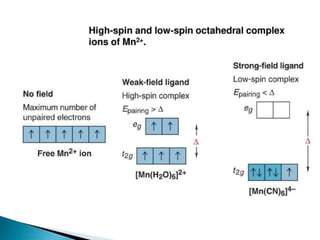
4. The ‘outer orbital’ and ‘inner orbital’ octahedral complexes in VB
terminology become ‘high spin’ and ‘low spin’ complexes in CF
terminology.
5. In the ‘inner orbital’ case VBT uses the dx2-y2 and dz2 in the
hybridisation and hence does not permit metal d-electrons to be
placed in these orbitals. In CFT these two d- orbitals form the doublet
set and because of their higher energy disfavours putting d-electrons
in this set.
Contd….
6. The explanation of colour of coordination complexes in the low energy
visible range is according to CFT due to transition from t2g set to the
higher energy eg set. However this has to be carried in our mind that
such d-d transitions are La porte forbidden. The VBT does not have any
such simple explanation.
7. CFT readily admits a gradual transition from high spin octahedral to low
spin octahedral with increasing donor strength of the ligands. But VBT
is not suitable for such changes.
8. CFT offers a satisfactory explanation of the cross over region and spin
state equilibrium. The VBT is unable to tackle such situation.
5.

Coordination Compounds CLASS 12 CHEMISTRY

  • 1.
    BONDING IN COORDINATION COMPOUNDS  EffectiveAtomic Number Rule  Valence Bond Theory  Crystal Field Theory  Modified CFT also known as Ligand Field Theory  Molecular Orbital Theory
  • 2.
    EFFECTIVE ATOMIC NUMBER (EAN)RULE  The formation of a complex was described as an acid- base reaction according to Lewis. The sum of electrons on the central atom (Lewis acid) including those donated from the ligans (Lewis base) should be equal to the number of electrons on a noble gas.
  • 3.
    VALENCE BOND THEORY Valence BondTheory predicts metal complex bonding arises from overlap of filled ligand orbitals and empty hybridized metal orbitals. Resulting bond is a coordinate covalent bond. Linus Carl Pauling (1901-1994)
  • 4.
    Isomerism  1.Structural Isomerism Inthis isomerism. isomers have different bonding pattern. Different types of structural isomers are  (i) Linkage isomerism This type of isomerism is shown by the coordination compounds having ambidentate ligands. e.g.,[Co(NH3)5(NO2)]Cl and [Co(NH3)5(ONO)]Cl or pentaammine nitrito- N Cobalt (III) chloride and pentaammine nitrito-O-Cobalt (III) chloride.  (ii) Coordination isomerism This type of isomerism arises from the interchange of ligands between cationic and anionic complexes of different metal ions present in a complex,  e.g.,[Cr(NH3)6] [Co(CN)6]and [Co(NH3)6] [Cr(CN)6]
  • 5.
    Isomerism  (iii) Ionisationisomerism This isomerism arise due to exchange of ionisable anion with an anionic ligand. e.g. [Co(NH3)5SO4]Br and [Co(NH3)5Br]SO4.  (iv) Solvate isomerism This is also known as hydrate isomerism. In this isomerism, water is taken as solvent. It has different number of water molecules in the coordination sphere and outside it. e.g..[Co(H2O)6]Cl3, [Co(H2O)4Cl2]Cl·2H2O, [Co(H2O)3Cl3]. 3H2O
  • 6.
    2. Stereoisomerism  Stereoisomershave the same chemical formula and chemical bonds but they have different spatial arrangement. These are of two types :  i) Geometrical isomerism Geometrical isomers are of two types i.e., cis and trans isomers. This isomensm is common in complexes with coordination number 4 and 6.  Geometrical isomerism in complexes with coordination number 4 (i) Tetrahedral complexes do not show geometrical isomerism. (ii) Square planar complexes of formula [MX2L2] (X and L are unidentate) show geometrical isomerism. The two X ligands may be arranged adjacent to each other in a cis isomer, or opposite to each other in a trans isomer, e.g.,
  • 7.
    Square planar complexesof formula [MX2L2]
  • 8.
    Square planar complexesof formula [MABXL] (iii) Square planar complex of the type [MABXL] (where A, B, X, L, are unidentate ligands)shows three isomers, two cis and one trans. e.g., [Pt(NH3) (Br)(Cl)(Py)].
  • 9.
     Geometrical isomerismin complexes with coordination number 6 Octahedral complexes of formula [MX2L4], in which the two X ligands may be oriented cis ortrans to each other, e.g., [Co(NH3)4Cl2]+
  • 10.
     Geometrical isomerismin complexes with coordination number 6  Octahedral complexes of formula [MX2A2], where X are unidentate ligands and A are bidentate ligand. form cis and trans isomers, e.g., [CoCl2(en)2]+ + + trans cis
  • 11.
     Geometrical isomerismin complexes with coordination number 6 In octahedral complexes of formula [MA3X3], if three donor atoms of the same ligands occupy adjacent positions at the corners of an octahedral face. it is known as facial (fac) isomer, when the positions are around the meridian of the octahedron, it is known as meridional (mer)isomer. e.g.,
  • 12.
    Optical Isomerism 20_446 Unpolarized light Polarizing filter Polarized light Tube containing sample  Rotated polarized light Enantiomersare mirror images that cannot be superimposed on one another. The molecules or ions that cannot be superimposed are called chiral. The two forms are called dextro (d) and laevo (l) depending upon the direction they rotate the plane of polarised light in a polarimeter (d rotates to the right, l to the left).
  • 14.
  • 15.
  • 16.
    SQUARE PLANAR GEOMETRY Ni 3d4p 4s Ni2+ dsp2 Gives [Ni(CN)4]2– all paired electrons, which makes it diamagnetic and weakly repelled by magnets.  2 4 [Ni(CN) ]  2 4 [Ni(CN) ]
  • 17.
    OCTAHEDRAL sp3d2 GEOMETRY Gives [CoF6]3–four unpaired electrons, which makes it paramagnetic and is called a high-spin complex. [CoF6]3– Ground State (Outer Orbital Complex)
  • 18.
    OCTAHEDRAL d2sp3 GEOMETRY Fe+3 3d4p 4s d2sp3 CN– Strong ligand (Inner orbital complex) 3– 6 [Fe(CN) ] 3– 6 [Fe(CN) ]
  • 19.
    MAGNETIC BEHAVIOUR •Electrons inincompletely filled shell give rise to a resultant spin angular momentum. µspin = n(n+2) Where n is the number of unpaired electrons This magnetic moment is then compared with experimentally determined magnetic moment. • A complex’s magnetic properties determine which hybrid is being used.
  • 20.
    LIMITATIONS OF V.B.T Magnetic moment alone cannot distinguish between the two steriochemistries sp3d2, sp3 .  Cannot account for colour of complexes.  May predict magnetic property wrongly.
  • 21.
    CRYSTAL FIELD THEORY A purely electrostatic model for transition metal complexes.  Ligands are considered as point charges.  Examines the energetics of d orbitals in given geometries.  Splitting of d orbitals in different steriochemistries  Used to rationalize spectroscopic and magnetic properties.
  • 22.
  • 23.
    OCTAHEDRAL CRYSTAL FIELD  Weassume an octahedral array of six negative charges placed around the metal ion.
  • 24.
    SPLITTING OF d-ORBITALS INOCTAHEDRAL FIELD  dx 2 - y 2 , dz 2 orbitals have lobes along the axis. -Therefore there is a large unfavourable interaction interaction between ligands and these orbitals. These orbitals form degenerate high energy pair of energy levels.  dxy , dyz, dzx orbitals have lobes in between the axis. - Therefore there is a smaller repulsion between the ligands and metal for these orbitals. These orbitals form degenerate low energy set of energy levels.
  • 29.
  • 30.
    SPLITTING OF dORBITALS IN TETRAHEDRAL FIELD
  • 31.
    Contd…  Imagine atetrahedral molecule inside a cube with metal ion at the center of the cube. The ligands occupy the four alternate corners of the cube.  The two ‘e’ (dx2-y2, dz2) orbitals point to the center of the face of the cube while the three ‘t2’(dxz, dyz, dxy ) orbitals point to the center of the edges of the cube.  Thus the t2 orbitals are nearer to the approach of the ligands than the e orbitals (the ligands do not directly approach any of the metal d orbitals ).
  • 32.
     There areonly 4 ligands in the tetrahedral complex and hence the ligand field is roughly 2/3 of the octahedral field.  The direction of ligand approach in tetrahedral complex does not coincide with the d-orbitals. This reduces the field by a factor of 2/3. Therefore Δt is roughly 2/3 x 2/3 = 4/9 of Δo.  As a result, all tetrahedral complexes are high-spin since the Δt is normally smaller than the paring energy. Hence, low spin configurations are rarely observed. Usually, if a very strong field ligand is present, square planar geometry will be favored.  When do we expect tetrahedral geometry?  Small metal ions and large ligands (Cl-, Br- and I-) because then ligand-ligand repulsions cancel the energy advantage of forming more metal-ligand bonds.  Metal ions with zero CFSE (d0, d5, d10) or small CFSE (d2 and d7).  Examples: MnO4 - (d0), FeCl4 - (d5, h.s.), CoCl4 2- (d7, h.s.), ZnCl4 2- (d10)
  • 33.
    SQUARE PLANAR GEOMETRY  Wecan reach to square planar geometry starting from octahedral geometry by removing two trans ligands along z axis to infinite distance.
  • 34.
    CRYSTAL FIELD STABILISATION ENERGY(C.F.S.E)  The stability gained by a dn ion due to the splitting of its d orbitals by a crystal field and preferential occupation of lower energy d- orbitals is called its crystal field stabilisation energy.
  • 35.
    Variation of 10Dq  1. Given the same metal ion and same geometry it varies from ligand to ligand. This gives the following spectrochemical series of ligands in order of increasing crystal field splitting.
  • 36.
    COLOUR OF TRANSITIONMETAL COMPOUNDS E2 E h E1 E = E2 – E1 = h Ligands influence O, therefore the colour
  • 37.
    The colour canchange depending on a number of factors e.g. 1. Metal charge 2. Ligand strength
  • 39.
  • 40.
     1. Fora required geometry the VBT hybridises suitable metal orbitals. On the contrary C.F Theory invokes no mixing of metal orbitals. Instead a steriochemistry is assumed, the ligands are placed at these steriochemical positions and then the energetics and hence the distribution of the metal ion d- electrons in the five d-orbitals are examined.  2.VBT of necessity has to promote some d-electrons to higher quantum shells particularly in the case of d7, d8, d9 ions in inner orbital octahedral cases. CFT merely reorganises the available d-electrons in the t2g and eg levels although they are not equienergetic.
  • 41.
    Contd….  3. VBTassumes overlap of filled ligand orbital with empty hybrid orbitals of the metal ion i.e. Covalence is assumed. But CFT does not accept any overlap between metal and ligand orbitals i.e. Complexes are regarded as ionic. 4. The ‘outer orbital’ and ‘inner orbital’ octahedral complexes in VB terminology become ‘high spin’ and ‘low spin’ complexes in CF terminology. 5. In the ‘inner orbital’ case VBT uses the dx2-y2 and dz2 in the hybridisation and hence does not permit metal d-electrons to be placed in these orbitals. In CFT these two d- orbitals form the doublet set and because of their higher energy disfavours putting d-electrons in this set.
  • 42.
    Contd…. 6. The explanationof colour of coordination complexes in the low energy visible range is according to CFT due to transition from t2g set to the higher energy eg set. However this has to be carried in our mind that such d-d transitions are La porte forbidden. The VBT does not have any such simple explanation. 7. CFT readily admits a gradual transition from high spin octahedral to low spin octahedral with increasing donor strength of the ligands. But VBT is not suitable for such changes. 8. CFT offers a satisfactory explanation of the cross over region and spin state equilibrium. The VBT is unable to tackle such situation. 5.