Information Security
What is Information Security?
Information Security
Information SecurityInformation Security is the name given to
the preventative stepspreventative steps we take to guard
our informationinformation and our capabilitiescapabilities.
Measures adopted to prevent the
unauthorized use, misuse, modification,
or denial of use of knowledge, facts
,data or capabilities.
Critical Characteristics of
Information
Availability
Accuracy
Authenticity
Confidentiality
Integrity
Availability
Enables users who need to accessaccess
information to do so without interferenceinterference
and receive it in requiredrequired format.format.
The information is availableavailable only to the
authorizedauthorized users.
Accuracy
Information is accurate when it is freefree
from mistakesfrom mistakes or errors and it has the
value that the end user expects.
Authenticity
Authenticity of information is the quality
or state of being genuine or original,genuine or original,
rather than a reproduction or fabrication.
e.g. Email SpoofingEmail Spoofing
 The unauthorized use of a third-partyThe unauthorized use of a third-party
domain name as the sender's name in an e-domain name as the sender's name in an e-
mail messagemail message
http://blockstatus.com/anonymous-
mailer
Confidentiality
Information is available only to people
with rightful access.rightful access.
Ensuring that only those with the rightsrights
and privilegesprivileges to accessaccess a particular set
of information are able to do so.
It is closely related with the privacyprivacy of
information.
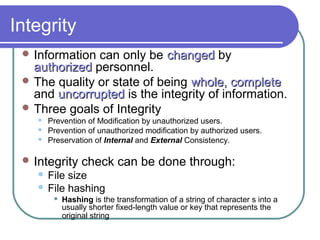
Integrity
 Information can only be changedchanged by
authorizedauthorized personnel.
 The quality or state of being whole, completewhole, complete
and uncorrupteduncorrupted is the integrity of information.
 Three goals of Integrity
 Prevention of Modification by unauthorized users.
 Prevention of unauthorized modification by authorized users.
 Preservation of Internal and External Consistency.
 Integrity check can be done through:
 File size
 File hashing
 Hashing is the transformation of a string of character s into a
usually shorter fixed-length value or key that represents the
original string
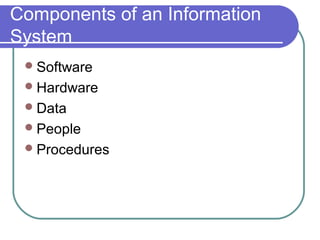
Components of an Information
System
Software
Hardware
Data
People
Procedures
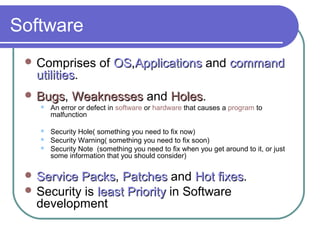
Software
 Comprises of OSOS,,ApplicationsApplications and commandcommand
utilitiesutilities.
 BugsBugs, WeaknessesWeaknesses and HolesHoles.
 An error or defect in software or hardware that causes a program to
malfunction
 Security Hole( something you need to fix now)
 Security Warning( something you need to fix soon)
 Security Note (something you need to fix when you get around to it, or just
some information that you should consider)
 Service PacksService Packs, PatchesPatches and Hot fixesHot fixes.
 Security is least Priorityleast Priority in Software
development
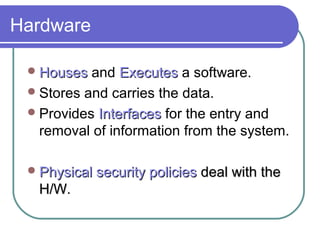
Hardware
HousesHouses and ExecutesExecutes a software.
Stores and carries the data.
Provides InterfacesInterfaces for the entry and
removal of information from the system.
Physical security policiesPhysical security policies deal with thedeal with the
H/WH/W.
Data
MainMain object of intentionalintentional attacks
People
Main threatMain threat to information security.
Often OverlookedOverlooked
Procedures
Procedures are written instructionswritten instructions for
accomplishingaccomplishing a specific tasktask.
Another frequently overlookedoverlooked
component
What is Network Security?
 Effort to create a secure computingsecure computing platformplatform,
so users or programs cannot perform actionscannot perform actions
that they are not allowed to do.
 Network Security is the protectionprotection of
networking componentsnetworking components, connectionsconnections and
contentscontents.
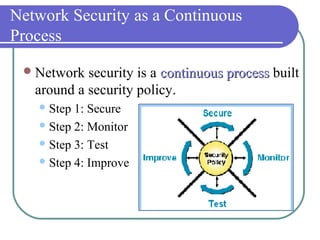
Network Security as a Continuous
Process
Network security is a continuous processcontinuous process built
around a security policy.
Step 1: Secure
Step 2: Monitor
Step 3: Test
Step 4: Improve
Step 1: Secure the Network
Implement security solutions to preventprevent
unauthorized accessunauthorized access and to protectprotect
information.information.
Authentication
Encryption
Firewalls
Vulnerability Patching
Step 2: Monitor Security
 Detects violationsDetects violations to the security policy
Involves system auditingsystem auditing and real-time intrusionintrusion
detectiondetection
 ValidatesValidates the securitysecurity implementation in
Step 1
Step 3: Test Security
 Validates effectivenessValidates effectiveness of the security policy
through system auditing and network scanningnetwork scanning
Step 4: Improve Security
Use information from the monitor and test
phases to make improvementsimprovements to the security
implementation.
Adjust the security policy as security holessecurity holes and
risksrisks are identified.
Terms related to Security
 Assets
 Threats
 Attack
 Vulnerability
 Risk Analysis
 Countermeasures
 Hacking
Asset
An asset is the organizational resourceorganizational resource
that is being protected.
It can be logicallogical like website,
information, data.
It can be physicalphysical like computer system
or other tangible object.
Threats, Vulnerability and Controls
 Threat
 a person, thing, event or idea which poses some danger to an asset
(in terms of confidentiality, integrity, availability).
 a possible means by which a security policy may be breached.
 An attack
 is a realization of a threat.
 Vulnerability
 A weakness in the system that can be exploited to cause loss or
harm
 Control, Countermeasure, safeguard
 An action, device, procedure or technique that removes or reduces a
vulnerability.
Risk = Threat + Vulnerability
Threats without vulnerabilities pose no risk.
Likewise, vulnerabilities without threats
pose no risk.
Risk is the probability that something can
happen.
Risk analysis can be quantitative or
qualitative.
Cont…
Risk can be qualitatively defined in three
levels:
 LowLow- Action to remove the vulnerability
should be taken if possible
 MediumMedium- Action to remove the vulnerability
is advisable
 HighHigh-- Action should be taken immediately to
remove this vulnerability
Hacking
Can be defined positively and
negatively:
To write computer programs for enjoyment.
To gain access to a computer illegally.
Summary
What is Information Security?
What is Network Security?
Assets, Threats and Countermeasures

Introduction Network security

  • 1.
    Information Security What isInformation Security?
  • 2.
    Information Security Information SecurityInformationSecurity is the name given to the preventative stepspreventative steps we take to guard our informationinformation and our capabilitiescapabilities. Measures adopted to prevent the unauthorized use, misuse, modification, or denial of use of knowledge, facts ,data or capabilities.
  • 3.
  • 4.
    Availability Enables users whoneed to accessaccess information to do so without interferenceinterference and receive it in requiredrequired format.format. The information is availableavailable only to the authorizedauthorized users.
  • 5.
    Accuracy Information is accuratewhen it is freefree from mistakesfrom mistakes or errors and it has the value that the end user expects.
  • 6.
    Authenticity Authenticity of informationis the quality or state of being genuine or original,genuine or original, rather than a reproduction or fabrication. e.g. Email SpoofingEmail Spoofing  The unauthorized use of a third-partyThe unauthorized use of a third-party domain name as the sender's name in an e-domain name as the sender's name in an e- mail messagemail message http://blockstatus.com/anonymous- mailer
  • 7.
    Confidentiality Information is availableonly to people with rightful access.rightful access. Ensuring that only those with the rightsrights and privilegesprivileges to accessaccess a particular set of information are able to do so. It is closely related with the privacyprivacy of information.
  • 8.
    Integrity  Information canonly be changedchanged by authorizedauthorized personnel.  The quality or state of being whole, completewhole, complete and uncorrupteduncorrupted is the integrity of information.  Three goals of Integrity  Prevention of Modification by unauthorized users.  Prevention of unauthorized modification by authorized users.  Preservation of Internal and External Consistency.  Integrity check can be done through:  File size  File hashing  Hashing is the transformation of a string of character s into a usually shorter fixed-length value or key that represents the original string
  • 9.
    Components of anInformation System Software Hardware Data People Procedures
  • 10.
    Software  Comprises ofOSOS,,ApplicationsApplications and commandcommand utilitiesutilities.  BugsBugs, WeaknessesWeaknesses and HolesHoles.  An error or defect in software or hardware that causes a program to malfunction  Security Hole( something you need to fix now)  Security Warning( something you need to fix soon)  Security Note (something you need to fix when you get around to it, or just some information that you should consider)  Service PacksService Packs, PatchesPatches and Hot fixesHot fixes.  Security is least Priorityleast Priority in Software development
  • 11.
    Hardware HousesHouses and ExecutesExecutesa software. Stores and carries the data. Provides InterfacesInterfaces for the entry and removal of information from the system. Physical security policiesPhysical security policies deal with thedeal with the H/WH/W.
  • 12.
    Data MainMain object ofintentionalintentional attacks
  • 13.
    People Main threatMain threatto information security. Often OverlookedOverlooked
  • 14.
    Procedures Procedures are writteninstructionswritten instructions for accomplishingaccomplishing a specific tasktask. Another frequently overlookedoverlooked component
  • 15.
    What is NetworkSecurity?  Effort to create a secure computingsecure computing platformplatform, so users or programs cannot perform actionscannot perform actions that they are not allowed to do.  Network Security is the protectionprotection of networking componentsnetworking components, connectionsconnections and contentscontents.
  • 16.
    Network Security asa Continuous Process Network security is a continuous processcontinuous process built around a security policy. Step 1: Secure Step 2: Monitor Step 3: Test Step 4: Improve
  • 17.
    Step 1: Securethe Network Implement security solutions to preventprevent unauthorized accessunauthorized access and to protectprotect information.information. Authentication Encryption Firewalls Vulnerability Patching
  • 18.
    Step 2: MonitorSecurity  Detects violationsDetects violations to the security policy Involves system auditingsystem auditing and real-time intrusionintrusion detectiondetection  ValidatesValidates the securitysecurity implementation in Step 1
  • 19.
    Step 3: TestSecurity  Validates effectivenessValidates effectiveness of the security policy through system auditing and network scanningnetwork scanning
  • 20.
    Step 4: ImproveSecurity Use information from the monitor and test phases to make improvementsimprovements to the security implementation. Adjust the security policy as security holessecurity holes and risksrisks are identified.
  • 21.
    Terms related toSecurity  Assets  Threats  Attack  Vulnerability  Risk Analysis  Countermeasures  Hacking
  • 22.
    Asset An asset isthe organizational resourceorganizational resource that is being protected. It can be logicallogical like website, information, data. It can be physicalphysical like computer system or other tangible object.
  • 23.
    Threats, Vulnerability andControls  Threat  a person, thing, event or idea which poses some danger to an asset (in terms of confidentiality, integrity, availability).  a possible means by which a security policy may be breached.  An attack  is a realization of a threat.  Vulnerability  A weakness in the system that can be exploited to cause loss or harm  Control, Countermeasure, safeguard  An action, device, procedure or technique that removes or reduces a vulnerability.
  • 24.
    Risk = Threat+ Vulnerability Threats without vulnerabilities pose no risk. Likewise, vulnerabilities without threats pose no risk. Risk is the probability that something can happen. Risk analysis can be quantitative or qualitative.
  • 25.
    Cont… Risk can bequalitatively defined in three levels:  LowLow- Action to remove the vulnerability should be taken if possible  MediumMedium- Action to remove the vulnerability is advisable  HighHigh-- Action should be taken immediately to remove this vulnerability
  • 26.
    Hacking Can be definedpositively and negatively: To write computer programs for enjoyment. To gain access to a computer illegally.
  • 27.
    Summary What is InformationSecurity? What is Network Security? Assets, Threats and Countermeasures