CRYPTOGRAPHY
Cryptography
Encryption
Traditional Ciphers
Substitution Ciphers
Transposition Ciphers
 Cryptographic Algorithm
 DES
 RSA
Public Key Cryptography
Digital Signature
 CRYPTOGRAPHY
The word Cryptography in Greek means “secret writing”. However ,the term today
Refers to the science and art of transforming messages to make them secure and
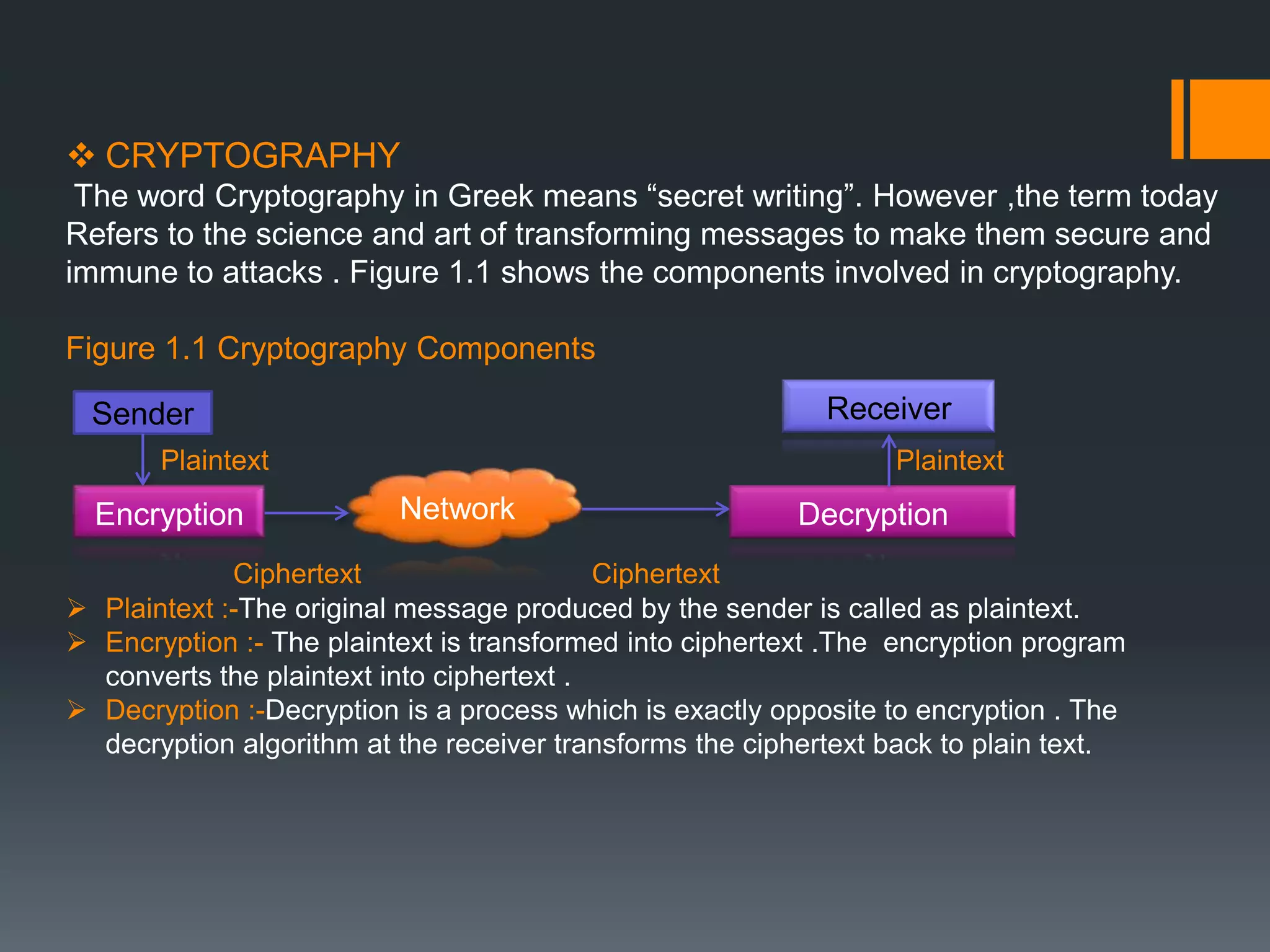
immune to attacks . Figure 1.1 shows the components involved in cryptography.
Figure 1.1 Cryptography Components
Plaintext Plaintext
Ciphertext Ciphertext
 Plaintext :-The original message produced by the sender is called as plaintext.
 Encryption :- The plaintext is transformed into ciphertext .The encryption program
converts the plaintext into ciphertext .
 Decryption :-Decryption is a process which is exactly opposite to encryption . The
decryption algorithm at the receiver transforms the ciphertext back to plain text.
Sender
Encryption Network Decryption
Receiver
 TRADITIONAL CIPHERS
Traditional ciphers are the earliest and simplest types of ciphers in which a character is
used as a unit of data to be encrypted.The traditional ciphers are of following two types :
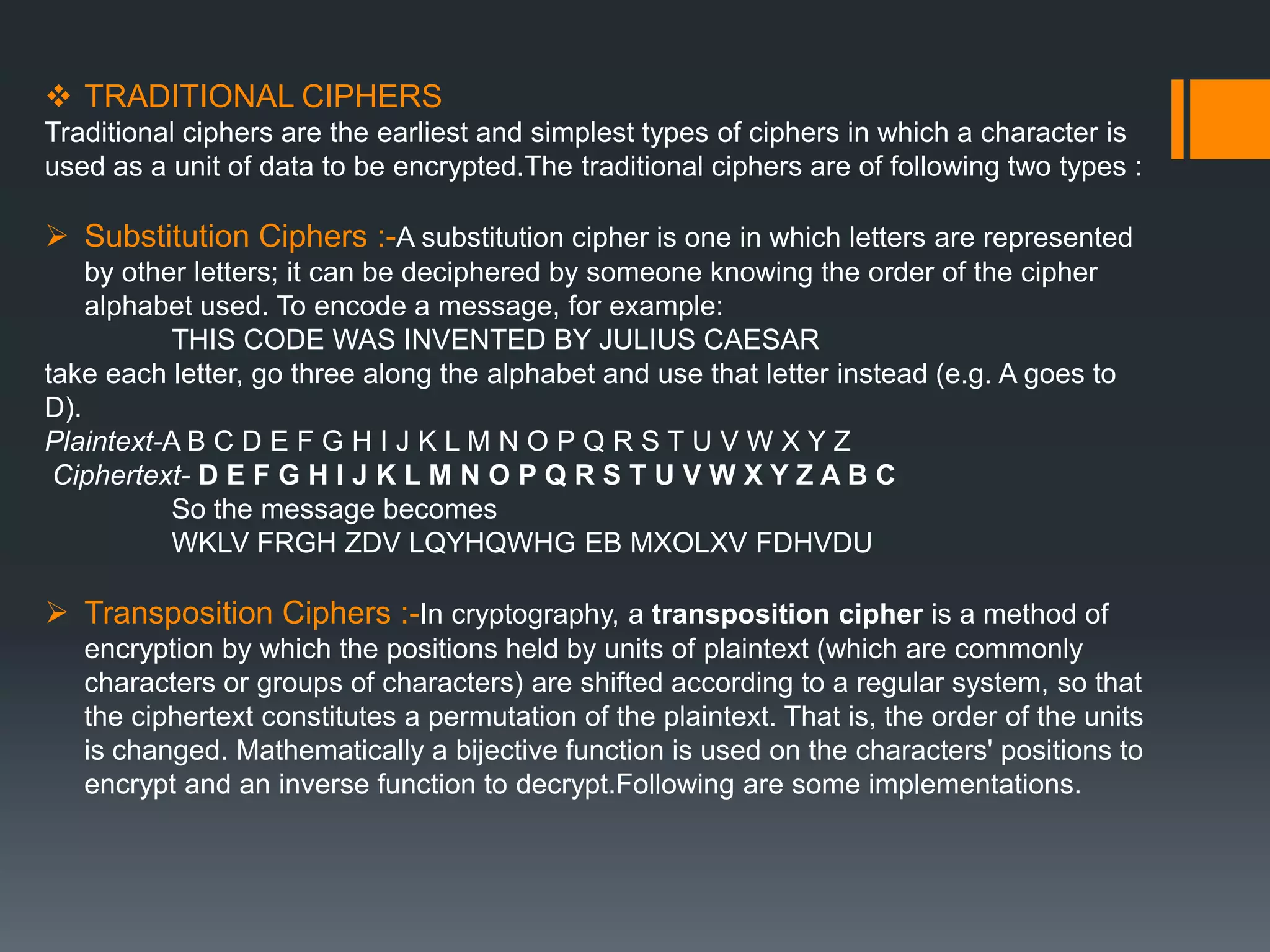
 Substitution Ciphers :-A substitution cipher is one in which letters are represented
by other letters; it can be deciphered by someone knowing the order of the cipher
alphabet used. To encode a message, for example:
THIS CODE WAS INVENTED BY JULIUS CAESAR
take each letter, go three along the alphabet and use that letter instead (e.g. A goes to
D).
Plaintext-A B C D E F G H I J K L M N O P Q R S T U V W X Y Z
Ciphertext- D E F G H I J K L M N O P Q R S T U V W X Y Z A B C
So the message becomes
WKLV FRGH ZDV LQYHQWHG EB MXOLXV FDHVDU
 Transposition Ciphers :-In cryptography, a transposition cipher is a method of
encryption by which the positions held by units of plaintext (which are commonly
characters or groups of characters) are shifted according to a regular system, so that
the ciphertext constitutes a permutation of the plaintext. That is, the order of the units
is changed. Mathematically a bijective function is used on the characters' positions to
encrypt and an inverse function to decrypt.Following are some implementations.
 CRYPTOGRAPHIC ALGORITHM
 DES :-Data Encryption Standard
 US encryption standard [NIST 1993]
 56-bit symmetric key, 64-bit plaintext input
 Block cipher with cipher block chaining
 How secure is DES?
o DES Challenge: 56-bit-key-encrypted phrase decrypted (brute force) in less than a day
o No known good analytic attack
 Making DES more secure:
o 3DES: encrypt 3 times with 3 different keys (actually encrypt, decrypt, encrypt)
 RSA :-Rivest,Shamir and Alderman One of the most commonly used public key
algorithms.The public key in RSA is a pair of numbers (N,e) and the private key also is a
pair of numbers (N,d).The number N is common between the private and public
keys.The algorithm used by the sender to encrypt the message is as follows:
C = Pe mod N
P = Plaintext represented as a number
C = Ciphertext represented as a number
e and N are components of public key
The algorithm used by the receiver to decrypt the message is as under :
P = Cd mod N
P = Plaintext
C = Ciphertext
d and N are components of private key
 PUBLIC KEY CRYPTOGRAPHY :
The public key cryptography is also called as the asymmetric key cryptography.
In this type of cryptography, there are two keys as under
o Public Key
o Private Key
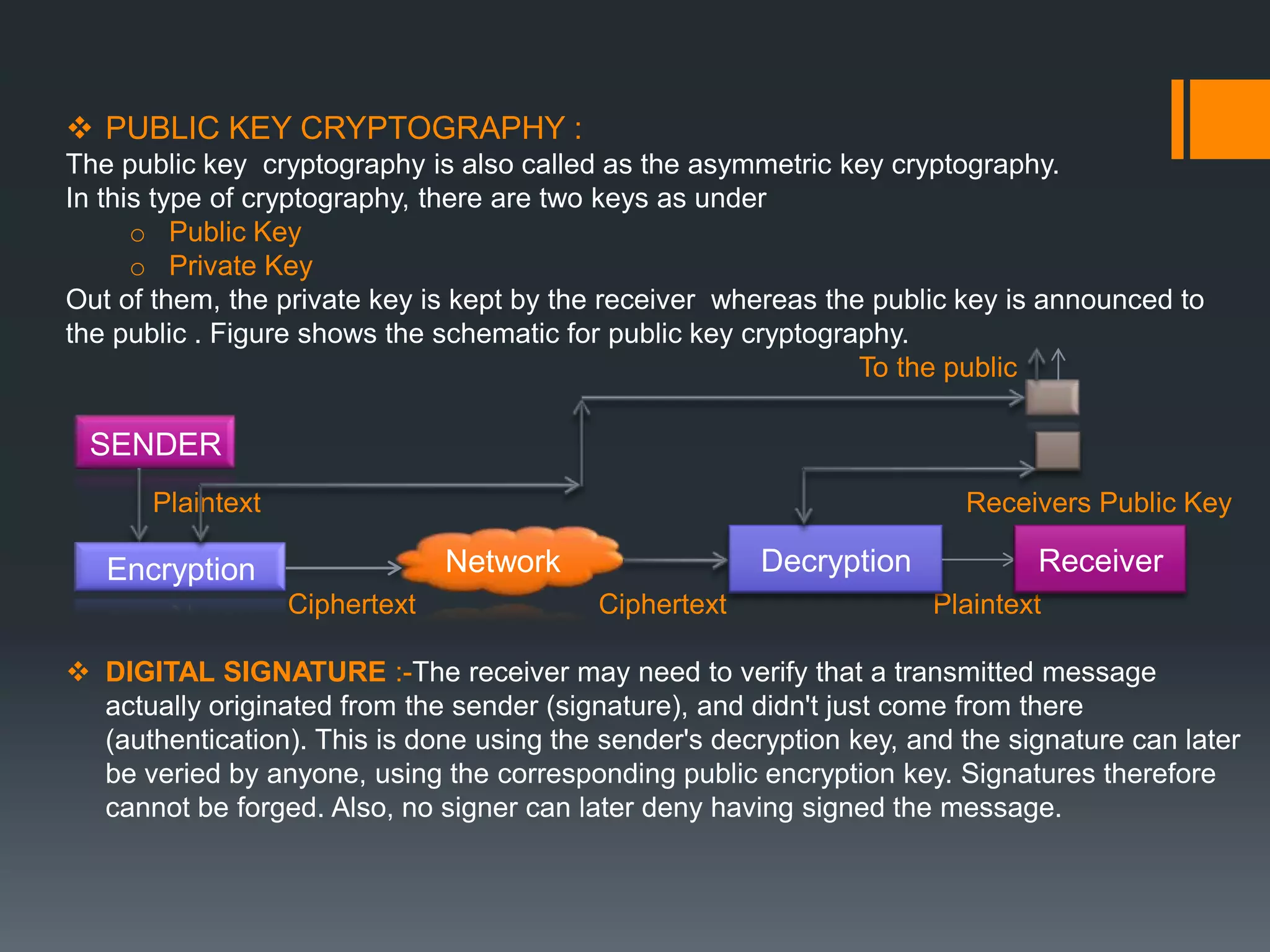
Out of them, the private key is kept by the receiver whereas the public key is announced to
the public . Figure shows the schematic for public key cryptography.
To the public
Plaintext Receivers Public Key
Ciphertext Ciphertext Plaintext
 DIGITAL SIGNATURE :-The receiver may need to verify that a transmitted message
actually originated from the sender (signature), and didn't just come from there
(authentication). This is done using the sender's decryption key, and the signature can later
be veried by anyone, using the corresponding public encryption key. Signatures therefore
cannot be forged. Also, no signer can later deny having signed the message.
SENDER
Encryption Network Decryption Receiver

Cryptography

  • 1.
    CRYPTOGRAPHY Cryptography Encryption Traditional Ciphers Substitution Ciphers TranspositionCiphers  Cryptographic Algorithm  DES  RSA Public Key Cryptography Digital Signature
  • 2.
     CRYPTOGRAPHY The wordCryptography in Greek means “secret writing”. However ,the term today Refers to the science and art of transforming messages to make them secure and immune to attacks . Figure 1.1 shows the components involved in cryptography. Figure 1.1 Cryptography Components Plaintext Plaintext Ciphertext Ciphertext  Plaintext :-The original message produced by the sender is called as plaintext.  Encryption :- The plaintext is transformed into ciphertext .The encryption program converts the plaintext into ciphertext .  Decryption :-Decryption is a process which is exactly opposite to encryption . The decryption algorithm at the receiver transforms the ciphertext back to plain text. Sender Encryption Network Decryption Receiver
  • 3.
     TRADITIONAL CIPHERS Traditionalciphers are the earliest and simplest types of ciphers in which a character is used as a unit of data to be encrypted.The traditional ciphers are of following two types :  Substitution Ciphers :-A substitution cipher is one in which letters are represented by other letters; it can be deciphered by someone knowing the order of the cipher alphabet used. To encode a message, for example: THIS CODE WAS INVENTED BY JULIUS CAESAR take each letter, go three along the alphabet and use that letter instead (e.g. A goes to D). Plaintext-A B C D E F G H I J K L M N O P Q R S T U V W X Y Z Ciphertext- D E F G H I J K L M N O P Q R S T U V W X Y Z A B C So the message becomes WKLV FRGH ZDV LQYHQWHG EB MXOLXV FDHVDU  Transposition Ciphers :-In cryptography, a transposition cipher is a method of encryption by which the positions held by units of plaintext (which are commonly characters or groups of characters) are shifted according to a regular system, so that the ciphertext constitutes a permutation of the plaintext. That is, the order of the units is changed. Mathematically a bijective function is used on the characters' positions to encrypt and an inverse function to decrypt.Following are some implementations.
  • 4.
     CRYPTOGRAPHIC ALGORITHM DES :-Data Encryption Standard  US encryption standard [NIST 1993]  56-bit symmetric key, 64-bit plaintext input  Block cipher with cipher block chaining  How secure is DES? o DES Challenge: 56-bit-key-encrypted phrase decrypted (brute force) in less than a day o No known good analytic attack  Making DES more secure: o 3DES: encrypt 3 times with 3 different keys (actually encrypt, decrypt, encrypt)  RSA :-Rivest,Shamir and Alderman One of the most commonly used public key algorithms.The public key in RSA is a pair of numbers (N,e) and the private key also is a pair of numbers (N,d).The number N is common between the private and public keys.The algorithm used by the sender to encrypt the message is as follows: C = Pe mod N P = Plaintext represented as a number C = Ciphertext represented as a number e and N are components of public key The algorithm used by the receiver to decrypt the message is as under : P = Cd mod N P = Plaintext C = Ciphertext d and N are components of private key
  • 5.
     PUBLIC KEYCRYPTOGRAPHY : The public key cryptography is also called as the asymmetric key cryptography. In this type of cryptography, there are two keys as under o Public Key o Private Key Out of them, the private key is kept by the receiver whereas the public key is announced to the public . Figure shows the schematic for public key cryptography. To the public Plaintext Receivers Public Key Ciphertext Ciphertext Plaintext  DIGITAL SIGNATURE :-The receiver may need to verify that a transmitted message actually originated from the sender (signature), and didn't just come from there (authentication). This is done using the sender's decryption key, and the signature can later be veried by anyone, using the corresponding public encryption key. Signatures therefore cannot be forged. Also, no signer can later deny having signed the message. SENDER Encryption Network Decryption Receiver