Dr. Boskey . P . Gandhi
Consultant pathologist at
Jaymala path lab,
chhayado trust,
surat
SPECTRUM OF THYROID DISEASE
Severe
mild
Subclinical
Epidemiology
According to the Indian Thyroid Society, it is estimated
that 4.2 crore people in the country are suffering from
thyroid disorders with almost 90 per cent undiagnosed.
As brand ambassador for the Abbott India Ltd healthcare
company, kajol is urging women to take thyroid tests so
that they can take timely medical advice and avoid
complications. –
See more at: http://www.bollywood.com/kajol-urges-women-take-
thyroid-test#sthash.ewxasQAt.dpuf
Even with the efforts in the past decade, we still
have a long way to go in terms of thyroid awareness.
As part of a pre cautionary measure, women should
check their TSH level as soon as pregnancy has
confirmed," said R V Jayakumar, President of The
Indian Thyroid Society.
Read more
at: http://indiatoday.intoday.in/story/Kajol+to+create+awareness+about
+Thyroid+/1/97851.html
Oprah win Frey
Owner of most famous oprah
win Frey talk show in America.
Having hashimoto’s thyroiditis.
Anatomy of Thyroid gland
The thyroid gland
is a butterfly-shaped
endocrine gland that is
normally located anterior
side of the neck lying in
front & around the larynx
& trachea just below the
laryngeal
prominence.(Adam’s
apple)
*Biosynthesis of thyroid
hormones:-
Steps:
1. Iodide (I-) enters the thryroid cell via sodium iodide symporter
2. It enters the colloid through pendrin receptor
3. It is oxidized into Iodine (I0) by peroxidase enzyme
4. Then it is organified into MIT and DIT (mono and di iodo thyronine)
5. Then after coupling it forms T3 (Tri iodo thyronine) and T4 (Thyroxine)
6. T3 and T4 conjugate with TBG (thyroid binding globulin)
7. conjugated TBG is stored in colloid till required
8. While releasing into blood stream, it is first endocytosed into thyroid cell and then
de -
coupled to form, T3 and T4 with MIT and DIT
9. MIT and DIT can be reutilized for coupling
10. T3 and T4 are released into the blood stream
*What happens to thyroid hormones after
release
*Concept of FT3 and FT4
1. Out of the total T3 and T4 in circulation, most of it
remains bound to thyroid binding
globulin *, prealbumin and albumin.
(*note :this is not thyroglobulin)
2. Only about 0.05% of each T3 and T4 remains free in
circulation. This is FT3 and FT4.
3. These are better indicators for thyroid function
than total T3 and Total T4.
(total=bound+free)
4. For example in pregnancy, level of thyroid binding
globulin rises; hence though total T3
and total T4 remains same, level of FT3 and FT4
decreases.
CLASSIFICATION OF
THYROID DISEASE
HYPO
THYROIDISM-
MOST
COMMON
HYPER
THYROIDISM
SUB CLINICAL
CASES-
1.HYPO
2.HYPER
(ASYMPTO-
MATIC
CASES)
Hypothyroidism
*Causes:
Primary Hypothyroidism ( High TSH, low T3 and T4)
1. Iodine deficiency
2. Goitrogens (excess amount interfere in iodine uptake)
SOY products
strawberry,
Sweet potatoes
cabbage, cauliflower, spinach
Broccoli
Millet e. t .c
3. Hashimoto’s
(anti microsomal antibodies)
4. Iatrogenic – surgery
Anti thyroid drugs,
Radiation
Continue……..
Secondary hypothyroidism (Low TSH with normal TRH
i.e. pituitary problem
diseases of pituitary
Tertiary hypothyroidism (LOW TSH, Low TRH)
i.e. hypothalamic problem1. diseases of the hypothalamus
Exaggerated response to TSH RH stimulation
Rise and Delayed response to TSH-RH stimulation
Common Signs and Symptoms
of Hypothyroidism
Dry skin
Brittle and lustreless hair
Weight gain
Tiredness
Constipation
Muscle aches
Bradycardia
Cold intolerance
Depression
Memory Loss
Mentrual
abnormality
Lab abnormalities in
hypothyroidism
Hyper lipidemia
Anemia(mac rocytic-due to vit B12 def)
High LDH
High CPK
Hyper prolactemia
Hypo natremia
*Hyperthyroidism
Causes:
Primary
hyperthyroidism
Low TSH, High T4
Secondary
Hyperthyroidism
High TSH, High T4
Pituitary/Para neo
plastic
syndrome
Factitious
Hyperthyroidism
1. Grave’s disease
2. Toxicity in
Multi nodular goitre
3. toxicity in adenoma
4. Sub acute thyroiditis
1. TSH secreting
pituitary adenoma
2. Tropho blastic tumours
that secrete TSH
(chorio carcinoma,
H. mole)
Exogenous ingestion of
large dose of thyroid
hormone.
Common Signs and Symptoms
of Hyper thyroidism
Worm moist skin
Hair loss
Weight loss
Nervousness
Increased bowel movements
Muscle weakness
Tachycardia
Heatintolerance
insomnia
Difficulty in concentrating
Light or Absent periods
Laboratory findings in
Hyperthyroidism
• TSH nearly undetectable
• Elevated FT4 or FT3
• Mild leuko penia
• N/N anemia
• ESR elevated
• ↑ed hepato cellular enzymes
• Mild ↑ Ca++
• ↓ Albumin
• ↓ Cholesterol
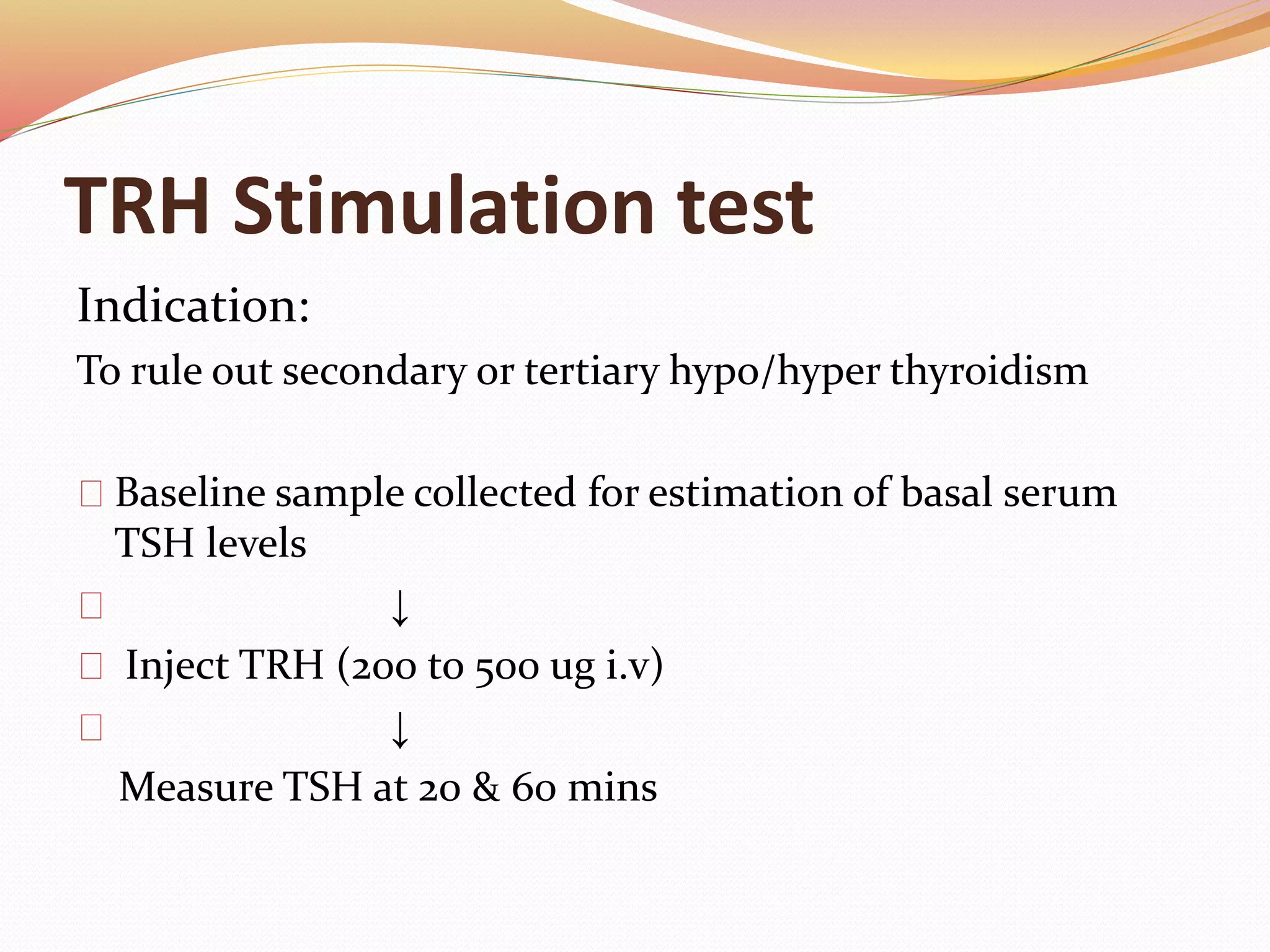
TRH Stimulation test
Indication:
To rule out secondary or tertiary hypo/hyper thyroidism
Baseline sample collected for estimation of basal serum
TSH levels
↓
Inject TRH (200 to 500 ug i.v)
↓
Measure TSH at 20 & 60 mins
Baseline
TSH
20 min
TSH
60 min
TSH
interpretation
Normal Rise of
>2mU/L
Small
decline
normal
Hypothyroidi
sm
Elevated Further rise Small
decline
Primary hypothyroidism
Low No rise Secondary
hypothyroidism
(pituitary)
Low rise Further rise
(delayed)
Hypothalamic
hypothyroidism
Hyperthyroi
dism
elevated rise Thyroid hormone
resistance
elevated No rise Pituitary
adenoma/ para
neoplastic
Subclinical Thyroid Disease
Asymptomatic
Among the group with sub clinical thyroid disease,
73.8% are hypothyroid and 26.2% are hyperthyroid.
TSH outside the reference interval but normal
serum levels of T3 and T4
The prevalence of SCH is about 4% to 10% in the
general population and may be as high as 20
percent in women older than 60 years
Anti thyroid antibodies can be detected in 80% of
patients with SCH.
80% of patients with SCH have a serum TSH of less
than 10 mIU/L.
To treat or not to treat –Strict follow up
Suspicion of thyroid disease based
on clinical signs and symptoms
Screening for
thyroid disease
Evaluation of treatment
for thyroid disease.
Thyroid Disease – Who Is At Risk ?
All newborns (neonatal screening)
personal history of thyroid disease
strong family history of thyroid disease
Have an autoimmune disease, such as Type 1 Diabetes
Some genetic conditions (e.g. Down, Turner
syndromes)
past history of neck irradiation
drug therapies such as lithium and amio darone
Investigation and Management of Primary Thyroid Dysfunction. Toward Optimized Practice
Program, Edmonton: AB, 2008 Update.
Contd…
women over age 35
elderly patients
Pregnant women during the first trimester
women 6 weeks to 6 months post-partum
Have elevated lipid levels
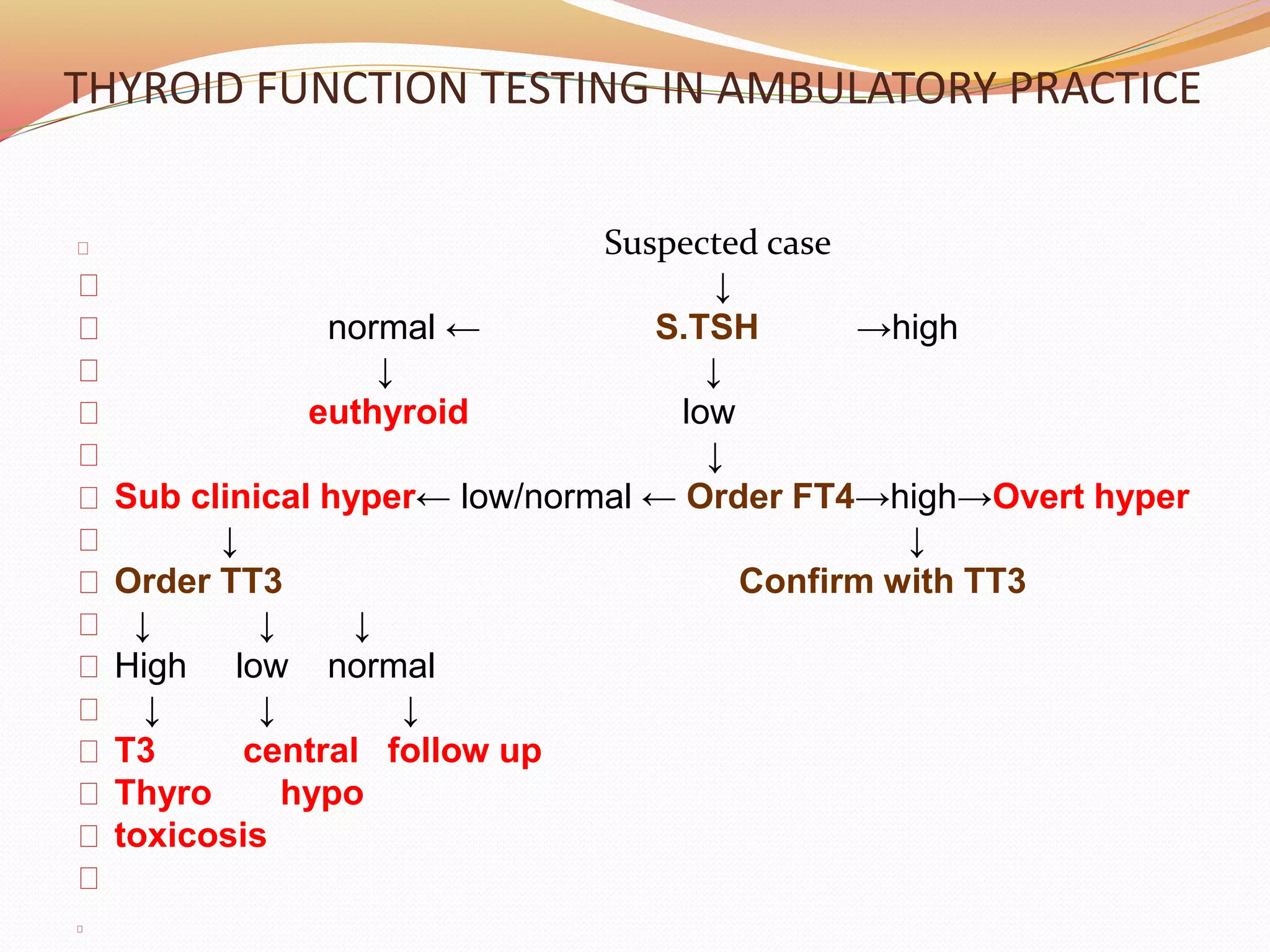
THYROID FUNCTION TESTING IN AMBULATORY PRACTICE
Suspected case
↓
normal ← S.TSH →high
↓ ↓
euthyroid low
↓
Sub clinical hyper← low/normal ← Order FT4→high→Overt hyper
↓ ↓
Order TT3 Confirm with TT3
↓ ↓ ↓
High low normal
↓ ↓ ↓
T3 central follow up
Thyro hypo
toxicosis
Continue…….
S.TSH
↓
high
↓
Overt hypo← Low← Order FT4→normal→Subclinical hypo
↓
high
↓
normal/low ← Order TT3→high→Secondary hyper
↓
T4 Assay interference
↓
Repeat with diff method
To screen or not to screen for
thyroid dysfunction
American Association of Clinical Endocrinologist
(AACE), American Academy of Family Physicians
(AAFP), The American College of Physician (ACP)
and the American Thyroid Association (ATA) vary
greatly in their recommendations.
ATA recommending routine screening at age 35
then every five years.
BLOOD test to evaluate thyroid disease:
TSH ,T4 ,T3
FT4 , FT3: Free hormone(Active metabolite)
rT3 :(inactive metabolite)high in NTI , newborn, hyperthyroidism
Thyro globulin mesurement
Thyroid antibodies: AntiTPO antibodies, (microsomal)
TSH receptor Abs
Anti TG antibodies
Urinary iodine mesurement
Thyroxine binding globulin:
• RadioimmunoassayRIA
• Enzyme-linked immunosorbant assayELISA
• Chemiluminescent immunoassayCLIA
• Fluorescent immunoassayFIA
Principle of FT4 measurement by
immunoassay method.
High affinity hormone Abs measure free hormone
as a fraction of binding site occupancy. Means (
unoccupied Abs sites are inversely proportional
to free hormone.)
Hormone labeled tracer quantified free hormone
level & passing signals which are converted to
concentration using calibrators.
Factors limit the validity of free T4 IMMUNO ASSAY
method
1.Dilution effects & protein dependence: dissociation of bound ligand
occurs with sample dilution
2.Anomalous protein binding of tracer: Certain tracer used in FT4 assay
have high binding capacity to protein(albumin)→ so in serum less tracer
available for free Abs binding site→ false high FT4;while (in dialysis pts
,low protein →more tracer bind to Abs→ False Low FT4.)
3.Heparin effect: Heparin induce sample→↑ed lipase activity(if TG is high,
Albumin is low, temp is prolong at 37C→high non esterified fatty acid
→inhibit binding of T4 to serum protein in vitro only→ false high FT4.
4.Dysalbuminemic hyper thyroxinemia pts have abnormal proteins which
bind T4 ,so spurious result of FT4 varies depending on labs.
Most accurate methods are: Equilibrium dialysis(time consumable),
Ultra filtration(avoid dilution effect) , mass spectroscopy.
When FT4 is not correlate persistently with other parameter, method
should be change.
Thyro globulin measurement
Thyroglobulin: One kind of organ specific protein.
Increased in Thyroid mass , injury , inflammation , TSH
stimulation.
Indication in practice:
1.congenital hypothyroidism(thyroid
dysgenesis(low)/dyshormonogenesis(high))
2.endemic goiter area, to monitor iodine supplementation.
3.Differentiated thyroid cancer cases ,after Sx to monitor
recurrence
4.Thyrotoxicosis factitia: endogenous
thyrotoxicosis(↑TG),exogenous ingestion of thyroid
hormone(↓TG)
Normal range of TG :10-13ug/L in euthyroid subject.
Method: immunoassay , RIA
By immunoassay : minimal Tg abs in
sample interfere with TG(low)
measurement. So TGAb should be
measure in all sample priror to TG
analysis.
If Abs present, RIA method S/b
used.(low interference)
Thyroxin binding globulin
Main carrier protein of T3 &T4
Measure by immunoassay
Normal Range:12 to 28 gm/dl.
Indicated ,when T3,T4 level do not agree with other parameter.
Increase TBG Decrease TBG
Liver disease Liver failure
Pregnancy, new born Malnutrition, nephrotic SX
Genetic disease Genetic disease
Drugs: Estrogen,
5-florouracil,
clofibrate ,
methadone
Drugs: Androgens,
gluco corticoids
Drugs alter thyroid function test
Alter
secretion
of T3,T4
↑ TBG ↓ TBG Competitio
n with
binding
protein
Induction
of
metabolism
Activation
from T4 to
T3
Centrl
TSH
suppresio
n
Thionamid
e
Estrogen Andro
gen
Aspirin Phenytoin Amio
darone
Dopamine
Ethiona
mide
Narcotics Danazol Heparin Carbema
zepine
Propyl
thiourecil
Dobuta
mine
Lithium 5-FU Nicotini
c acid
Furosemide
(high dose)
Pheno
barbitone
Dexameth
asone
Octreotide
Clofibrat
e
L-
asparagi
nase
Rifampicin Radio
graphic
agent
Oxcarbema
Sick Euthyroid Syndrome
Thyroid related changes that occur during
systemic illness in the absence of intrinsic
thyroid disease
The syndrome is acute, reversible, and occurs
commonly after surgery, starvation and in many
acute febrile illnesses, These changes may be
observed in up to 75% of hospitalized patients
Any abnormality in hormone level is possible,
usually low fT3 and tT3
Thyroid Disorders in Elderly Patients, S Med J 2005;98(5):543-549
Critically ill pt (hospitalization) stage i.e
1. infections
2. liver diseases
3. malignancies
4. trauma
5. surgery
6. renal failure
7. cardiac failure
Decresed D1→T4 to T3 conversion inhibited.
→high T4,low T3
Incrased D3→inactivation of t4 to rt3
→high rT3
TSH will remain normal.
All parameters are normal on recovery.
THYROID FUCTION TEST DURING
PREGNANCY
Physiologial changes during pregnancy:
(TSH ↓, T3,T4↑) Because:
hepatic & estrogen induce TBG ↑ ed
B- hcg mimicking TSH, Stimulate Thyroid gland
↑ plasma volume→↑ T4 & T3 pool size.
High iodine clearance →more demand
↑D3 from placental mass → more degradation of
T3,T4
Gestational variation of TFT
0
1
2
3
4
5
6
10weeks 20weeks 30weeks 40weeks
TSH
FT3
FT4
Trimester specific referance range
of TFT
TSH(mIu/L) FT3(pmol/L) FT4(pmol/L)
Trimester-1 2.1(0.6-5) 4.4(1.9-5.8) 14.4(12-19.4)
Trimester-2 2.4(0.4-5.7) 4.3(3.2-5.7) 13.4(9.4-19.4)
Trimester-3
(Roche-cobas-
e411/Elecsys)
instrument
specific
2.1(0.7-5.7) 4.1(3.3-5.1) 13.2(11.3-17.7)
According to endocrine society of
india
In lab report ,ref range s/b trimester specific &
depands upon instrument
Method use by lab
Ethicity
Iodine status of population
Age
Subclinical hypothyroidism with
pregnancy
Associated with hypertension and toxaemia
Subclinical hypothyroidism is associated with
ovulatory dysfunction and infertility..
Undetected SCH during pregnancy may
adversely affect the neuropsychological
development ,survival of the fetus
Screening of TFT during pregnancy
According to endocrine society of india:
S/S of thyroid disease
previous H/O of thyroid disease
Family history of thyroid disease.
Autoimmune dis: i.e Hashimoto,type-1 diabetes,
H/O irradiation
Previous H/O miscarriage, infertility, preterm delivery.
Although
Studies suggest that All pregnant women s/b screen for
TSH & AntiTPO(more responsible for post partum
thyroiditis) in 1st trimester.
THYROID FUNCTION IN INFANTS
changes of thyroid hormone in first 120 hrs of life
0
1
2
3
4
5
6
Born 24hrs 48hrs 72hrs 96hrs 120hrs
TSH
RT3
T3
T4
Normal range of TFT in infant &
children
Age FT4(n
g/dl)
T4(ug/
dl
FT3(pg/d
l)
T3(ng/
ml
TSH(mu/
L)
TBG(mg/d
l)
Cord blood 0.9-2.2 7.4-13.0 15-75 1.0-17.4 2.5-5.1
1-4 days 2.2-
5.3↑
14.0-
28.4↑
180-760 100-740↑ 1.0-39.0↑
2-20weeks 0.9-
2.3↓
7.2-
15.7↓
185-770 105-245↓ 1.7-9.1↓ 2.1-6.0
5-24
months
0.8-
1.8↓
7.2-15.7 215-770 105-269 0.8-8.2
2-7 years 1.0-
2.1↑
6.0-14.2 215-700 94-241 0.7-5.7↓ 2.0-5.3
8-20 yrs o.8-1.9 4.7-
12.4↓
230-650 80-210 0.7-5.7 1.8-4.2
21-45 years 0.9-2.5 5.3-
10.5↓
210-440 70-204 0.4-4.2 1.8-4.2
SCREENING OF INFANTS-WHY?
S/S not develop up to 3-6 months
Most common cause congenital hypothyroidism is thyroid
dysgenesis / dys hormono genesis.
It affects neuro psychological status & growth of body.
In united states ,its routine screening
World wide 25% newborn babies undergo screening
tests.
Some program screen at 2-5 days, while others screen
at 2-6 weeks of life.
SCREENING OF INFANTS
2 APPROCHES:
1. Initial T4 measuring followed by TSH , if T4 is
low
2. Primary TSH determination.
Pre term babies
Preterm term baby has their own unique set of thyroid
function tests & its directly co relate with gestation age &
birth wts.
Usually preterm babies have” low T4-non elevated TSH “
result in screening programe.
Because
1.discontinuation of maternal T4.
2.immaturity of hypothalamic-pitutary stimulation(low
TSH surge).
3.immaturity in thyroid hormone production.
. 4.low iodine intake( due to i.v fluids).
repeat test is indicated in most
cases.
Cancer thyroid
Thyroid carcinoma occurs relatively infrequently compared
to the common occurrence of benign thyroid disease
Thyroglobulin Assays:
 Determines the amount of thyroid tissue after a thyroidectomy ie
there should be no thyroglobulin after complete thyroid gland
removal.
 Used to monitor the recurrence of the common thyroid cancers
(follicular cell–derived tumors)
 Tg measurements should always be interpreted in the context of
simultaneous measurement of Tg autoantibodies (TgAB). TgAB
occur in about 20% of thyroid cancer patients and can lead to falsely
low Tg measurements
Calcitonin Assay:
Used to detect and monitor the recurrence of medullary thyroid
cancer
NEW UPDATES
1.NAFLD,Female,obesity----Hypo thyrodism S/b rule
out.(metabolic syndrome)
2.Chronic HCV infection in children →mimic structure
thyroid cells → Anti TPO, Anti TG antibodies produce→
Sub clinical hypothyroidism →Overt hypothyroidism →
So screening is mandatory before starting treatment
3.Steroid responsive nephrotic syndrome relaps pts
may have hypothyroidism(temporary) because (they have
oxidative stress in body ↘ affect kidney↘↑ed permeability
of GBM↘ loss of TG↘low T3,T4 ↘high TSH)
Improve with remission
No need for thyroid treatment.
Take home message
When FT4 level dose not match with other parameter
,it should be repeated by more accurate method.
Trimester specific reference range should be included
in report.
In case of thyrotoxicosis factatia ,TG is more useful
parameter.
AntiTgAb S/b screen in all samples demand for TG
measurement by immunoassay method.
Sick euthyroid Sx is identified by high rT3 level.
Referances
Todd & Henry
Springer
Indian thyroid society manual
Internet
THANK
YOU FOR
YOUR
PATIENCE

Thyroid function test , made by dr.boskey,surat

  • 1.
    Dr. Boskey .P . Gandhi Consultant pathologist at Jaymala path lab, chhayado trust, surat
  • 2.
    SPECTRUM OF THYROIDDISEASE Severe mild Subclinical
  • 3.
    Epidemiology According to theIndian Thyroid Society, it is estimated that 4.2 crore people in the country are suffering from thyroid disorders with almost 90 per cent undiagnosed. As brand ambassador for the Abbott India Ltd healthcare company, kajol is urging women to take thyroid tests so that they can take timely medical advice and avoid complications. – See more at: http://www.bollywood.com/kajol-urges-women-take- thyroid-test#sthash.ewxasQAt.dpuf
  • 4.
    Even with theefforts in the past decade, we still have a long way to go in terms of thyroid awareness. As part of a pre cautionary measure, women should check their TSH level as soon as pregnancy has confirmed," said R V Jayakumar, President of The Indian Thyroid Society. Read more at: http://indiatoday.intoday.in/story/Kajol+to+create+awareness+about +Thyroid+/1/97851.html
  • 5.
    Oprah win Frey Ownerof most famous oprah win Frey talk show in America. Having hashimoto’s thyroiditis.
  • 6.
    Anatomy of Thyroidgland The thyroid gland is a butterfly-shaped endocrine gland that is normally located anterior side of the neck lying in front & around the larynx & trachea just below the laryngeal prominence.(Adam’s apple)
  • 8.
  • 9.
    Steps: 1. Iodide (I-)enters the thryroid cell via sodium iodide symporter 2. It enters the colloid through pendrin receptor 3. It is oxidized into Iodine (I0) by peroxidase enzyme 4. Then it is organified into MIT and DIT (mono and di iodo thyronine) 5. Then after coupling it forms T3 (Tri iodo thyronine) and T4 (Thyroxine) 6. T3 and T4 conjugate with TBG (thyroid binding globulin) 7. conjugated TBG is stored in colloid till required 8. While releasing into blood stream, it is first endocytosed into thyroid cell and then de - coupled to form, T3 and T4 with MIT and DIT 9. MIT and DIT can be reutilized for coupling 10. T3 and T4 are released into the blood stream
  • 10.
    *What happens tothyroid hormones after release
  • 11.
    *Concept of FT3and FT4 1. Out of the total T3 and T4 in circulation, most of it remains bound to thyroid binding globulin *, prealbumin and albumin. (*note :this is not thyroglobulin) 2. Only about 0.05% of each T3 and T4 remains free in circulation. This is FT3 and FT4. 3. These are better indicators for thyroid function than total T3 and Total T4. (total=bound+free) 4. For example in pregnancy, level of thyroid binding globulin rises; hence though total T3 and total T4 remains same, level of FT3 and FT4 decreases.
  • 12.
  • 13.
    Hypothyroidism *Causes: Primary Hypothyroidism (High TSH, low T3 and T4) 1. Iodine deficiency 2. Goitrogens (excess amount interfere in iodine uptake) SOY products strawberry, Sweet potatoes cabbage, cauliflower, spinach Broccoli Millet e. t .c 3. Hashimoto’s (anti microsomal antibodies) 4. Iatrogenic – surgery Anti thyroid drugs, Radiation
  • 14.
    Continue…….. Secondary hypothyroidism (LowTSH with normal TRH i.e. pituitary problem diseases of pituitary Tertiary hypothyroidism (LOW TSH, Low TRH) i.e. hypothalamic problem1. diseases of the hypothalamus Exaggerated response to TSH RH stimulation Rise and Delayed response to TSH-RH stimulation
  • 15.
    Common Signs andSymptoms of Hypothyroidism Dry skin Brittle and lustreless hair Weight gain Tiredness Constipation Muscle aches Bradycardia Cold intolerance Depression Memory Loss Mentrual abnormality
  • 16.
    Lab abnormalities in hypothyroidism Hyperlipidemia Anemia(mac rocytic-due to vit B12 def) High LDH High CPK Hyper prolactemia Hypo natremia
  • 17.
    *Hyperthyroidism Causes: Primary hyperthyroidism Low TSH, HighT4 Secondary Hyperthyroidism High TSH, High T4 Pituitary/Para neo plastic syndrome Factitious Hyperthyroidism 1. Grave’s disease 2. Toxicity in Multi nodular goitre 3. toxicity in adenoma 4. Sub acute thyroiditis 1. TSH secreting pituitary adenoma 2. Tropho blastic tumours that secrete TSH (chorio carcinoma, H. mole) Exogenous ingestion of large dose of thyroid hormone.
  • 18.
    Common Signs andSymptoms of Hyper thyroidism Worm moist skin Hair loss Weight loss Nervousness Increased bowel movements Muscle weakness Tachycardia Heatintolerance insomnia Difficulty in concentrating Light or Absent periods
  • 19.
    Laboratory findings in Hyperthyroidism •TSH nearly undetectable • Elevated FT4 or FT3 • Mild leuko penia • N/N anemia • ESR elevated • ↑ed hepato cellular enzymes • Mild ↑ Ca++ • ↓ Albumin • ↓ Cholesterol
  • 20.
    TRH Stimulation test Indication: Torule out secondary or tertiary hypo/hyper thyroidism Baseline sample collected for estimation of basal serum TSH levels ↓ Inject TRH (200 to 500 ug i.v) ↓ Measure TSH at 20 & 60 mins
  • 21.
    Baseline TSH 20 min TSH 60 min TSH interpretation NormalRise of >2mU/L Small decline normal Hypothyroidi sm Elevated Further rise Small decline Primary hypothyroidism Low No rise Secondary hypothyroidism (pituitary) Low rise Further rise (delayed) Hypothalamic hypothyroidism Hyperthyroi dism elevated rise Thyroid hormone resistance elevated No rise Pituitary adenoma/ para neoplastic
  • 22.
    Subclinical Thyroid Disease Asymptomatic Amongthe group with sub clinical thyroid disease, 73.8% are hypothyroid and 26.2% are hyperthyroid. TSH outside the reference interval but normal serum levels of T3 and T4 The prevalence of SCH is about 4% to 10% in the general population and may be as high as 20 percent in women older than 60 years Anti thyroid antibodies can be detected in 80% of patients with SCH. 80% of patients with SCH have a serum TSH of less than 10 mIU/L. To treat or not to treat –Strict follow up
  • 23.
    Suspicion of thyroiddisease based on clinical signs and symptoms Screening for thyroid disease Evaluation of treatment for thyroid disease.
  • 24.
    Thyroid Disease –Who Is At Risk ? All newborns (neonatal screening) personal history of thyroid disease strong family history of thyroid disease Have an autoimmune disease, such as Type 1 Diabetes Some genetic conditions (e.g. Down, Turner syndromes) past history of neck irradiation drug therapies such as lithium and amio darone Investigation and Management of Primary Thyroid Dysfunction. Toward Optimized Practice Program, Edmonton: AB, 2008 Update.
  • 25.
    Contd… women over age35 elderly patients Pregnant women during the first trimester women 6 weeks to 6 months post-partum Have elevated lipid levels
  • 26.
    THYROID FUNCTION TESTINGIN AMBULATORY PRACTICE Suspected case ↓ normal ← S.TSH →high ↓ ↓ euthyroid low ↓ Sub clinical hyper← low/normal ← Order FT4→high→Overt hyper ↓ ↓ Order TT3 Confirm with TT3 ↓ ↓ ↓ High low normal ↓ ↓ ↓ T3 central follow up Thyro hypo toxicosis
  • 27.
    Continue……. S.TSH ↓ high ↓ Overt hypo← Low←Order FT4→normal→Subclinical hypo ↓ high ↓ normal/low ← Order TT3→high→Secondary hyper ↓ T4 Assay interference ↓ Repeat with diff method
  • 28.
    To screen ornot to screen for thyroid dysfunction American Association of Clinical Endocrinologist (AACE), American Academy of Family Physicians (AAFP), The American College of Physician (ACP) and the American Thyroid Association (ATA) vary greatly in their recommendations. ATA recommending routine screening at age 35 then every five years.
  • 29.
    BLOOD test toevaluate thyroid disease: TSH ,T4 ,T3 FT4 , FT3: Free hormone(Active metabolite) rT3 :(inactive metabolite)high in NTI , newborn, hyperthyroidism Thyro globulin mesurement Thyroid antibodies: AntiTPO antibodies, (microsomal) TSH receptor Abs Anti TG antibodies Urinary iodine mesurement Thyroxine binding globulin:
  • 30.
    • RadioimmunoassayRIA • Enzyme-linkedimmunosorbant assayELISA • Chemiluminescent immunoassayCLIA • Fluorescent immunoassayFIA
  • 31.
    Principle of FT4measurement by immunoassay method. High affinity hormone Abs measure free hormone as a fraction of binding site occupancy. Means ( unoccupied Abs sites are inversely proportional to free hormone.) Hormone labeled tracer quantified free hormone level & passing signals which are converted to concentration using calibrators.
  • 32.
    Factors limit thevalidity of free T4 IMMUNO ASSAY method 1.Dilution effects & protein dependence: dissociation of bound ligand occurs with sample dilution 2.Anomalous protein binding of tracer: Certain tracer used in FT4 assay have high binding capacity to protein(albumin)→ so in serum less tracer available for free Abs binding site→ false high FT4;while (in dialysis pts ,low protein →more tracer bind to Abs→ False Low FT4.) 3.Heparin effect: Heparin induce sample→↑ed lipase activity(if TG is high, Albumin is low, temp is prolong at 37C→high non esterified fatty acid →inhibit binding of T4 to serum protein in vitro only→ false high FT4. 4.Dysalbuminemic hyper thyroxinemia pts have abnormal proteins which bind T4 ,so spurious result of FT4 varies depending on labs. Most accurate methods are: Equilibrium dialysis(time consumable), Ultra filtration(avoid dilution effect) , mass spectroscopy. When FT4 is not correlate persistently with other parameter, method should be change.
  • 33.
    Thyro globulin measurement Thyroglobulin:One kind of organ specific protein. Increased in Thyroid mass , injury , inflammation , TSH stimulation. Indication in practice: 1.congenital hypothyroidism(thyroid dysgenesis(low)/dyshormonogenesis(high)) 2.endemic goiter area, to monitor iodine supplementation. 3.Differentiated thyroid cancer cases ,after Sx to monitor recurrence 4.Thyrotoxicosis factitia: endogenous thyrotoxicosis(↑TG),exogenous ingestion of thyroid hormone(↓TG)
  • 34.
    Normal range ofTG :10-13ug/L in euthyroid subject. Method: immunoassay , RIA By immunoassay : minimal Tg abs in sample interfere with TG(low) measurement. So TGAb should be measure in all sample priror to TG analysis. If Abs present, RIA method S/b used.(low interference)
  • 35.
    Thyroxin binding globulin Maincarrier protein of T3 &T4 Measure by immunoassay Normal Range:12 to 28 gm/dl. Indicated ,when T3,T4 level do not agree with other parameter. Increase TBG Decrease TBG Liver disease Liver failure Pregnancy, new born Malnutrition, nephrotic SX Genetic disease Genetic disease Drugs: Estrogen, 5-florouracil, clofibrate , methadone Drugs: Androgens, gluco corticoids
  • 36.
    Drugs alter thyroidfunction test Alter secretion of T3,T4 ↑ TBG ↓ TBG Competitio n with binding protein Induction of metabolism Activation from T4 to T3 Centrl TSH suppresio n Thionamid e Estrogen Andro gen Aspirin Phenytoin Amio darone Dopamine Ethiona mide Narcotics Danazol Heparin Carbema zepine Propyl thiourecil Dobuta mine Lithium 5-FU Nicotini c acid Furosemide (high dose) Pheno barbitone Dexameth asone Octreotide Clofibrat e L- asparagi nase Rifampicin Radio graphic agent Oxcarbema
  • 37.
    Sick Euthyroid Syndrome Thyroidrelated changes that occur during systemic illness in the absence of intrinsic thyroid disease The syndrome is acute, reversible, and occurs commonly after surgery, starvation and in many acute febrile illnesses, These changes may be observed in up to 75% of hospitalized patients Any abnormality in hormone level is possible, usually low fT3 and tT3 Thyroid Disorders in Elderly Patients, S Med J 2005;98(5):543-549
  • 38.
    Critically ill pt(hospitalization) stage i.e 1. infections 2. liver diseases 3. malignancies 4. trauma 5. surgery 6. renal failure 7. cardiac failure Decresed D1→T4 to T3 conversion inhibited. →high T4,low T3 Incrased D3→inactivation of t4 to rt3 →high rT3 TSH will remain normal. All parameters are normal on recovery.
  • 39.
    THYROID FUCTION TESTDURING PREGNANCY Physiologial changes during pregnancy: (TSH ↓, T3,T4↑) Because: hepatic & estrogen induce TBG ↑ ed B- hcg mimicking TSH, Stimulate Thyroid gland ↑ plasma volume→↑ T4 & T3 pool size. High iodine clearance →more demand ↑D3 from placental mass → more degradation of T3,T4
  • 40.
    Gestational variation ofTFT 0 1 2 3 4 5 6 10weeks 20weeks 30weeks 40weeks TSH FT3 FT4
  • 41.
    Trimester specific referancerange of TFT TSH(mIu/L) FT3(pmol/L) FT4(pmol/L) Trimester-1 2.1(0.6-5) 4.4(1.9-5.8) 14.4(12-19.4) Trimester-2 2.4(0.4-5.7) 4.3(3.2-5.7) 13.4(9.4-19.4) Trimester-3 (Roche-cobas- e411/Elecsys) instrument specific 2.1(0.7-5.7) 4.1(3.3-5.1) 13.2(11.3-17.7)
  • 42.
    According to endocrinesociety of india In lab report ,ref range s/b trimester specific & depands upon instrument Method use by lab Ethicity Iodine status of population Age
  • 43.
    Subclinical hypothyroidism with pregnancy Associatedwith hypertension and toxaemia Subclinical hypothyroidism is associated with ovulatory dysfunction and infertility.. Undetected SCH during pregnancy may adversely affect the neuropsychological development ,survival of the fetus
  • 44.
    Screening of TFTduring pregnancy According to endocrine society of india: S/S of thyroid disease previous H/O of thyroid disease Family history of thyroid disease. Autoimmune dis: i.e Hashimoto,type-1 diabetes, H/O irradiation Previous H/O miscarriage, infertility, preterm delivery. Although Studies suggest that All pregnant women s/b screen for TSH & AntiTPO(more responsible for post partum thyroiditis) in 1st trimester.
  • 45.
    THYROID FUNCTION ININFANTS changes of thyroid hormone in first 120 hrs of life 0 1 2 3 4 5 6 Born 24hrs 48hrs 72hrs 96hrs 120hrs TSH RT3 T3 T4
  • 46.
    Normal range ofTFT in infant & children Age FT4(n g/dl) T4(ug/ dl FT3(pg/d l) T3(ng/ ml TSH(mu/ L) TBG(mg/d l) Cord blood 0.9-2.2 7.4-13.0 15-75 1.0-17.4 2.5-5.1 1-4 days 2.2- 5.3↑ 14.0- 28.4↑ 180-760 100-740↑ 1.0-39.0↑ 2-20weeks 0.9- 2.3↓ 7.2- 15.7↓ 185-770 105-245↓ 1.7-9.1↓ 2.1-6.0 5-24 months 0.8- 1.8↓ 7.2-15.7 215-770 105-269 0.8-8.2 2-7 years 1.0- 2.1↑ 6.0-14.2 215-700 94-241 0.7-5.7↓ 2.0-5.3 8-20 yrs o.8-1.9 4.7- 12.4↓ 230-650 80-210 0.7-5.7 1.8-4.2 21-45 years 0.9-2.5 5.3- 10.5↓ 210-440 70-204 0.4-4.2 1.8-4.2
  • 47.
    SCREENING OF INFANTS-WHY? S/Snot develop up to 3-6 months Most common cause congenital hypothyroidism is thyroid dysgenesis / dys hormono genesis. It affects neuro psychological status & growth of body. In united states ,its routine screening World wide 25% newborn babies undergo screening tests. Some program screen at 2-5 days, while others screen at 2-6 weeks of life.
  • 49.
    SCREENING OF INFANTS 2APPROCHES: 1. Initial T4 measuring followed by TSH , if T4 is low 2. Primary TSH determination.
  • 50.
    Pre term babies Pretermterm baby has their own unique set of thyroid function tests & its directly co relate with gestation age & birth wts. Usually preterm babies have” low T4-non elevated TSH “ result in screening programe. Because 1.discontinuation of maternal T4. 2.immaturity of hypothalamic-pitutary stimulation(low TSH surge). 3.immaturity in thyroid hormone production. . 4.low iodine intake( due to i.v fluids). repeat test is indicated in most cases.
  • 51.
    Cancer thyroid Thyroid carcinomaoccurs relatively infrequently compared to the common occurrence of benign thyroid disease Thyroglobulin Assays:  Determines the amount of thyroid tissue after a thyroidectomy ie there should be no thyroglobulin after complete thyroid gland removal.  Used to monitor the recurrence of the common thyroid cancers (follicular cell–derived tumors)  Tg measurements should always be interpreted in the context of simultaneous measurement of Tg autoantibodies (TgAB). TgAB occur in about 20% of thyroid cancer patients and can lead to falsely low Tg measurements Calcitonin Assay: Used to detect and monitor the recurrence of medullary thyroid cancer
  • 52.
    NEW UPDATES 1.NAFLD,Female,obesity----Hypo thyrodismS/b rule out.(metabolic syndrome) 2.Chronic HCV infection in children →mimic structure thyroid cells → Anti TPO, Anti TG antibodies produce→ Sub clinical hypothyroidism →Overt hypothyroidism → So screening is mandatory before starting treatment 3.Steroid responsive nephrotic syndrome relaps pts may have hypothyroidism(temporary) because (they have oxidative stress in body ↘ affect kidney↘↑ed permeability of GBM↘ loss of TG↘low T3,T4 ↘high TSH) Improve with remission No need for thyroid treatment.
  • 53.
    Take home message WhenFT4 level dose not match with other parameter ,it should be repeated by more accurate method. Trimester specific reference range should be included in report. In case of thyrotoxicosis factatia ,TG is more useful parameter. AntiTgAb S/b screen in all samples demand for TG measurement by immunoassay method. Sick euthyroid Sx is identified by high rT3 level.
  • 54.
    Referances Todd & Henry Springer Indianthyroid society manual Internet
  • 55.