ABO Discrepancies
Dr. Ajit Kumar Singh
(MD Laboratory Medicine)
PGT 1st year
Moderator
Dr. Rathindra Nath Biswas
M.B.B.S., M.D ( Transfusion Medicine )
Assistant Professor
Department Of Laboratory Medicine
CHITTRANJAN NATIONAL CANCER INSTITUTE , KOLKATA
Introduction
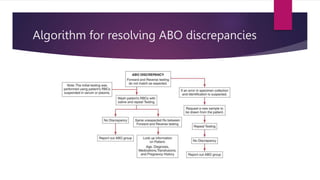
 ABO discrepancies occur when unexpected reactions are obtained in the forward
and/or reverse grouping .
 These can be due to problems with the patient’s serum (reverse grouping) ,
problems with the patient’s RBCs (forward grouping) , or problems with both the
serum and cells .
 The unexpected reactions may be due to an extra positive reaction , a weak
reaction or missing reaction in the forward and reverse grouping .
 All ABO discrepancies must be resolved prior to reporting a patient or donor ABO
group .
Technical errors resulting in ABO
discrepancies
•Clerical errors or incorrect recording of results
•Incorrect or inadequate identification of blood specimens , test tubes or slides
• Cell suspension either too heavy or too light
• A mix-up in samples
• Missed observation of hemolysis
• Failure to add reagents
Technical errors resulting in ABO
discrepancies
• Failure to add sample
• Failure to follow manufacturer’s instructions
• Uncalibrated centrifuge
• Over centrifugation or under centrifugation
• Contaminated reagents
• Warming during centrifugation
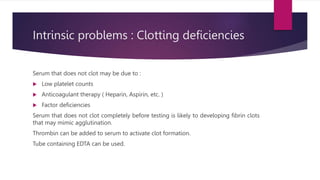
Intrinsic problems : Clotting deficiencies
Serum that does not clot may be due to :
 Low platelet counts
 Anticoagulant therapy ( Heparin, Aspirin, etc. )
 Factor deficiencies
Serum that does not clot completely before testing is likely to developing fibrin clots
that may mimic agglutination.
Thrombin can be added to serum to activate clot formation.
Tube containing EDTA can be used.
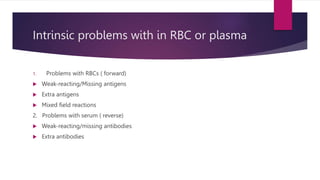
Intrinsic problems with in RBC or plasma
1. Problems with RBCs ( forward)
 Weak-reacting/Missing antigens
 Extra antigens
 Mixed field reactions
2. Problems with serum ( reverse)
 Weak-reacting/missing antibodies
 Extra antibodies
Categories of ABO Discrepancies
ABO discrepancies may be arbitrarily divided into four major categories
 Group I
 Group II
 Group III and
 Group IV discrepancies
Group I Discrepancies
Group I discrepancies are associated with unexpected reactions in the reverse
grouping due to weakly reacting or missing antibodies.
Common populations with discrepancies in this group are:
• Newborns (ABO antibody production is not detectable until 3 to 6 months of age)
• Elderly patients (production of ABO antibodies is depressed)
• Patients with a leukemia (e.g., chronic lymphocytic leukemia) or lymphoma (e.g.
malignant lymphoma) demonstrating hypogammaglobulinemia
Group I Discrepancies
•Patients using immunosuppressive drugs that yield hypogammaglobulinemia
•Patients with congenital or acquired agammaglobulinemia or immunodeficiency
diseases
•Patients with bone marrow or hematopoietic progenitor stem cell (HPC) transplants
(patients develop hypogammaglobulinemia from therapy and start producing a
different RBC population from that of the transplanted bone marrow)
•Patients whose existing ABO antibodies may have been diluted by plasma
transfusion or exchange transfusion
• ABO subgroups
Group II Discrepancies
Group II discrepancies are associated with unexpected reactions in the forward
grouping due to weakly reacting or missing antigens .
The following are some of the causes of discrepancies in this group :
• Subgroups of A or B may be present .
• Leukemias may yield weakened A or B antigens , and Hodgkin’s disease has been
reported in some cases to mimic the depression of antigens found in leukemia .
• The “acquired B” phenomenon will show weak reactions with anti-B antisera and is
most often associated with diseases of the digestive tract (e.g. cancer of the colon ) .
Group III Discrepancies
These discrepancies between forward and reverse groupings are caused by protein or
plasma abnormalities and result in rouleaux formation or pseudo-agglutination ,
attributable to the following :
• Elevated levels of globulin from certain disease states , such as multiple myeloma ,
Waldenström’s macroglobulinemia and certain moderately advanced cases of
Hodgkin’s lymphomas
• Elevated levels of fibrinogen
• Plasma expanders , such as dextran
• Wharton’s jelly in cord blood samples
Group IV Discrepancies
These discrepancies between forward and reverse groupings are due to miscellaneous
problems that have the following causes:
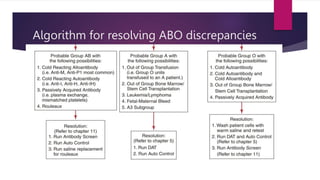
• Cold reactive autoantibodies in which RBCs are so heavily coated with antibody that
they spontaneously agglutinate , independent of the specificity of the reagent
antibody .
• Circulating RBCs of more than one ABO group due to RBC transfusion or
marrow/stem cell transplant
• Unexpected ABO ISO AGGLUTININS
• Uexpected non ABO ALLOANTIBODIES
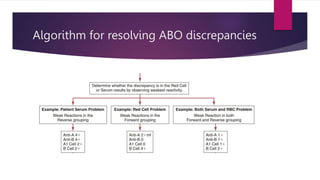
Finding the problem…
 Forward type tests for the antigen (red cell)
 Reverse type tests for the antibody (serum)
 Identify what the patient types as in both Forward & Reverse Groupings
 Is there a weaker than usual reaction?
 Is it a missing, weak, or extra reaction??
Resolving ABO discrepancies
Get the patient’s history :
 age
 Recent transplant
 Recent transfusion
 Patient medications
Resolving weak or missing antibodies
 Place serum testing for 45 minutes (RT) to enhance antibody reactions
 If negative , place serum testing at 4°C for 45 minutes with autologous control (
a.k.a. Auto control, AC )
 This is called a “mini-cold” panel and should enhance the reactivity of the
antibodies
Reverse grouping : extra antibodies
 Cold antibodies (alloantibodies or autoantibodies ) : Cold antibodies may include
anti-I, H, M, N, P, Lewis
 Anti-A1 in an A2 or A2B individual
Cold reacting antibodies cause agglutination with red cells at room temperature and
below.
The auto control will be positive.
Resolution
 warming tube to 37° and washing red cells can disperse agglutination
 breaking the IgM bonds with 2-mercapto ethanol will also disperse cells
Rouleaux
Can cause both extra antigens and extra antibodies “stack of coins” appearance
May falsely appear as agglutination due to the increase of serum proteins (globulins)
Associated with:
 Multiple myeloma
 Waldenstrom’s macroglobulinemia
 Hydroxyethyl starch (HES), dextran etc.
Resolving rouleaux
 If the forward grouping is affected, wash cells to remove protein and repeat test
 If the reverse grouping is affected, perform saline replacement technique
 Serum is removed and replaced by an equal volume of saline
(saline disperses cells)
 Cells (reagent) and serum (patient) centrifuged to allow antigen and antibody to
react
 Mixed , centrifuged and re-examined for agglutination (macro and micro)
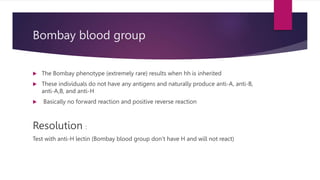
Bombay blood group
 The Bombay phenotype (extremely rare) results when hh is inherited
 These individuals do not have any antigens and naturally produce anti-A, anti-B,
anti-A,B, and anti-H
 Basically no forward reaction and positive reverse reaction
Resolution :
Test with anti-H lectin (Bombay blood group don’t have H and will not react)
Algorithm for resolving ABO discrepancies
References
1.D. M . Harmening
2.Dacie and Lewis practical hematology
Thank you

ABO Discrepancies

  • 1.
    ABO Discrepancies Dr. AjitKumar Singh (MD Laboratory Medicine) PGT 1st year Moderator Dr. Rathindra Nath Biswas M.B.B.S., M.D ( Transfusion Medicine ) Assistant Professor Department Of Laboratory Medicine CHITTRANJAN NATIONAL CANCER INSTITUTE , KOLKATA
  • 2.
    Introduction  ABO discrepanciesoccur when unexpected reactions are obtained in the forward and/or reverse grouping .  These can be due to problems with the patient’s serum (reverse grouping) , problems with the patient’s RBCs (forward grouping) , or problems with both the serum and cells .  The unexpected reactions may be due to an extra positive reaction , a weak reaction or missing reaction in the forward and reverse grouping .  All ABO discrepancies must be resolved prior to reporting a patient or donor ABO group .
  • 3.
    Technical errors resultingin ABO discrepancies •Clerical errors or incorrect recording of results •Incorrect or inadequate identification of blood specimens , test tubes or slides • Cell suspension either too heavy or too light • A mix-up in samples • Missed observation of hemolysis • Failure to add reagents
  • 4.
    Technical errors resultingin ABO discrepancies • Failure to add sample • Failure to follow manufacturer’s instructions • Uncalibrated centrifuge • Over centrifugation or under centrifugation • Contaminated reagents • Warming during centrifugation
  • 6.
    Intrinsic problems :Clotting deficiencies Serum that does not clot may be due to :  Low platelet counts  Anticoagulant therapy ( Heparin, Aspirin, etc. )  Factor deficiencies Serum that does not clot completely before testing is likely to developing fibrin clots that may mimic agglutination. Thrombin can be added to serum to activate clot formation. Tube containing EDTA can be used.
  • 7.
    Intrinsic problems within RBC or plasma 1. Problems with RBCs ( forward)  Weak-reacting/Missing antigens  Extra antigens  Mixed field reactions 2. Problems with serum ( reverse)  Weak-reacting/missing antibodies  Extra antibodies
  • 8.
    Categories of ABODiscrepancies ABO discrepancies may be arbitrarily divided into four major categories  Group I  Group II  Group III and  Group IV discrepancies
  • 9.
    Group I Discrepancies GroupI discrepancies are associated with unexpected reactions in the reverse grouping due to weakly reacting or missing antibodies. Common populations with discrepancies in this group are: • Newborns (ABO antibody production is not detectable until 3 to 6 months of age) • Elderly patients (production of ABO antibodies is depressed) • Patients with a leukemia (e.g., chronic lymphocytic leukemia) or lymphoma (e.g. malignant lymphoma) demonstrating hypogammaglobulinemia
  • 10.
    Group I Discrepancies •Patientsusing immunosuppressive drugs that yield hypogammaglobulinemia •Patients with congenital or acquired agammaglobulinemia or immunodeficiency diseases •Patients with bone marrow or hematopoietic progenitor stem cell (HPC) transplants (patients develop hypogammaglobulinemia from therapy and start producing a different RBC population from that of the transplanted bone marrow) •Patients whose existing ABO antibodies may have been diluted by plasma transfusion or exchange transfusion • ABO subgroups
  • 11.
    Group II Discrepancies GroupII discrepancies are associated with unexpected reactions in the forward grouping due to weakly reacting or missing antigens . The following are some of the causes of discrepancies in this group : • Subgroups of A or B may be present . • Leukemias may yield weakened A or B antigens , and Hodgkin’s disease has been reported in some cases to mimic the depression of antigens found in leukemia . • The “acquired B” phenomenon will show weak reactions with anti-B antisera and is most often associated with diseases of the digestive tract (e.g. cancer of the colon ) .
  • 12.
    Group III Discrepancies Thesediscrepancies between forward and reverse groupings are caused by protein or plasma abnormalities and result in rouleaux formation or pseudo-agglutination , attributable to the following : • Elevated levels of globulin from certain disease states , such as multiple myeloma , Waldenström’s macroglobulinemia and certain moderately advanced cases of Hodgkin’s lymphomas • Elevated levels of fibrinogen • Plasma expanders , such as dextran • Wharton’s jelly in cord blood samples
  • 13.
    Group IV Discrepancies Thesediscrepancies between forward and reverse groupings are due to miscellaneous problems that have the following causes: • Cold reactive autoantibodies in which RBCs are so heavily coated with antibody that they spontaneously agglutinate , independent of the specificity of the reagent antibody . • Circulating RBCs of more than one ABO group due to RBC transfusion or marrow/stem cell transplant • Unexpected ABO ISO AGGLUTININS • Uexpected non ABO ALLOANTIBODIES
  • 14.
    Finding the problem… Forward type tests for the antigen (red cell)  Reverse type tests for the antibody (serum)  Identify what the patient types as in both Forward & Reverse Groupings  Is there a weaker than usual reaction?  Is it a missing, weak, or extra reaction??
  • 15.
    Resolving ABO discrepancies Getthe patient’s history :  age  Recent transplant  Recent transfusion  Patient medications
  • 16.
    Resolving weak ormissing antibodies  Place serum testing for 45 minutes (RT) to enhance antibody reactions  If negative , place serum testing at 4°C for 45 minutes with autologous control ( a.k.a. Auto control, AC )  This is called a “mini-cold” panel and should enhance the reactivity of the antibodies
  • 17.
    Reverse grouping :extra antibodies  Cold antibodies (alloantibodies or autoantibodies ) : Cold antibodies may include anti-I, H, M, N, P, Lewis  Anti-A1 in an A2 or A2B individual Cold reacting antibodies cause agglutination with red cells at room temperature and below. The auto control will be positive.
  • 18.
    Resolution  warming tubeto 37° and washing red cells can disperse agglutination  breaking the IgM bonds with 2-mercapto ethanol will also disperse cells
  • 19.
    Rouleaux Can cause bothextra antigens and extra antibodies “stack of coins” appearance May falsely appear as agglutination due to the increase of serum proteins (globulins) Associated with:  Multiple myeloma  Waldenstrom’s macroglobulinemia  Hydroxyethyl starch (HES), dextran etc.
  • 20.
    Resolving rouleaux  Ifthe forward grouping is affected, wash cells to remove protein and repeat test  If the reverse grouping is affected, perform saline replacement technique  Serum is removed and replaced by an equal volume of saline (saline disperses cells)  Cells (reagent) and serum (patient) centrifuged to allow antigen and antibody to react  Mixed , centrifuged and re-examined for agglutination (macro and micro)
  • 21.
    Bombay blood group The Bombay phenotype (extremely rare) results when hh is inherited  These individuals do not have any antigens and naturally produce anti-A, anti-B, anti-A,B, and anti-H  Basically no forward reaction and positive reverse reaction Resolution : Test with anti-H lectin (Bombay blood group don’t have H and will not react)
  • 22.
    Algorithm for resolvingABO discrepancies
  • 23.
    Algorithm for resolvingABO discrepancies
  • 24.
    Algorithm for resolvingABO discrepancies
  • 25.
    References 1.D. M .Harmening 2.Dacie and Lewis practical hematology Thank you