Hemolytic Transfusion
Reaction Work up
Dr R Amita
Assistant Professor
Dept of Transfusion Medicine
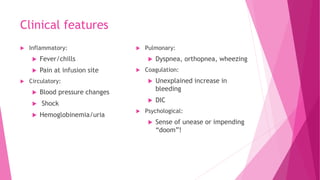
Clinical features
 Inflammatory:
 Fever/chills
 Pain at infusion site
 Circulatory:
 Blood pressure changes
 Shock
 Hemoglobinemia/uria
 Pulmonary:
 Dyspnea, orthopnea, wheezing
 Coagulation:
 Unexplained increase in
bleeding
 DIC
 Psychological:
 Sense of unease or impending
“doom”!
 Assume all suspected reactions are hemolytic, and
work to disprove your assumption
 A high index of suspicion is much better than low
 You will be wrong in your assumption almost every
time,
 But the one time that you are right, will be life-
saving!
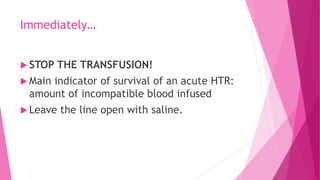
Immediately…
 STOP THE TRANSFUSION!
 Main indicator of survival of an acute HTR:
amount of incompatible blood infused
 Leave the line open with saline.
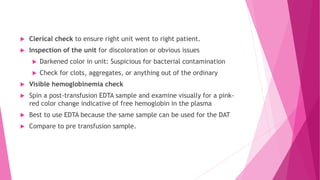
 Clerical check to ensure right unit went to right patient.
 Inspection of the unit for discoloration or obvious issues
 Darkened color in unit: Suspicious for bacterial contamination
 Check for clots, aggregates, or anything out of the ordinary
 Visible hemoglobinemia check
 Spin a post-transfusion EDTA sample and examine visually for a pink-
red color change indicative of free hemoglobin in the plasma
 Best to use EDTA because the same sample can be used for the DAT
 Compare to pre transfusion sample.
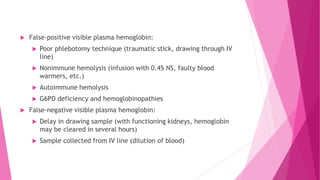
 False-positive visible plasma hemoglobin:
 Poor phlebotomy technique (traumatic stick, drawing through IV
line)
 Nonimmune hemolysis (infusion with 0.45 NS, faulty blood
warmers, etc.)
 Autoimmune hemolysis
 G6PD deficiency and hemoglobinopathies
 False-negative visible plasma hemoglobin:
 Delay in drawing sample (with functioning kidneys, hemoglobin
may be cleared in several hours)
 Sample collected from IV line (dilution of blood)
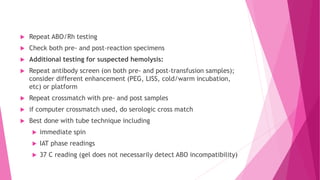
 Repeat ABO/Rh testing
 Check both pre- and post-reaction specimens
 Additional testing for suspected hemolysis:
 Repeat antibody screen (on both pre- and post-transfusion samples);
consider different enhancement (PEG, LISS, cold/warm incubation,
etc) or platform
 Repeat crossmatch with pre- and post samples
 if computer crossmatch used, do serologic cross match
 Best done with tube technique including
 immediate spin
 IAT phase readings
 37 C reading (gel does not necessarily detect ABO incompatibility)
DAT
 Demonstrates coating of RBCs with antibody and/or complement in-
vivo
 Most commonly done with polyspecific method (IgG + C3d)
 If positive, must compare to pretransfusion DAT
 Positive DAT does not prove an acute hemolytic reaction
 Nonspecific positives in hospitalized patients (20%),
 Autoantibodies, drugs, passive administration of other things like
RhIG or IVIG
 A negative DAT does not disprove an acute hemolytic reaction
 If donor RBCs are completely destroyed by brisk hemolysis, DAT
will be negative
 Elution studies if DAT is positive to determine specificity of the antibody
 Serum Haptoglobin
 Haptoglobin binds to free hemoglobin molecules, facilitating their
clearance from the circulation by monocytes and macrophages in the RE
system
 This interaction prevents iron from escaping through the kidneys
 Levels decrease sharply in acute intravascular hemolysis
 Long turnaround time and acute phase reaction make for limited
usefulness in acute setting.
 Direct and indirect bilirubin
 Both will rise quickly, peak in less than 10 hours, may be normal within 24
hours
 Lactate dehydrogenase (LDH)
 LDH is abundant in RBCs (especially LDH 1 and LDH2 isoenzymes)
 Not specific for intravascular hemolysis (+/- in extravascular, too)
 Urine hemoglobin
 Not as sensitive or as fast as hemoglobinemia for intravascular
hemolysis
 Remember that hematuria is not same as hemoglobinuria!
 Blood product bag sent for culture if contamination is suspected or if
any of the following clinical indicators are present:
 shock
 hypertensive (systolic rises > 30mm Hg)
 hypotensive (systolic falls > 30mm Hg)
 fever (2ºC or 3.5ºF rise in temperature)
 rigors (shaking chills)
 tachycardia (heart rate is > 120/min, or rises > 40/min above pre-
transfusion rate).
 Both patient and product must be evaluated
 Patient: Blood cultures; both aerobic and anaerobic
 Consider culture of all intravenous fluids running at the time of
reaction if clinically suspicious of sepsis
 Product: Gram stain and culture of actual residual product in the
bag (don’t culture a segment)
Classification of reactions
 Based on the timing of the reaction
 Acute : during or < 24 hrs after transfusion,
 Delayed : > 24 hrs after transfusion
Acute hemolytic transfusion reactions
(AHTRs)
 Symptoms:
 Fever and chills: Most common presenting symptom (> 80%)
 Back or infusion site pain
 Hypotension/shock
 Hemoglobinuria (may be first indication of hemolysis in anesthetized patients)
 DIC/increased bleeding (also important in anesthetized patients)
 Sense of “impending doom”
 Lab findings
 Hemoglobinemia (pink or red serum/plasma); lasts several hours in those with
adequate renal function
 Hemoglobinuria (typically clears by the end of one day)
 Positive DAT (unless all donor cells destroyed); may be “mixed field
 Elevated indirect and direct bilirubin
 Peripheral smear:
 Schistocytes: Intravascular hemolysis
 Spherocytes: Extravascular hemolysis
 Pathophysiology
 ABO antibodies fix complement well, leads to membrane attack complexes
and rapid RBC lysis
 Other antibodies (especially Kidd) may also fix complement and lyse RBCs
 Seen much less commonly with incompatible donor plasma (e.g., platelet
transfusions from group O donor with high-titer anti-A to group A recipient)
 Hemolysis leads to a complex chain of events, including:
 Release of free HGB and HGB-free RBC stroma into circulation
 Stimulation of intrinsic coag pathway and bradykinin via Ag-Ab complexes
 C3a and C5a generation (“anaphylatoxins”)
 Production of several very important cytokines:
 • Tumor necrosis factor (TNF-α)
 • Interleukin-1β (IL-1β)
 • Interleukin-6 (IL-6)
 • Interleukin-8 (IL-8)
 Inflammation: TNF-α, IL-1β, and IL-6 strongly promote fever
 Coagulation: Activation of intrinsic pathway by Ag-Ab complex interaction
with factor XII
 Circulatory consequences:
 Increased C3a/5a, IL-1β, and TNF-α stimulate increased nitric oxide (NO)
levels, which leads to systemic vasodilation,
 Bradykinin promotes transient systemic hypotension
 Renal consequences:
 Sympathetic response to hypotension leads to renal vasoconstriction
 Free hemoglobin scavenges renal NO, promoting vasoconstriction
 Renal microthrombi from diffuse coagulation also decrease renal blood
flow
 Hemoglobin-free RBC stroma also damages renal tubules directly
 All of above contribute to risk for acute tubular necrosis, with resultant
oliguric renal failure in about 1/3 of confirmed acute HTRs
 Respiratory consequences:
 Anaphylatoxins promote bronchoconstriction, with resultant
wheezing/dyspnea
 Aggressive hydration during resuscitation gives pulmonary edema risk
 Extravascular hemolysis (e.g., Rh/Kell/Duffy, etc.) is usually but not always
less severe due to lack of systemic complement and cytokine activation
 Treatment
 Hydration and diuresis are critical early components for hypotension
treatment and renal function preservation
 Maintain urine output > 1 mL/Kg/hr with saline +/- furosemide
 Prevention possibilities
 Training and careful attention to phlebotomy, labeling, issue, and
administration
 two separate ABO/Rh types before transfusion
 Advanced methods (RFID, bar codes, etc) will likely be helpful in future
Delayed hemolytic transfusion reactions
(DHTRs)
 Hemolysis occurring at least 24 hours after, but less than 28 days after
transfusion (CDC definition)
 Pathophysiologic possibilities
 1) Anamnestic response
 Patient exposed to non-ABO red cell antigen not present on own RBCs
 Antibody is formed but fades from detection over time (if patient is not
retested after transfusion antibody might never be known) Patient is re-
exposed to antigen in a future transfusion.
 Eg: Kidd, Duffy, Kell antibodies
 Classically leads to extravascular hemolysis
 IgG antibodies coat red cells and lead to their removal in the liver/spleen
 Signs/symptoms
 Often completely asymptomatic
 Fever and anemia of unknown origin
 Mild jaundice/scleral icterus may be seen
 Lab findings
 Icteric serum
 DAT positive (classically “mixed field”)
 Anemia
 Newly identified red cell antibody
 Spherocytes on peripheral smear
 Elevated LDH and indirect and direct bilirubin
 Treatment
 As for AHTR if severe and intravascular
 Often no treatment necessary

Hemolytic Transfusion reaction work up

  • 1.
    Hemolytic Transfusion Reaction Workup Dr R Amita Assistant Professor Dept of Transfusion Medicine
  • 2.
    Clinical features  Inflammatory: Fever/chills  Pain at infusion site  Circulatory:  Blood pressure changes  Shock  Hemoglobinemia/uria  Pulmonary:  Dyspnea, orthopnea, wheezing  Coagulation:  Unexplained increase in bleeding  DIC  Psychological:  Sense of unease or impending “doom”!
  • 3.
     Assume allsuspected reactions are hemolytic, and work to disprove your assumption  A high index of suspicion is much better than low  You will be wrong in your assumption almost every time,  But the one time that you are right, will be life- saving!
  • 4.
    Immediately…  STOP THETRANSFUSION!  Main indicator of survival of an acute HTR: amount of incompatible blood infused  Leave the line open with saline.
  • 5.
     Clerical checkto ensure right unit went to right patient.  Inspection of the unit for discoloration or obvious issues  Darkened color in unit: Suspicious for bacterial contamination  Check for clots, aggregates, or anything out of the ordinary  Visible hemoglobinemia check  Spin a post-transfusion EDTA sample and examine visually for a pink- red color change indicative of free hemoglobin in the plasma  Best to use EDTA because the same sample can be used for the DAT  Compare to pre transfusion sample.
  • 6.
     False-positive visibleplasma hemoglobin:  Poor phlebotomy technique (traumatic stick, drawing through IV line)  Nonimmune hemolysis (infusion with 0.45 NS, faulty blood warmers, etc.)  Autoimmune hemolysis  G6PD deficiency and hemoglobinopathies  False-negative visible plasma hemoglobin:  Delay in drawing sample (with functioning kidneys, hemoglobin may be cleared in several hours)  Sample collected from IV line (dilution of blood)
  • 7.
     Repeat ABO/Rhtesting  Check both pre- and post-reaction specimens  Additional testing for suspected hemolysis:  Repeat antibody screen (on both pre- and post-transfusion samples); consider different enhancement (PEG, LISS, cold/warm incubation, etc) or platform  Repeat crossmatch with pre- and post samples  if computer crossmatch used, do serologic cross match  Best done with tube technique including  immediate spin  IAT phase readings  37 C reading (gel does not necessarily detect ABO incompatibility)
  • 8.
    DAT  Demonstrates coatingof RBCs with antibody and/or complement in- vivo  Most commonly done with polyspecific method (IgG + C3d)  If positive, must compare to pretransfusion DAT  Positive DAT does not prove an acute hemolytic reaction  Nonspecific positives in hospitalized patients (20%),  Autoantibodies, drugs, passive administration of other things like RhIG or IVIG  A negative DAT does not disprove an acute hemolytic reaction  If donor RBCs are completely destroyed by brisk hemolysis, DAT will be negative
  • 9.
     Elution studiesif DAT is positive to determine specificity of the antibody  Serum Haptoglobin  Haptoglobin binds to free hemoglobin molecules, facilitating their clearance from the circulation by monocytes and macrophages in the RE system  This interaction prevents iron from escaping through the kidneys  Levels decrease sharply in acute intravascular hemolysis  Long turnaround time and acute phase reaction make for limited usefulness in acute setting.  Direct and indirect bilirubin  Both will rise quickly, peak in less than 10 hours, may be normal within 24 hours
  • 10.
     Lactate dehydrogenase(LDH)  LDH is abundant in RBCs (especially LDH 1 and LDH2 isoenzymes)  Not specific for intravascular hemolysis (+/- in extravascular, too)  Urine hemoglobin  Not as sensitive or as fast as hemoglobinemia for intravascular hemolysis  Remember that hematuria is not same as hemoglobinuria!
  • 11.
     Blood productbag sent for culture if contamination is suspected or if any of the following clinical indicators are present:  shock  hypertensive (systolic rises > 30mm Hg)  hypotensive (systolic falls > 30mm Hg)  fever (2ºC or 3.5ºF rise in temperature)  rigors (shaking chills)  tachycardia (heart rate is > 120/min, or rises > 40/min above pre- transfusion rate).  Both patient and product must be evaluated  Patient: Blood cultures; both aerobic and anaerobic  Consider culture of all intravenous fluids running at the time of reaction if clinically suspicious of sepsis  Product: Gram stain and culture of actual residual product in the bag (don’t culture a segment)
  • 12.
    Classification of reactions Based on the timing of the reaction  Acute : during or < 24 hrs after transfusion,  Delayed : > 24 hrs after transfusion
  • 13.
    Acute hemolytic transfusionreactions (AHTRs)  Symptoms:  Fever and chills: Most common presenting symptom (> 80%)  Back or infusion site pain  Hypotension/shock  Hemoglobinuria (may be first indication of hemolysis in anesthetized patients)  DIC/increased bleeding (also important in anesthetized patients)  Sense of “impending doom”  Lab findings  Hemoglobinemia (pink or red serum/plasma); lasts several hours in those with adequate renal function  Hemoglobinuria (typically clears by the end of one day)  Positive DAT (unless all donor cells destroyed); may be “mixed field
  • 14.
     Elevated indirectand direct bilirubin  Peripheral smear:  Schistocytes: Intravascular hemolysis  Spherocytes: Extravascular hemolysis  Pathophysiology  ABO antibodies fix complement well, leads to membrane attack complexes and rapid RBC lysis  Other antibodies (especially Kidd) may also fix complement and lyse RBCs  Seen much less commonly with incompatible donor plasma (e.g., platelet transfusions from group O donor with high-titer anti-A to group A recipient)
  • 15.
     Hemolysis leadsto a complex chain of events, including:  Release of free HGB and HGB-free RBC stroma into circulation  Stimulation of intrinsic coag pathway and bradykinin via Ag-Ab complexes  C3a and C5a generation (“anaphylatoxins”)  Production of several very important cytokines:  • Tumor necrosis factor (TNF-α)  • Interleukin-1β (IL-1β)  • Interleukin-6 (IL-6)  • Interleukin-8 (IL-8)
  • 16.
     Inflammation: TNF-α,IL-1β, and IL-6 strongly promote fever  Coagulation: Activation of intrinsic pathway by Ag-Ab complex interaction with factor XII  Circulatory consequences:  Increased C3a/5a, IL-1β, and TNF-α stimulate increased nitric oxide (NO) levels, which leads to systemic vasodilation,  Bradykinin promotes transient systemic hypotension  Renal consequences:  Sympathetic response to hypotension leads to renal vasoconstriction  Free hemoglobin scavenges renal NO, promoting vasoconstriction  Renal microthrombi from diffuse coagulation also decrease renal blood flow  Hemoglobin-free RBC stroma also damages renal tubules directly  All of above contribute to risk for acute tubular necrosis, with resultant oliguric renal failure in about 1/3 of confirmed acute HTRs
  • 17.
     Respiratory consequences: Anaphylatoxins promote bronchoconstriction, with resultant wheezing/dyspnea  Aggressive hydration during resuscitation gives pulmonary edema risk  Extravascular hemolysis (e.g., Rh/Kell/Duffy, etc.) is usually but not always less severe due to lack of systemic complement and cytokine activation  Treatment  Hydration and diuresis are critical early components for hypotension treatment and renal function preservation  Maintain urine output > 1 mL/Kg/hr with saline +/- furosemide  Prevention possibilities  Training and careful attention to phlebotomy, labeling, issue, and administration  two separate ABO/Rh types before transfusion  Advanced methods (RFID, bar codes, etc) will likely be helpful in future
  • 18.
    Delayed hemolytic transfusionreactions (DHTRs)  Hemolysis occurring at least 24 hours after, but less than 28 days after transfusion (CDC definition)  Pathophysiologic possibilities  1) Anamnestic response  Patient exposed to non-ABO red cell antigen not present on own RBCs  Antibody is formed but fades from detection over time (if patient is not retested after transfusion antibody might never be known) Patient is re- exposed to antigen in a future transfusion.  Eg: Kidd, Duffy, Kell antibodies  Classically leads to extravascular hemolysis  IgG antibodies coat red cells and lead to their removal in the liver/spleen
  • 19.
     Signs/symptoms  Oftencompletely asymptomatic  Fever and anemia of unknown origin  Mild jaundice/scleral icterus may be seen  Lab findings  Icteric serum  DAT positive (classically “mixed field”)  Anemia  Newly identified red cell antibody  Spherocytes on peripheral smear  Elevated LDH and indirect and direct bilirubin  Treatment  As for AHTR if severe and intravascular  Often no treatment necessary