Dr. Shahida Baloch
Compatibility testing
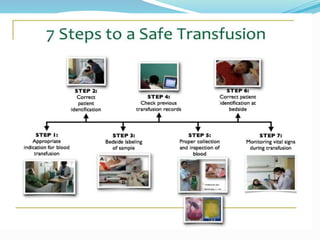
1. Correct recipient identification
 Blood request form and recipient sample
 Clerical check every patient every time computerized or
manual
 To detect irregular antibodies in the recipient serum that are
directed against the donor’s cells.
2. To detect errors in ABO grouping.
 3. To detect errors in labeling, recording, or identifying
donor’s or recipient’s samples.
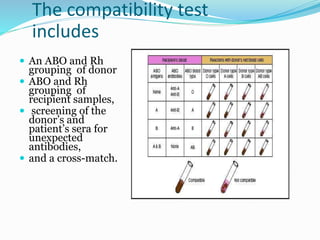
The compatibility test
includes
 An ABO and Rh
grouping of donor
 ABO and Rh
grouping of
recipient samples,
 screening of the
donor’s and
patient’s sera for
unexpected
antibodies,
 and a cross-match.
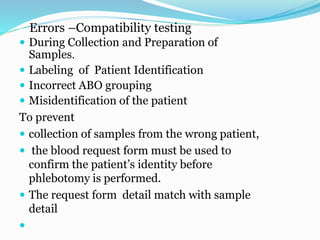
Errors –Compatibility testing
 During Collection and Preparation of
Samples.
 Labeling of Patient Identification
 Incorrect ABO grouping
 Misidentification of the patient
To prevent
 collection of samples from the wrong patient,
 the blood request form must be used to
confirm the patient’s identity before
phlebotomy is performed.
 The request form detail match with sample
detail

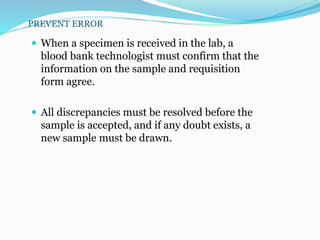
PREVENT ERROR
 When a specimen is received in the lab, a
blood bank technologist must confirm that the
information on the sample and requisition
form agree.
 All discrepancies must be resolved before the
sample is accepted, and if any doubt exists, a
new sample must be drawn.
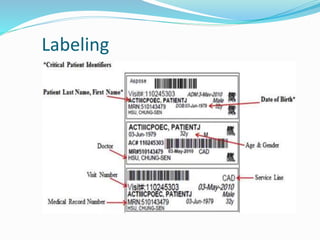
Labeling
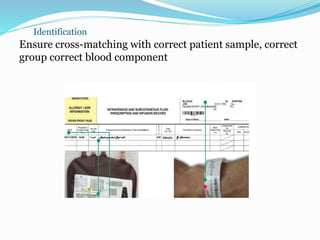
Identification
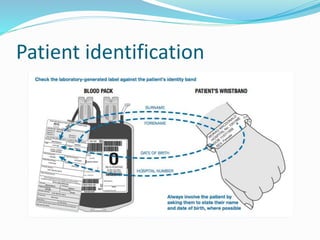
Ensure cross-matching with correct patient sample, correct
group correct blood component
Patient identification
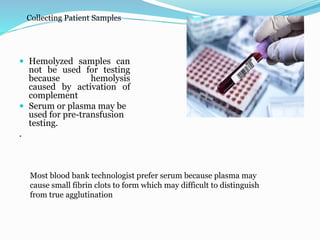
Collecting Patient Samples
 Hemolyzed samples can
not be used for testing
because hemolysis
caused by activation of
complement
 Serum or plasma may be
used for pre-transfusion
testing.
.
Most blood bank technologist prefer serum because plasma may
cause small fibrin clots to form which may difficult to distinguish
from true agglutination
Donor Samples.
 Donor testing samples must be taken when the full
donor unit is drawn.
Donor information and medical history card, the
pilot samples for processing, and the collection bag
must all be labeled with the same unique number
code (Donor Number) before starting the
phlebotomy, and the numbers must be verified
again immediately after filling.
 Donor and recipient samples must be stored
for a minimum of 7 days following transfusion.
 The samples should be stoppered and
refrigerated at 2-6°C, correctly labeled, and
adequate in volume so that they can be re-
evaluated if the patient experiences an adverse
response to the transfusion.
Selection of Appropriate Donor Units.
Blood and blood components of the patient’s own
ABO and Rh group should be selected for
transfusion.
When blood and blood components of the patient’s
type are unavailable or when some other reason
precludes their use, units selected must lack any
Antigen against which the patient has a significant
Antibody.
Selection of Appropriate Donor Units.
 When transfusion of an ABO group different
from the recipient must be given, packed red
cells must be used rather than whole blood
which contains plasma Abs that are
incompatible with the patient’s red blood cells.
 Group O packed red blood cells can be safely
used for all patients, however, conservation of
a limited supply of group O blood should
dictate its use for patients of other AB types
only in special circumstances.
Selection of Appropriate Donor Units.
 Rh-negative blood can be given to Rh-positive
patients, however, good inventory
management again should conserve this
limited resource for use in Rh-neg recipients.
 If Rh-neg units is near expiration, the unit
should be given rather than wasted.
 Rh-pos blood should not be given to Rh-
neg women of childbearing age.
 Transfusion of Rh-neg male patients and
female patients beyond menopause with
Rh-pos blood is acceptable as long as no
performed anti-D is demonstrable in the
sera
Compatibility Testing Protocols.
Testing of the donor sample.
 ABO and Rh grouping (including a test for
weak D) and tests intended to prevent disease
transmission must be performed on a sample
of blood taken at the time of collection of the
unit of blood from the donor.
 A screening test for unexpected antibodies to
red blood cell Antigens is required on samples
from donors.
 To confirm the ABO cell grouping on all
units and Rh grouping on units labeled Rh-
neg.
Testing of the patient sample.
 ABO and Rh grouping and Ab screening of the
patient’s serum can be performed in advance
of or at the same time as the cross-match.
 If the patient has had a transfusion or has been
pregnant within the last 3 months or if the
history is unavailable or uncertain, the sample
must be obtained from the patient within 3
days of scheduled transfusion.
Testing of the patient sample.
ABO Grouping.
 Determination of the patient’s correct ABO group
is the most critical pre-transfusion serologic test.
 If the cell and serum grouping results do not agree,
additional testing must be conducted to resolve the
discrepancy.
 If the patient’s ABO group cannot be satisfactory
determined and immediate transfusion is essential,
group O packed red blood cells should be used.
Testing of the patient sample.
Rh Grouping.
 Rh grouping is performed using anti-D blood
grouping serum. Tube or slide tests should be
performed according to the manufacture’s
directions for the reagent, which may or may not
include the use of a suitable diluents control.
 Control must be run in parallel with Rh grouping
tests performed on patient’s samples, to avoid
incorrect designation of Rh neg, patient as Rh
positive.
Testing of the patient sample.
 Direct antiglobulin test (DAT) should be
performed on the patient’s red blood cells to
determine whether uptake of autoantibody,
(alloantibodies, if the patient’s has been
recently transfused) is responsible for the
positive control result.
Testing of the patient sample.
 If the Rh group of the recipient can not be
determined and transfusion is essential, Rh
negative blood should be given.
 The test for Du is unnecessary when testing
transfusion recipients. Individuals typing as Rh
neg in direct testing should receive Rh-Neg
blood and those typing as Rh Pos in direct
testing should receive Rh Pos blood.
 As Du are considered Rh Pos and may receive
Rh pos blood during transfusion.
Testing of the patient sample.
Antibody Screening.
 The patient’s serum or plasma must be tested for
unexpected Antibodies.
 The aim of the Antibody screening test is to detect
as many clinically significant Antibodies as
possible.
 Clinically significant Antibodies refers to
Antibodies that are reactive at 37°C or in the DAT
or both and are known to have caused a
transfusion reaction or unacceptably short survival
of the transfused red blood cells.
Testing of the patient sample.
 Abs Regarded as always being potentially clinically
significant
ABO Rh Kell Duffy Kidd S s U
 Abs that may sometime be clinically Significant
Lea p Lua Lub Cartwright.
 Abs that rarely, if ever, are clinically significant
Leb Chido/Rodgers (Cha/Rha) York, Sd Xg& Bg
Testing of the patient sample.
 Correct ABO grouping results are much more
critical to transfusion safety than Ab screening.
 Most Abs, other than anti-A and anti-B do not
cause severe hemolytic transfusion reactions.
Thus the vast majority of patients would not
suffer grave consequences if transfused with
blood from ABO group compatible donor
without the benefit of Ab screening tests.
Testing of the patient sample.
 Detection of unexpected Abs is important, however, for
the selection of donor red blood cells that are likely to
survive maximally in the patient circulation.
 Weakly reactive Abs that are capable of reacting with
their Ags at 37°C can cause decreased survival of
transfused incompatible red cells.
Testing of the patient sample.
 Because large numbers of Antibody molecules are
present in the patient’s circulation compared with
the number of red cells in a unit of blood,
incompatible donor cells are highly vulnerable to
destruction by patient Abs.
 Antibodies screening offers several advantages
over direct cross-matched testing for detection of
Abs;
 1- Testing is performed using selected group O red
cells that are known to carry optimal
representation of important blood group Antigens.
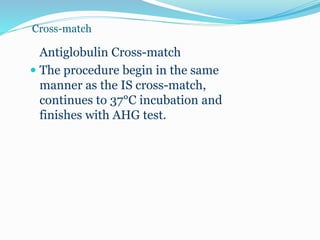
CROSS MATCH
Major and Minor cross-match tests
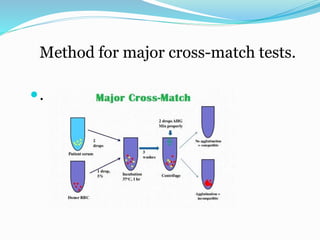
 Major cross-match test, consisting
of mixing the patient’s serum with
donor RBCs.
 Minor cross-match test, consisting
of mixing the donor’s plasma with
patient’s RBCs
 The minor cross-match test has
been completely eliminated in
most blood banks, because donor
samples are screened beforehand
for the more common Abs.
Cross-match
The two main functions of the cross-match test:
1. A final check of ABO compatibility between donor
and patient.
2. detect the presence of an antibody in the
patient’s serum that will react with antigens on
the donor RBCs but that was not detected in the
antibody screening because the corresponding
Antigens was lacking from the screening cell.
Method for major cross-match tests.
.
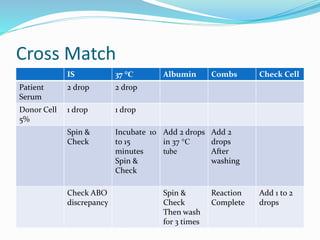
Cross Match
IS 37 °C Albumin Combs Check Cell
Patient
Serum
2 drop 2 drop
Donor Cell
5%
1 drop 1 drop
Spin &
Check
Incubate 10
to 15
minutes
Spin &
Check
Add 2 drops
in 37 °C
tube
Add 2
drops
After
washing
Check ABO
discrepancy
Spin &
Check
Then wash
for 3 times
Reaction
Complete
Add 1 to 2
drops
Cross-match
 In (immediate Spin) (IS)the patient’s serum
with donor cell are centrifuge immediately)
absence of hemolysis or agglutination indicates
compatibility.
 False reaction may be seen in the presence of
other IS reaction. In patient with hyper-
immune ABO Abs, when the procedure is not
performed correctly (delayed in centrifugation
or reading) when rouleauex is observed, or
when infant’s specimens are tested.
Cross-match
Antiglobulin Cross-match
 The procedure begin in the same
manner as the IS cross-match,
continues to 37°C incubation and
finishes with AHG test.
SUMMARY
 Is to provide safe, compatible blood for transfusion to
each individual patient. The steps necessary for safe
transfusion are:
 1. Accurate ABO and Rh typing of the patient.
 2. Accurate ABO and Rh typing of the donor.
 3. Screening tests for antibodies in the donors and
patients serum.
 4. In the presence of patient antibodies, selection of
appropriate units for each patient.
 5. Compatibility Testing - (Major)
 6. Accurate completion of paperwork and labels
Each compatibility test is a unique experiment
in which an unknown (patient) serum and
(donor) red cells are tested for the detection of
unexpected antibodies which are directed
against antigens found on the cells. Negative
results indicate compatibility. This is one of
the most important tests performed by a
transfusion service.
 1. Ensure normal survival of donor red cells.
 Prove that donor and or recipient serum is free of
antibodies. Prevent immunization of the recipient.
 Detect ALL ABO typing errors.
 Detect errors in Rh typing of either recipient or
donor unless the recipient’s serum contains an Rh
antibody.
 Detect ALL error of identification.
 Pre-transfusion testing of the recipient must
include an ABO and Rh typing, antibody screen,
and a cross-match with all donor units.

Compatibility ss

  • 1.
  • 2.
    Compatibility testing 1. Correctrecipient identification  Blood request form and recipient sample  Clerical check every patient every time computerized or manual  To detect irregular antibodies in the recipient serum that are directed against the donor’s cells. 2. To detect errors in ABO grouping.  3. To detect errors in labeling, recording, or identifying donor’s or recipient’s samples.
  • 4.
    The compatibility test includes An ABO and Rh grouping of donor  ABO and Rh grouping of recipient samples,  screening of the donor’s and patient’s sera for unexpected antibodies,  and a cross-match.
  • 6.
    Errors –Compatibility testing During Collection and Preparation of Samples.  Labeling of Patient Identification  Incorrect ABO grouping  Misidentification of the patient To prevent  collection of samples from the wrong patient,  the blood request form must be used to confirm the patient’s identity before phlebotomy is performed.  The request form detail match with sample detail 
  • 7.
    PREVENT ERROR  Whena specimen is received in the lab, a blood bank technologist must confirm that the information on the sample and requisition form agree.  All discrepancies must be resolved before the sample is accepted, and if any doubt exists, a new sample must be drawn.
  • 8.
  • 9.
    Identification Ensure cross-matching withcorrect patient sample, correct group correct blood component
  • 10.
  • 11.
    Collecting Patient Samples Hemolyzed samples can not be used for testing because hemolysis caused by activation of complement  Serum or plasma may be used for pre-transfusion testing. . Most blood bank technologist prefer serum because plasma may cause small fibrin clots to form which may difficult to distinguish from true agglutination
  • 12.
    Donor Samples.  Donortesting samples must be taken when the full donor unit is drawn. Donor information and medical history card, the pilot samples for processing, and the collection bag must all be labeled with the same unique number code (Donor Number) before starting the phlebotomy, and the numbers must be verified again immediately after filling.
  • 13.
     Donor andrecipient samples must be stored for a minimum of 7 days following transfusion.  The samples should be stoppered and refrigerated at 2-6°C, correctly labeled, and adequate in volume so that they can be re- evaluated if the patient experiences an adverse response to the transfusion.
  • 14.
    Selection of AppropriateDonor Units. Blood and blood components of the patient’s own ABO and Rh group should be selected for transfusion. When blood and blood components of the patient’s type are unavailable or when some other reason precludes their use, units selected must lack any Antigen against which the patient has a significant Antibody.
  • 16.
    Selection of AppropriateDonor Units.  When transfusion of an ABO group different from the recipient must be given, packed red cells must be used rather than whole blood which contains plasma Abs that are incompatible with the patient’s red blood cells.  Group O packed red blood cells can be safely used for all patients, however, conservation of a limited supply of group O blood should dictate its use for patients of other AB types only in special circumstances.
  • 17.
    Selection of AppropriateDonor Units.  Rh-negative blood can be given to Rh-positive patients, however, good inventory management again should conserve this limited resource for use in Rh-neg recipients.  If Rh-neg units is near expiration, the unit should be given rather than wasted.  Rh-pos blood should not be given to Rh- neg women of childbearing age.  Transfusion of Rh-neg male patients and female patients beyond menopause with Rh-pos blood is acceptable as long as no performed anti-D is demonstrable in the sera
  • 18.
    Compatibility Testing Protocols. Testingof the donor sample.  ABO and Rh grouping (including a test for weak D) and tests intended to prevent disease transmission must be performed on a sample of blood taken at the time of collection of the unit of blood from the donor.  A screening test for unexpected antibodies to red blood cell Antigens is required on samples from donors.  To confirm the ABO cell grouping on all units and Rh grouping on units labeled Rh- neg.
  • 19.
    Testing of thepatient sample.  ABO and Rh grouping and Ab screening of the patient’s serum can be performed in advance of or at the same time as the cross-match.  If the patient has had a transfusion or has been pregnant within the last 3 months or if the history is unavailable or uncertain, the sample must be obtained from the patient within 3 days of scheduled transfusion.
  • 20.
    Testing of thepatient sample. ABO Grouping.  Determination of the patient’s correct ABO group is the most critical pre-transfusion serologic test.  If the cell and serum grouping results do not agree, additional testing must be conducted to resolve the discrepancy.  If the patient’s ABO group cannot be satisfactory determined and immediate transfusion is essential, group O packed red blood cells should be used.
  • 21.
    Testing of thepatient sample. Rh Grouping.  Rh grouping is performed using anti-D blood grouping serum. Tube or slide tests should be performed according to the manufacture’s directions for the reagent, which may or may not include the use of a suitable diluents control.  Control must be run in parallel with Rh grouping tests performed on patient’s samples, to avoid incorrect designation of Rh neg, patient as Rh positive.
  • 22.
    Testing of thepatient sample.  Direct antiglobulin test (DAT) should be performed on the patient’s red blood cells to determine whether uptake of autoantibody, (alloantibodies, if the patient’s has been recently transfused) is responsible for the positive control result.
  • 23.
    Testing of thepatient sample.  If the Rh group of the recipient can not be determined and transfusion is essential, Rh negative blood should be given.  The test for Du is unnecessary when testing transfusion recipients. Individuals typing as Rh neg in direct testing should receive Rh-Neg blood and those typing as Rh Pos in direct testing should receive Rh Pos blood.  As Du are considered Rh Pos and may receive Rh pos blood during transfusion.
  • 24.
    Testing of thepatient sample. Antibody Screening.  The patient’s serum or plasma must be tested for unexpected Antibodies.  The aim of the Antibody screening test is to detect as many clinically significant Antibodies as possible.  Clinically significant Antibodies refers to Antibodies that are reactive at 37°C or in the DAT or both and are known to have caused a transfusion reaction or unacceptably short survival of the transfused red blood cells.
  • 25.
    Testing of thepatient sample.  Abs Regarded as always being potentially clinically significant ABO Rh Kell Duffy Kidd S s U  Abs that may sometime be clinically Significant Lea p Lua Lub Cartwright.  Abs that rarely, if ever, are clinically significant Leb Chido/Rodgers (Cha/Rha) York, Sd Xg& Bg
  • 26.
    Testing of thepatient sample.  Correct ABO grouping results are much more critical to transfusion safety than Ab screening.  Most Abs, other than anti-A and anti-B do not cause severe hemolytic transfusion reactions. Thus the vast majority of patients would not suffer grave consequences if transfused with blood from ABO group compatible donor without the benefit of Ab screening tests.
  • 27.
    Testing of thepatient sample.  Detection of unexpected Abs is important, however, for the selection of donor red blood cells that are likely to survive maximally in the patient circulation.  Weakly reactive Abs that are capable of reacting with their Ags at 37°C can cause decreased survival of transfused incompatible red cells.
  • 28.
    Testing of thepatient sample.  Because large numbers of Antibody molecules are present in the patient’s circulation compared with the number of red cells in a unit of blood, incompatible donor cells are highly vulnerable to destruction by patient Abs.  Antibodies screening offers several advantages over direct cross-matched testing for detection of Abs;  1- Testing is performed using selected group O red cells that are known to carry optimal representation of important blood group Antigens.
  • 29.
    CROSS MATCH Major andMinor cross-match tests  Major cross-match test, consisting of mixing the patient’s serum with donor RBCs.  Minor cross-match test, consisting of mixing the donor’s plasma with patient’s RBCs  The minor cross-match test has been completely eliminated in most blood banks, because donor samples are screened beforehand for the more common Abs.
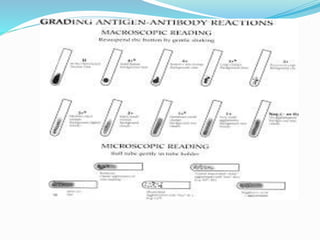
  • 30.
    Cross-match The two mainfunctions of the cross-match test: 1. A final check of ABO compatibility between donor and patient. 2. detect the presence of an antibody in the patient’s serum that will react with antigens on the donor RBCs but that was not detected in the antibody screening because the corresponding Antigens was lacking from the screening cell.
  • 33.
    Method for majorcross-match tests. .
  • 34.
    Cross Match IS 37°C Albumin Combs Check Cell Patient Serum 2 drop 2 drop Donor Cell 5% 1 drop 1 drop Spin & Check Incubate 10 to 15 minutes Spin & Check Add 2 drops in 37 °C tube Add 2 drops After washing Check ABO discrepancy Spin & Check Then wash for 3 times Reaction Complete Add 1 to 2 drops
  • 35.
    Cross-match  In (immediateSpin) (IS)the patient’s serum with donor cell are centrifuge immediately) absence of hemolysis or agglutination indicates compatibility.  False reaction may be seen in the presence of other IS reaction. In patient with hyper- immune ABO Abs, when the procedure is not performed correctly (delayed in centrifugation or reading) when rouleauex is observed, or when infant’s specimens are tested.
  • 36.
    Cross-match Antiglobulin Cross-match  Theprocedure begin in the same manner as the IS cross-match, continues to 37°C incubation and finishes with AHG test.
  • 38.
    SUMMARY  Is toprovide safe, compatible blood for transfusion to each individual patient. The steps necessary for safe transfusion are:  1. Accurate ABO and Rh typing of the patient.  2. Accurate ABO and Rh typing of the donor.  3. Screening tests for antibodies in the donors and patients serum.  4. In the presence of patient antibodies, selection of appropriate units for each patient.  5. Compatibility Testing - (Major)  6. Accurate completion of paperwork and labels
  • 39.
    Each compatibility testis a unique experiment in which an unknown (patient) serum and (donor) red cells are tested for the detection of unexpected antibodies which are directed against antigens found on the cells. Negative results indicate compatibility. This is one of the most important tests performed by a transfusion service.
  • 40.
     1. Ensurenormal survival of donor red cells.  Prove that donor and or recipient serum is free of antibodies. Prevent immunization of the recipient.  Detect ALL ABO typing errors.  Detect errors in Rh typing of either recipient or donor unless the recipient’s serum contains an Rh antibody.  Detect ALL error of identification.  Pre-transfusion testing of the recipient must include an ABO and Rh typing, antibody screen, and a cross-match with all donor units.