GEOSPATIAL TECHNOLOGIES
FOR
CROP IDENTIFICATION
Identify your crop using GIS
●
Introduction
●
Cloud Masking
●
Data Collection
●
Visualization of Field Crop
●
TCC and FCC
●
NDVI and MSAVI
●
Thresholding
●
Graph
INDEX
● “Geo Spatial Analysis” covers a wide range of techniques to
analyze spatial data.
● We are assessing how Geo Spatial techniques are utilized
for identification of the crop field.
● The ability to identify crop type makes it possible to
estimate the area allocated to each crop type and thus
compute relevant statistics providing essential information.
● Accurate and faster estimation of crop area is very essential
for projecting yearly agriculture and deciding agriculture
policies.
● Here, We try to analyze and identify the difference between
paddy and sugarcane crops.
Introduction
Data Collection
● To solve the problems in targeted fields we collect data
(information) of the field.
● we downloaded three months of LANSAT8(OLI) satellite images
from earth explorer in the purpose of gathering data and tried to
identify features in the image.
● We selected Anakapalle as our field area to collect the data
● With the help of an Android app KRITI DEMO we collected some
points of the field at a distance of 100 meters each and the app
records the coordinates of that points using GPS.
● we used open source GIS tools (QGIS) for getting the values of
chlorophyll of three months of the gathered points by performing
(TCC, FCC, NDVI and MSAVI) in order to understand vegetation
area.
● The data in the app is in .CSV format which we add as delineate
layer in Qgis for plotting the points on the image.
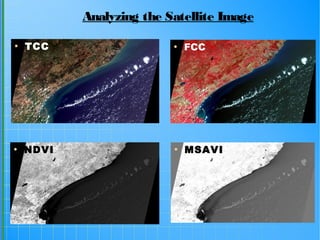
Analyzing the Satellite Image
●
TCC ●
FCC
●
MSAVI●
NDVI
Cloud Masking
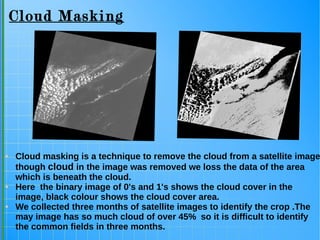
● Cloud masking is a technique to remove the cloud from a satellite image
though cloud in the image was removed we loss the data of the area
which is beneath the cloud.
● Here the binary image of 0's and 1's shows the cloud cover in the
image, black colour shows the cloud cover area.
● We collected three months of satellite images to identify the crop .The
may image has so much cloud of over 45% so it is difficult to identify
the common fields in three months.
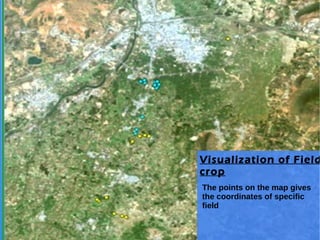
Visualization of Field
crop
The points on the map gives
the coordinates of specific
field
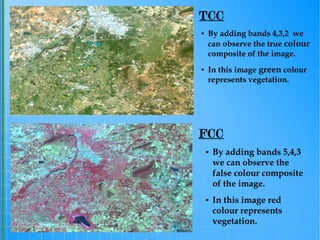
● By adding bands 4,3,2 we
can observe the true colour
composite of the image.
●
In this image green colour
represents vegetation.
● By adding bands 5,4,3
we can observe the
false colour composite
of the image.
● In this image red
colour represents
vegetation.
TCC
FCC
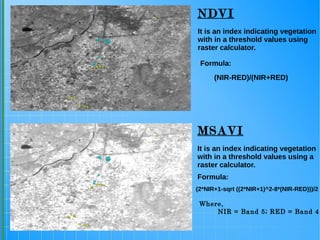
It is an index indicating vegetation
with in a threshold values using a
raster calculator.
It is an index indicating vegetation
with in a threshold values using
raster calculator.
NDVI
MSAVI
(2*NIR+1-sqrt ((2*NIR+1)^2-8*(NIR-RED)))/2
Formula:
Where,
NIR = Band 5; RED = Band 4
Formula:
(NIR-RED)/(NIR+RED)
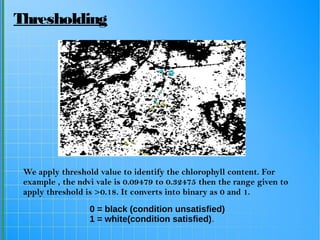
We apply threshold value to identify the chlorophyll content. For
example , the ndvi vale is 0.09479 to 0.32475 then the range given to
apply threshold is >0.18. It converts into binary as 0 and 1.
0 = black (condition unsatisfied)
1 = white(condition satisfied).
Thresholding
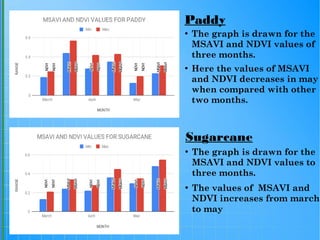
Paddy
●
The graph is drawn for the
MSAVI and NDVI values of
three months.
●
Here the values of MSAVI
and NDVI decreases in may
when compared with other
two months.
Sugarcane
●
The graph is drawn for the
MSAVI and NDVI values to
three months.
●
The values of MSAVI and
NDVI increases from march
to may
● Crop identification through ground
surveys are expensive and yet cover only
a sample of farms. Where as Geo Spatial
Analysis covers a wide range of
techniques which are used in identifying
the crops in spatial data and it is faster
and cheaper. Accurate and faster
estimation of crop area is very essential
for area-based subsidies and helps in
deciding agriculture policies.
CONCLUSION
Thank You
ACKNOWLEDGEMENT
● In this project, we used open source software QGIS
(https://qgis.org/) and satellite images of March, April, and May
2018 from NASA’s USGS portal (https://earthexplorer.usgs.gov/)
● Thank you KAIINOS (https://www.kaiinos.com/) for your support
and guidance in completion of our project.
Sai Kiran: http://www.linkedin.com/in/godi-saikiran
Komali: http://www.linkedin.com/in/komaliavirneni
Krishna: http://linkedin.com/in/krishnacheekatla

Crop identification using geo spatial technologies

  • 1.
  • 2.
    ● Introduction ● Cloud Masking ● Data Collection ● Visualizationof Field Crop ● TCC and FCC ● NDVI and MSAVI ● Thresholding ● Graph INDEX
  • 3.
    ● “Geo SpatialAnalysis” covers a wide range of techniques to analyze spatial data. ● We are assessing how Geo Spatial techniques are utilized for identification of the crop field. ● The ability to identify crop type makes it possible to estimate the area allocated to each crop type and thus compute relevant statistics providing essential information. ● Accurate and faster estimation of crop area is very essential for projecting yearly agriculture and deciding agriculture policies. ● Here, We try to analyze and identify the difference between paddy and sugarcane crops. Introduction
  • 4.
    Data Collection ● Tosolve the problems in targeted fields we collect data (information) of the field. ● we downloaded three months of LANSAT8(OLI) satellite images from earth explorer in the purpose of gathering data and tried to identify features in the image. ● We selected Anakapalle as our field area to collect the data ● With the help of an Android app KRITI DEMO we collected some points of the field at a distance of 100 meters each and the app records the coordinates of that points using GPS. ● we used open source GIS tools (QGIS) for getting the values of chlorophyll of three months of the gathered points by performing (TCC, FCC, NDVI and MSAVI) in order to understand vegetation area. ● The data in the app is in .CSV format which we add as delineate layer in Qgis for plotting the points on the image.
  • 5.
    Analyzing the SatelliteImage ● TCC ● FCC ● MSAVI● NDVI
  • 6.
    Cloud Masking ● Cloudmasking is a technique to remove the cloud from a satellite image though cloud in the image was removed we loss the data of the area which is beneath the cloud. ● Here the binary image of 0's and 1's shows the cloud cover in the image, black colour shows the cloud cover area. ● We collected three months of satellite images to identify the crop .The may image has so much cloud of over 45% so it is difficult to identify the common fields in three months.
  • 7.
    Visualization of Field crop Thepoints on the map gives the coordinates of specific field
  • 8.
    ● By addingbands 4,3,2 we can observe the true colour composite of the image. ● In this image green colour represents vegetation. ● By adding bands 5,4,3 we can observe the false colour composite of the image. ● In this image red colour represents vegetation. TCC FCC
  • 9.
    It is anindex indicating vegetation with in a threshold values using a raster calculator. It is an index indicating vegetation with in a threshold values using raster calculator. NDVI MSAVI (2*NIR+1-sqrt ((2*NIR+1)^2-8*(NIR-RED)))/2 Formula: Where, NIR = Band 5; RED = Band 4 Formula: (NIR-RED)/(NIR+RED)
  • 10.
    We apply thresholdvalue to identify the chlorophyll content. For example , the ndvi vale is 0.09479 to 0.32475 then the range given to apply threshold is >0.18. It converts into binary as 0 and 1. 0 = black (condition unsatisfied) 1 = white(condition satisfied). Thresholding
  • 11.
    Paddy ● The graph isdrawn for the MSAVI and NDVI values of three months. ● Here the values of MSAVI and NDVI decreases in may when compared with other two months. Sugarcane ● The graph is drawn for the MSAVI and NDVI values to three months. ● The values of MSAVI and NDVI increases from march to may
  • 12.
    ● Crop identificationthrough ground surveys are expensive and yet cover only a sample of farms. Where as Geo Spatial Analysis covers a wide range of techniques which are used in identifying the crops in spatial data and it is faster and cheaper. Accurate and faster estimation of crop area is very essential for area-based subsidies and helps in deciding agriculture policies. CONCLUSION
  • 13.
    Thank You ACKNOWLEDGEMENT ● Inthis project, we used open source software QGIS (https://qgis.org/) and satellite images of March, April, and May 2018 from NASA’s USGS portal (https://earthexplorer.usgs.gov/) ● Thank you KAIINOS (https://www.kaiinos.com/) for your support and guidance in completion of our project. Sai Kiran: http://www.linkedin.com/in/godi-saikiran Komali: http://www.linkedin.com/in/komaliavirneni Krishna: http://linkedin.com/in/krishnacheekatla