An Intro to
Remote Sensing and
Machine Learning
HAMED ALEMOHAMMAD
LEAD GEOSPATIAL DATA SCIENTIST, RADIANT EARTH FOUNDATION
IMED, 2018, Vienna, Austria
Remote Sensing
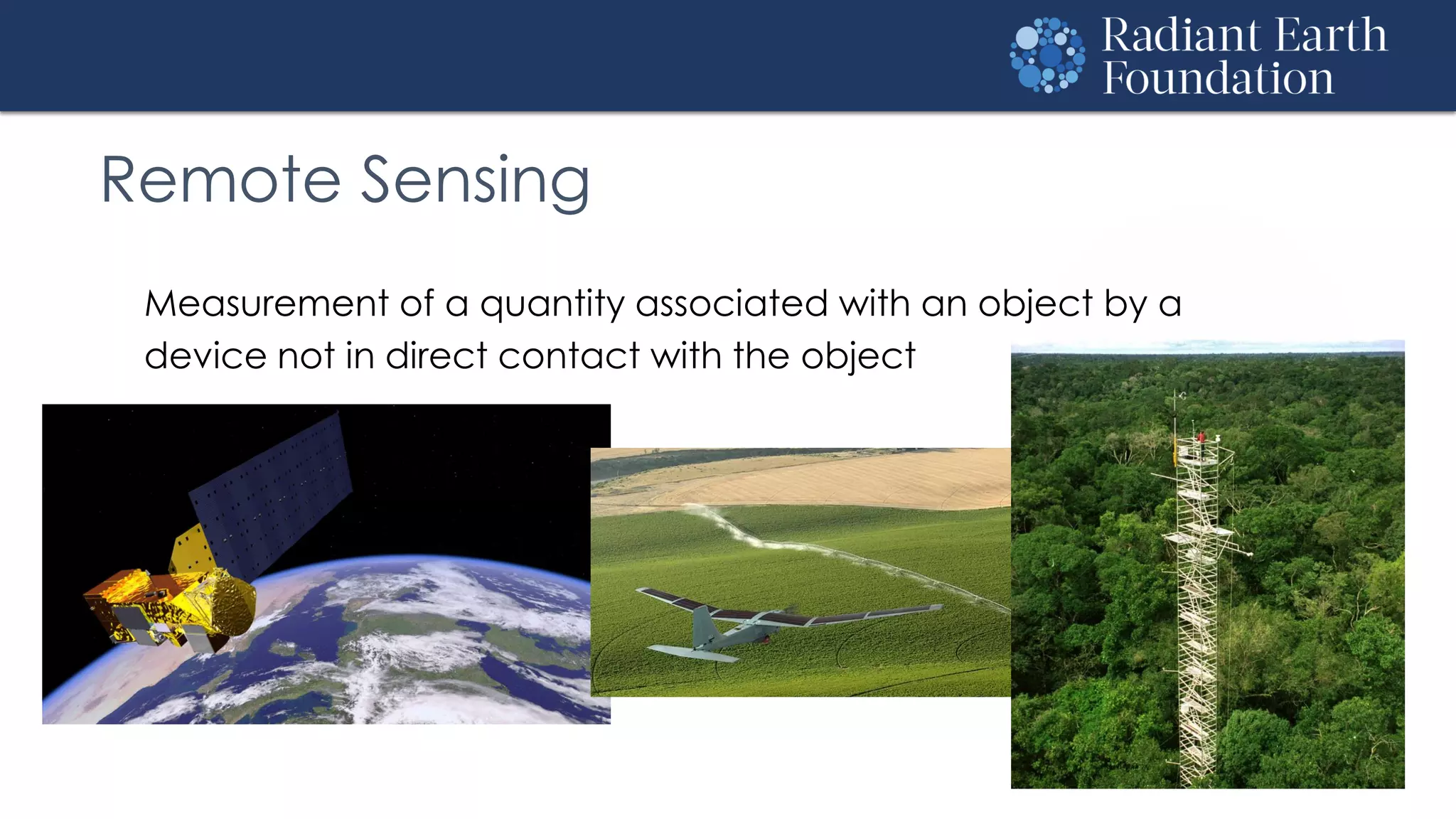
Measurement of a quantity associated with an object by a
device not in direct contact with the object
Satellite Remote Sensing
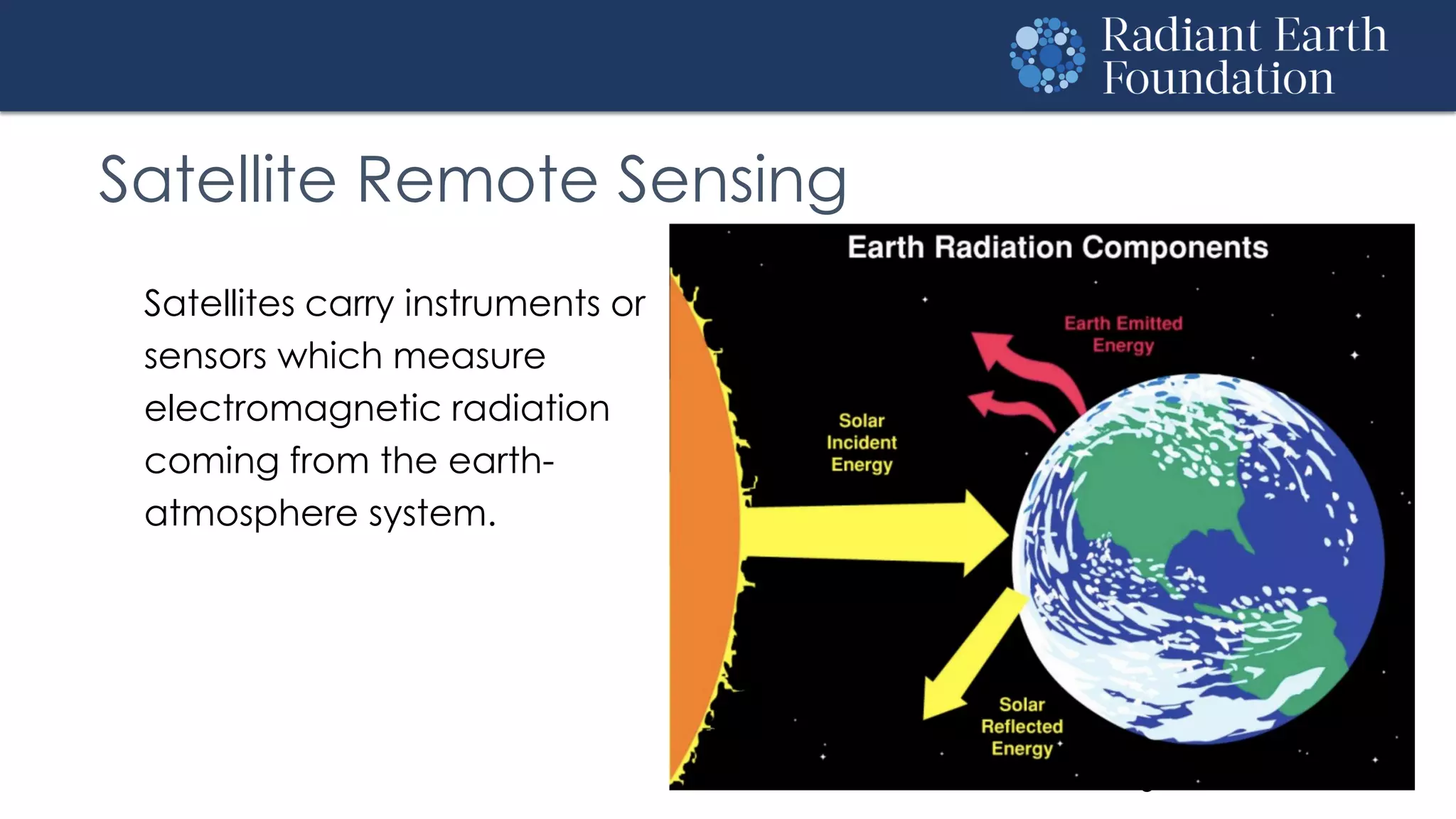
Satellites carry instruments or
sensors which measure
electromagnetic radiation
coming from the earth-
atmosphere system.
3
Measuring Earth Surface and
Atmospheric Properties
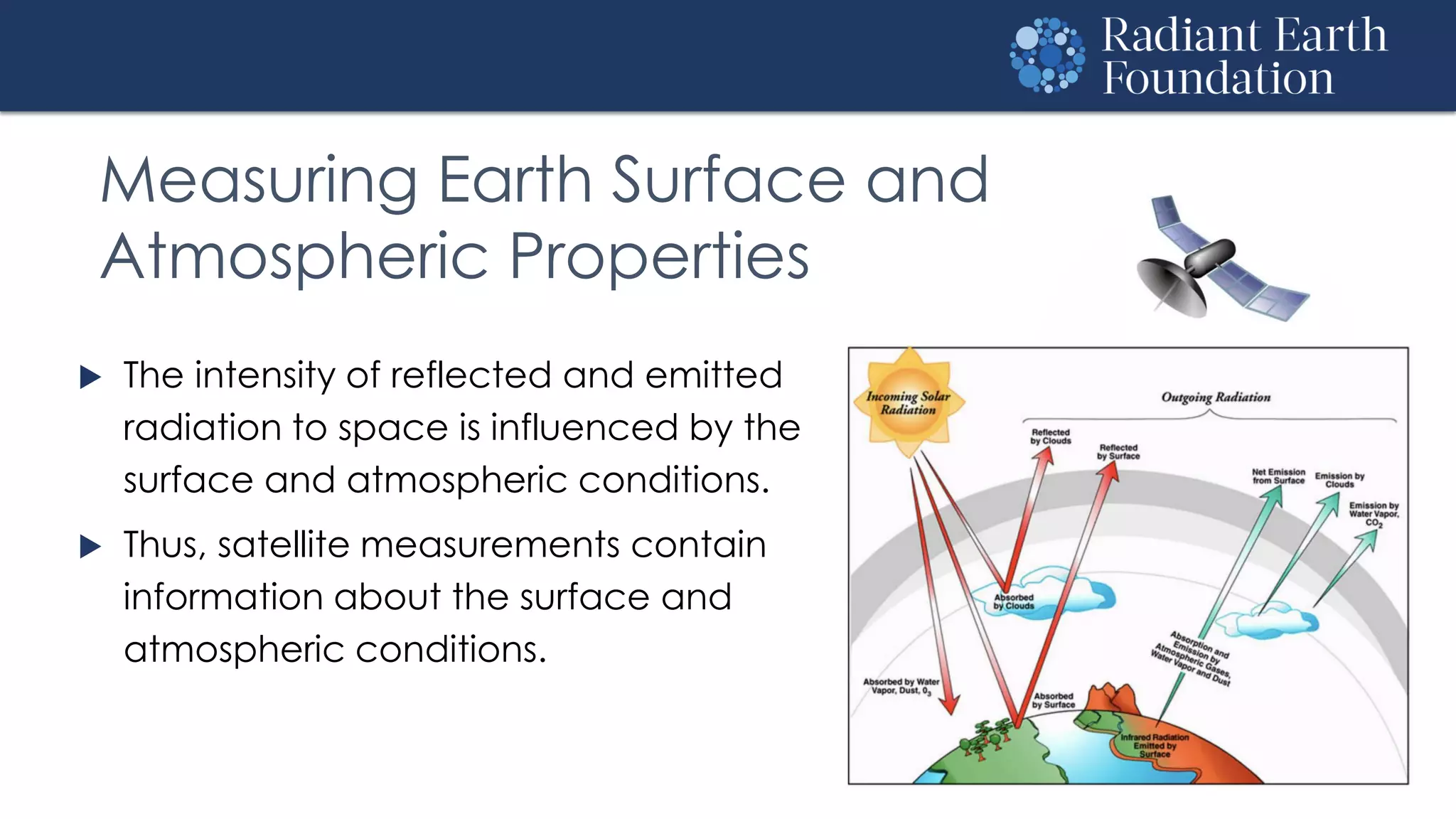
 The intensity of reflected and emitted
radiation to space is influenced by the
surface and atmospheric conditions.
 Thus, satellite measurements contain
information about the surface and
atmospheric conditions.
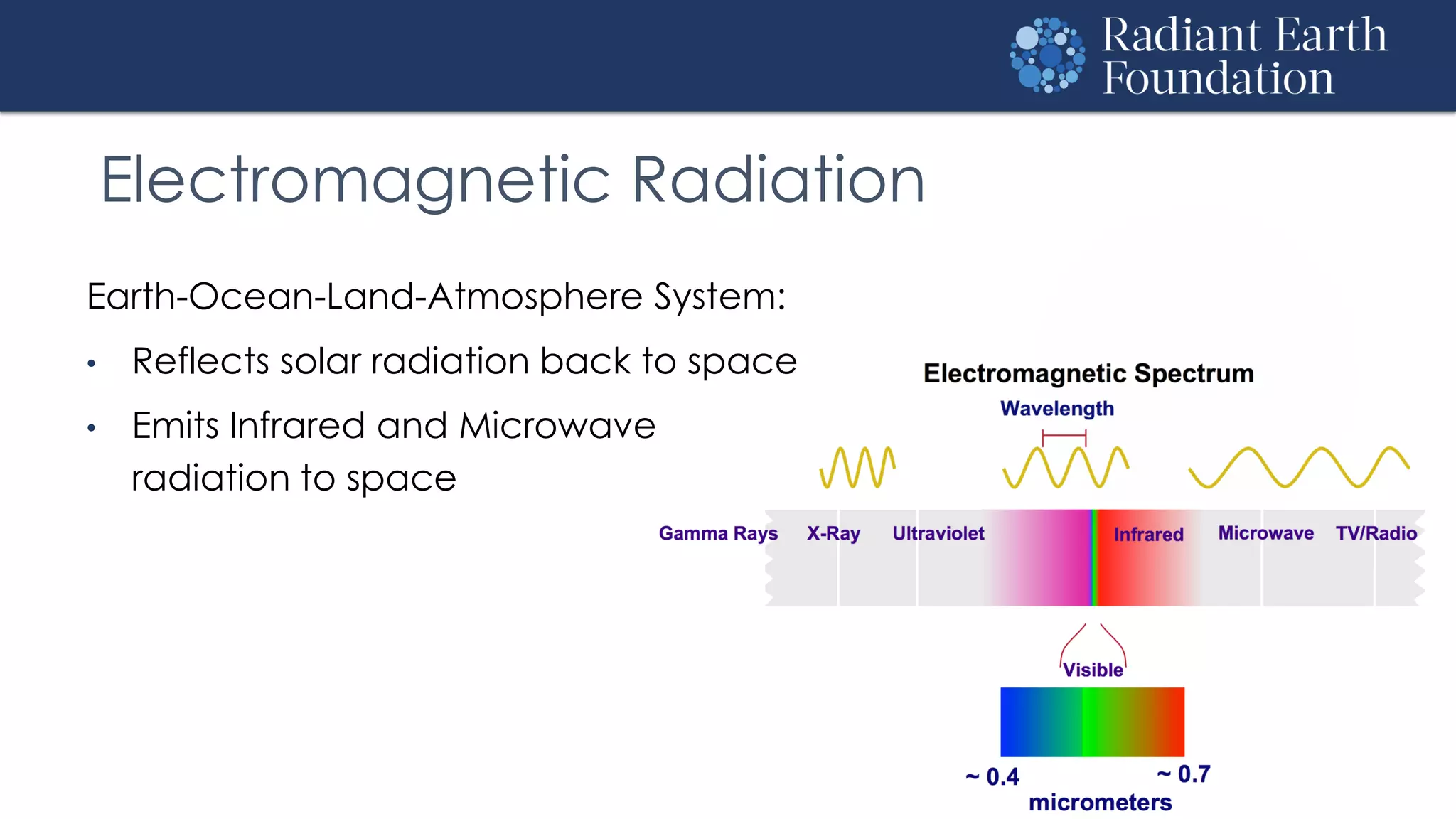
Electromagnetic Radiation
Earth-Ocean-Land-Atmosphere System:
• Reflects solar radiation back to space
• Emits Infrared and Microwave
radiation to space
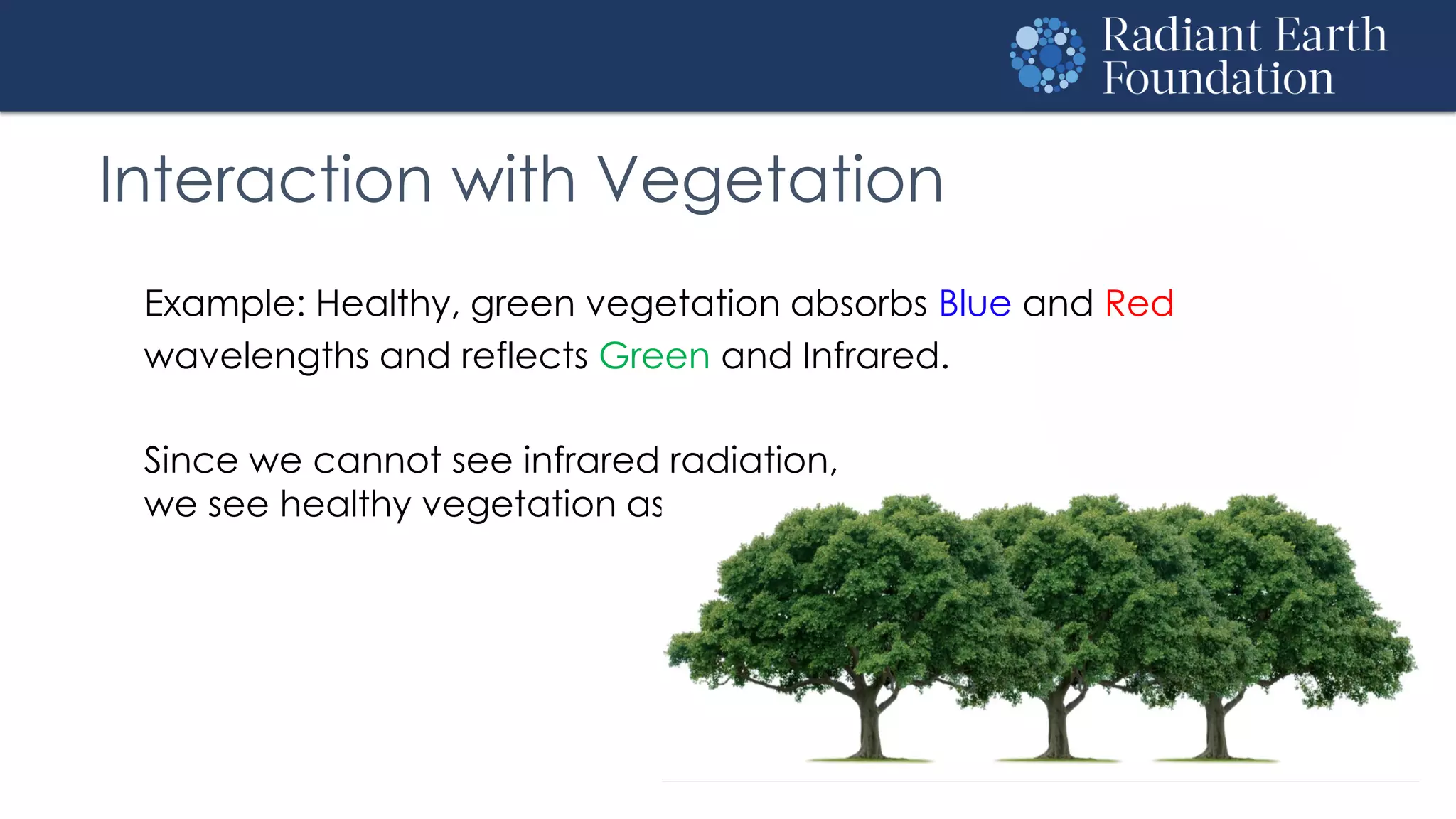
Interaction with Vegetation
Example: Healthy, green vegetation absorbs Blue and Red
wavelengths and reflects Green and Infrared.
Since we cannot see infrared radiation,
we see healthy vegetation as green.
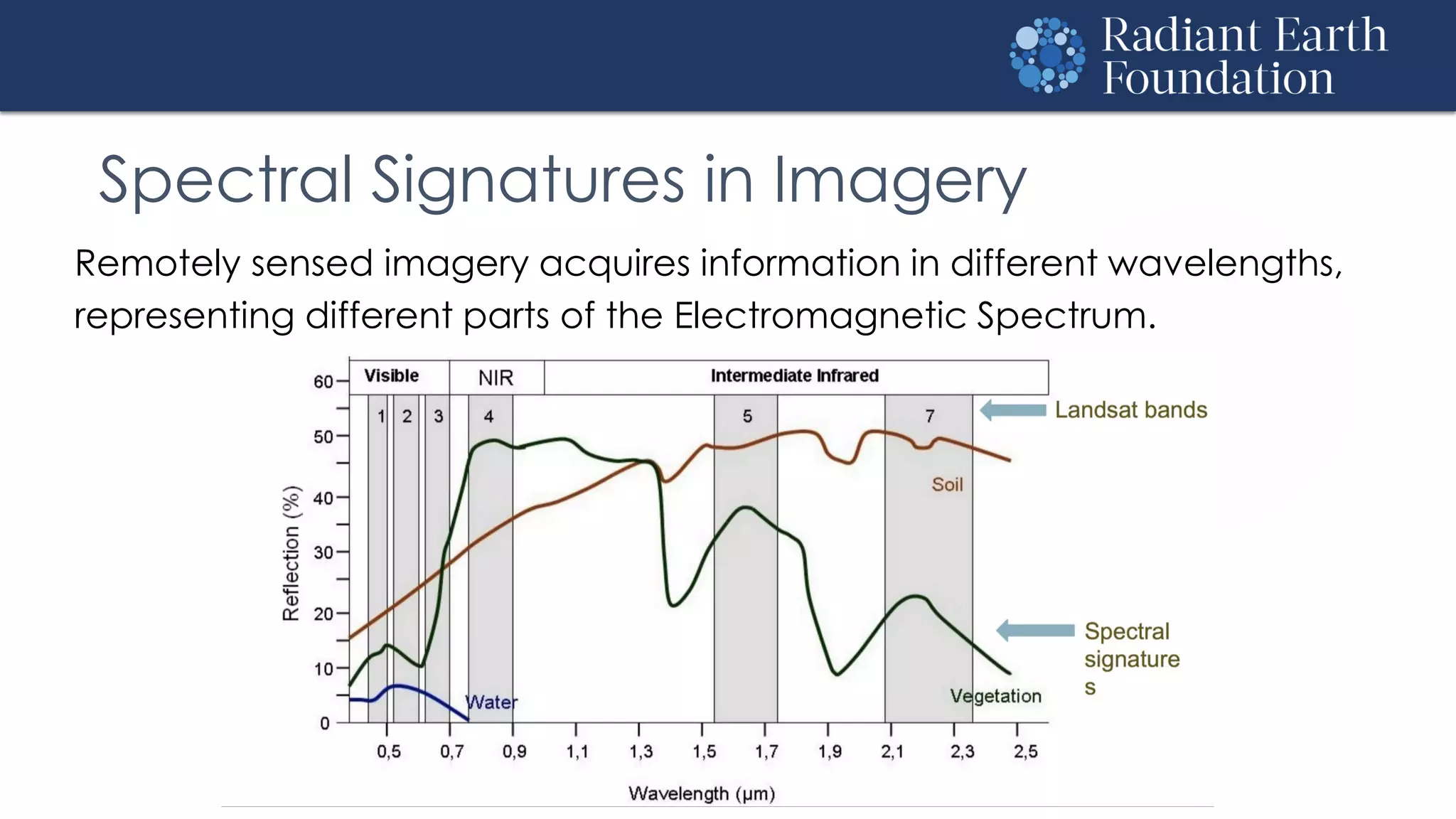
Spectral Signatures in Imagery
Remotely sensed imagery acquires information in different wavelengths,
representing different parts of the Electromagnetic Spectrum.
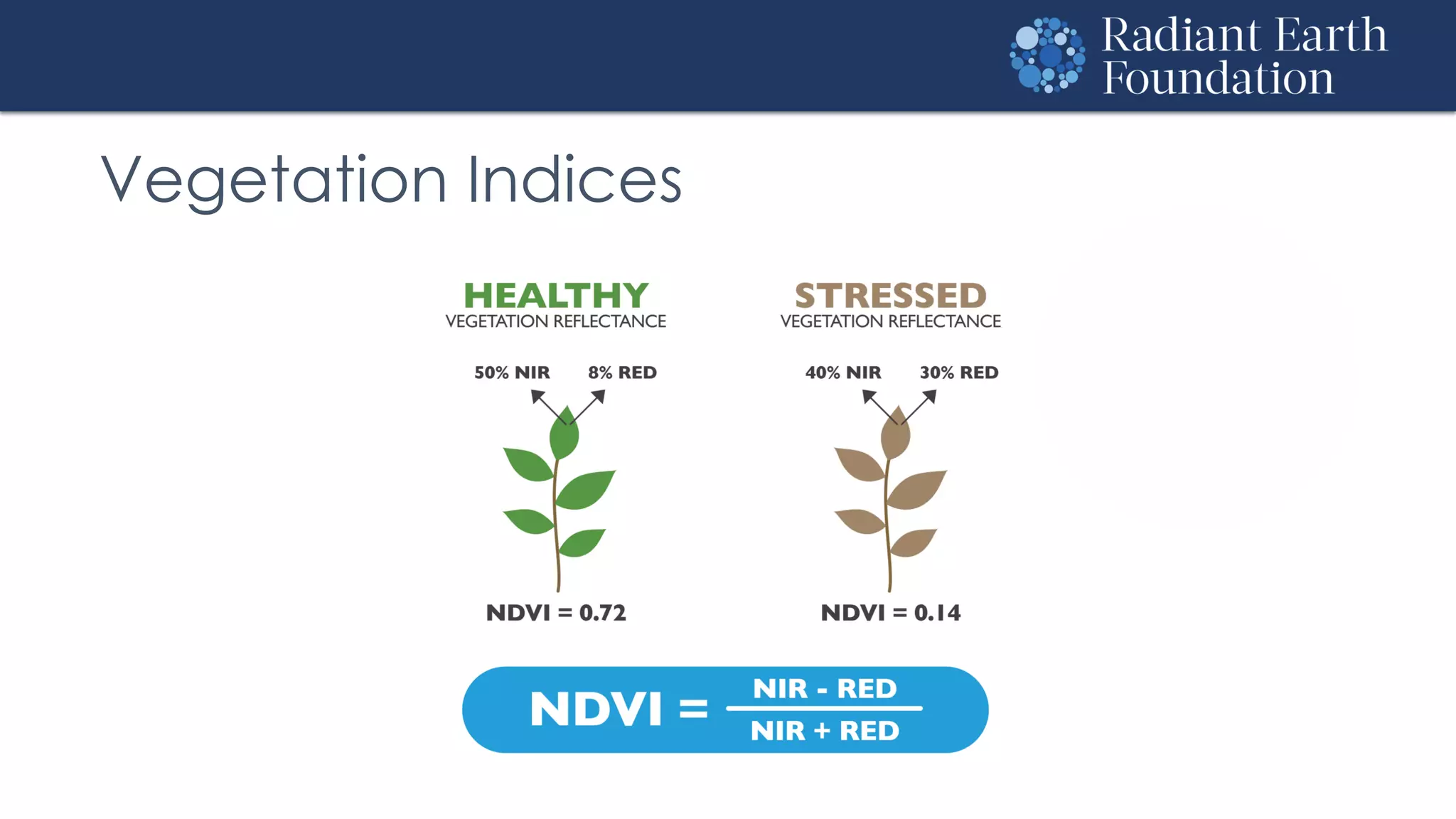
Vegetation Indices
Solar Induced Fluorescence (SIF)
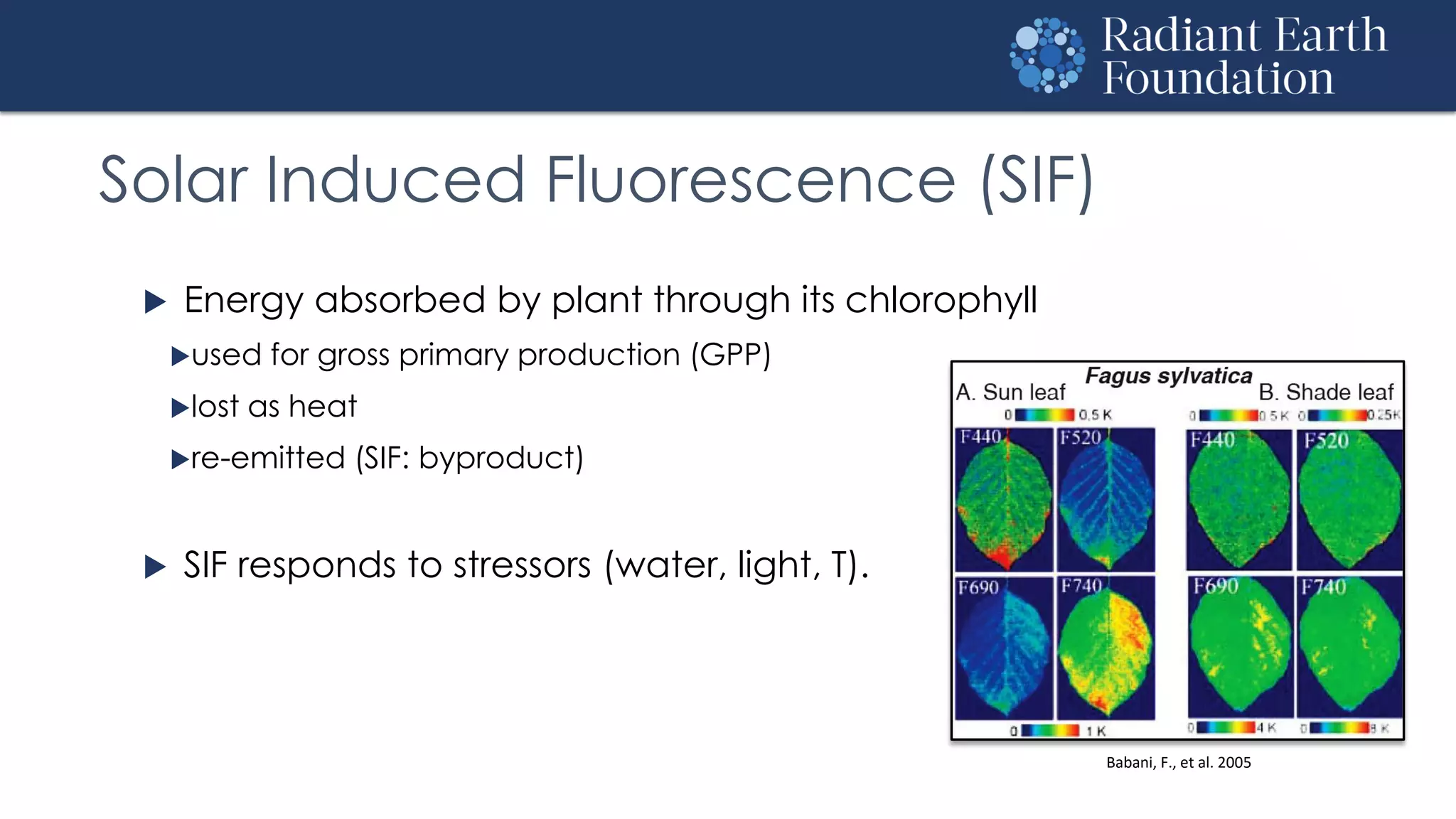
 Energy absorbed by plant through its chlorophyll
used for gross primary production (GPP)
lost as heat
re-emitted (SIF: byproduct)
 SIF responds to stressors (water, light, T).
Babani, F., et al. 2005
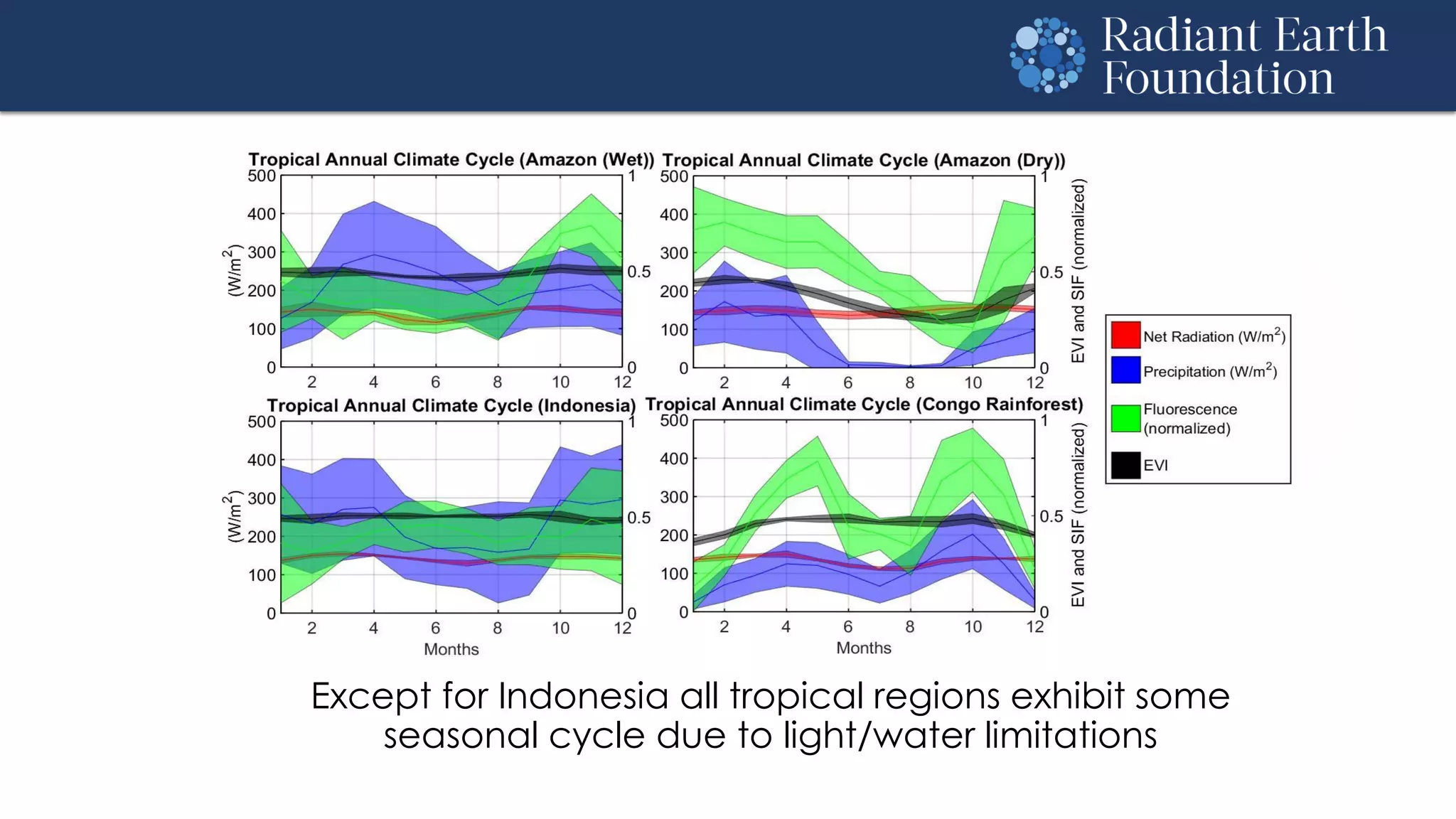
Except for Indonesia all tropical regions exhibit some
seasonal cycle due to light/water limitations
11
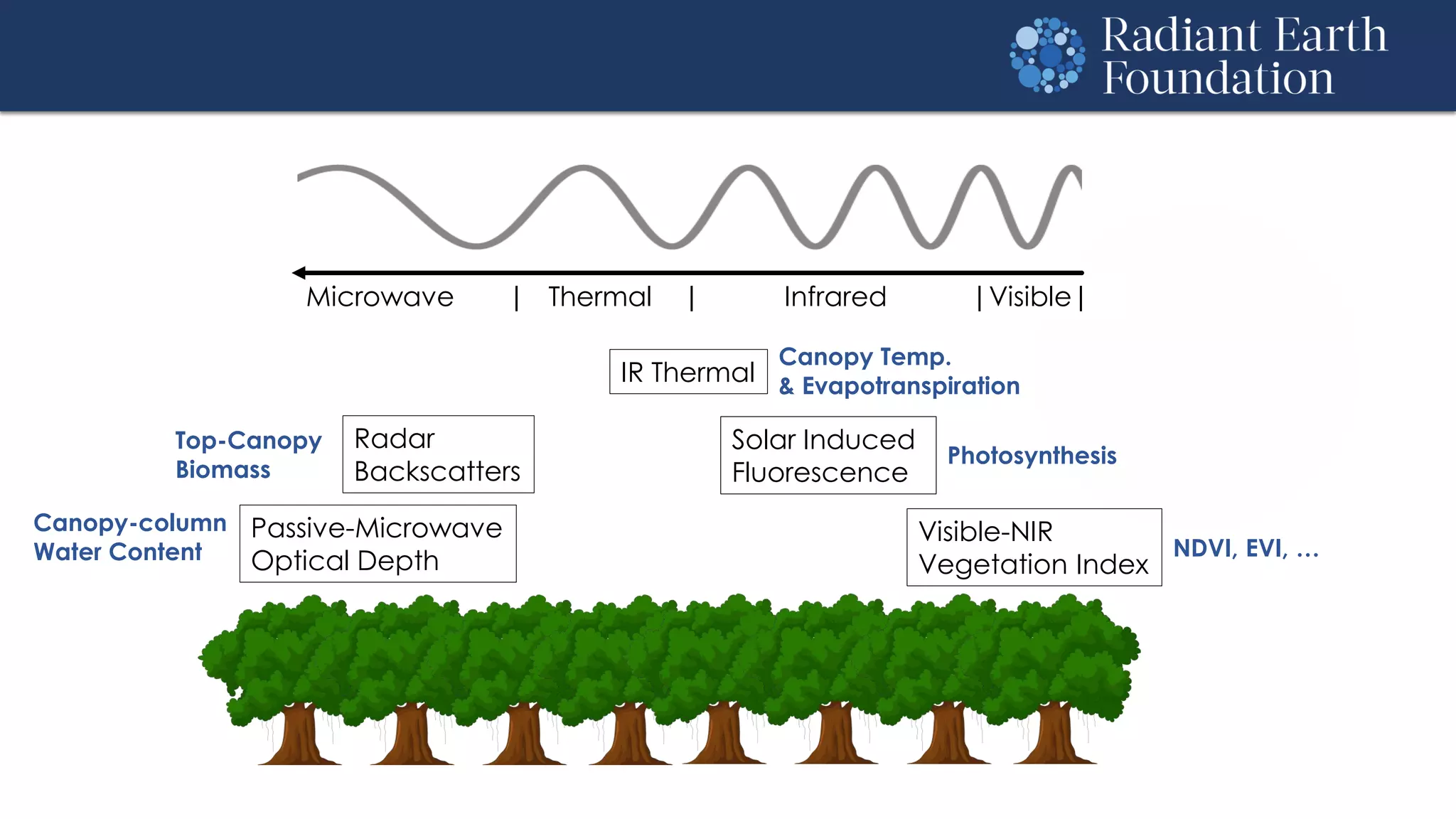
Microwave | Thermal | Infrared |Visible|
Visible-NIR
Vegetation Index
Solar Induced
Fluorescence
IR Thermal
Radar
Backscatters
Passive-Microwave
Optical Depth NDVI, EVI, …
Photosynthesis
Canopy Temp.
& Evapotranspiration
Top-Canopy
Biomass
Canopy-column
Water Content
Mean Annual Soil Moisture
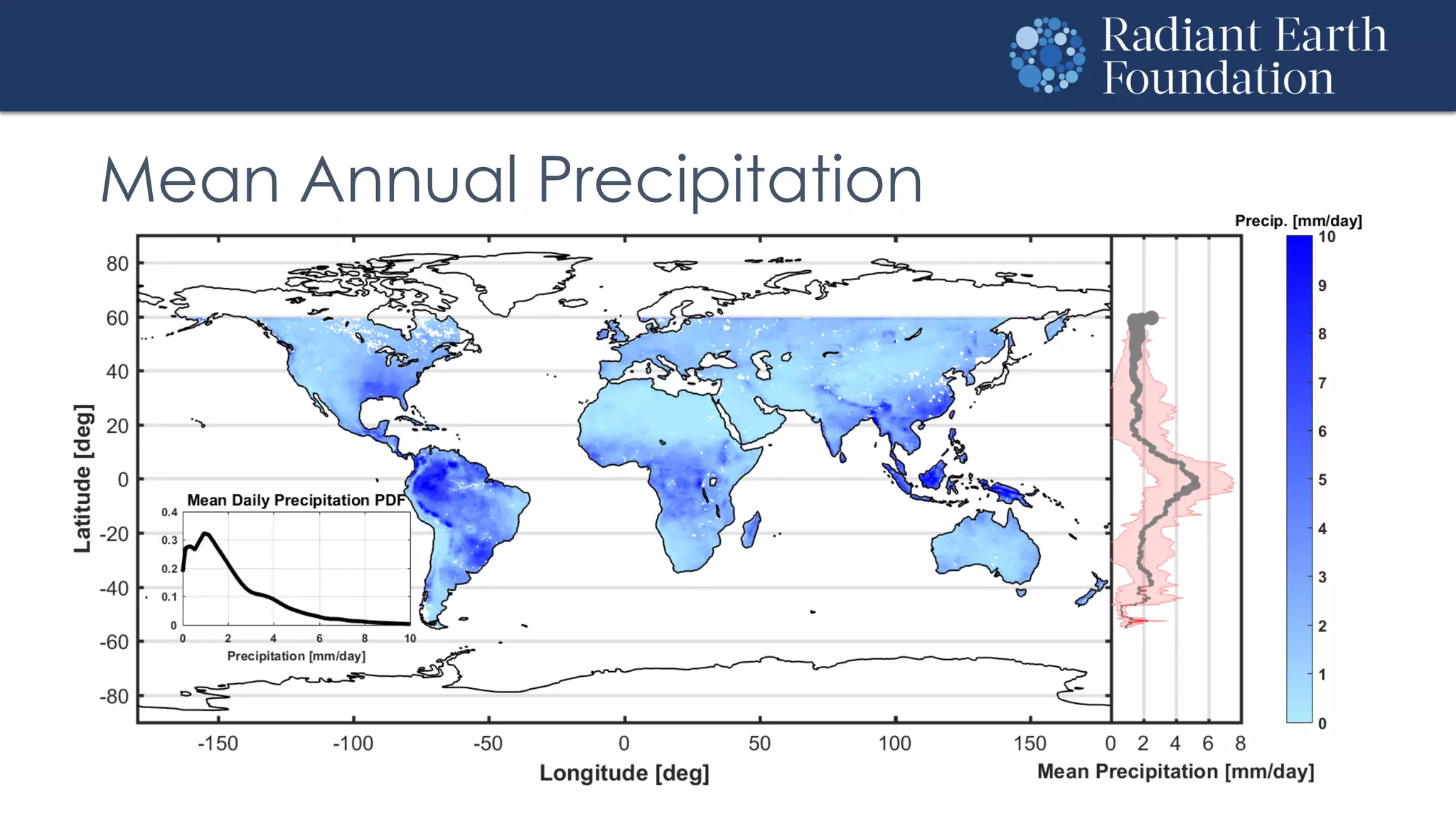
Mean Annual Precipitation
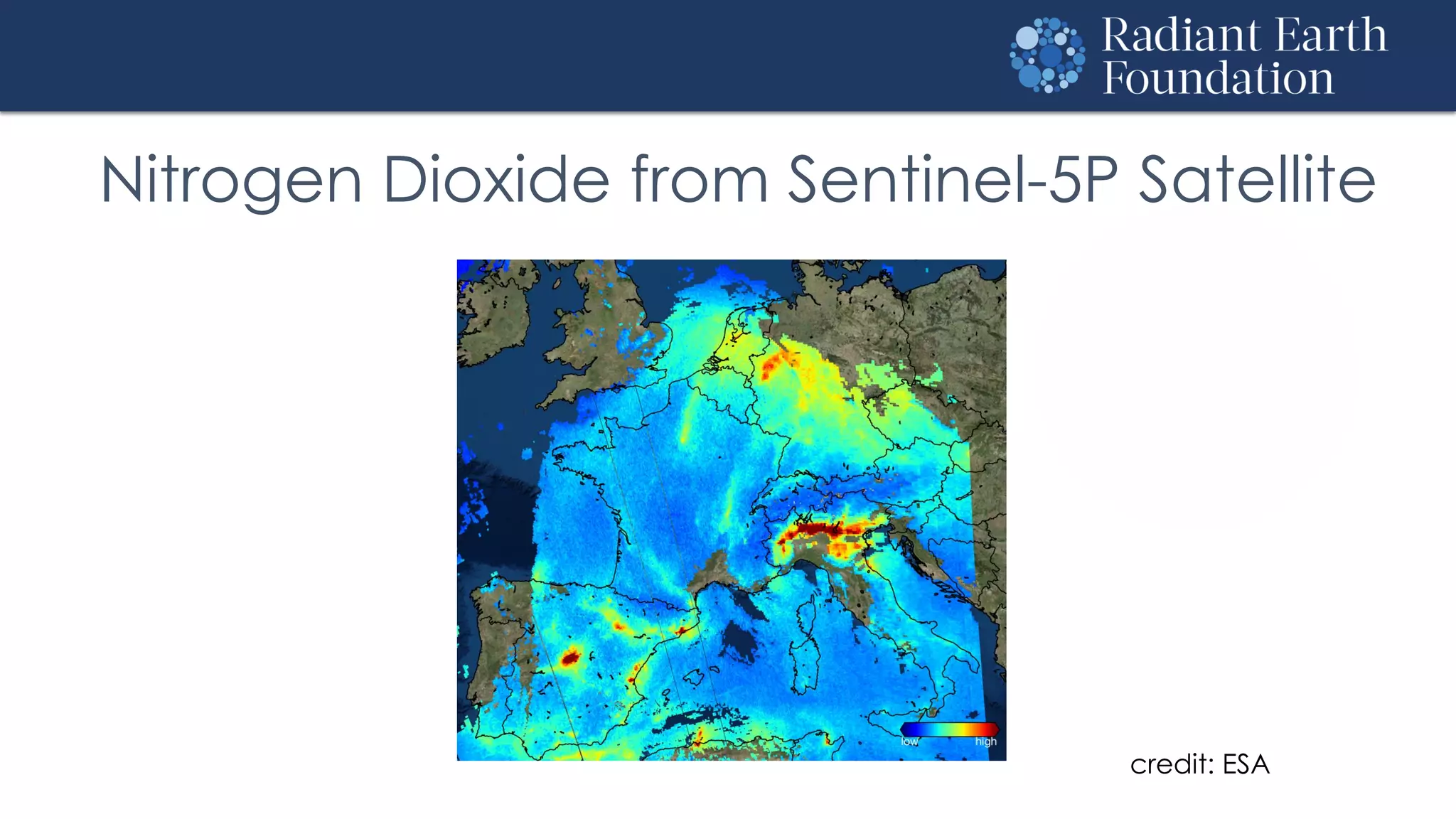
Nitrogen Dioxide from Sentinel-5P Satellite
credit: ESA
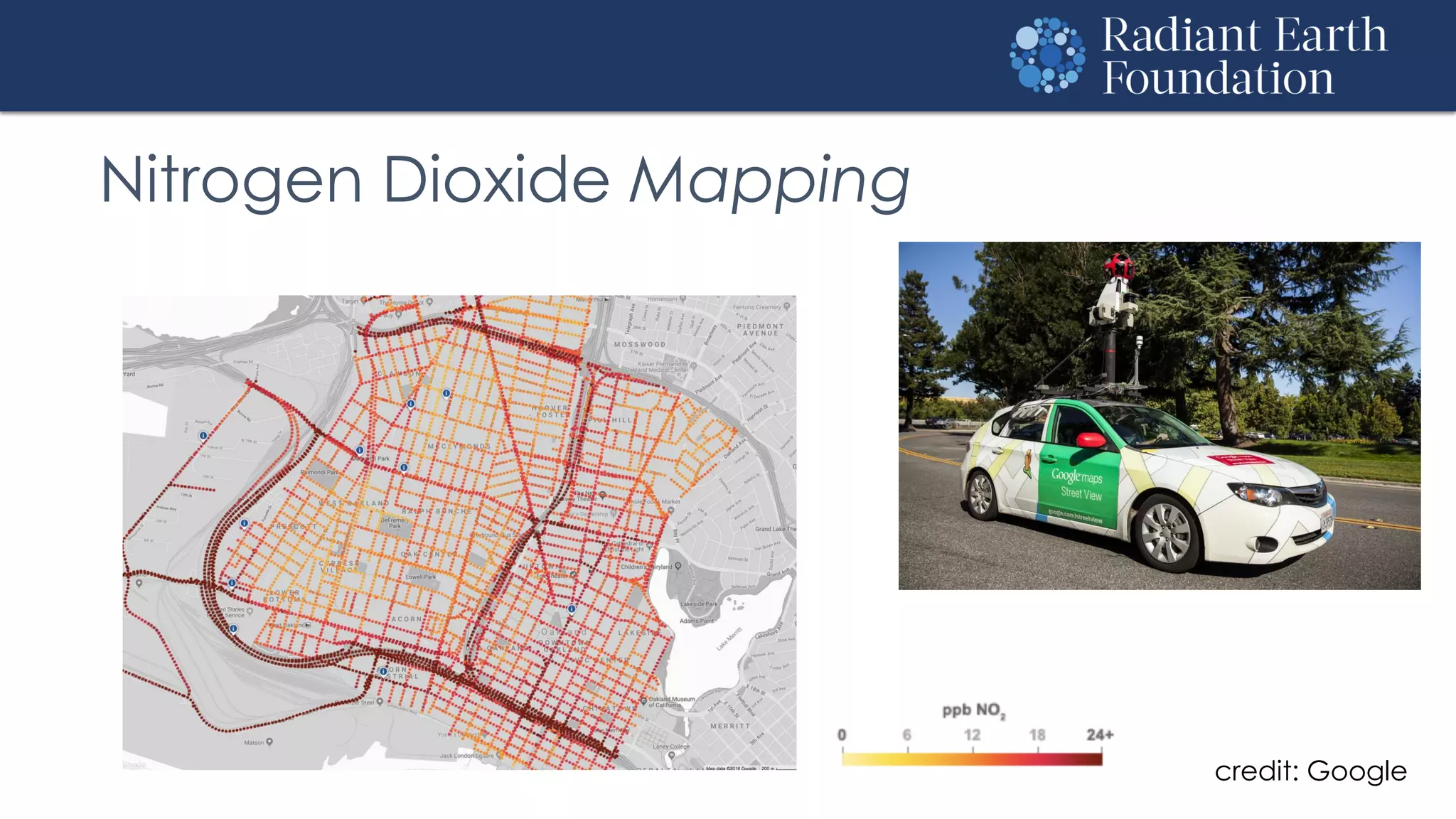
Nitrogen Dioxide Mapping
credit: Google
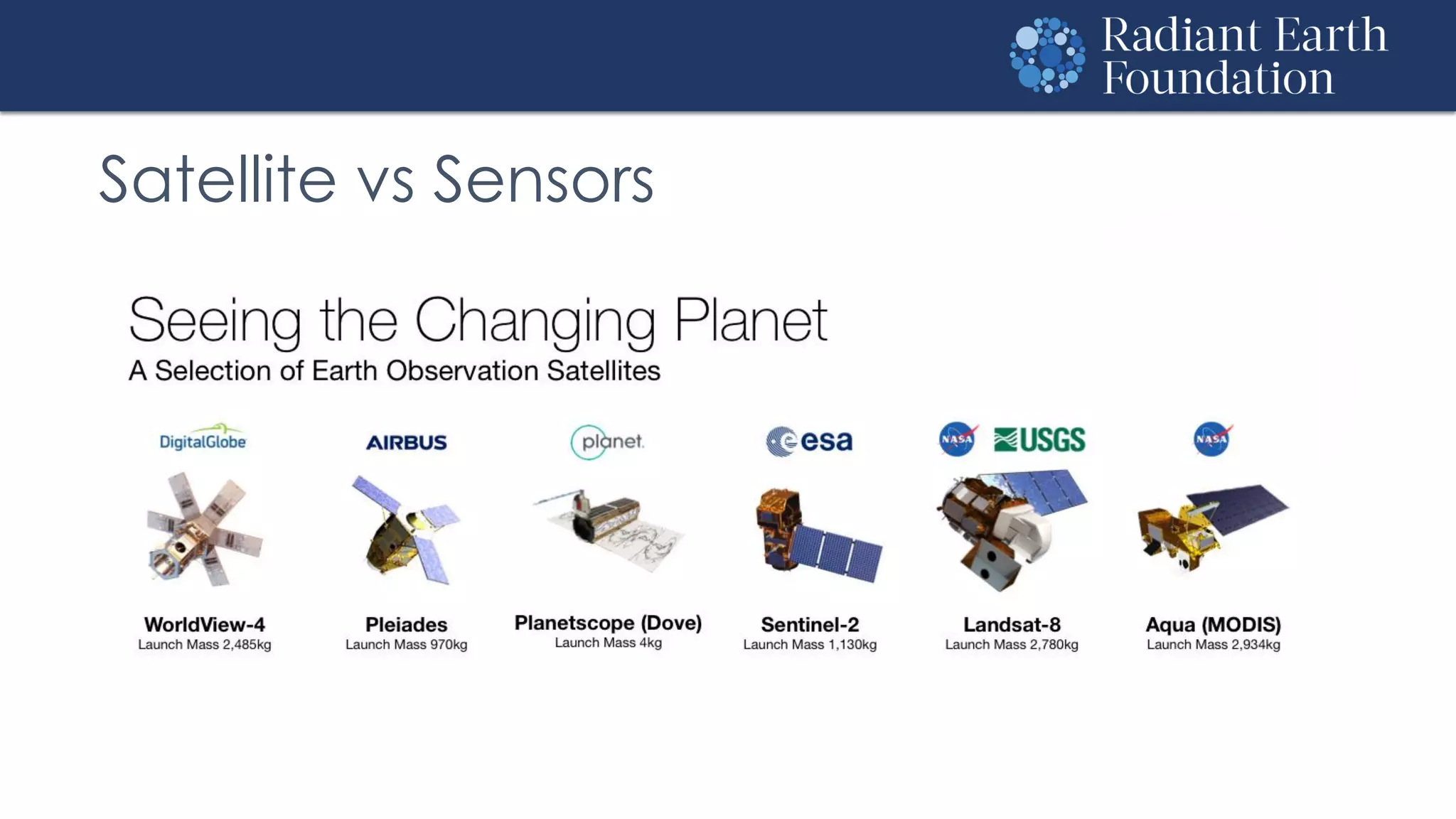
Satellite vs Sensors
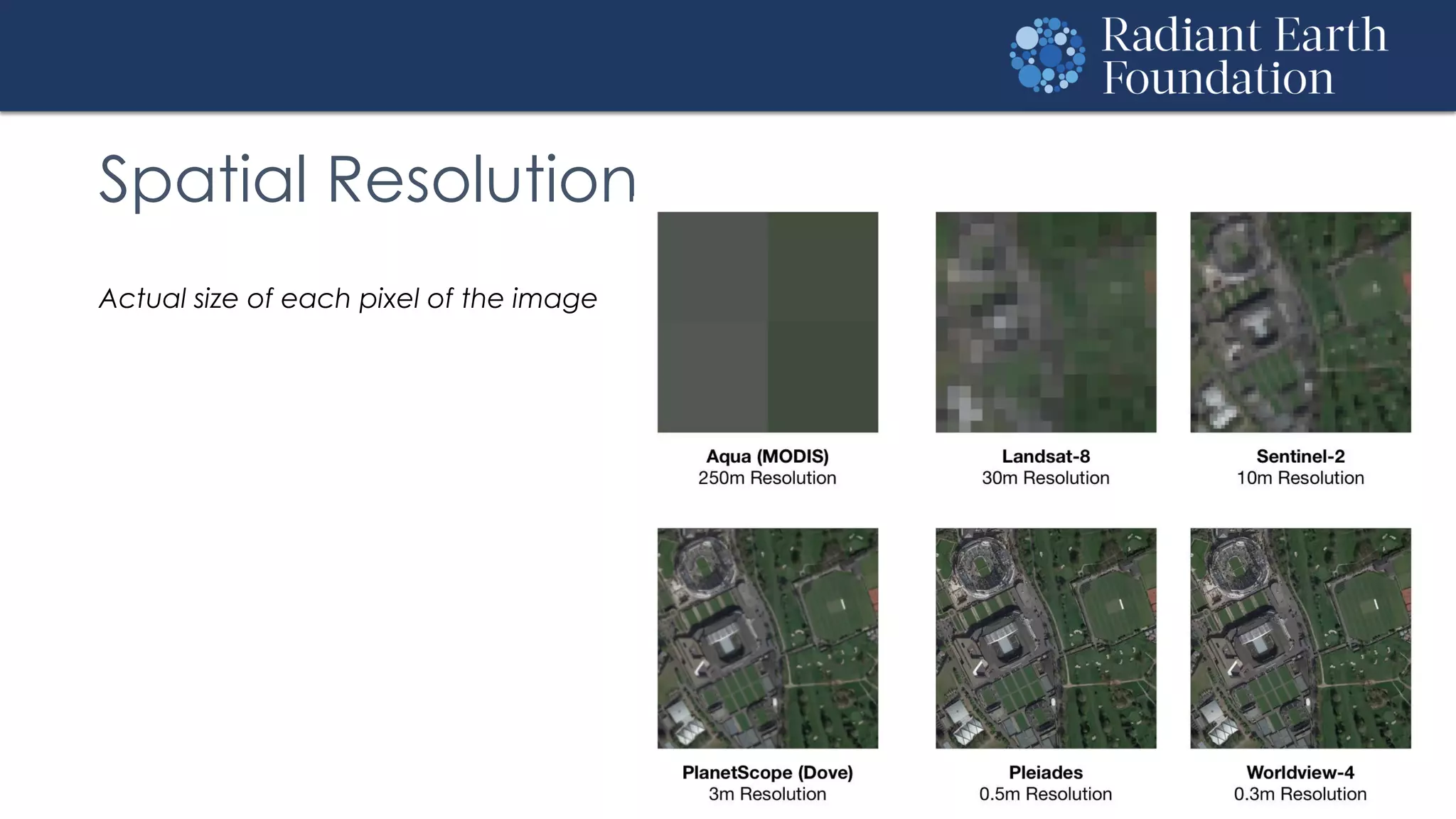
Spatial Resolution
Actual size of each pixel of the image
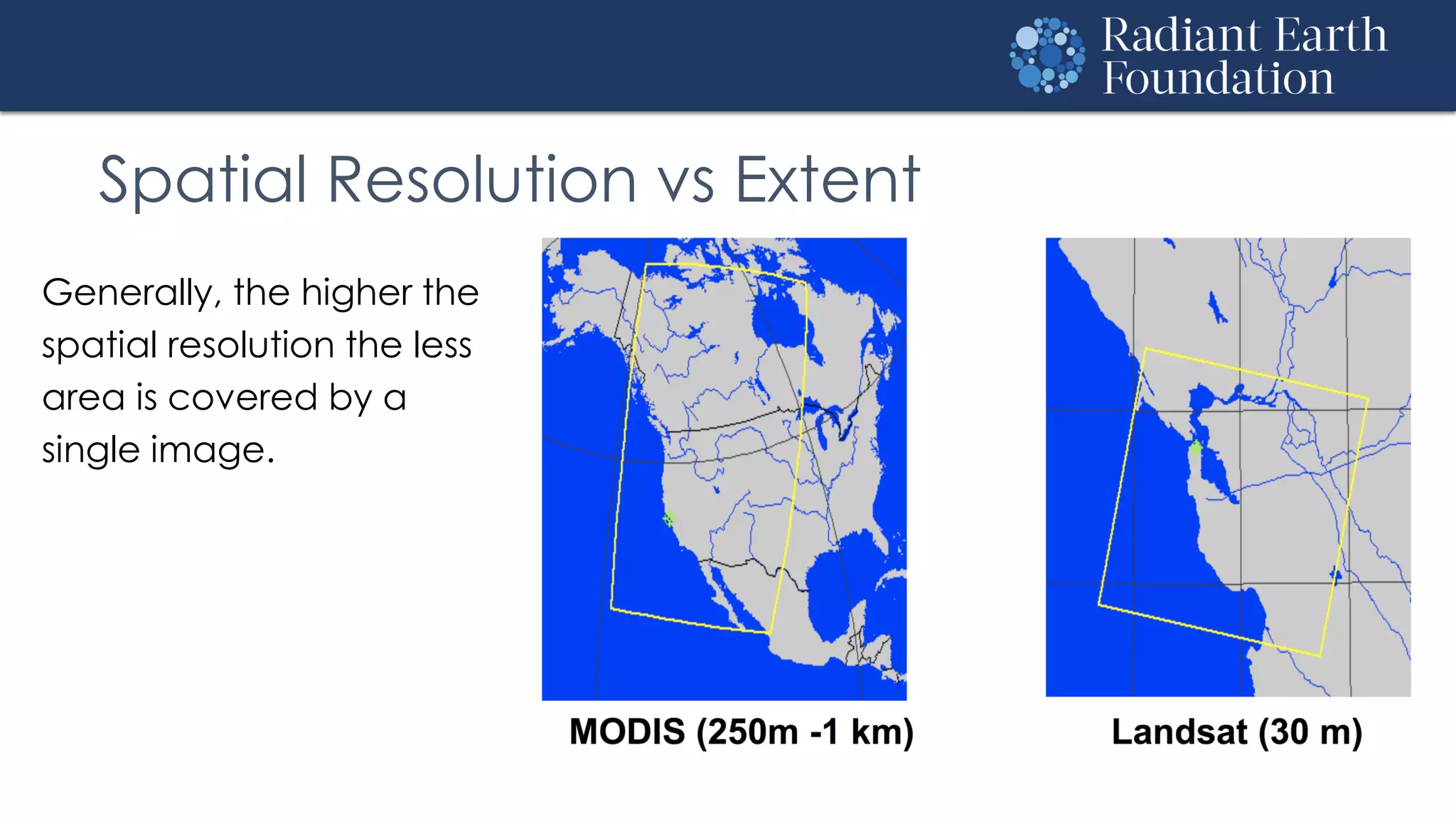
Spatial Resolution vs Extent
Generally, the higher the
spatial resolution the less
area is covered by a
single image.
The European Copernicus Initiative
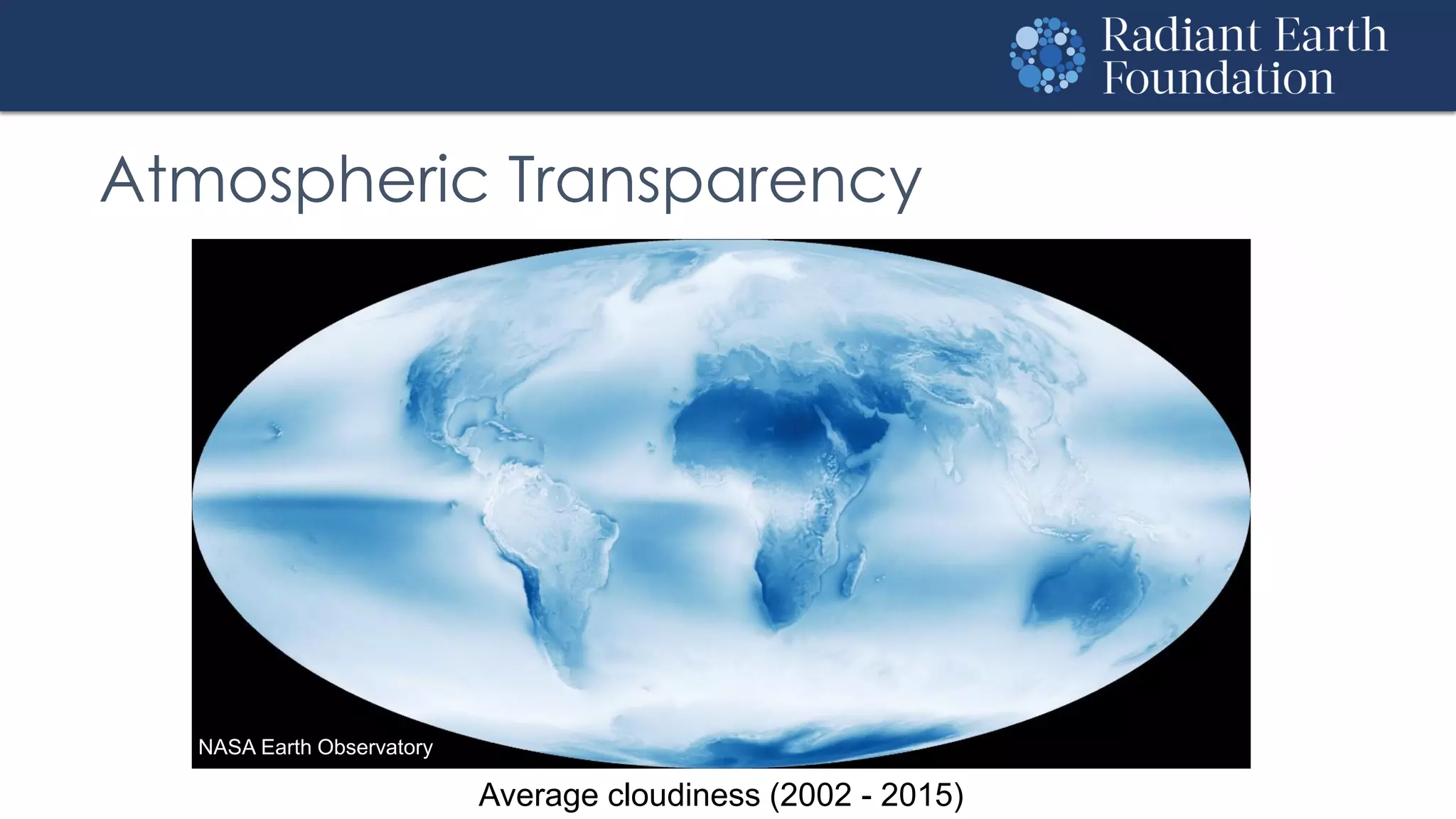
Atmospheric Transparency
Average cloudiness (2002 - 2015)
NASA Earth Observatory
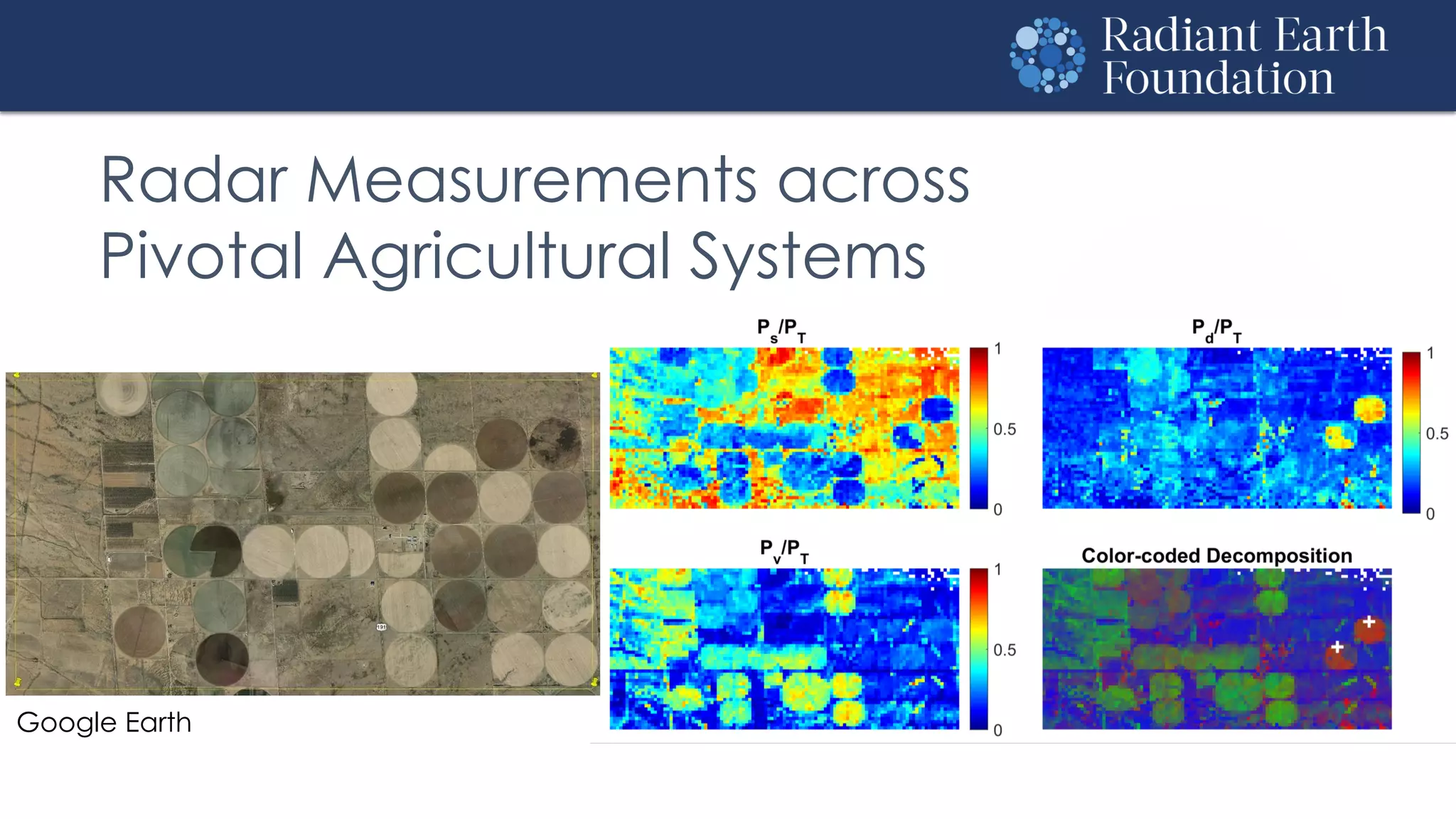
Radar Measurements across
Pivotal Agricultural Systems
Google Earth
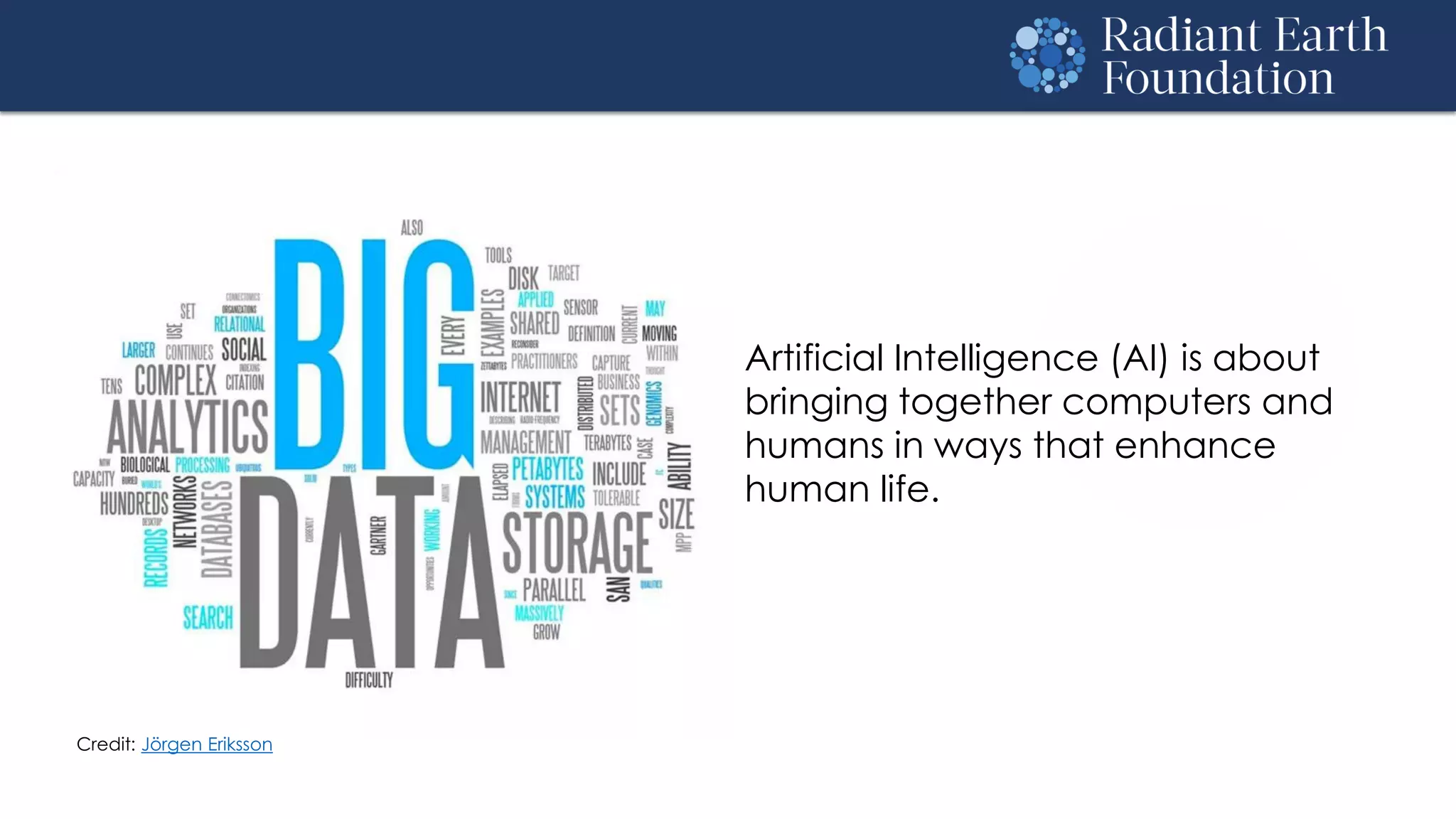
Credit: Jörgen Eriksson
Artificial Intelligence (AI) is about
bringing together computers and
humans in ways that enhance
human life.
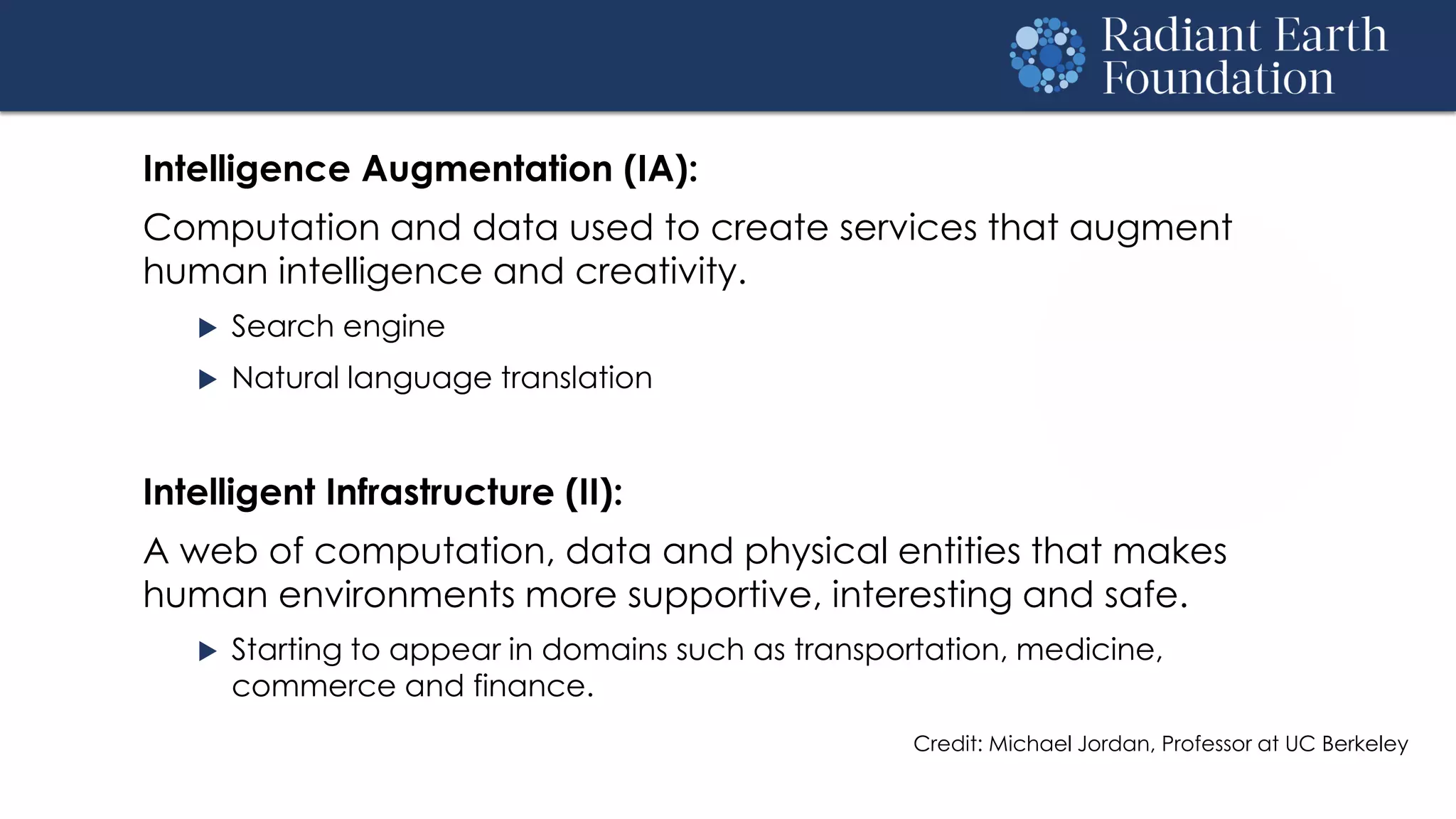
Intelligence Augmentation (IA):
Computation and data used to create services that augment
human intelligence and creativity.
 Search engine
 Natural language translation
Intelligent Infrastructure (II):
A web of computation, data and physical entities that makes
human environments more supportive, interesting and safe.
 Starting to appear in domains such as transportation, medicine,
commerce and finance.
Credit: Michael Jordan, Professor at UC Berkeley
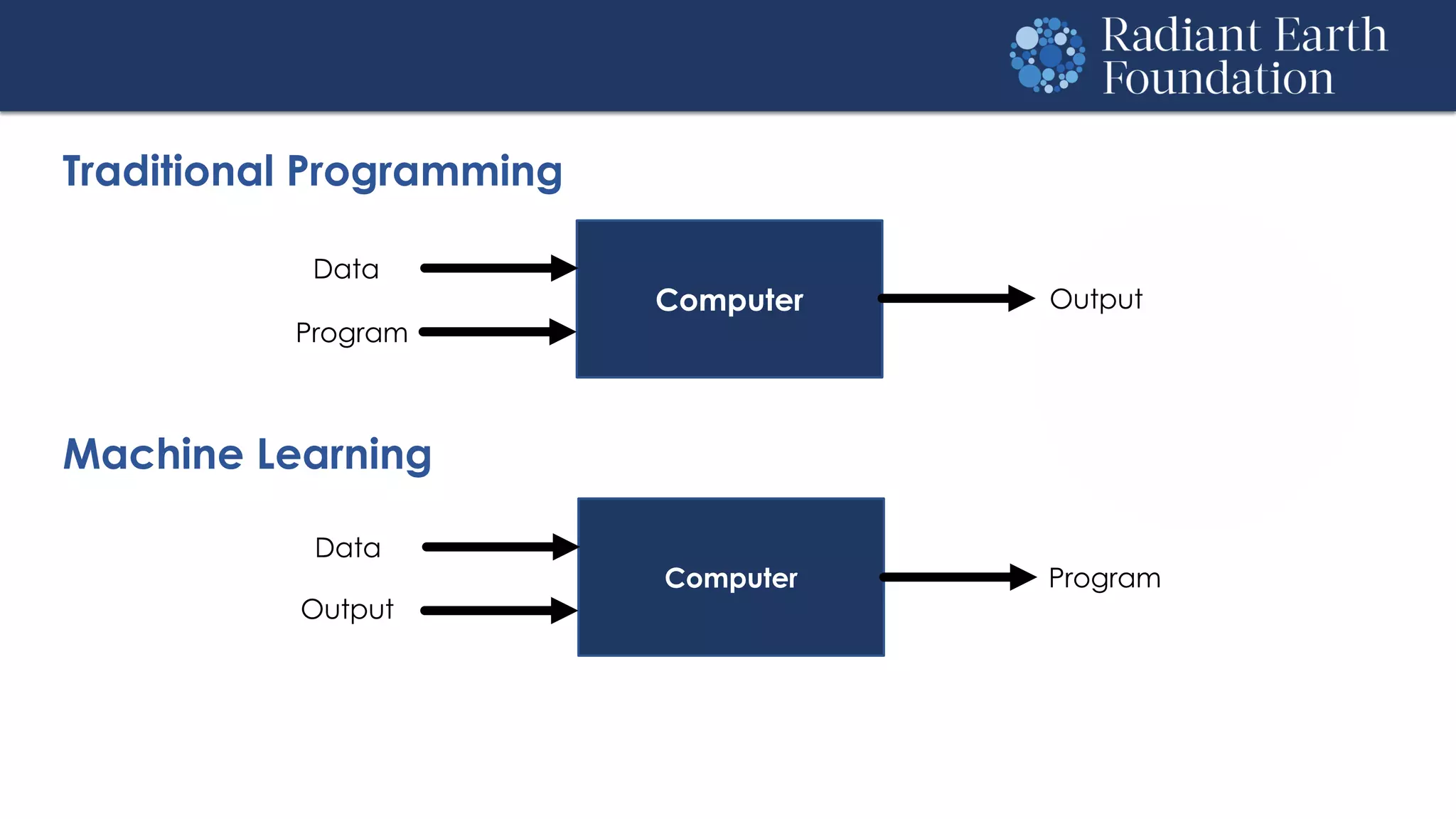
Computer
Computer
Data
Program
Output
Data
Program
Output
Traditional Programming
Machine Learning
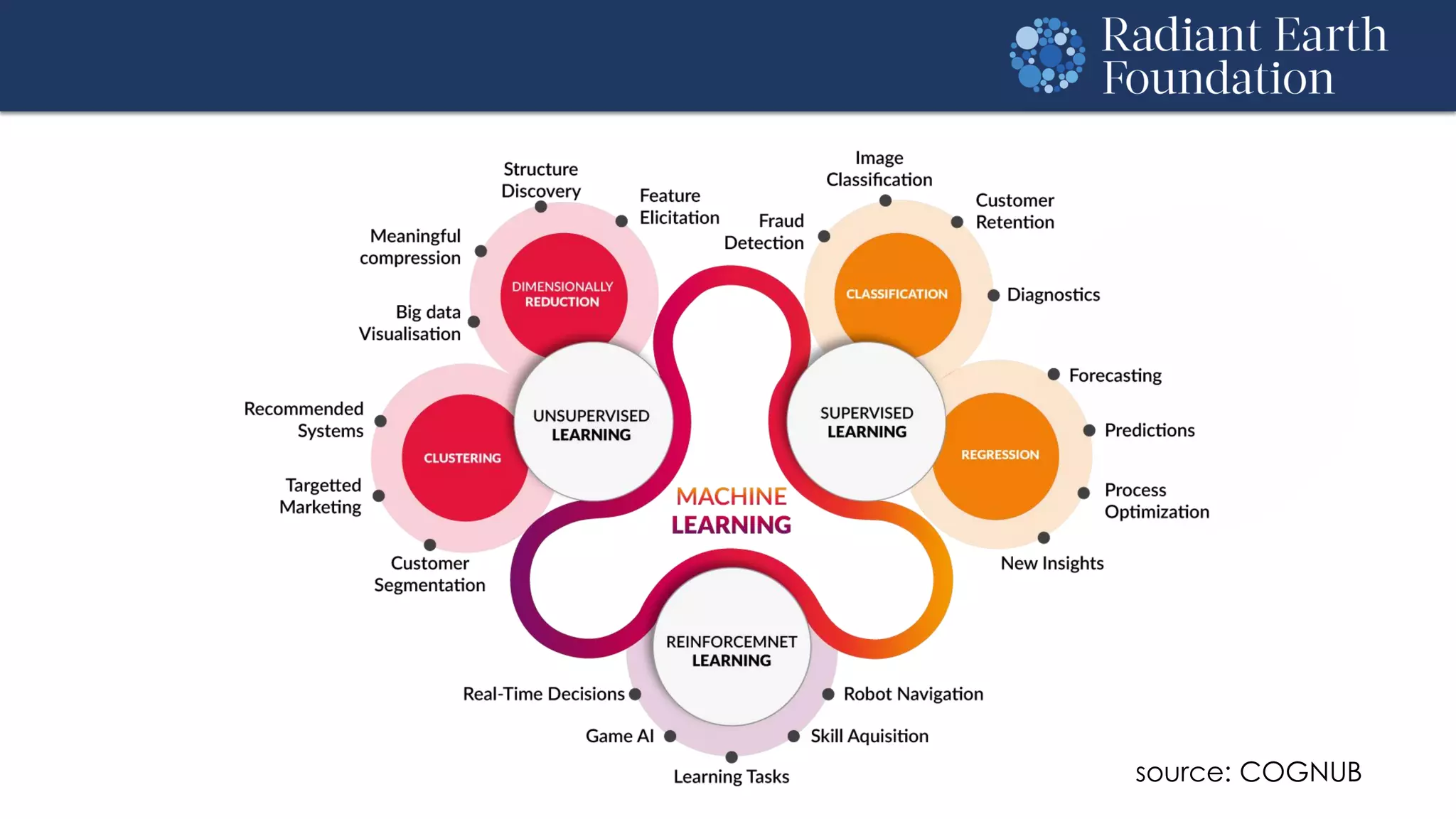
source: COGNUB
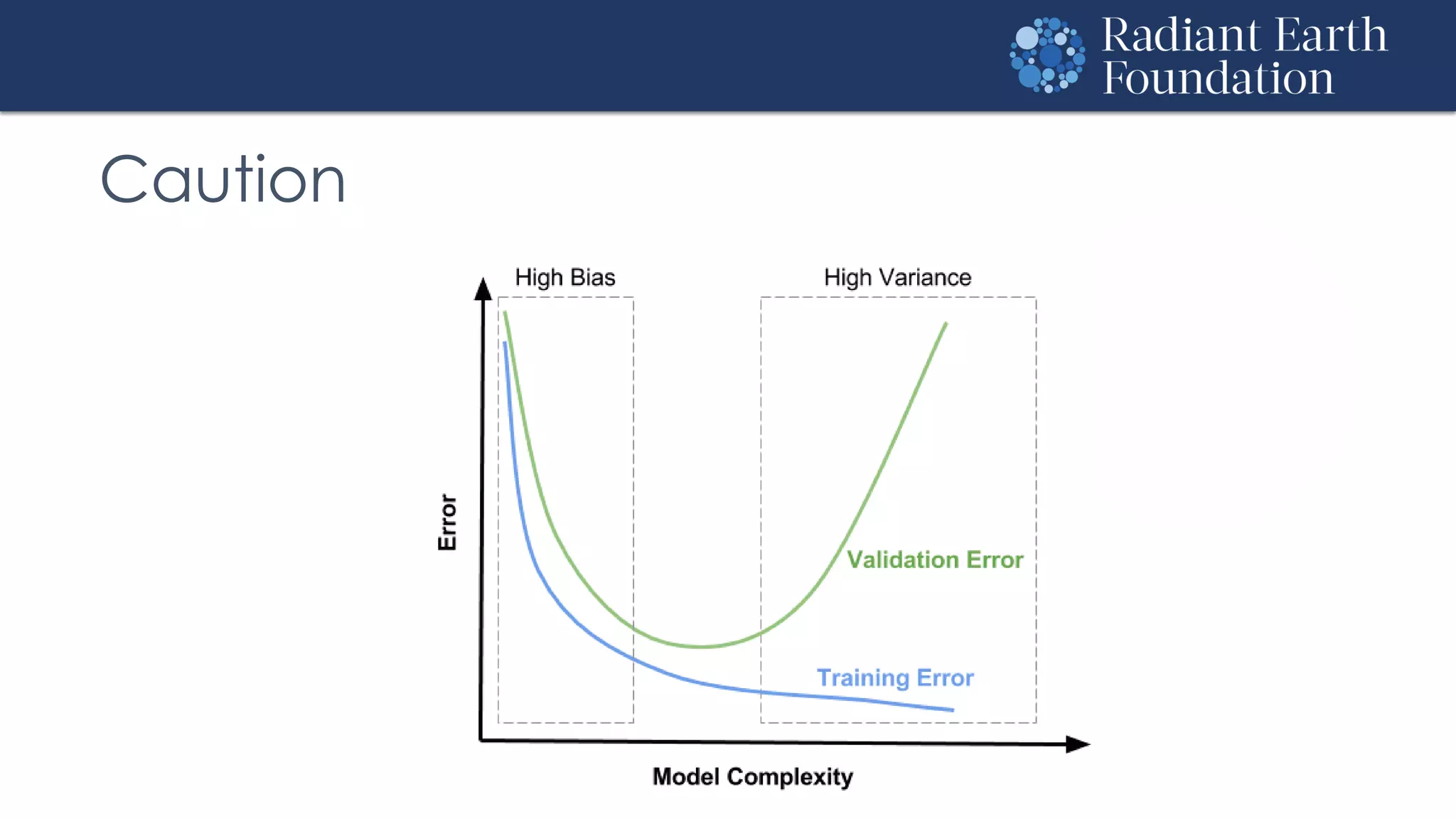
Caution
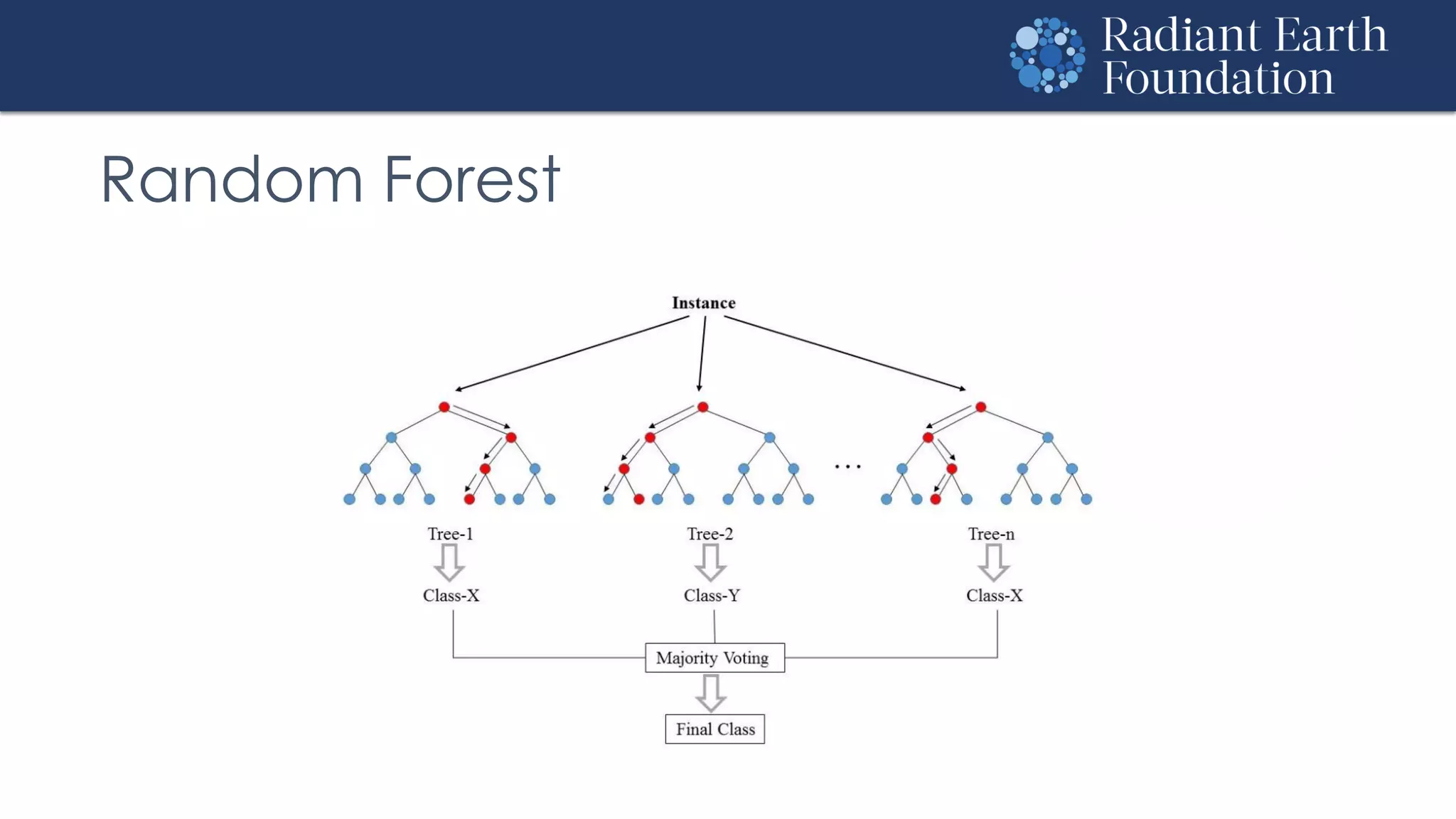
Random Forest
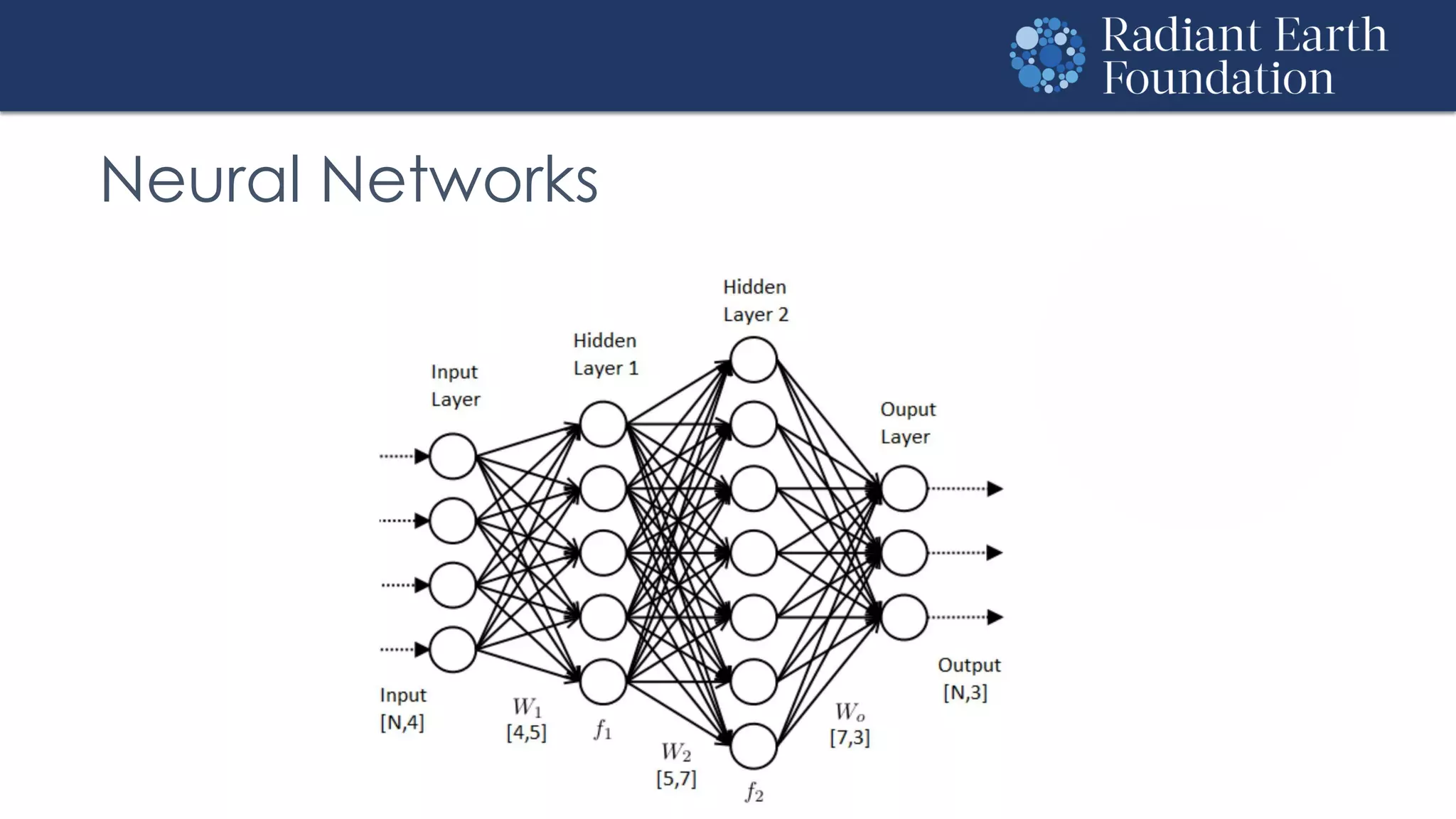
Neural Networks
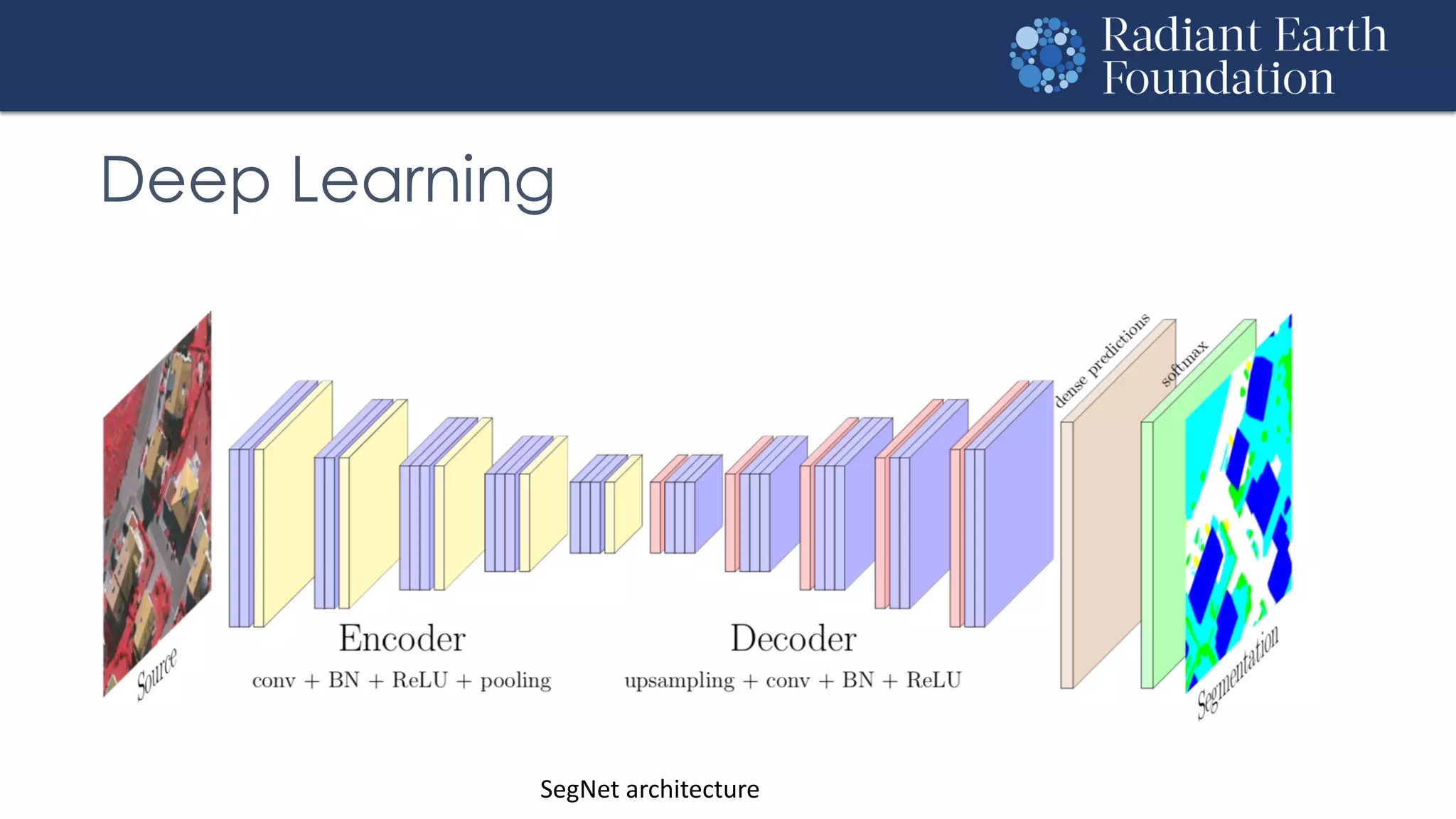
Deep Learning
SegNet architecture
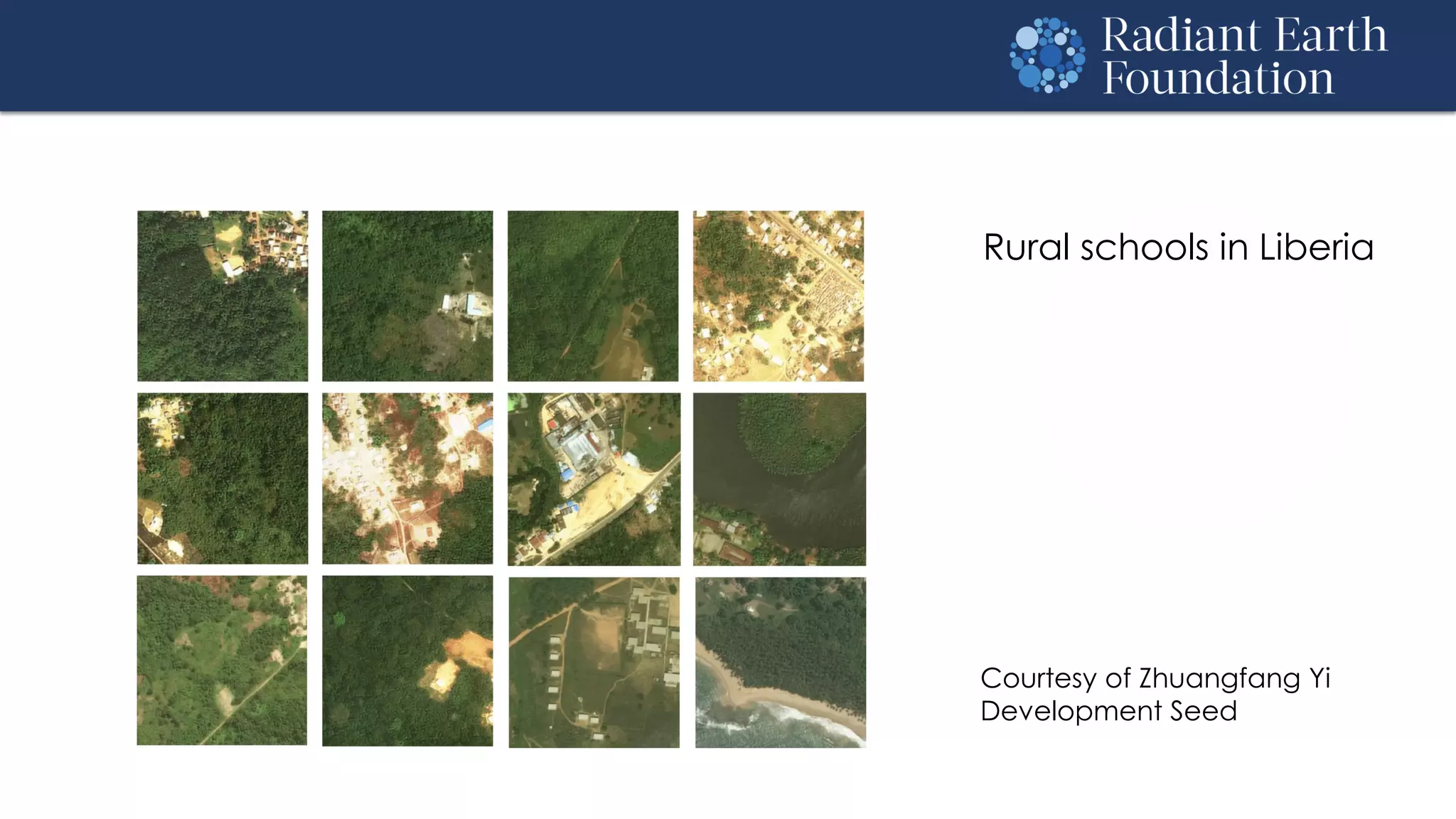
Rural schools in Liberia
Courtesy of Zhuangfang Yi
Development Seed
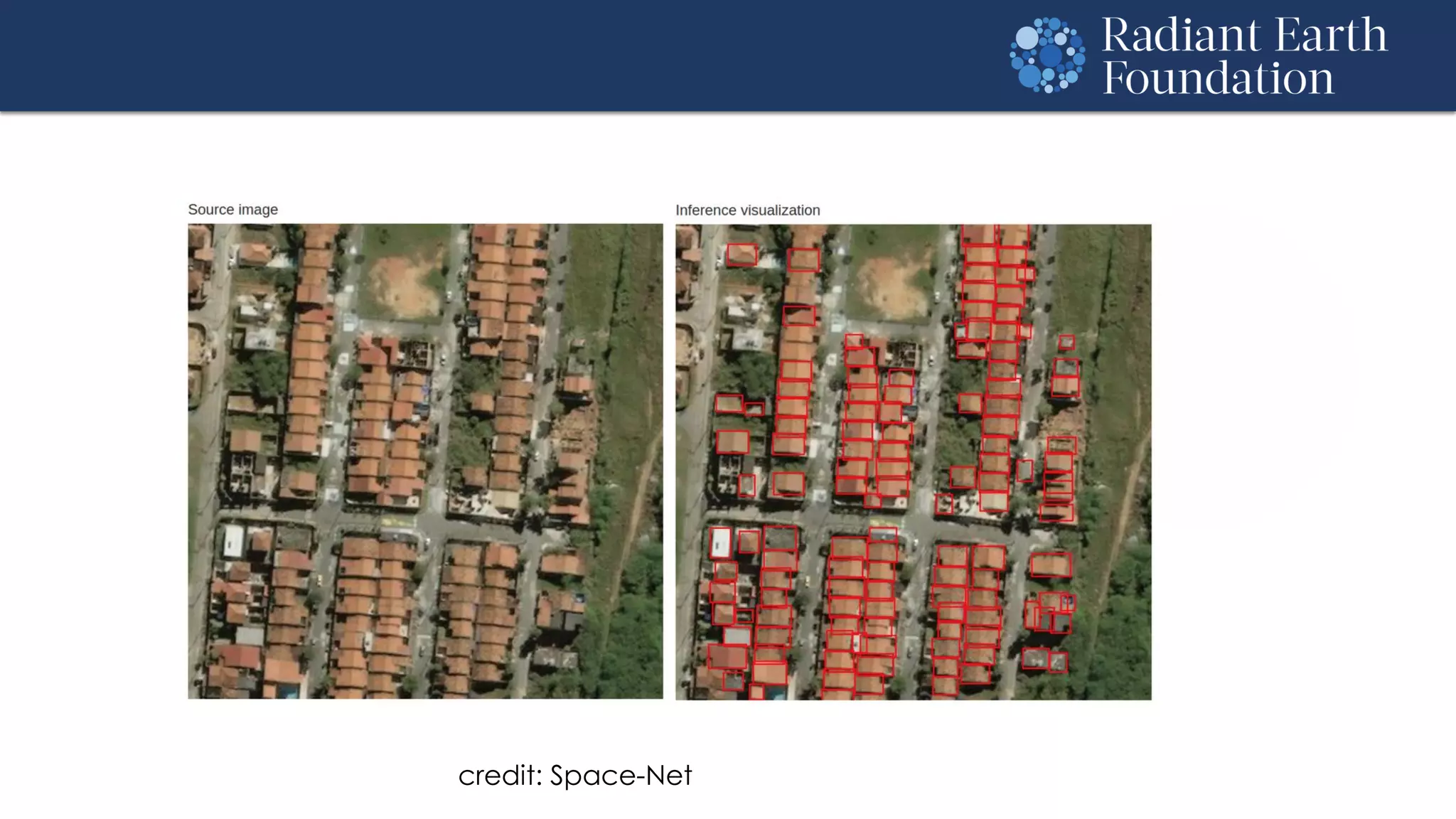
credit: Space-Net
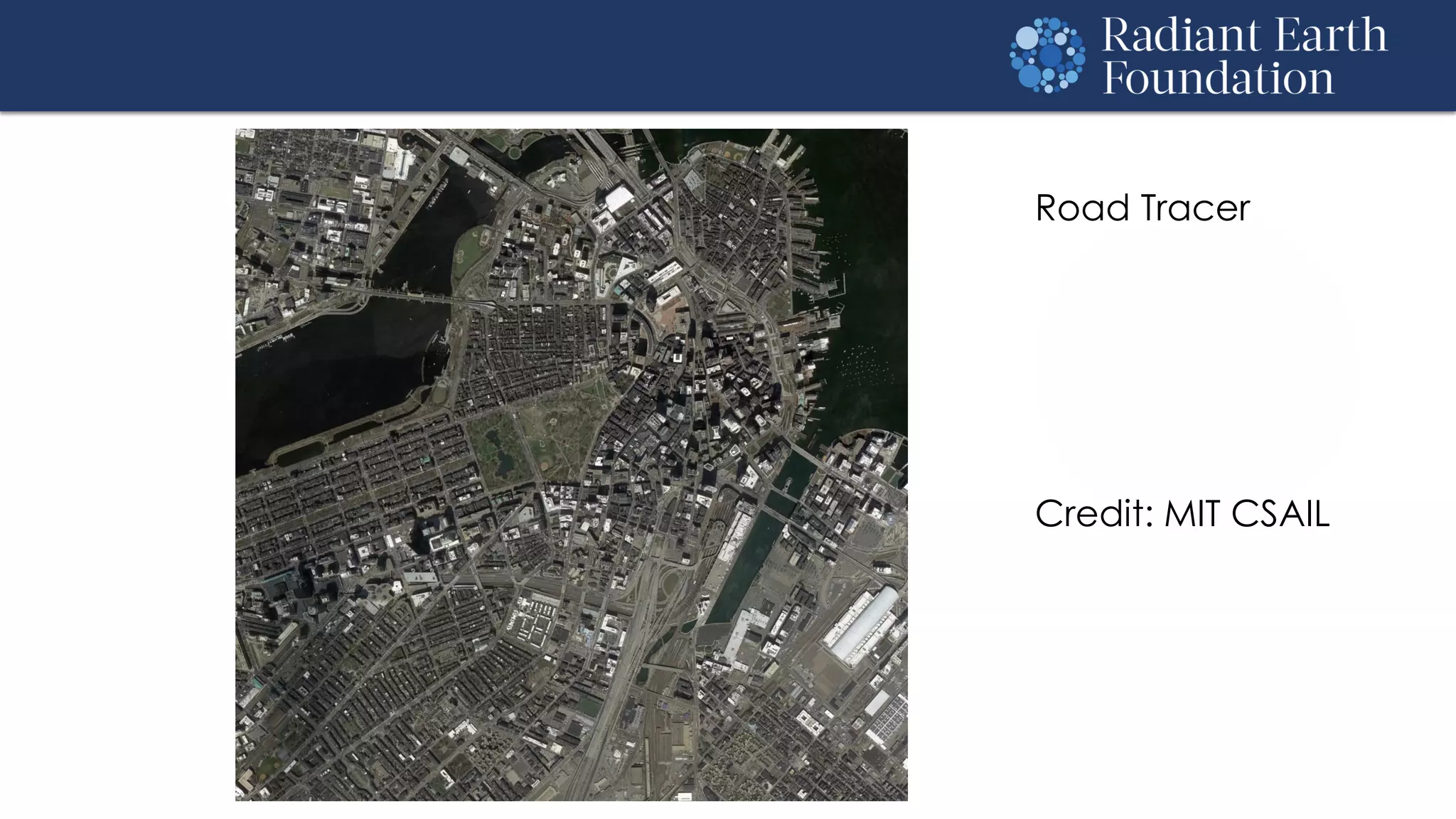
Road Tracer
Credit: MIT CSAIL
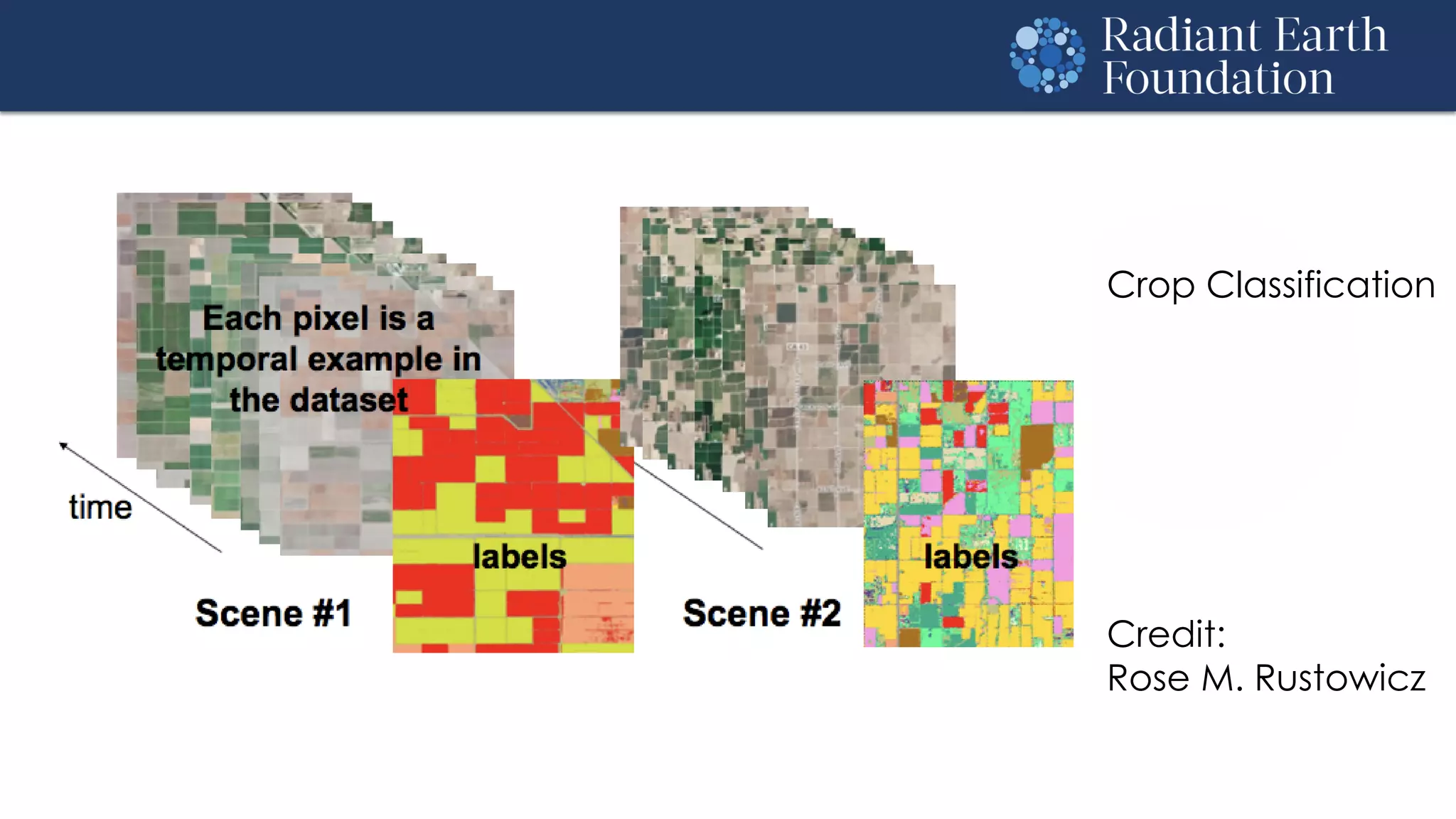
Crop Classification
Credit:
Rose M. Rustowicz
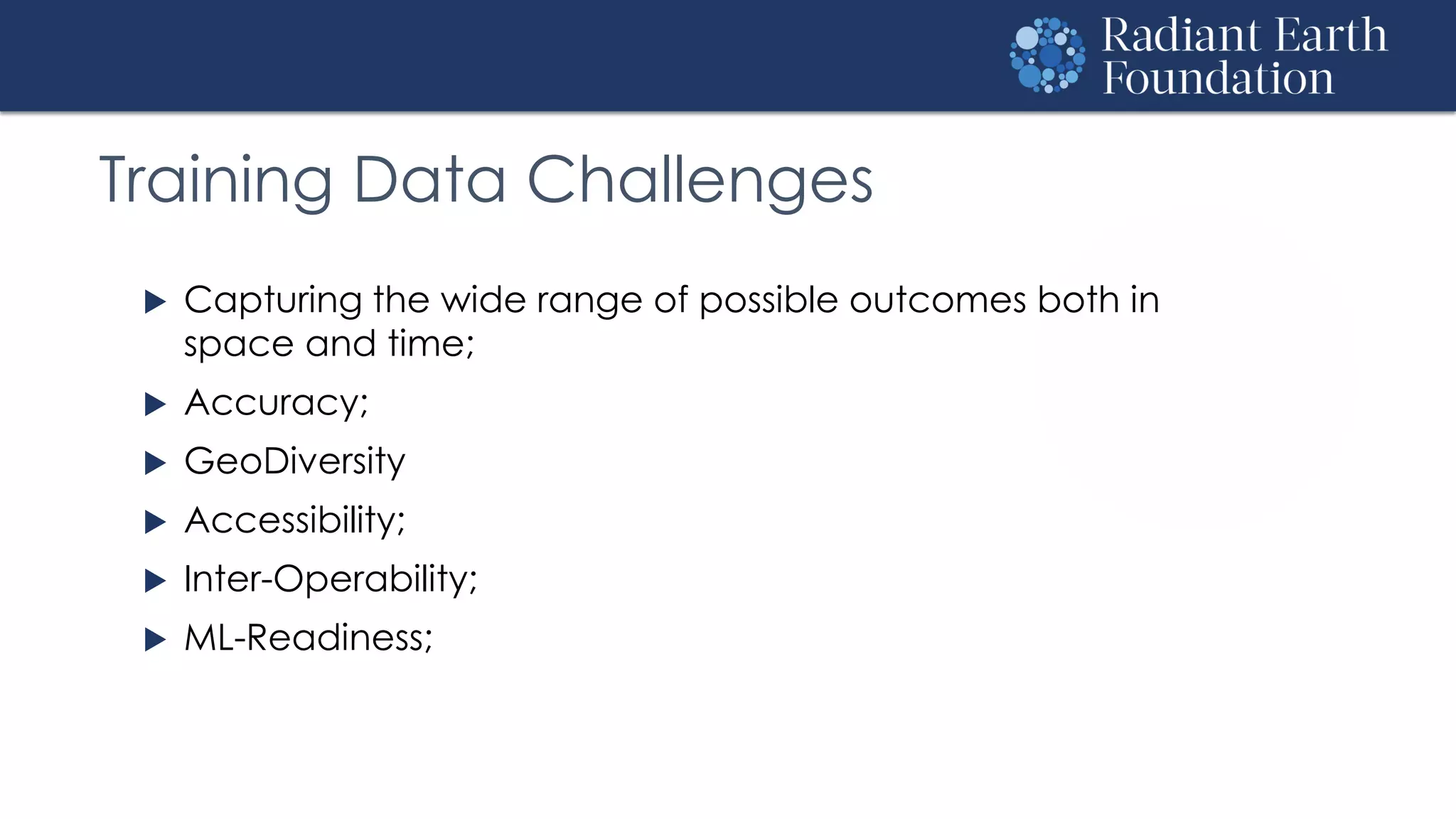
Training Data Challenges
 Capturing the wide range of possible outcomes both in
space and time;
 Accuracy;
 GeoDiversity
 Accessibility;
 Inter-Operability;
 ML-Readiness;
Open source machine learning commons
for Earth Observations.
Promoting creation of open libraries of labeled images and
algorithms to advance ML for global development, and
democratize ML applications for EO data.
Developers can join the collaborative initiative and
contribute their tools and knowledge on Github.
Imagery training data will be created as STAC compliant
and in COG format.
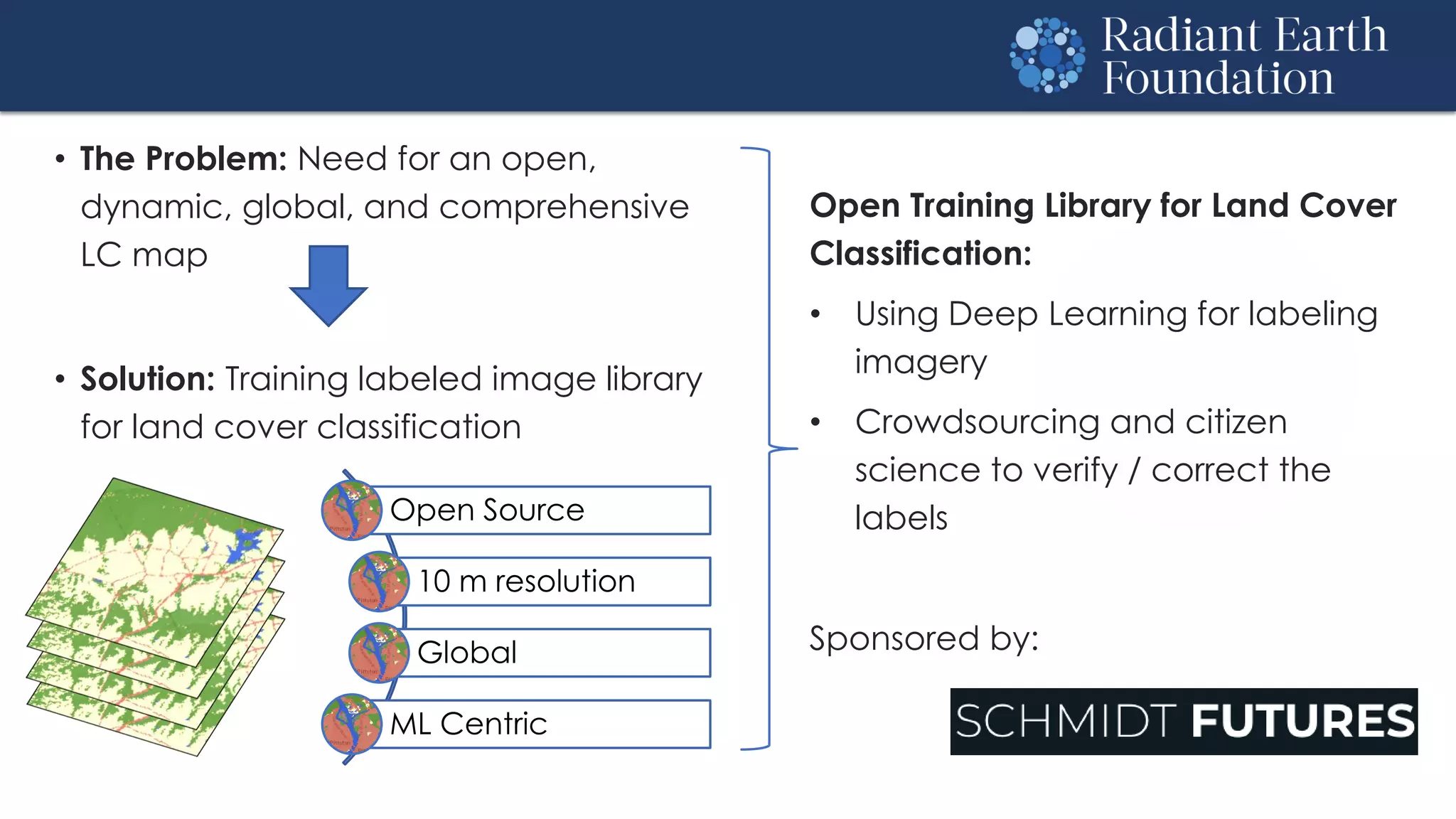
• The Problem: Need for an open,
dynamic, global, and comprehensive
LC map
Open Training Library for Land Cover
Classification:
• Using Deep Learning for labeling
imagery
• Crowdsourcing and citizen
science to verify / correct the
labels
Sponsored by:
Open Source
10 m resolution
Global
ML Centric
• Solution: Training labeled image library
for land cover classification
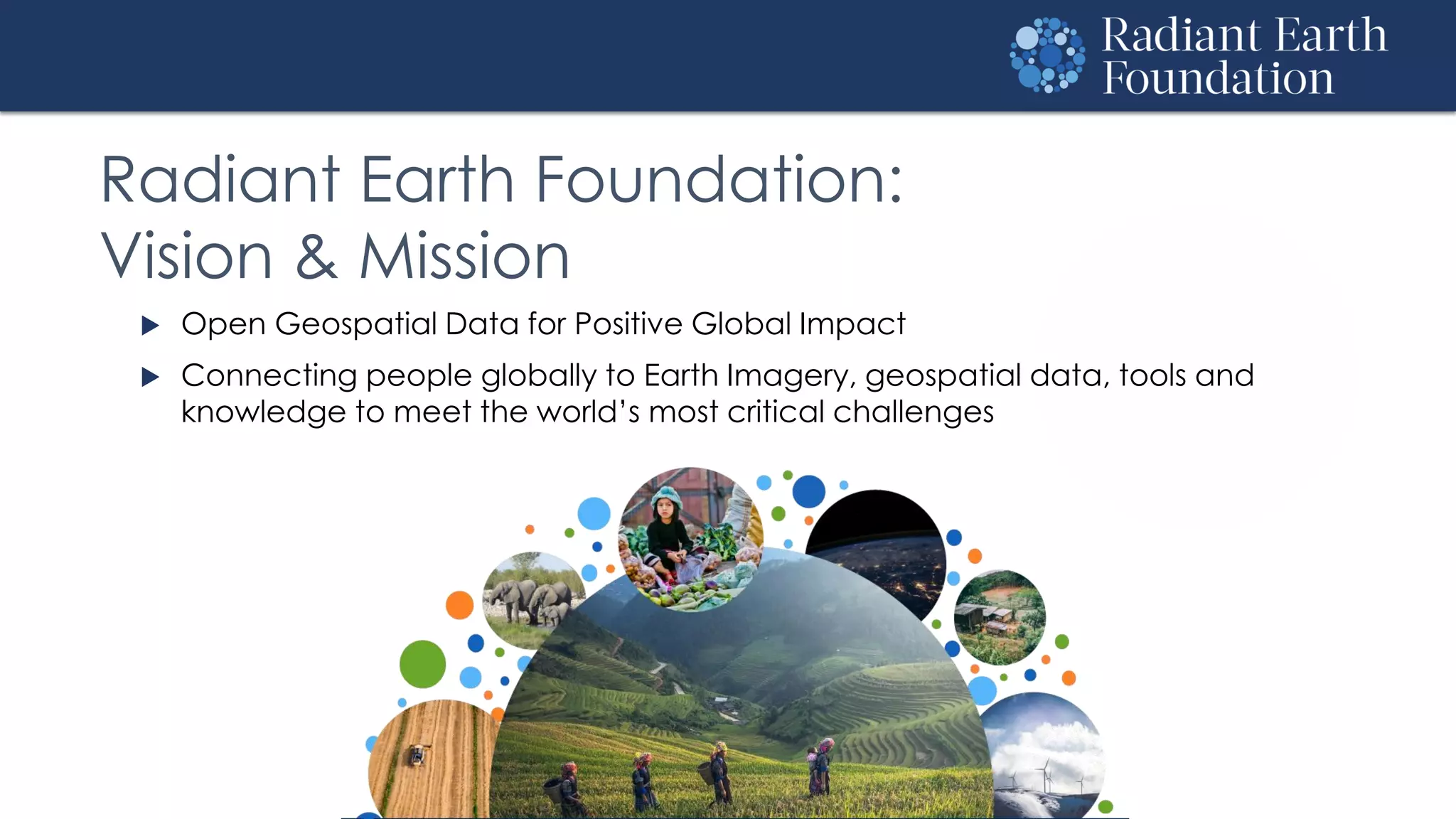
Radiant Earth Foundation:
Vision & Mission
 Open Geospatial Data for Positive Global Impact
 Connecting people globally to Earth Imagery, geospatial data, tools and
knowledge to meet the world’s most critical challenges
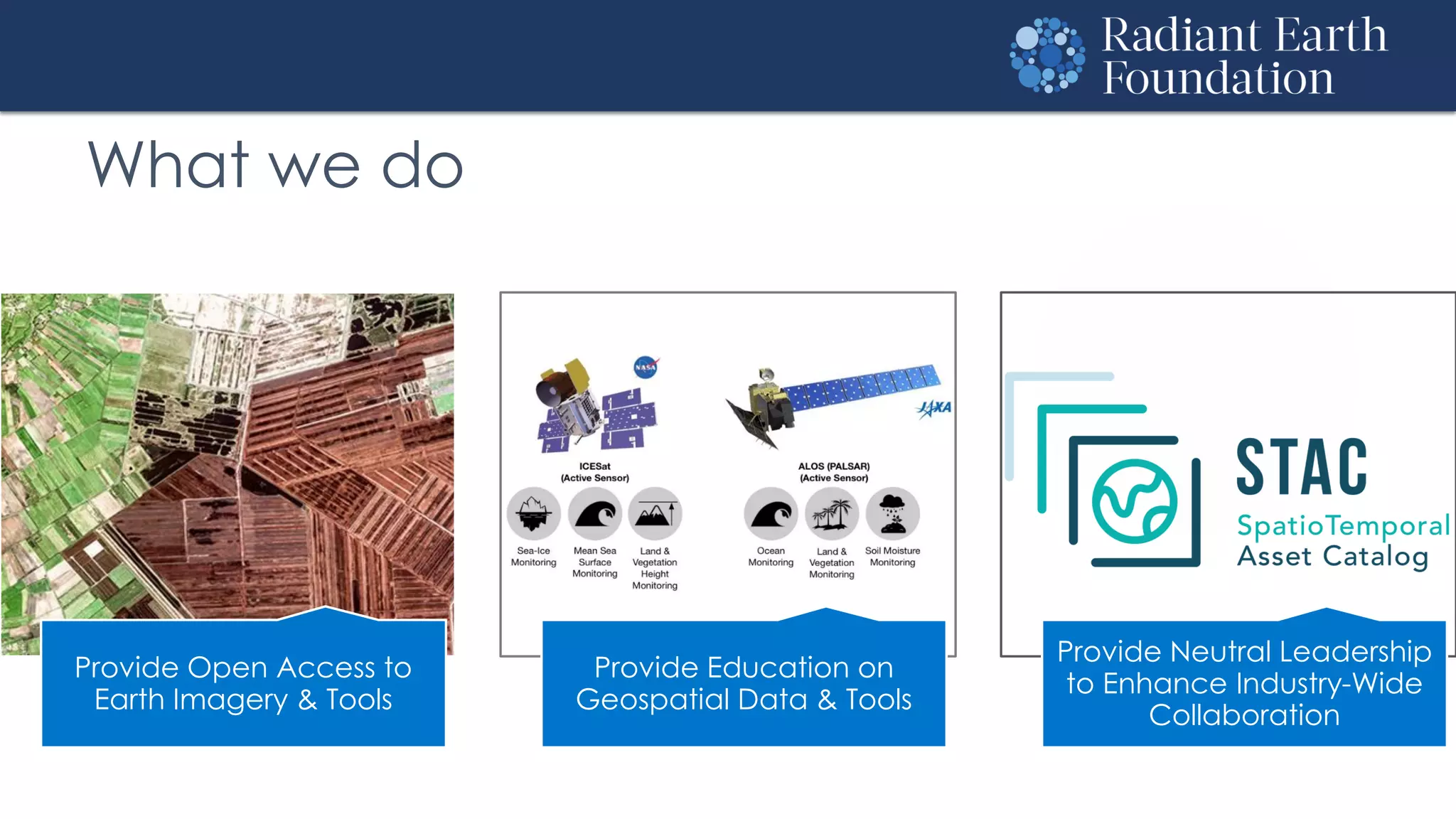
What we do
Provide Open Access to
Earth Imagery & Tools
Provide Education on
Geospatial Data & Tools
Provide Neutral Leadership
to Enhance Industry-Wide
Collaboration
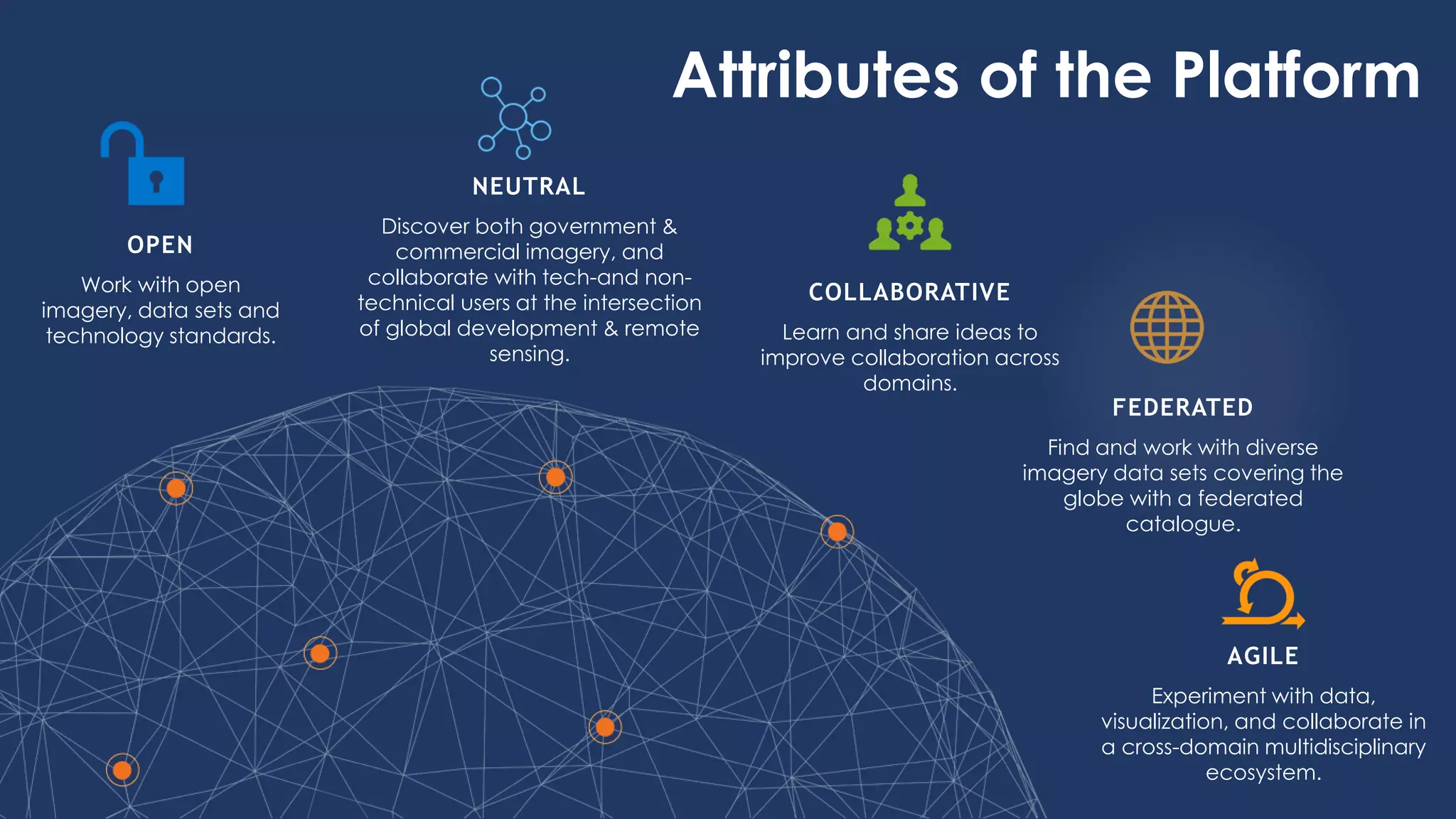
Attributes of the Platform
AGILE
Experiment with data,
visualization, and collaborate in
a cross-domain multidisciplinary
ecosystem.
OPEN
Work with open
imagery, data sets and
technology standards.
NEUTRAL
Discover both government &
commercial imagery, and
collaborate with tech-and non-
technical users at the intersection
of global development & remote
sensing.
COLLABORATIVE
Learn and share ideas to
improve collaboration across
domains.
FEDERATED
Find and work with diverse
imagery data sets covering the
globe with a federated
catalogue.
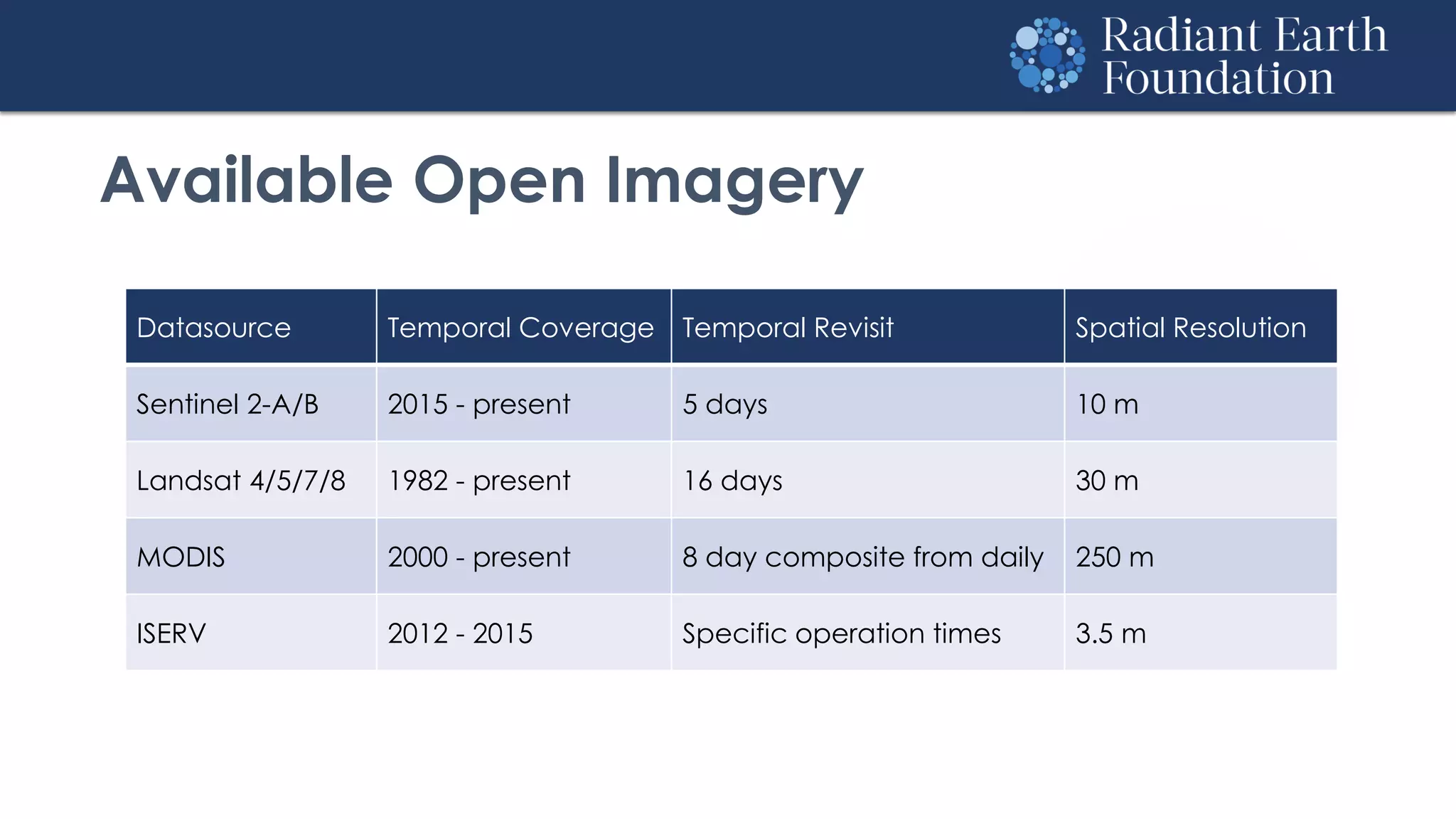
Available Open Imagery
Datasource Temporal Coverage Temporal Revisit Spatial Resolution
Sentinel 2-A/B 2015 - present 5 days 10 m
Landsat 4/5/7/8 1982 - present 16 days 30 m
MODIS 2000 - present 8 day composite from daily 250 m
ISERV 2012 - 2015 Specific operation times 3.5 m
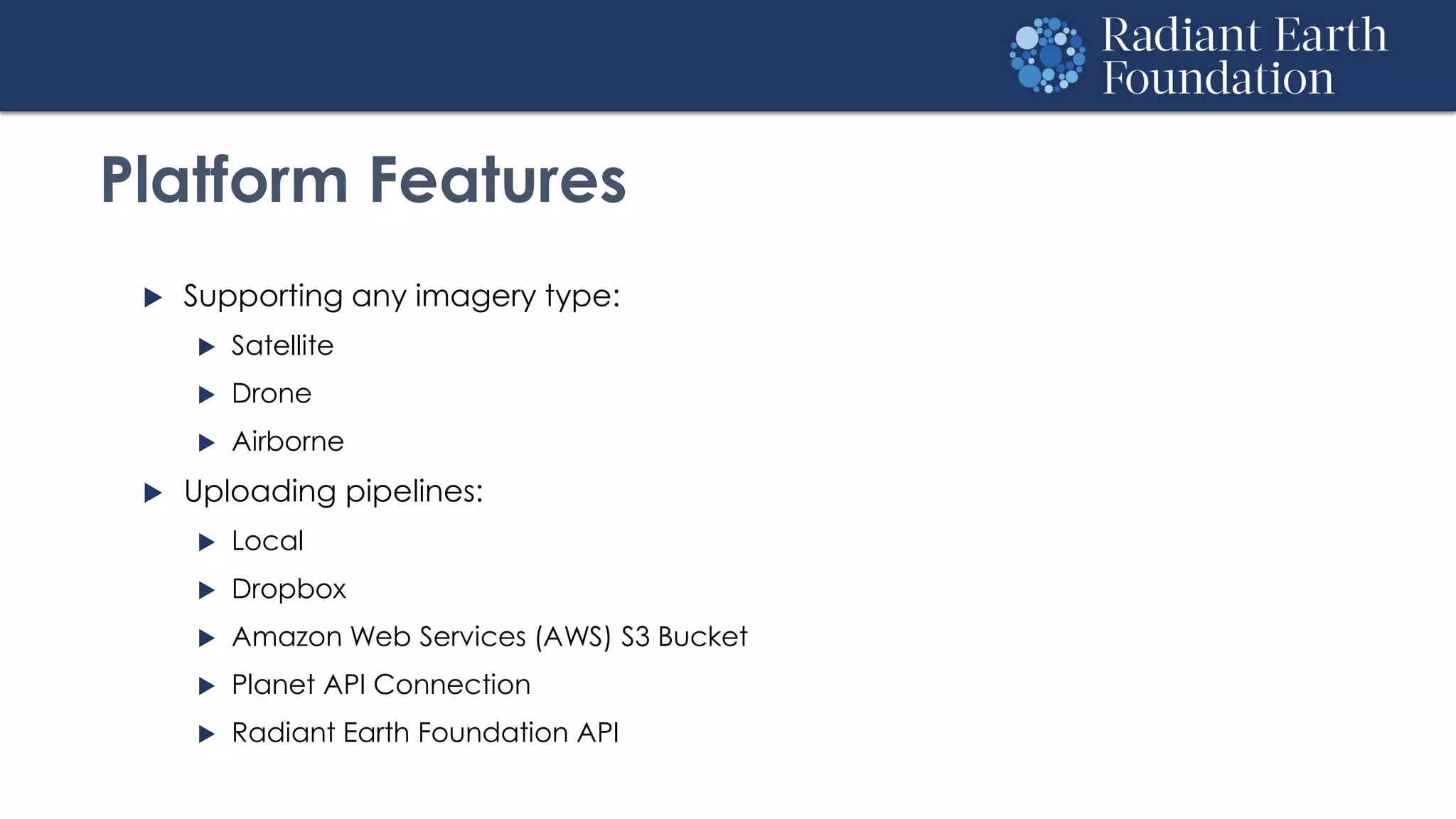
Platform Features
 Supporting any imagery type:
 Satellite
 Drone
 Airborne
 Uploading pipelines:
 Local
 Dropbox
 Amazon Web Services (AWS) S3 Bucket
 Planet API Connection
 Radiant Earth Foundation API
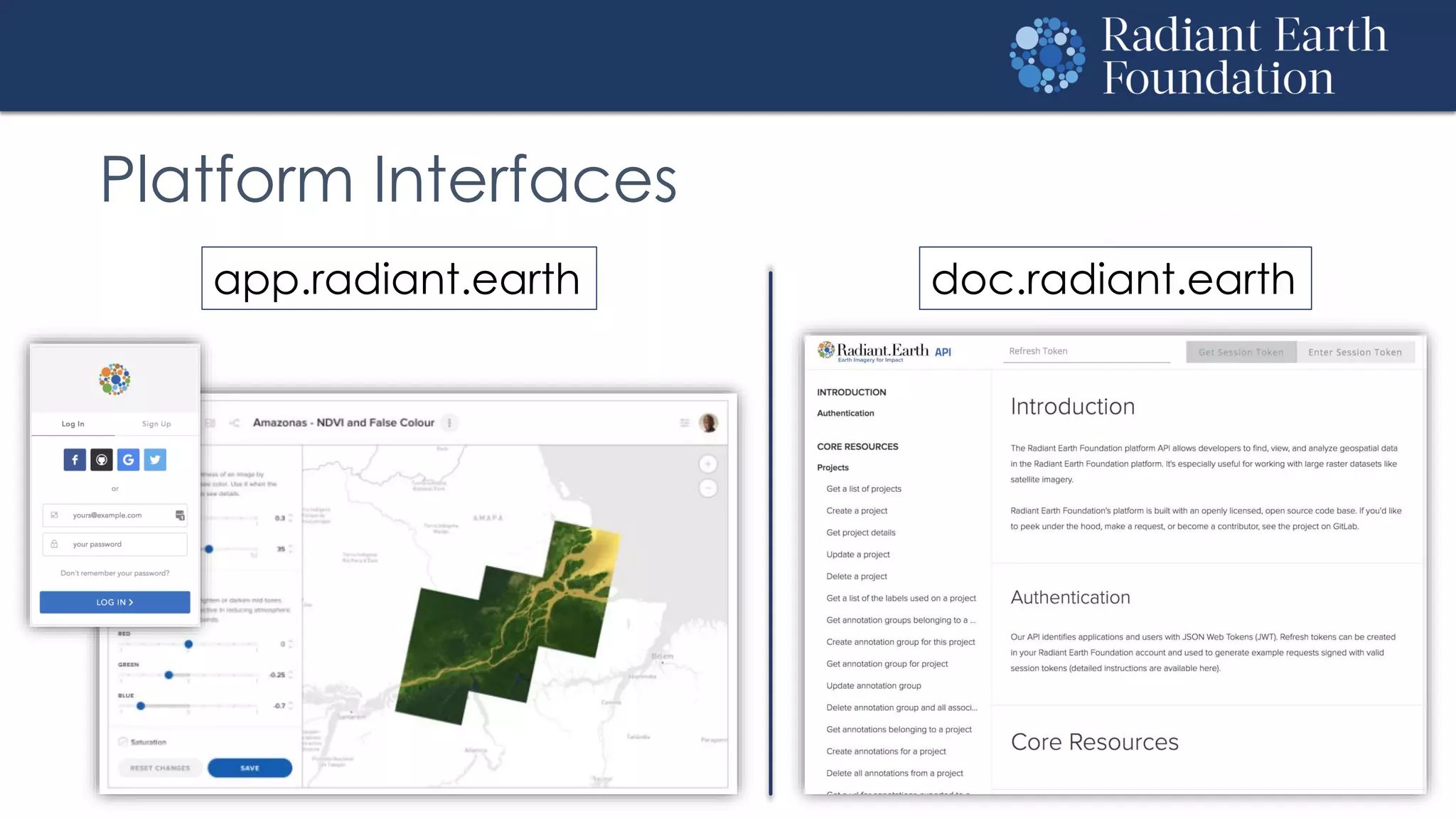
Platform Interfaces
app.radiant.earth doc.radiant.earth
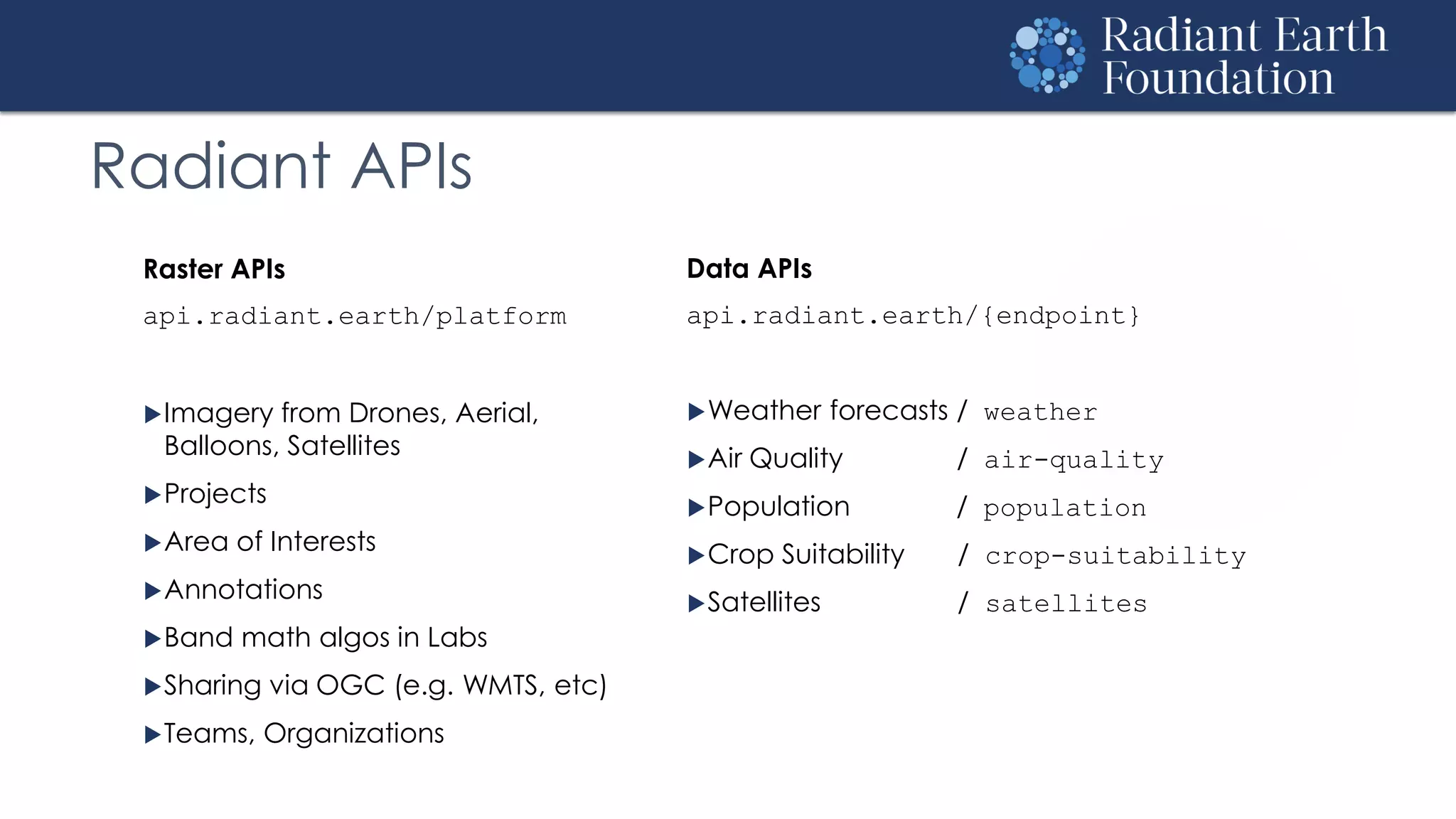
Radiant APIs
Raster APIs
api.radiant.earth/platform
Imagery from Drones, Aerial,
Balloons, Satellites
Projects
Area of Interests
Annotations
Band math algos in Labs
Sharing via OGC (e.g. WMTS, etc)
Teams, Organizations
Data APIs
api.radiant.earth/{endpoint}
Weather forecasts / weather
Air Quality / air-quality
Population / population
Crop Suitability / crop-suitability
Satellites / satellites
Platform Demonstration
Get in touch Follow Us
740 15th St NW, Suite 900
Washington DC 20005
+ 1. 202.596.3603
hello@radiant.earth
www.radiant.earth | app.radiant.earth | help.radiant.earth | demos.radiant.earth
@OurRadiantEarth
https://www.facebook.com/OurRadiantEarth
Q & A

IMED 2018: An intro to Remote Sensing and Machine Learning

  • 1.
    An Intro to RemoteSensing and Machine Learning HAMED ALEMOHAMMAD LEAD GEOSPATIAL DATA SCIENTIST, RADIANT EARTH FOUNDATION IMED, 2018, Vienna, Austria
  • 2.
    Remote Sensing Measurement ofa quantity associated with an object by a device not in direct contact with the object
  • 3.
    Satellite Remote Sensing Satellitescarry instruments or sensors which measure electromagnetic radiation coming from the earth- atmosphere system. 3
  • 4.
    Measuring Earth Surfaceand Atmospheric Properties  The intensity of reflected and emitted radiation to space is influenced by the surface and atmospheric conditions.  Thus, satellite measurements contain information about the surface and atmospheric conditions.
  • 5.
    Electromagnetic Radiation Earth-Ocean-Land-Atmosphere System: •Reflects solar radiation back to space • Emits Infrared and Microwave radiation to space
  • 6.
    Interaction with Vegetation Example:Healthy, green vegetation absorbs Blue and Red wavelengths and reflects Green and Infrared. Since we cannot see infrared radiation, we see healthy vegetation as green.
  • 7.
    Spectral Signatures inImagery Remotely sensed imagery acquires information in different wavelengths, representing different parts of the Electromagnetic Spectrum.
  • 8.
  • 9.
    Solar Induced Fluorescence(SIF)  Energy absorbed by plant through its chlorophyll used for gross primary production (GPP) lost as heat re-emitted (SIF: byproduct)  SIF responds to stressors (water, light, T). Babani, F., et al. 2005
  • 10.
    Except for Indonesiaall tropical regions exhibit some seasonal cycle due to light/water limitations
  • 11.
  • 12.
    Microwave | Thermal| Infrared |Visible| Visible-NIR Vegetation Index Solar Induced Fluorescence IR Thermal Radar Backscatters Passive-Microwave Optical Depth NDVI, EVI, … Photosynthesis Canopy Temp. & Evapotranspiration Top-Canopy Biomass Canopy-column Water Content
  • 13.
  • 14.
  • 15.
    Nitrogen Dioxide fromSentinel-5P Satellite credit: ESA
  • 16.
  • 17.
  • 19.
    Spatial Resolution Actual sizeof each pixel of the image
  • 20.
    Spatial Resolution vsExtent Generally, the higher the spatial resolution the less area is covered by a single image.
  • 22.
  • 23.
    Atmospheric Transparency Average cloudiness(2002 - 2015) NASA Earth Observatory
  • 25.
    Radar Measurements across PivotalAgricultural Systems Google Earth
  • 26.
    Credit: Jörgen Eriksson ArtificialIntelligence (AI) is about bringing together computers and humans in ways that enhance human life.
  • 27.
    Intelligence Augmentation (IA): Computationand data used to create services that augment human intelligence and creativity.  Search engine  Natural language translation Intelligent Infrastructure (II): A web of computation, data and physical entities that makes human environments more supportive, interesting and safe.  Starting to appear in domains such as transportation, medicine, commerce and finance. Credit: Michael Jordan, Professor at UC Berkeley
  • 28.
  • 30.
  • 31.
  • 32.
  • 33.
  • 34.
  • 35.
    Rural schools inLiberia Courtesy of Zhuangfang Yi Development Seed
  • 36.
  • 37.
  • 38.
  • 39.
    Training Data Challenges Capturing the wide range of possible outcomes both in space and time;  Accuracy;  GeoDiversity  Accessibility;  Inter-Operability;  ML-Readiness;
  • 40.
    Open source machinelearning commons for Earth Observations. Promoting creation of open libraries of labeled images and algorithms to advance ML for global development, and democratize ML applications for EO data. Developers can join the collaborative initiative and contribute their tools and knowledge on Github. Imagery training data will be created as STAC compliant and in COG format.
  • 41.
    • The Problem:Need for an open, dynamic, global, and comprehensive LC map Open Training Library for Land Cover Classification: • Using Deep Learning for labeling imagery • Crowdsourcing and citizen science to verify / correct the labels Sponsored by: Open Source 10 m resolution Global ML Centric • Solution: Training labeled image library for land cover classification
  • 42.
    Radiant Earth Foundation: Vision& Mission  Open Geospatial Data for Positive Global Impact  Connecting people globally to Earth Imagery, geospatial data, tools and knowledge to meet the world’s most critical challenges
  • 43.
    What we do ProvideOpen Access to Earth Imagery & Tools Provide Education on Geospatial Data & Tools Provide Neutral Leadership to Enhance Industry-Wide Collaboration
  • 44.
    Attributes of thePlatform AGILE Experiment with data, visualization, and collaborate in a cross-domain multidisciplinary ecosystem. OPEN Work with open imagery, data sets and technology standards. NEUTRAL Discover both government & commercial imagery, and collaborate with tech-and non- technical users at the intersection of global development & remote sensing. COLLABORATIVE Learn and share ideas to improve collaboration across domains. FEDERATED Find and work with diverse imagery data sets covering the globe with a federated catalogue.
  • 45.
    Available Open Imagery DatasourceTemporal Coverage Temporal Revisit Spatial Resolution Sentinel 2-A/B 2015 - present 5 days 10 m Landsat 4/5/7/8 1982 - present 16 days 30 m MODIS 2000 - present 8 day composite from daily 250 m ISERV 2012 - 2015 Specific operation times 3.5 m
  • 46.
    Platform Features  Supportingany imagery type:  Satellite  Drone  Airborne  Uploading pipelines:  Local  Dropbox  Amazon Web Services (AWS) S3 Bucket  Planet API Connection  Radiant Earth Foundation API
  • 47.
  • 48.
    Radiant APIs Raster APIs api.radiant.earth/platform Imageryfrom Drones, Aerial, Balloons, Satellites Projects Area of Interests Annotations Band math algos in Labs Sharing via OGC (e.g. WMTS, etc) Teams, Organizations Data APIs api.radiant.earth/{endpoint} Weather forecasts / weather Air Quality / air-quality Population / population Crop Suitability / crop-suitability Satellites / satellites
  • 49.
  • 51.
    Get in touchFollow Us 740 15th St NW, Suite 900 Washington DC 20005 + 1. 202.596.3603 hello@radiant.earth www.radiant.earth | app.radiant.earth | help.radiant.earth | demos.radiant.earth @OurRadiantEarth https://www.facebook.com/OurRadiantEarth Q & A