CHAPTER 1
Thinking skills
MGT 315
CREATIVE AND CRITICAL
THINKING
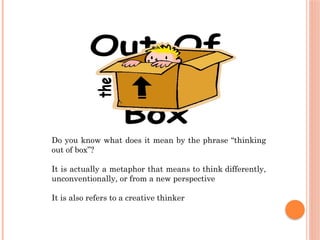
Do you know what does it mean by the phrase “thinking
out of box”?
It is actually a metaphor that means to think differently,
unconventionally, or from a new perspective
It is also refers to a creative thinker
LEARNING OBJECTIVES
 Student will be able to define thinking skills
 Student will learn the types of thinking skills
 Students will be able to learn the importance of
thinking skills
 Student will be able to examine the thinking
tools and ways to implement it.
DEFINE THINKING SKILLS
 Thinking skills is where an information is
process by using cognitive ability skill and
making meaning from it.
 In order for a person to effectively process the
information , one can be taught a specific
metacognitive strategies.
 Metacognitive strategies involve activities such
as planning how to approach a given learning
task and monitoring comprehension.
INTRODUCTION
Because whenever we
are dealing with
human life, we are
almost always
dealing with
thinking.
Thinking is the way
that the mind makes
sense of the world.
There is no way to
understand anything
except through
thinking.
 what there is
 what is happening
 what our problems are
 what our options are
 what threatens us
 what is important
 what is unimportant
 who our friends are
 who our enemies are
 what our “history” is
 who we are
 who loves us
Thinking tells us:
THINKING DETERMINES:
 what we learn
 how we learn
 what we think is important to learn
 what effort we should expend
 what we think is true
 what we think is false
 how things should be viewed
 whether our learning is of high or low
quality
 whether our learning is deep or superficial
Everything we know,
believe, want, fear and
hope for, our thinking
tells us.
Think of some problem
behavior your students
engage in.
See if you can identify the
thinking that leads to the
behavior.
THINKING
is
the core
of the curriculum
Critical Thinking
Is a Self-Directed
Process
By Which We Take
Deliberate Steps
To Think at the Highest
Level of Quality.
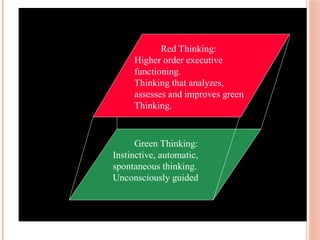
Red Thinking:
Higher order executive
functioning.
Thinking that analyzes,
assesses and improves green
Thinking.
Green Thinking:
Instinctive, automatic,
spontaneous thinking.
Unconsciously guided
Critical Thinking Is Not New
Socrates 2,400 years ago discovered by a
method of probing questioning that people
often could not rationally justify their
confident claims to knowledge.
In 1605, Francis Bacon, wrote the first book on
critical thinking, The Advancement of Learning,
in which he documented various forms of
human irrationality and the need to establish
new habits of thought through education.
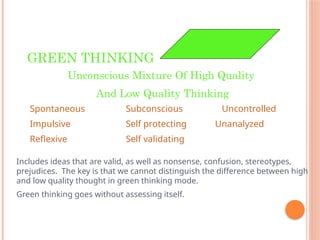
GREEN THINKING
Unconscious Mixture Of High Quality
And Low Quality Thinking
Spontaneous Subconscious Uncontrolled
Impulsive Self protecting Unanalyzed
Reflexive Self validating
Includes ideas that are valid, as well as nonsense, confusion, stereotypes,
prejudices. The key is that we cannot distinguish the difference between high
and low quality thought in green thinking mode.
Green thinking goes without assessing itself.
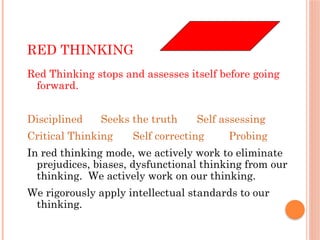
RED THINKING
Red Thinking stops and assesses itself before going
forward.
Disciplined Seeks the truth Self assessing
Critical Thinking Self correcting Probing
In red thinking mode, we actively work to eliminate
prejudices, biases, dysfunctional thinking from our
thinking. We actively work on our thinking.
We rigorously apply intellectual standards to our
thinking.
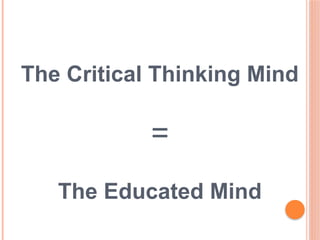
The Critical Thinking Mind
=
The Educated Mind
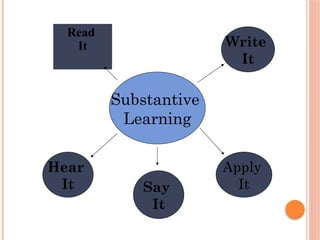
Substantive
Learning
Write
It
Hear
It Say
It
Apply
It
Read
It
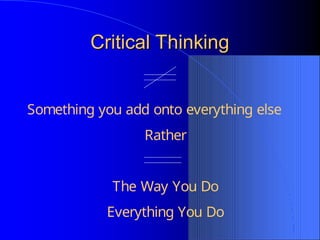
Critical Thinking
Critical Thinking
Something you add onto everything else
Rather
The Way You Do
Everything You Do
ACTIVITY: WHAT IS CRITICAL
THINKING?
To be clear in writing:
 1) state
 2) elaborate (In other words…)
 3) exemplify and/or illustrate
Write out the most important thing you know
about critical thinking, in this form:
1) Critical thinking is …..
2) In other words…
3) For example of…
THINK FOR YOURSELF: 1-1
BEGINNING TO
THINK ABOUT YOUR THINKING
 To begin to think about your thinking, make a list
of any problems you believe currently exist with
your thinking. Try to be as explicit as possible.
The more problems you identify the better. For
each problem you identify, complete the following
statements:
 1. One problem with my thinking is…
 2. This is a problem because…
 3. If I adequately addressed this problem, the
quality of my life would improve in the following
ways…
THINK FOR YOURSELF: 1-2
CRITIQUE YOUR THINKING
Consider your thinking in these domains of your life: at work, in personal
relationships, in teaching, in intimate relationships, as a reader, as a
writer, in planning your life, in dealing with your emotions, in figuring out
complex situations. Complete these statements:
 Right now, I believe my thinking across all domains of my life is of
______________ quality. I based this judgment on _________________.
 1. In the following areas, I think very well…
 2. In the following areas, my thinking is OK, not great, but not terrible
either…
 3. In the following areas, my thinking is probably of low quality…
 List at least three areas for each of the above.
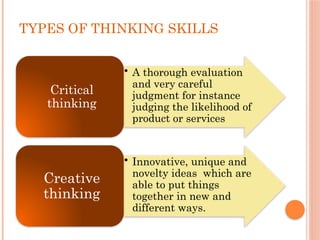
TYPES OF THINKING SKILLS
• A thorough evaluation
and very careful
judgment for instance
judging the likelihood of
product or services
Critical
thinking
• Innovative, unique and
novelty ideas which are
able to put things
together in new and
different ways.
Creative
thinking
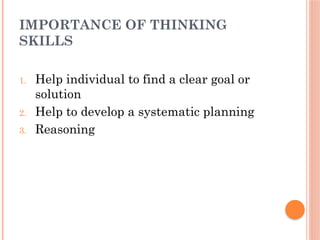
IMPORTANCE OF THINKING
SKILLS
1. Help individual to find a clear goal or
solution
2. Help to develop a systematic planning
3. Reasoning
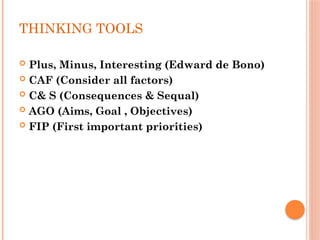
THINKING TOOLS
 Plus, Minus, Interesting (Edward de Bono)
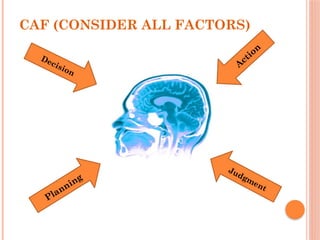
 CAF (Consider all factors)
 C& S (Consequences & Sequal)
 AGO (Aims, Goal , Objectives)
 FIP (First important priorities)
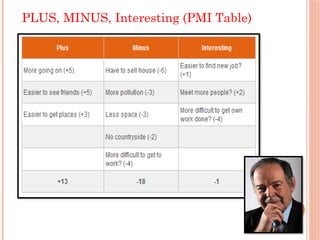
PLUS, MINUS, Interesting (PMI Table)
CAF (CONSIDER ALL FACTORS)
Decision
Planning
Judgment
A
ction
C&S (CONSEQUENCES & SEQUAL)
 Predicting consequences and effects
 Anticipatory thinking
 Short term effect
 Mid term effect
 Long term effect
AGO (AIMS, GOAL , OBJECTIVES)
 Focus on aims, goal and objective
 Focus thinking
 Understand the other people if we know their
AGO
FIP (FIRST IMPORTANT
PRIORITIES)
 Priority first
 Selecting the most important factor
 Eliminate the least important factor
SUMMARY
 Human is said to only use portion of its brain
capability.
 Human can actually boost their brain capability
by understanding specific types of thinking, how
they work, and practicing the various type of
thinking skills.
REFERENCES
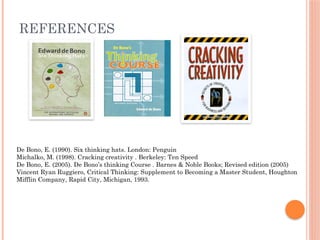
De Bono, E. (1990). Six thinking hats. London: Penguin
Michalko, M. (1998). Cracking creativity . Berkeley: Ten Speed
De Bono, E. (2005). De Bono’s thinking Course . Barnes & Noble Books; Revised edition (2005)
Vincent Ryan Ruggiero, Critical Thinking: Supplement to Becoming a Master Student, Houghton
Mifflin Company, Rapid City, Michigan, 1993.

Chapter 1-thinking skills managent_.pptx

  • 1.
    CHAPTER 1 Thinking skills MGT315 CREATIVE AND CRITICAL THINKING
  • 2.
    Do you knowwhat does it mean by the phrase “thinking out of box”? It is actually a metaphor that means to think differently, unconventionally, or from a new perspective It is also refers to a creative thinker
  • 3.
    LEARNING OBJECTIVES  Studentwill be able to define thinking skills  Student will learn the types of thinking skills  Students will be able to learn the importance of thinking skills  Student will be able to examine the thinking tools and ways to implement it.
  • 4.
    DEFINE THINKING SKILLS Thinking skills is where an information is process by using cognitive ability skill and making meaning from it.  In order for a person to effectively process the information , one can be taught a specific metacognitive strategies.  Metacognitive strategies involve activities such as planning how to approach a given learning task and monitoring comprehension. INTRODUCTION
  • 5.
    Because whenever we aredealing with human life, we are almost always dealing with thinking.
  • 6.
    Thinking is theway that the mind makes sense of the world.
  • 7.
    There is noway to understand anything except through thinking.
  • 8.
     what thereis  what is happening  what our problems are  what our options are  what threatens us  what is important  what is unimportant  who our friends are  who our enemies are  what our “history” is  who we are  who loves us Thinking tells us:
  • 9.
    THINKING DETERMINES:  whatwe learn  how we learn  what we think is important to learn  what effort we should expend  what we think is true  what we think is false  how things should be viewed  whether our learning is of high or low quality  whether our learning is deep or superficial
  • 10.
    Everything we know, believe,want, fear and hope for, our thinking tells us.
  • 11.
    Think of someproblem behavior your students engage in. See if you can identify the thinking that leads to the behavior.
  • 12.
  • 13.
    Critical Thinking Is aSelf-Directed Process By Which We Take Deliberate Steps To Think at the Highest Level of Quality.
  • 14.
    Red Thinking: Higher orderexecutive functioning. Thinking that analyzes, assesses and improves green Thinking. Green Thinking: Instinctive, automatic, spontaneous thinking. Unconsciously guided
  • 15.
    Critical Thinking IsNot New Critical Thinking Is Not New Socrates 2,400 years ago discovered by a method of probing questioning that people often could not rationally justify their confident claims to knowledge. In 1605, Francis Bacon, wrote the first book on critical thinking, The Advancement of Learning, in which he documented various forms of human irrationality and the need to establish new habits of thought through education.
  • 16.
    GREEN THINKING Unconscious MixtureOf High Quality And Low Quality Thinking Spontaneous Subconscious Uncontrolled Impulsive Self protecting Unanalyzed Reflexive Self validating Includes ideas that are valid, as well as nonsense, confusion, stereotypes, prejudices. The key is that we cannot distinguish the difference between high and low quality thought in green thinking mode. Green thinking goes without assessing itself.
  • 17.
    RED THINKING Red Thinkingstops and assesses itself before going forward. Disciplined Seeks the truth Self assessing Critical Thinking Self correcting Probing In red thinking mode, we actively work to eliminate prejudices, biases, dysfunctional thinking from our thinking. We actively work on our thinking. We rigorously apply intellectual standards to our thinking.
  • 18.
    The Critical ThinkingMind = The Educated Mind
  • 19.
  • 20.
    Critical Thinking Critical Thinking Somethingyou add onto everything else Rather The Way You Do Everything You Do
  • 21.
    ACTIVITY: WHAT ISCRITICAL THINKING? To be clear in writing:  1) state  2) elaborate (In other words…)  3) exemplify and/or illustrate Write out the most important thing you know about critical thinking, in this form: 1) Critical thinking is ….. 2) In other words… 3) For example of…
  • 22.
    THINK FOR YOURSELF:1-1 BEGINNING TO THINK ABOUT YOUR THINKING  To begin to think about your thinking, make a list of any problems you believe currently exist with your thinking. Try to be as explicit as possible. The more problems you identify the better. For each problem you identify, complete the following statements:  1. One problem with my thinking is…  2. This is a problem because…  3. If I adequately addressed this problem, the quality of my life would improve in the following ways…
  • 23.
    THINK FOR YOURSELF:1-2 CRITIQUE YOUR THINKING Consider your thinking in these domains of your life: at work, in personal relationships, in teaching, in intimate relationships, as a reader, as a writer, in planning your life, in dealing with your emotions, in figuring out complex situations. Complete these statements:  Right now, I believe my thinking across all domains of my life is of ______________ quality. I based this judgment on _________________.  1. In the following areas, I think very well…  2. In the following areas, my thinking is OK, not great, but not terrible either…  3. In the following areas, my thinking is probably of low quality…  List at least three areas for each of the above.
  • 24.
    TYPES OF THINKINGSKILLS • A thorough evaluation and very careful judgment for instance judging the likelihood of product or services Critical thinking • Innovative, unique and novelty ideas which are able to put things together in new and different ways. Creative thinking
  • 25.
    IMPORTANCE OF THINKING SKILLS 1.Help individual to find a clear goal or solution 2. Help to develop a systematic planning 3. Reasoning
  • 26.
    THINKING TOOLS  Plus,Minus, Interesting (Edward de Bono)  CAF (Consider all factors)  C& S (Consequences & Sequal)  AGO (Aims, Goal , Objectives)  FIP (First important priorities)
  • 28.
  • 29.
    CAF (CONSIDER ALLFACTORS) Decision Planning Judgment A ction
  • 30.
    C&S (CONSEQUENCES &SEQUAL)  Predicting consequences and effects  Anticipatory thinking  Short term effect  Mid term effect  Long term effect
  • 31.
    AGO (AIMS, GOAL, OBJECTIVES)  Focus on aims, goal and objective  Focus thinking  Understand the other people if we know their AGO
  • 32.
    FIP (FIRST IMPORTANT PRIORITIES) Priority first  Selecting the most important factor  Eliminate the least important factor
  • 33.
    SUMMARY  Human issaid to only use portion of its brain capability.  Human can actually boost their brain capability by understanding specific types of thinking, how they work, and practicing the various type of thinking skills.
  • 34.
    REFERENCES De Bono, E.(1990). Six thinking hats. London: Penguin Michalko, M. (1998). Cracking creativity . Berkeley: Ten Speed De Bono, E. (2005). De Bono’s thinking Course . Barnes & Noble Books; Revised edition (2005) Vincent Ryan Ruggiero, Critical Thinking: Supplement to Becoming a Master Student, Houghton Mifflin Company, Rapid City, Michigan, 1993.

Editor's Notes

  • #1 INSTRUCTION: VO MGT 315 – CREATIVE AND CRITICAL THINKING CHAPTER 1 Thinking skills
  • #2  Do you know what does it mean by the phrase “thinking out of box”? It is actually a metaphor that means to think differently, unconventionally, or from a new perspective It is also refers to a creative thinker
  • #3  There are four learning objective for Chapter 1 which are: 1. Student will be able to define thinking skills 2. Student will learn the types of thinking skills 3. Students will be able to learn the importance of thinking skills 4. Student will be able to examine the thinking tools and ways to implement it.
  • #4  Thinking skills is where an information is process by using cognitive ability skill and making meaning from it. In order for a person to effectively process the information , one can be taught a specific metacognitive strategies. Metacognitive strategies involve activities such as planning how to approach a given learning task and monitoring comprehension
  • #24  Critical thinking can be defined as a thorough evaluation and very careful judgment for instance judging the likelihood of product or services Creative thinking on the other hand is an innovative, unique and novelty ideas which are able to put things together in new and different ways
  • #25  1. Thinking skills help individual to find a clear goal or solution, which can be achieved by using mnemonic SMART (Specific, Measurable, Achievable, Realistic and Time-bounded) 2. Thinking skills help to develop a systematic planning by using correct method and correct procedure to achieve goal. 3. Thinking skills help in reasoning which means the process of forming conclusions, judgments, and decision making.
  • #26  There are several tools that can be use to increase the level of creative and critical thinking such as: 1. Plus, Minus, Interesting (Edward de Bono) 2. CAF (Consider all factors) 3. C& S (Consequences & Sequal) 4. AGO (Aims, Goal , Objectives) 5. FIP (First important priorities)
  • #27  How to Use the PMI Tool First, draw up three columns on a piece of paper. Head them 'Plus', 'Minus', and 'Interesting'. In the column underneath 'Plus', write down all the positive results of taking the action. Underneath 'Minus' write down all the negative effects. In the 'Interesting' column write down the implications and possible outcomes of taking the action, whether positive, negative, or uncertain.
  • #28 Example: A young professional is deciding where to live. Her question is 'Should she move to the big city?‘ She draws up the PMI table as follows Referring to the table, she scores the table as 13 (Plus) minus 18 (Minus) minus 1 (Interesting) = negative 6 For her, the comforts of a settled rural existence outweigh the call of the 'bright lights' thus it would be much better for her to live outside the city, but close enough to travel in if necessary.
  • #29  Second tool is CAF (Consider All Factors) CAF is a crystallization of the process of trying to consider all the factors in a situation. This thinking operation is essentially related to: 1. Action 2. Decision 3. Planning 4. Judgment When you have to choose or make a decision or  just think about something, there are always, many factors that you have to consider. If you leave out some of these factors, your choice may seem right at the time but will later turn out to be wrong.
  • #30  Third thinking tools will be C&S (Consequences & Sequal) A person that use this tools needs to predict the consequences and effects before making the decision. The effects can be short term, mid term and lastly long term effect.
  • #31  This fourth tools require a thinker to focus on their aims, goal and objective. It also need the thinker to be focus in their thinking process Lastly, we can understand other people by identifying their aims, goal and objective
  • #32  The last tool is FIP (first important priorities) a thinker can make a decision based on priority by selecting the most important factor and eliminate the least important factor.
  • #33  Human is said to only use portion of its brain capability. Human can actually boost their brain capability by understanding specific types of thinking, how they work, and practicing the various type of thinking skills.