THYROID DISORDERS AND ANAESTHESIA
PRESENTOR :DR. RAJESH CHOUDHURI
MODERATOR: DR. C.R. MONDAL, PROF. & HOD
PGT, DEPARTMENT OF ANAESTHESIOLOGY
AGMC & GBP HOSPITAL, AGARTALA
THYROID GLAND
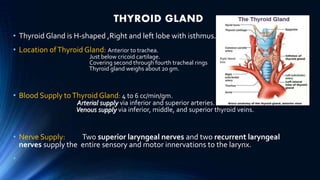
• Thyroid Gland is H-shaped ,Right and left lobe with isthmus.
• Location ofThyroid Gland: Anterior to trachea.
Just below cricoid cartilage.
Covering second through fourth tracheal rings
Thyroid gland weighs about 20 gm.
• Blood Supply toThyroid Gland: 4 to 6 cc/min/gm.
Arterial supply via inferior and superior arteries.
Venous supply via inferior, middle, and superior thyroid veins.
• Nerve Supply: Two superior laryngeal nerves and two recurrent laryngeal
nerves supply the entire sensory and motor innervations to the larynx.
•
THYROID GLAND
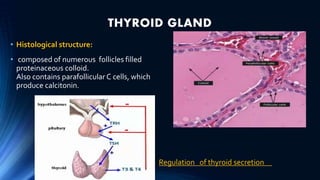
• Histological structure:
• composed of numerous follicles filled
proteinaceous colloid.
Also contains parafollicular C cells, which
produce calcitonin.
•
• Regulation of thyroid secretion
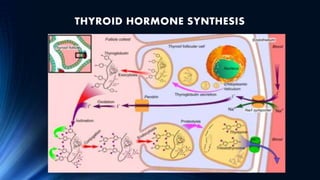
THYROID HORMONE SYNTHESIS
THYROID HORMONE: PHYSIOLOGY
-T4/T3 ratio in blood is 10:1. -
-In blood,T4 andT3 bind reversibly to three major proteins:TBG (80%),
prealbumin(10%) and albumin ( 5% to 10%).
-T3 is 3-4 times more active thanT4.
SITE OF ACTION: Cell nucleus → stimulates m RNA synthesis → controles protein synthesis.
Mitochondria→ oxidative phosphorylation and ATP formation.
Plasma membrane→influences transcellular flux of substrate and cations.
FUNCTIONS: 1. stimulates all metabolic processes.
2. influences growth and maturation of tissues, enhance tissue function.
3. stimulates protein synthesis ; carbohydrate and lipid metabolism.
4. Cardiac: acts directly on cardiac myocytes and vascular smooth muscle
cells. Increases myocardial contractility, decreases SVR, increases intravascular volume,
increases number of beta adrenergic rceptor.
5. CNS: effect on neuronal function and reflexes. Reaction time of stretch
reflex is shortened in hyperthyroidism. Also affects RAS.
SICK EUTHYROID SYNDROME
 Abnormal thyroid function tests that occur in the setting of acute and severe
nonthyroidal illness without pre-existing hypothalamic-pituitary and thyroid gland
dysfunction.
 Most common findings are a lowT3,T4 andTSH.
 Reversible after recovery from the illness.
 Partly caused by cytokines or other inflammatory mediators acting at the
hypothalamus, pituitary, thyoid gland and hepatic deiodinase system.
 Degree of abnormality correlates with the disease severity.
 Administration of thyroid hormones in this situation is controversial and has not been
shown to improve outcomes.
HYPERTHYROIDISM
• CAUSES: 1. Graves disease—most common cause.
2. toxic multinodular goiter.
3. TSH secreting pituitary tumor.
4. functioning thyroid adenomas.
5. overdose of thyroid replacement medications.
6. S/E of amiodarone/ irradiation thyroiditis.
• DIAGNOSIS: made by abnormal TFTs, elevated total and free T4, T3, low TSH,
raised free thyroxine index.
A TSH level of 0.1-0.4 munits/L with normal level of FT3 and FT4 is
diagnostic of subclinical hyperthyroidism.
A TSH level of less than 0.03 munits/L with elevated T3 and T4 is diagnostic
of overt hyperthyroidism.
HYPERTHYROIDISM
• CLINICAL MANIFESTATION:
classical symptoms: hyperactivity, weight loss and tremor.
Other symptoms: palpitation, anxiety/nervousness, diarrhea,
intolerance to heat, large muscle group weakness, menstrual abnormalities.
Signs: tachycardia ( ↑ sleeping PR), warm moist skin, irregularly
irregular pulse, fine brittle hair, ↑ CO, IHD, HF .
Eye signs: 1. Eyelid retraction.
2. Lid lag sign.
3. Joffroy sign-absence of wrinkling.
4. Mobius sign-difficulty in convergence.
5. Stellwag’s sign-absence of blinking.
HYPERTHYROIDISM
TREATMENT:
1. Antithyroid drugs: methimazole or proylthiouracil ( PTU)
-interfere with thyroid hormone synthesis. PTU also inhibits the peripheral
conversion ofT4 toT3.
- euthyroid state can almost always be achieved within 6-8 weeks.
- S/E: agranulocytosis, hepatotoxicity, vasculitis, teratogenicity.
2. Iodide: Inhibit hormone release. Effects occur immediately but short –lived.
Reserved for hyperthyroid patients for surgery, thyroid storm, severe
thyrocardiac disease.
Potassium iodide- 3 drops PO every 8 hrly for 10-14 days.
Lithium carbonate 300 mg PO every 6 hrly .
3. beta adrenergic antagonists: relieve signs and symptoms of increased
adrenergic activity. Propanolol has the added feature-inhibit conversion ofT4 toT3.
4. radioactive iodine and subtotal thyroidectomy: other alternative to
medical therapy.
HYPERTHYROIDISM: ANAESTHETIC CONSIDERATIONS
• Pre-operative consideration
Antithyroid medications and beta blockers should be continued through the morning of
surgery.
Miller: ideally patients should be rendered euthyroid prior to any elective procedure .
Begining pre-op antithyroid medication take 2-6 weeks for effect, can use KI with beta-
blockers in addition or alternatively.
Benzodiazepines are good choice for pre-medication.
Carefull evaluation of air-way.
HYPERTHYROIDISM: ANAESTHETIC CONSIDERATIONS
• Intra-operative considerations:
No controlled study suggest advantages of particular anaesthetic drug or technique
for hyperthyroid patients, however:
Drugs that stimulate SNS should be avoided because of the possibility of large
increase in BP and HR. Ex-ketamin, pancuronium, atropine, ephedrine.
Thiopental may be the induction agent of choice as it possesses antithyroid activity
at high doses.
Close monitoring of cardiac function and body temperature. Need for invasive
monitoring?
Adequate anaesthetic depth should be obtained prior to laryngoscopy or surgical
stimulation to avoid tachycardia, Htn., ventricular arrhythmia.
HYPERTHYROIDISM: ANAESTHETIC CONSIDERATIONS
• Intra-operative considerations:
Anticipate exacerbated hypotensive response during induction as patient may be
hypovolaemic.
Eye protection.
Muscle relaxants can be used safely. Note: patients with autonomic thyrotoxicosis are
associated with increased risk of myopathies and myesthenia gravis.
Reversal with glycopyrolate instead of atropine.
Hyperthyroidism doesn’t increase MAC requirements, volatile agents can be used safely.
HYPERTHYROIDISM: ANAESTHETIC CONSIDERATIONS
• Post-operative considerations:
 thyroid storm is the most-serious post operative problem.
Precipitating factors: trauma, infection, medical illness or surgery.
Characterized by: hyperpyrexia, tachycardia, hypermetabolism, altered conciousness and
hypertension.
Incidence is 10% in patients hospitalized for thyrotoxicosis.
Onset is 6-24 hrs after surgery, but can happen intra-operatively mimicking MH.
Thyroid hormone levels may not be significantly higher than during uncomplicated
hyperthyroidism.
Unlike MH, not associated with muscle rigidity, ↑ CPK or marked degree of lactic or
respiratory acidosis.
HYPERTHYROIDISM: ANAESTHETIC CONSIDERATIONS
Thyroid storm: treatment
IV hydration with glucose containing crystalloids and cooling measures.
Beta-blockers: IV propanolol ( 0.5 mg increments) , esmolol to control HR until < 90/m.
PTU 200-400 microgram every 8 hrly orally or by NG tube/rectally.
Sodium iodide 1 gm over 12 hrs.
Correction of any precipitating events ( infection).
Dexamethasone 2 mg every 6 hrly or Cortisol 100-200 mg every 8 hrly.
Mortality rate is approximately 20%.
ANAESTHETIC CONSIDERATIONS: SUBTOTAL THYROIDECTOMY
• Associated with several complications:
 recurrent laryngeal nerve palsy can cause hoarseness if unilateral , or stridor
if bilateral.
Vocal cord function may be evaluated by DL after deep extubation if there is
concern.
Haematoma formation may cause airway compromise . May require
immediate opening of neck wound.
Hypothyroidism may result from unintentional removal of parathyroid gland .
Hypocalcaemia will result within 24-72 hrs.
Pneumothorax-may be developed.
HYPOTHYROIDISM
• INCIDENCE: 0.5%TO 0.8% of adult population; ten times more common in females.
• CAUSES: - primary hypothyroidism—95% of all cases.
-autoimmunue ( Hashimoto’s thyroiditis)
-post radioactive iodine.
-post thyroidectomy.
-overdose of anti-thyroid medication.
- iodine deficiency.
-secondary hypothyroidism( failure of the hypothalamo-pituitary axis)
• DIAGNOSIS: can be confirmed by low free thyroxin levels and elevatedTSH( if free).
ATSH level of 5.0 to 10 milliunits/L with normal levels of FT3 and FT4 is
diagnostic of subclinical hypothyroidism.
ATSH level of more than 20 milliunits/L with reduced levels ofT3 andT4 is
diagnostic of overt hypothyroidism.
HYPOTHYROIDISM
• CLINICAL MANIFESTATIONS:
Hypothyroidism in early neonatal development may result in cretinism.
In adults, manifestation can be subtle: weight gain, cold intolerance, muscle fatigue,
lathergy ,constipation, hypoactive muscle reflexes, depression, periorbital or pre-tibial
swelling.
HR, contractility , stroke-volume and CO decreases, extremity may be cold, hair may be
coarse and brittle, large tongue.
Anaemia, hypoglycaemia, hyponatraemia, ↑ cholesterol levels.
ECG: flattened or inverted T waves, low amplitude P waves and QRS
complexes, sinus bradycardia, ventricular dysarrythmia.
HYPOTHYROIDISM
• TREATMENT:
• Oral replacements.
• L-thyroxine: started with 50-100 microgram ( 25 mcg in the elderly or in the
patients with IHD)
Titrated by clinical improvement and by monitoring TSH level.
T4 has a half-life of 7 days, onset of action 12 hrs and takes almost 2 weeks
for peak action.
T3 has a half-life of 1.5 days and is available in injected form.
HYPOTHYROIDISM: ANAESTHETIC CONSIDERATION
• PRE-OPERATIVE:
Patients with uncorrected severe hypothyroidism ( T4<1 mcg/dl) or
myxedema coma should not undergo elective surgery. Potential for severe
cardiovascular instability intra-operatively and myxedema coma.
If emergency surgery is necessary, in patients with overt ds. Or myxedema
coma , IV thyroxine and steroid coverage.
Euthyroid state is ideal, however, subclinical cases of hypothyroidism has not
been shown to significantly increase risk of surgery.
Continue thyroid replacement medication on morning of surgery.
HYPOTHYROIDISM: ANAESTHETIC CONSIDERATION
• PRE-OPERATIVE:
Air-way evaluation : patients tend to be obese, large tongue, short neck, swelling of
upper airway.
Pre-op sedation should be administered cautiously if at all, as patients are more prone
to drug induced respiratory depression from sedation and narcotics.
Consider aspiration prophylaxis-delayed gastric emptying.
Increased incidence of adrenocortical insufficiency and reduced adrenocorticotropic
hormone response to stress—patients should receive hydrocortisone cover during
surgery.
Specific investigations: Hb, platelet count and clotting tests, serum electrolytes, Bld.
Sugar, ECG.
HYPOTHYROIDISM: ANAESTHETIC CONSIDERATION
• INTRA-OPERATIVE:
Patients are more sensitive to hypotensive effects of anaesthetic agents because of decreased CO,
blunted baroreceptor reflexes and decreased intravascular vol,; invasive monitoring on a per
patient basis.
Ketamin or etomidate may be induction agent of choice.
Succinylcholine and NDMRs are generally safe for use; monitor with peripheral nerve stimulator.
Controlled ventilation is recommended as patients tend to hypoventilate.
Hypothermia occurs quickly and difficult to prevent and treat.
MAC is essentially unchanged.
Haematological ( anaemia, platelet, coag dusfx) abnormalities, electrolyte imbalance and
hypoglycaemia are common and require close monitoring intra-operatively.
HYPOTHYROIDISM: ANAESTHETIC CONSIDERATION
• MYXEDIMA COMA:
Rare form of decompensated hypothyroidism.
Characterised by stupor or coma, hypoventilation, hypothermia, bradycardia,
hypotension and severe dilutional hypontraemia( SIADH) , CHF.
Medical emergency with mortality rate of 15-20%.
Infection, trauma, cold, CNS depressants predispose hypothyroid patients, especially in
elderly.
Treatment: IV thyroxine is indicated( L-thyroxine loading dose 300-500 mcg followed by 50
mcg/day for 24-48 Hrs)
IV hydration with dextrose containing crystalloids , correction of electrolyte
imbalance.
Support cardio-vascular and pulmonary system as necessary.
OTHER PERIOPERATIVE CONSIDERATIONS
Eyes should be protected especially if exophthalmos is present.
The patient is positioned slightly head up to help venous drainage.
Neck is hyper extended and should be well-established.
Extension tubing for iv lines and long respiratory hoses may be required.
Valsalva maneuver inTrendelenberg position is carried out to check hemostasis.
Steroids may be given if extensive tracheal handling and edema suspected.
Extubation should be smooth and coughing should be avoided to prevent bleeding.
The possibility of tracheomalacia and vocal cord palsy should be kept in mind.
Surgeon may wish to observe the movement of vocal cord at the end of operation.
Thyroid ppt [autosaved]

Thyroid ppt [autosaved]

  • 1.
    THYROID DISORDERS ANDANAESTHESIA PRESENTOR :DR. RAJESH CHOUDHURI MODERATOR: DR. C.R. MONDAL, PROF. & HOD PGT, DEPARTMENT OF ANAESTHESIOLOGY AGMC & GBP HOSPITAL, AGARTALA
  • 2.
    THYROID GLAND • ThyroidGland is H-shaped ,Right and left lobe with isthmus. • Location ofThyroid Gland: Anterior to trachea. Just below cricoid cartilage. Covering second through fourth tracheal rings Thyroid gland weighs about 20 gm. • Blood Supply toThyroid Gland: 4 to 6 cc/min/gm. Arterial supply via inferior and superior arteries. Venous supply via inferior, middle, and superior thyroid veins. • Nerve Supply: Two superior laryngeal nerves and two recurrent laryngeal nerves supply the entire sensory and motor innervations to the larynx. •
  • 3.
    THYROID GLAND • Histologicalstructure: • composed of numerous follicles filled proteinaceous colloid. Also contains parafollicular C cells, which produce calcitonin. • • Regulation of thyroid secretion
  • 4.
  • 5.
    THYROID HORMONE: PHYSIOLOGY -T4/T3ratio in blood is 10:1. - -In blood,T4 andT3 bind reversibly to three major proteins:TBG (80%), prealbumin(10%) and albumin ( 5% to 10%). -T3 is 3-4 times more active thanT4. SITE OF ACTION: Cell nucleus → stimulates m RNA synthesis → controles protein synthesis. Mitochondria→ oxidative phosphorylation and ATP formation. Plasma membrane→influences transcellular flux of substrate and cations. FUNCTIONS: 1. stimulates all metabolic processes. 2. influences growth and maturation of tissues, enhance tissue function. 3. stimulates protein synthesis ; carbohydrate and lipid metabolism. 4. Cardiac: acts directly on cardiac myocytes and vascular smooth muscle cells. Increases myocardial contractility, decreases SVR, increases intravascular volume, increases number of beta adrenergic rceptor. 5. CNS: effect on neuronal function and reflexes. Reaction time of stretch reflex is shortened in hyperthyroidism. Also affects RAS.
  • 6.
    SICK EUTHYROID SYNDROME Abnormal thyroid function tests that occur in the setting of acute and severe nonthyroidal illness without pre-existing hypothalamic-pituitary and thyroid gland dysfunction.  Most common findings are a lowT3,T4 andTSH.  Reversible after recovery from the illness.  Partly caused by cytokines or other inflammatory mediators acting at the hypothalamus, pituitary, thyoid gland and hepatic deiodinase system.  Degree of abnormality correlates with the disease severity.  Administration of thyroid hormones in this situation is controversial and has not been shown to improve outcomes.
  • 7.
    HYPERTHYROIDISM • CAUSES: 1.Graves disease—most common cause. 2. toxic multinodular goiter. 3. TSH secreting pituitary tumor. 4. functioning thyroid adenomas. 5. overdose of thyroid replacement medications. 6. S/E of amiodarone/ irradiation thyroiditis. • DIAGNOSIS: made by abnormal TFTs, elevated total and free T4, T3, low TSH, raised free thyroxine index. A TSH level of 0.1-0.4 munits/L with normal level of FT3 and FT4 is diagnostic of subclinical hyperthyroidism. A TSH level of less than 0.03 munits/L with elevated T3 and T4 is diagnostic of overt hyperthyroidism.
  • 8.
    HYPERTHYROIDISM • CLINICAL MANIFESTATION: classicalsymptoms: hyperactivity, weight loss and tremor. Other symptoms: palpitation, anxiety/nervousness, diarrhea, intolerance to heat, large muscle group weakness, menstrual abnormalities. Signs: tachycardia ( ↑ sleeping PR), warm moist skin, irregularly irregular pulse, fine brittle hair, ↑ CO, IHD, HF . Eye signs: 1. Eyelid retraction. 2. Lid lag sign. 3. Joffroy sign-absence of wrinkling. 4. Mobius sign-difficulty in convergence. 5. Stellwag’s sign-absence of blinking.
  • 9.
    HYPERTHYROIDISM TREATMENT: 1. Antithyroid drugs:methimazole or proylthiouracil ( PTU) -interfere with thyroid hormone synthesis. PTU also inhibits the peripheral conversion ofT4 toT3. - euthyroid state can almost always be achieved within 6-8 weeks. - S/E: agranulocytosis, hepatotoxicity, vasculitis, teratogenicity. 2. Iodide: Inhibit hormone release. Effects occur immediately but short –lived. Reserved for hyperthyroid patients for surgery, thyroid storm, severe thyrocardiac disease. Potassium iodide- 3 drops PO every 8 hrly for 10-14 days. Lithium carbonate 300 mg PO every 6 hrly . 3. beta adrenergic antagonists: relieve signs and symptoms of increased adrenergic activity. Propanolol has the added feature-inhibit conversion ofT4 toT3. 4. radioactive iodine and subtotal thyroidectomy: other alternative to medical therapy.
  • 10.
    HYPERTHYROIDISM: ANAESTHETIC CONSIDERATIONS •Pre-operative consideration Antithyroid medications and beta blockers should be continued through the morning of surgery. Miller: ideally patients should be rendered euthyroid prior to any elective procedure . Begining pre-op antithyroid medication take 2-6 weeks for effect, can use KI with beta- blockers in addition or alternatively. Benzodiazepines are good choice for pre-medication. Carefull evaluation of air-way.
  • 11.
    HYPERTHYROIDISM: ANAESTHETIC CONSIDERATIONS •Intra-operative considerations: No controlled study suggest advantages of particular anaesthetic drug or technique for hyperthyroid patients, however: Drugs that stimulate SNS should be avoided because of the possibility of large increase in BP and HR. Ex-ketamin, pancuronium, atropine, ephedrine. Thiopental may be the induction agent of choice as it possesses antithyroid activity at high doses. Close monitoring of cardiac function and body temperature. Need for invasive monitoring? Adequate anaesthetic depth should be obtained prior to laryngoscopy or surgical stimulation to avoid tachycardia, Htn., ventricular arrhythmia.
  • 12.
    HYPERTHYROIDISM: ANAESTHETIC CONSIDERATIONS •Intra-operative considerations: Anticipate exacerbated hypotensive response during induction as patient may be hypovolaemic. Eye protection. Muscle relaxants can be used safely. Note: patients with autonomic thyrotoxicosis are associated with increased risk of myopathies and myesthenia gravis. Reversal with glycopyrolate instead of atropine. Hyperthyroidism doesn’t increase MAC requirements, volatile agents can be used safely.
  • 13.
    HYPERTHYROIDISM: ANAESTHETIC CONSIDERATIONS •Post-operative considerations:  thyroid storm is the most-serious post operative problem. Precipitating factors: trauma, infection, medical illness or surgery. Characterized by: hyperpyrexia, tachycardia, hypermetabolism, altered conciousness and hypertension. Incidence is 10% in patients hospitalized for thyrotoxicosis. Onset is 6-24 hrs after surgery, but can happen intra-operatively mimicking MH. Thyroid hormone levels may not be significantly higher than during uncomplicated hyperthyroidism. Unlike MH, not associated with muscle rigidity, ↑ CPK or marked degree of lactic or respiratory acidosis.
  • 14.
    HYPERTHYROIDISM: ANAESTHETIC CONSIDERATIONS Thyroidstorm: treatment IV hydration with glucose containing crystalloids and cooling measures. Beta-blockers: IV propanolol ( 0.5 mg increments) , esmolol to control HR until < 90/m. PTU 200-400 microgram every 8 hrly orally or by NG tube/rectally. Sodium iodide 1 gm over 12 hrs. Correction of any precipitating events ( infection). Dexamethasone 2 mg every 6 hrly or Cortisol 100-200 mg every 8 hrly. Mortality rate is approximately 20%.
  • 15.
    ANAESTHETIC CONSIDERATIONS: SUBTOTALTHYROIDECTOMY • Associated with several complications:  recurrent laryngeal nerve palsy can cause hoarseness if unilateral , or stridor if bilateral. Vocal cord function may be evaluated by DL after deep extubation if there is concern. Haematoma formation may cause airway compromise . May require immediate opening of neck wound. Hypothyroidism may result from unintentional removal of parathyroid gland . Hypocalcaemia will result within 24-72 hrs. Pneumothorax-may be developed.
  • 16.
    HYPOTHYROIDISM • INCIDENCE: 0.5%TO0.8% of adult population; ten times more common in females. • CAUSES: - primary hypothyroidism—95% of all cases. -autoimmunue ( Hashimoto’s thyroiditis) -post radioactive iodine. -post thyroidectomy. -overdose of anti-thyroid medication. - iodine deficiency. -secondary hypothyroidism( failure of the hypothalamo-pituitary axis) • DIAGNOSIS: can be confirmed by low free thyroxin levels and elevatedTSH( if free). ATSH level of 5.0 to 10 milliunits/L with normal levels of FT3 and FT4 is diagnostic of subclinical hypothyroidism. ATSH level of more than 20 milliunits/L with reduced levels ofT3 andT4 is diagnostic of overt hypothyroidism.
  • 17.
    HYPOTHYROIDISM • CLINICAL MANIFESTATIONS: Hypothyroidismin early neonatal development may result in cretinism. In adults, manifestation can be subtle: weight gain, cold intolerance, muscle fatigue, lathergy ,constipation, hypoactive muscle reflexes, depression, periorbital or pre-tibial swelling. HR, contractility , stroke-volume and CO decreases, extremity may be cold, hair may be coarse and brittle, large tongue. Anaemia, hypoglycaemia, hyponatraemia, ↑ cholesterol levels. ECG: flattened or inverted T waves, low amplitude P waves and QRS complexes, sinus bradycardia, ventricular dysarrythmia.
  • 18.
    HYPOTHYROIDISM • TREATMENT: • Oralreplacements. • L-thyroxine: started with 50-100 microgram ( 25 mcg in the elderly or in the patients with IHD) Titrated by clinical improvement and by monitoring TSH level. T4 has a half-life of 7 days, onset of action 12 hrs and takes almost 2 weeks for peak action. T3 has a half-life of 1.5 days and is available in injected form.
  • 19.
    HYPOTHYROIDISM: ANAESTHETIC CONSIDERATION •PRE-OPERATIVE: Patients with uncorrected severe hypothyroidism ( T4<1 mcg/dl) or myxedema coma should not undergo elective surgery. Potential for severe cardiovascular instability intra-operatively and myxedema coma. If emergency surgery is necessary, in patients with overt ds. Or myxedema coma , IV thyroxine and steroid coverage. Euthyroid state is ideal, however, subclinical cases of hypothyroidism has not been shown to significantly increase risk of surgery. Continue thyroid replacement medication on morning of surgery.
  • 20.
    HYPOTHYROIDISM: ANAESTHETIC CONSIDERATION •PRE-OPERATIVE: Air-way evaluation : patients tend to be obese, large tongue, short neck, swelling of upper airway. Pre-op sedation should be administered cautiously if at all, as patients are more prone to drug induced respiratory depression from sedation and narcotics. Consider aspiration prophylaxis-delayed gastric emptying. Increased incidence of adrenocortical insufficiency and reduced adrenocorticotropic hormone response to stress—patients should receive hydrocortisone cover during surgery. Specific investigations: Hb, platelet count and clotting tests, serum electrolytes, Bld. Sugar, ECG.
  • 21.
    HYPOTHYROIDISM: ANAESTHETIC CONSIDERATION •INTRA-OPERATIVE: Patients are more sensitive to hypotensive effects of anaesthetic agents because of decreased CO, blunted baroreceptor reflexes and decreased intravascular vol,; invasive monitoring on a per patient basis. Ketamin or etomidate may be induction agent of choice. Succinylcholine and NDMRs are generally safe for use; monitor with peripheral nerve stimulator. Controlled ventilation is recommended as patients tend to hypoventilate. Hypothermia occurs quickly and difficult to prevent and treat. MAC is essentially unchanged. Haematological ( anaemia, platelet, coag dusfx) abnormalities, electrolyte imbalance and hypoglycaemia are common and require close monitoring intra-operatively.
  • 22.
    HYPOTHYROIDISM: ANAESTHETIC CONSIDERATION •MYXEDIMA COMA: Rare form of decompensated hypothyroidism. Characterised by stupor or coma, hypoventilation, hypothermia, bradycardia, hypotension and severe dilutional hypontraemia( SIADH) , CHF. Medical emergency with mortality rate of 15-20%. Infection, trauma, cold, CNS depressants predispose hypothyroid patients, especially in elderly. Treatment: IV thyroxine is indicated( L-thyroxine loading dose 300-500 mcg followed by 50 mcg/day for 24-48 Hrs) IV hydration with dextrose containing crystalloids , correction of electrolyte imbalance. Support cardio-vascular and pulmonary system as necessary.
  • 23.
    OTHER PERIOPERATIVE CONSIDERATIONS Eyesshould be protected especially if exophthalmos is present. The patient is positioned slightly head up to help venous drainage. Neck is hyper extended and should be well-established. Extension tubing for iv lines and long respiratory hoses may be required. Valsalva maneuver inTrendelenberg position is carried out to check hemostasis. Steroids may be given if extensive tracheal handling and edema suspected. Extubation should be smooth and coughing should be avoided to prevent bleeding. The possibility of tracheomalacia and vocal cord palsy should be kept in mind. Surgeon may wish to observe the movement of vocal cord at the end of operation.