DR.ZIKRULLAH
 Introduction to ECT
 History
 Indications
 Practicalities
 Side Effects
 Anaesthesia for ECT
 Patient factors – Hx / Exam / Ix
 Venue / Equipment
 Conduct
 Induction / Muscle relaxation
 Recovery
 It is a treatment for severe mental illness in
which brief application of electrical stimulus
is used to produce genaralized seizure.
 ECT induces a generalized, tonic–clonic
epileptic seizure, yet despite being first
described in 1937 the exact mechanism of
action remains elusive.
 1934 Von Meduna – Insulin
induced seizures for
schizophrenia
 1937 Cerletti and bini–
Electric shock induced
seizures
 For almost 30 year it was
used without anaesthesia.
 Safer (Mortality 2-5 : 100
000)
 Life threatening illness
 Sever depression- if drug tt fail or is not tolerated.
 Bipolar disorder- manic or depressed phase.
 Acute or catatonic schizophrenia.
 Refusal of food / fluids
 Depressive delusions / hallucinations
 Prolonged / severe manic episode
 Treatment resistance
 Depression
 Mania
 Schizophrenia (4th line treatment)
 Patient choice
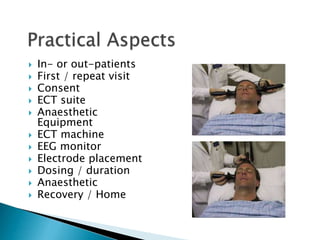
 In- or out-patients
 First / repeat visit
 Consent
 ECT suite
 Anaesthetic
Equipment
 ECT machine
 EEG monitor
 Electrode placement
 Dosing / duration
 Anaesthetic
 Recovery / Home
 ABSOLUTE-
CVS-
-Recent MI<3mths
-Sever angina, CHF
-Aneurysm
-Pheocromocytoma
CNS-
-Cerebral tumor or
aneurysm
-Recent CVA<1mth
RESPIRATORY-
Severe resp. failure
 RELATIVE-
- Pregnacy
- Thyrotoxicosis
- Cardiac
dysrythmias
- Glaucoma
- Retinal
detatchment
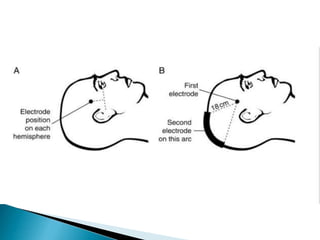
 An electrical current applied transcutaneous
to brain via two electrode positioned either
bilaterally or unilaterally.
BILATERAL ECT- used more commonly and
preferred when speed of clinical recovery
take priority.
UNILATERAL ECT- performed on nondominant
hemisphere.
-it performed twice weekly until lack of
further improvement( on average 3-4 week)
 Genaralized seizure for 30-60s in duration
are required for therapeutic effect.
- To short(<10s) or to long(>120s) may
reduce clinical efficacy.
- Amount of current deliverd is more
important than length of seizure.
- Almost 75-90% pt exhibit dramatic and
sustained improvement.
- Transient neurological deficit but permanent
neurological deficit is rare.
 Initial parasympathetic discharge(15 s )
- Coincident with tonic phase
- Bradicardia <30 bpm
- Transient asystole
- Sustained sympathetic discharge(1-3min)
-Coicident with clonic phase
-Tachycardia
- Hypertension
- dysarrythmias and T wave abnormalities.
CNS-
 Initial vasoconstriction.
 Sustained increase in cerebral blood flow.
 Increase cerebral metabolism.
 Increase intracranial HTN.
 TIA,intracranial haemorrhage,cortical
blindness.
 Cognitve adverse effects-disorientation,
impaired attention, Short term memory
loss.
- Intraocular and intragastric pressure rises.
 Unmodified ECT- Incidence of fracture and
dislocation( now rare).
- Headache ,myalgia.
- Drowsiness,weakness, nausea , anorexia.
- Increased salivation.
- Dental damage and oral cavity laceration.
 Procedure should be provided at remote site.
 Anaesthesia should be provided by
experienced anaesthetist.
 Appropriate resuscitation equipment drugs
must be immediately available.
- Trained assistance and recovery facilities
must be available.
 Routine Hx
 Previous Anaes Hx
 IHD / MI / HT /
Valvular pathology /
Dysrhythmias
 CVA / Raised ICP
 HH / GORD
 Diabetes
 Medications
 Drugs / Alcohol
 Behaviour
 Airway (incl
wobbly teeth)
 Vitals
 Routine
Examination
 Ix only as needed
 Uncontrolled CCF
 DVT (untreated)
 Acute respiratory tract infection
 Recent MI / CVA
 Unstable major fracture
 Untreated phaeochromocytoma
 Raised ICP / untreated cerebral aneurysm
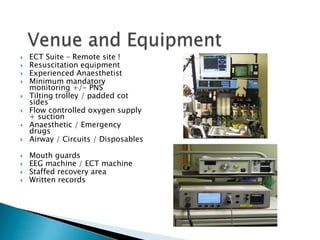
 ECT Suite – Remote site !
 Resuscitation equipment
 Experienced Anaesthetist
 Minimum mandatory
monitoring +/- PNS
 Tilting trolley / padded cot
sides
 Flow controlled oxygen supply
+ suction
 Anaesthetic / Emergency
drugs
 Airway / Circuits / Disposables
 Mouth guards
 EEG machine / ECT machine
 Staffed recovery area
 Written records
 IV access
 Monitoring
 Pre-oxygenation
 IV induction
 Muscle relaxant
 Mouth block
 Seizure induction
 Recovery
 To provide ultra brief, light general
anaesthesia with moderate degree of
musle relaxation.
 Minimizing aforementioned physiological
and physical effect.
 Avoiding drug having anticonvulsant
properties.
 Balance b/w to provide adequte
anaesthesia without affecting efficacy of
ECT.
 Rapid unconciousness.
 Painless on injection.
 No hemodynamics effect.
 No anticonvulsant properties.
 Rapid recovery.
 Inexpensive.
CONT.
 Methohexitol- 0.5-1mg/kg
 Thiopental - 2-4mg/kg
 Ketamine - 0.5- 2mg/kg
 Propofol - 1.5-3mg/kg
 Etomidate - 0.15- 0.3mg/kg
 Gold standard.
 Methylbarbiturate.
 White powder with 6% anhydrous sodium
carbonate.
 Induction similar to STP.
 Less cvs and respiratory depression than STP.
 Recovery within 3-4 min after single dose.
S/E-
- Pain on injection.
- causes convulsion in epileptic pt.
- incidence of involuntary movement, hiccup
and laryngospasm.
 Phenol derivative.
 Widely used.
 Increase seizure threshold, reduces duration.
 Better cardiovascular stability.
 Imidazole derivatives.
 Greater hemodynamic response.
 Longer seizure duration.
 Useful in resistant cases.
 PONV/HP axis suppresion.
Objective-
 to prevent injuries to musculoskeletal system.
 to improve airways management.
 adequecy of muscle relaxation should be
ascertained before applying ECT stimulus.
Cont.
 Suxamethonium – 0.5-1mg/kg
 Atracurium - 0.3-0.5mg/kg
 Mivacurium - 0.15-0.2mg/kg
 Rocuronium - 0.45-0.6mg/kg
 Adequate no. of trained personnel.
 Should be Fully equipped
 O2 until awake and maintaining Saturation.
 Written instructions
 ECT is safe and effective if appropriately
administered.
- Anaesthetics must be aware of not only
physiological response to ECT and how to
modify this, but also understand the
anaesthetic factors that may influence the
efficacy of ECT.
THANKS

Anaesthesia for ELECTROCONVULSIVE THERAPY/ECT

  • 1.
  • 2.
     Introduction toECT  History  Indications  Practicalities  Side Effects  Anaesthesia for ECT  Patient factors – Hx / Exam / Ix  Venue / Equipment  Conduct  Induction / Muscle relaxation  Recovery
  • 3.
     It isa treatment for severe mental illness in which brief application of electrical stimulus is used to produce genaralized seizure.  ECT induces a generalized, tonic–clonic epileptic seizure, yet despite being first described in 1937 the exact mechanism of action remains elusive.
  • 4.
     1934 VonMeduna – Insulin induced seizures for schizophrenia  1937 Cerletti and bini– Electric shock induced seizures  For almost 30 year it was used without anaesthesia.  Safer (Mortality 2-5 : 100 000)
  • 5.
     Life threateningillness  Sever depression- if drug tt fail or is not tolerated.  Bipolar disorder- manic or depressed phase.  Acute or catatonic schizophrenia.  Refusal of food / fluids  Depressive delusions / hallucinations  Prolonged / severe manic episode  Treatment resistance  Depression  Mania  Schizophrenia (4th line treatment)  Patient choice
  • 7.
     In- orout-patients  First / repeat visit  Consent  ECT suite  Anaesthetic Equipment  ECT machine  EEG monitor  Electrode placement  Dosing / duration  Anaesthetic  Recovery / Home
  • 8.
     ABSOLUTE- CVS- -Recent MI<3mths -Severangina, CHF -Aneurysm -Pheocromocytoma CNS- -Cerebral tumor or aneurysm -Recent CVA<1mth RESPIRATORY- Severe resp. failure
  • 9.
     RELATIVE- - Pregnacy -Thyrotoxicosis - Cardiac dysrythmias - Glaucoma - Retinal detatchment
  • 10.
     An electricalcurrent applied transcutaneous to brain via two electrode positioned either bilaterally or unilaterally. BILATERAL ECT- used more commonly and preferred when speed of clinical recovery take priority. UNILATERAL ECT- performed on nondominant hemisphere. -it performed twice weekly until lack of further improvement( on average 3-4 week)
  • 12.
     Genaralized seizurefor 30-60s in duration are required for therapeutic effect. - To short(<10s) or to long(>120s) may reduce clinical efficacy. - Amount of current deliverd is more important than length of seizure. - Almost 75-90% pt exhibit dramatic and sustained improvement. - Transient neurological deficit but permanent neurological deficit is rare.
  • 13.
     Initial parasympatheticdischarge(15 s ) - Coincident with tonic phase - Bradicardia <30 bpm - Transient asystole - Sustained sympathetic discharge(1-3min) -Coicident with clonic phase -Tachycardia - Hypertension - dysarrythmias and T wave abnormalities.
  • 14.
    CNS-  Initial vasoconstriction. Sustained increase in cerebral blood flow.  Increase cerebral metabolism.  Increase intracranial HTN.  TIA,intracranial haemorrhage,cortical blindness.  Cognitve adverse effects-disorientation, impaired attention, Short term memory loss. - Intraocular and intragastric pressure rises.
  • 15.
     Unmodified ECT-Incidence of fracture and dislocation( now rare). - Headache ,myalgia. - Drowsiness,weakness, nausea , anorexia. - Increased salivation. - Dental damage and oral cavity laceration.
  • 16.
     Procedure shouldbe provided at remote site.  Anaesthesia should be provided by experienced anaesthetist.  Appropriate resuscitation equipment drugs must be immediately available. - Trained assistance and recovery facilities must be available.
  • 17.
     Routine Hx Previous Anaes Hx  IHD / MI / HT / Valvular pathology / Dysrhythmias  CVA / Raised ICP  HH / GORD  Diabetes  Medications  Drugs / Alcohol
  • 18.
     Behaviour  Airway(incl wobbly teeth)  Vitals  Routine Examination  Ix only as needed
  • 19.
     Uncontrolled CCF DVT (untreated)  Acute respiratory tract infection  Recent MI / CVA  Unstable major fracture  Untreated phaeochromocytoma  Raised ICP / untreated cerebral aneurysm
  • 20.
     ECT Suite– Remote site !  Resuscitation equipment  Experienced Anaesthetist  Minimum mandatory monitoring +/- PNS  Tilting trolley / padded cot sides  Flow controlled oxygen supply + suction  Anaesthetic / Emergency drugs  Airway / Circuits / Disposables  Mouth guards  EEG machine / ECT machine  Staffed recovery area  Written records
  • 21.
     IV access Monitoring  Pre-oxygenation  IV induction  Muscle relaxant  Mouth block  Seizure induction  Recovery
  • 22.
     To provideultra brief, light general anaesthesia with moderate degree of musle relaxation.  Minimizing aforementioned physiological and physical effect.  Avoiding drug having anticonvulsant properties.  Balance b/w to provide adequte anaesthesia without affecting efficacy of ECT.
  • 23.
     Rapid unconciousness. Painless on injection.  No hemodynamics effect.  No anticonvulsant properties.  Rapid recovery.  Inexpensive. CONT.
  • 24.
     Methohexitol- 0.5-1mg/kg Thiopental - 2-4mg/kg  Ketamine - 0.5- 2mg/kg  Propofol - 1.5-3mg/kg  Etomidate - 0.15- 0.3mg/kg
  • 25.
     Gold standard. Methylbarbiturate.  White powder with 6% anhydrous sodium carbonate.  Induction similar to STP.  Less cvs and respiratory depression than STP.  Recovery within 3-4 min after single dose. S/E- - Pain on injection. - causes convulsion in epileptic pt. - incidence of involuntary movement, hiccup and laryngospasm.
  • 26.
     Phenol derivative. Widely used.  Increase seizure threshold, reduces duration.  Better cardiovascular stability.
  • 27.
     Imidazole derivatives. Greater hemodynamic response.  Longer seizure duration.  Useful in resistant cases.  PONV/HP axis suppresion.
  • 29.
    Objective-  to preventinjuries to musculoskeletal system.  to improve airways management.  adequecy of muscle relaxation should be ascertained before applying ECT stimulus. Cont.
  • 30.
     Suxamethonium –0.5-1mg/kg  Atracurium - 0.3-0.5mg/kg  Mivacurium - 0.15-0.2mg/kg  Rocuronium - 0.45-0.6mg/kg
  • 31.
     Adequate no.of trained personnel.  Should be Fully equipped  O2 until awake and maintaining Saturation.  Written instructions
  • 32.
     ECT issafe and effective if appropriately administered. - Anaesthetics must be aware of not only physiological response to ECT and how to modify this, but also understand the anaesthetic factors that may influence the efficacy of ECT.
  • 33.