Electron microscopy and
production of antisera
N. H. SHANKAR REDDY
Ph.D., Plant Pathology
Annamalai University
• Electron microscopy (EM) can be used for the detection or identification of
viruses in tissue extracts of infected plant samples
• The principle of detection of plant viruses in sap preparations by transmission
electron microscopy (TEM) is based on the adsorption of virus particles onto
carbon coated formvar- or pioloform-supported copper or nickel grids followed by
contrasting with a suitable heavy metal solution.
• This technique is often combined with the use of antisera, referred to as immuno
electron microscopy (IEM)
• EM can be very useful when no information on virus identity is available.
Furthermore, EM may be used in characterization of new viruses and also allows
the detection of mixed viral infections.
• The most commonly used TEM tests are:
i. Dip preparation for a first screening of virus presence and particle morphology
ii. Dip preparation for ISEM and/or decoration for virus enrichment and
identification
Current applications of electron
microscopy in plant virology
• Nucleic acid characterisation
i. Used to gain knowledge on virus morphology and NA structure of plant
viruses, viroid's and virusoids
ii. NA extraction followed by treatment with DNase and RNase, sucrose
density gradient centrifugation, buoyant density gradient centrifugation
• Host virus interactions
i. TEM used to examine the host virus interactions within the host cells
ii. Often used to examine the production of crystalline arrays associated
with specific organelles, or production of protein inclusion bodies
iii. Eg – PVY and Wheat streak mosaic virus
Analytical application of EM
• Analytical EM is the use of TEM and SEM beyond their normal applications in
morphological and anatomic studies
• Eg – Autoradiography, specific staining, specific antibody-ferritin and specific
antibody-colloidal gold labelling and x-ray analysis
Immunosorbent electron microscopy (ISEM)
• This technique was introduced by Derrick (1973) as serologically specific electron
microscopy (SSEM) and has become widely used in plant virology
• Because of its similarity with solid phase immunoassays, the method has become
known as immunosorbent electron microscopy (ISEM)
• The principle of immunosorbent electron microscopy (ISEM) is the selective trapping
of plant viruses on to electron microscope grids precoated with a specific antiserum
• Virus particles are selectively trapped on antibody-coated grids with little contaminating
host-plant material.
• The grids are stained with 1.0% uranyl acetate in 50% ethanol, dried and examined in
the electron microscope
• This technique has been used to detect polyhedral and rod shaped virus. It has the great
advantage of requiring only very small amounts of antiserum and antigens, and does not
require the use of labelled antibodies
• ISEM can also be used to estimate the degree of serological relationship between
viruses.
• The consensus is that ISEM is highly reliable (there are virtually no false positives), as
sensitive as ELISA, fast (results can often be obtained within one or two hours) and
operationally simple (it requires tools and reagents readily available in most
laboratories).
production of antisera
Definition
• A serum contains antibodies produced by natural / artificial immunity against a
given antigen from human or animals
Types of sera
1) Homogeneous serum: serum obtained from blood donor volunteers, have been
immunized.
2) Heterogeneous serum: serum obtained from blood of animals(horse) hyper
immunized
Three important properties of an antiserum are avidity, specificity, and titer
• The avidity of an antiserum is a measure of the strength of the interactions of its
antibodies with an antigen.
• The specificity of an antiserum is a measure of the ability of its antibodies to
distinguish the immunogen from related antigens.
• The titer of an antiserum is the final (optimal) dilution at which it is employed in
the procedure; it depends on the concentrations of the antibodies present and on
their affinities for the antigen.
Materials
1. SIX rabbits each of 2 kg body weight (Various types can be used, e g , New
Zealand whites, Dutch, and so on)
2. Solution of the purified immunogen in an appropriate buffer to maintain its
stability.
3. Complete and incomplete Freund’s adjuvant, available from various commercial
sources.
4. Heat lamp.
Procedure
1. One volume is mixed with three volumes of Freund’s adjuvants
2. The mixture can then be transferred to a syringe.
3. The rabbit is prepared by cutting away the long hair along the center
of its back
4. The emulsion of immunogen and complete Freund’s adjuvant is
injected via a 1 mL syringe
5. After 10 wk, a test bleeding is carried out on the rabbit. Blood 1s
collected m a glass vessel (up to 20 mL can be collected)
6. The blood is allowed to clot standing at room temperature for a few
hours.
7. The serum is separated from the clot by centrifugation and can be
stored at 4°C in the presence of 0.1% sodium azide as antibacterral
agent until tested.
7. If on testing the serum shows the characteristics required for its particular usage,
then further bleeding can be carried out. Up to three bleedings can be made
on successive days.
8. If the orginal antiserum is unsatisfactory or if the quality of the bleedings taken
over a period of several weeks or months starts to become unsatisfactory,
then the rabbit can be boostered,, receive a second injection of
immunogen.
9. After 10 d a test bleeding is obtained from the rabbit and the serum so produced
is analyzed.
10. Further bleedings can be carried out over a period of time if the boostered
antiserum is satisfactory, go for another rabbit and perform same
11. Each sample of antiserum can now be tested for its ability to form an immune
precipitate with the immunogen by carrying out immunodiffusion and
immunoelectrophoresis
Eg - The specificity of the antibodies can be determined by running the antiserum
against the immunogen and related antigens m Ouchterlony double diffusion
Note - Many antisera can be satisfactorily stored at 4°C m the presence of an
antibacterial agent for many months.
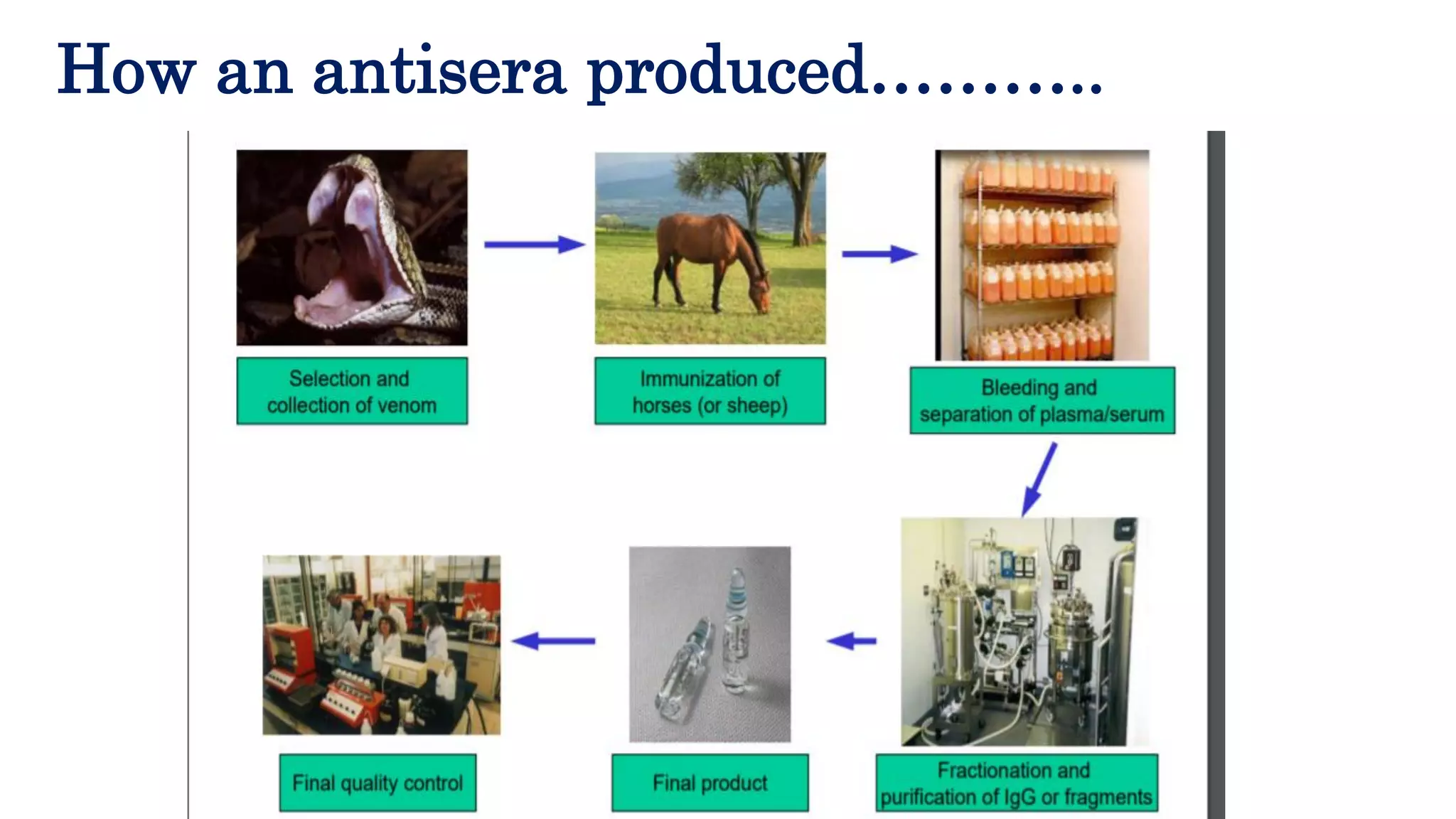
How an antisera produced………..
Video available at you tube
Channel – Geeky Researcher

Electron microscopy and production of antisera

  • 1.
    Electron microscopy and productionof antisera N. H. SHANKAR REDDY Ph.D., Plant Pathology Annamalai University
  • 2.
    • Electron microscopy(EM) can be used for the detection or identification of viruses in tissue extracts of infected plant samples • The principle of detection of plant viruses in sap preparations by transmission electron microscopy (TEM) is based on the adsorption of virus particles onto carbon coated formvar- or pioloform-supported copper or nickel grids followed by contrasting with a suitable heavy metal solution. • This technique is often combined with the use of antisera, referred to as immuno electron microscopy (IEM)
  • 3.
    • EM canbe very useful when no information on virus identity is available. Furthermore, EM may be used in characterization of new viruses and also allows the detection of mixed viral infections. • The most commonly used TEM tests are: i. Dip preparation for a first screening of virus presence and particle morphology ii. Dip preparation for ISEM and/or decoration for virus enrichment and identification
  • 4.
    Current applications ofelectron microscopy in plant virology • Nucleic acid characterisation i. Used to gain knowledge on virus morphology and NA structure of plant viruses, viroid's and virusoids ii. NA extraction followed by treatment with DNase and RNase, sucrose density gradient centrifugation, buoyant density gradient centrifugation • Host virus interactions i. TEM used to examine the host virus interactions within the host cells ii. Often used to examine the production of crystalline arrays associated with specific organelles, or production of protein inclusion bodies iii. Eg – PVY and Wheat streak mosaic virus
  • 5.
    Analytical application ofEM • Analytical EM is the use of TEM and SEM beyond their normal applications in morphological and anatomic studies • Eg – Autoradiography, specific staining, specific antibody-ferritin and specific antibody-colloidal gold labelling and x-ray analysis
  • 6.
    Immunosorbent electron microscopy(ISEM) • This technique was introduced by Derrick (1973) as serologically specific electron microscopy (SSEM) and has become widely used in plant virology • Because of its similarity with solid phase immunoassays, the method has become known as immunosorbent electron microscopy (ISEM) • The principle of immunosorbent electron microscopy (ISEM) is the selective trapping of plant viruses on to electron microscope grids precoated with a specific antiserum
  • 7.
    • Virus particlesare selectively trapped on antibody-coated grids with little contaminating host-plant material. • The grids are stained with 1.0% uranyl acetate in 50% ethanol, dried and examined in the electron microscope • This technique has been used to detect polyhedral and rod shaped virus. It has the great advantage of requiring only very small amounts of antiserum and antigens, and does not require the use of labelled antibodies • ISEM can also be used to estimate the degree of serological relationship between viruses. • The consensus is that ISEM is highly reliable (there are virtually no false positives), as sensitive as ELISA, fast (results can often be obtained within one or two hours) and operationally simple (it requires tools and reagents readily available in most laboratories).
  • 8.
    production of antisera Definition •A serum contains antibodies produced by natural / artificial immunity against a given antigen from human or animals Types of sera 1) Homogeneous serum: serum obtained from blood donor volunteers, have been immunized. 2) Heterogeneous serum: serum obtained from blood of animals(horse) hyper immunized
  • 9.
    Three important propertiesof an antiserum are avidity, specificity, and titer • The avidity of an antiserum is a measure of the strength of the interactions of its antibodies with an antigen. • The specificity of an antiserum is a measure of the ability of its antibodies to distinguish the immunogen from related antigens. • The titer of an antiserum is the final (optimal) dilution at which it is employed in the procedure; it depends on the concentrations of the antibodies present and on their affinities for the antigen.
  • 10.
    Materials 1. SIX rabbitseach of 2 kg body weight (Various types can be used, e g , New Zealand whites, Dutch, and so on) 2. Solution of the purified immunogen in an appropriate buffer to maintain its stability. 3. Complete and incomplete Freund’s adjuvant, available from various commercial sources. 4. Heat lamp.
  • 11.
    Procedure 1. One volumeis mixed with three volumes of Freund’s adjuvants 2. The mixture can then be transferred to a syringe. 3. The rabbit is prepared by cutting away the long hair along the center of its back 4. The emulsion of immunogen and complete Freund’s adjuvant is injected via a 1 mL syringe 5. After 10 wk, a test bleeding is carried out on the rabbit. Blood 1s collected m a glass vessel (up to 20 mL can be collected) 6. The blood is allowed to clot standing at room temperature for a few hours. 7. The serum is separated from the clot by centrifugation and can be stored at 4°C in the presence of 0.1% sodium azide as antibacterral agent until tested.
  • 12.
    7. If ontesting the serum shows the characteristics required for its particular usage, then further bleeding can be carried out. Up to three bleedings can be made on successive days. 8. If the orginal antiserum is unsatisfactory or if the quality of the bleedings taken over a period of several weeks or months starts to become unsatisfactory, then the rabbit can be boostered,, receive a second injection of immunogen. 9. After 10 d a test bleeding is obtained from the rabbit and the serum so produced is analyzed. 10. Further bleedings can be carried out over a period of time if the boostered antiserum is satisfactory, go for another rabbit and perform same
  • 13.
    11. Each sampleof antiserum can now be tested for its ability to form an immune precipitate with the immunogen by carrying out immunodiffusion and immunoelectrophoresis Eg - The specificity of the antibodies can be determined by running the antiserum against the immunogen and related antigens m Ouchterlony double diffusion Note - Many antisera can be satisfactorily stored at 4°C m the presence of an antibacterial agent for many months.
  • 15.
    How an antiseraproduced………..
  • 16.
    Video available atyou tube Channel – Geeky Researcher